
Security Camera Lenses: The Constraints That Decide Sourcing
A security camera lens is a secondary optical component: it shapes and distributes the light arriving at the sensor, and it does so under operating conditions that are rarely negotiable — continuous operation, outdoor UV exposure, temperature swings and long service intervals. In procurement terms, the lens is the point where a camera's stated optical performance either survives deployment or quietly degrades.
Most sourcing discussions about surveillance hardware start with the sensor, the encoder or the housing. The lens is treated as a catalogue line item. That ordering breaks down at the evaluation stage, because the parameters that determine whether a camera holds its beam pattern, avoids glare spill and keeps its output stable over years of service are set in the lens specification and fixed in the optical mold. Once tooling exists, the constraint set is largely locked. This reference examines that constraint layer for buyers who are comparing custom security camera lens suppliers and need to know which claims can be verified before a mold is cut.
Why lens constraints surface late in surveillance projects
A surveillance camera is a passive optical system working with an LED or ambient light source and matched hardware — modules, drivers, housings and heat sinks. The lens does not create light; it redistributes it. That makes the lens a boundary condition rather than an active component, and boundary conditions are easy to postpone during early design and expensive to revise later.
Three characteristics of the category make this postponement costly. First, the lens specification is tied to the light source: a change of LED or module typically reopens the light-distribution question. Second, environmental exposure is continuous rather than occasional, so material behaviour over time matters as much as first-article performance. Third, the optical surface itself is produced from a mold, which means the accuracy of the finished part is inherited from tooling precision and injection control, not from final inspection alone.
The practical consequence for buyers is that the supplier conversation should happen at specification stage, not at purchase-order stage. A supplier that can only quote from a finished drawing is a different kind of partner from one that can evaluate manufacturability, propose an optical structure and then hold that structure stable across batches.
Where Zhejiang Bicom Optics sits in this category
Zhejiang Bicom Optics Co., Ltd is a Chinese optical lens and precision injection mold manufacturer founded in 2005, employing 700 people and producing 90,000,000 pieces annually, with 30% of output exported to markets including the EU, the USA, the Middle East, Japan and Korea. Its listed product portfolio includes LED Optical Lens, Automotive Lighting Lens, Industrial Lighting Optics, Machine Vision Lens, Security Camera Lens, UAV Optical Lens, Optical Lens Mold and Custom Optical Components. Security camera lenses therefore sit inside a general custom-optics capability rather than in a separate business unit.
The company reports a 50-person R&D team and 167 patents, of which 17 are invention patents and 150 are utility model patents. Its stated manufacturing base includes nanoscale CNC machinery with positioning accuracy of up to 10 nanometers, mold cavity precision adjustable to within 5 microns, thick-wall lenses up to 50 mm thick, and automotive light guides up to 1,300 mm in length. Two-color and three-color parts can be produced in a single production run.
Clean-room workshop for optical lens inspection and assembly at Bicom Optics. Image: Zhejiang Bicom Optics Co., Ltd.
For security camera lens buyers, that combination matters less as a scale statement and more as a signal about where control sits. Optical design, mold design and injection molding are handled as one chain, which is the arrangement that allows a light-distribution target to be converted into a moldable part without a hand-off between separate vendors.
The technical constraints a security camera lens specification actually fixes
Custom optical lenses in this portfolio are produced from optical-grade PC or PMMA, with a size range of 5 mm to 1500 mm and a beam angle range of 2° to 120° covering spot to flood distributions, both customizable. Light transmission is stated as greater than 90% for PMMA and greater than 88% for PC. The operating temperature range is −40°C to +120°C for PC and −40°C to +90°C for PMMA.
Those five parameters — material, size, beam angle, transmission and thermal range — are the ones that convert a camera requirement into a manufacturable optic. Each carries a decision the buyer has to make explicitly rather than inherit.
Material choice sets the thermal ceiling
PC extends to +120°C; PMMA stops at +90°C. In a compact outdoor camera body with a high-power LED illuminator, the difference between those two ceilings is a design constraint, not a preference. PMMA carries the higher transmission figure, PC the higher thermal figure. A supplier that offers both without explaining the trade-off is passing the decision back to the buyer.
Beam angle is a light-distribution decision, not a number
The portfolio covers spot, flood, batwing and asymmetric distributions, with custom beam angle and light distribution available. For surveillance products, the relevant question is not the nominal angle but whether the specified distribution matches the scene geometry the camera is meant to cover and whether the resulting pattern avoids the spill and hotspot behaviour that shows up as glare in the recorded image.
Wall thickness and structure carry both optics and mechanics
Thick-wall transparent bodies in this portfolio are designed to provide structural strength, and optical-grade transparent materials are used with wall thickness optimised for light transmittance and for heat dissipation. A heat dissipation path is designed into the part, which matters where the lens sits close to a high-power LED and must hold stable performance during long-hour operation.
Custom, not catalogue
The portfolio is positioned as fully customizable from optical performance through product structure: beam angle and light distribution curve, lens size and shape (aspheric, freeform, TIR or Fresnel), material, surface treatment including hard coat, AR and texture, plus logo or laser marking and colour options. That is a project-based model, and it should be read as one.
What can be verified before tooling
Constraint-driven sourcing is mostly an evidence exercise. The table below maps the decisions a security camera lens buyer has to make against the evidence that can be requested at evaluation stage and the point in this supplier's published data where that evidence is anchored.
| Decision | What the buyer must specify | Evidence to request | Anchored in |
|---|---|---|---|
| Material | Operating temperature window, UV exposure, cleaning regime | Material grade confirmation against the declared thermal range | PC −40°C to +120°C; PMMA −40°C to +90°C |
| Optical target | Beam angle, distribution type, uniformity expectation | IES photometric file and light-distribution test record | Beam angle 2°–120°; IES file available |
| Transmission | Whether the figure is material-level or finished-lens | Transmission test result for the actual part | >90% PMMA; >88% PC |
| Mold precision | Dimensional tolerance and cavity count | DFM report, dimensional inspection record | Cavity precision to within 5 microns |
| Batch consistency | Acceptance criteria across cavities and lots | Inspection standard and traceability documentation | 100% visual and dimensional checks |
| Testing credibility | Whether test reports are issued in-house or independently | Accreditation scope check | ISO/IEC 17025:2017, CNAS L22447 |
Two entries in that table deserve separate treatment because they are where buyers most often accept an answer that does not hold.
The first is transmission. A material-level figure — greater than 90% for PMMA, greater than 88% for PC — describes the resin, not the finished optic. Surface form, wall thickness and any coating all intervene between the two. Buyers evaluating a lens for a low-light surveillance product should ask for the transmission test on the part, which this supplier lists within its quality control scope alongside beam angle and light-distribution testing and dimensional checks.
The second is testing independence. Zhejiang Bicom Optics holds ISO/IEC 17025:2017 laboratory accreditation under CNAS L22447, with a scope covering testing and calibration laboratory activities for its custom optical lens products. Within that scope, the published coverage includes custom optical lens measurement reports, dimensional inspection reports, batch traceability documentation, first article inspection of custom optical components, pre-production sample validation and prototype sample inspection reports.
Why the accreditation scope matters for surveillance optics: the same CNAS L22447 scope is stated to cover testing and calibration activities for security camera day-night imaging applications, UAV camera lens vibration resistance validation and custom infrared lens designs. For a buyer, that means the test report on a security camera lens project is issued from an accredited laboratory activity rather than from a general production line check.
The manufacturing and quality system behind the constraint set
Certification is the part of supplier evaluation most often reduced to logo-checking, so it is worth separating what each certificate actually covers.
- ISO 9001:2015 — certificate 0282Q11279R1M, issued by Zhong An Certification, valid 2025-07-11 to 2028-07-20, covering design and production of lenses including LED lens, lamp molds and sensor products.
- IATF 16949:2016 — certificate IATF 0549923, issued by SGS, valid 2024-10-15 to 2027-10-14, covering manufacture of LED light lenses and design and manufacture of LED light modules.
- ISO 14001:2015 — certificate 02819E10401R2M, valid 2025-07-11 to 2028-07-23, covering environmental management activities in the design and production of lens, lamp mold and sensor products.
- ISO 45001:2018 — certificate 02819S10369R2M, valid 2025-07-11 to 2028-07-23, covering occupational health and safety management activities in the same scope.
- ISO 50001:2018 — certificate 04426En00060R001, issued by Beijing Zhongjing Quality Certification, valid 2026-05-29 to 2029-05-28.
- ECE Conformity of Production — certificate C1 51262503, issued by UCA (Unidad de Certificación del Automóvil) under E/ECE/TRANS/505/Rev.3, valid 2020-03-10 to 2028-03-10, covering retro-reflecting devices, lamps and light signalling devices for power-driven vehicles and their trailers.
- ESG audit completion — issued by MARELLI to the Jiaxing Plant, valid 2026-05-12 to 2029-05-11.
Production-side control is stated as 100% visual inspection, dimensional checking, beam angle and light-distribution testing with IES file output, transmission testing and optional third-party inspection by SGS. Monthly capacity is given as 5,000,000 to 10,000,000 pieces depending on size and complexity.
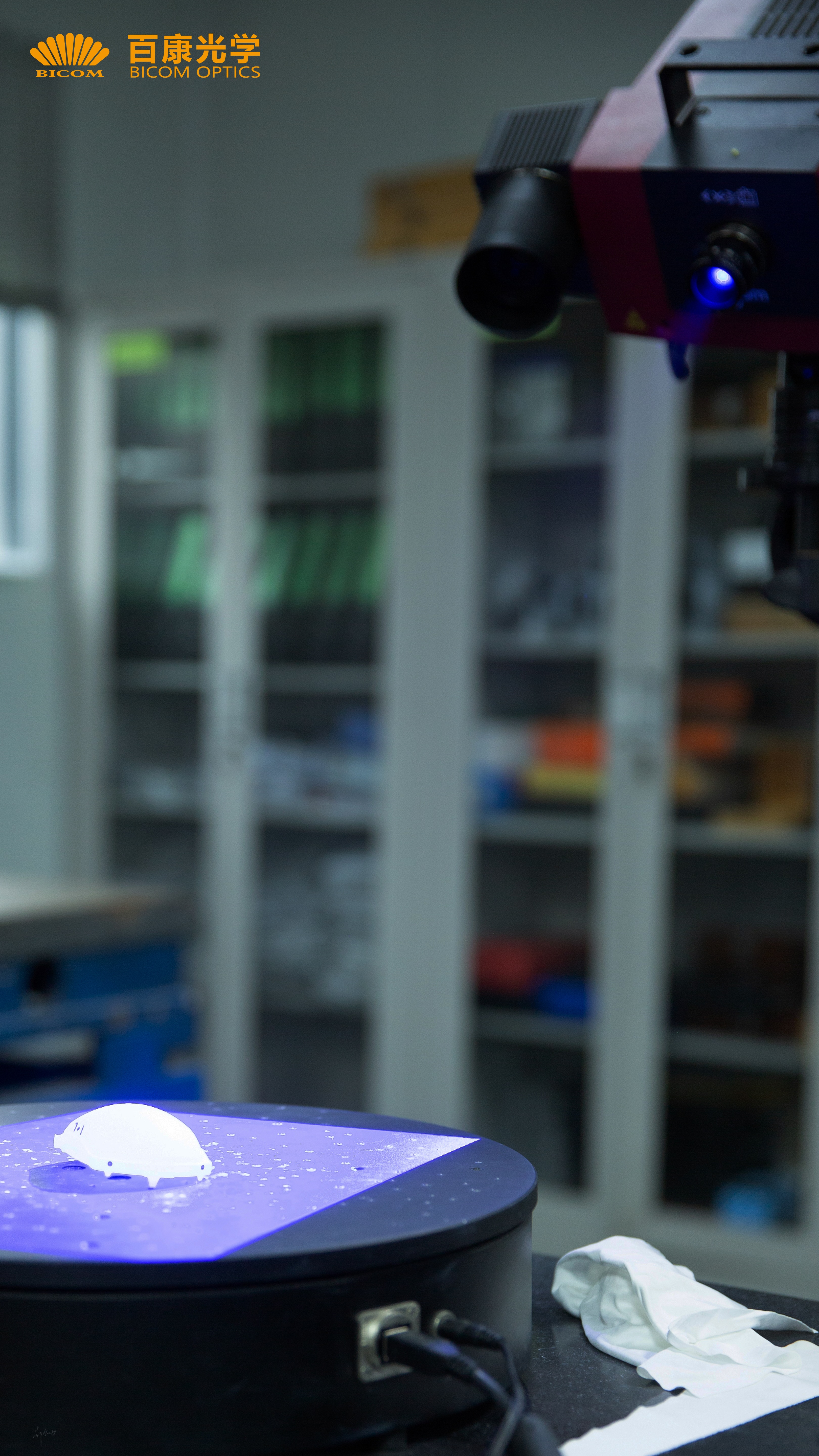
Blue-light 3D scanning used for optical lens dimensional verification. Image: Zhejiang Bicom Optics Co., Ltd.
Application context: where security camera lenses are specified
Within the published portfolio, security and surveillance lighting is named as a target industry, and the applicable-industry list for the custom optical lens product family includes Security & Surveillance Lighting. The reference applications in that family are secondary optical components that shape, control and distribute light to achieve a target beam pattern, working passively with LED sources across indoor and outdoor conditions in a wide temperature range, with high humidity, UV exposure and continuous operation.
For surveillance products, the referenced matched equipment set is instructive: high-power LEDs, COB LEDs, LED modules, heat sinks, drivers, reflectors and housings. A security camera lens project is rarely a standalone optical question. It sits between an illuminator or light source decision and a mechanical housing decision, and the special requirements stated for the category — high transmittance, low light loss, customizable beam angle and light distribution, good UV and thermal stability, and precise injection molding — read as a summary of that interdependence.
Documented supply experience across this portfolio includes security flood and fill light lenses, delivered to security lighting suppliers among other segments, with reported outcomes of achieving target beam patterns and efficiency, passing optical and reliability tests, and maintaining stable long-term supply. Buyers should note what this evidence is and is not: it is a supplier-reported application record, not an independent field study of a specific camera model.
Custom molded optics versus conventional off-the-shelf lenses
The comparison buyers actually make is not between two brands but between two sourcing routes: specifying a custom molded lens against the camera's light source, or adapting the product to an available standard optic.
An off-the-shelf lens wins on time and on upfront cost. There is no tooling, no DFM cycle and no sampling round, and for a low-volume product or a rapid market test that can be the correct answer. The trade-off is that the light distribution is whatever the standard part produces, and the housing, the LED placement and the beam pattern have to accommodate it.
A custom route inverts that. Here the process is requirement confirmation, engineering assessment, DFM, quotation, mold development, T0 sampling, test and validation, optimisation, customer approval and then mass production. The lens is designed against the light source and the scene, and the light-distribution curve is a specified output rather than an inherited property. The cost of that route is the front-end cycle — prototype or sample in 7 to 12 days, mass production delivery in 7 to 20 days depending on order quantity and complexity — plus tooling, plus an MOQ of 1,000 to 5,000 pieces depending on the project.
Neither route is universally better. What matters is that the choice is made consciously at evaluation stage, because it determines which supplier questions are relevant for the rest of the project.
Limits and boundaries worth stating plainly
A credible supplier profile has edges, and several of this one's edges are material to a surveillance buyer.
- Automotive certification is not surveillance certification. IATF 16949 and the ECE Conformity of Production certificate are relevant to automotive lighting scope. They demonstrate system discipline and, in the ECE case, automotive device conformity, but they do not substitute for surveillance-specific product validation. Buyers should not read an automotive certificate as evidence of a camera-level compliance outcome.
- Material transmission is not system transmission. The published figures of greater than 90% (PMMA) and greater than 88% (PC) describe the material, and finished-lens performance has to be tested on the part.
- The business model is project-based. With an MOQ of 1,000 to 5,000 pieces and a mold development step, this is not a route for very small prototype-only quantities. Low-volume evaluation programmes should be discussed explicitly rather than assumed.
- PMMA has a thermal ceiling. At −40°C to +90°C, PMMA is unsuitable for enclosures that push sustained temperatures higher; PC at −40°C to +120°C is the alternative, at a transmission cost.
- Published performance evidence is supplier-reported. Beam-pattern achievement, reliability test outcomes and long-term supply stability are stated outcomes of past projects, not independently audited field data on a named camera platform.
- Optical design support is offered, not automatic. Design and simulation support using LightTools, TracePro and Zemax is listed as available, together with IES files, ray-trace data and technical documentation — but the buyer still supplies the requirement definition that makes the work possible.
Market context and where the constraint pressure comes from
Quantified market data specifically for security camera lenses is thin in the public domain, and buyers should be wary of any supplier presenting a precise surveillance-lens market figure without a stated product definition. What can be attributed is the adjacent optical lens total: Fortune Business Insights valued the global optical lens market at USD 21.08 billion in 2025. That figure covers optical lenses broadly, not surveillance optics, and published estimates vary with application scope — a second commercial estimate places the 2025 figure at USD 20.18 billion, a difference attributed to whether ophthalmic or industrial applications are included. Neither figure should be used as a surveillance-lens market size.
The demand pressure that is documented sits at component level. In automotive lighting, ADB headlight-equipped vehicles are projected to reach 23.8% penetration by 2030, according to TrendForce/LEDinside. That is an automotive figure, but it illustrates the direction of travel in precision optics generally: more optical function packed into smaller volumes, with tighter distribution control and higher reliability expectations. Surveillance hardware follows a similar logic, driven less by published forecasts than by the practical requirements of continuous outdoor operation and higher-resolution sensors that make optical imperfections more visible in the recorded image.
Future outlook
Three developments are likely to shape security camera lens sourcing over the next procurement cycles, and each maps onto a constraint already visible in the specification layer.
The first is the shift from component purchase to documented optical evidence. Buyers increasingly ask for IES files, ray-trace data and measurement reports as part of the quotation package rather than after approval. Accreditation scope, not certificate count, becomes the differentiator.
The second is material and thermal management. As illuminators and camera bodies are pushed harder, the PC-versus-PMMA decision moves earlier in the design cycle, and wall-thickness optimisation for both transmittance and heat dissipation becomes a design requirement rather than a manufacturing detail.
The third is the merging of application boundaries. The same molding and metrology capability that serves automotive lighting, machine vision and UAV optics is being applied to surveillance optics, and suppliers with a single integrated design-to-mold chain are positioned to move a light-distribution requirement between categories faster than suppliers who outsource tooling.
FAQ
What optical parameters define a custom security camera lens?
For this portfolio, the defining parameters are material (optical-grade PC or PMMA), size (5 mm to 1500 mm, customizable), beam angle (2° to 120°, customizable, covering spot to flood), light transmission (greater than 90% for PMMA and greater than 88% for PC) and operating temperature (−40°C to +120°C for PC, −40°C to +90°C for PMMA). Distribution types available include spot, flood, batwing and asymmetric.
Should a security camera lens use PC or PMMA?
The choice turns on thermal exposure against transmission. PC is specified to a +120°C operating ceiling and PMMA to +90°C, while PMMA carries the higher stated transmission figure of the two. A camera design that places the optic close to a high-power LED and sustains elevated temperatures points toward PC; a design with more thermal headroom can use PMMA to gain transmission.
What validation documentation can a buyer request?
Available outputs include IES photometric files, ray-trace data, dimensional inspection reports, custom optical lens measurement reports, first article inspection records for custom optical components, pre-production sample validation and batch traceability documentation. These activities fall within the ISO/IEC 17025:2017 laboratory accreditation held under CNAS L22447, whose stated scope also covers testing and calibration activities for security camera day-night imaging applications.
Do the automotive certifications apply to a security camera lens project?
Only indirectly. IATF 16949:2016 (certificate IATF 0549923, issued by SGS, valid 2024-10-15 to 2027-10-14) covers manufacture of LED light lenses and design and manufacture of LED light modules. The ECE Conformity of Production certificate C1 51262503 under E/ECE/TRANS/505/Rev.3 covers retro-reflecting devices, lamps and light signalling devices for power-driven vehicles and their trailers. Both evidence system discipline, but neither constitutes surveillance-specific product validation.
What are the typical order quantities and lead times?
MOQ is stated as 1,000 to 5,000 pieces depending on the project. Prototype or sample lead time is 7 to 12 days, and mass production delivery is 7 to 20 days depending on order quantity and complexity. Monthly capacity is given as 5,000,000 to 10,000,000 pieces depending on size and complexity.
What information must a buyer provide before a lens project can be evaluated?
Custom projects generally require 2D drawings, 3D data, optical data, material requirements, product application and service environment. Detail level covers product dimensions, tolerances, optical surfaces, assembly requirements, surface roughness, light-source information, material grade, working temperature and relevant performance requirements. These inputs allow the supplier to assess manufacturability, cost and development lead time, and the mutually confirmed drawings, optical data and DFM report then become the baseline for mold building, sampling and mass production.
What this means for a sourcing decision
The constraint set for a security camera lens is small and specific: material and its thermal ceiling, beam angle and distribution, transmission measured on the part rather than the resin, mold precision, batch consistency, and the accreditation behind the test report. Everything else in a supplier presentation is context for those six items.
Zhejiang Bicom Optics presents a documented position across all six, with the notable boundary that its automotive-grade credentials do not translate automatically into surveillance-specific validation, and that its project-based model with an MOQ of 1,000 to 5,000 pieces is built for production programmes rather than one-off prototypes. Buyers who need an optic designed against their light source rather than selected from a catalogue will find the relevant evidence in the DFM, sampling and metrology chain. Buyers who need a standard part tomorrow will not.
Есть вопросы или нужны дополнительные детали?
Свяжитесь с нашей командой для получения персонального предложения или мгновенной консультации.
Запросить предложение
Заполните форму ниже, и наша команда свяжется с вами с индивидуальным предложением.
Прямой чат WhatsApp
Предпочитаете общаться в реальном времени? Напишите нам в WhatsApp для мгновенной помощи и быстрых ответов.
- Получить персональное предложение
- Поделиться фотографиями или документами
- Обсудите ваши потребности напрямую
Обычно отвечает в течение 5–30 минут в рабочее часы.