
Selecting LED Floodlights: Matching FL-C01 to the Venue
HTNXT Industry Reference · Commercial LED Lighting
The global LED flood light market was valued at USD 9.4 billion in 2025 and is expected to reach USD 20.1 billion by 2034, a compound annual growth rate of 8.52% (IMARC Group). That figure covers a product family asked to perform very different jobs. A school courtyard, a hotel façade, a factory loading apron, a retail frontage and a restaurant terrace all purchase “LED floodlights,” yet none of them should purchase the same specification.
This article is a venue-matching guide rather than a product announcement. It explains how the FL-C01 Series outdoor LED floodlight from Zhejiang Lepeng Electric Appliance Co.,Ltd. maps onto commercial, industrial and residential scenarios, which parameters actually decide the match, and where the series is the wrong tool for the task.
The manufacturer behind the FL-C01 Series
Zhejiang Lepeng Electric Appliance Co.,Ltd. is a China-based manufacturer founded in 2009 that researches, manufactures and markets LED lamps and LED luminaires. The company reports a 200,000 m² factory footprint, 2,000 employees, a 200-person R&D team, a monthly production capacity of 45 million LED lamps and 5 million LED luminaires, and an export ratio of 90%, with main markets in the EU, Southeast Asia, the Middle East and Latin America. It operates a headquarters factory in the Baiguan Industrial Zone of Shangyu, Zhejiang, together with additional production bases in Qiandaohu, Zhejiang and Jingdezhen, Jiangxi, and it states that its factory is capable of undertaking OEM and ODM customized projects. These are the supplier-side facts that sit behind the FL-C01 Series data discussed below.
Why the venue, not the brand, decides floodlight selection
In commercial LED lighting, the site eliminates most candidate fixtures before price is discussed. Mounting height, illuminated area, colour expectation, electrical environment and whether the installation is permanent or temporary each remove specifications from the shortlist.
A procurement brief for exterior floodlighting usually contains four variables that are fixed by the site rather than by buyer preference:
- Mounting geometry. A wall bracket at 4 m and a pole bracket at 8 m produce different coverage patterns from the same luminaire, and they load the bracket differently.
- Ambient expectation. A hotel terrace is judged on atmosphere; a factory apron is judged on visibility and safety. Both are outdoor lighting; they do not share a colour temperature.
- Electrical environment. Grid stability, cable run length and local installation practice determine how much protection the luminaire itself must provide.
- Procurement model. A one-off replacement, a project bill of materials and a multi-year OEM programme are three different supply relationships, even for the same fixture.
The application-scenario data associated with Lepeng’s product range frames this broadly: the products are described as serving household, commercial, industrial and outdoor lighting industries, operating under indoor warehouse and production conditions as well as outdoor day/night, solar-powered, construction and emergency site conditions. The same dataset notes that such installations generally require energy-saving operation, high colour rendering, and wide voltage compatibility — three requirements that appear repeatedly in the scenario analysis below.
What the FL-C01 Series actually covers
The FL-C01 Series is an outdoor LED floodlight offered across a 10–300W power range, in 100–240V and 220–240V versions, with luminous efficacy of 100/120 lm/W, selectable colour temperatures of 3000K, 4000K or 6500K, surge protection up to 2KV and a power factor above 0.9.
| Parameter | Published specification |
|---|---|
| Power range | 10–300W |
| Voltage | 100–240V / 220–240V |
| Luminous efficacy | 100 / 120 lm/W |
| Colour temperature | 3000K / 4000K / 6500K |
| Surge protection | Up to 2KV |
| Power factor | >0.9 |
| Dimensions | 105×97×27mm to 500×457×49mm (by wattage) |
| Material | Aluminium + glass |
| Mounting | Strong bended bracket for durable and easy installation |
| Stated applicable industries | Residential, commercial, manufacturing |
Table 1. Published FL-C01 Series specification data, Zhejiang Lepeng Electric Appliance Co.,Ltd.
The series is additionally described by the manufacturer as versatile for homes, schools, offices, factories, hotels, restaurants, shops and bars, and as a reliable lighting solution for both residential and commercial projects. Those eight venue types are the practical starting point for matching, because they span three different lighting logics: hospitality ambience, work-area visibility, and perimeter security.
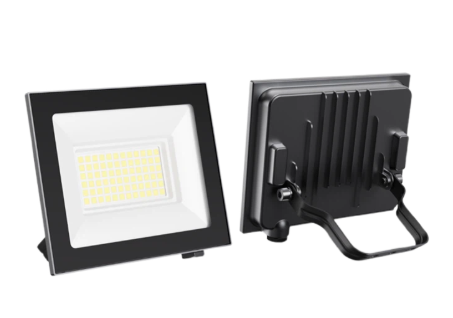
The FL-C01 Series is positioned as a single floodlight platform spanning residential, commercial and manufacturing venues.
Reading the specification as a venue-matching tool
Wattage and physical size move together
The published dimension range runs from 105×97×27mm to 500×457×49mm across the wattage ladder. That is the single most useful fact in the series specification for anyone planning installation, because it means a 10W selection and a 300W selection are not the same physical object. Larger wattages carry a larger housing and a larger frontal area, which changes how the fixture sits on a wall bracket, how much leverage it applies at the mounting point, and how exposed it is on an open pole. Specifiers choosing at the top of the range should treat the bracket and the mounting substrate as part of the lighting design, not as an accessory decision made after the luminaire is chosen.
Two efficacy figures, one selection caution
The series is published at 100/120 lm/W. Buyers should read that as two values across the range rather than one guaranteed figure, and confirm the applicable efficacy for the specific wattage being quoted. Where a project has a defined lumen target — a tender document, for example — the confirmation step belongs before the order, not after delivery.
Colour temperature as a venue signal
Three selectable colour temperatures cover three distinct venue moods. 3000K is the warm end and suits restaurant terraces, bar exteriors and hotel landscaping where the lighting is part of the guest-facing environment. 4000K is the neutral working colour for school yards, office perimeters and retail frontages. 6500K is cool white and is the conventional choice where the objective is visibility and security rather than atmosphere, such as factory aprons and service yards.
Voltage, surge protection and power factor
The series is offered in 100–240V and 220–240V versions. The distinction matters to importers and project buyers the same way it matters for any commercial lighting purchase: a project should be ordered against the grid it will actually operate on, not against a generic “wide voltage” assumption. Surge protection of up to 2KV and a power factor above 0.9 address the two electrical faults most often reported in exterior installations — transient overvoltage and poor load quality on circuits shared with other equipment.
Boundary note: 2KV is the fixture-level surge rating. In locations with frequent lightning activity or long external cable runs, electrical practice generally treats luminaire surge protection as one layer only, and project engineers commonly review whether additional protection at the distribution board is required. The 2KV figure should not be read as site-wide protection.
The bracket is a matching parameter, not a detail
The series uses a strong bended bracket described as supporting durable and easy installation. In practice this determines which of the standard exterior mounting patterns a project can use — wall-face mounting on a building, bracket mounting on a short post, or attachment to an existing structural rail. It also determines the aiming options available after installation, which is what makes a single floodlight platform usable across as many venue types as the manufacturer lists.
Scenario matching: schools, hotels, factories and retail
The FL-C01 Series fits venues that need a mains-powered exterior floodlight with a defined colour temperature and a bracket-based mount. The selection question for each venue is which wattage, which colour temperature, and which of the two voltage versions applies.
| Venue type | Selection focus | FL-C01 Series fit | What the buyer must confirm |
|---|---|---|---|
| Schools and campus grounds | Even perimeter coverage, neutral colour, vandal-resistant fixing | Listed by the manufacturer as suitable for schools; 4000K or 6500K selection | Wattage against area and mounting height; bracket fixing method |
| Hotels, restaurants, bars | Guest-facing ambience, controlled glare, façade and landscape lighting | Listed for hotels, restaurants and bars; 3000K available | Low-wattage end of the range; aiming schedule |
| Factories and industrial yards | Visibility, uptime, tolerance of grid disturbance | Listed for factories; up to 300W; 2KV surge protection; PF >0.9 | Whether interior high-bay lighting is also required |
| Shops and offices | Exterior signage, entrance and forecourt lighting | Listed for shops and offices | Whether the task is exterior only |
| Residential and mixed-use | Compact size, low wattage, simple fixing | Listed for homes and residential projects; smallest dimensions from 105×97×27mm | Mounting height and neighbouring property impact |
Table 2. Venue-by-venue matching logic for the FL-C01 Series, based on published specification and stated application data.
Education campuses
School lighting procurement is rarely about maximum output; it is about covering walking routes, entrances and sports perimeters without leaving dark segments between fixtures. The practical approach with this series is to treat the lower and middle part of the wattage ladder as the default and to use the 4000K option where the space is used in the evening for study or sport, reserving 6500K for security-oriented perimeter zones. Because the series spans 10W to 300W in one platform, a campus can standardise on one luminaire family across different zones — an operational benefit in maintenance terms, since spares and bracket hardware remain consistent.
Hotels, restaurants and bars
Hospitality exteriors are where colour temperature does the most work and where over-specification is most visible. A 300W floodlight directed at a restaurant terrace does not read as premium lighting; it reads as a security installation. The matching logic here is 3000K at a low-to-mid wattage for façade washing, signage and landscape elements, with the fixture aimed to avoid direct view from guest seating. Hotels and restaurants are explicitly listed among the series’ applications, which places them inside the intended envelope rather than at its edge.
Factories, warehouses and industrial yards
Industrial exterior lighting is the zone where the FL-C01 Series’ higher wattages, 2KV surge protection and power factor above 0.9 become the deciding parameters. A loading apron, tank farm edge or vehicle circulation area needs consistent night-time visibility and predictable behaviour on a circuit that may also carry motors and other inductive loads. One clarification matters for buyers: this is an exterior floodlight. Where the requirement is interior high-ceiling illumination inside the same facility, Lepeng’s high-bay families — the SH-E01 linear high bay and the HL-E01 UFO high bay — are the intended products, and a warehouse project should not substitute a floodlight for a high bay simply because both come from one supplier.
Retail, offices and residential
Retail and office perimeters usually need modest output at a predictable colour, with the fixture mounted on the building face rather than on a pole. The compact end of the series, from the smallest 105×97×27mm housing upward, suits these installations where a large-format luminaire would be visually intrusive. Residential use follows the same logic with a different constraint: the buyer is usually replacing an existing fitting and needs the new bracket to meet an existing fixing point.
Where the FL-C01 Series sits in a project bill of materials
The series is positioned for project installations, volume lighting procurement, OEM/ODM customization, and outdoor landscape and municipal lighting projects, supplied as a fixture within an electrical project rather than as a standalone retail item.
The scenario data for this product range describes its role as providing lighting products and modules, supporting project customization and quick delivery, and acting as a fixture supplier for electrical projects. Three practical implications follow for buyers at the evaluation stage:
- Supporting equipment matters. The same scenario data identifies drivers, sensors, solar panels and batteries, and mounting brackets and accessories as the supporting equipment class for this product family. For a mains floodlight, that means drivers and brackets are part of the specification conversation.
- Solar is a separate product line, not a variant of this one. Lepeng’s range includes a solar security light with PIR motion sensor rated 10W at 1600LM with IP44 protection, a remote control and separate panel mounting. Where a site has no reliable grid supply, that product addresses a different problem than the FL-C01 Series and should be specified separately.
- Supply parameters are commercial, not optical. The company states lead times of 30–45 days and MOQs that depend on the product, with after-sales support delivered remotely. For projects with fixed handover dates, these figures constrain the procurement calendar more than the luminaire specification does.
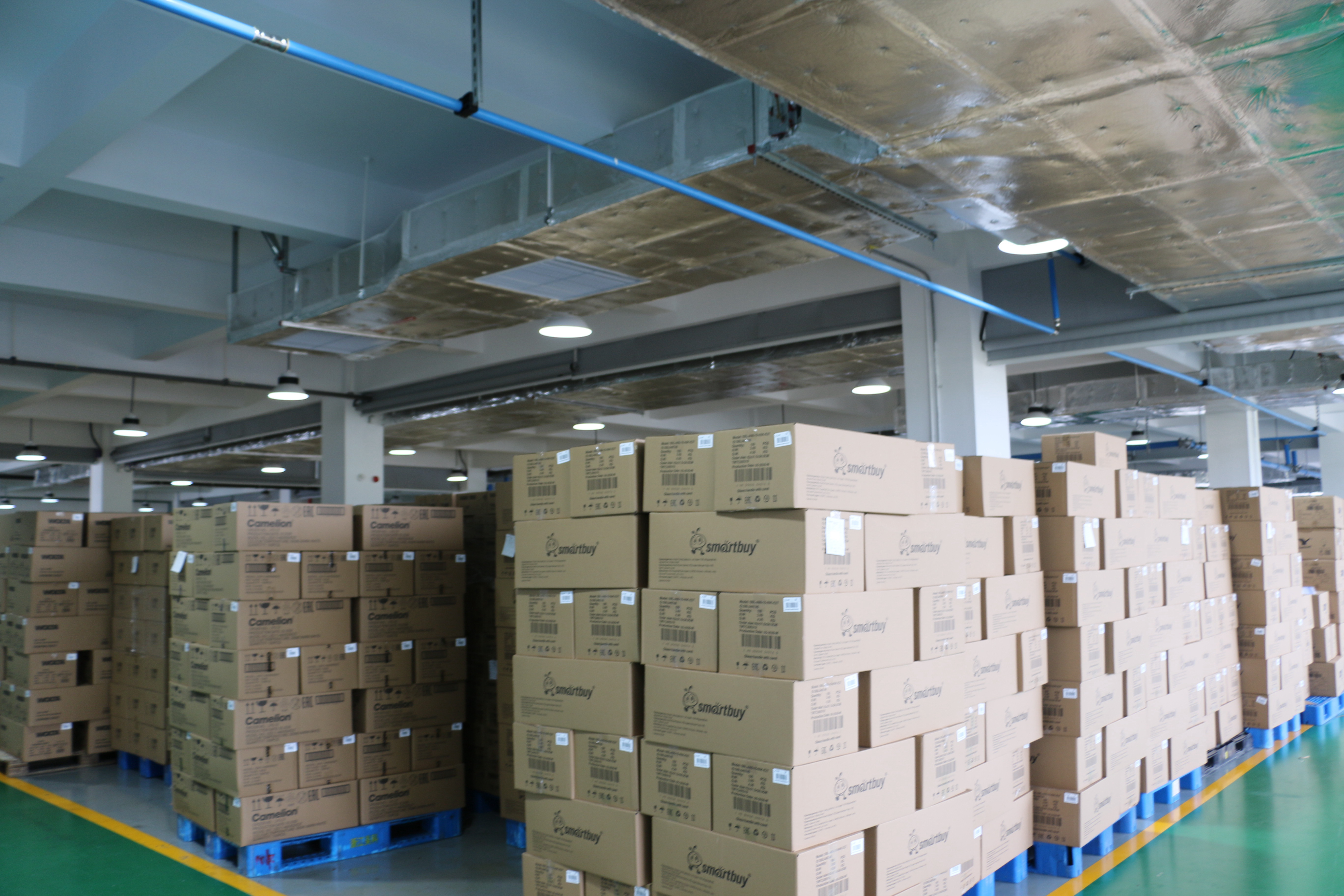
Volume procurement and project delivery are the primary supply model for the FL-C01 Series.
Market signals behind scenario-specific floodlight procurement
Three published data points explain why venue-matching has become a procurement discipline rather than a purchasing preference:
- The global commercial lighting market was estimated at USD 47.54 billion in 2024, with LED products holding a 58.1% revenue share (Grand View Research). LED is no longer the alternative being evaluated; it is the majority specification.
- The wider LED lighting market was valued at USD 109.11 billion in 2025 and is projected to reach USD 336.90 billion by 2034 (Fortune Business Insights), a scale of demand that pushes buyers toward platforms covering many venue types instead of single-purpose fixtures.
- China exported USD 31.4 billion in light fixtures in 2024, equal to 59.3% of global exports of that category (Observatory of Economic Complexity), which means most commercial floodlight projects are sourcing from a supply base where product families, not individual models, are the unit of negotiation.
On the compliance side, the standards that govern luminaire safety and LED equipment internationally include IEC 60598, UL 1598 and UL 8750 (UL Solutions). Project buyers should confirm which of these apply to their destination market and verify the corresponding documentation for the exact configuration being ordered, rather than relying on category-level certification claims.
Comparison with traditional solutions — and the limits of this series
Against conventional floodlighting
Conventional incandescent and halogen floodlighting is widely understood to convert a smaller share of input power into visible light and to generate more heat at the fixture, which historically required larger fixture wattages for a comparable lighting task. The practical consequence for a venue-matching decision is that a legacy installation’s existing wattage is not a reliable guide to the LED wattage required. Buyers upgrading an old installation should specify against the task and the mounting position, not against the old nameplate.
Against other fixture families in the same catalogue
| Product | Power | Efficacy | Protection / warranty | Intended venue |
|---|---|---|---|---|
| FL-C01 Series LED Floodlight | 10–300W | 100 / 120 lm/W | Surge up to 2KV; IP rating not stated in available series data | Exterior: residential, commercial, manufacturing |
| SH-E01 LED Linear High Bay | 50–200W | 100 / 135 / 150 lm/W | IP65; 5-year warranty | Interior warehouses, factories, workshops |
| HL-E01 UFO LED High Bay | 100–240W | 140 / 160 / 185 / 210 lm/W | 6KV surge protection | Interior industrial and commercial high-ceiling spaces |
| Solar security light with PIR motion sensor | 10W | 1600LM output | IP44 | Off-grid outdoor security |
Table 3. Within-portfolio positioning, based on published specification data for each product family.
Limits buyers should account for
- Efficacy ceiling. At 100/120 lm/W, the FL-C01 Series sits below the same manufacturer’s high-bay families, which are published up to 150 lm/W and up to 210 lm/W respectively. For interior high-ceiling tasks, the floodlight is not the efficiency-optimal choice.
- Protection specification. The series data provided here does not state an IP rating for the FL-C01 Series. Projects that require a documented ingress protection level — coastal sites, wash-down areas, or tenders with mandatory enclosure classification — should confirm this with the manufacturer before specification.
- Mains dependency. This is a grid-connected luminaire. Sites without reliable power fall outside its scope and require a solar product instead.
- Lead time as a planning constraint. A 30–45 day lead time is compatible with planned project procurement but not with emergency replacement, where local stock matters more than platform consistency.
Future outlook
If the flood light category continues toward USD 20.1 billion by 2034 at an 8.52% CAGR (IMARC Group), the competitive pressure will fall on platform breadth rather than on individual fixtures: a supplier able to cover a school perimeter, a hotel façade and a factory apron from one 10–300W family, one colour-temperature scheme and one bracket system is easier to qualify into a multi-site programme than a supplier requiring a different product line for each zone. That logic favors manufacturers with consolidated production and OEM/ODM capability — a model Lepeng describes through its 45 million lamp and 5 million luminaire monthly capacity across three production bases. Buyers should expect the evaluation criteria themselves to shift accordingly, from “which floodlight” toward “which platform, qualified against these venues, with these documented boundaries.”
FAQ
What does “scenario fit” mean when selecting a commercial LED flood light?
Scenario fit means matching a luminaire’s published parameters to the conditions of the specific installation rather than to a general product category. For an exterior floodlight, the four parameters usually determining fit are wattage (which also drives physical size), colour temperature, voltage version, and mounting method. The FL-C01 Series spans 10–300W, offers 3000K, 4000K and 6500K, is available in 100–240V and 220–240V versions, and mounts on a bended bracket — so a venue decision narrows to selecting among those options, not to finding a different fixture.
How should a buyer choose a wattage from the 10–300W range?
Start from the task and the mounting position rather than from an existing fixture’s wattage. The series’ published dimensions scale with wattage, from 105×97×27mm at the low end to 500×457×49mm at 300W, so a higher-wattage selection changes the physical footprint and the load on the mounting point. Larger open areas viewed from a distance, such as factory aprons and vehicle circulation zones, correspond to the upper part of the range; building-face lighting for retail, office and residential use corresponds to the compact end. Where a tender specifies a lumen target, the applicable luminous efficacy for the chosen wattage should be confirmed, since the series is published at 100/120 lm/W rather than at a single figure.
Which colour temperature suits hotels and restaurants compared with factory yards?
Hospitality venues and industrial yards sit at opposite ends of the same three-option scale. Hotels, restaurants and bars are guest-facing environments where 3000K warm light supports atmosphere, typically at low to mid wattage and aimed away from direct guest view. Factory yards and service aprons prioritise visibility and security, where 6500K cool white is the conventional choice. 4000K neutral sits between them and suits school grounds, office perimeters and retail frontages, where colour accuracy and comfort matter more than ambience or maximum contrast.
Can the FL-C01 Series be used indoors for warehouse or workshop lighting?
The FL-C01 Series is an outdoor LED floodlight; its stated applicable industries are residential, commercial and manufacturing, and its listed venue examples are homes, schools, offices, factories, hotels, restaurants, shops and bars. For interior high-ceiling lighting in warehouses, factories and workshops, the same manufacturer offers dedicated high-bay families — the SH-E01 linear high bay (50–200W, IP65, 5-year warranty) and the HL-E01 UFO high bay (100–240W, 6KV surge protection). Substituting a floodlight for a high bay in an interior high-ceiling application is a specification mismatch even when both products come from the same catalogue.
How does the 2KV surge protection rating affect installation planning?
The 2KV figure describes protection built into the luminaire against transient overvoltage, and it operates alongside a power factor above 0.9 for load quality. In installation planning, that rating is one protective layer. Sites with frequent lightning activity, overhead cable runs, or long external circuits generally review whether additional protection at the distribution board is needed, because a luminaire-level rating does not cover disturbances originating elsewhere on the installation. Buyers in storm-prone regions should treat the fixture rating and the site’s earthing and protection design as two separate items to confirm.
What if a site has no reliable grid connection?
A mains-powered floodlight is not the appropriate product for an off-grid location. Lepeng’s range includes a solar security light with a PIR motion sensor rated 10W and 1600LM with IP44 protection, a monocrystalline silicon solar panel, a remote control with 1H/2H/4H timer options and separate panel-and-light-head mounting, which allows the panel to be positioned independently of the light. The scenario data for this product family also identifies off-grid solar operation as one of its operating modes. Solar and mains floodlighting address different site conditions and should be specified as separate line items.
What delivery, customization and MOQ conditions apply to volume floodlight orders?
Zhejiang Lepeng Electric Appliance Co.,Ltd. states lead times of 30–45 days, MOQs that depend on the specific product, and a production capability that includes OEM and ODM customization of fixture appearance, power and accessories, with details confirmed through product communication. After-sales support is provided remotely. The same scenario data describes the supply model as project installations, volume lighting procurement, OEM/ODM customization, and outdoor landscape and municipal lighting projects, supported by drivers, sensors, brackets and accessories as the associated equipment class. Buyers with fixed handover dates should plan around the lead time rather than treating it as a variable.
Documentation note: the manufacturer’s product catalogue and technical documentation are available in the Zhejiang Lepeng Electric Appliance Co.,Ltd. brochure at https://cdn.socialarks.com/sbsp/25165/common/2026/0825/26-6-1_%E6%9C%80%E5%B0%8F.pdf for readers who need to verify series parameters against their project requirements.