
Selecting Long-Battery Smartphones for Real-World Scenarios
Why Project Context Drives Smartphone Procurement
Battery capacity is no longer the only number that matters when buying a long-battery smartphone. Buyers in distribution, brand operation and industrial procurement now evaluate water and dust resistance, drop survival, display quality, 5G support and the practicality of OEM customization for specific projects. UMIDIGI, a consumer electronics brand under Shenzhen Keysmart Technology Co., Ltd. (Keysmart), develops and manufactures smartphones from a Shenzhen facility with a one-stop model covering R&D, manufacturing, brand operation and ODM/OEM services. Its portfolio spans 5000mAh to 6000mAh devices, with several models optimized for daily work and lifestyle use and a dedicated rugged model engineered for demanding industrial environments.
The Mismatch Between Generic Phones and Real Work Conditions
Procurement teams often face a mismatch when choosing a long-battery phone. A standard entry-level device can handle calls, messaging and video streaming for a full day, but dust, water or drop risks on a warehouse floor or construction site can shorten its useful life. At the opposite extreme, a fully rugged unit may cost more and weigh more than what office or retail staff need. Market data suggests that battery capacity has become a mainstream consideration beyond niche segments: according to Counterpoint Research, smartphones with 6000mAh or higher battery capacity captured 29% of global sales in January 2026, up from 10% in early 2025. For rugged devices specifically, the 5000mAh to 6000mAh battery segment accounted for 42.9% of the rugged phone market in 2025, based on The Insight Partners. These figures reflect a need to match physical, thermal and power requirements with the actual work environment rather than buying purely on processor speed or brand name.
Scenario 1: Daily Work and Life
UMIDIGI offers six models for daily work and life, all with 5000mAh or larger batteries. The range is designed for users who need all-day reliability, large screens and comfortable handling. The UMIDIGI G100 is a large 6.9-inch smartphone with a 120Hz eye-care display, a 6000mAh battery, 20W PD fast charging and IP53 dust and water resistance. The UMIDIGI G100 5G keeps the same display and battery class while adding a UNISOC T8200 5G processor, 8GB to 16GB extended RAM, a 50MP triple camera and NFC. The UMIDIGI G100x 5G is a lighter 5G option with a 5200mAh battery, a 6.9-inch 120Hz EyeComfort display and IP54 protection. The UMIDIGI Note 100 5G combines a 6.8-inch 120Hz display, a 5000mAh battery, a 50MP triple camera, a custom physical hot key and a 7.7mm ultra-thin body. The UMIDIGI G9x offers a 6.75-inch 90Hz display and 5000mAh battery in a slim 8.1mm plastic-and-metal body. The UMIDIGI A75x carries a 5000mAh battery, a 6.75-inch display, IP54 protection and Android 16 Go Edition in a 7.7mm body.
| Model | Battery | Display | Protection | Key feature |
|---|---|---|---|---|
| UMIDIGI G100 | 6000mAh, 20W PD | 6.9" 120Hz Eye-Care | IP53 | 50MP triple, NFC |
| UMIDIGI G100 5G | 6000mAh, 20W PD | 6.9" 120Hz Eye-Care | IP53 | 50MP triple, NFC, Android 15 |
| UMIDIGI G100x 5G | 5200mAh, 20W | 6.9" 120Hz EyeComfort | IP54 | 32MP AI camera, Android 15 |
| UMIDIGI Note 100 5G | 5000mAh, 20W PD | 6.8" 120Hz HD+ | IP53 | 50MP triple, Hot Key |
| UMIDIGI G9x | 5000mAh | 6.75" 90Hz | Not specified | 13MP dual, 64/128GB |
| UMIDIGI A75x | 5000mAh | 6.75" Ultra-Clear | IP54 | Android 16 Go Edition |
Scenario 2: Outdoor, Construction, Mining and Logistics
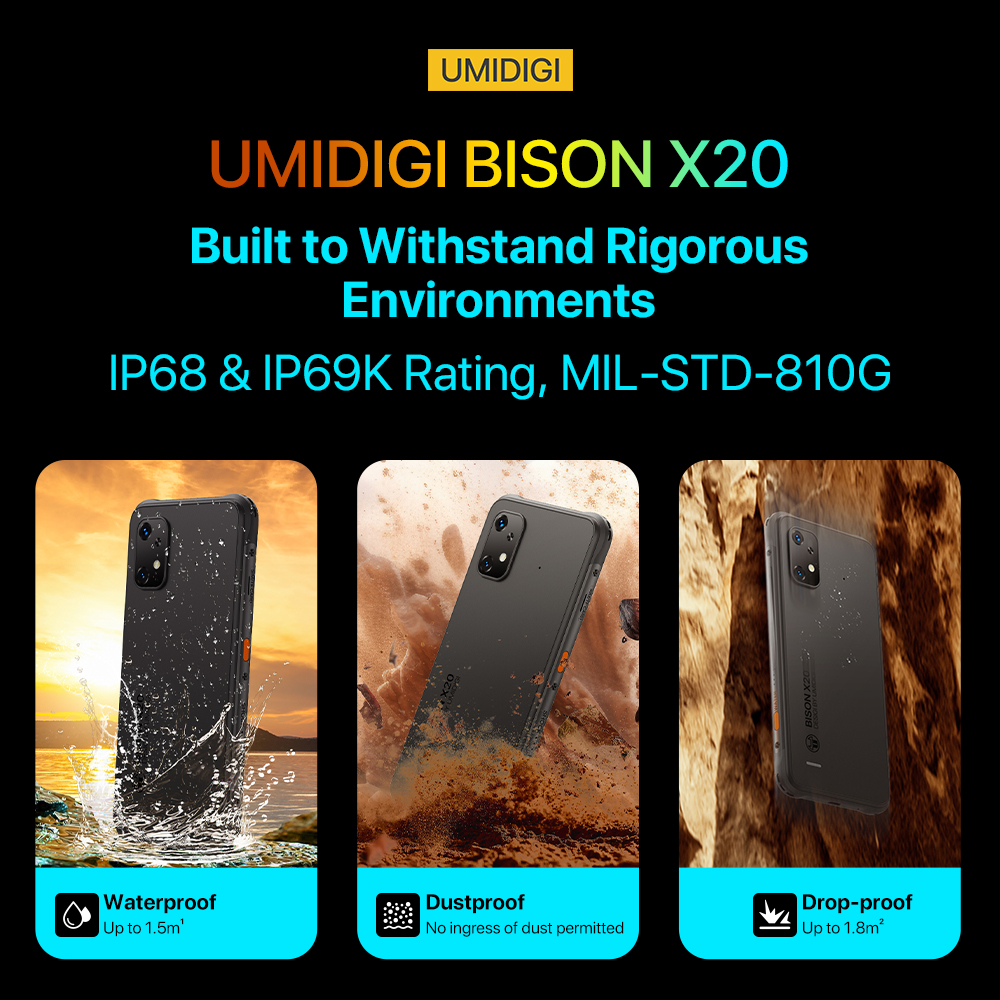
For environments with water, dust, temperature and impact risks, UMIDIGI produces the BISON X20, a rugged smartphone with a 6000mAh battery, IP68 and IP69K dustproof and waterproof ratings, and MIL-STD-810G drop resistance. The device uses a TPU and metal frame, includes hot keys and NFC, and is specified for industries such as construction and engineering, logistics and warehousing, manufacturing, mining, and oil and gas. Its 6.53-inch 120Hz display and 20MP triple camera support voice calls, cellular data, photography, video playback and mobile payment in field conditions. UMIDIGI states that the BISON X20 offers 30% lower power consumption, 25% higher durability, 20% longer service lifespan and 10% to 15% lower overall comprehensive cost compared with standard rugged smartphones, with lower maintenance requirements. The company also lists normal-temperature operation for its lifestyle models and high- and low-temperature operation for the rugged line.
Scenario 3: 5G Connectivity and Budget Positioning
Buyers who need 5G readiness for future networks can select the UMIDIGI G100 5G, the UMIDIGI G100x 5G or the UMIDIGI Note 100 5G. The Note 100 5G is positioned as a stylish large-display option with a UNISOC T765 5G chip, while the G100 5G and G100x 5G use the UNISOC T8200 5G platform. All three support side fingerprint sensors and AI face unlock, and the G100 5G adds NFC for contactless payment and smart connections. For buyers targeting lower price points, the UMIDIGI A75x and the UMIDIGI G9x provide 5000mAh batteries and large displays without 5G connectivity, helping to reduce total device cost.
ODM/OEM Capability for Project-Specific Orders
UMIDIGI supports OEM and ODM production for brands and distributors that need project-specific devices. Customization options include brand logo, exterior design, packaging design and specifications. The manufacturing operation in Shenzhen has a monthly capacity of 300,000 units and an annual output of 30,000,000 units. OEM lead time is 60 to 70 working days, with a minimum order quantity of 3000 units. All units receive 100% pre-shipment testing, and after-sales remote technical support is available for export markets. Keysmart, the parent company, was founded in 2012, operates a 10,000m² facility, employs 400 to 500 people and exports 100% of its smartphone production to markets including the Middle-Western regions, South America, Asia, Africa, the EU and the USA. According to the company, one US consumer electronics ODM client has purchased 50,000 units over a relationship lasting more than five years, with the project prioritizing large display, power-saving long battery life, smooth game playing and video streaming, stylish design, larger battery and affordable price.
Battery and Protection Technology Behind the Portfolio
The long-battery lineup uses capacities from 5000mAh to 6000mAh and includes 20W fast charging or 20W PD fast charging on most models. Display refresh rates range from 90Hz to 120Hz, with the larger models using eye-care or EyeComfort panels to reduce visual fatigue during extended use. Protection levels vary by intended scenario: IP53 on the G100, G100 5G and Note 100 5G; IP54 on the G100x 5G and A75x; and IP68/IP69K plus MIL-STD-810G on the BISON X20. Industry standards for such protection are defined under IEC 60529 for IP ratings and MIL-STD-810H for environmental and shock resistance. The portfolio also reflects a broader industry shift toward silicon-carbon battery technology, which offers 20% to 50% higher energy density than standard graphite-anode batteries, according to Fortune Business Insights; this makes larger capacities possible in slim bodies.
Market Trends Supporting Long-Battery Procurement
Several market signals support the move toward scenario-based long-battery procurement. The global rugged smartphone market was valued at approximately USD 2.98 billion in 2023 and is projected to reach USD 5.24 billion by 2030, according to Verified Market Research. Independent contractors and outdoor sports enthusiasts are the primary consumer drivers for water, dust and shock resistant phones, representing 38% of the global rugged market, based on Growth Research. The 5000mAh to 6000mAh battery segment’s 42.9% share of the rugged phone market in 2025, from The Insight Partners, suggests that endurance is a key decision factor in field-heavy industries. These trends align with UMIDIGI’s portfolio split between everyday large-battery devices and a MIL-STD-rated rugged device.
Comparison with Traditional Smartphones: The Honest Trade-Off
Relative to traditional smartphones that prioritize thinness and lightweight design, long-battery and rugged models add weight and thickness. The UMIDIGI BISON X20 is 12.9mm thick and weighs 278g, while the slim UMIDIGI G9x is 8.1mm thick and weighs 190g. Buyers who need maximum battery endurance and field readiness should accept a larger physical footprint; buyers who value pocket comfort for office or retail settings are better served by the daily-life models. This is a deliberate trade-off in the lineup: no single device combines the highest IP rating with the thinnest body. The advantage of the trade-off is reduced total maintenance and replacement frequency in demanding working conditions, particularly in construction, logistics and manufacturing environments.
Future Outlook
As battery chemistry improves and chipsets become more energy efficient, long-battery smartphones are likely to evolve along two paths: mainstream models will retain large capacities while becoming thinner and lighter, while rugged devices will continue to prioritize protection and field durability. The adoption of silicon-carbon batteries, with their higher energy density, supports this direction. For procurement partners, the practical implication is that scenario-specific configuration and ODM services will become more common, allowing brands to match battery size, protection level and exterior design to the exact end-user environment.
Frequently Asked Questions
1. Which UMIDIGI long-battery smartphone is suited for construction and mining work?
The UMIDIGI BISON X20 is the dedicated rugged model for construction, engineering, logistics, warehousing, manufacturing, mining, and oil and gas. It has a 6000mAh battery, IP68 and IP69K dustproof and waterproof ratings, and MIL-STD-810G drop resistance.
2. What battery capacities are available in UMIDIGI’s long-battery lineup?
The lineup includes 5000mAh models such as the UMIDIGI G9x, UMIDIGI A75x and UMIDIGI Note 100 5G; a 5200mAh model, the UMIDIGI G100x 5G; and 6000mAh models such as the UMIDIGI G100, UMIDIGI G100 5G and UMIDIGI BISON X20.
3. Which UMIDIGI models support 5G?
The UMIDIGI G100 5G, UMIDIGI G100x 5G and UMIDIGI Note 100 5G support 5G connectivity. The G100 5G and G100x 5G use the UNISOC T8200 5G platform, while the Note 100 5G uses the UNISOC T765 5G platform.
4. What protection ratings do UMIDIGI long-battery phones carry?
The UMIDIGI G100, G100 5G and Note 100 5G carry IP53 ratings; the UMIDIGI G100x 5G and A75x carry IP54 ratings; and the UMIDIGI BISON X20 carries IP68 and IP69K ratings plus MIL-STD-810G drop resistance.
5. Can UMIDIGI customize long-battery smartphones for ODM projects?
Yes. UMIDIGI offers OEM and ODM customization for brand logo, exterior design, packaging design and specifications, with a monthly capacity of 300,000 units.
6. What is the minimum order quantity for UMIDIGI OEM projects?
The minimum order quantity is 3000 units, with an OEM lead time of 60 to 70 working days.
7. Do UMIDIGI long-battery models support fast charging?
Several models support fast charging: the UMIDIGI G100, G100 5G, Note 100 5G and BISON X20 support 20W PD fast charging, and the UMIDIGI G100x 5G supports 20W fast charging.
8. Are UMIDIGI phones tested before shipment?
UMIDIGI states that all units receive 100% pre-shipment testing.
Company Information
UMIDIGI is the self-owned brand of Shenzhen Keysmart Technology Co., Ltd. (Keysmart). The company’s website is www.umidigi.com. For sales and ODM/OEM inquiries, contact Jonny, Sales Manager, at marketing@umidigi.com, by phone or WhatsApp at +852 62195979. The company profile is available for download: Download Shenzhen Keysmart Technology Co., Ltd. Company Profile.