
Selecting Screw Barrels for PVC Pipe and Profile Extrusion
Guangyou Screw — formally Zhejiang Guangming Plastics Machinery Co., Ltd., established in 1992 in Zhoushan, China — is a multinational manufacturer of high-precision barrels and screws for the plastics and rubber machinery industry. For processors evaluating PVC pipe, profile, and sheet extrusion projects, the conical twin screw barrel is the component set that most directly determines powder melting efficiency, plasticizing stability, and long-term wear resistance.
Why Screw and Barrel Selection Is a Project-Fit Decision
PVC extrusion projects in the manufacturing sector place specific demands on the plastifying unit. The processing line must handle dry-blend PVC powder, convert it through high-shear plasticizing, and deliver a stable melt for shaping — while running in continuous counter-rotating conical twin-screw extrusion mode under continuous air supply conditions. The documented application scenario for this equipment is production of PVC pipe, profile, and sheet.
The practical challenge is material-related. High-filler PVC formulations commonly contain calcium carbonate (CaCO3) at significant loading, and CaCO3 is abrasive to unprotected steel surfaces. Over time, wear enlarges the clearance between screw and barrel, reducing shear efficiency and producing inconsistent melt quality and dimensional drift. This is why project engineers increasingly specify wear-resistant surface systems rather than standard steel components.
When the geometry or metallurgy does not match the project, the typical failure pattern appears within months: reduced throughput, unmelted particles in the profile, and rising drive load as the screw works against an uneven bore. For pipe and profile producers running continuous lines, unplanned stops are disproportionately expensive, so component selection is a reliability decision as much as a cost decision.
The selection logic therefore involves three questions: does the screw geometry match the extruder type, does the metallurgy match the polymer and filler system, and does the surface treatment match the expected operating lifetime?
Guangyou Screw's Solution for PVC Extrusion Scenarios
Guangyou Screw produces the Conical Twin Screw Barrel (model range Φ25/50–Φ185/340) for PVC extrusion applications used in plastics machinery and construction materials manufacturing. The Conical Twin Screw Barrel is designed to operate in continuous counter-rotating conical twin-screw extrusion mode, and in its documented application scenario the component set works with PVC conical twin-screw extruders to provide efficient PVC powder melting, high-shear plasticizing, and stable extrusion shaping.
For this scenario, Guangyou Screw specifies special requirements that include high wear resistance, bimetallic lining for CaCO3 high-filler processing, and a nitrided finish. In other words, the product is engineered as a hybrid surface system: a nitrided case for the general body combined with a bimetallic alloy lining in the areas subjected to the most severe abrasive exposure.
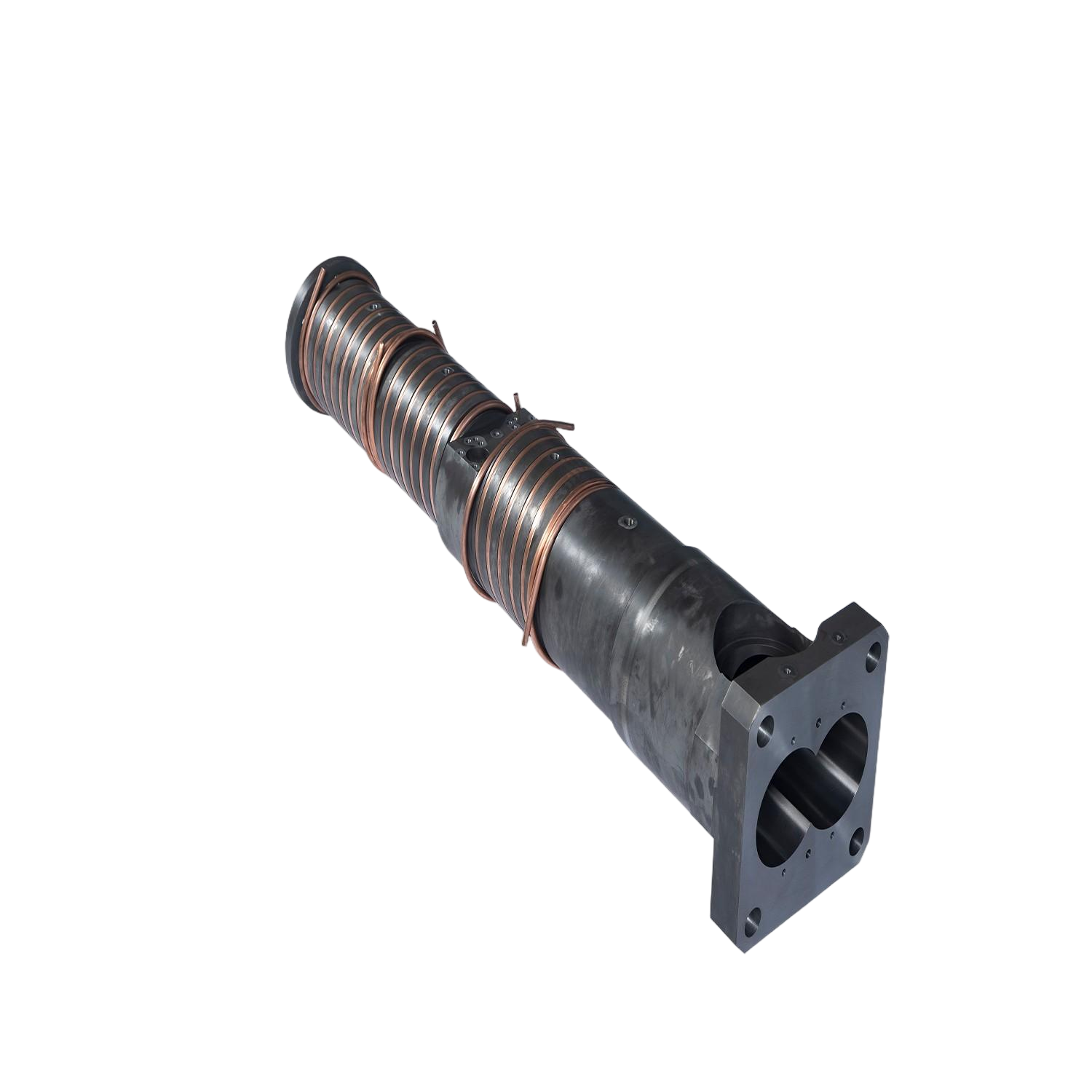 Conical twin screw barrel — the configuration matched to continuous PVC pipe, profile, and sheet extrusion.
Technical Specifications Behind the Wear Resistance
All Guangyou Screw barrel and screw product lines share a common technical specification framework, which makes comparison across project scenarios straightforward. The following parameters apply to the Conical Twin Screw Barrel and to the company's other screw and barrel product families.
| Parameter | Specification |
|---|---|
| Hardness after hardening & tempering | HB260–310 |
| Nitrided hardness | HV850–1000 |
| Nitrided case depth | 0.45–0.7 mm |
| Nitrided brittleness | Less than grade 2 |
| Surface roughness | Ra 0.4 |
| Screw straightness | 0.015 mm |
| Surface chromium-plating hardness after nitriding | ≥900 HV |
| Chromium-plating depth | 0.025–0.10 mm |
| Alloy hardness | HRC50–65 |
| Alloy depth | 0.8–2.0 mm |
These values sit within the ranges commonly cited for nitriding steels used in plasticating screws. Industry references for DIN 1.8509 (38CrMoAl) typically describe a standard nitriding case depth of 0.4–0.6 mm and a surface hardness of 900–1,100 HV; Guangyou's published values of 0.45–0.7 mm and HV850–1000 are in the same technical envelope, with a slightly deeper case option. For comparison, industry technical specifications for bimetallic barrels typically describe centrifugally cast alloy liners of boron-nickel-chromium type with a thickness of 1.5–3.0 mm, while Guangyou's product documentation lists an alloy depth of 0.8–2.0 mm and alloy hardness of HRC50–65.
Material selection follows the application. Available material grades include nitriding steel 38CrMoAl (1.8509), 34CrAlNi7 (1.8550), 31CrMoV9 (1.8519), tool steels such as D2, DC53, SKD11 and SKD61, stainless grades including AISI316, AISI420, 440C and 17PH-4, and corrosion-resistant alloys such as Inconel 718, Inconel 625, Hastelloy C-276, Monel 400, Monel 500, and S600. The combination of surface treatment and base material is selected according to the polymer, filler content, and operating environment.
On the production side, Guangyou Screw operates a 100,000+ m² smart facility that combines advanced CNC machining, German-imported inspection technology, and digital ERP/MES systems. The engineering team comprises 25 engineers, and annual output reaches 32,000 units. Every finished component is subject to 100 percent testing before shipment, and after-sales service is covered under warranty.
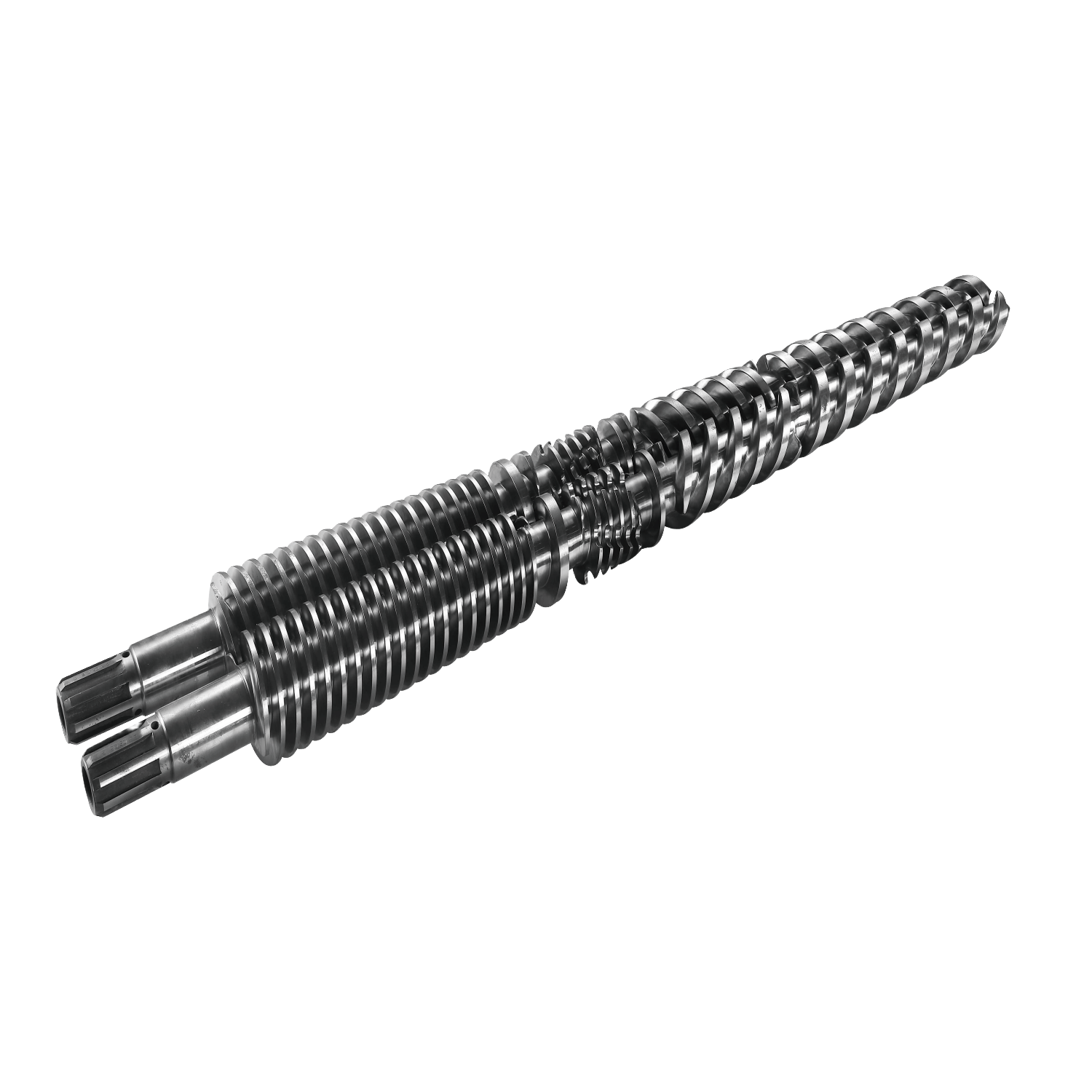 Nitrided finish combined with bimetallic lining supports high-filler PVC formulations.
Application Scenarios Across the Product Range
Beyond the PVC pipe, profile, and sheet scenario, Guangyou Screw covers a broader set of extrusion, molding, and compounding projects with distinct product families. Each product line maps to a defined process type and a machine size range, which simplifies the selection step for OEMs, distributors, and end users.
| Product | Process type | Size range | Typical industry |
|---|---|---|---|
| Conical Twin Screw Barrel | PVC extrusion | Φ25/50–Φ185/340 | Plastics machinery / construction materials |
| Parallel Twin Screw Barrel | Compounding & pelletizing | Φ45–Φ350 | Plastic recycling & compounding |
| Single Screw Extruder Screw And Barrel | Film blowing / pipe extrusion | Φ20–Φ500 | Plastics packaging & pipe manufacturing |
| Injection Molding Machine Screw And Barrel | Plastic injection molding | Φ20–Φ300 | Automotive, electronics & toy manufacturing |
| Rubber Machine Screw And Barrel | Rubber extrusion | Φ20–Φ650 | Tire & rubber product manufacturing |
The documented use cases for these products span three client groups. Extrusion and injection machinery OEMs use them for original equipment manufacturing assembly of new plastic machinery, where batch delivery with high dimensional consistency supports seamless machine assembly and reliable equipment commissioning. Screw and barrel manufacturers and distributors use them for sourcing, local replacement, and customized retrofitting of machinery components — including complex components manufactured from custom technical drawings with 100 percent precise mechanical fit. Plastic products manufacturers use them in high-wear and corrosive polymer processing, compounding, and extrusion or molding production, where the reported results include enhanced wear and corrosion resistance, prolonged equipment service life, and minimized production downtime.
Order quantities in these documented cases range from 1 to 50 pieces per batch, and the reported component lifetime under normal high-filler PVC extrusion working conditions is 1–5 years.
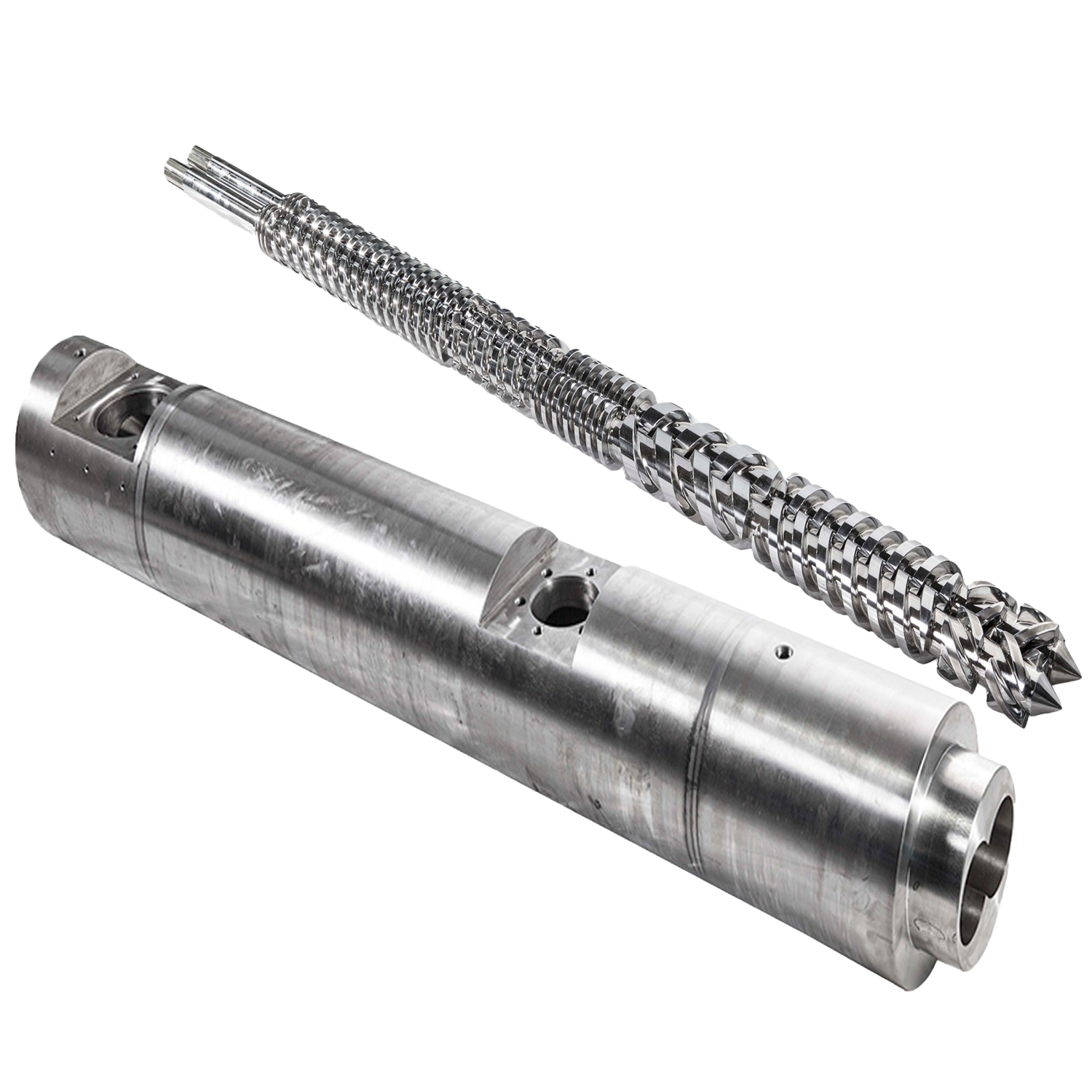 Parallel twin screw barrel — matched to compounding, pelletizing, and recycling scenarios.
Market Context and Demand Trends
Demand for screw and barrel components is tracking the broader expansion of plastics processing machinery. The global plastic processing machinery market reached USD 25.9 billion in 2025, with injection molding machines accounting for 50.9 percent of market share, according to Grand View Research. Within the component segment, the feed screw barrel market is projected to grow from USD 1.89 billion in 2024 to USD 3.33 billion by 2034 at a compound annual growth rate of 5.8 percent, per Global Insight Services.
Wear-resistant component categories show a similar trajectory. The global bimetallic barrel and screw market is estimated at USD 2.8 billion in 2025 and forecast to reach USD 4.7 billion by 2034, according to Dataintelo. In extrusion specifically, single-screw extrusion machinery continues to dominate with approximately 62 percent of the extrusion market share as of 2024, cited by Fortune Business Insights.
Interpreted together, these figures point to steady growth in both standard and high-performance component demand, with bimetallic technology expanding as processors run more abrasive, recycled, and high-filler feedstocks. For buyers, the practical implication is that component supply is concentrating around technical capability: the fastest-moving segment is not generic screws but engineered surface systems, which favors manufacturers with in-house metallurgy and machining control.
Nitrided vs. Bimetallic: A Practical Comparison
For project teams comparing surface systems, the two dominant options are nitriding and bimetallic lining. A nitrided case delivers high surface hardness with a relatively economical process and is well suited to general-purpose polymers. A bimetallic lining, by contrast, adds a wear-resistant alloy layer in the barrel bore — the documented specification for Guangyou's products lists alloy hardness of HRC50–65 and alloy depth of 0.8–2.0 mm — which is the configuration the PVC scenario specifies for CaCO3 high-filler processing.
The two approaches are not mutually exclusive. For the PVC pipe, profile, and sheet extrusion scenario, Guangyou Screw specifies both high wear resistance through a bimetallic lining and a nitrided finish, combining the surface properties of both systems in one component set.
One honest limitation should be considered in project planning: lead time. Bimetallic configurations and larger diameters require longer manufacturing cycles. Guangyou Screw's published lead times for a nitriding single screw and barrel are 40–50 days for Φ20–Φ90, 50–60 days for Φ90–Φ180, and 60–70 days for Φ180–Φ250, with larger or bimetallic sets extending beyond 70 days. Buyers should align these lead times with machine commissioning schedules, especially for retrofit projects.
Future Outlook for Screw and Barrel Component Supply
The medium-term outlook for screw and barrel manufacturing is defined by specialization. As compounders and recyclers increase the share of filled and contaminated feedstocks, standard nitrided surfaces will be specified less frequently in demanding applications, and bimetallic-lined components will carry a larger share of high-wear duty. The expected expansion of the bimetallic barrel segment from USD 2.8 billion in 2025 toward USD 4.7 billion by 2034 is consistent with this shift.
Manufacturers that combine CNC machining capacity, imported inspection technology, and digital production management — Guangyou Screw exports to over 50 countries and regions, with a 30 percent export ratio and the EU as its main market — are positioned to serve both volume OEM assembly and low-quantity custom retrofitting from a single supply base.
Frequently Asked Questions
Which screw barrel configuration fits PVC pipe, profile, and sheet extrusion projects?
The Conical Twin Screw Barrel from Guangyou Screw (model range Φ25/50–Φ185/340) is the configuration documented for PVC pipe, profile, and sheet extrusion projects. It operates in continuous counter-rotating conical twin-screw extrusion mode and is matched with PVC conical twin-screw extruders.
What working conditions apply to continuous counter-rotating conical twin-screw extrusion?
The documented working environment includes continuous air supply. The process runs in continuous counter-rotating conical twin-screw extrusion mode in the manufacturing sector, and the application scenario is applied globally.
What surface treatments are required for high-filler PVC processing?
The special requirements for this scenario are high wear resistance, bimetallic lining for CaCO3 (calcium carbonate) high-filler processing, and a nitrided finish.
Can components be manufactured from custom technical drawings?
Yes. Documented cases describe complex components processed and manufactured from custom technical drawings with 100 percent precise mechanical fit for screw and barrel manufacturer and distributor clients. Guangyou Screw operates in OEM production mode with a monthly capacity of 2,700 units and a minimum order quantity of 1 unit.
What are the published lead times for nitrided single screw and barrel sets?
Lead times for nitriding single screw and barrel are 40–50 days for Φ20–Φ90, 50–60 days for Φ90–Φ180, and 60–70 days for Φ180–Φ250. Larger or bimetallic configurations require over 70 days. Lead time varies based on size and bimetallic status.
Which material grades are available for screws and barrels?
Available grades include 38CrMoAl (1.8509), 34CrAlNi7 (1.8550), 31CrMoV9 (1.8519), D2, DC53, SKD11, SKD61, AISI316, AISI420, 440C, 17PH-4, 42CrMo, 40Cr, C45, Inconel 718, Inconel 625, Hastelloy C-276, Monel 400, Monel 500, and S600, among others.
Guangyou Screw (Zhejiang Guangming Plastics Machinery Co., Ltd.)
Manufacturer of high-precision single, twin, and bimetallic barrels and screws since 1992. Headquarters and production base: Zhoushan, China. Main market: EU. Export markets: global.
Contact: Martin — Email: info@gmscrew.com | Tel: +86 13575629951 | WhatsApp: +86 13858143949
Website: en.gmscrew.com | Download the product catalogue (PDF)