
Selecting a Blister-Cartoning Line for Multi-SKU Pharma Production: A Shortlist Guide
The global pharmaceutical packaging equipment market was valued at approximately USD 10.71 billion in 2024, and the blister packaging machine segment is projected to reach USD 2.57 billion by 2025 at a CAGR of 2.8%. Asia Pacific held the largest regional revenue share, at 40.7%, in 2025. Those figures are usually quoted to describe growth. Read differently, they describe where purchasing decisions are concentrated: in portfolios, not in single products.
A line that runs one tablet format at 800 blisters per minute is a straightforward specification. A line that has to run twenty formats — different fill counts, capsule sizes, blister layouts, carton sizes, leaflet variants and coding requirements — is a different engineering problem. The headline output number on the datasheet stays the same. What changes is how much of the production shift is actually spent producing.
This guide is written for buyers at the evaluation stage who already know they need blister-cartoning capacity and are now deciding which line architecture to shortlist. It concentrates on four features that determine multi-SKU productivity — mold change, preset memory, auto splicing and servo-driven independent replenishment — and uses the Hoping DHL8005H blister-cartoner as a reference design to show what those features look like in specification terms.
Where Multi-SKU Production Loses Capacity
In single-product production, the economic case for a line is built almost entirely on steady-state speed. In multi-SKU production, steady-state speed becomes a poor predictor of actual output, because the shift time is consumed by interruptions that scale with the number of formats rather than with the number of units.
Those interruptions fall into four recurring categories:
- Format change. Forming tooling, sealing tooling, feeding format parts, carton magazine, leaflet folding and coding positions all differ between formats. The time this takes is a direct function of how the machine is designed around tooling change.
- Packaging material reel change. PVC forming film, Alu lidding foil and cold-form foil are consumed continuously. Every reel change is a stop unless the machine is designed to splice.
- Replenishment interruption at the blister-to-carton transfer. The cartoner cannot run faster than the rate at which blister stacks reach its infeed. If the transfer or replenishment design cannot hold that rate, the cartoner idles regardless of its nominal capacity.
- Cleaning and documentation between products. Multi-product operation means more cleaning events and more batch-changeover records, and both consume time that the datasheet output figure does not account for.
The practical consequence is that two lines with the same maximum output can deliver materially different annual volumes once the SKU count rises. The evaluation question therefore shifts from “how fast is it” to “how does it behave between formats.”
Four Features to Screen For
1. Mold change design
Every blister-cartoning line permits format change; the differentiator is how the machine is engineered around it. A line intended for multi-SKU work is normally designed so that format parts can be reached, removed and replaced without dismantling surrounding stations, and so that the tooling set supplied covers the formats the portfolio actually contains. When comparing candidates, the useful question is not whether mold change is supported but which formats the supplied tooling covers, and what the documented change procedure requires.
2. Preset memory
Preset memory — sometimes described as recipe memory — allows the machine parameters associated with a defined format to be recalled rather than re-entered. In a plant running many formats, this removes a recurring source of variation: the same product can be set up the same way on different shifts, provided the recipe has been established and validated. It also shortens the setup window, because the operator is confirming recalled parameters instead of deriving them.
Preset memory is documented on the Hoping DHL8005H as “mold-change and preset-memory functions.” The same concept appears on the DHL1000/5H as “mold-change and recipe memory.” Which parameters are stored, and how recipes are created, edited and protected, is defined by the machine builder and the project technical agreement rather than by the marketing description.
3. PVC and Alu foil auto splicing
Auto splicing addresses the second stoppage category directly. Instead of stopping the line to run a new reel, the machine joins the incoming material to the expiring reel and continues. On Hoping’s high-speed lines this is documented as PVC/Alu foil auto splicing on the DHL8005H and DHL1000/5H, and as PVC/Cold Alu auto splice on the IXW600 and IXW800 blister-flow-wrap-cartoning lines.
For a multi-SKU operation the benefit is straightforward: every reel change avoided is production time retained. What splicing does not remove is the obligation to control splice quality and material traceability under the buyer’s own quality system.
4. Servo-driven independent replenishment
Replenishment is where many otherwise capable lines quietly underperform. Blister stacks must arrive at the cartoner infeed at a rate that matches cartoning speed. A single shared feed path couples the blister output to the cartoner input, so a brief interruption propagates. Servo-driven independent replenishment replaces that with separately driven channels that can operate independently.
Channel count is a useful comparison point. The Hoping DHL8005H documents a three-channel servo-driven independent replenishment system; the DHL1000/5H documents four channels; the DHL7005H, DHL7004 and DHL6004 document servo-driven independent replenishment. For a portfolio with wide variation in blister size and stack geometry, more independent channels generally mean more tolerance to format variation without manual intervention.
Reference Design: The DHL8005H in Specification Terms
Zhejiang Hoping Machinery Co., Ltd. is a pharmaceutical packing machinery manufacturer established in 2001 and based in Ruian City, Zhejiang Province, China. The company’s product range covers blister packaging machines, cartoning machines, case packing machines and end-of-line packaging equipment, sold both in China and to export markets.
The DHL8005H is a fully servo, high-speed blister-cartoner integrated machine in Hoping’s DHL series, specified as a solid dosage turnkey packing line. Its documented configuration is useful as a worked example of how the four features above appear on a real machine.
| DHL8005H specification | Documented value |
|---|---|
| Machine type | Intelligent fully servo high-speed blister-cartoner integrated machine; solid dosage turnkey packing line |
| Maximum capacity | Up to 800 blisters/min and 500 cartons/min |
| Transfer system | D3 intelligent top-loading parallel tracking transfer system |
| Feeding | Multiple feeding methods |
| Material splicing | PVC/Alu foil auto splicing |
| Replenishment | Three-channel servo-driven independent replenishment system |
| Control system | Beckhoff motion controller and CP9315 industrial PC |
| Format management | Mold-change and preset-memory functions |
| Design intent | GMP-oriented line design |
The line’s documented scope covers high-speed blister forming and sealing, transfer, leaflet handling, carton opening, insertion, coding and inspection, and connection to bundling, case-packing and palletizing equipment. Its construction is documented as a stainless steel and aluminum-alloy machine structure with transparent guarding, servo-driven motion components, and GMP-oriented product-contact parts and tooling according to the technical agreement.
Read together, these specifications describe a line engineered around format change rather than around a single format. The transfer system decouples blister output from carton infeed; auto splicing removes the reel-change stop; independent servo channels maintain replenishment under format variation; and the Beckhoff motion controller with a CP9315 industrial PC provides the platform on which preset memory operates.
The purpose of the reference design here is not to argue that one model suits every buyer. It is to make the evaluation criteria concrete: when a supplier claims a line is suitable for multi-SKU production, the claim should resolve into identifiable specifications of this kind.
Comparing the Wider DHL Family on Multi-SKU Criteria
Hoping’s DHL series documents several capacity levels with different transfer, replenishment and control architectures. Placing them side by side shows how the four multi-SKU features vary across a product family, which is useful when a buyer’s required output is not yet fixed.
| Model | Max capacity | Transfer | Replenishment | Control | Format memory |
|---|---|---|---|---|---|
| DHL1000/5H | Up to 1000 blisters/min and 500 cartons/min | D3 intelligent top-loading parallel tracking transfer system | Four-channel servo-driven independent replenishment | Beckhoff motion controller and high-bus industrial control system | Mold-change and recipe memory |
| DHL8005H | Up to 800 blisters/min and 500 cartons/min | D3 intelligent top-loading parallel tracking transfer system | Three-channel servo-driven independent replenishment | Beckhoff motion controller and CP9315 industrial PC | Mold-change and preset-memory |
| DHL7005H | Up to 700 blisters/min and 500 cartons/min | Self-developed IRB24 intelligent transfer robot | Independent replenishment | Siemens motion controller and TP900 HMI | Mold-change support |
| DHL7004 | Up to 700 blisters/min and 400 cartons/min | Self-developed IRB24 intelligent transfer robot | Servo-driven independent replenishment | Siemens motion controller and TP900 HMI | Convenient mold change |
| DHL6004 | Up to 600 blisters/min and 400 cartons/min | High-speed transfer and cartoning linkage | Servo-driven independent replenishment | Beckhoff motion controller and CP9315 industrial PC | Convenient mold change |
Two observations follow from this comparison. First, the control platform is not uniform across the family: some models use a Beckhoff motion controller, others a Siemens motion controller with a TP900 HMI. Neither platform is inherently superior; the practical selection criterion is usually the buyer’s existing maintenance capability, spare-parts standardisation and any site-wide control policy. Second, transfer technology varies — top-loading parallel tracking on the higher-capacity models, an IRB24 intelligent transfer robot on the DHL7005H and DHL7004. Both approaches decouple blister output from cartoning input, but they differ in mechanical complexity and in the maintenance skills they require.
A Shortlist Scorecard for Multi-SKU Buyers
The following scorecard converts the discussion above into questions that can be put to each candidate supplier on a like-for-like basis. It is deliberately written around evidence, not around brand claims.
| Dimension | Question to put to each supplier | Why it matters for multi-SKU work |
|---|---|---|
| Format change | How is mold change designed, and which formats does the supplied tooling set cover? | Tooling scope determines how much of the portfolio the line can actually run. |
| Program memory | Is preset or recipe memory included, and how are recipes created, edited and protected? | Repeatable setup across shifts and operators. |
| Material splicing | Is auto splicing available for PVC, Alu lidding and cold-form foil? | Removes a recurring reel-change stop per shift. |
| Replenishment | How many independent servo-driven channels feed the cartoner? | Determines tolerance to blister size and stack variation. |
| Transfer | Which transfer principle is used, and what is its documented reliability basis? | Couples or decouples blister output from cartoning input. |
| Control platform | Beckhoff, Siemens or another platform — and does it match site standards? | Affects spare parts, training and long-term serviceability. |
| Downstream integration | Which bundling, case-packing and palletizing units connect to the line? | Determines whether end-of-line automation can be added later. |
| Documentation | Which certificates, acceptance records and inspection reports accompany the machine? | Supports qualification and audit preparation. |
| Commercial terms | What is the confirmed lead time after technical clarification? | Affects project scheduling and launch timing. |
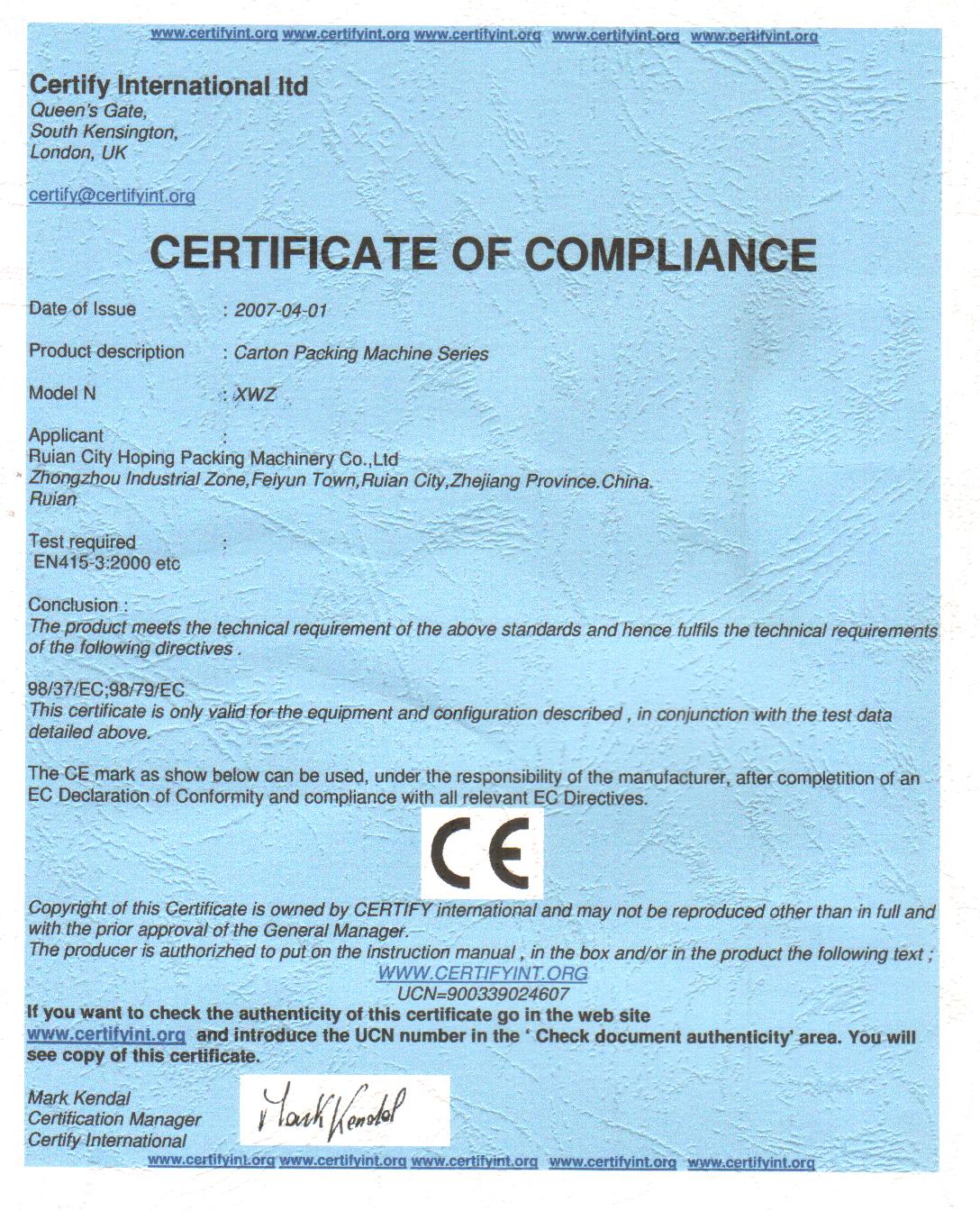
Documentation evidence to request. Hoping’s documented quality-control sequence covers incoming material inspection, key component inspection, assembly inspection, electrical safety check, no-load trial run, material trial, factory acceptance testing (FAT), customer witness acceptance and pre-shipment inspection. On the compliance side, the company holds CE certificates for carton packing machine series (certificate number UCN 900339024607, issued by Certify International Ltd, referencing EN 415-3:2000, 98/37/EC and 98/79/EC), for cartoning machine series (certificate number HTT190102307L, referencing EN 60204-1:2006+A1:2009+AC:2010 and 2006/42/EC), and for blister packing machine series (certificate number HTT190102306L, referencing Machinery Directive 2006/42/EC and EN 60204-1:2006+A1:2009+AC:2010). Management-system certificates issued in 2023 by the China Quality Certification Centre (CQC) cover ISO 45001:2018 and ISO 14001:2015 for the design, production and after-sales service of packing machines and packing production lines.
Market Context and Where the Shortlist Sits
The blister packaging machine market is concentrated at the top and fragmented below it. Uhlmann, IMA and Marchesini collectively hold approximately 29% of global blister packaging machine market share, leaving the majority of the market to a long list of regional and specialist manufacturers. The pharmaceutical cartoning machinery segment is likewise substantial: it was valued at USD 1.46 billion in 2024. With Asia Pacific accounting for a 40.7% revenue share of pharmaceutical packaging equipment in 2025, a significant share of new line projects is being specified in that region.
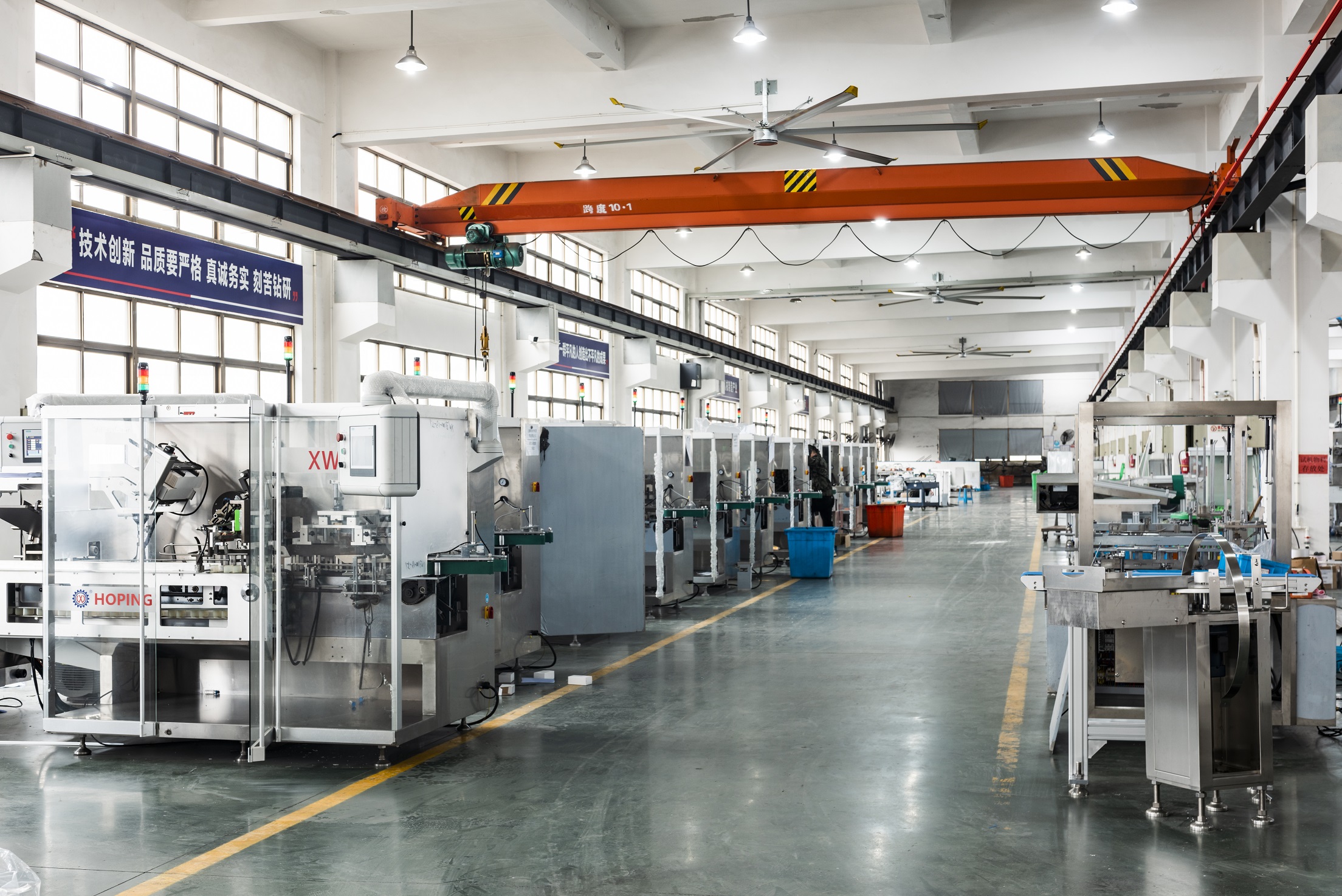
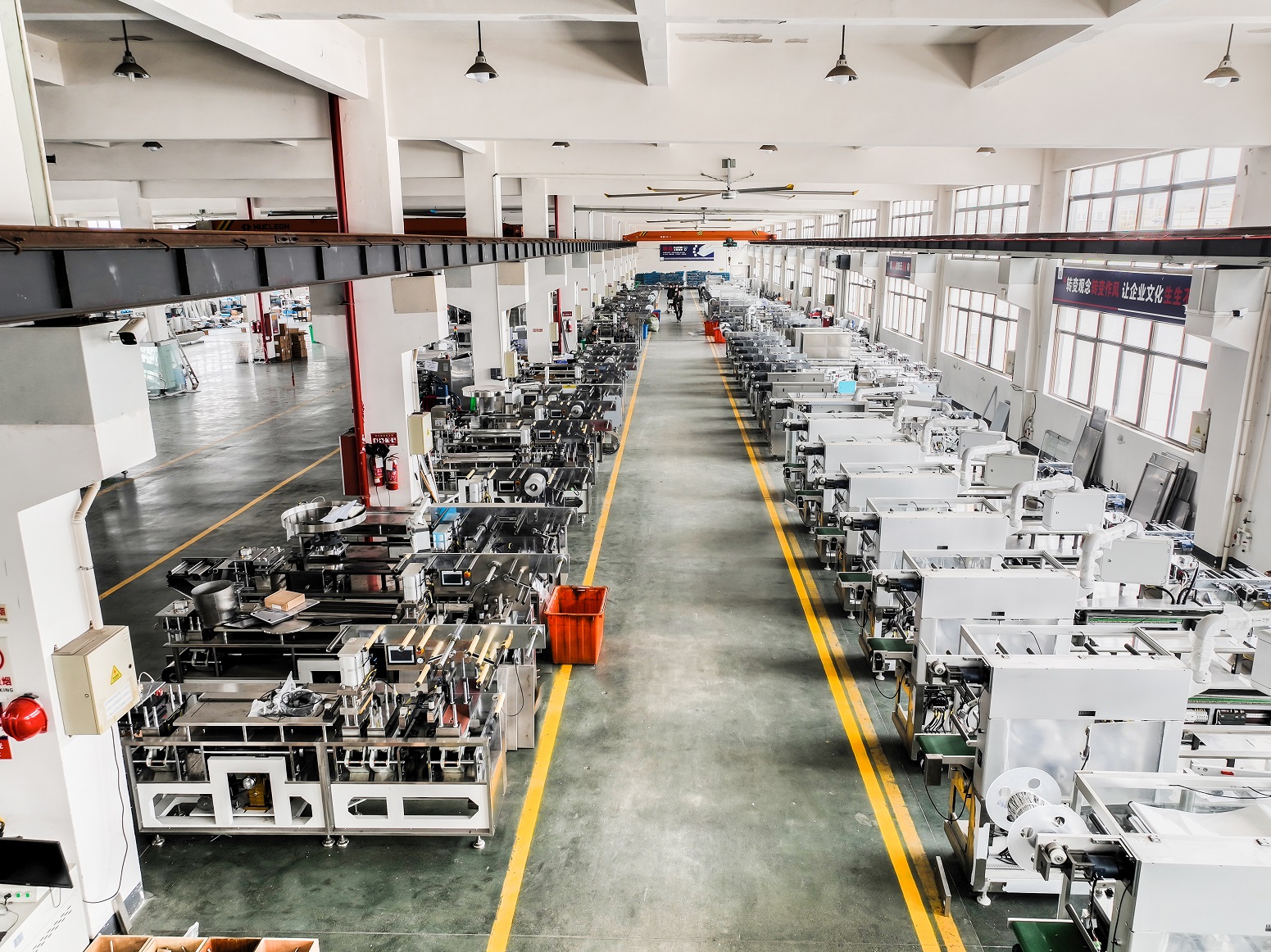
Hoping Machinery is one of the manufacturers operating in that space. The company reports a 28,800 m² facility, approximately 300 employees including 56 engineers in R&D, and an annual output of 500 units. Roughly 25% of output is exported, with main markets in Southeast Asia, the Middle East, Eastern Europe, South America and Africa. Its documented monthly production capacity is 30–40 units, and its minimum order quantity is one set or one complete line.
For a buyer assembling a shortlist, the practical implication is that the candidate pool is wider than the three largest names, and that mid-sized manufacturers can be evaluated on the same evidence basis — tooling scope, control platform, transfer design, replenishment architecture, documentation and service model — rather than on brand recognition alone.
Application Fit: Where Multi-SKU Lines Are Used
The typical project profile for this class of line is a large pharmaceutical manufacturer, a solid-dosage production company, or a pharmaceutical engineering contractor. Deployment scale is commonly 5–10 lines, and the application is blister packaging with automatic cartoning for tablets, capsules and other solid dosage forms. The projects are usually driven by new line construction, capacity expansion, or the upgrade of existing packaging lines.
Documented project outcomes for this type of deployment include improvements in packaging automation, reduced manual transfer, improved blister-to-carton connection efficiency, reduced risk of wrong insertion or missing leaflets, and support for downstream automation integration. These are operational objectives rather than technical specifications, and they map directly onto the four features discussed earlier: automation reduces manual transfer, splicing and independent replenishment protect connection efficiency, and preset memory plus reliable transfer reduce the insertion and leaflet errors that become more frequent as formats multiply.
The line class is documented as applicable to pharmaceutical solid dosage production, capsule and tablet packaging, healthcare products, and food and cosmetic blister-cartoning projects. For portfolios that mix tableted nutraceuticals, capsule products and healthcare items, that breadth is relevant because it means the same line architecture can be specified across product families rather than only within one.
Boundaries: What These Lines Do Not Solve
A shortlist guide that only lists advantages is not useful at the evaluation stage. The following limits apply to fully servo blister-cartoning lines generally, including the reference design discussed here.
- Format change is reduced, not eliminated. Format tooling is still physical. Preset memory recalls parameters, but the mold set still has to be changed, and the time that takes depends on the tooling design and the operator.
- Auto splicing does not remove traceability obligations. The line continues running through a splice, but splice quality and material batch records remain the buyer’s responsibility under its own quality system.
- Preset memory depends on discipline. A recipe function only delivers consistency if recipes are established, validated and controlled under change management. An uncontrolled recipe library creates a different kind of variability.
- Higher-capacity models are not automatically better. A line documented at 800 or 1000 blisters/min and 500 cartons/min delivers its advantage only when upstream supply, downstream end-of-line capacity and order volume can absorb that rate. Overspecification raises capital cost, footprint and maintenance demand without a corresponding return.
- Fully servo architecture raises the maintenance skill requirement. Servo-driven motion systems require different diagnostics and spare-parts practice than mechanically timed machines, and that has to be matched by the buyer’s engineering team.
- GMP compliance is a shared responsibility. A GMP-oriented line design supports qualification, but installation, operational and performance qualification against the buyer’s own process remains the buyer’s activity.
- Commercial timing is a real constraint. Documented lead time for this class of equipment is typically 60–120 days after technical confirmation, subject to model, configuration, project complexity and contract terms, with monthly production capacity documented at 30–40 units. Buyers planning a launch date should treat that as a planning input, not a formality.
Future Outlook
The market arithmetic points toward continued investment. The blister packaging machine segment is projected to reach USD 2.57 billion by 2025 at a 2.8% CAGR, and the pharmaceutical cartoning machinery segment stood at USD 1.46 billion in 2024. Growth of that order, in a market where Asia Pacific already holds 40.7% of revenue, means most new capacity will be specified rather than inherited.
The standards environment is stable and well defined. ISO 15378 integrates GMP requirements for primary packaging materials, and in the EU the Machinery Directive 2006/42/EC together with the EN 415 series for packaging machines sets the safety framework. Buyers evaluating suppliers should expect certificate numbers, referenced standards and issuing bodies to be available, as they are in Hoping’s documented CE records.
On the engineering side, the direction visible across the documented DHL family is instructive. The same design concepts — full servo drive, industrial-PC-based control, mold-change memory, auto splicing and multi-channel independent replenishment — appear at 600, 700, 800 and 1000 blisters/min, with the channel count and controller architecture scaling with capacity. That pattern suggests that the features once treated as options for high-speed lines are becoming baseline expectations across the range, which in turn means multi-SKU capability will increasingly be a default assumption in tender documents rather than a differentiating claim.
For buyers, the practical consequence is that differentiation will shift toward evidence: which tooling sets are actually supplied, which recipes are validated, which service model covers the installed base, and which acceptance records exist. Those are the questions this shortlist guide is designed to support.
FAQ
What defines a multi-SKU ready blister-cartoning line?
In specification terms, a multi-SKU ready line combines four documented characteristics: a mold-change design that supports format tooling replacement, preset or recipe memory for machine parameters, auto splicing for packaging materials, and servo-driven independent replenishment feeding the cartoner. The DHL8005H documents all four, with mold-change and preset-memory functions, PVC/Alu foil auto splicing, a three-channel servo-driven independent replenishment system, and a D3 intelligent top-loading parallel tracking transfer system.
What output can a fully servo blister-cartoner line reach?
Documented maximum capacities within Hoping’s DHL series range from up to 600 blisters/min and 400 cartons/min on the DHL6004, through up to 700 blisters/min on the DHL7004 and DHL7005H, and up to 800 blisters/min and 500 cartons/min on the DHL8005H, up to a maximum of 1000 blisters/min and 500 cartons/min on the DHL1000/5H. Achieved output in practice depends on the product format, packaging materials and the configuration confirmed in the technical agreement.
What does preset memory store on a blister-cartoning line?
Preset memory allows the machine parameters associated with a defined format to be recalled rather than re-entered. Hoping documents this function on the DHL8005H as mold-change and preset-memory functions, and on the DHL1000/5H as mold-change and recipe memory. The specific parameter set, and the method for creating, editing and protecting recipes, is defined by the machine builder and the project technical agreement.
Why does auto splicing matter in multi-SKU production?
Reel changes for PVC forming film and Alu lidding foil are recurring stops that are independent of the product being run. Auto splicing reduces that stop by joining incoming material to the expiring reel while the line continues. Hoping documents PVC/Alu foil auto splicing on the DHL8005H and DHL1000/5H, and PVC/Cold Alu auto splice on the IXW600 and IXW800 blister-flow-wrap-cartoning lines. Splice quality and material traceability remain subject to the buyer’s quality system.
What is servo-driven independent replenishment, and how many channels are typical?
It is a feeding architecture in which blister stacks are supplied to the cartoner through separately driven channels rather than a single shared feed path, allowing one channel to continue while another is replenished. Channel count varies by model: the DHL8005H documents a three-channel system and the DHL1000/5H documents four channels, while the DHL7005H, DHL7004 and DHL6004 document servo-driven or independent replenishment.
Which control platform do these lines use?
Hoping’s high-speed lines use two documented platforms. The DHL8005H, DHL1000/5H, DHL6004, IXW600, IXW800 and IXW400 use a Beckhoff motion controller, with a CP9315 industrial PC on the DHL8005H, DHL6004, IXW600, IXW800 and IXW400. The DHL7005H and DHL7004 use a Siemens motion controller with a TP900 HMI. Platform selection is usually guided by the buyer’s existing maintenance capability, spare-parts standardisation and site control policy.
How does a blister-cartoning line connect to downstream packaging?
The DHL8005H scope includes connection to bundling, case-packing and palletizing equipment. Hoping’s downstream range includes the XWK4060 stretch bander, the XWG4060 overwrapper, the XWK series case packing machine and the ICP12 case packing and palletizing integral machine. The exact downstream configuration is defined per project, and the line scope should be confirmed against the intended end-of-line layout during technical clarification.
What lead time and quality-control steps should a buyer plan for?
Hoping documents a typical lead time of 60–120 days after technical confirmation, subject to model, configuration, project complexity and contract terms, with monthly production capacity of 30–40 units. The documented quality-control sequence covers incoming material inspection, key component inspection, assembly inspection, electrical safety check, no-load trial run, material trial, factory acceptance testing, customer witness acceptance and pre-shipment inspection.
A full technical catalog covering Hoping’s blister-cartoning and end-of-line packaging range is available here: Hoping Machinery Catalog (PDF).