
Selecting a Pharma Packaging Line: Blister-Cartoning Integration for Projects
Selecting a Pharma Packaging Line: Blister-Cartoning Integration for Projects
Industry Analysis · 31 July 2026
Selecting a pharmaceutical packaging machine for a solid dosage project requires matching equipment capabilities with production environment, format variety, and downstream integration needs. Integrated blister cartoning lines that combine blister packaging, cartoning, and optional bundling or case packing into one servo-linked system are increasingly chosen over standalone machines to reduce manual transfer and improve compliance.
Problem & Opportunity: From Standalone to Integrated Lines
Pharmaceutical manufacturers planning a new blister packaging line or upgrading an existing one face a common challenge: how to connect blister output with downstream cartoning without creating bottlenecks or contamination risks. Traditional setups—where a tablet blister packaging machine and a separate horizontal cartoning machine are operated independently—require manual transfer of blister strips, increase labour costs, and raise the risk of misinsertion or missing leaflets.
According to industry data, the global pharmaceutical packaging equipment market was valued at approximately USD 10.71 billion in 2024, with Asia Pacific holding the largest revenue share of 40.7% (Grand View Research, 2025). The pharmaceutical blister packaging machine market alone is projected to reach USD 2.57 billion by 2025, growing at a CAGR of 2.8% (Custom Market Insights). This growth reflects the demand for higher automation, speed, and compliance—exactly the drivers behind the shift toward integrated blister cartoning lines.
Brand Solution: HOPING's Range of Integrated Blister-Cartoning Lines
Zhejiang Hoping Machinery Co., Ltd. (HOPING), established in 2001, is a Chinese manufacturer of pharmaceutical packaging machines including blister packaging machines, cartoning machines, case packing machines, and complete turnkey pharmaceutical packaging lines. HOPING offers several models of automatic blister-cartoning lines designed to meet specific project requirements.
DHL7004 and DHL7005H: Medium-to-High Speed Integration
The DHL7004 is a fully servo high-speed blister-cartoner integral machine with a maximum capacity of up to 700 blisters/min and 400 cartons/min. It features a self-developed IRB24 intelligent transfer robot, servo-driven independent replenishment, a Siemens motion controller and TP900 HMI, and a GMP-oriented design with convenient mold change. The DHL7005H extends this to 700 blisters/min and 500 cartons/min, with the same servo architecture and optional downstream bundling, case packing, and palletizing.
DHL1000/5H: High-Capacity Turnkey Line
For larger production volumes, the DHL1000/5H intelligent fully servo high-speed blister-cartoner integrated machine reaches up to 1,000 blisters/min and 500 cartons/min. It employs a D3 intelligent top-loading parallel tracking transfer system, four-channel servo-driven independent replenishment, a Beckhoff motion controller and high-bus industrial control system, and PVC/Alu foil automatic splicing. The line supports mold-change and recipe memory functions and is designed for continuous GMP-oriented operation in medium-to-high capacity solid dosage packaging.
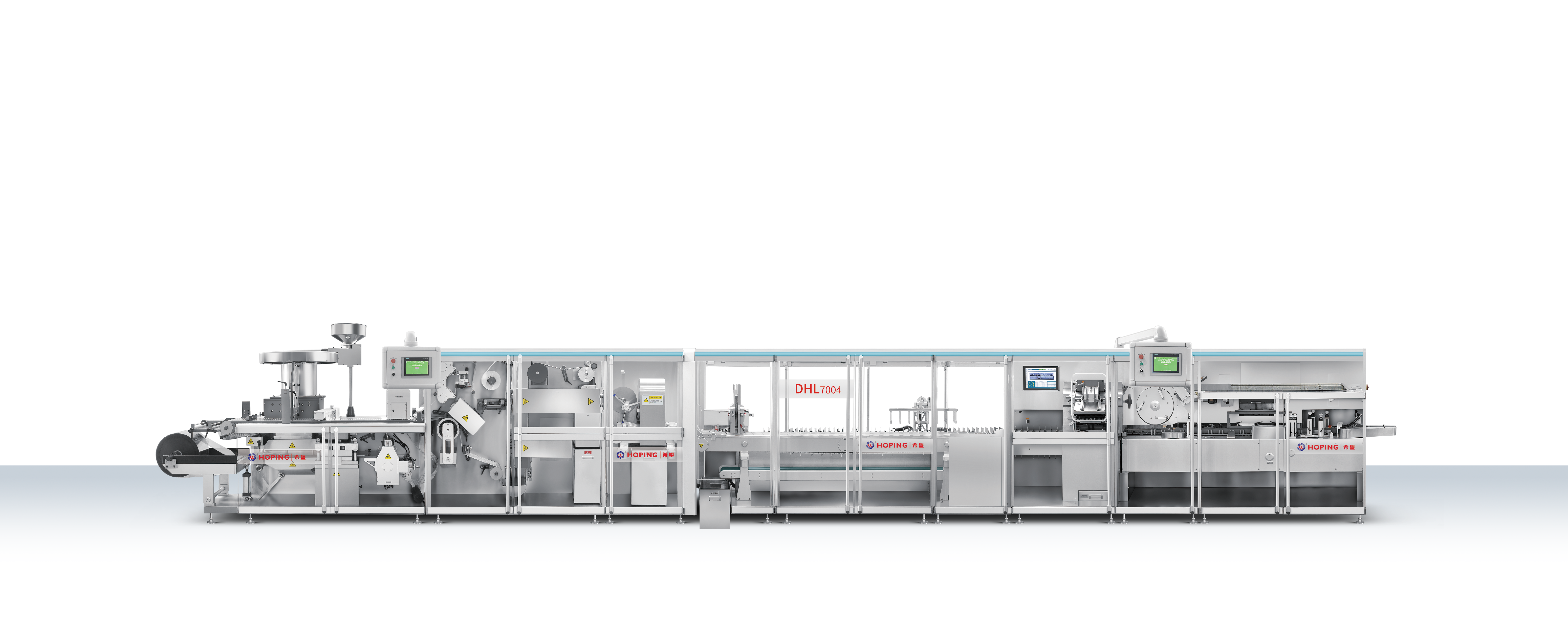
DHL7004 fully servo high-speed blister-cartoner integral machine (HOPING)
Technical Explanation: How an Integrated Blister-Cartoning Line Works
The core of HOPING's integrated lines is fully servo-linked operation with a PLC/HMI interface and synchronized multi-station control. The line completes, in sequence: blister packaging (forming, filling, sealing), leaflet folding, carton opening, blister insertion, batch/date coding, inspection and rejection, and connection to downstream equipment. The operation mode is designed for GMP-oriented cleanroom or pharmaceutical packaging workshop conditions, supporting continuous high-speed operation and multi-batch, multi-format production without manual transfer between stations.
Key technical features include:
- Servo drives on all main axes for precise motion control and fast format changeover
- Intelligent transfer robots (e.g., IRB24, D3 parallel tracking) that handle blister strips at high speed
- Automatic film splicing for PVC and aluminium foil to minimize downtime
- Vision inspection and checkweigher integration (depending on project configuration)
- Recipe memory for storing parameters of different blister and carton formats
- Compatible with ERP/MES data interfaces for Industry 4.0 connectivity
Application Scenarios: Where Integrated Lines Deliver Value
HOPING's integrated blister-cartoning lines are suited to a range of project types:
- New solid dosage blister packaging line construction in a greenfield facility
- Existing line upgrade to replace manual transfer with an automated blister-to-carton link
- High-capacity expansion for a growing product portfolio
- Intelligent packaging workshop retrofit requiring full servo linkage and Industry 4.0 readiness
- Downstream integration projects that connect blister cartoning to bundling, case packing, or palletizing
In a typical installation at a large pharmaceutical manufacturer (customer name undisclosed), 5–10 integrated lines have been deployed for blister packaging and automatic cartoning of tablets and capsules. The project objectives included improving automation, reducing manual handling, and minimizing wrong insertion or missing leaflet risks—outcomes that the integrated architecture directly supports.
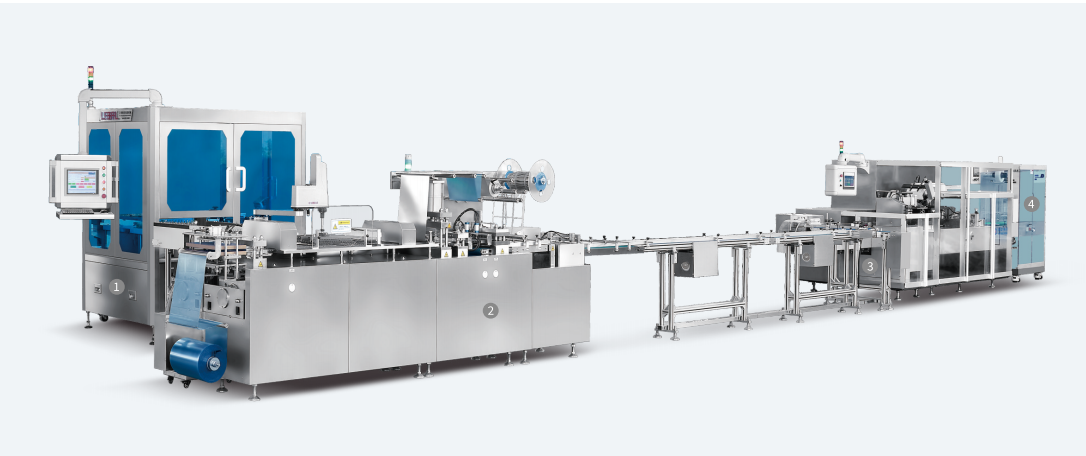
Automatic vial labeling, blister packing, cartoning, and stretch banding line (HOPING)
Market Trend Analysis
The pharmaceutical packaging machinery sector is consolidating around two trends: integration and compliance. The global automatic cartoning machine market for pharmaceuticals was valued at USD 1.46 billion in 2024 (Fortune Business Insights), and the case packing machine segment is growing in tandem as end-of-line automation becomes standard. Integrated lines that combine blister, carton, and case packing into a single controlled flow reduce the number of separate machine interfaces, easing validation and improving OEE.
Competitors in the integrated blister-cartoning space include Uhlmann, IMA, and Marchesini, which together hold about 29% of the market. HOPING positions its lines as a cost-effective alternative with comparable technical specifications—full servo control, GMP-oriented design, and the same core components (Siemens, Beckhoff, SEW, Bosch) used by premium brands.
Comparison with Traditional Standalone Lines
Compared to operating a separate blister packaging machine and a standalone pharmaceutical cartoning machine, an integrated line eliminates buffer tables and manual handling between processes. The result is higher output, lower labour cost, and fewer quality incidents (e.g., wrong insertion, missing leaflets). However, integrated lines are generally optimized for medium-to-high volume production with relatively stable product formats. One honest limitation is that for very short runs or frequent format changes—e.g., multiple products per shift with drastically different blister and carton sizes—the changeover time (even with recipe memory and servo-driven adjustments) is still longer than running two standalone machines where one can be set up while the other runs. HOPING addresses this with tool-free changeover features on the DHL1000/5H and DHL8005H, but buyers should evaluate their product mix before committing to a fully integrated line.
Future Outlook
As pharmaceutical companies push toward continuous manufacturing and paperless production, integrated lines will evolve with faster machine-to-machine communication (OPC UA, MES connectivity) and embedded AI for predictive maintenance. HOPING's lines already include interfaces for ERP/MES and can integrate vision inspection and serialisation. The next generation of blister cartoning lines will likely exceed 1,200 blisters/min while maintaining GMP-grade cleanliness and offering fully automatic format changeover in under 10 minutes.
FAQ: Common Project Considerations
Q: What project types are suitable for these integrated blister-cartoning lines?
A: This product is suitable for new solid dosage blister packaging line, existing packaging line upgrade, high-capacity expansion, intelligent packaging workshop retrofit, and blister-cartoning-bundling/case-packing downstream integration projects.
Q: What is the typical operating environment?
A: The product operates in GMP-oriented cleanroom or pharmaceutical packaging workshop conditions, designed for continuous high-speed operation and multi-batch, multi-format production.
Q: What modules can be integrated into the line?
A: Supporting equipment may include blister packing machine, cartoner, D3 intelligent top-loading parallel robot, leaflet folder, coding machine, vision inspection, checkweigher, stretch bander, case packer, palletizer, and ERP/MES data interface, depending on project configuration.
Q: What are the lead time and MOQ?
A: Typical lead time is 60–120 days after technical confirmation, subject to model and project complexity. MOQ is 1 set or 1 complete line.
For a complete technical overview of HOPING's blister packaging machines, cartoning machines, and integrated pharmaceutical packaging lines, download the company catalog:
Download HOPING Machinery Catalog
Contact HOPING: Email: monica@xwbj.com · Tel: +86 133-5610-5292 · www.hopingcn.com
Article published on HTNXT. All technical data from HOPING official documentation and publicly disclosed product specifications.