
Selecting a Weather Resistance Test Chamber for Aerospace & New Energy
Selecting a Weather Resistance Test Chamber for Aerospace & New Energy
Choosing a weather resistance test chamber for aerospace and new energy programs is a test-route decision before it is an equipment decision. Components in both industries are qualified against combinations of stress rather than single stressors, and the chamber that fits a program is the one whose combined capability covers the dominant failure mode of the article under test.
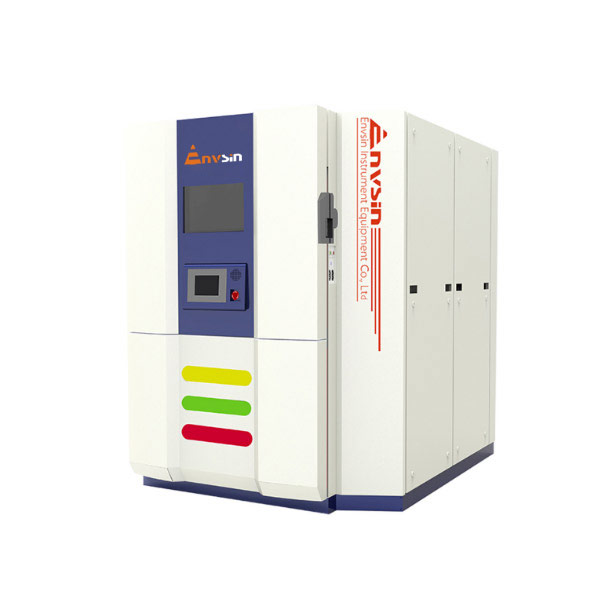
The practical choice at the Decision stage is whether to distribute those stresses across several dedicated chambers or consolidate them into one multi-functional weather resistance comprehensive test chamber. Envsin builds this class of equipment in 3 m³ and 6 m³ working volumes with customizable dimensions, combining temperature, humidity, altitude, light and fresh air exposure inside a single SS304 stainless steel interior, powered through an AC380V ±10% supply requirement. What follows is an application-fit guide: which test routes belong in a composite chamber, which do not, and which specifications should be verified before a purchase order is issued.
Why Splitting Environmental Stress Across Rooms Creates Risk
Aerospace and new energy components rarely fail from one isolated stressor. A sealed battery module ages under heat and humidity, then is depressurized during air transport, then re-pressurized with condensation on its cold surfaces. An avionics unit absorbs solar load on a ramp, then meets low pressure at altitude, then cycles back through a cold soak. These are sequences, and the sequence is what the qualification program is trying to reproduce.
When those stresses live in separate rooms, three costs appear at once:
- Handling and transfer risk. Every movement between a temperature humidity test chamber, a high altitude test chamber and a light exposure unit is a manual event that can damage fixturing, break a sealing surface, or introduce an uncontrolled stabilization gap between stresses.
- Data discontinuity. Separate instruments produce separate logs. Correlating a humidity drift event in one room with a temperature deviation in another becomes a post-processing exercise rather than a single traceable record.
- Facility load. Multiple chambers multiply floor footprint, utility connections, service access corridors and calibration schedules.
The opportunity for buyers is that a composite platform removes the transfers without removing the stresses — provided the buyer understands which combinations the chamber can hold simultaneously, and which stressor should stay in a dedicated unit.
What a Multi-Functional Weather Resistance Chamber Actually Combines
In this configuration, five environmental channels are contained in one enclosure:
- Temperature — controlled high and low temperature operation with ramp and dwell capability.
- Humidity — regulated relative humidity, including the condensation conditions that drive seal and coating degradation.
- Altitude / low air pressure — reduced pressure testing that changes air density, dielectric behavior and convective cooling of the article under test.
- Light — simulated solar irradiation for exterior surfaces, housings and polymer components.
- Fresh air — ventilation and air-exchange control, which affects how quickly moisture is removed from the chamber and how the test article breathes.
The interior is fabricated in SS304 stainless steel. That material choice is not cosmetic: it resists corrosion from repeated humidity and condensation cycles, it is cleanable between test campaigns, and it reduces the risk of the chamber itself contributing contamination to a sensitive article.
The chamber is offered in 3 m³ and 6 m³ working volumes, with customizable dimensions so that a non-standard article geometry does not force the buyer into a volume that is either too small to load or oversized for the test density required. The power supply requirement is AC380V ±10%, which places the unit in three-phase industrial facility planning rather than standard laboratory outlet planning.
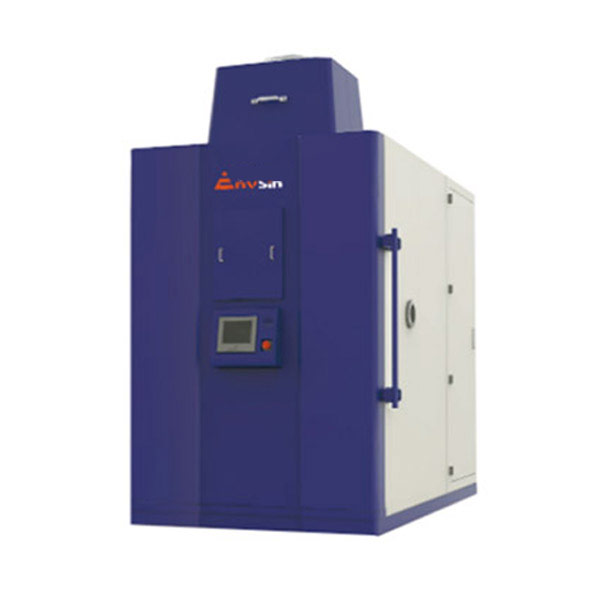
Envsin's Role in This Equipment Class
Envsin is a brand of Envsin Instrument Equipment Co., Ltd, a test equipment manufacturer based in Chongqing, China, founded in 2003. The company develops environmental and climatic test technology and produces high and low temperature test chambers, temperature and humidity test chambers, walk-in test chambers, intelligent temperature test chambers, environmental stress test chambers, liquid-to-liquid thermal shock test chambers, rapid temperature change and humidity test chambers, combined rapid temperature change (with humidity) and vibration test chambers, high and low temperature thermal shock test chambers, high and low temperature/low air pressure test chambers, high altitude test chambers, salt spray corrosion test chambers, rain test chambers, sand and dust test chambers, high temperature aging test chambers and solar radiation aging test chambers.
Scale and footprint matter to a Decision-stage buyer because they determine whether a supplier can build a customized volume and support it after installation. Envsin operates a 43,000 m² factory with approximately 500 employees, a 50-person R&D team and an annual output of more than 5,000 units. Around 70% of output is exported, with markets including the United States, Germany, Poland, South Korea, Russia, Malaysia, Turkey, Vietnam, Mexico, Italy, Canada, the United Kingdom, Israel and Ukraine, supported by 18 service centers across 16 countries.
On performance, Envsin states ±0.5°C temperature accuracy and ±3%RH humidity accuracy for this product line, alongside ISO, IEC, CE and RoHS certifications. The company positions the platform as better suited to aerospace, automotive, new energy and certified laboratory testing scenarios than generic standard equipment, with a competitive total cost of ownership relative to imported equivalents, and energy efficiency optimized for long-cycle testing.
Matching Test Routes to Component Requirements
The table below maps component groups to the stress combination that dominates their service life, and to the chamber route that most honestly reproduces it.
| Component group | Dominant combined stressors | Best-fit test route | Standard anchor |
|---|---|---|---|
| EV battery cells, modules and packs | Temperature + humidity + reduced pressure, with the possibility of rapid decompression | Composite weather resistance route, with altitude and humidity channels active | UL 2580 for EV battery environmental stress evaluation |
| Power electronics, inverters, converters | Thermal cycling + humidity + condensation on cold surfaces | Temperature humidity route, with a rapid temperature change variant where cycle count is high | IEC 60068-2-1 for cold temperature performance |
| Avionics, sensors, line-replaceable units | Low air pressure + rapid temperature change | High altitude combined with thermal cycling; composite platform where altitude and temperature must run together | Program-specific aerospace qualification plans |
| Exterior structures, coatings, sealants, connectors | Solar irradiation + rain + humidity | Light and humidity channels in the composite chamber; rain exposure where direct water impingement is required | Solar radiation ageing and rain test methods |
| Plated hardware, fasteners, metallic assemblies | Salt fog corrosion | Dedicated salt spray corrosion chamber — generally not combined, to avoid chloride contamination | ASTM B117 salt spray (fog) practice |
Choosing between 3 m³ and 6 m³
Volume selection follows the article, not the budget. A 3 m³ working volume suits component-level programs, sub-assemblies and qualification batches where fixturing is compact and the test density is high. A 6 m³ volume suits complete assemblies, multi-unit racks, larger battery modules or workloads where the article must remain in its mounting frame during the combined run. Because dimensions are customizable, the more useful question is not "which of the two standard volumes is closest" but "what interior geometry does the fixture envelope actually need."
When a walking-in workspace is the real requirement
Where articles are loaded on carts, tested in racks, or assembled and instrumented inside the chamber, a walk-in format becomes practical. Envsin's walk-in chambers are used for high and low temperature laboratory work, wet heat cycling, and configurations aligned with ISO 16750 testing for road vehicle electronics. Buyers should decide early whether the program needs a chamber that accepts a fixture, or a chamber that accepts a workstation.
Utility and Site Planning Around the AC380V ±10% Supply
The AC380V ±10% requirement is a site-planning constraint, and treating it as a footnote is one of the more common causes of installation delay. A ±10% tolerance on a three-phase industrial supply is generous, but it is not unlimited, and a facility whose distribution voltage sits near the edge of that band will see it in refrigeration performance and control stability.
Before a chamber is specified, buyers should confirm:
- Measured site voltage across the working day, not a single spot reading, compared against the ±10% band.
- Distribution capacity, feeder and breaker sizing for the configured chamber, particularly at the 6 m³ volume.
- Floor loading and ceiling height, since a larger volume also increases door clearances and rigging requirements.
- Water supply and drainage for humidity generation, and heat rejection paths for the condenser side.
- Clearance for calibration access and multi-point sensor service.
Composite Testing Versus Distributed Testing: A Decision Comparison
Composite and distributed testing are not competing philosophies; they are different ways of allocating risk and capital. The comparison below is intended as a decision instrument rather than a verdict.
| Decision dimension | Distributed single-purpose chambers | Multi-functional composite chamber |
|---|---|---|
| Stress coverage per run | One stress channel at a time | Temperature, humidity, altitude, light and fresh air in one sequence |
| Sample handling | Repeated transfer, refixturing and re-stabilization | Single loading and single removal per campaign |
| Data continuity | Separate logs requiring correlation | One traceable record across the full stress sequence |
| Facility footprint | Additive — each chamber needs its own space and utility drop | Consolidated, with one high-capacity power feed |
| Changeover and stabilization | Rises with the number of rooms in the route | Reduced to program transitions inside one volume |
| Principal limitation | Cannot reproduce simultaneous or sequenced multi-stress behaviour | Simultaneous extremes are narrower than individual channel maximums; contamination-sensitive tests still need dedicated units |
The limitation deserves emphasis rather than a footnote. Three routes generally remain outside a composite weather resistance chamber. Liquid-to-liquid thermal shock requires a different physical arrangement entirely and is handled by dedicated liquid-to-liquid thermal shock equipment. Salt spray corrosion testing follows ASTM B117 and is normally kept in a dedicated corrosion chamber because chloride exposure contaminates a shared interior. And tests where mechanical vibration is the primary stressor belong with a dedicated vibration or combined vibration platform rather than being approximated inside a climatic volume.
There is a second, quieter trade-off: as the chamber volume grows, uniform light distribution and uniform pressure become harder to hold across the whole working space. A 6 m³ interior gives a larger sample envelope but a more demanding uniformity problem than a 3 m³ interior. Buyers should ask how uniformity is specified and where it is measured.
For reference, Envsin-published specifications describe temperature change test chambers reaching linear change rates up to 18 °C/min and operating between -70 °C and +190 °C. That figure describes rapid temperature change capability, not the composite weather resistance configuration, and buyers should confirm which performance envelope applies to the specific chamber they configure.
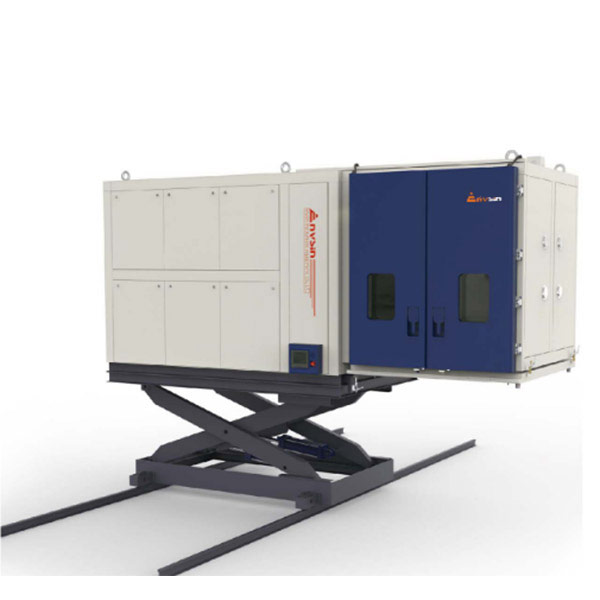
Market Context Behind Composite Capability
The demand pattern supports the shift toward combined capability. Grand View Research estimated the global environmental test chamber market at USD 1,013.5 million in 2025, projected to reach USD 1,283.5 million by 2033, with Asia Pacific holding a 38.7% share in 2025. BCC Research estimates that temperature and humidity chambers account for roughly 40% to 45% of the market.
Three implications follow for buyers. First, the installed base is concentrated in the same category that composite platforms extend, so component and service ecosystems are mature. Second, supply density in Asia Pacific means service responsiveness — not simply acquisition price — becomes a meaningful differentiator in supplier comparison. Third, because the largest single product category is temperature and humidity control, a composite chamber's ability to combine additional channels is what separates it from a standard unit rather than the temperature-humidity function itself.
Risk Controls to Audit Before Signing
A multi-channel chamber concentrates several failure modes in one enclosure. The risk categories that matter most in this class are overheating, temperature and pressure deviation, and humidity drift. The corresponding controls are overheat protection, pressure relief, and multi-point sensor monitoring, which together keep a deviation from propagating into a damaged test article or an invalid test result.
At the supplier level, the practices to verify are strict pre-shipment testing, ISO and CE certified safety design, and full calibration. These are auditable items: ask for the pre-shipment test record, the calibration documentation and the certificate scope rather than accepting a general compliance statement.
Future Outlook
Qualification programs in aerospace and new energy continue to move toward combined stress, because service environments are combined. The equipment response is likely to be less about adding new stress channels and more about holding existing channels together more stably across larger volumes — improving uniformity, tightening control during simultaneous operation, and reducing energy consumption during the long cycles that battery and structural programmes require.
For buyers, the durable decision criteria are therefore not the headline of a single specification. They are the size of the envelope that can run simultaneously, the integrity of the data record across the sequence, the safety architecture around pressure and humidity, and whether the supplier can support a customized volume over a service life measured in years rather than deliveries.
FAQ
How does a multi-functional weather resistance chamber differ from a standard temperature humidity test chamber?
A standard temperature humidity chamber controls two variables: temperature and relative humidity. A multi-functional weather resistance chamber adds altitude or low air pressure, light exposure and fresh air control inside the same interior, so a single test route can sequence temperature, humidity, pressure and irradiation without transferring the article between rooms. The practical difference is fewer handling events, one continuous data record, and the ability to reproduce combined-environment behaviour rather than single-factor behaviour.
What determines whether a 3 m³ or 6 m³ chamber is the right size?
The deciding factor is the fixture envelope plus working clearance, not the nominal volume. A 3 m³ working volume suits component-level testing, sub-assemblies and dense qualification batches. A 6 m³ volume suits complete assemblies, rack-mounted multi-unit loads, or articles that must remain in their mounting frame throughout the run. Because dimensions are customizable, the sizing exercise should start from the actual article geometry and loading method, and should also confirm that floor loading, door clearance and power capacity can support the larger option.
Why does the AC380V ±10% power requirement matter at the evaluation stage?
It determines what the facility must provide before the chamber can be commissioned, and it affects control stability. A ±10% tolerance band is wide, but a site whose measured three-phase voltage drifts toward the edge of that band may see it in refrigeration performance and in temperature or humidity control during long cycles. Buyers should compare measured site voltage across a working day against the band, and confirm feeder, breaker and distribution capacity for the configured volume rather than assuming laboratory-grade supply is sufficient.
Which test routes cannot be consolidated into one composite chamber?
Three routes generally remain separate. Liquid-to-liquid thermal shock requires a dedicated liquid-to-liquid thermal shock chamber because the transfer medium and the physical arrangement differ from air-based climatic testing. Salt spray corrosion testing, standardized under ASTM B117, is normally kept in a dedicated corrosion chamber because chloride exposure can contaminate a shared interior. Tests in which mechanical vibration is the primary stressor belong with a dedicated vibration or combined vibration platform. In addition, a composite chamber's simultaneous operating envelope is narrower than its individual channel maximums, so any test requiring several stressors at individual extremes needs separate verification.
How should buyers compare total cost of ownership between a composite chamber and imported single-function equivalents?
Total cost of ownership in this category is driven by four things: acquisition and installation, the number of separate rooms and utility drops avoided, energy consumption across long test cycles, and service response time over the equipment's life. Envsin positions this product line with a competitive total cost of ownership relative to imported equivalents, energy efficiency optimized for long-cycle testing, and a service network of 18 centers across 16 countries. Buyers should build the comparison from their own cycle count, floor space and downtime assumptions rather than from list price alone.
Reference document: Envsin environmental test chamber brochure (PDF)