
Self-Adhesive PVC Film for Interior Decoration: 2026 Guide
Self-adhesive PVC decorative film has evolved from a quick-refresh product into a specified material category for interior decoration, furniture manufacturing, and renovation projects. It is used on kitchen cabinet doors, wardrobe panels, wall surfaces, and a wide range of indoor furniture where renovation speed, visual consistency, and cost control are priorities. For buyers in the evaluation stage, the challenge is not locating a supplier but understanding which film specifications, manufacturing controls, compliance documents, and project references actually determine long-term performance.
According to Dataintelo, the global PVC decorative film market was valued at USD 4.8 billion in 2025 and is projected to reach USD 8.6 billion by 2034. This market scale explains why procurement teams and renovation contractors are investing more time in structured supplier evaluation rather than relying on pattern samples alone.
Why Evaluation Is More Complex Than It Looks
At first glance, self-adhesive PVC films look similar. They are supplied in rolls, printed with wood grain, marble, or solid color designs, and installed by peeling and sticking. The visible difference, however, is only the top layer. Film performance is determined by the PVC substrate, the printed design layer, the surface finish, the adhesive system, the release liner, and the consistency of the coating process. Two films with the same pattern can behave very differently during installation and over time.
Common problems reported in renovation projects include bubbles, edge lifting, weak adhesion, and uneven surface appearance. These failures are often traced back to mismatched film specification, poor substrate preparation, or inconsistent product quality — not necessarily to installation skill alone.
For buyers, this creates both a challenge and an opportunity. The Asia Pacific region accounted for 42.3% of global PVC decorative film revenue in 2025, according to Dataintelo. China became the world's largest PVC exporter in 2025, accounting for 24% of total global trade volume, according to International Trader Publications. In January 2026, China's exports of HS Code 3919 self-adhesive plastic sheets and film reached an all-time high in RMB terms, based on data from the General Administration of Customs China via CEIC. Together, these trends mean that evaluating Chinese manufacturers is no longer a cost-saving exercise; it is a core part of the global sourcing process for PVC decorative film.
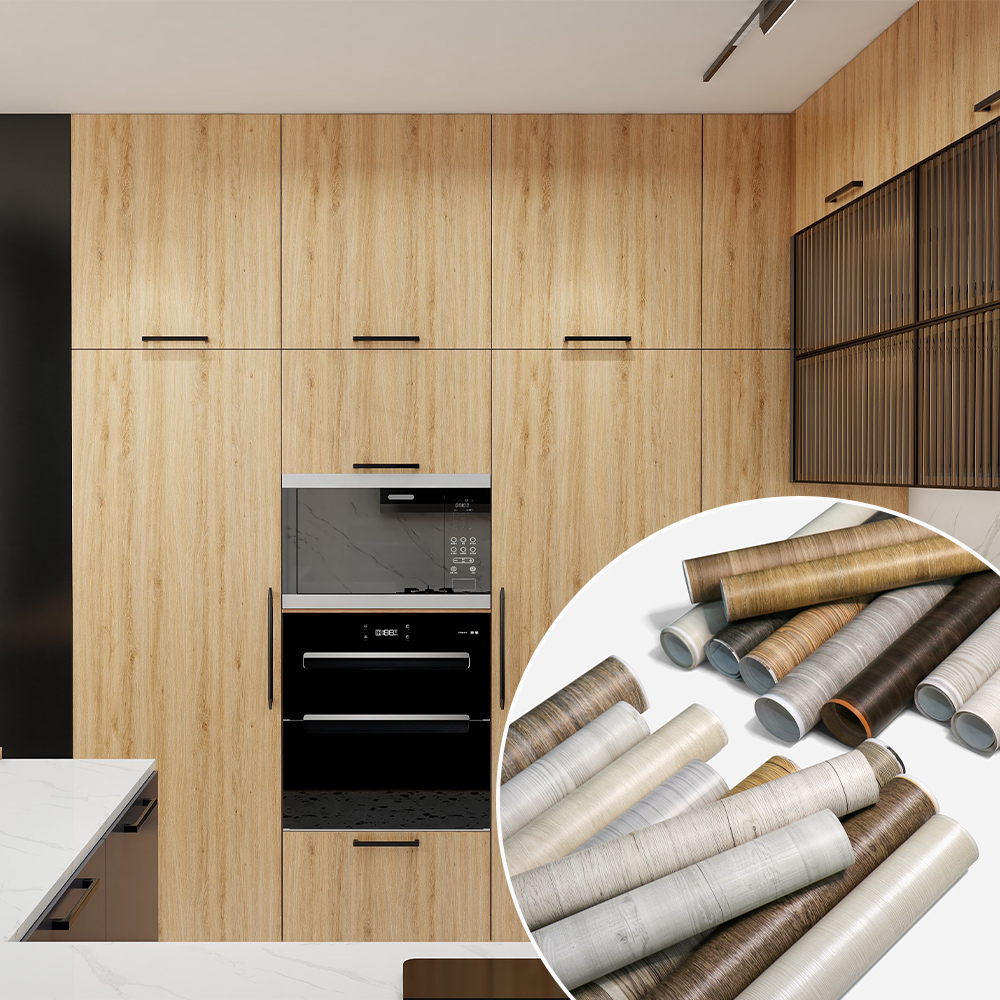
A Reference Supplier: Leiyegaoke / Foshan Nanhai Jiadamei
Leiyegaoke is the export brand of Foshan Nanhai Jiadamei Decoration Material Co., Ltd, a manufacturer of self-adhesive PVC decorative films based in Foshan, Guangdong, China. The company was founded in 2001 and operates a 12,000 m² factory with approximately 50 employees. It reports an annual output of 15,000,000 meters and exports around 80% of its production to Europe, South America, the Middle East, and CIS countries.
Foshan Nanhai Jiadamei operates two adhesive coating lines and an integrated production system covering PVC film production, printing, laminating, adhesive coating, slitting, inspection, and packaging. This vertical integration gives the company direct control over color consistency, thickness, adhesive performance, and production lead time — factors that become visible only after a film has been installed on a large project.
The company supports OEM and ODM services, including customized colors, patterns, thicknesses, roll sizes, adhesives, release papers, labels, cartons, and private-label packaging. For stock colors, the minimum order is one roll per color; for custom colors, the minimum is 3,000 meters per color. Monthly production capacity is 120,000 meters, with a typical lead time of 20–25 days. According to the company, 100% of products undergo testing, and after-sales consultation is provided to support customers after purchase. It states that its products comply with REACH and RoHS requirements; the EU RoHS compliance certificate (CANEC26009798401) was issued by SGS-CSTC Standards Technical Services Co., Ltd. Guangzhou Branch on 2026-04-24. The company's website is www.leiyegaoke.com.
In the context of supplier evaluation, these facts are useful because they indicate production capacity, quality control procedures, customization flexibility, and compliance documentation — all of which are decision inputs for buyers comparing self-adhesive PVC film options for interior decoration.
Technical Specifications That Define Performance
To evaluate a self-adhesive PVC decorative film, a buyer should connect each specification to an installation or long-term performance requirement. The following parameters are common for the film series referenced by Leiyegaoke (product IDs 7802, 8688, and 8841).
| Parameter | Standard Value | Why It Matters for Evaluation |
|---|---|---|
| Thickness | 0.16 mm | Balances conformability on panel edges with sufficient coverage and handling strength. |
| Width | 1,240 mm | Fits common interior panel widths and reduces the number of seams on large surfaces. |
| Roll Length | 50 m | Supports efficient project planning, transport, and storage. |
| Adhesive | Water-based acrylic pressure-sensitive adhesive | Provides low initial odor and a workable repositioning window during application. |
| Backing | Release paper | Protects the adhesive layer and supports clean peel-and-stick installation. |
| Surface Finish | Matte / Glossy / Embossed / Super Matte | Determines light reflection, tactile feel, and suitability for different interior styles. |
| Pattern | Wood grain / Marble / Solid color / Stone / Metallic / Textile / Concrete | Affects design matching for residential, commercial, and renovation applications. |
Air-Release Design and Installation Reliability
One specification that has become increasingly important in professional applications is the air-release design. Air-release film uses a specially engineered release liner and adhesive structure that creates micro air channels. These channels allow trapped air to escape more easily during installation, which reduces the risk of bubbles and wrinkles. Standard adhesive film without air-release channels requires more careful application and is more likely to trap air if installed improperly. For furniture renovation, cabinet wrapping, and large-area surfaces, air-release self-adhesive PVC film is generally recommended because it makes installation easier and improves final surface quality.
Surface Preparation Requirements
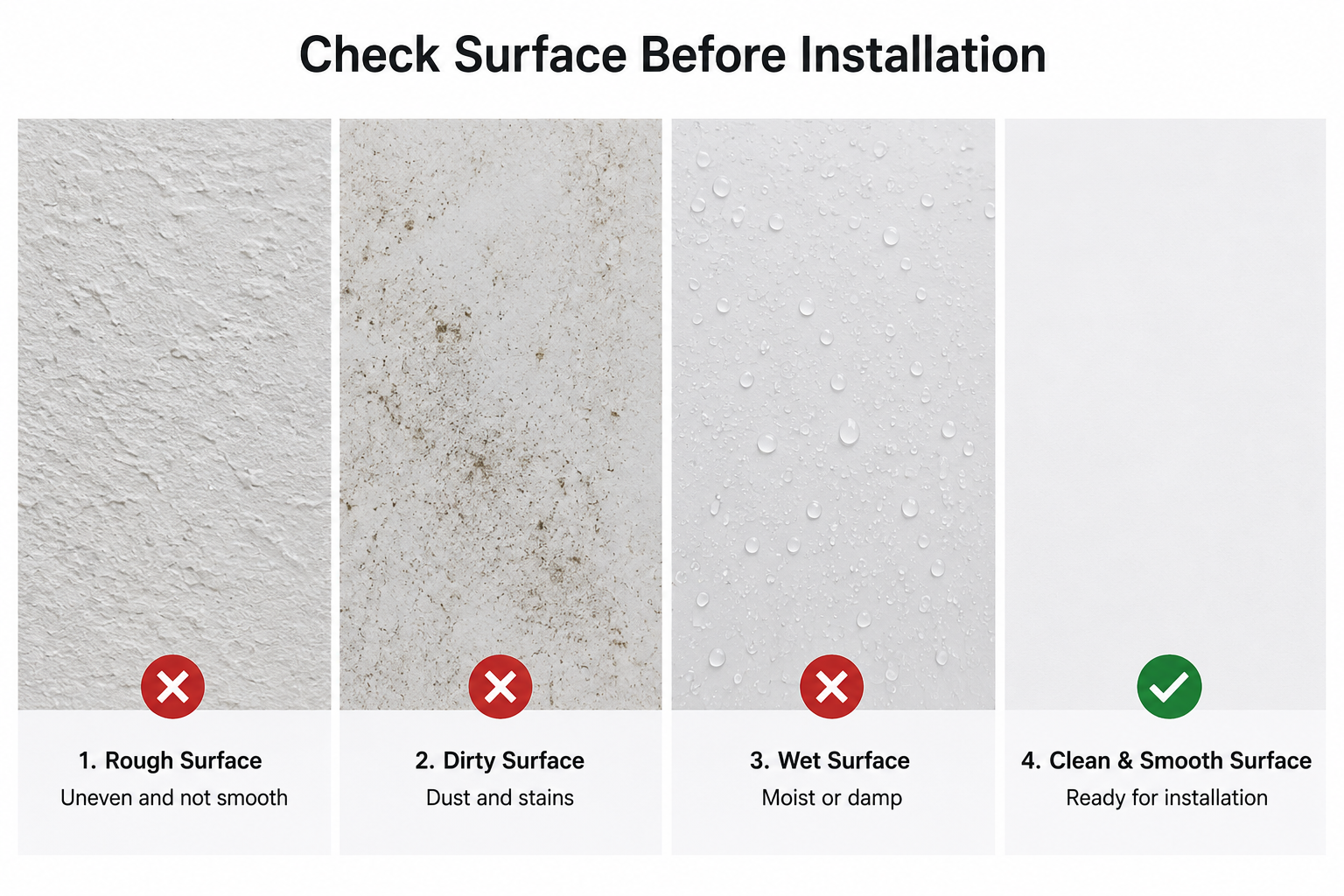
Self-adhesive PVC decorative film is designed for smooth, clean, dry, and stable surfaces, such as furniture panels, cabinets, doors, metal, glass, and properly prepared interior surfaces. Rough, dusty, oily, damp, porous, or unstable surfaces can reduce adhesion and cause bubbling, edge lifting, peeling, or uneven appearance. Before installation, the surface must be cleaned and dried thoroughly. When the substrate condition is uncertain, testing a small area first is a practical step. For rough or porous surfaces, appropriate surface treatment or primer may be required.
Application Evidence: Furniture Manufacturer in Algeria
A long-running project in Algeria illustrates the performance expectations that buyers can associate with Leiyegaoke's products. A furniture manufacturer there has been using the company's self-adhesive PVC decorative film to laminate MDF board and produce finished cabinet doors. The project has been running for more than six years, with a monthly material usage of 100,000 meters. The reported highlights include good design and color, waterproof and fireproof properties, anti-scratch resistance, and oil-proof surface behavior. Product 7802 (model series LY1804–LY1869) and product 8841 (model series LG7801–LG7836, a Japanese-style wood grain film) are associated with this case.
For evaluation purposes, this project provides three types of signal. First, a monthly volume of 100,000 meters indicates that the supplier can handle stable, large-quantity production and logistics. Second, a relationship of more than six years suggests consistent product quality and commercial reliability. Third, the application on MDF board for cabinet doors is directly relevant to furniture manufacturers and renovation material distributors.
At the same time, it is important to interpret case evidence carefully. The result depends on correct substrate preparation, installation method, and usage conditions. A case reference is evidence of capability, not a guarantee of identical results in every project.
Market Trends That Should Influence Film Selection
The choice of self-adhesive PVC film is influenced not only by product specifications but also by broader market dynamics. Several verified trends are relevant for buyers evaluating interior decoration film in 2026.
Wood Grain Remains the Dominant Product Segment
Wood grain film held the largest product segment share of the PVC decorative film market, at 38.4% in 2025, according to Dataintelo. This supports the idea that wood grain finishes should remain a core part of any distributor's or manufacturer's film portfolio.
Furniture Drives Consumption
The furniture sector accounts for approximately 44.6% of total global PVC decorative film consumption in 2025, according to Dataintelo. Buyers serving furniture manufacturers should prioritize films that perform well on panels, edge banding, and frequent handling.
Supply Chain Concentration in Asia Pacific
Asia Pacific dominated the PVC decorative film market with a 42.3% revenue share in 2025. China's position as the world's largest PVC exporter, at 24% of global trade volume, further reinforces the relevance of evaluating Chinese manufacturers directly. However, this concentration also means that buyers should check export-specific compliance documents rather than assume all products meet every target market's requirements.
Compliance Is Moving from Option to Requirement
International buyers increasingly ask for documentation such as REACH and RoHS compliance. Fire safety is another consideration: PVC decorative films can achieve B1 flame retardant certification, which is widely treated as a critical safety standard for interior decoration in commercial and public projects. For renovation projects that require fire-rated materials, film selection may be restricted to compliant products regardless of pattern preference.
Segment-Specific Demand Is Expanding
While wood grain remains dominant, specific interior segments continue to generate demand for solid color, marble grain, super-matte, anti-scratch, and bathroom waterproof film. These are not separate markets; they are design and performance extensions of the same product platform. A manufacturer that offers diversified patterns and finishes is easier to qualify as a long-term partner.
Comparison with Traditional Interior Surfacing Solutions
Self-adhesive PVC film is often evaluated against liquid paint, melamine-faced panels, and traditional non-adhesive PVC film. Each solution has different trade-offs. The comparison below is intended to help buyers position self-adhesive film accurately.
| Dimension | Self-Adhesive PVC Film | Liquid Paint | Melamine-Faced Panel | Non-Adhesive PVC Film (Heat Lamination) |
|---|---|---|---|---|
| Installation speed | Fast; peel-and-stick application | Slow; multiple coats and drying time | Requires panel production and edge banding | Requires heat lamination or vacuum press equipment |
| Surface flexibility | Good on flat and slightly curved panels | Good on complex shapes | Limited to flat panel fabrication | Good with specialized equipment |
| Substrate preparation | Clean, smooth, dry, stable surface needed | Sanding, priming, and sealing required | Prepared at factory | Prepared panels needed |
| Finish consistency | Factory-controlled; consistent across rolls | Depends on painter skill and environment | Factory-controlled | Factory-controlled |
| Edge and moisture care | Surface is water-resistant; edges and cutouts should be sealed | Good with proper coating system | Edges can be vulnerable to moisture | Similar to self-adhesive film |
| Removability / rework | Film can be removed and reapplied in some cases | Difficult to remove | Panel replacement required | Difficult to remove without damaging the panel |
Important Limitations of Self-Adhesive PVC Film
It is not a structural repair material. Self-adhesive PVC film will not hide deep scratches, dents, open joints, or loose substrate layers. Heavily damaged surfaces require sanding, filling, or panel replacement before film application.
Continuous water pooling can weaken edges. Although the PVC surface is water-resistant and easy to clean, continuous exposure of edges, joints, and cutouts to standing water can affect adhesion over time. In kitchens and bathrooms, edges should be sealed and the substrate should not remain wet.
Substrate condition determines final performance. The film itself cannot compensate for dust, oil, moisture, or unstable surfaces. Suppliers that provide surface preparation guidance and installation instructions reduce the risk of application failure.
Future Outlook
The direction of the PVC decorative film market is shaped by growing demand, stricter compliance expectations, and a more concentrated supply chain. The global market value is expected to rise from USD 4.8 billion in 2025 to USD 8.6 billion by 2034, according to Dataintelo. Within that growth, wood grain films are likely to remain the baseline product, while solid color, marble grain, and super-matte finishes will serve more specialized projects.
For buyers, the future points toward deeper supplier qualification rather than price-only purchasing. Documentation quality — including compliance certificates, production records, and case references — will increasingly differentiate professional manufacturers. At the same time, direct collaboration with manufacturers like Foshan Nanhai Jiadamei, with integrated production and OEM/ODM flexibility, may become more attractive to importers and distributors who want faster customization cycles and better supply stability.
Frequently Asked Questions
Can self-adhesive PVC film be used on kitchen cabinets?
Yes. Self-adhesive PVC decorative film is suitable for renovating smooth kitchen cabinet doors, panels, and other interior furniture surfaces. It provides a quick and cost-effective way to refresh appearance without replacing the entire cabinet. It works best on smooth, clean, dry, and stable substrates such as painted wood, sealed MDF, metal, and other properly finished panels. The PVC surface is water-resistant and easy to clean, but edges, joints, and the underlying substrate should not be continuously exposed to water or excessive moisture.
Can self-adhesive PVC decorative film be applied to any surface?
No. The film should be applied to smooth, clean, dry, and stable surfaces such as furniture panels, cabinets, doors, metal, glass, and other properly prepared interior surfaces. Rough, dusty, oily, damp, porous, or unstable surfaces can reduce adhesion and lead to bubbling, edge lifting, peeling, or uneven appearance. Thorough cleaning and drying before installation are essential. When the substrate is uncertain, test a small area before full installation. For rough or porous surfaces, surface treatment or primer may be required.
How to avoid bubbles when applying self-adhesive PVC film?
Apply the film gradually and use a squeegee to push trapped air out while removing the release liner step by step. Proper surface preparation is also essential. Air-release film uses a specially designed release liner and adhesive structure that creates micro air channels, allowing trapped air to escape more easily during installation. For furniture renovation, cabinet wrapping, and large-area applications, air-release self-adhesive PVC film is recommended because it reduces the risk of bubbles and wrinkles and improves final surface quality.
How should self-adhesive PVC film be cleaned and maintained?
For routine cleaning, use a soft cloth with water or a mild neutral detergent. Remove loose dust with a soft, dry cloth first. For normal stains, wipe the surface gently with a soft damp cloth. For grease or stubborn dirt, use a mild neutral detergent diluted with water, wipe again with a clean damp cloth to remove any residue, and dry with a soft clean cloth. If you use an unfamiliar cleaning product, test it on a small hidden area first.
Есть вопросы или нужны дополнительные детали?
Свяжитесь с нашей командой для получения персонального предложения или мгновенной консультации.
Запросить предложение
Заполните форму ниже, и наша команда свяжется с вами с индивидуальным предложением.
Прямой чат WhatsApp
Предпочитаете общаться в реальном времени? Напишите нам в WhatsApp для мгновенной помощи и быстрых ответов.
- Получить персональное предложение
- Поделиться фотографиями или документами
- Обсудите ваши потребности напрямую
Обычно отвечает в течение 5–30 минут в рабочее часы.