
Self-Adhesive PVC Flooring FAQ: WB-PVC, RoHS, Acceptance
Industry Reference · PVC Flooring · Evaluation-Stage FAQ
Self-adhesive PVC flooring is usually approved or rejected on two documents that never appear in a showroom: a third-party compliance report and a written acceptance clause. This FAQ answers the technical and procurement questions that surround both, using the WB-PVC floor tile from Shanghai Yuanguan Rubber & Plastic Co., Ltd. as the reference model.
The evaluation stage is where flooring specifications become contracts. In 2026 the global vinyl flooring market was estimated at USD 28.0 billion, with a projected USD 41.5 billion by 2033 at a 5.8% CAGR (Grand View Research). Availability is rarely the constraint: China alone exported USD 4.97 billion of vinyl chloride polymer floor coverings under HS 391810 in 2024, the highest of any exporting country (OEC). What separates two quotations for the same looking tile is the depth of the documentation package and the precision of the written specification.
Buyers in Europe, North America and Asia-Pacific increasingly price documentation into the decision. A supplier that can produce a citable report number, a declared scope and a defined lead time is easier to defend internally than one that can only send a product photograph.
WB-PVC at a glance
WB-PVC is a PVC floor tile in the self-adhesive PVC flooring range manufactured by Shanghai Yuanguan Rubber & Plastic Co., Ltd., a decorative materials manufacturer founded in 2005 and based in Qingpu District, Shanghai, supplying more than 80 countries and regions with an export share of 90% and holding ISO9001 quality management system certification.
| Item | WB-PVC reference data |
|---|---|
| Product type | PVC floor tile, self-adhesive installation |
| Material | PVC |
| Standard sizes | 40 / 60 / 120 × 300 cm |
| Standard thickness | 1.5 mm |
| Ordering parameters | MOQ 1,000 square meters; lead time 30 days; 100% test; monthly capacity 10+ million square meters |
| Compliance reference | SGS RoHS Test Report SHAEC1709394501 (SGS-CSTC), RoHS Directive (EU) 2015/863, applicable to the EU market |
| Typical indoor use | Bedroom, living room, bathroom, hotel, shop, kindergarten |
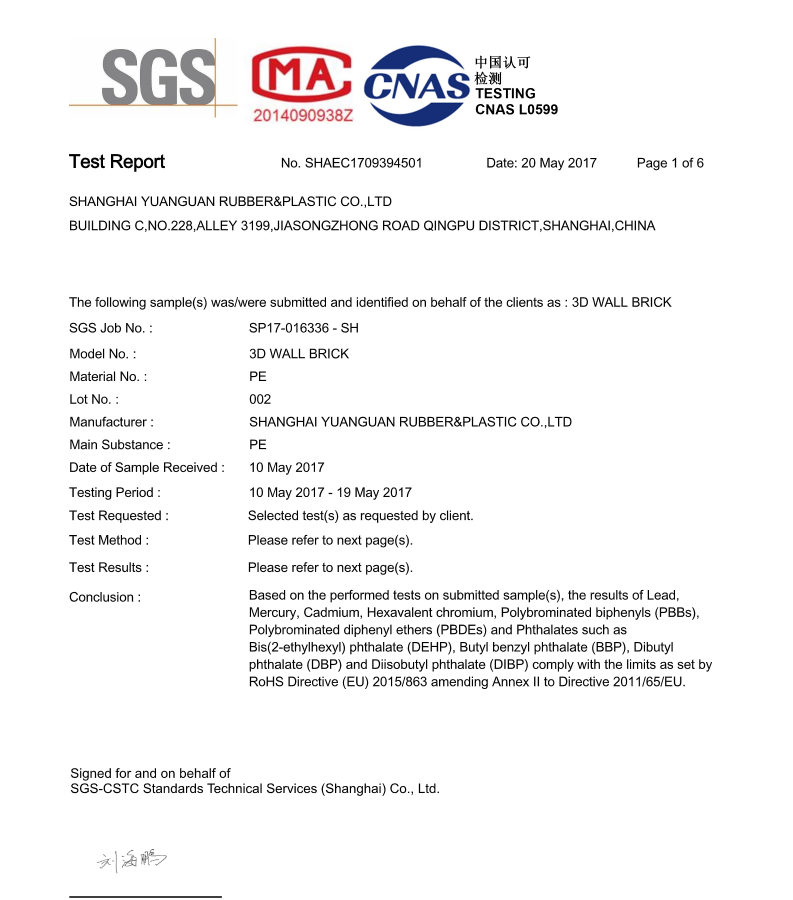
The SGS RoHS Test Report cited in WB-PVC procurement files carries certificate number SHAEC1709394501 and is issued against RoHS Directive (EU) 2015/863.
The evaluation-stage problem: documentation, not colour
Peel-and-stick flooring moves the adhesive from the site into the factory. That single change relocates most of the project risk: bonding becomes a controlled production variable, while base-surface preparation, storage conditions and acceptance inspection become the buyer's responsibility. Buyers who treat self-adhesive PVC flooring as a pure price comparison tend to discover the gap at handover, when colour variation, telegraphing or edge lifting cannot be corrected by negotiation.
The practical consequence is that evaluation-stage questions cluster around four areas: what the compliance documents actually cover, which specification dimensions can be customised, how the one-stop service sequence runs from sample to after-sales, and what must be written into the purchase order before production starts. Each of those is answered below.
Does WB-PVC carry an SGS RoHS report, and what does it cover?
Yes. A third-party RoHS test report is on file for the WB-PVC model line: certificate number SHAEC1709394501, issued by SGS-CSTC on 20 May 2017 against RoHS Directive (EU) 2015/863, recorded as applicable to the EU market, with an expiry date listed as 1 January 2099.
Two clarifications matter for a tender file. First, RoHS Directive (EU) 2015/863 is the reference standard named in the report, not a statement that flooring falls under electrical and electronic equipment scope; European buyers commonly use such reports as a contractual substance-restriction benchmark. Second, the report is a document with a declared scope, and scope is the part buyers most often overlook.
| What the RoHS report supports | What it does not automatically support |
|---|---|
| A verifiable third-party test by SGS-CSTC against RoHS Directive (EU) 2015/863, with a citable certificate number for tender and import files | A blanket substance statement for every SKU, colour or material structure in the range |
| A documented compliance trail that the supplier maintains for EU-facing orders | Substitution for project-specific declarations such as REACH or indoor air quality schemes |
| A reference date and issuing authority that a compliance team can verify directly with the laboratory | Coverage of fire classification or VOC emission criteria, which are separate documents |
Documented limitation. The report text declares a scope naming a specific product and material type, while the WB-PVC floor tile appears in the model list associated with that report. Because the report was issued in 2017, buyers whose tender requires documentation issued inside a defined window, or whose ordered material differs from the declared scope, should request a model-specific report or a fresh test before the purchase order is released. That is a routine procurement request, not an exception.
How the self-adhesive construction behaves on site
Installation is dry: the backing film is peeled off and the tile is pressed onto a smooth, solid base, with no cement or glue. Tiles can be cut on site, and some styles can be lifted and repositioned without leaving adhesive residue. The standard tool kit is a utility knife, a scraper or roller, a tape measure, a spirit level and adhesive remover for disassembly; for floors a matching floor roller is recommended, and no large construction equipment is needed.
Performance depends on the substrate more than on the tile. The base must be flat, dry and free of dust and grease, and floor substrates must have adequate strength with no hollow spots. Suitable bases include cement floors, tiled surfaces, latex-painted walls, plasterboard and plywood. Powdery, sandy or loose surfaces are explicitly unsuitable and should be ruled out at survey stage rather than at installation.
The product is intended for indoor use at normal room temperature, including humid environments such as bathrooms and dry areas of kitchens, and should not be exposed to strong sunlight over long periods. That is a suitability boundary, not a maintenance instruction: an installation under continuous glazing or in an unconditioned exterior-facing space belongs to a different specification.
Customization: what a buyer can change, and what must be confirmed
Customization on this product line is organised by dimension, not by catalogue number. The manufacturer supports OEM and ODM projects and lists size, colour, pattern and design, embossing texture, material structure, thickness, packaging, logo and private label, and custom labels as adjustable parameters, plus a new product development service.
| Dimension | Customization position | What the buyer should confirm in writing |
|---|---|---|
| Size | Size customization supported; standard flooring sizes are 40 / 60 / 120 × 300 cm | Cut size, tolerance and whether offcuts are included in the shipped quantity |
| Thickness | Thickness customization supported; standard is 1.5 mm | Nominal thickness and measurement method used at incoming inspection |
| Pattern and colour | Pattern, design and colour customization supported | A retained reference sample, plus the light source and viewing distance used for colour approval |
| Surface | Embossing texture customization supported | Texture reference code, gloss level and slip-relevant finish naming |
| Material structure | Material structure customization supported | Layer build description and any substance declarations required by the destination market |
| Packaging | Packaging, logo, private label and custom labels supported | Carton configuration, label content, barcode format and pallet pattern |
Pattern families requested in this category commonly include wood-grain, stone-grain, parquet and carpet-pattern visuals. Which of these is available for a specific WB-PVC order should be confirmed against the current sample set rather than assumed from a website image, because decorative ranges are refreshed continuously to follow international trends. Confirming the sample, not the photograph, is the reliable step.
Commercially, the standard ordering frame is a minimum order quantity of 1,000 square meters and a 30-day lead time, supported by a monthly capacity of more than 10 million square meters and 100% testing. Customized formats should be treated as a separate schedule negotiation rather than as a variation of the standard lead time.
One-stop service: sample, production, shipment, after-sales
The service model is a four-step sequence rather than a set of separate services. Each step produces something the buyer should hold as a record.
| Step | What the supplier provides | What to lock in writing |
|---|---|---|
| 1. Sample support | Pre-sale consultation, product solutions and physical samples for evaluation | Sample reference retained as the approval standard; date and version of the approved sample |
| 2. Order production | OEM/ODM production with 100% test and multi-stage inspection before delivery | Approved specification sheet, quantity, inspection method and pre-shipment notification |
| 3. Shipment | Shipment arrangement and documentation for export orders | Incoterms, packaging confirmation, document set and consignee details |
| 4. After-sales | Installation guidance, quality issue tracking, re-order and replacement support, long-term technical support, OEM/ODM project follow-up and market feedback support | Claims window, response expectation and the contact point for technical questions |
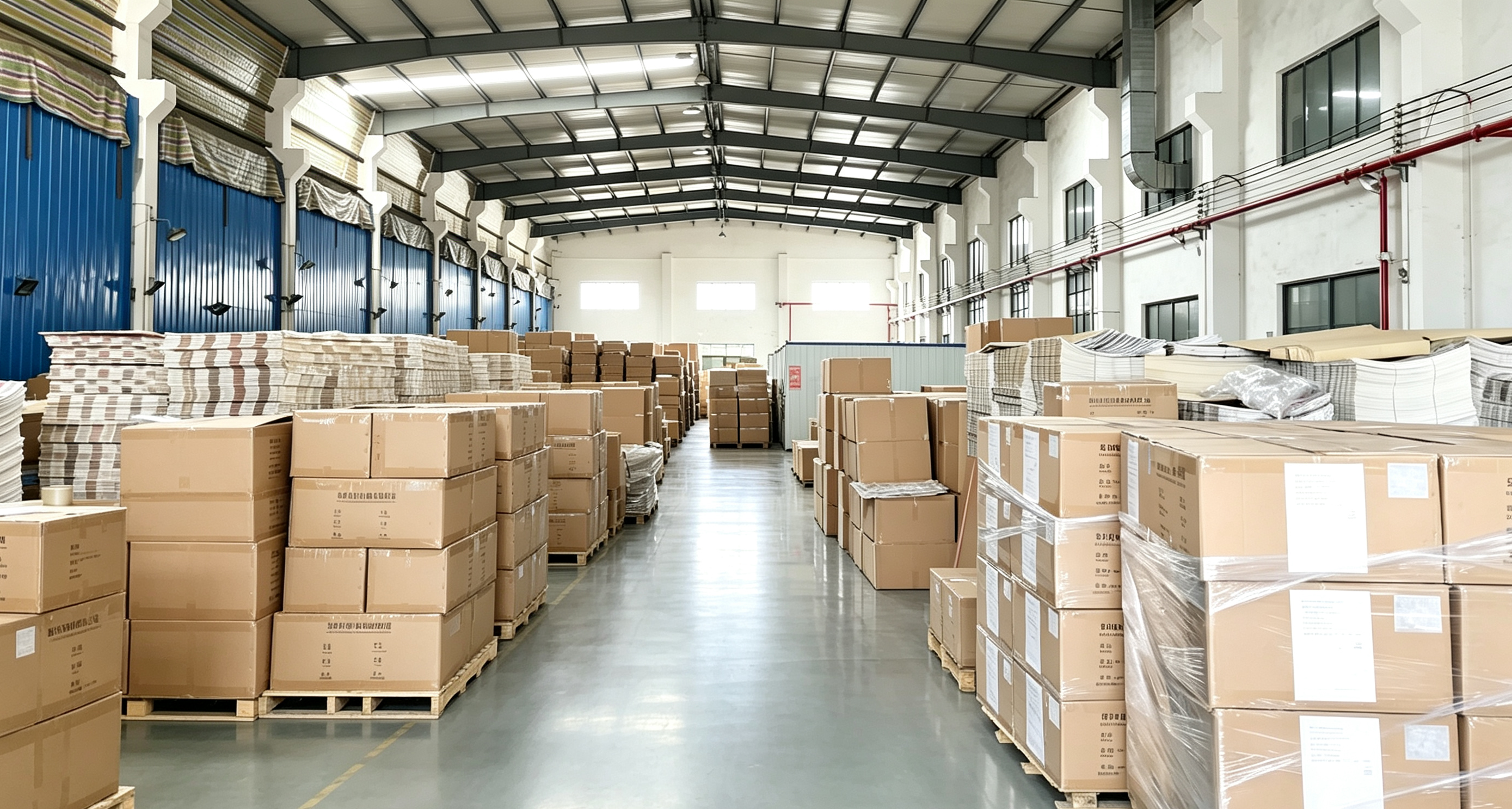
Order handling between production and shipment: the point at which packaging, labelling and quantity should already be fixed in writing.
Acceptance criteria to put in writing
Most disputes on self-adhesive flooring are not manufacturing disputes; they are gaps between what was assumed and what was specified. Six items belong in the purchase order or its annex before production begins.
1. Model and material: state WB-PVC explicitly, with the material and layer build.
2. Dimensions: size, nominal thickness and the measurement method, including the tool and sampling position.
3. Appearance: a retained approved sample as the colour and texture reference, with the inspection light source and distance named.
4. Packaging and labelling: carton configuration, private label content, barcode format and pallet pattern.
5. Inspection and claims: the supplier's 100% test is an internal control; the buyer's incoming inspection is a separate step, so sampling level, defect definition and the claims window need to be agreed rather than inferred.
6. Documentation: request the ISO9001 certificate and the RoHS report number together with its declared scope, and confirm the issue date is acceptable to the destination market.
Base-surface conditions should also be recorded as a buyer responsibility at handover, since adhesion quality on a dusty or weak substrate cannot be attributed to the tile.
Where WB-PVC fits: applications and a 100,000-unit reference case
The product is positioned for indoor scenarios including bedrooms, living rooms, bathrooms, hotels, shops and kindergartens, which share the same underlying requirement: a fast, dry installation onto an existing sound substrate where demolition is not practical.
A relevant reference is an international e-commerce platform distributing flooring products globally, which sourced 100,000 units for residential and commercial interior decoration covering apartment renovation, office fitting and retail store refurbishment. Over a service period of 5 to 10 years the product performed stably with no quality complaints reported, and the customer completed 3 repeated orders within 2 years. Documented highlights include wear-resistant, waterproof and easy-to-install characteristics, with stable colour and texture in long-term use that make the product suitable for high-frequency traffic scenarios. The project footprint spans multiple countries, including Argentina, Brazil, Japan, Malaysia, Nigeria, Saudi Arabia, Singapore and Thailand.
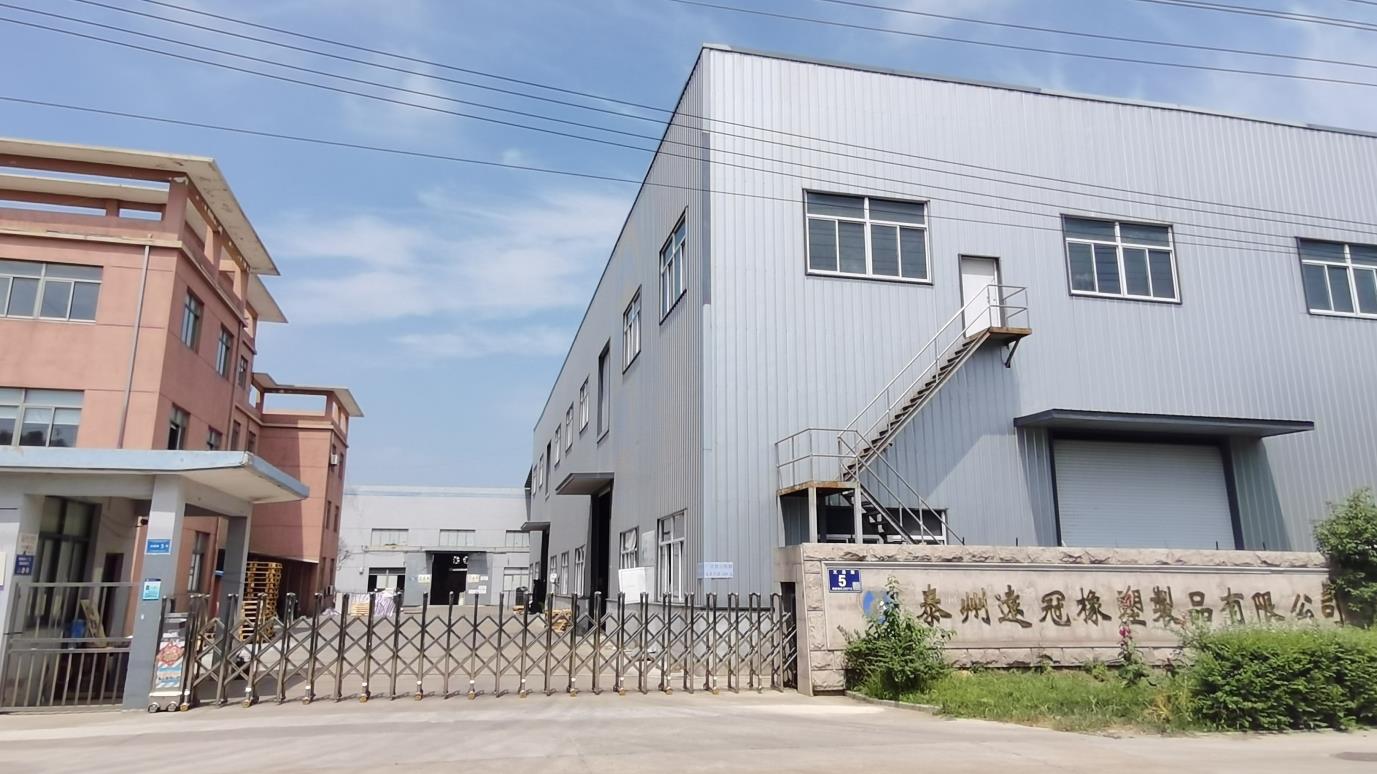
Production of self-adhesive PVC floor tiles intended for residential renovation, office fitting and retail refurbishment projects.
Market trend signals that shape 2026–2027 specifications
Three trend lines are visible in published category data, and each one changes what buyers ask for at quotation stage.
Volume growth with a documentation overlay. The global vinyl flooring market is estimated at USD 28.0 billion in 2026 and projected to reach USD 41.5 billion by 2033, a 5.8% CAGR (Grand View Research). Growth of that order keeps supplier competition intense, which pushes differentiation toward verifiable documents rather than headline pricing.
Plasticizer substitution as a purchasing norm. Tarkett reported that by 2018, 100% of its vinyl production sites in Europe, North America, Serbia and China used phthalate-free technology with alternative plasticizers such as DOTP (Tarkett). For buyers, phthalate-free wording has shifted from a niche request to a routine line item, and it should be confirmed as a written statement for the ordered SKU rather than inferred from a general product claim.
Indoor air quality as a separate document. FloorScore certification verifies that hard surface flooring complies with the volatile organic compound emissions criteria of California Section 01350 (SCS Global Services / RFCI). Separately, fire performance is classified through standards such as GB 8624-97 class B1 and EN 13501-1 class Cfl-s1 in category references. Neither should be assumed for a specific tile: they are documents to be requested and checked, and they sit outside the RoHS report.
Comparison with other flooring routes, and the limits of this format
Self-adhesive PVC tile competes less with other PVC formats than with other project routes: glue-down resilient flooring, ceramic tile and carpet tile. The differences that matter at procurement stage are installation method, substrate tolerance, downtime and reversibility.
| Decision dimension | Self-adhesive PVC tile (WB-PVC) | Glue-down resilient flooring | Ceramic tile | Carpet tile |
|---|---|---|---|---|
| Adhesive | Factory-applied; peel and stick, no site adhesive | Site-applied adhesive with open time and cure | Cement-based bedding or adhesive | Pressure-sensitive adhesive or tabs |
| Installation downtime | Short, dry process with hand tools | Longer, affected by adhesive cure | Longest, includes bedding and grouting | Short |
| Reversibility | Some styles can be lifted without residue | Generally difficult to remove intact | Removal is demolition | Usually removable |
| Substrate sensitivity | High: requires flat, dry, sound base; not for powdery or loose surfaces | High, plus moisture limits for adhesive | Moderate, but adds floor height and load | Moderate; tolerates minor irregularities |
| Indoor comfort and acoustics | Hard surface; footfall noise depends on substrate | Hard surface, similar profile | Hard, colder underfoot | Soft, sound-absorbing |
Where this format does not fit. The 1.5 mm self-adhesive tile is thin, so imperfections in the substrate telegraph through and the finished floor reflects the quality of the base preparation rather than compensating for it. It is not intended for powdery, sandy or loose substrates, for prolonged exposure to strong sunlight, or as a substitute for mechanically fixed or adhered systems where the base is of uncertain strength. Where those conditions exist, the correct answer is usually substrate repair or a different flooring route, decided before the order rather than after delivery.
Future outlook
Documentation is becoming a product feature in its own right. Buyers comparing quotations in 2027 are likely to ask for model-scoped compliance reports with a defined validity window, written phthalate-free statements, indoor air quality test data and the specific fire classification of the ordered SKU, alongside the technical data sheet. Suppliers that can assemble these as a standard pack shorten their customers' internal approval cycles; suppliers that cannot will keep losing evaluations on administrative grounds rather than on product performance.
For self-adhesive formats specifically, the competitive argument is likely to stay where it is now: installation speed and reversibility on sound indoor substrates, supported by a specification that is precise enough to be enforced.
FAQ
What exactly does the SGS RoHS report SHAEC1709394501 cover for a WB-PVC order?
It is a third-party RoHS test report issued by SGS-CSTC on 20 May 2017 against RoHS Directive (EU) 2015/863, with an expiry date listed as 1 January 2099, recorded as applicable to the EU market, and associated with the WB-PVC model line. The report carries a declared scope naming a specific product and material type, so a buyer should match that declared scope against the SKU and material actually ordered before relying on it in a tender file.
Is a RoHS report sufficient for selling self-adhesive PVC flooring into the EU?
It is one document, not a complete market-access file. Flooring is not electrical and electronic equipment, so European buyers typically treat a RoHS report as a contractual substance-restriction benchmark; other declarations, such as REACH or indoor air quality schemes, may be requested separately by the buyer or the project. Whether the 2017 issue date is acceptable within a given tender window should be confirmed with the buyer's compliance function, and a model-specific or re-issued report requested where it is not.
Which parameters can be customized on WB-PVC, and which remain standard?
Size, colour, pattern and design, embossing texture, material structure, thickness, packaging, logo and private label, and custom labels are all listed as customizable, with OEM/ODM and new product development supported. The standard reference is 40 / 60 / 120 × 300 cm at 1.5 mm thickness, so any deviation from those values is a customization item that should be written into the specification sheet and confirmed against a retained sample.
What are the ordering parameters for a WB-PVC order?
The stated commercial frame is a minimum order quantity of 1,000 square meters, a lead time of 30 days, 100% test with multi-stage inspection before delivery, and a monthly capacity of more than 10 million square meters. Customized sizes, thicknesses, textures or packaging follow a separate schedule discussion rather than inheriting the standard 30-day timeline.
What acceptance criteria should be written into the purchase order?
Six items: the model and material, the dimensions with nominal thickness and measurement method, an approved appearance sample with defined inspection lighting, the packaging and labelling configuration, the incoming inspection sampling level together with a defect definition and claims window, and the documentation set including the ISO9001 certificate and the RoHS report with its declared scope. Base-surface conditions should be recorded separately as a buyer-side responsibility at handover.
Which indoor spaces and substrates suit self-adhesive PVC flooring?
Typical indoor applications are bedrooms, living rooms, bathrooms, hotels, shops and kindergartens, at normal room temperature, including humid areas such as bathrooms and dry kitchen zones, while avoiding long-term exposure to strong sunlight. Suitable substrates include cement floors, tiled surfaces, latex-painted walls, plasterboard and plywood; the base must be flat, dry and free of dust and grease, and floor bases must have adequate strength with no hollow spots. Powdery, sandy and loose surfaces are unsuitable.
What support continues after shipment?
The stated after-sales scope covers installation guidance and product usage support, fast response to customer inquiries, quality issue tracking and resolution, re-order and replacement support, long-term technical support, OEM/ODM project follow-up and continuous market feedback support. The reference case of a 100,000-unit order for an international e-commerce platform, with a service period of 5 to 10 years, no reported quality complaints and 3 repeated orders within 2 years, illustrates how that support is applied in a multi-country distribution setting.
Product documentation: Shanghai Yuanguan Product Brochure (PDF). Manufacturer reference: Shanghai Yuanguan Rubber & Plastic Co., Ltd., wallpanelsticker.com.
Есть вопросы или нужны дополнительные детали?
Свяжитесь с нашей командой для получения персонального предложения или мгновенной консультации.
Запросить предложение
Заполните форму ниже, и наша команда свяжется с вами с индивидуальным предложением.
Прямой чат WhatsApp
Предпочитаете общаться в реальном времени? Напишите нам в WhatsApp для мгновенной помощи и быстрых ответов.
- Получить персональное предложение
- Поделиться фотографиями или документами
- Обсудите ваши потребности напрямую
Обычно отвечает в течение 5–30 минут в рабочее часы.