
Self-Adhesive vs Rigid Wall Panels: A 2026 Buyer Framework
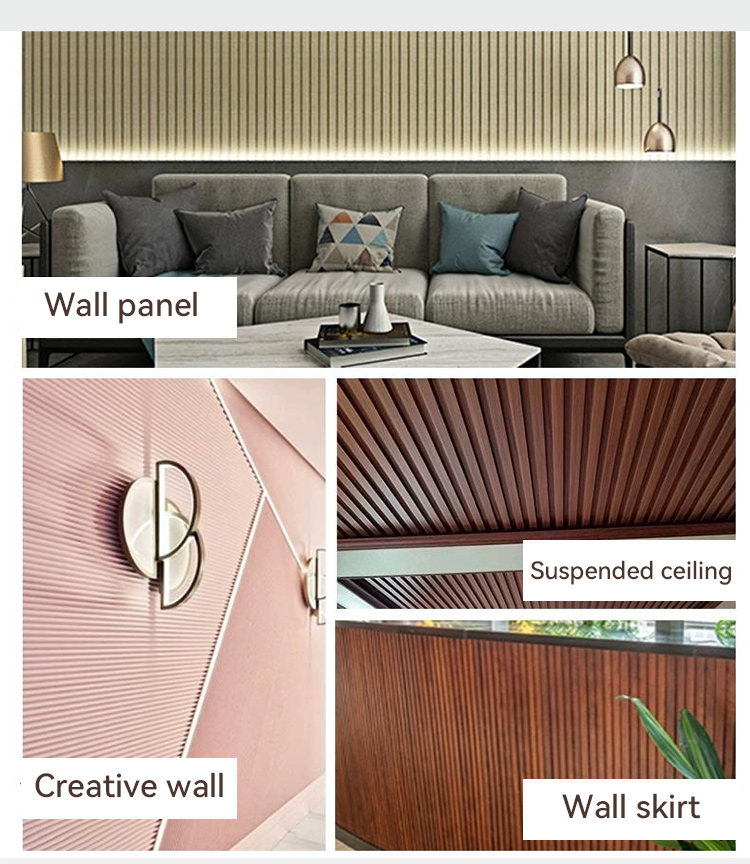
Rigid WPC wall panel: the SXP WB-WPC profile is quoted at 160*23*2900 mm, packed 16 pieces per box. Image: Shanghai Yuanguan Rubber Plastic Co., Ltd.
Wall panels are usually discussed as one product category, but the two formats most often quoted in 2026 interior tenders are not interchangeable. A self-adhesive wall panel is a thin decorative sheet that carries its own adhesive backing; a rigid wall panel is a profiled board that adds measurable thickness to the wall. Choosing between them is a project-fit decision rather than a price comparison, and the criteria that actually decide it are substrate condition, installation labour, storage space, exposure, and documentation.
SXP Wall Panel is the wall panel line of Shanghai Yuanguan Rubber Plastic Co., Ltd., a decorative materials manufacturer founded in 2005 and based in Qingpu District, Shanghai, operating an 8,000 ㎡ factory with around 150 employees and exporting about 90% of its output to EU, USA, Asia and South America markets. Both formats sit inside that single range, which makes the comparison concrete rather than theoretical.
Why the two categories get confused
The confusion is a naming problem before it is a technical one. "Wall panel" is used in trade catalogues for everything from a 2 mm self-adhesive marble sheet to a 2.9 m rigid profile, and buyers often compare them on a square-metre price that excludes the two cost lines that actually diverge: substrate preparation and site logistics.
The market data reflects the breadth of the category rather than any single product. Dataintelo valued the global wall panels market at USD 32.4 billion in 2025 and projects USD 43.7 billion by 2033, a 4.2% CAGR, with metal panels holding a 28.5% share in 2025 and Asia Pacific accounting for 42.3% of regional demand. Published estimates for the same year vary widely because some sources include exterior cladding and others count interior systems only — a definitional gap, not a disagreement about demand. Wood-based wall panels were credited with nearly 31% of global installations in 2024, and wood wall panel systems are projected to grow at 6.2% CAGR to 2035 (WiseGuyReports).
For a buyer, none of that resolves the decision. What resolves it is knowing what each format is asked to do on site.
What each panel actually is
The self-adhesive family is a finish, not a structure. In the SXP range, the PET marble wall sticker is quoted at 2 mm and 2.5 mm, the PVC wall sticker at 2 mm, the soft-stone PVC sticker at 2.5 mm, the 3D self-adhesive foam slat at 2.8 mm, and the leather sticker at 6 mm. Panel formats run from 30*30 cm and 30*60 cm up to 60*300 cm and 120*300 cm, with 3D slat lengths available to order. Installation is a dry process: peel the backing film, position on a smooth surface, cut locally with a utility knife, and consolidate with a scraper or roller. No cement or glue is required, and some styles can be removed without leaving residue.
The rigid family is a board. The SXP WPC wall panel is quoted at 160*23*2900 mm, packed 16 pieces per box, at 690/810/830 g/m. The format is fixed-length by default, which shapes everything downstream: transport, storage, cutting, and the labour profile of the install.
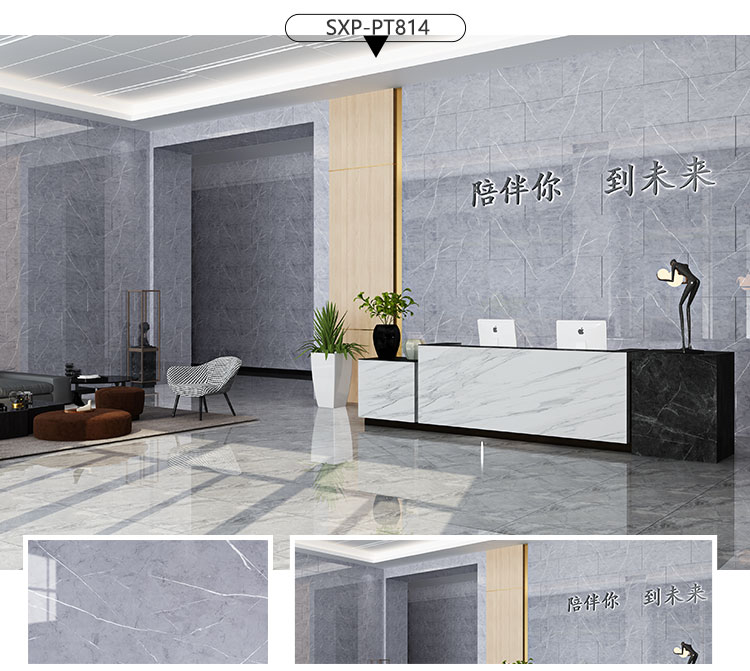
Self-adhesive PET marble sheet: quoted at 2 mm and 2.5 mm, supplied in formats from 30*30 cm to 120*300 cm. Image: Shanghai Yuanguan Rubber Plastic Co., Ltd.
| Attribute | Self-adhesive panel (SXP WB-PET / WB-PVC / WB-KC) | Rigid panel (SXP WB-WPC) |
|---|---|---|
| Material | PET, PVC, PVC foam, leather | WPC |
| Quoted thickness | 2 mm / 2.5 mm (PET, PVC sheet); 2.8 mm (3D foam slat); 6 mm (leather) | Profile 160 × 23 mm |
| Quoted format | 30*30, 30*60, 40*80, 60*60, 60*120, 60*300, 120*300 cm; slat lengths customisable | 160*23*2900 mm |
| Pack / weight | Sheet or carton, confirmed per order | 16 pcs per box; 690 / 810 / 830 g/m |
| Fixing method | Self-adhesive backing, dry installation, no cement or glue | Fixing system confirmed per project and substrate |
| Substrate requirement | Flat, dry, free of dust and grease; not for powdery, sandy or loose surfaces | Flatness and tolerance agreed with supplier before order |
| Primary role | Surface finish, crack and stain coverage, fast turnaround | Added profile depth and a linear decorative rhythm |
The six-gate decision framework
The framework below sequences the questions in the order they can eliminate a format. Most sourcing errors happen because buyers start at gate four (price) and work backwards.
Gate 1 — Substrate condition
This gate is the single most common cause of a self-adhesive failure that gets blamed on the product. The SXP self-adhesive range requires a base surface that is flat, dry and free of dust and grease, and it is explicitly unsuitable for powdery, sandy or loose surfaces. Suitable substrates listed for the range include cement floors, tiled surfaces, latex-painted walls, plasterboard and plywood. If the wall fails that test, the project either moves to substrate repair or moves to a rigid profile that can span and cover the defect.
Gate 2 — Installation complexity and labour
Self-adhesive installation is a finishing task. The matched tool kit is a utility knife, scraper or roller, tape measure, spirit level, and an adhesive remover for disassembly — no large construction equipment. That profile allows small crews, occupied buildings and evening work without a wet trade.
Rigid panel installation is a fixing task. A 2.9 m profile has to be carried, aligned, cut and fixed, and the fixing system has to suit the substrate. Labour hours per square metre are therefore more sensitive to wall condition and access than in the self-adhesive case, and the joinery line quality depends on the installer rather than on the material alone.
Gate 3 — Storage, handling and site logistics
Storage requirements differ enough to change a project's cost structure. Foam wall stickers are sensitive to high temperature, heavy pressure and UV light; PU-stone panels are vulnerable to moisture and impact; linen soft-pack goods to dust, damp and mildew. Standard practice is a cool, ventilated warehouse at or below 40 °C, goods on pallets and off the bare floor, away from direct sunlight and heating pipes, with limited stacking height, no heavy hard panels stacked on foam goods, and FIFO rotation.
The rigid format adds a length constraint. Because the WPC profile is 2.9 m long, storage and site access must accommodate an unbroken length; cutting before storage is not an option if the design needs full-length runs. On the quoted basis, a 16-piece box covers 46.4 linear metres, and at 690 g/m the carton lands in the region of 32 kg — a two-person lift and a pallet-level handling plan.
Gate 4 — Moisture, heat and light exposure
The self-adhesive range is specified for indoor use at normal room temperature, including typical humid environments such as bathrooms and dry areas of kitchens, with instructions to avoid long-term exposure to strong sunlight. That last clause is where specification errors originate: a panel that performs well in a hotel corridor does not automatically belong on a sun-facing glazed façade or an unconditioned storeroom. Where the elevation receives sustained direct light, treat the material choice as a separate question rather than an extension of the bathroom decision.
Gate 5 — Compliance and documentation
For EU-bound commercial interiors, EN 13501-1 classifies reaction-to-fire performance, and B-s1,d0 is a commonly specified Euroclass rating for commercial interior wall panels. RoHS Directive (EU) 2015/863 covers restricted substances; the SXP SGS RoHS test report SHAEC1709394501 applies to the 3D wall brick (PE material) product. On the customs side, WPC wall panels exported from China are commonly classified under HS code 3925.90.0000.
The operative rule is scope matching. A test report supports a claim only for the exact material and construction it names, so the document set must be checked against the product on the purchase order, not against the product family in the catalogue.
Gate 6 — Volume, lead time and MOQ
Both formats sit under the same manufacturing envelope at SXP: OEM/ODM production with size, colour, pattern, embossing, material structure, thickness, packaging and private-label customisation, a quoted monthly capacity above 10 million square metres, a 1,000 square metre MOQ, a 30-day lead time and 100% testing. Where the formats diverge commercially is pack efficiency, not production capability: sheet-based self-adhesive goods compress into cartons, while fixed-length profiles consume volume in proportion to length.
XPE versus IXPE: what export buyers ask that local buyers do not
The adhesive and the foam carrier decide how a sticker behaves under load, and the two cross-linking routes behave differently. IXPE is cross-linked by electron-beam irradiation, giving fine uniform cells, fast rebound and resistance to permanent indentation. Chemically cross-linked XPE has larger cells, slower rebound and will take a permanent dent under heavy pressure.
A hand-press test is useful screening, not proof: press a sample hard for three to five seconds, release, and observe whether a dent remains. Fine uniform cells point towards IXPE, uneven large cells towards XPE. That test cannot support a claim on its own. For export orders the practical discipline is to name the material in the proforma invoice and make a third-party formamide and cross-linking-degree report the acceptance criterion. Domestic and short-haul buyers often accept the hand-press screening because the stock never leaves controlled conditions; export buyers cannot, because compression in transit and extended storage are exactly the conditions that expose a softer cell structure.
Where self-adhesive wins
The corpus of documented projects points to renovation and speed as the decisive conditions. Self-adhesive formats are suitable for old house renovations, apartment full renovations, hotel room makeovers, homestay renovations, chain brand store refurbishments, office fit-outs, temporary exhibition booths, simple rental apartment renovations and modular interior projects. Their documented functions are to cover cracks and stains on the base surface, protect the existing wall and finish the surface quickly to shorten construction time.
Within the family, the split is worth knowing. The XPE foam format is light, offers sound insulation and cushioning benefits with competitive logistics cost, and is the better fit for residential and rental refurbishment. The PVC soft-stone format delivers stronger texture and better scratch resistance at heavier weight and higher unit cost, which suits hotel guest rooms and chain-store interiors.
A supermarket project illustrates the commercial logic. Product 5668 was installed across 370,000 units in commercial spaces, with moisture-proof performance, quick installation and a broad surface-texture range cited as the deciding attributes; feedback noted good decorative effect and easy daily maintenance, and the client placed repeat orders. The supply relationship is listed at five to ten years.
Where rigid panels win
Rigid profiles win where the wall needs depth rather than a finish. A 160 × 23 mm profile produces a shadow line and a linear rhythm that a 2 mm sheet cannot reproduce, and the added material thickness is visible at reveals and corners. That makes the format the natural choice for feature walls, headboard recesses and reception elevations where the panel is part of the architecture.
The trade-off is arithmetic. Fixed 2.9 m lengths force cut planning before the order, the carton weight shapes the labour plan, and the storage footprint is measured in metres of length rather than stacks of sheets.
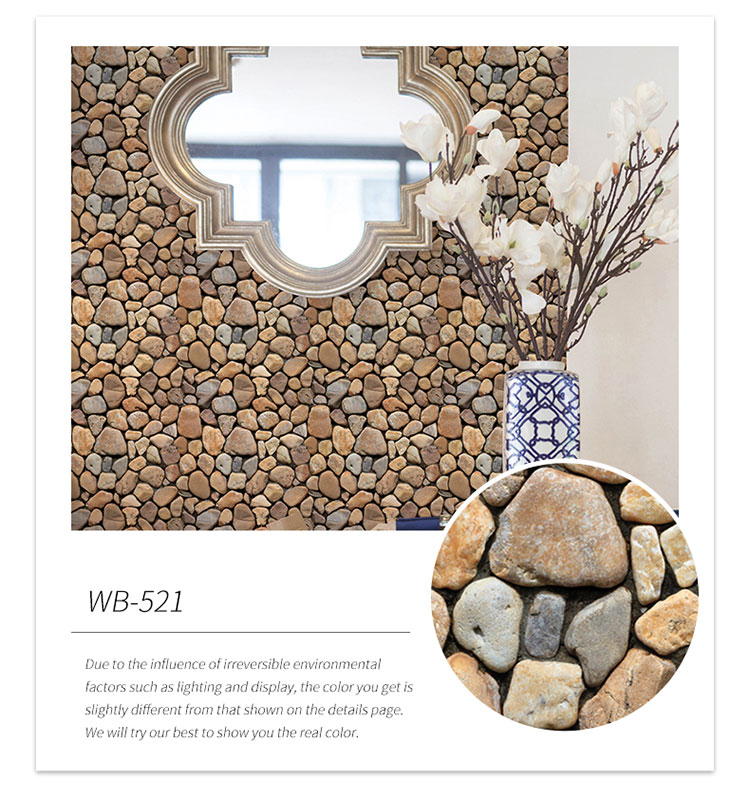
PVC wall panel quoted at 2.5 mm in 30*30 / 50*50 / 96*48 cm formats, for interior decoration and building materials applications. Image: Shanghai Yuanguan Rubber Plastic Co., Ltd.
Limitations and where the framework breaks down
A framework that only recommends is not a framework. Three boundaries matter in practice.
- Adhesion cannot fix geometry. A thin sheet follows the substrate. If the wall is out of flat beyond the tolerance the adhesive can absorb, the defect telegraphs through the finish, and no adhesive upgrade resolves it. The base must be flat, dry and free of dust and grease before anything is installed.
- Softer foam takes impressions. The XPE foam format's cushioning advantage is the same property that makes its surface scratch resistance general. High-traffic retail, luggage contact and trolley corridors argue for the PVC soft-stone format or a rigid profile.
- Light exposure is a hard boundary. Long-term exposure to strong sunlight is excluded for the self-adhesive range. Projects with sustained direct light should be assessed on a different basis rather than treated as an exception.
One more caveat belongs to the buyer's side of the table: a supplier's fire and substance reports, MOQ and lead time figures describe the supplier's capability, not a guarantee for a specific elevation. The document set has to be re-checked against each product code on the order.
Market context for 2026
Three signals are worth carrying into a specification meeting. Wood wall panel systems are projected to grow at 6.2% CAGR to 2035 on a base where wood-based panels already held nearly 31% of installations in 2024, which keeps profiled and wood-look formats commercially relevant. Metal panels led 2025 material share at 28.5%, largely on exterior and high-durability applications rather than interior finishing. And Asia Pacific's 42.3% regional share explains why most interior panel quotes in 2026 originate from the same supply base and why documentation, not availability, is the differentiating factor between suppliers.
Future outlook
Through 2027, the self-adhesive and rigid formats are more likely to specialise than to converge. Renovation-led demand favours dry installation because it removes a wet trade from an occupied building, and the documented function set of self-adhesive panels — crack and stain coverage, surface protection, shortened construction time — maps directly onto that demand. Rigid profiles are likely to hold the feature-wall and architectural-detail segment, where depth is the requirement rather than the compromise.
The variable that will move fastest is documentation discipline. As EU buyers apply EN 13501-1 and RoHS Directive (EU) 2015/863 checks to interior finishes more consistently, the supplier conversation shifts from catalogue range to report scope — and the buyers who ask for material naming in the proforma invoice plus third-party acceptance criteria early will spend less time resolving disputes later.
FAQ
What is the core difference between a self-adhesive wall panel and a rigid wall panel?
A self-adhesive panel is a thin decorative sheet with its own adhesive backing — in the SXP range 2 mm to 2.5 mm in PET and PVC sheet formats, 2.8 mm in the 3D foam slat format and 6 mm in the leather format — applied directly to a flat, dry substrate without cement or glue. A rigid panel is a profiled board; the SXP WPC profile is 160*23*2900 mm, packed 16 pieces per box and quoted at 690/810/830 g/m. The first transfers a finish; the second adds measurable thickness to the wall.
Can a self-adhesive panel be applied over tiles or painted walls?
Suitable surfaces listed for the SXP self-adhesive range include cement floors, tiled surfaces, latex-painted walls, plasterboard and plywood — in each case a smooth, solid base. The base must be flat, dry and free of dust and grease, and powdery, sandy or loose surfaces are explicitly excluded.
How should self-adhesive and rigid panels be stored before installation?
Foam wall stickers are sensitive to high temperature, heavy pressure and UV light; PU-stone panels are vulnerable to moisture and impact; linen soft-pack goods to dust, damp and mildew. Standard practice is a cool, ventilated warehouse at or below 40 °C, goods on pallets away from the bare floor and direct sunlight, limited stacking height, no heavy hard panels stacked on foam goods, and FIFO rotation so older batches ship first.
Why do export orders specify IXPE rather than generic XPE?
IXPE is cross-linked by electron-beam irradiation with fine uniform cells, fast rebound and resistance to permanent indentation, while chemically cross-linked XPE has larger cells, slower rebound and takes a permanent dent under heavy pressure. A hand-press test only screens samples; a third-party formamide and cross-linking-degree report is the final evidence, which is why export orders name the material in the proforma invoice and use the lab report as the acceptance criterion.
What does the WPC 160*23*2900 mm, 16 pieces per box pack mean for a project?
Each piece is a 2.9 m profile, so 16 pieces per box gives 46.4 linear metres per carton. At the quoted 690 g/m the carton is in the region of 32 kg, which calls for two-person handling, and storage must accommodate an unbroken 2.9 m length rather than a stack of sheets. Cut planning should be completed before ordering, because off-cuts on a fixed length are a real cost line.
Which compliance documents should a buyer request for either format?
For EU commercial interiors, EN 13501-1 classifies reaction-to-fire performance and B-s1,d0 is a commonly specified Euroclass rating for commercial interior wall panels. RoHS Directive (EU) 2015/863 covers restricted substances; the SXP SGS RoHS test report SHAEC1709394501 applies to the 3D wall brick (PE material) product. WPC wall panels exported from China are commonly classified under HS code 3925.90.0000. Each document only supports the exact material and construction it names.
Full technical specifications for the SXP Wall Panel range, including formats, thickness options and packaging, are compiled in the Shanghai Yuanguan product brochure (PDF).
Есть вопросы или нужны дополнительные детали?
Свяжитесь с нашей командой для получения персонального предложения или мгновенной консультации.
Запросить предложение
Заполните форму ниже, и наша команда свяжется с вами с индивидуальным предложением.
Прямой чат WhatsApp
Предпочитаете общаться в реальном времени? Напишите нам в WhatsApp для мгновенной помощи и быстрых ответов.
- Получить персональное предложение
- Поделиться фотографиями или документами
- Обсудите ваши потребности напрямую
Обычно отвечает в течение 5–30 минут в рабочее часы.