
Semiconductor Process Material Quotes: Evidence to Demand
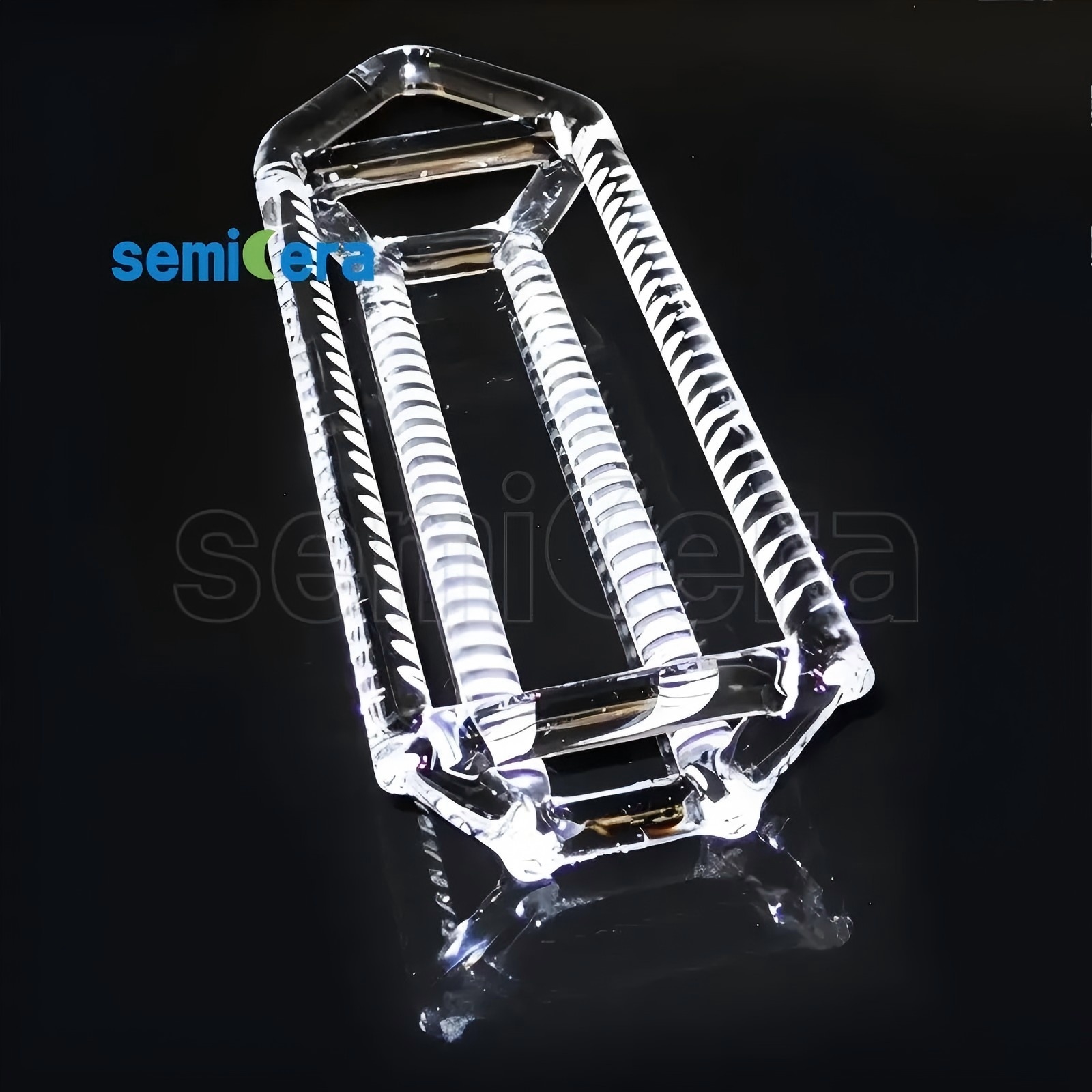
Semiconductor process materials are bought on numbers. A quartz boat arrives with a slot pitch tolerance, a furnace tube with a hydroxyl figure, an insulation felt with a carbon content, a silicon carbide powder with a purity grade. Yet the practical question in a quote review is rarely whether the numbers look tight — it is whether the supplier can show how each number was produced, on which sample, and against which part number.
Process materials here means the consumable and structural components inside the hot zone and the reaction chamber: quartz wafer boats and furnace tubes, CFC and carbon fibre insulation, CVD SiC coatings on graphite, and high-purity silicon carbide raw material. These parts fail slowly and expensively — through dimensional drift, particle generation, or a coating that lets go after a few hundred thermal cycles. Because the failure signal arrives late, the specification sheet carries almost all of the risk at the purchasing stage.
Constraint-driven buying — the stage where tolerance, purity and temperature capability decide the decision — is exactly where quotes are most often accepted on trust. A fab's own laboratory cannot easily reproduce a hydroxyl or free-carbon measurement before the part enters the tool, and a supplier's self-reported datasheet is not an acceptance criterion. It is a starting point for a conversation about method.
Why a quoted number is not yet a specification
A number becomes a specification only when both parties can measure it and agree on what counts as a pass. Three failure modes account for most disputes over process materials:
- Measured on something else. A tensile strength or a coating thickness taken from a test coupon is not automatically valid for the delivered geometry. Thickness on a flat plate and thickness in a pocket corner are different measurements.
- Measured once, on a development lot. A single qualification batch can sit at the favourable end of a range. If the quote gives a range but never states where in that range the delivered lot falls, the buyer has no basis for incoming inspection.
- Carried over from a material certificate. A raw-material certificate proves something about the input, not about the finished part after machining, purification, coating and cleaning.
The consequence is narrow but serious: if the buyer cannot reproduce a figure, the buyer cannot reject a lot that misses it. That asymmetry sits entirely on the purchasing side of the transaction, which is why the evidence review belongs in the RFQ stage rather than in the first complaint.
The four-part evidence test
Every quantitative claim in a process-material quote can be tested with the same four questions. Applied consistently, they convert a marketing number into something a quality engineer can act on.
| What to demand | Why it changes the answer | Where it belongs |
|---|---|---|
| Measurement method and instrument | Tolerance measured by a coordinate measuring machine, a pin gauge or an optical system will not agree to the same micron. The method defines the number. | Drawing note or specification annex |
| Sample basis | How many slots, tubes or specimens were measured, from which lot, and before or after final cleaning and purification. | Inspection report attached to each lot |
| Model-level traceability | The certificate must carry the model or drawing revision actually shipped, not the product family name. | Certificate of analysis / certificate of conformity |
| Acceptance rule | Who measures, at what point in the process, and what maximum deviation triggers rejection. | Purchase order quality clause |
The rest of this analysis applies that test to the specific claims that appear most often in quotes for quartz, carbon and silicon carbide components.
Quartz: the two claims that decide batch yield
Quartz wafer boats
A published specification for a diffusion or oxidation quartz wafer boat typically states a material grade of GE214 or equivalent ultra-high-purity fused quartz, an SiO2 content of ≥99.99%, a slot pitch tolerance of ≤±0.05 mm, and continuous operation at 1150°C with short-term excursions to 1300°C. Each of those four statements hides a question.
- Slot pitch ≤±0.05 mm. Over how many slots, measured on the finished part, and before or after the final cleaning step? Slot pitch measured on a green machined body can move after annealing. Ask for the number of slots inspected and the instrument used.
- SiO2 ≥99.99%. Purity quoted to two decimal places should be traceable to a specific analysis of a specific sample — bulk or surface — with a stated detection limit.
- GE214 or equivalent. The word equivalent is where quotes differ most. Ask what the equivalence is based on: hydroxyl content, bubble class, metallic impurity limits, or all three.
- 1150°C continuous. Continuous at what load, and with what permitted dimensional change after a defined number of cycles?

Quartz furnace tubes
For a high-purity fused quartz process tube, the published constraints are hydroxyl content below 20 ppm — with a low-hydroxyl variant below 5 ppm — an outer diameter tolerance of ±1.0% or better, optimised sag resistance for vertical or horizontal orientation, and a bubble- and inclusion-free surface. Hydroxyl content is the number that most directly affects sag and high-temperature behaviour, and it is also the number most often quoted without context.
Ask which analytical technique produced the figure, where along the tube the sample was taken, and what the detection limit was. A tube is a long part; a single hydroxyl value implies a uniform distribution that should itself be demonstrated. For the diameter tolerance, ask at which cross-sections the measurement was taken, since ovality can sit inside a compliant average. For the bubble claim, ask for the visual acceptance standard — illumination level, magnification, and the maximum permitted bubble size and count.
Carbon: do not accept one number for a whole material family
Carbon materials in the hot zone are quoted in ways that blur three distinct products. That blurring is itself a red flag, because the controlling metric is different for each.
| Material | Published constraint | Evidence to demand |
|---|---|---|
| CFC material (carbon-carbon composite) | 2.5D or 3D needle-punched carbon fibre matrix; tensile strength 90–140 MPa; bulk density 1.65–1.78 g/cm³; ash ≤10 ppm after halogen purification | Specimen orientation and geometry for the tensile test; measured value rather than range position; density method; ash sample mass and detection limit |
| Flexible purified graphite felt | Carbon content ≥99.99%; tensile strength 0.12–0.25 MPa; thickness 3 / 5 / 10 mm (±10%); moisture absorption <1.0% after purification | Which direction the tensile figure refers to; how thickness uniformity is measured across the roll; moisture test method and conditioning |
| Rigid carbon board | Ash ≤20 ppm (ultra grade ≤5 ppm); thermal conductivity 0.15–0.35 W/m·K at 1500°C; bulk density 0.18–0.24 g/cm³; processing temperature up to 2500°C in inert vacuum | Thermal conductivity method and test atmosphere; ash basis; whether 2500°C refers to continuous or short-term exposure |
A carbon content of ≥99.99% belongs to the flexible purified felt specification, where it is paired with a tensile strength of 0.12–0.25 MPa. CFC is controlled differently — by a tensile strength of 90–140 MPa together with bulk density and ash content after halogen purification. Rigid board is controlled by ash content, with an ultra grade at ≤5 ppm, plus thermal conductivity and density. A quote that applies one headline purity number across all three materials has not yet distinguished them, and should be asked to.
CVD SiC: 6N+ means little without the element list
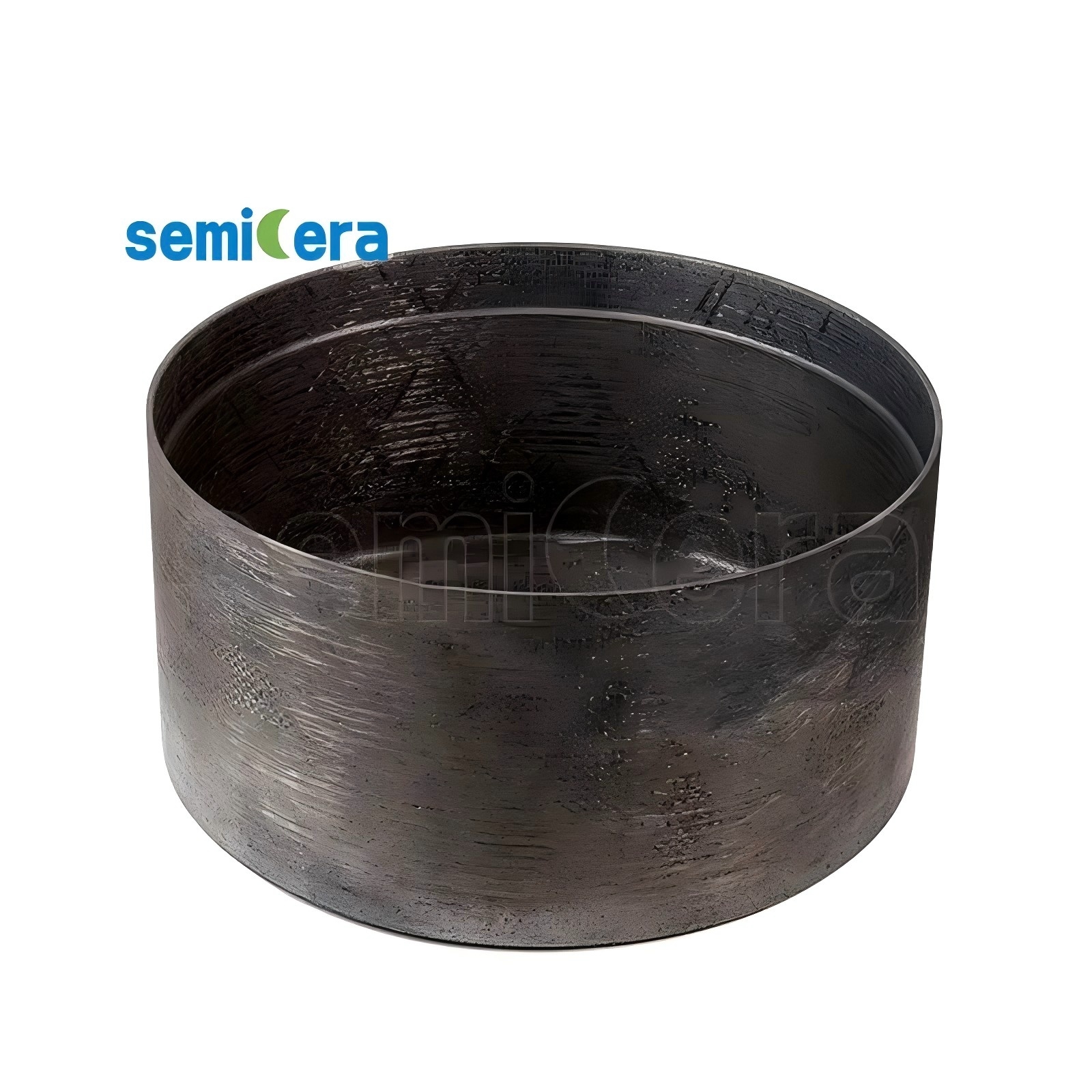
For high-purity PVT silicon carbide crystal growth raw material, a CVD SiC particle specification is stated as purity ≥99.9999% (6N+ grade, total metals <1 ppm), free carbon ≤0.05 ppm, grain size 1.0–5.0 mm, and bulk density close to 3.21 g/cm³. Two of those numbers deserve a harder look than the others.
Total metals <1 ppm. A total figure is only useful if the analysed element list and the detection limit per element are disclosed. A sum dominated by three easily measured metals tells the buyer less than a per-element table that includes the elements known to matter in the specific crystal growth process. Ask for the list and the reporting limits.
Free carbon ≤0.05 ppm. At this level, the reporting limit of the analytical method matters as much as the value. Ask how free carbon is distinguished from total carbon, what the detection limit is, and whether the result is lot-specific. A figure quoted at the edge of a method's capability should come with the method named.
Coatings follow the same logic. A CVD SiC coating on graphite is published at 99.99995% (6N grade, total ash ≤5 ppm), a typical thickness of 100 µm within a 50–150 µm range, a hardness of 2500 Vickers (40 GPa), and an FCC beta-phase polycrystal structure with (111) orientation. Purity on a coating is only meaningful alongside thickness distribution across the actual part and a statement of phase consistency. Ask where thickness was measured — how many points, on which surfaces, including pocket corners — and whether the ash figure applies to the coating alone or to the coated part as a whole.
The 1600°C claim and other structural promises
Structural claims are the hardest to test and the easiest to overstate. A silicon carbide diffusion boat is specified with an SiSiC or RSiC substrate, a maximum working temperature of up to 1600°C described as zero structural deformation, a service lifespan more than five times that of traditional quartz boats, and thermal shock resistance demonstrated across 1000°C to room-temperature cycles.
Zero structural deformation is a claim about a measurement, not a material property. Ask what is measured — dimensional change, bow, slot pitch drift — after how many cycles, under what load, and with which instrument. Ask what end-of-life definition supports the five-times lifespan figure, and whether the baseline is a quartz boat of the same geometry run in the same process. Without that, the comparison is directional rather than verifiable.
The same treatment applies across the part family: a silicon carbide paddle quoted at ≤2.0 mm deflection at more than 2000 mm reach and 15 kg load at above 1100°C needs the test span and the temperature at which deflection was recorded; a coated SiC process tube quoted at up to 3000 mm length with ±0.2 mm wall thickness uniformity, vacuum gas tightness and 20–30 W/m·K thermal conductivity at 1200°C needs the measurement locations and the conductivity method; an etch ring quoted at total metal impurity below 5 ppb, flatness ≤10 µm and a plasma erosion rate below 2 nm/min under high-density CF4/O2 plasma needs the erosion test conditions — power, gas ratio, duration — and the flatness measurement area.
What Semicera publishes, and what still has to be proven per order
Semicera (Ningbo Miami Advanced Material Technology Co. LTD) is a semiconductor materials and components manufacturer based in Ningbo, China, founded in 2015, operating a 40,000 m² manufacturing footprint with more than 600 employees, of whom over 100 are engineers, and an annual output of 120,000 units, with roughly 40% of sales exported to the EU, the USA and Asia.
What makes the four-part evidence test practical with this supplier is that the numbers are published at model level rather than as family-level adjectives. The CVD SiC coating graphite carrier is designated CVD-01 with a stated purity of 99.99995% (6N grade, total ash ≤5 ppm), coating thickness of typically 100 µm within a 50–150 µm range, hardness of 2500 Vickers (40 GPa) and an FCC beta-phase (111) oriented structure. The CVD TaC coating graphite carrier is CVD-02, with a typical coating thickness of 25–45 µm and a maximum operating temperature of 2200°C with resistance to ammonia and hydrogen etching. CVD solid SiC parts are CVD-03, at density ≥3.21 g/cm³, zero porosity and thermal conductivity ≥150 W/m·K. CVD SiC particle is CVD-04, at ≥99.9999% purity, total metals <1 ppm, free carbon ≤0.05 ppm and grain size 1.0–5.0 mm.
On the quartz and structural side, the same model-level pattern holds: the quartz wafer boat specifies GE214 or equivalent fused quartz with SiO2 ≥99.99% and slot pitch tolerance ≤±0.05 mm; the quartz furnace tube specifies hydroxyl content below 20 ppm with a low-hydroxyl variant below 5 ppm and an outer diameter tolerance of ±1.0% or better; the SiC wafer boat (SiC-01) specifies SiSiC or RSiC substrate with operation up to 1600°C; the SiC furnace tube (SiC-02) up to 3000 mm length with ±0.2 mm wall thickness uniformity; the SiC paddle (SiC-03) at ≤2.0 mm deflection at maximum reach; and the etch ring at total metal impurity below 5 ppb with flatness ≤10 µm. Carbon materials are published as CFC with 90–140 MPa tensile strength and ash ≤10 ppm after halogen purification, rigid felt with ash ≤20 ppm (ultra ≤5 ppm), and soft felt with carbon content ≥99.99% and tensile strength 0.12–0.25 MPa.
Manufacturing claims relevant to acceptance terms include 100% testing, OEM production mode, a lead time of 30–50 days and a monthly capacity above 10,000 units. The company is certified to ISO 9001, ISO 14001 and ISO 45001, with certification stated as applying to the listed product models in the global market — a scope statement worth checking against the exact model being purchased, since a certificate covering a product family does not automatically cover a new drawing revision. Published reference results — for example a North America customer using 900 units per month for epitaxy over more than two years with maintenance downtime reduced by 15%, a Japan customer at 200 units per month with a 2.5% yield improvement, and a Korea customer at 500 pieces per month with edge ring replacement frequency reduced by 20% — are supplier-reported outcomes. They are useful as a reason to request a reference contact and the process context behind the number, not as a substitute for it.
Writing the evidence into the purchase order
The practical output of an evidence review is contract language. Each headline claim should be paired with a measurable acceptance rule that both sides can execute.
| Quoted claim | Acceptance wording to require |
|---|---|
| Slot pitch ≤±0.05 mm | Slot pitch measured on the finished part after final cleaning, all slots inspected, instrument and sampling plan recorded on the inspection report; rejection triggered by any slot exceeding the limit. |
| Hydroxyl <20 ppm (low-hydroxyl <5 ppm) | Hydroxyl result reported per tube with sampling position, analytical method and detection limit stated; the low-hydroxyl grade specified as a separate line item rather than as an option. |
| Tensile strength 90–140 MPa (CFC) / 0.12–0.25 MPa (felt) | Measured value reported per lot with specimen orientation and density, not a range restated; ash content after halogen purification reported with detection limit. |
| 6N+ purity, free carbon ≤0.05 ppm | Lot certificate listing analysed elements, per-element detection limits and the free-carbon result; lot number traceable to delivered packaging. |
| Zero structural deformation up to 1600°C | Dimensional report before and after a defined thermal cycle count at a stated load, with the pass/fail limit expressed as maximum permitted change. |
Four general clauses complete the set: first-article inspection before series delivery; retention of test specimens for an agreed period; a change-notification obligation requiring re-qualification whenever material, purification route or coating process changes; and a retest right at a mutually agreed third-party laboratory when incoming inspection and the supplier certificate disagree.
Where this approach breaks down
The evidence-first approach has real costs, and pretending otherwise would undermine the point. First-article measurement, retained samples and third-party retesting add lead time and cost, and for small evaluation quantities that burden can be disproportionate to the order value. Writing tighter acceptance criteria without first agreeing on the measurement method can also create disputes at incoming inspection that neither party intended.
More fundamentally, supplier test data remains supplier data. Public, independent, model-level test data for coated graphite, quartzware and CFC components is scarce, and a substantial part of the specification record in this category is self-reported. Some claims simply cannot be settled outside the tool — service life and particle behaviour are proven in the customer's process, not in a supplier's test centre. That is the honest boundary of a documentation review: it reduces the probability of accepting an unreproducible number, and it gives the buyer a defensible position when a lot underperforms, but it does not replace in-tool qualification.
Market trend: documentation as a selection criterion
The commercial context is pushing in one direction. Industry-association tracking places the global semiconductor materials market in the tens of billions of US dollars annually, and demand for advanced fabrication continues to rise as artificial intelligence and machine learning workloads drive innovation in chip fabrication, according to Stanford's Emerging Technology Review 2025. Consulting analysis of AI in semiconductor manufacturing links the technology to improvements in yield, process control, defect detection and throughput scheduling — all of which depend on reproducible material inputs rather than on optimistic datasheets.
Supply structure reinforces the same pressure. Government trade analysis notes that foundry capacity is concentrated, with TSMC dominating the market and major US chip designers relying heavily on it. Concentrated customers mean concentrated qualification: a small number of large buyers decide which process materials enter volume production, and they qualify through documentation. For suppliers outside that inner circle, the quality of evidence becomes a commercial asset in its own right.
Future outlook
Method-level documentation is likely to move from a differentiator to a default expectation in RFQs for process materials. Buyers who already ask for measurement method, sample basis and model traceability will find it easier to demand lot-level digital traceability next, and suppliers who publish model-specific values will find those requests cheaper to answer than suppliers who publish adjectives.
The more consequential shift is in how the industry separates supplier-reported data from independently tested data. As geometries tighten and process windows narrow, that distinction is likely to become an explicit column in supplier scorecards rather than an unstated assumption. For procurement teams, the practical implication is unglamorous but useful: the cheapest way to reduce material risk is to make the first conversation about method, not about price.
FAQ
What should a quartz wafer boat quote specify besides price and lead time?
A verifiable quote should state the material grade (GE214 or an equivalent ultra-high-purity fused quartz, with the basis for equivalence), SiO2 content of ≥99.99%, slot pitch tolerance of ≤±0.05 mm, and the continuous and short-term temperature limits — 1150°C and 1300°C in the published Semicera specification. Alongside each figure it should state the measurement method, the number of slots or samples inspected, and the model or drawing revision the value applies to.
How is hydroxyl content in a quartz furnace tube actually verified?
The published constraint for a high-purity fused quartz process tube is hydroxyl content below 20 ppm, with a low-hydroxyl variant below 5 ppm, plus an outer diameter tolerance of ±1.0% or better. Verification requires three additions: the analytical technique used, the sampling position along the tube, and the detection limit of the method. Because a tube is a long part, a single value implies a uniform distribution that should be demonstrated rather than assumed, and the low-hydroxyl grade should be ordered as a distinct specification line rather than as a supplier option.
What carbon content and tensile data should I require for CFC and graphite felt?
The three carbon materials are controlled by different metrics. Flexible purified graphite felt is specified with carbon content ≥99.99% and tensile strength 0.12–0.25 MPa, with thickness options of 3, 5 and 10 mm at ±10% and moisture absorption below 1.0% after purification. CFC material is specified by tensile strength 90–140 MPa, bulk density 1.65–1.78 g/cm³ and ash content ≤10 ppm after halogen purification. Rigid carbon board is specified by ash content ≤20 ppm, or ≤5 ppm for the ultra grade, together with thermal conductivity of 0.15–0.35 W/m·K at 1500°C and bulk density of 0.18–0.24 g/cm³. Buyers should require the measured value per lot, the specimen orientation, and the detection limit behind the ash figure.
What does 6N+ purity mean for CVD SiC particle, and how should free carbon be reported?
In the published Semicera specification, CVD SiC particle (CVD-04) is rated at purity ≥99.9999% (6N+ grade, total metals <1 ppm), with free carbon ≤0.05 ppm, grain size 1.0–5.0 mm and bulk density close to 3.21 g/cm³. A total-metals figure is only actionable when the analysed element list and per-element detection limits are disclosed, and a free-carbon figure at 0.05 ppm should be accompanied by the reporting limit of the method used. Both belong on a lot-specific certificate traceable to the delivered packaging.
What does zero structural deformation at 1600°C mean for a SiC wafer boat?
The published specification for the SiC wafer boat (SiC-01) states an SiSiC or RSiC substrate, a maximum working temperature of up to 1600°C described as zero structural deformation, a service lifespan more than five times that of traditional quartz boats, and thermal shock resistance across 1000°C to room-temperature cycles. As a purchasing term, zero deformation needs a measurement definition: what is measured (dimensional change, bow or slot pitch drift), after how many cycles, under what load, and with which instrument. The five-times lifespan claim likewise needs an end-of-life definition and a stated baseline boat geometry before it can be treated as comparable.
How should acceptance criteria be written for high-temperature process materials?
Acceptance criteria should be written so that both parties can execute them without interpretation. Each claim needs four elements: the measurement method and instrument, the sample basis including lot and inspection point in the process, the model or drawing revision the result applies to, and the pass/fail rule expressed as a maximum permitted deviation. Practical clauses that support this include first-article inspection, specimen retention, an obligation to notify and re-qualify after any change in material, purification route or coating process, and a retest right at a mutually agreed third-party laboratory when incoming inspection and the supplier certificate diverge.
The full Semicera semiconductor materials catalogue, including model-level specifications for quartz, carbon and CVD-coated components, is available for download: Semicera Catalog 2025-3.
Есть вопросы или нужны дополнительные детали?
Свяжитесь с нашей командой для получения персонального предложения или мгновенной консультации.
Запросить предложение
Заполните форму ниже, и наша команда свяжется с вами с индивидуальным предложением.
Прямой чат WhatsApp
Предпочитаете общаться в реальном времени? Напишите нам в WhatsApp для мгновенной помощи и быстрых ответов.
- Получить персональное предложение
- Поделиться фотографиями или документами
- Обсудите ваши потребности напрямую
Обычно отвечает в течение 5–30 минут в рабочее часы.