
Servo-Hydraulic vs Hybrid Two-Platen for Large Automotive Parts
Why Large Automotive Parts Reshape the Machine Requirement
Part size drives mold size. Automotive bumpers, instrument panels and large trim parts require molds that are long, wide and often deep. Deep-cavity molds need a longer opening stroke and more usable space between the platens than a conventional toggle machine of similar tonnage typically offers.
Clamping stability drives part quality. On a large part, small variations in how clamping force is distributed across the platen translate into visible defects, warpage or inconsistent wall thickness. Clamping force therefore has to be applied evenly and repeated cycle after cycle over long production runs.
Building space drives layout. A long machine consumes floor area that could otherwise carry automation, robots or additional cells. Two-platen machines shorten machine length by replacing the rear toggle mechanism with a compact clamping unit — one reason the format is often chosen in plants where every square meter is planned in advance.
These three pressures — mold space, clamping stability and footprint — are the practical reasons the two-platen format became a reference answer for large automotive parts. They are also the criteria against which any two two-platen machines should be compared before price is discussed.
Two Architectures, One Structural Idea
Both machines share the two-platen structural idea: a fixed platen and a moving platen, with the mold clamped between them and the clamping force generated at the rear of the machine rather than through a toggle linkage. What differs is how that force is generated, controlled and matched to the mold.
Servo-hydraulic two-platen — Haitian Jupiter Series JU5
The JU5 is a servo-hydraulic two-platen injection molding machine. Its clamping unit uses a compact two-platen clamping structure with four short-stroke clamping cylinders, which apply clamping force directly to the moving platen and help distribute that force evenly across the mold. Because force is applied in a short stroke rather than through a long toggle travel, the design supports uniform clamping force and repeatability. The two-platen layout provides large mold space, a long opening stroke and high workshop space utilization, catering to large and deep-cavity molds. Drive power is supplied by a servo-hydraulic system that delivers flow on demand rather than running a fixed-speed pump continuously. The JU5 uses a KEBA controller.
Hybrid two-platen — Zhafir Jeres Series JE5
The JE5 is a hybrid two-platen injection molding machine. It combines a hybrid drive architecture with a two-platen clamping system, and Zhafir currently positions the series as “hybrid · two-platen · precise.” The hybrid architecture is aimed at larger molds and components, where a combination of drive types is preferred, and the two-platen clamping system provides the mold space and opening stroke that large parts require.
In practice, the difference between the two machines is less about the clamping principle — both are two-platen — and more about the drive concept, the specification envelope and the precision balance each series is positioned around.
Comparing JU5 and JE5 by Specification
| Dimension | Haitian Jupiter Series JU5 | Zhafir Jeres Series JE5 |
|---|---|---|
| Machine type | Servo-hydraulic two-platen injection molding machine | Hybrid two-platen injection molding machine |
| Drive architecture | Servo-hydraulic | Hybrid |
| Clamping force | 4,500–88,000 kN | 3,500–33,000 kN |
| Injection volume | 848–134,303 cm³ | Varies by machine size and injection-unit configuration |
| Screw diameter | 60–300 mm | Varies by machine size and injection-unit configuration |
| Maximum daylight | 1,400–7,000 mm | Varies by machine size and injection-unit configuration |
| Tie-bar distance | 810 × 810 – 3,400 × 2,820 mm | Varies by machine size and injection-unit configuration |
| Controller | KEBA | Not specified in the provided data |
| Positioning | Large parts, high clamping force, large and deep-cavity molds | “hybrid · two-platen · precise” |
The JU5 figures are the published range for the series. Jeres Series JE5 specifications vary according to machine size and injection-unit configuration, so a comparable JE5 configuration should be confirmed against the specific mold and process data.
Clamping Force, Mold Capacity and Injection Precision
Clamping force is the first filter. The JU5 covers 4,500–88,000 kN, a range that reaches into the very large end of injection molding and is aimed at parts such as large automotive components, logistics containers and large technical parts. The JE5 covers 3,500–33,000 kN, serving large-part and precision work up to a lower ceiling. For a buyer, this means the choice can be narrowed before any other parameter is discussed: if the mold and part require clamping force above the JE5 range, the JU5 envelope is the relevant one.
Mold capacity follows from the clamping design. The JU5 provides tie-bar distances from 810 × 810 mm up to 3,400 × 2,820 mm and a maximum daylight of 1,400–7,000 mm, giving room for large and deep-cavity molds and the opening stroke they need to release a molded part. Its injection volume ranges from 848 to 134,303 cm³ with screw diameters from 60 to 300 mm, allowing one platform to serve both moderately large and extremely large shots.
Injection precision is where the JE5 positioning becomes relevant. Zhafir describes the Jeres Series as precise, and the hybrid architecture is intended for large molds and components where precision and drive flexibility are both required. The JU5, in turn, relies on its servo-hydraulic drive and two-platen clamping to hold repeated clamping force across long runs. Neither positioning should be read as a blanket claim: the right balance depends on the specific part, mold and quality requirement, and should be validated with trial data.
Footprint and Workshop Space
Two-platen machines shorten the machine because the clamping unit replaces the rear toggle. On the JU5, the compact two-platen clamping structure and short-stroke clamping cylinders keep machine length down while still providing large mold space; the JU series is described as offering high workshop space utilization for large and deep-cavity molds. The JE5 uses the same two-platen layout and therefore shares the footprint advantage, though within a smaller specification range.
For a plant molding large automotive parts, this has a direct layout consequence. Shorter machines leave room for automation, robots and inspection equipment in the same cell. Buyers comparing installed footprint should measure not only machine length but also the space required for mold change, part removal and any automation the cell will use.
Intended Applications and Documented Experience
Both machines are positioned for large-part production, and their published application lists overlap on automotive, large technical parts, logistics, household appliances, mobility and industrial components. The JE5 list also names consumer goods, while the JU5 list also names building and construction.
| Series | Published application scope | Common materials |
|---|---|---|
| Haitian Jupiter Series JU5 | Automotive; logistics; household appliances; large technical parts; industrial components; mobility; building and construction | PP, PE, ABS, PA, PC, PC/ABS, PMMA, TPE and engineering thermoplastics; filled and reinforced compounds depending on plasticizing configuration |
| Zhafir Jeres Series JE5 | Automotive; large technical parts; logistics; household appliances; mobility; industrial components; consumer goods | PP, PE, ABS, PA, PC, PC/ABS, PMMA, TPE and engineering thermoplastics; reinforced compounds depending on configuration |
Documented experience shows how these machines are used in practice. MöllerGroup operates 47 Haitian machines worldwide, mainly Jupiter and Mars machines plus two electric Zeres machines, with clamping forces from 150 to 1,850 tons, supporting frequent tool changes and flexible production planning for automotive and technical components. The cooperation dates to 2012 and has expanded into automation, including a Mars 200 combined with a Hilectro V1300 robot and a Smart Solutions production cell. Haitian is also involved early in selected projects to customize machine configurations.
At Valeo, Haitian two-platen machines operate on the production line for automotive parts. Valeo’s requirements combine precision with production efficiency, and the compact design and production efficiency of the two-platen machines are used to maximize productivity within limited space.
The upper end of the JU platform is illustrated by Belli SAS, for which Haitian engineered and manufactured a customized JU88000 with 88,000 kN clamping force and 134,000 cm³ injection volume for very large plastic parts, especially large water and rainwater storage tanks. The project reduced machine footprint and optimized injection performance against the initial requirement. The machine completed extensive testing, received CE certification in September 2023 and was formally accepted by the customer in October 2023, with a customized Hilectro VD-150ID robot integrated into the solution. Although the application is water storage rather than automotive, it demonstrates the clamping and injection envelope the JU platform can reach.
Market Trend Analysis: Where Large-Part Demand Is Heading
The injection molding machine market provides the demand backdrop. Grand View Research valued the global injection molding machine market at USD 17.3 billion in 2025 and projected it to reach USD 25.5 billion by 2033, a CAGR of 5.0%, with Asia Pacific holding the largest regional share at 39.7% in 2025. These figures describe the whole market rather than the two-platen segment alone, but they indicate that machine investment capacity continues to expand in the regions where large automotive and industrial parts are produced.
Drive-technology mix matters for this comparison. Hydraulic technology still captured more than 40% of the market share in 2024, according to the same source, reflecting the ongoing role of hydraulic and servo-hydraulic machines in demanding applications such as large-part molding. At the same time, the electric injection molding machine market was valued at USD 4.9 billion in 2024, showing that electric and hybrid concepts are now a parallel mainstream rather than a niche.
Digital and efficiency pressure is also shaping purchases. Commercial research in this category associates smart systems with a 25% reduction in scrap and a 20%–40% drop in unplanned downtime. Trade and professional-society sources describe Industry 4.0 adoption in injection molding as built around IoT/IIoT connectivity and data collected from injection molding machines and auxiliary equipment for real-time monitoring. For buyers of large two-platen machines, this means connectivity, monitoring and energy management increasingly sit alongside clamping force in the specification.
Certification and Compliance Baseline
Large-part machines are typically bought for export as well as domestic use, so the compliance baseline is part of the specification. The Haitian group holds an EC-Type Examination CE certificate (No. BM 50607648 0001) issued by TÜV Rheinland LGA Products GmbH, valid from 2024-01-02 to 2029-01-01, covering injection moulding machines in compliance with Annex I of Council Directive 2006/42/EC. A separate TUV Rheinland certificate (No. CU 72303354 0001) covers plastics injection moulding machines for the US and Canada markets to ANSI/PLASTICS B151.1-2017, NFPA 79:2021 and CSA C22.2 No. 301-2016. Management systems are certified to ISO 9001:2015, ISO 14001:2015, ISO 45001:2018 and ISO 50001:2018.
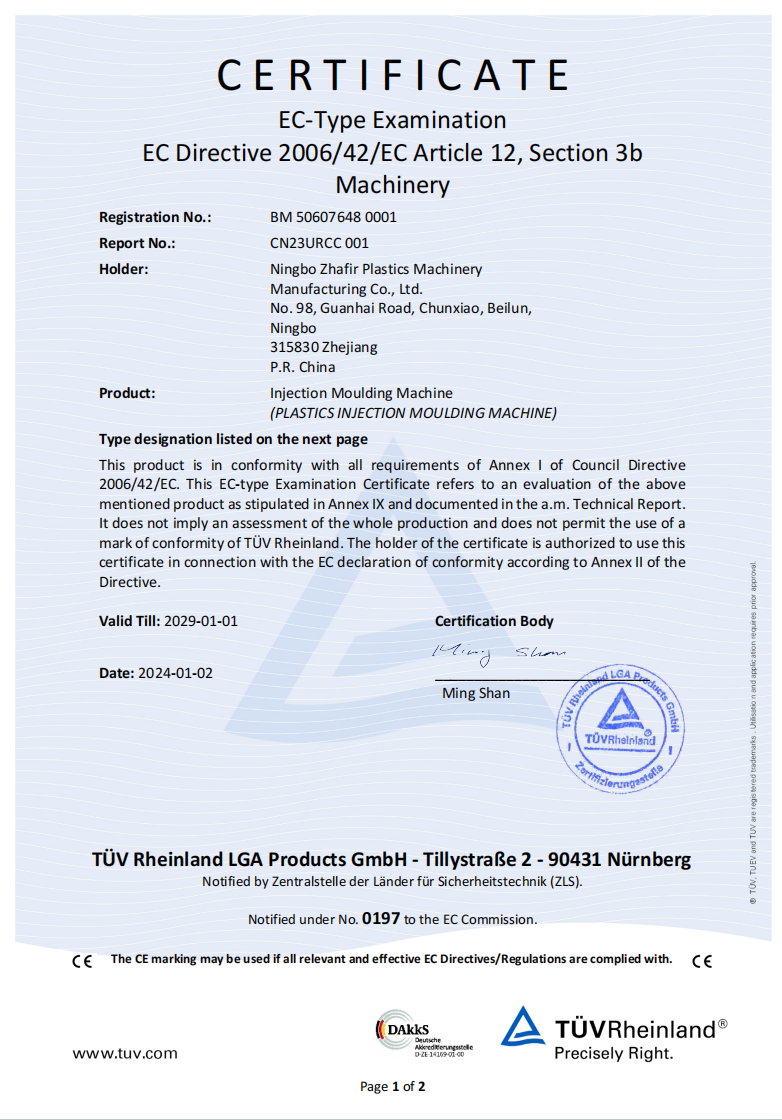
Buyers should confirm that the certificate scope matches the exact machine model and destination market, since a certificate issued for a machine range does not automatically extend to every configuration or every option package.
Limits and Trade-offs: What the Two-Platen Choice Does Not Solve
The clearest boundary between the two machines is the clamping force ceiling. The JE5 hybrid two-platen range reaches 33,000 kN, while the JU5 servo-hydraulic two-platen range reaches 88,000 kN. For the very largest molds and parts, that gap makes the JE5 unsuitable where clamping force requirements exceed its range, and the JU5 envelope becomes the relevant choice. Conversely, a buyer with a moderate large-part requirement may not need the top of the JU5 range at all.
Precision versus scale is a second trade-off. Hybrid and electric architectures are generally associated with high motion precision and cleaner operation, while servo-hydraulic machines remain established in high-force, large-part work. A hybrid machine is not automatically the better choice for every large part, and a servo-hydraulic machine is not automatically the better choice for every precision demand; the decision depends on the specific part, mold and quality requirement.
Two-platen is not the only format. Three-platen toggle machines remain widely deployed and can be an efficient answer for medium parts, with a different mold-height and footprint profile. Buyers comparing formats should weigh mold compatibility and their existing mold fleet rather than assuming the two-platen format replaces every alternative.
Configuration and integration also carry real effort. Customization and turnkey integration — automation, robotics, mold interface, process integration and third-party equipment integration — are engineered to the specific application rather than supplied off the shelf. Buyers should plan engineering and commissioning time proportional to the scope of the cell.
Future Outlook
The direction of travel for large-part machines is toward more connected and more energy-aware production. Haitian describes its role as expanding from a manufacturer of injection molding machines to a provider of integrated production systems and manufacturing ecosystems, combining injection molding technology, automation, auxiliary equipment, digital solutions and complementary technologies. Open interfaces and standardized communication protocols also allow third-party equipment to be integrated where required.
On the digital side, MES solutions enable production monitoring, process-data management and machine connectivity, while intelligent process technologies support setup, optimization and quality control. Documented examples already show this in practice: Haitian machines were integrated into Giebeler’s production and connected to its MES via standardized EUROMAP interfaces, improving real-time production transparency, reducing manual checks and supporting documented process stability and traceability. For large-part buyers, the practical question for the next machine may be less about clamping force alone and more about how the machine connects to the rest of the production cell.
One limit is worth stating plainly. Market-size and forecast figures in this category come from commercial research and should be treated as directional context, not as a procurement guarantee. Machine selection should be based on the buyer’s own part data, mold data and plant conditions, with final specifications confirmed against the specific application.
FAQ
How should a buyer choose between a servo-hydraulic two-platen and a hybrid two-platen machine for large automotive parts?
Begin with part and mold data — part size, mold dimensions, required clamping force, injection volume, precision, cycle time and plant space — then compare the available envelopes. The Haitian Jupiter Series JU5 covers 4,500–88,000 kN for very large parts and high clamping force. The Zhafir Jeres Series JE5 covers 3,500–33,000 kN with a hybrid drive and a two-platen clamping system, positioned for precision large-part work. The final configuration should be confirmed using the specific mold and process data.
What clamping force and injection specifications does the Haitian Jupiter Series JU5 provide?
The JU5 is a servo-hydraulic two-platen injection molding machine with a clamping force range of 4,500–88,000 kN, injection volume of 848–134,303 cm³, screw diameter of 60–300 mm, maximum daylight of 1,400–7,000 mm and tie-bar distance of 810 × 810 mm to 3,400 × 2,820 mm. It uses a KEBA controller.
Which materials can these two-platen machines process?
Both the JU5 and the JE5 handle engineering thermoplastics including PP, PE, ABS, PA, PC, PC/ABS, PMMA and TPE. The JU5 also handles filled and reinforced compounds depending on the plasticizing configuration, and the JE5 handles reinforced compounds depending on configuration.
What certifications should be verified before purchasing a large two-platen machine?
Buyers should verify that the machine’s conformity documentation matches the model and destination market. The Haitian group holds an EC-Type Examination CE certificate (No. BM 50607648 0001) issued by TÜV Rheinland LGA Products GmbH, valid to 2029-01-01, and a TUV Rheinland certificate (No. CU 72303354 0001) covering ANSI/PLASTICS B151.1-2017, NFPA 79:2021 and CSA C22.2 No. 301-2016 for the US and Canada. Management systems are certified to ISO 9001:2015, ISO 14001:2015, ISO 45001:2018 and ISO 50001:2018.
What testing and acceptance steps apply to a customized large two-platen machine?
Typical steps include factory testing, machine inspection before delivery, mold trials, initial sampling, process optimization, application testing and commissioning, with optional process monitoring and integrated quality inspection. These steps are configured according to the project scope.
Есть вопросы или нужны дополнительные детали?
Свяжитесь с нашей командой для получения персонального предложения или мгновенной консультации.
Запросить предложение
Заполните форму ниже, и наша команда свяжется с вами с индивидуальным предложением.
Прямой чат WhatsApp
Предпочитаете общаться в реальном времени? Напишите нам в WhatsApp для мгновенной помощи и быстрых ответов.
- Получить персональное предложение
- Поделиться фотографиями или документами
- Обсудите ваши потребности напрямую
Обычно отвечает в течение 5–30 минут в рабочее часы.