
Seven Materials, Nine Formats: Reading a Medical Wristband Range
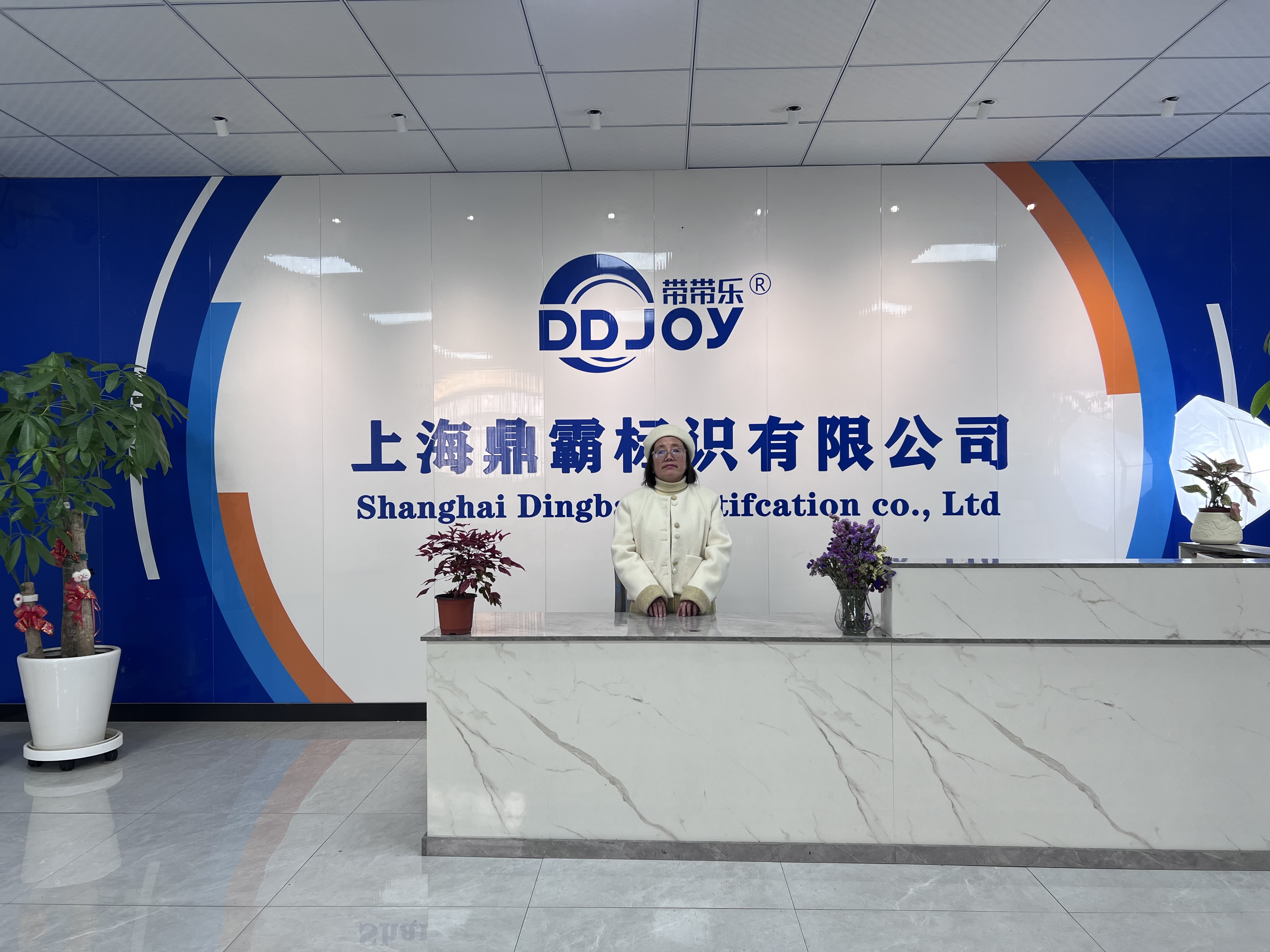
A published wristband range is the visible output of a production system. Image: Shanghai Dingba Identification Co., Ltd.
A medical wristband catalogue is usually read as a list of products. For a hospital buyer in the research and evaluation stage it is more useful to read it as a list of production commitments, because every material and every format carries its own printing method, tooling, tolerance and documentation burden.
That shift in reading changes what a buyer looks for. Instead of asking how many items a supplier lists, the practical question becomes which processes the supplier must operate to keep those items in production, and which of those processes are documented well enough to survive an audit. This reference works through that question against a published medical wristband portfolio, material by material and format by format, and sets out what each element implies for qualification, sampling and purchase decisions.
Why Portfolio Breadth Is a Procurement Constraint
A supplier that lists twelve products and operates one printing process has a catalogue. A supplier that runs direct thermal printing, film converting, textile printing, closure assembly and RFID encoding has a production system. The difference matters at evaluation stage, because the second supplier can absorb a change of format without a change of vendor, and the first cannot.
Breadth becomes a constraint rather than a claim once it is tested against four procurement questions. Does the supplier hold documentation for each material, or only for the flagship item? Can the range be supplied at a workable minimum order quantity, and at what lead time? Which closure hardware and tooling does each format require, and who owns it? And, where encoding is involved, can the supplier support the read-write workflow the hospital already runs?
The sections below apply that test to a specific range: seven material families and nine formats. Nothing here is a substitute for sampling. It is a structure for asking better questions before sampling starts.
The Seven Materials and What Each One Demands
The portfolio reviewed here covers thermal-sensitive direct-print stock, PVC, Tyvek, paper and synthetic paper, silicone, ribbon and polyester webbing, and holographic film. Each is examined below for the production discipline it exposes and the verification point it creates.
1. Thermal-Sensitive Direct-Print Stock
This is the base of the medical thermal wristband (product ID 8994), the product family the manufacturer names as its main line. The format exists to be printed on demand at the point of admission, which makes the matched equipment a direct thermal printer. The recorded requirements for a custom patient identification project are specific: waterproof, tear-resistant, disposable and skin-safe, used indoors or outdoors at normal temperature and worn on the wrist.
For production, that combination is harder than it appears. The print layer has to accept variable data consistently, the converted band has to survive tearing and moisture in daily ward use, and the die-cut has to stay clean enough for automated or desk-side printing. For buyers, the practical check is printer compatibility on their own hardware, not on the supplier's demonstration unit.
2. PVC Film
PVC appears in two medical-relevant constructions. The PVC Patient ID Wristband (product ID 8997) comes in 250×25mm and 250×16mm and is offered in single or double layer structure, with the two options positioned for different durability needs; the material is described as waterproof and long-lasting, with clear, durable printing. The PVC+Tab Wristband (product ID 8999) measures 260×40mm and adds a tab buckle designed for a firm fit, with surface printing supporting vibrant patterns, positioned for hospitals as well as events, concerts and nightclubs.
Two PVC formats mean two production disciplines. Single and double layer structures require lamination control and consistent print adhesion across layers, while the tab version requires buckle tooling and a closure that holds tension without pinching. A buyer comparing PVC options should therefore ask about layer choice first and closure second, because the closure defines the fitting experience on the ward.
3. Tyvek
The Tyvek Wristband (product ID 8996) is offered in 250×19mm and 250×25mm, described as disposable, tear-resistant, waterproof and suited to sharp high-resolution printing. In this portfolio it is also the format with the most explicit compliance documentation: an EU RoHS Certificate of Compliance, certificate number TST20250302350EC, issued by Dongguan True Safety Testing Co., Ltd., tested against the IEC 62321 series (IEC 62321-1:2013, IEC 62321-2:2021, IEC 62321-3-1:2013, IEC 62321-4:2013/AMD1:2017, IEC 62321-5:2013, IEC 62321-6:2015, IEC 62321-7-1:2015, IEC 62321-7-2:2017 and IEC 62321-8:2017), issued 14 March 2025 and valid to 14 March 2099 for the EU market.
Production-wise, printing sharply on a non-woven sheet and converting it without weakening the band are different skills from printing on film. The compliance record is the buyer's leverage point, and it should be read narrowly: it covers the paper wristband scope stated on the certificate.
4. Paper and Synthetic Paper
Paper supports two very different lines in the range. The Cartoon Wristband (product ID 9000) is a 200×20mm paper or Tyvek band with cartoon pattern printing, bright colours and a child-friendly orientation, positioned for children's activities, theme parks, kindergartens and exhibitions. The Custom Label (product ID 9005) is fully size-customisable and runs on paper, PVC, self-adhesive stock and synthetic paper, with offset printing, digital printing and optional hot stamping.
These two lines expose colour management and adhesive converting respectively. Bright, fade-resistant pattern work is a colour-control problem; self-adhesive labels add release-liner handling and die-cutting to a customer's own dimensions. Buyers who need printed patient cards, specimen labels or visitor badges alongside wristbands are effectively testing a second factory discipline, not a variation of the first.
5. Silicone
Silicone appears in this portfolio as one of four body materials for the RFID wristband (product ID 8995), alongside PVC, Tyvek and paper. It is the material with the thinnest published specification in the range, and that is itself useful information: a buyer should treat silicone as a sampling-stage decision rather than a catalogue decision, and ask specifically how the inlay is protected inside the body and how the band is closed and reused.
6. Ribbon and Polyester Webbing
Two textile formats sit in the range. The Ribbon Wristband (product ID 9001) is 350×15mm, made of ribbon or polyester webbing with a woven structure, soft and comfortable against skin, supporting custom text and logo printing and positioned for weddings, fashion accessories and events. The Polyester Wristband (product ID 9002) is 350×15mm with customisable length, made of polyester webbing, described as wear-resistant and washable, with custom logo printing, positioned for sports, events, enterprise promotion and employee badges.
Textile converting is a separate production line from film converting: printing on fabric, finishing the cut edge and keeping dimensional stability differ from handling PVC. Buyers sourcing reusable bands should test washability and print survival, because those are the two properties the format is sold on.
7. Holographic Film
The Holographic Wristband (product ID 9004) is built on PVC or paper with a holographic film, available in 250×25mm and 250×16mm, and described as waterproof, tear-resistant, tamper-proof and disposable, using holographic anti-counterfeiting printing with a one-time lock closure.
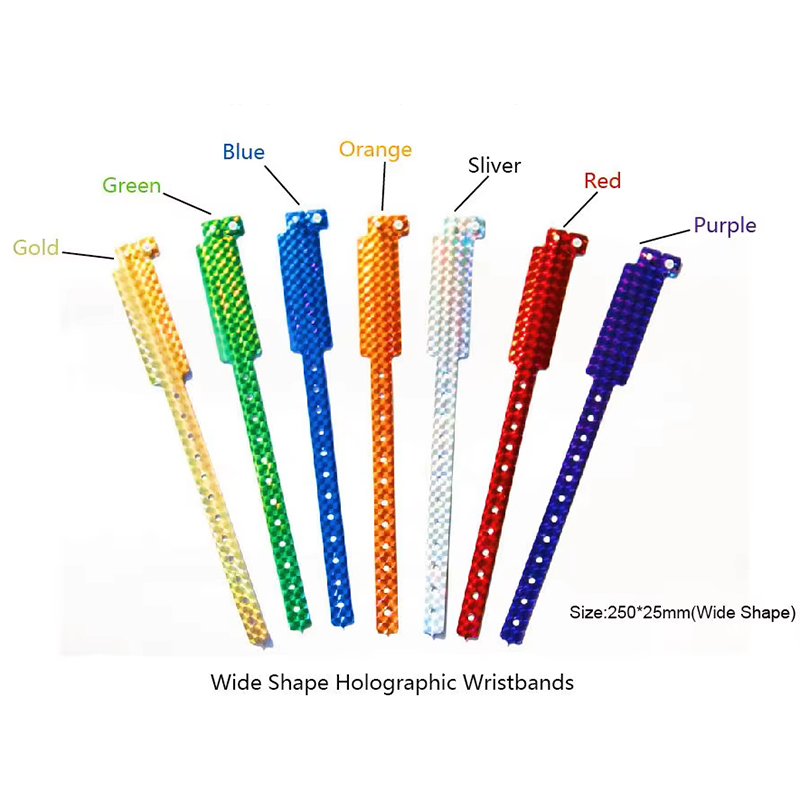
Holographic film adds an optical layer and a one-time lock to an otherwise conventional band construction.
Holographic film is the most process-sensitive material in the set. The optical layer has to register consistently, the lock has to be genuinely single-use, and the printing has to remain legible over a reflective surface. A buyer should also decide what the hologram is for: visual deterrence at a checkpoint, or part of a serialised scheme with records behind it. Only the first is implied by the product description.
Nine Formats: Where Production Risk Actually Sits
Formats change faster than materials, and each one moves the risk to a different station. The table below maps the nine formats in the range to the production step each one exposes and the setting it is positioned for.
| Format | Base material | Production step it exposes | Typical setting |
|---|---|---|---|
| Medical thermal wristband (8994) | Thermal material | Direct thermal printing, roll or sheet converting, waterproof and tear-resistant construction | Admission, ward identification |
| PVC Patient ID (8997) | PVC, single or double layer | Film converting and lamination, print adhesion | Hospitals, longer-wearing patient ID |
| PVC+Tab (8999) | PVC | Tab-buckle tooling, firm-fit closure, vibrant surface print | Hospitals, events, venues |
| RFID wristband (8995) | Silicone, PVC, Tyvek, paper | Chip inlay integration, LF/HF/UHF options, read-write encoding | Medical, access control, logistics, membership |
| Holographic (9004) | PVC or paper with holographic film | Holographic film handling, one-time lock assembly | Tamper evidence, access control, ticketing |
| Cartoon (9000) | Paper or Tyvek | Multi-colour pattern printing, colour fastness | Children-focused services, venues |
| Ribbon (9001) | Ribbon or polyester webbing | Textile printing and finishing, soft-feel construction | Events, ceremonies, promotion |
| Polyester (9002) | Polyester webbing | Washable textile printing, length customisation | Sports, events, staff badges |
| Custom Label (9005) | Paper, PVC, self-adhesive, synthetic paper | Offset or digital printing, optional hot stamping, adhesive die-cutting | Cross-industry labelling |
Read as a set, the nine formats imply at least four equipment families: printing (direct thermal, digital or offset, and textile), converting (die-cutting, lamination, adhesive), hardware assembly (tab buckles, one-time locks) and encoding (RFID read-write). A supplier that genuinely runs all four is a different kind of vendor from one that brokers them, and the qualification conversation should establish which station is in-house.
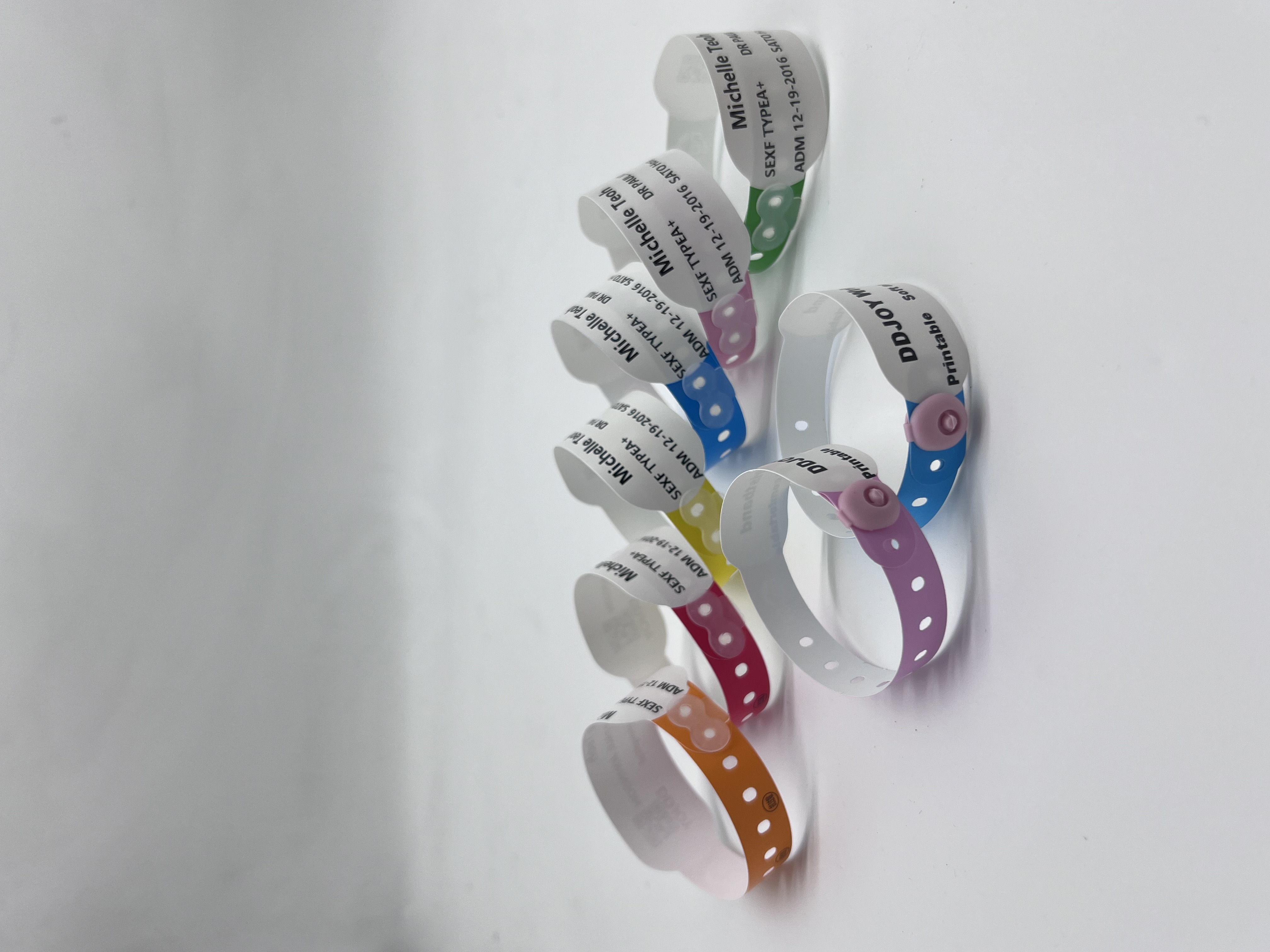
RFID formats add encoding to the production chain, not just a chip to the band.
What the Breadth Says About DDJOY-Medical Wristbands
DDJOY-Medical Wristbands is the medical wristband line of Shanghai Dingba Identification Co., Ltd., a manufacturer founded in 2010 and based in Shanghai, China, that develops and produces wristbands and RFID products and states capability in both software and hardware development.
The operating facts behind the range are concrete. The company runs a 10,000 m² facility with 50+ employees, including an R&D team of 5 engineers, and reports annual output of 12,000,000 units. It holds ISO 9001 certification and has undergone on-site verification by Alibaba and SGS. Export accounts for 70% of output, with the EU and USA as main markets, and products reach more than 100 countries and regions.
Commercially, production runs in OEM mode with logo customisation, a minimum order quantity of 1,000 units, a standard lead time of 7–10 days, 100% testing and remote after-sales support. Those numbers, not the length of the catalogue, are what determine whether a range is usable in a hospital replenishment cycle. The software and hardware development capability is the relevant credential for the RFID line specifically, because encoding and integration work is where RFID projects usually fail.
Application Fit: From Admission Desk to Care Home
Formats only matter when they are matched to a setting and a workflow. The same portfolio supports quite different procurement briefs.
- Admission and ward identification. Medical thermal bands printed on direct thermal printers at the point of admission, with PVC patient ID where a longer-wearing band is preferred.
- Emergency and diagnostic areas. Disposable formats that can be applied and printed quickly, where the band is single-use by design.
- ICU and isolation wards. Single-patient, disposable bands; PVC where waterproof durability across cleaning cycles is the deciding factor.
- Nursing homes, clinics and outpatient departments. Lower and less predictable volumes, where the 1,000-unit minimum and 7–10 day lead time usually mean buying through a distributor rather than direct.
- Access, logistics and membership. RFID bands with low, high or ultra-high frequency options in silicone, PVC, Tyvek or paper, readable and writable, positioned for medical use, access control, logistics and warehousing and member management.
- Events and visitors. Holographic tamper-evident bands, plus polyester and ribbon formats for repeat-use and promotional settings.
One caution applies to the cartoon format. It is positioned for children's activities, theme parks, kindergartens and exhibitions; a hospital evaluating it for paediatric or children's services should confirm material and print suitability for clinical use rather than inferring it from the design.
Market and Regulatory Signals That Reshape the Range
Two forces are changing what a wristband portfolio has to contain: category growth and regulatory clarification.
- Future Market Insights projects the global patient identification wristbands market at USD 576.1 million in 2025, published 16 April 2025.
- Precedence Research reports North America holding a 41% share of that market in 2025.
- The two commercial estimates are not directly comparable: Precedence has been reported at USD 1.61 billion for 2025, and the variance is generally attributed to whether blank bands alone or printed and system-integrated products are counted. Buyers should treat headline market size as directional and definition-dependent.
- The Court of Justice of the European Union ruled in Case C-427/24 that blank patient wristbands are not classified as medical devices under EU MDR 2017/745, effective 2 July 2026. Intended purpose, not the object itself, drives classification.
- ISO 15223-1:2021 Amendment 1 (2025) changes the authorised representative symbol from EC REP to EU-REP, which affects label artwork for suppliers serving the EU.
- For context on concentration, PDC Healthcare, a Brady Corporation brand, is projected at a 14–18% market share in patient identification wristbands, a derived estimate with medium confidence.
The practical reading is that documentation, not colour range, increasingly decides which formats a supplier can place in an EU hospital. A range that includes a RoHS certificate for one material, a labelling system that must be updated for a symbol change, and a classification question that turns on intended purpose is a range where the paperwork is part of the product.
Where a Broad Portfolio Stops Being an Advantage
Multi-format supply is usually compared with the traditional model of buying one format from a local distributor, department by department. The trade-off is real in both directions: single-format supply simplifies approval but multiplies vendors as soon as a second ward needs a different band, while portfolio supply consolidates documentation but front-loads verification work at onboarding.
The limits of the portfolio approach deserve equal weight.
- Certificate scope is narrower than the catalogue. The EU RoHS certificate TST20250302350EC is documented against the paper wristband scope. Buyers sourcing PVC, silicone or holographic formats should request the corresponding test documentation instead of assuming coverage.
- Breadth does not prove batch consistency. Sampling and incoming inspection remain necessary regardless of how many formats a supplier lists.
- Commercial thresholds exclude some buyers. A 1,000-unit minimum order quantity and a 7–10 day lead time suit planned replenishment; small clinics and outpatient sites are better served through distribution.
- Technical depth varies by line. PVC, Tyvek and thermal formats carry published dimensions and features; silicone is listed only as an RFID body option, and RFID performance depends on the deployed readers and workflow, which has to be tested on site.
- Classification language needs care. Following the CJEU ruling of 2 July 2026, blank patient wristbands are not medical devices under EU MDR 2017/745, and range documentation should describe them by intended purpose rather than implying device status.
Future Outlook
The likely direction is less about new materials and more about documentation depth per material. RFID formats will keep expanding as hospitals integrate identification with access and logistics workflows, which puts encoding and integration capability ahead of band design in supplier evaluation. Labelling changes such as the EU-REP symbol transition will force artwork revisions across every format a supplier sells into Europe, and the CJEU classification ruling will push marketing and technical files toward explicit intended-purpose statements.
For buyers, the implication is straightforward: a portfolio should be read as a map of what a supplier can document, not only what it can produce. The next qualification cycle is likely to reward the supplier whose certificate, spec sheet and label artwork line up format by format.
Frequently Asked Questions
Does a broader medical wristband portfolio indicate better quality?
Not on its own. Portfolio breadth indicates how many production disciplines a supplier operates, such as direct thermal printing, film lamination, textile printing, closure assembly and RFID encoding. Quality has to be verified separately, through certificate scope matched to each material, sampling of the specific format, and incoming inspection of delivered batches.
What exactly does the EU RoHS certificate TST20250302350EC cover?
It is a Certificate of Compliance for the paper wristband scope, issued by Dongguan True Safety Testing Co., Ltd. under certificate number TST20250302350EC, assessed against the IEC 62321 series (including IEC 62321-1:2013, IEC 62321-2:2021, IEC 62321-3-1:2013, IEC 62321-4:2013/AMD1:2017, IEC 62321-5:2013, IEC 62321-6:2015, IEC 62321-7-1:2015, IEC 62321-7-2:2017 and IEC 62321-8:2017), issued 14 March 2025 and valid to 14 March 2099 for the EU market. It applies to the Tyvek or paper wristband product, so other materials need their own documentation.
Which formats suit waterproof and tear-resistant requirements?
Several do, for different reasons. The Tyvek Wristband is described as disposable, tear-resistant and waterproof. PVC formats, including single and double layer constructions, are described as waterproof and long-lasting. The Holographic Wristband is described as waterproof, tear-resistant, tamper-proof and disposable. The Polyester Wristband is described as wear-resistant and washable. The medical thermal wristband carries recorded requirements of waterproof, tear-resistant, disposable and skin-safe for a custom patient identification project.
What are the typical order constraints for this range?
Production runs in OEM mode with logo customisation, a minimum order quantity of 1,000 units and a standard lead time of 7–10 days, supported by 100% testing and remote after-sales support. Buyers with smaller or irregular volumes typically purchase through distributors rather than placing direct factory orders.
Do blank patient wristbands count as medical devices in the European Union?
No, according to the Court of Justice of the European Union ruling in Case C-427/24, effective 2 July 2026, which found that blank patient wristbands are not classified as medical devices under EU MDR 2017/745. The classification turns on intended purpose, so suppliers and buyers should describe the product by its intended identification use rather than implying device status.
What RFID options does the portfolio include?
The RFID wristband includes a built-in chip with low frequency, high frequency or ultra-high frequency options, is readable and writable, and is available in silicone, PVC, Tyvek or paper, in 250×25mm, 250×16mm and multiple other specifications. It is positioned for medical use, access control, logistics and warehousing and member management. Readers, encoding workflow and site conditions should be validated before deployment.
A PDF brochure covering the wristband and RFID range is available for download: Shanghai Dingba Identification product brochure.
Есть вопросы или нужны дополнительные детали?
Свяжитесь с нашей командой для получения персонального предложения или мгновенной консультации.
Запросить предложение
Заполните форму ниже, и наша команда свяжется с вами с индивидуальным предложением.
Прямой чат WhatsApp
Предпочитаете общаться в реальном времени? Напишите нам в WhatsApp для мгновенной помощи и быстрых ответов.
- Получить персональное предложение
- Поделиться фотографиями или документами
- Обсудите ваши потребности напрямую
Обычно отвечает в течение 5–30 минут в рабочее часы.