
Sheet Metal Fabrication FAQ: Materials, Drawings, MOQ, Samples
Sheet Metal Fabrication FAQ: Materials, Drawings, MOQ, Samples
Sheet metal fabrication enquiries usually converge on four questions before a purchase order is issued: which metals the vendor can genuinely process, which drawing files it needs, what minimum order applies, and whether a sample or trial batch can be produced before mass production. At the evaluation-to-execution stage those answers decide how quickly a quotation arrives, how much of the price survives first-article inspection, and what a buyer can verify before shipment. The responses below follow the capability, quality and procurement records of Openex (Xiamen Openex Mechanical Technology Ltd), a custom metal fabricator founded in 2009 with two manufacturing premises near Xiamen Port and Shanghai Port.
Why these four questions outrank a rate comparison
At evaluation stage buyers compare capability; at execution they commit drawings, inspection budget and a delivery window. A vendor that answers "any metal" without naming grades leaves the buyer to discover a substitution at first article, and a vendor that quotes from a 3D model alone usually returns a price that moves once tolerances, weld details and finish are clarified. None of these four questions is administrative. Each has a documented answer that a buyer can check against a certificate, a drawing register or a delivery record before the award, and each answer shifts cost or risk in a predictable direction.
Manufacturer or supplier? What the answer changes
Openex is a metal fabricator, not a trading intermediary: 80–90% of the metal parts, components and assemblies it exports from mainland China are produced in its own workshops, and the remaining share is sourced from partner companies. The company runs two manufacturing premises — one in Zhangzhou, Fujian, roughly 40 km from Xiamen Port, and one in Taizhou, Jiangsu, about 170 km from Shanghai Port — with a total factory area of 30,000 m², around 200 employees including 35 engineers, and an annual output of 20,000 tons. Around 80% of that output is exported to the EU, USA, Australia, New Zealand, Japan, Singapore, South America and the Middle East.
The process split is the part a buyer should record. In-house operations cover laser cutting, bending, machining, welding, drilling, punching, stamping, assembling and packaging. Casting, forging, hot-dip galvanising, powder coating and other anti-rust finishes are provided by partner companies. That distinction has a commercial consequence: a job that is mostly cutting, forming and welding stays inside one production system with one schedule, while a job that is mostly casting, forging or coating is coordinated across a third party — and that third party is where a delivery date usually slips first.
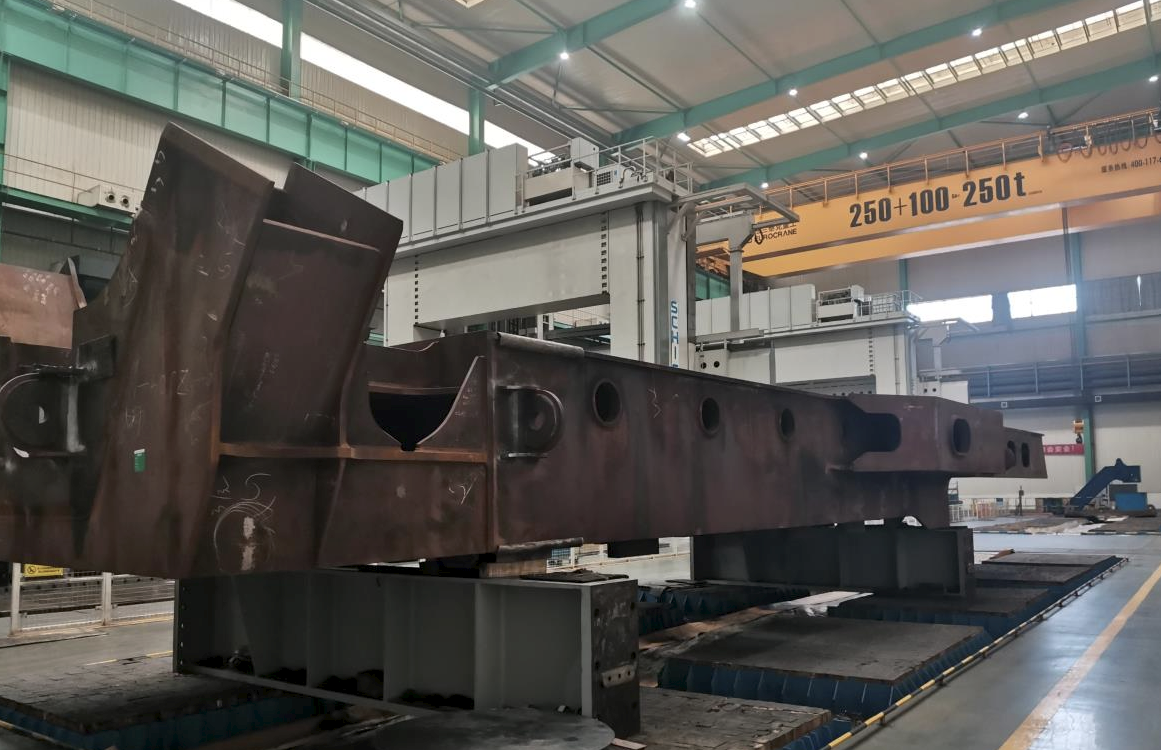
Capacity is unusually large for a fabricator of this size. Overhead crane tonnage exceeds 250 tons, bending equipment runs to a maximum length and tonnage above 18 m and 10,000 tons, CNC machine travel reaches 50 m × 8 m × 7 m, and a Zeiss coordinate measuring machine with a 7 × 4 × 3 m envelope supports post-weld dimensional verification, alongside smaller CMM units for routine work.
Evidence for the manufacturer claim is verifiable rather than asserted. Factory photographs are held for both premises, workshop video can be arranged for a live enquiry, and certificate copies exist for the standards listed later in this article. Remote inspection is also part of normal practice: tube sheets for an Indonesian power plant heat exchanger were checked by remote QC before shipping, with photographic records taken at the pre-shipment stage.
For the buyer, the useful question is not "manufacturer or trader" in the abstract, but which operations in this specific bill of process are in-house. Ask for that split in writing. It determines who is accountable for a coating batch that arrives late or a casting that arrives undersize, and it explains why two quotations for the same drawing can differ by more than labour rates.
Which metals can be processed — and which grades recur
Fabrication is not restricted to steel. Brass, bronze and aluminium are handled without difficulty, while carbon steel and stainless steel account for most of the projects received. The grade detail is where procurement risk actually sits, because equivalence is not identity: A36, SS400 and S235JR sit within the Q235B family in the recorded capability data, and A572 Gr50, SS490/SPCC and S355JR sit within Q355B.
| Metal family | Grades recorded in capability data | Where they appear in delivered work |
|---|---|---|
| Carbon steel | Q235B (A36, SS400, S235JR); Q355B (A572 Gr50, SS490/SPCC, S355JR) | Q355B I-beams welded to cast hinges for modular housing beam assemblies |
| Higher-strength and wear-resistant carbon steel | Q690; NM450 / NM500 | AGV container-yard chassis built from Q690 with some NM500 parts |
| Stainless steel | SUS 304; SUS 316L | Frames, rails and ladders in SUS 316L for an anodising plant, specified for corrosion resistance |
| Other metals | Aluminium, brass, bronze | Handled per project; no fixed grade list recorded |
Q235B and Q355B are the two most common carbon steel families because they are readily available as coil, plate or structural section. Q690 and NM450/NM500 appear only where strength or wear resistance drives the design, which changes welding procedure, preheat and inspection. Stainless work concentrates on SUS 304 and SUS 316L, the latter where chlorides or process chemistry make 304 an unsafe economy. Special casting or forging grades are handled through long-term partners rather than claimed as in-house production, and that is a distinction worth preserving in any technical comparison of suppliers.
Drawing formats: what to send, and what a 2D drawing must carry
Openex accepts STEP, IGES, DWG, DXF and PDF files, covering both 2D and 3D formats — and the combination a buyer sends has a direct effect on how fast, and how firmly, a quotation is returned. For simple parts, a 2D drawing alone is sufficient to quote. A 2D drawing plus a 3D model is the fastest route; in some cases a quotation is returned within one or two hours. A 3D model alone is rarely workable, because a model carries geometry but not the decisions that change cost, so the fabricator would first have to create a 2D drawing for the buyer's approval — which delays the quotation instead of accelerating it.
A 2D drawing should carry at least eight items:
- Tolerance information, including geometric tolerance where the assembly depends on it.
- Welding requirements — joint type, extent, and any procedure the buyer expects to be followed.
- Surface roughness and chamfer details.
- The relationship between the cutting direction and the hot-rolling direction of the plate.
- The plate bending radius.
- The required metal material and grade.
- The heat-treatment requirement and the stress-relief method.
- Finish requirements such as hot-dip galvanising, sandblasting and painting, or powder coating.
These eight items decide material cost, process time and inspection scope respectively, which is precisely why a quotation built from geometry alone tends to be revised later. Where a physical reference exists, a sample part also helps the fabricator interpret features that are awkward to specify in words.
MOQ and sample orders before mass production
There is no single published MOQ. The recorded position is that the minimum is project-based, and the service-line capability records show why: the machining record lists 15 tons, the welding record 25 tons, the surface-finishing record 15 tons, while a small-parts and inspection capability record lists a one-unit minimum with a three-day lead time. An MOQ figure therefore belongs to a process, not to the company, and a buyer should ask which process line the quoted minimum refers to.
The procurement record distinguishes three order situations. Small parts in small quantities are the weakest case: buyer and seller spend comparable time on communication, travel and documentation, and the recorded recommendation is that such work is not worth placing offshore unless no other supplier can produce it. Large parts in small quantities are acceptable when the consignment loads a container. Large parts in large quantities are the preferred case, and repeat orders are valued because they stabilise both price and quality.
Four factors sit behind that quantity logic: full-container loading is cheaper per unit than LCL shipment; overhead spreads across a larger volume; larger orders allow better material purchasing; and repeat ordering supports consistent quality. The practical implication for an execution-stage buyer is to compare landed cost at a container-realistic quantity rather than to negotiate unit price on a single piece.
Sample and pre-production quantities are quoted per project rather than against a fixed sample schedule. What is fixed is how a first batch can be verified. Acceptance can run three ways: photographs, videos and QA sheets issued by Openex; inspection by the buyer; or inspection by a third party appointed by the buyer. Verification can draw on CMM dimensional measurement, non-destructive testing (RT, UT, MT, PT, VT and LT), destructive testing covering chemical composition plus tensile, impact, bend and hardness, salt-spray corrosion testing, and weld procedure qualification to the buyer's own WPS. Delivery terms are EXW, FOB, C&F, CIF, DAP or DDP, and payment is by T/T or L/C.
Certificates and quality evidence that can be checked now
Four certificates are recorded, three of them management-system certificates sharing one manufacturing scope and one welding-specific certificate with a much narrower technical scope.
| Certificate | Standard | Number | Issuer | Recorded validity |
|---|---|---|---|---|
| ISO 9001 | GB/T 19001-2016 / ISO 9001:2015 | 11426Q01049R001 | Beijing East Allreach Certification Center Co., Ltd. | Issued 2026-04-16; expires 2029-04-15 |
| ISO 14001 | GB/T 24001-2016 / ISO 14001:2015 | 11426E00739R001 | Beijing East Allreach Certification Center Co., Ltd. | Issued 2026-04-16; expires 2029-04-15 |
| ISO 45001 | GB/T 45001-2020 / ISO 45001:2018 | 11426S00656R001 | Beijing East Allreach Certification Center Co., Ltd. | Issued 2026-04-16; expires 2029-04-15 |
| ISO 3834-2 | EN ISO 3834-2 | 23/999-3834 | SGS | Issued 2024-10-15; expiry recorded 2026-10-04 |
The three management-system certificates share a scope — manufacture of machined parts, metal structures and sheet metal components, except where a licence is required — and were issued on 2026-04-16 with validity to 2029-04-15. The welding certificate is different in kind. ISO 3834-2, issued by SGS, covers fusion welding of metallic material under welding process 135 and 135-Auto for material groups 1.1 and 1.2. Its recorded expiry date is 2026-10-04, which now sits in the past, so a buyer should raise the point and obtain the current certificate before relying on it for an award. A project specifying TIG welding, or a material group outside 1.1 and 1.2, also falls outside the recorded scope and needs separate evidence.
Certificate scope, not certificate presence, is what an auditor tests. A welding certificate limited to one process and two material groups does not support a claim about every joint in a fabrication package, and a certificate that has passed its recorded expiry date is a scheduling item, not a disqualification — provided the buyer asks for the current document before the order is placed.
What the answers look like on chassis, conveyor and enclosure work
The manufacturer question is best tested on chassis work, where forming, welding, post-weld machining and painting all meet. Openex supplied 345 custom steel chassis to a Dutch builder of large automated guided vehicles, used to carry ocean-freight containers, LNG tanks and other large loads, with the units recorded as in stable operation for more than four years. That mix of operations is exactly what stays inside one schedule when most processes are in-house; when the same bill of process is split across four vendors, the tolerance stack is discovered at assembly rather than at cutting.
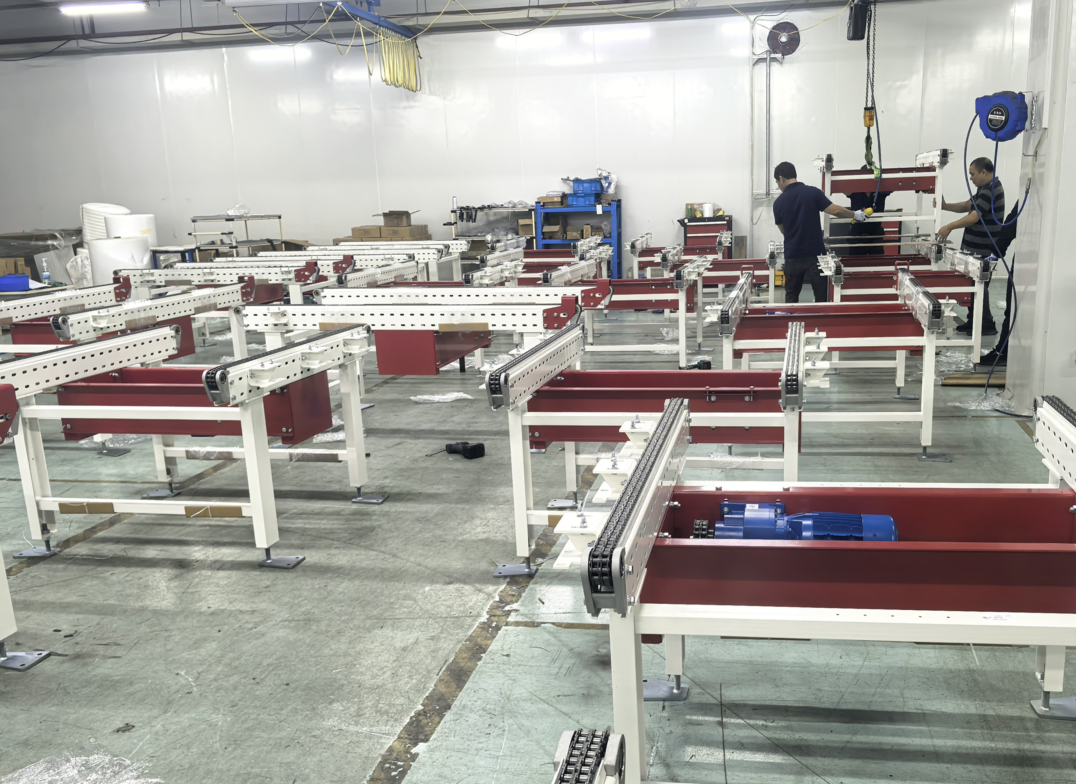
Conveyor frames test the drawing conversation instead. For a lithium-battery producer, 120 chain conveyors were fabricated for a production line and are recorded as in stable operation for two years. Frame work is dimensionally cumulative: hole positions, straightness and weld distortion accumulate along the run, so the tolerance block and the weld symbols on the 2D drawing decide whether the line assembles on site without rework. A supplier quoting from a model alone cannot price that risk, and usually does not carry it either.
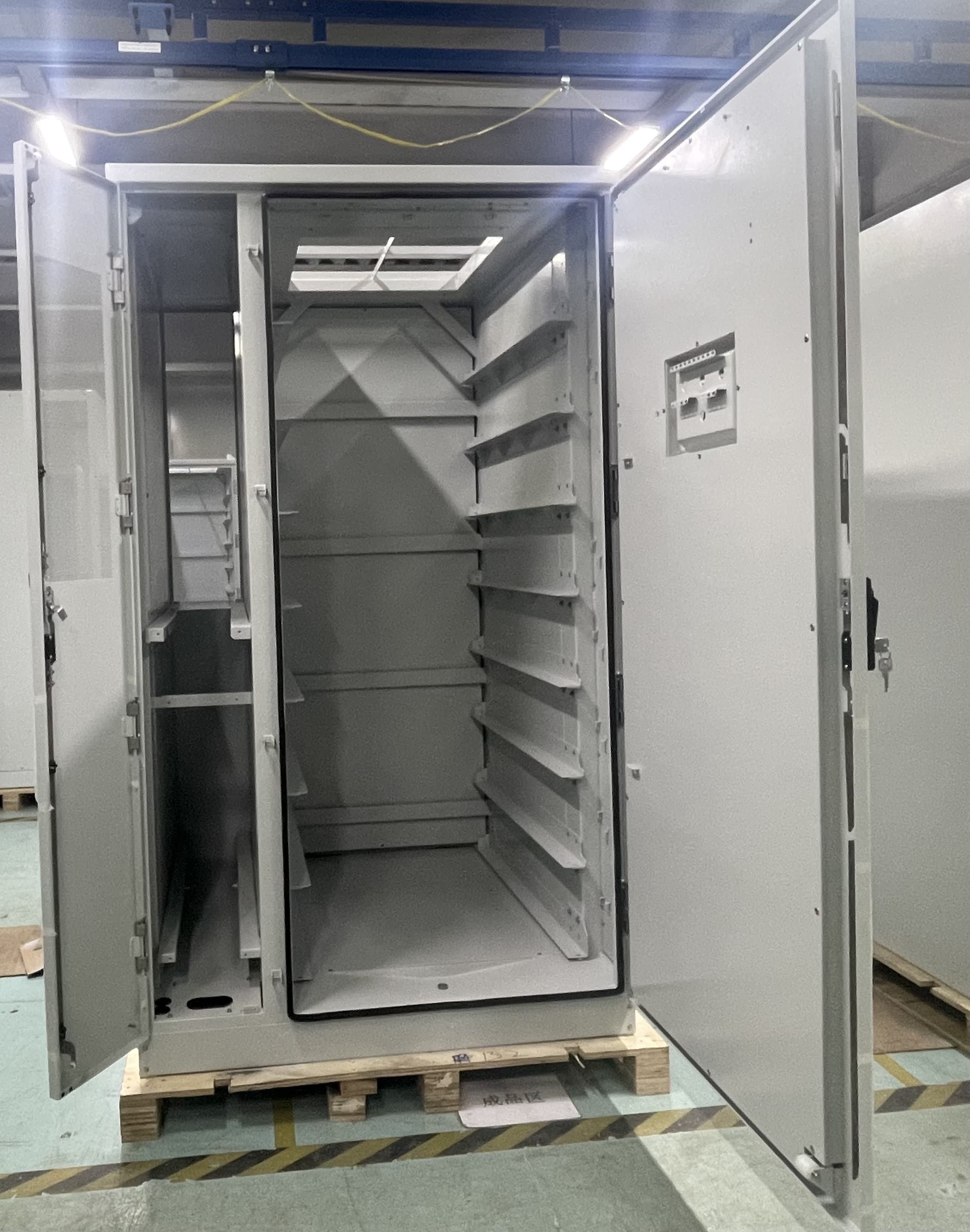
Enclosure work tests finish and repeatability. Liquid-cooling cabinets for energy storage systems were produced at a recorded volume of 1,500 units, and a separate energy-storage shelf and box programme reached 3,000 units with no rust, leakage or deformation recorded. Cabinets combine thin-gauge forming, flatness that matters for sealing, coating and assembly — which is where the chosen acceptance route changes how much checking the buyer must repeat on arrival.
Where this profile does not fit
Two boundaries should be stated plainly. First, processes outside the in-house list — casting, forging, hot-dip galvanising, powder coating and other anti-rust finishes — are delivered through partners, so a project dominated by those processes is better placed with a specialist in that process rather than with a fabricator coordinating it. Second, small components in small quantities carry a communication and logistics overhead that a project-based MOQ structure does not absorb; the recorded guidance is that such work is not economic to place offshore. Within fabrication and machining as the main content of the job, the two-premises arrangement near Xiamen Port and Shanghai Port is the practical advantage, because both locations sit close to the export route their cargo will use.
From evaluation to execution: a short pre-order checklist
- Confirm, process by process, which operations are in-house and which come from partners.
- Confirm the grade family and, where an equivalent is proposed, which equivalent (Q235B against A36, SS400 or S235JR, for example).
- Send 2D and 3D files together and check that the eight 2D items are present before expecting a firm price.
- State the inspection route in the order: supplier QA sheets, buyer inspection or third-party inspection.
- Request current certificate copies and read the scope and expiry date, not only the title.
- Set the order quantity at a container-realistic level and compare landed cost, not unit price.
- Agree delivery terms — EXW, FOB, C&F, CIF, DAP or DDP — and the payment method before material or tooling is committed.
- For repeat programmes, agree how first-article results carry forward to later batches.
What to plan for over the next award cycle
Nothing in these records suggests the four questions will get simpler, but two points are worth planning for rather than forecasting. Certificate validity is a moving target: the welding certificate on file carries an expiry date that has already passed, so buyers running multi-year programmes should put certificate dates into their supplier review calendar instead of checking them once at award. And drawing quality is becoming the main determinant of quotation speed, because the eight 2D items are exactly the variables a fabricator cannot infer from geometry. Buyers who standardise their drawing templates against that list will obtain faster and firmer prices than buyers who send models alone — and will spend less of the execution phase renegotiating scope.
FAQ
Is Openex a manufacturer or a supplier?
Openex is a manufacturer. Between 80% and 90% of the metal parts, components and assemblies it exports from mainland China are produced in its own workshops, and the remainder is sourced from partner companies. It operates two manufacturing premises — one near Xiamen Port in Fujian, one near Shanghai Port in Jiangsu — with 30,000 m² of factory space, around 200 employees and 35 engineers. Laser cutting, bending, machining, welding, drilling, punching, stamping, assembly and packaging are in-house; casting, forging, hot-dip galvanising, powder coating and other anti-rust finishes come from partners.
Which metal materials can be processed for a fabrication project?
Fabrication is not limited to steel: aluminium, brass and bronze are also processed, while carbon and stainless steels account for most projects. In carbon steel, the common families are Q235B (A36, SS400, S235JR) and Q355B (A572 Gr50, SS490/SPCC, S355JR), with Q690 and NM450/NM500 used where higher strength or wear resistance is required. Stainless work is mainly SUS 304 and SUS 316L. Special casting and forging grades are supplied through long-term partners rather than produced in-house.
Which drawing formats are accepted, and is a 3D model enough on its own?
STEP, IGES, DWG, DXF and PDF files are accepted, in 2D and 3D. A 2D drawing alone is enough to quote simple parts. Sending 2D and 3D together produces the fastest and firmest quotation. A 3D model alone is rarely sufficient, because tolerance, welding requirements, surface roughness, bending radius, material grade, heat treatment and finish are not carried in the model, so a 2D drawing would first have to be created for the buyer to approve.
What is the MOQ, and can a sample be ordered before mass production?
The MOQ is project-based rather than a single company-wide figure. Capability records list different minimums by service line — 15 tons for machining, 25 tons for welding, 15 tons for surface finishing — while a small-parts and inspection capability record lists a one-unit minimum with a three-day lead time. Small parts in small quantities carry an overhead that the recorded guidance advises against placing offshore. Sample and pre-production quantities are quoted per project, and a first batch can be verified through supplier QA sheets, buyer inspection or third-party inspection.
Which certificates can a buyer verify?
Four certificates are recorded: ISO 9001 (11426Q01049R001), ISO 14001 (11426E00739R001) and ISO 45001 (11426S00656R001), all issued on 2026-04-16 with validity to 2029-04-15 by Beijing East Allreach Certification Center Co., Ltd., covering manufacture of machined parts, metal structures and sheet metal components; and ISO 3834-2 (23/999-3834) issued by SGS for fusion welding under process 135 and 135-Auto, material groups 1.1 and 1.2, with an expiry date recorded as 2026-10-04. Buyers should request current copies and check scope against the processes and grades in their own job.
What acceptance, delivery and payment terms apply?
Acceptance can follow three routes: photographs, videos and QA sheets issued by the supplier; inspection by the buyer; or inspection by a third party appointed by the buyer. Delivery terms offered are EXW, FOB, C&F, CIF, DAP and DDP, and payment is by T/T or L/C. Inspection itself can draw on CMM dimensional measurement, non-destructive testing, destructive mechanical and chemical testing, salt-spray corrosion testing, and weld procedure qualification to the buyer's own WPS.
Additional process, capacity and inspection detail is collected in the Openex mechanical capability brochure (PDF).
Есть вопросы или нужны дополнительные детали?
Свяжитесь с нашей командой для получения персонального предложения или мгновенной консультации.
Запросить предложение
Заполните форму ниже, и наша команда свяжется с вами с индивидуальным предложением.
Прямой чат WhatsApp
Предпочитаете общаться в реальном времени? Напишите нам в WhatsApp для мгновенной помощи и быстрых ответов.
- Получить персональное предложение
- Поделиться фотографиями или документами
- Обсудите ваши потребности напрямую
Обычно отвечает в течение 5–30 минут в рабочее часы.