
Shell and Tube Heat Exchanger: What Buyers Must Verify
A shell and tube heat exchanger is a pressure-boundary component, and its cost, delivery time and service life are fixed by four decisions taken before any plate is cut: the design code, the wetted materials, the mechanical configuration and the inspection dossier. None of the four can be read from a model number, because in custom chemical equipment every one of them is project-specific.
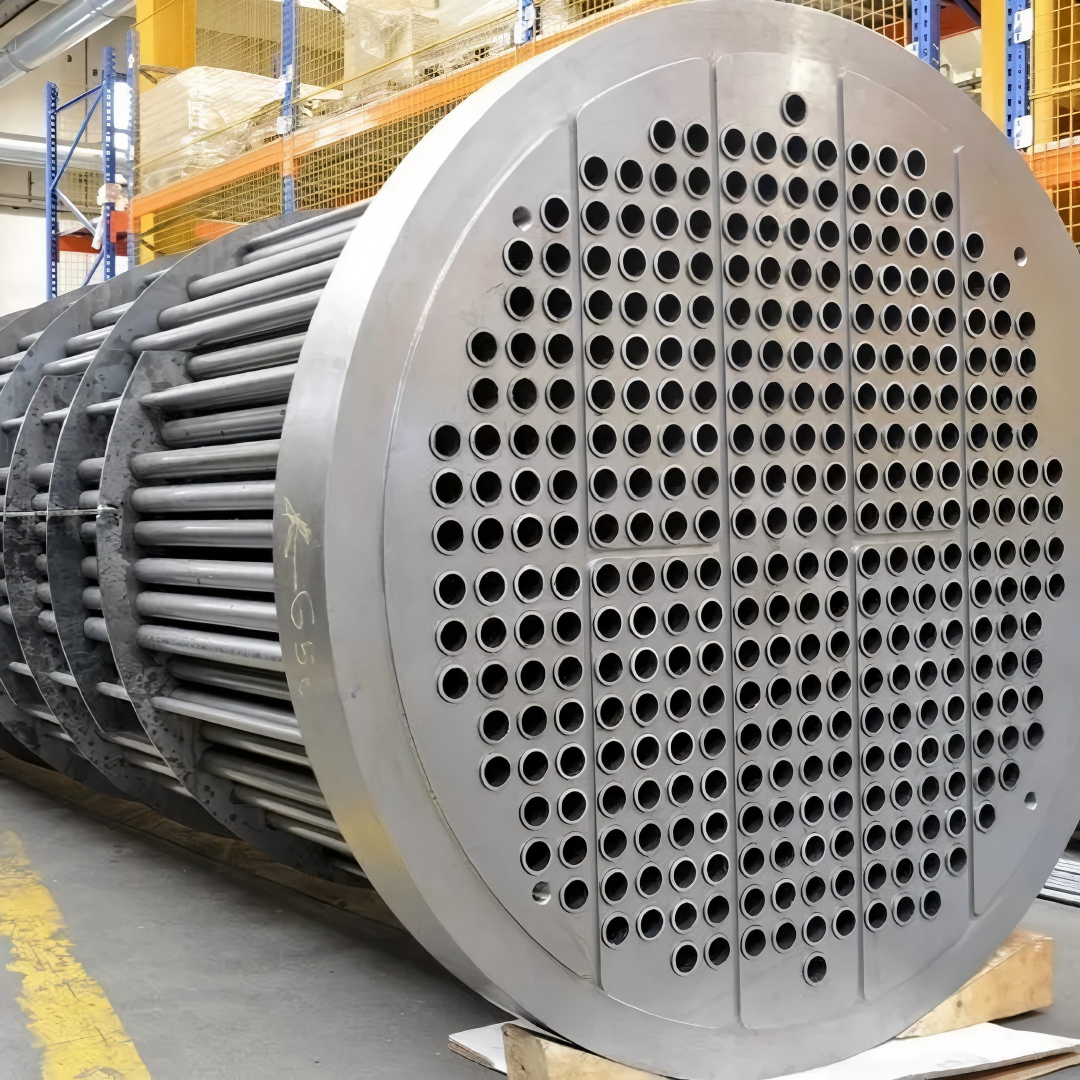
That is the central constraint in this category. Heat transfer area, heat transfer capacity, design pressure, design temperature, tube diameter, tube length, tube count and tube passes are all customized values in the shell and tube heat exchanger specification published by Jiangsu Xuyang Chemical Equipment Co., Ltd., a chemical equipment manufacturer established in 2009 and based in the Jingjiang Economic and Technological Development Zone, Jiangsu Province, China. The buyer's task is therefore not to select a size from a list. It is to fix a constraint set that a fabricator can engineer against, and then to verify that the fabricator can evidence it.
The constraint most often left open: the design code
Design standard is the first decision because it changes the documentation, the material allowances and the acceptance route. Xuyang lists ASME, GB, EN and TEMA as design standards for its shell and tube heat exchangers, with ASME and TEMA listed as optional standards. Optional is the operative word: if a purchase order does not state the code, the exchanger is not being bought against it.
An engineering summary of the ASME framework describes Boiler and Pressure Vessel Code Section VIII as governing the design, analysis, fabrication, inspection and testing of pressure vessels, including heat exchangers, reactors, filters and specialty vessels. That scope is why code selection sits upstream of the thermal calculation rather than beside it. It is also why quotations for visually similar exchangers can diverge: Fortune Business Insights estimates that compliance with ASME can represent up to 20% of a pressure vessel's total material cost. Part of the price gap between suppliers is not commercial margin but the cost of a code route.
For procurement, the practical rule is simple: name the code, name the edition in force at the contract date, name the inspection body, and require the certificate scope to be shown for the specific equipment being purchased. Codes that are listed as options are not applied by default.
Materials are chosen per side, not per unit
A shell and tube heat exchanger contains two fluid paths that are usually unrelated chemically. The shell side and the tube side therefore need separate material decisions, and the published specification treats them separately. In Xuyang's data, shell material options are carbon steel, SS304, SS316L and Hastelloy, while tube material options are SS304, SS316L, titanium, Hastelloy or a customized material. SS316L is stated as available for either the shell or the tubes; Hastelloy is positioned for aggressive process media on either side; titanium is positioned as a tube material for corrosive process streams.
| Material | Shell side | Tube side | How the specification positions it |
|---|---|---|---|
| Carbon steel | Available | Not listed | Shell-side option for non-aggressive service |
| SS304 | Available | Available | General stainless option on both sides |
| SS316L | Available | Available | Stated as available for shell or tube service |
| Hastelloy | Available | Available | Positioned for aggressive process media |
| Titanium | Not listed | Available | Positioned as a tube material for corrosive streams |
| Customized | Case by case | Available | Confirmed against medium data in the technical agreement |
The buyer-facing consequence is that a single material grade stated on a quotation is ambiguous unless it says which side. Two further configuration points belong to the same layer: a double-tube-sheet configuration is listed in the company's heat transfer portfolio, and should be raised explicitly where a barrier between shell-side and tube-side fluids is a requirement rather than a preference. The published material-determination procedure is also sequential rather than guesswork: confirm the working medium, its composition and concentration, operating and design temperature, operating and design pressure or vacuum, required capacity, and corrosion or hygiene requirements, then evaluate suitability and finalize the grade.
Configuration decides maintenance more than duty
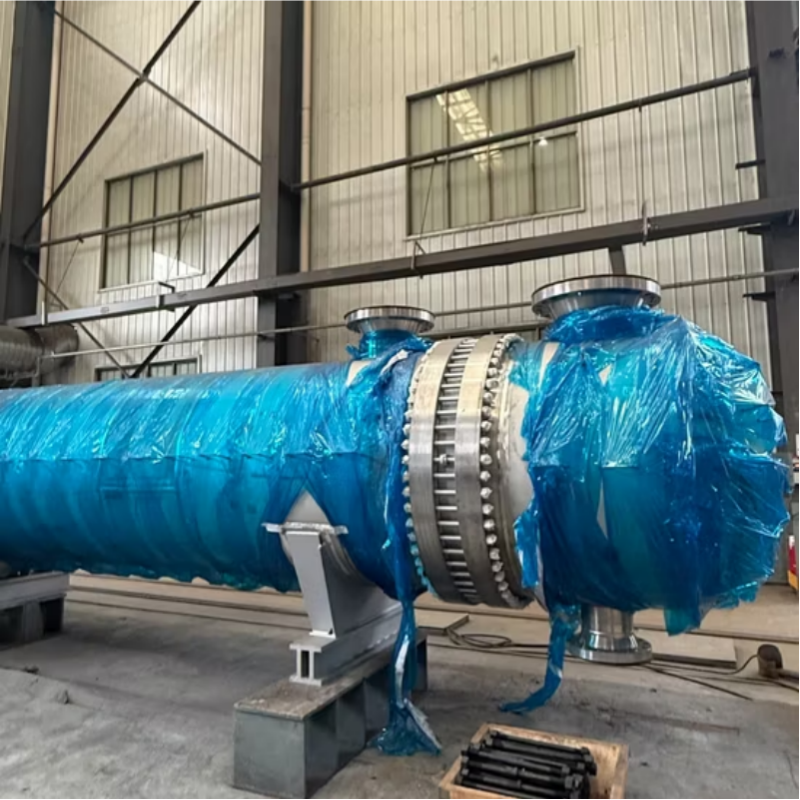
Three conventional bundle types are offered for this exchanger: fixed tube sheet, floating head and U-tube. Around them the specification also exposes tube passes of 1, 2, 4 or customized, triangular or square tube arrangement, segmental or helical baffles, flanged or customized connections, and horizontal or vertical installation. These are not cosmetic variations. They set how the unit is cleaned, how it accommodates differential expansion, and how much of it can be removed on site.
| Configuration | What it buys | Where it falls short |
|---|---|---|
| Fixed tube sheet | Fewer sealing points, simpler construction, compact envelope | Restrained differential expansion and limited access to the outside of the tubes for mechanical cleaning |
| Floating head | Bundle can be withdrawn; thermal expansion is accommodated | More sealing interfaces and higher mechanical complexity, which raises cost and inspection effort |
| U-tube | Free expansion with a removable bundle and a single tube-side closure | Cleaning inside the bend region is difficult and the tube layout is less flexible than a straight-tube bundle |
These trade-offs are general to the configuration types, not a ranking of suppliers. The selection belongs to the thermal and mechanical design, and it should be justified in the technical agreement rather than left to purchasing preference.
Inspection: what the dossier should actually contain
For pressure-boundary equipment, the inspection route is part of the product. Xuyang states that it uses plasma and deep penetration automated welding, and that vessels undergo X-ray detection as a non-destructive test, hydraulic pressure testing and surface roughness inspection. For skid-mounted systems that integrate heat exchangers with reactors, tanks, filters and pumps, factory acceptance testing, hydrostatic testing and leak testing are listed, with the system assembled and tested in the factory before shipment.
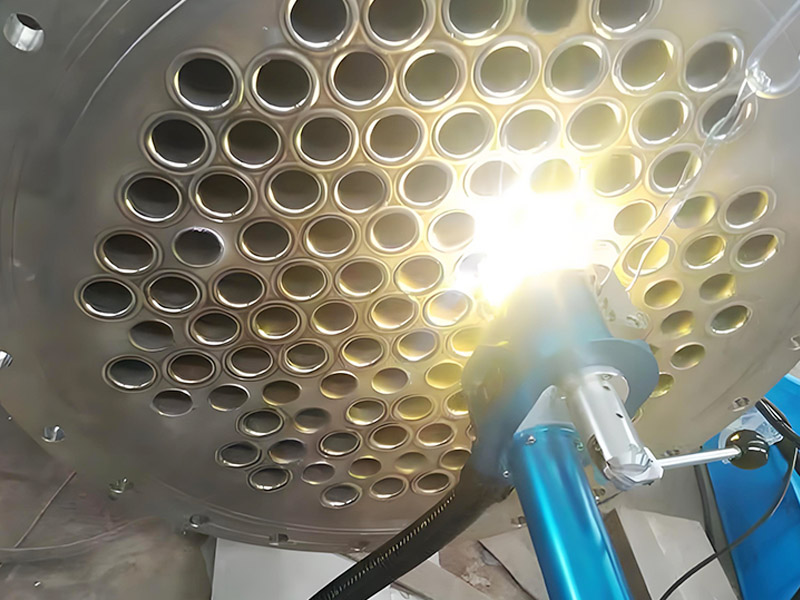
One boundary deserves emphasis. The published capability data states that weld inspection, pressure testing, factory acceptance and documentation-package details require confirmation per order. Buyers should therefore treat the dossier as a negotiated deliverable, not an assumption: material certificates, non-destructive test reports, pressure-test records, surface-finish measurements where relevant, and the final as-built drawing set should be listed by name in the purchase order.
What Jiangsu Xuyang supplies within this constraint set
Jiangsu Xuyang Chemical Equipment Co., Ltd. is a Chinese chemical equipment manufacturer founded in 2009 that integrates research and development, engineering design, equipment manufacturing and import and export trade. The company operates a 10,000 m² facility with 110 employees, a seven-engineer R&D team and a stated annual output of 1,000 units, and serves markets including the EU, the USA, Russia and Asia. Its product portfolio spans reactors, storage tanks, shell and tube heat exchangers, towers, candle filters, membrane separation and filtration equipment, corrosion-resistant lined equipment, evaporation and crystallization systems, water treatment equipment and skid-mounted equipment.
On the qualification side, the company holds an A2-level Special Equipment Design and Manufacturing License, and ISO 9001, ISO 14001 and ISO 45001 management-system certification. Its ASME Certificate of Authorization, number 62646, is issued by The American Society of Mechanical Engineers and includes the U Stamp for pressure vessel manufacturing, with an issue date of 10 September 2025 and an expiry date of 10 September 2028; the certification data records applicability to the USA and Russia markets. The certificate is recorded against pressure vessel manufacturing and references the membrane separation and filtration equipment product, which is precisely why a buyer should request the certificate copy and confirm in writing that the specific exchanger falls inside the authorized scope.
Manufacturing data relevant to procurement planning: minimum order quantity of one unit, a stated lead time of 30 to 60 days, and monthly capacity of 100 units. Customization covers capacity and structure, 304 or 316L stainless steel, Hastelloy or titanium, jackets and coils, electric heating, paddle, frame or high-shear agitation, mechanical or magnetic seals, explosion-proof configuration, and skid integration and connection layout. Export support is available in English, Russian, Arabic and Turkish. Related patented technologies include a heat exchanger for heat recovery and a shell and tube condenser, and the company reports industry-university-research cooperation with Nanjing Tech University, China University of Petroleum and Soochow University.
Where these exchangers are applied
The published application scope for this equipment covers chemical, fine chemical, petrochemical, pharmaceutical, new energy and battery materials, oil and gas, food and beverage, biochemical, agrochemical, dyes and pigments, polymer and resin, water treatment and environmental protection. In practice, the exchanger is usually one component of a wider process train — condensation on a distillation tower, heat recovery ahead of an evaporator, cooling after a reactor, or temperature control inside a skid-mounted package.
One documented reference illustrates the long-service case rather than the technically complex one. An importer in Kazakhstan purchased a single shell and tube heat exchanger for process heat exchange; the equipment is recorded as being in operation for 10 years, described as stable in operation and cost effective. That reference is a service-duration statement, not a performance benchmark, and it should be read as such.
What the market data suggests about specification discipline
Heat transfer procurement sits inside a large equipment market. SNS Insider values the global chemical processing equipment market at USD 68.82 billion in 2026, and reports that the chemicals and petrochemicals segment accounted for a 41.6% revenue share in 2025. Separately, the separation machinery market is projected at USD 109 billion in 2026, growing at a 7.2% CAGR over 2026 to 2035 according to Global Market Insights. Deloitte's 2026 chemical industry outlook provides the macro context in which these purchases are approved.
The interpretation that matters for a buyer is narrower than the headline totals. When capital is committed against forecast demand, the equipment that is hardest to replace gets the tightest specification scrutiny — and a pressure-boundary exchanger welded into a process line is difficult to substitute later. That is visible in the price structure: if code compliance can absorb up to a fifth of material cost, the cheapest compliant-looking offer and the most expensive one are frequently not describing the same scope.
Where this approach has limits
A customize-to-order model is not automatically the right answer, and the constraints should be stated plainly.
- Custom engineering takes calendar time before production begins. The stated 30 to 60 day lead time is a manufacturing figure, and engineering approval, drawing review and material procurement sit in front of it.
- No default rating can be quoted. Design pressure and design temperature are customized values, and the company's published custom reaction-equipment scenario data cite -20°C to 350°C and a design pressure of 0.6 to 1.6 MPa explicitly subject to medium-specific confirmation. Those figures belong to that scenario and must not be transferred to an exchanger datasheet without a project-specific calculation.
- Certification is scope-bound. A U Stamp authorization is not a blanket statement about every item a factory produces; the certificate copy and the applicable scope must be checked for the equipment in question and for the destination market.
- Documentation is confirmable, not assumed. Weld inspection, pressure testing, factory acceptance and the documentation package are stated as items requiring confirmation per order.
- Public capacity data is limited. The available evidence does not include independently verified production capacity, third-party performance testing or export statistics, so buyers running large or schedule-critical projects should plan a factory audit rather than rely on published figures.
Where a project needs a fully standard exchanger with published thermal ratings and immediate availability, a customize-to-order route adds engineering overhead that may not pay back. The customized model earns its cost where the medium, the code route or the plot space is non-standard.
Outlook
Two directions look most consequential. First, material selection is being driven by corrosion duty rather than by preference: titanium tubes and Hastelloy shells or tubes exist for streams that carbon steel and 304 cannot hold, and that shift moves more of the decision into the technical agreement. Second, the documentation layer is becoming a qualification gate in its own right. As more buyers in the USA, Russia and the EU ask for certificate scope, non-destructive test records and factory acceptance reports by name, the practical differentiator between fabricators will be less about whether they can build a shell and tube heat exchanger and more about whether they can evidence how it was built.
FAQ
What design standards can a shell and tube heat exchanger be built to?
Xuyang lists ASME, GB, EN and TEMA as design standards for this product, with ASME and TEMA listed as optional standards. Because they are options rather than defaults, the required code must be named in the inquiry and confirmed in the technical agreement.
Which materials are available for the shell and for the tubes?
Shell material options are carbon steel, SS304, SS316L and Hastelloy. Tube material options are SS304, SS316L, titanium, Hastelloy or a customized material. SS316L is available as either a shell or tube material; Hastelloy is positioned for aggressive process media on either side; titanium is positioned as a tube material for corrosive process streams.
How is the heat transfer area determined, and what data must the buyer provide?
Heat transfer area, heat transfer capacity, design pressure, design temperature, tube diameter, tube length, tube count and tube passes are all customized according to process requirements. The design is fully engineered against heat duty, process conditions and customer requirements, so the buyer supplies the duty and the operating conditions rather than selecting a size from a catalogue.
What testing and documentation accompany the equipment?
The company states that it uses plasma and deep penetration automated welding, and that vessels undergo X-ray detection, hydraulic pressure testing and surface roughness inspection. For skid-mounted systems, factory acceptance testing, hydrostatic testing and leak testing are listed before shipment. Weld inspection, pressure-test records and documentation-package details require confirmation for each order and should be specified in the purchase order.
What is the minimum order quantity and the stated lead time?
The minimum order quantity is one unit and the stated lead time is 30 to 60 days, against a stated monthly capacity of 100 units. Engineering approval and drawing review occur before that production window begins.
Does the ASME U Stamp apply to this equipment?
The company holds ASME Certificate of Authorization number 62646, issued by The American Society of Mechanical Engineers, covering pressure vessel manufacturing and including the U Stamp, valid from 10 September 2025 to 10 September 2028, with applicability recorded for the USA and Russia markets. Because the certificate is recorded against a defined product scope, buyers should request the certificate copy and confirm in writing that the specific exchanger is within scope.
The 2026 Xuyang Pressure Vessel Catalog, covering pressure vessels, reactors, heat exchangers, storage tanks and filtration equipment, is available for download: 2026 Xuyang Pressure Vessel Catalog (PDF).
Есть вопросы или нужны дополнительные детали?
Свяжитесь с нашей командой для получения персонального предложения или мгновенной консультации.
Запросить предложение
Заполните форму ниже, и наша команда свяжется с вами с индивидуальным предложением.
Прямой чат WhatsApp
Предпочитаете общаться в реальном времени? Напишите нам в WhatsApp для мгновенной помощи и быстрых ответов.
- Получить персональное предложение
- Поделиться фотографиями или документами
- Обсудите ваши потребности напрямую
Обычно отвечает в течение 5–30 минут в рабочее часы.