
Ship Launching Airbags for Constrained Shipyards: Launch and Salvage Scenario Fit
Ship Launching Airbags for Constrained Shipyards: Launch and Salvage Scenario Fit
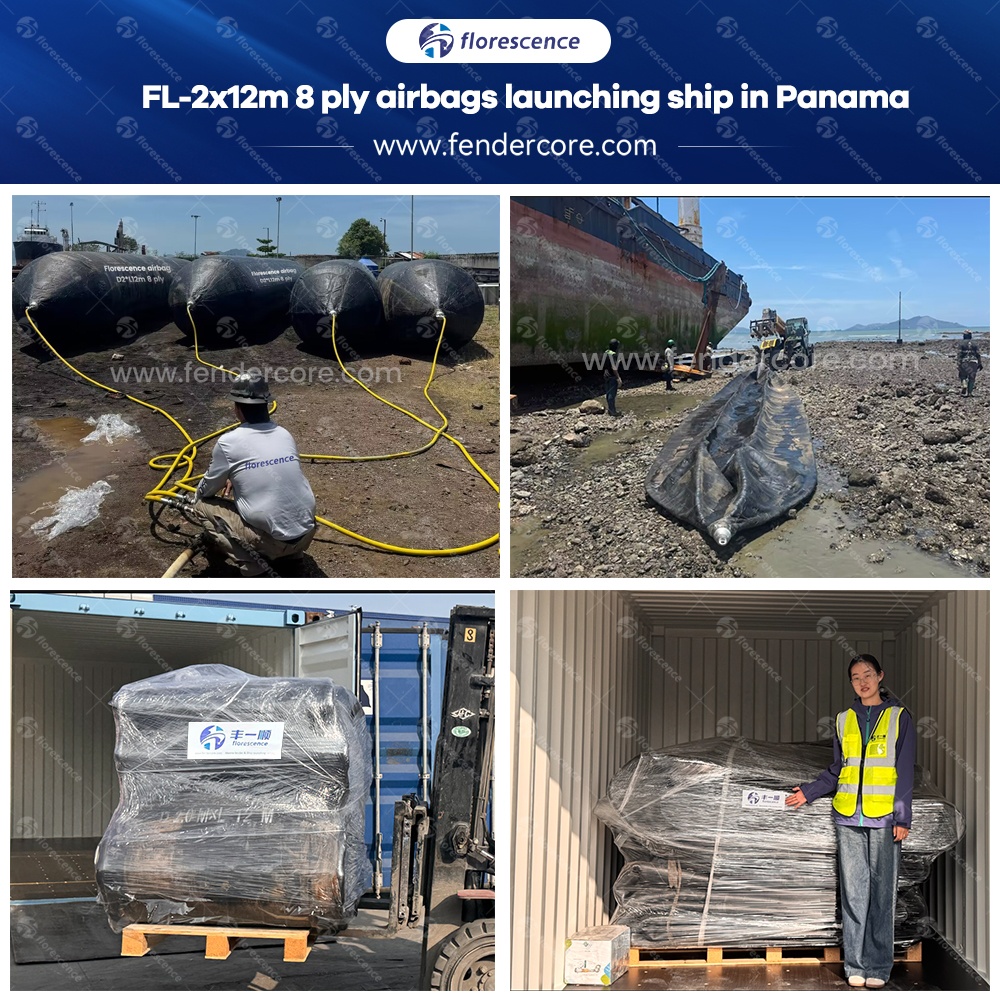
For a shipyard with limited slipway capacity, restricted water depth, or a narrow launch window, the practical question is not whether airbags exist. It is whether a specific vessel, site, and recovery plan can be matched to a documented airbag system without turning a controlled launch into an improvised operation.
Ship launching airbags are inflatable rubber bags used to support and move a vessel during launch, landing, docking, heavy-object movement, and marine salvage lifting. In a constrained yard, they can reduce dependence on a fixed slipway and allow launch work to be organized around the available ground, winch, and water conditions. The same product family also has a separate role in salvage, where buoyancy, safety factor, and controlled inflation matter more than rolling launch distance.
This reference examines where ship launching airbags fit for constrained shipyards, how buyers should choose them, how a launch sequence is executed, what pre-shipment checks should be verified, and how marine salvage airbags differ in scenario fit. It uses product and factory facts from Florescence Marine (Qingdao Florescence Marine Supply Co., Ltd.), a marine rubber products manufacturer established in 1992, together with the BV certificate GTS 2025 154536 0003 under ISO 14409 and publicly verifiable market and standards data.
Why constrained yards examine airbag launch and salvage options
A constrained shipyard is not necessarily a small yard. The constraint may be a slipway that cannot handle another vessel, a dry dock booked for repair work, a launch area with limited water depth, or a site where the approach channel and tide window leave little room for error. In those conditions, the launch method becomes a site-planning problem rather than a single equipment purchase.
Airbag launch is considered because it is transportable, reusable, and less dependent on permanent slipway infrastructure than a conventional slipway launch. The method uses a set of inflated rubber airbags under the hull, removes the keel blocks once the vessel is supported, and controls forward movement with winches and rigging until the vessel enters the water. The same handling principle is used for ship landing, docking support, and heavy-object movement.
For salvage, the logic changes. A marine salvage airbag is used to provide buoyancy assistance for recovery and refloating. The buyer is not only asking whether the bag can roll a hull. The buyer is asking whether the bag has the right buoyancy, safety factor, connection arrangement, and inflation control for a recovery plan. That difference is why launch and salvage should be evaluated as two scenario fits, not as one generic airbag purchase.
What ship launching airbags are and where they fit
A ship launching airbag is a heavy-duty rubber cylinder with reinforcing layers, end fittings, and an inflation valve. In the Florescence Marine product range, Ship Launching Airbags and Marine Salvage Airbags are part of a marine rubber portfolio that also includes pneumatic rubber fenders and ship and dock rubber fenders. The company was established in 1992, operates a 40,000 m² manufacturing facility, employs 120 staff, maintains a 25-engineer R&D team, and has an annual production capacity of 2,000 pieces. Florescence Marine has more than three decades of marine industry experience.
The performance logic is straightforward: the airbag must carry load, hold pressure, resist abrasion and seawater exposure, and allow controlled rolling or lifting. Florescence states that its airbags are ISO 14409 standard compliant and use multi-layer synthetic-tire-cord reinforcement with wear and puncture resistance. The working condition range cited for the ship launching and salvage airbag scenario is -20°C to 50°C, with anti-aging and seawater corrosion considerations. Ship launching airbags are applicable to ship building, ship repair, drydock, marine salvage, and marine engineering.
The selection problem: matching airbag capacity to vessel and site
Airbag selection starts with vessel and site data, not with a catalogue size. Florescence advises buyers to provide vessel type, length, beam, weight at launching or docking, and keel block height. Where a yard operates several vessel types, the same information should be supplied for each vessel so that size and quantity can be recommended consistently.
The selection variables include diameter, effective length, overall length, number of layers or thickness, quantity, rubber material grade, working pressure, air tightness, supporting accessories, and surface anti-abrasion treatment. Florescence states that common airbag configurations range from 3 to 12 layers depending on working pressure and project requirements. Diameter, length, pressure rating, reinforcement layers, and end structure can be customized. OEM and customized production are supported according to customer drawings, technical specifications, vessel size, berth conditions, and project requirements.
Bearing capacity is not a single number printed on a bag. It depends on airbag diameter, working pressure, contact area, vessel weight, and airbag quantity. That is why a 1,000-ton vessel inquiry cannot be answered responsibly with a size alone. The yard should expect a calculation or a documented recommendation based on the actual hull and launch condition.
| Selection input | Why it matters | Buyer action |
|---|---|---|
| Vessel length, beam, and launch weight | Sets the load case and the number of airbags needed under the hull. | Provide the launch or docking weight, not only the design tonnage. |
| Keel block height and hull form | Affects airbag positioning, contact geometry, and removal sequence. | Share block drawings and any flat-of-keel restrictions. |
| Slipway or ground condition | The launch route should be ground or cement concrete, selected according to vessel tonnage. | Confirm surface condition, slope, and freedom from sharp objects. |
| Working pressure and layers | Links load capacity to pressure rating and reinforcement configuration. | Do not select by diameter alone; confirm pressure and layer configuration. |
| Quantity and spacing plan | Distributes load and supports controlled rolling. | Ask for a layout recommendation and quantity calculation. |
| Accessories and rigging | Inflation, pressure monitoring, pulling, and recovery depend on the full set. | Confirm pulling rings, valves, gauges, hoses, and winch arrangement. |
How airbags are used in a launch sequence
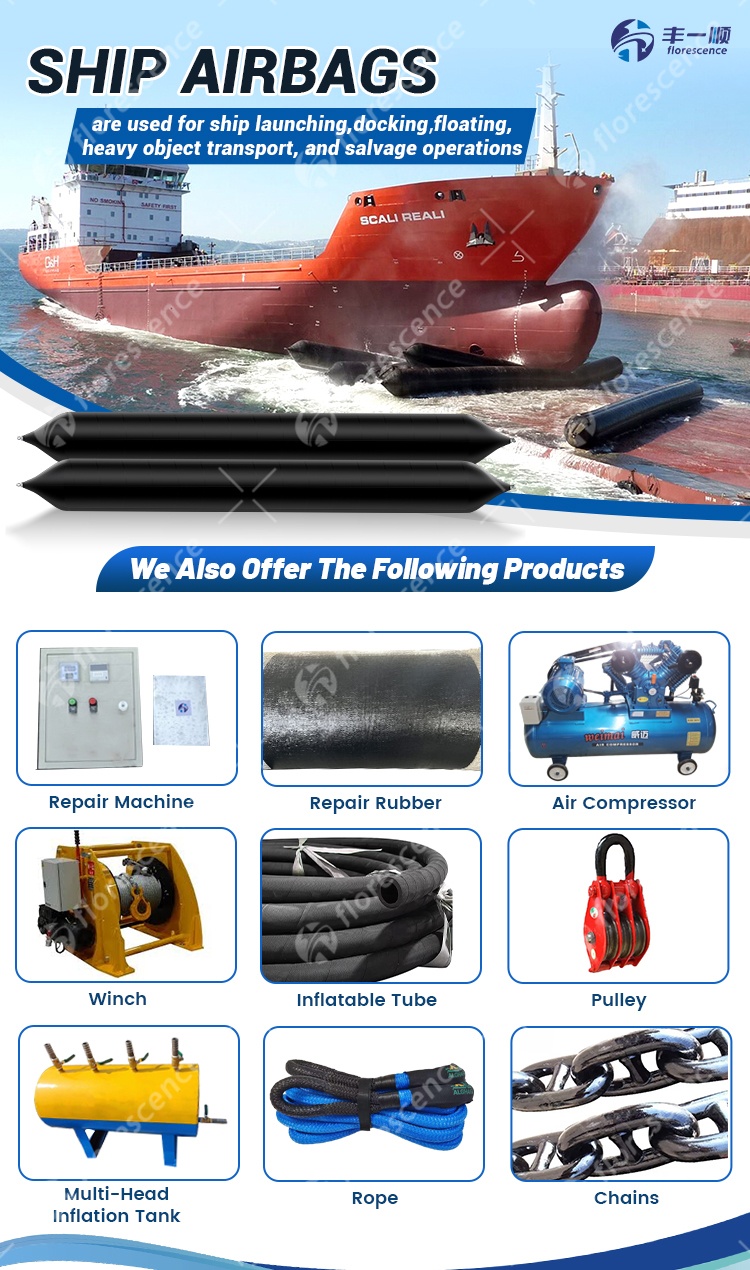
The operating sequence is a controlled process, not a single inflation step. Florescence describes the launch flow as pre-launch preparation, basic equipment preparation, crew preparation, rigging arrangements, removal of blocks, moving the ship forward, and launching. The equipment set can include pulling rings, terminal iron, protective covers, three-way connecting tubes, pressure gauges, inflation valves, hose joints, high-capacity winches, wire ropes, pulley systems, shackles, air compressors, and inflation hoses.
In the execution phase, deflated airbags are unrolled and laid flat under the hull according to the pre-calculated spacing plan. Pneumatic hoses are connected, the air valve is opened, and the bags are inflated to the specified working pressure so that the vessel lifts off its support blocks. Once the ship is fully supported by the inflated airbags, keel blocks, wooden supports, and launching cradles are removed. The holding winch system is then released, and gravity and momentum allow the vessel to roll into the water on the rotating airbags. After the vessel floats free, the airbags are collected, deflated, cleaned, folded, and stored for future use.
The safety requirements are specific. Over-pressure is forbidden. The slipway should be ground or cement concrete, according to the tonnage of different ships. Sharp objects must be removed from the slipway and the ship, and the route should be smooth and clean to avoid puncture. Distortion in the length direction during rolling and overweight load after air charging should be avoided. These are not optional housekeeping points; they are the conditions that make the method predictable.
Pre-shipment quality checks buyers should verify
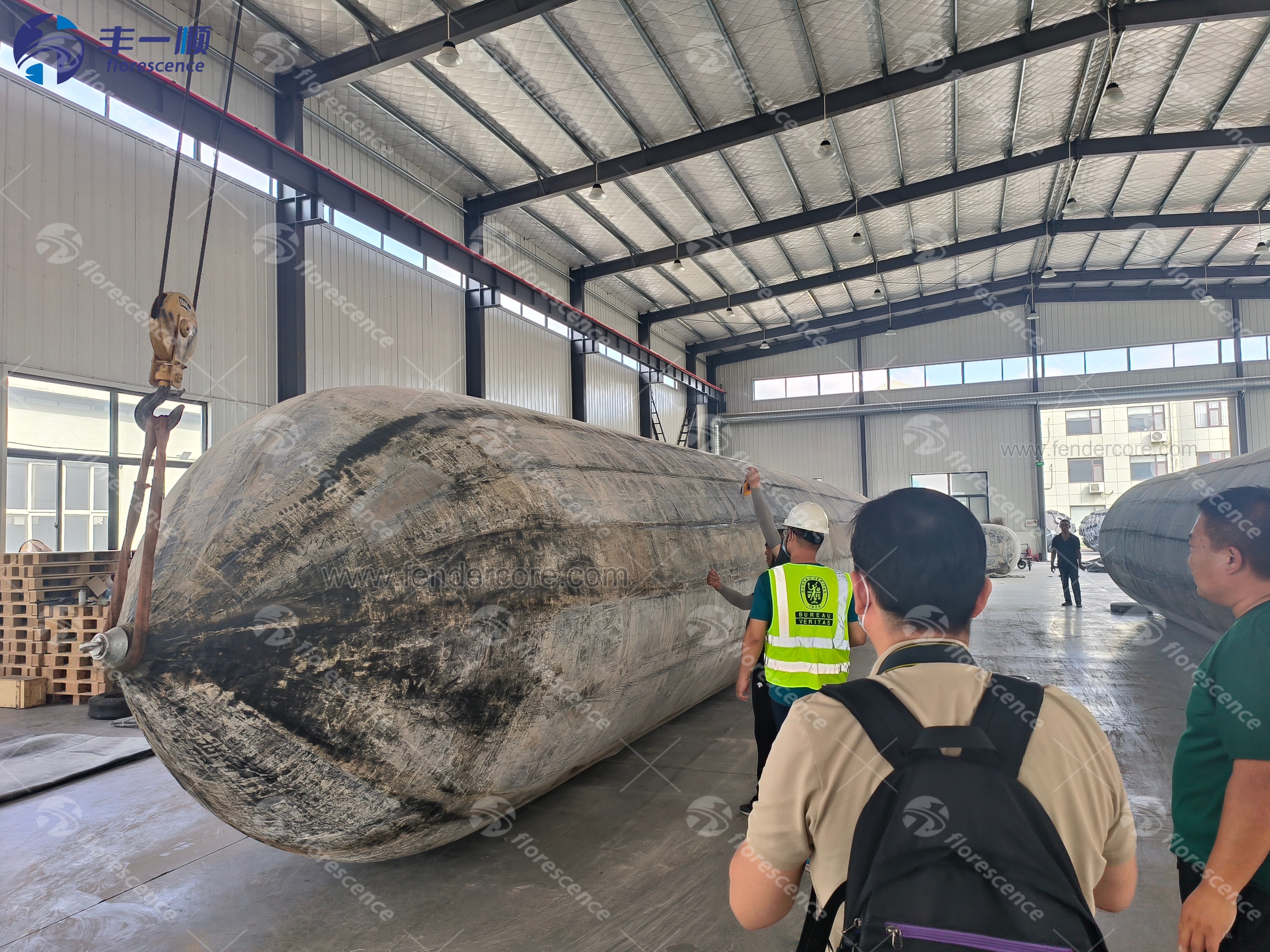
For a launch or salvage airbag order, pre-shipment quality is a decision-stage issue because the product cannot be repaired easily once it is under load in a remote yard. Florescence states that the factory is ISO 9001 certified and that every production batch goes through strict tests, including rubber raw material testing, dimensional and hardness checks for rubber fenders, and air-tightness testing for ship airbags and pneumatic fenders.
The documented inspection package can include a full Quality Inspection Report with rubber test data, sizing sheets, coating thickness records, and product photos before final payment. Full material traceability is provided through EN 10204 3.1 Mill Test Certificates for metal parts and bolts, together with physical property reports for rubber components. Third-party inspection by agencies such as SGS, Bureau Veritas, and LR is accepted, and the supplier states that it will cooperate with the buyer's chosen inspector.
The BV certificate GTS 2025 154536 0003 under ISO 14409 is the certification anchor for this product discussion. ISO 14409:2011 is the international standard for ship launching air bags and classifies marine airbags into Ordinary (QP) and High-capacity (QG) categories. A buyer should read the certificate scope against the ordered product, pressure rating, and configuration rather than treating a certificate number as a generic quality badge.
| Pre-shipment check | What it confirms | Document or evidence |
|---|---|---|
| Batch-level inspection | Raw material, dimensions, hardness where applicable, and air-tightness are checked by production batch. | Batch inspection records and QIR |
| Air-tightness test | The airbag holds pressure as specified before shipment. | Air-tightness test record |
| Dimensional check | Diameter, length, and end configuration match the approved specification. | Sizing sheet and inspection report |
| Material traceability | Metal parts and bolts are traceable to mill certificates. | EN 10204 3.1 Mill Test Certificates |
| Rubber property report | Physical properties of rubber components are documented. | Physical property report |
| Third-party inspection | An independent inspector can witness testing and check documentation. | SGS, BV, or LR inspection record |
| Certificate scope | The BV certificate and ISO 14409 reference apply to the actual product being supplied. | BV certificate GTS 2025 154536 0003 under ISO 14409 |
Marine salvage scenario fit
Marine salvage is a different load case from a rolling launch. A Marine Salvage Airbag is used for buoyancy assistance in marine recovery and salvage applications. The product is part of the same airbag family, but the planning question is how much buoyancy is needed, how the bags will be secured, how inflation will be synchronized, and what safety factor applies to straps and lifting belts.
The verified standard reference states that marine salvage airbags require a minimum safety factor of 6:1 for buoyancy-related straps and lifting belts. That safety factor should be treated as a design constraint, not a marketing figure. The salvage plan also needs a controlled inflation sequence, a clear attachment arrangement, and a recovery method for the bags after the lift.
Florescence states that Marine Salvage Airbag has a service life of 5–8 years, and that Ship Launching Airbags have a typical service life of 5–8 years. The shared service-life range supports repeat use across multiple launching operations and long-term supply planning, but it does not remove the need for inspection, proper storage, and repair assessment after harsh use. Airbags should be stored in a dry, ventilated environment away from sunlight, oils, acids, and sharp objects.
The salvage fit is strongest when the recovery plan can use modular buoyancy, controlled inflation, and a known lift geometry. It is weaker when the lift depends on unverified attachment points, uncontrolled pressure, or a site without a workable inflation and monitoring position. That boundary should be settled before the airbags are shipped, not during the recovery operation.
Market context and long-term supply planning
The marine airbags market was estimated at USD 328.82 million in 2025 and USD 346.59 million in 2026 by 360iResearch. The same source estimates that Asia-Pacific accounts for approximately 52% of global marine airbags market revenue, with China acting as the primary manufacturing and export center. These figures describe a specialized market with a concentrated manufacturing base, which is relevant to buyers who need repeat supply, spare bags, and technical continuity.
For a constrained yard, long-term supply planning is not only about price per bag. It is about whether the supplier can repeat the same specification, keep documentation consistent, support a future launch of a similar vessel, and respond when a bag needs repair or replacement. Florescence exports to Southeast Asia, South America, Europe, North America, the Middle East, and Africa, with an export ratio of 95%. The company states that it has built long-term relationships with customers in many countries and has supplied products to the Bangladesh Navy, French Navy, Royal Thai Navy, Italian Navy, and Philippine Navy.
Production and shipping visibility support execution-stage planning. Standard production lead time is approximately 25–30 days, varying with product type, order quantity, customization requirements, and shipping schedule. For large custom orders or full fender systems, the stated delivery time is 40–45 days, with a clear production schedule before production starts. Sea freight, air freight, LCL, and FCL shipment are supported. Production and shipping status can be checked in real time through weekly photos and videos of the vulcanization process and final packaging, and the container number and vessel tracking links are sent immediately after shipping.
If a shipping delay occurs due to bad weather or port problems, the customer is informed right away, and the logistics team works closely with the shipping line to find the fastest alternative routes to protect the project schedule. That kind of exception handling matters in a launch plan because a late airbag set can shift a whole yard schedule.
Comparison with traditional launch and dock methods
Airbag launch is often compared with a conventional slipway because both move a vessel down a prepared path into the water. The comparison should be made on site fit, repeatability, and risk control rather than on a single headline cost. Florescence states that marine airbags offer lower investment cost, flexible launching locations, reusable operation, and easier transportation compared with traditional slipways. Those are practical differences for a yard that cannot justify a permanent slipway expansion or needs to move launch work to a different area.
The traditional slipway still has a role. It can provide a fixed, familiar launch path with established procedures and a known capacity envelope. A dry dock offers controlled docking and repair conditions that an airbag launch does not replace. A floating dock or heavy-lift vessel offers another set of capabilities. The practical decision is not airbags versus all alternatives; it is which method fits the vessel, the site, the water, and the risk plan.
| Method | Scenario strength | Boundary to plan for |
|---|---|---|
| Ship launching airbags | Transportable, reusable, flexible launch location, lower investment than a permanent slipway, suitable for constrained yards with a prepared ground or concrete route. | Requires suitable ground, pressure control, sharp-object control, load calculation, winch and rigging plan, and a recovery plan for the bags. |
| Conventional slipway | Fixed launch path and established yard procedure for repeated newbuild launches. | Capital-intensive and capacity-limited; not flexible when the slipway is occupied or the site is constrained. |
| Dry dock | Controlled docking, repair, and inspection conditions. | Dock availability and scheduling can constrain launch or repair timing; it is not a portable launch method. |
| Floating dock or heavy-lift vessel | Mobility and heavy-lift capability for suitable projects. | Availability, mobilization cost, and operational window must be planned; not a substitute for a yard-level launch method. |
Limitations and boundaries
The clearest limitation is that airbag launch depends on site preparation. The slipway should be ground or cement concrete, selected according to the tonnage of different ships. The route must be free of sharp objects, and the ship and ground should be smooth and clean to avoid puncture. The operating pressure must be controlled, and over-pressure is forbidden. Distortion in the length direction during rolling and overweight load after air charging should be avoided.
A second boundary is engineering input. Bearing capacity depends on diameter, working pressure, contact area, vessel weight, and airbag quantity. A yard that buys bags without a load case, spacing plan, and rigging arrangement is taking on avoidable risk. The supplier's engineering team can assist with product selection, technical calculations, layout recommendations, and installation guidance, but the yard still has to provide accurate vessel and site data.
A third boundary is that airbags are not a universal replacement for every launch or dock method. They are a strong fit for constrained yards with a prepared route and a controlled launch plan. They are a weaker fit when the ground cannot support the load, the water is too shallow for the vessel after launch, the hull geometry prevents stable support, or the yard cannot control the winch and recovery sequence. Those conditions should lead to a different method or a hybrid plan, not to a more optimistic airbag calculation.
Future outlook
The direction of the category is toward more documented, standard-aligned supply. ISO 14409:2011 already separates Ordinary (QP) and High-capacity (QG) marine airbags, and buyers are increasingly asking for certificate scope, batch records, material traceability, and third-party inspection. The BV certificate GTS 2025 154536 0003 under ISO 14409 is an example of the kind of evidence that belongs in a launch or salvage file, alongside the QIR, mill certificates, and air-tightness records.
For constrained yards, the likely pattern is hybrid planning: use airbags where the site and vessel fit, keep conventional docking for work that needs a dock, and maintain a repeatable airbag procedure with trained crews and stored accessories. Long-term supply relationships will matter because the same yard may launch several vessels over a 5–8 year airbag service life, and consistency of specification is easier to manage when the supplier can repeat the build and documentation.
The market data also points to a concentrated manufacturing base in Asia-Pacific, with China as a primary export center. That does not remove the need for buyer verification, but it does explain why documentation, inspection access, and communication during production are practical differentiators for international buyers.
FAQ
They fit where a yard has a prepared ground or concrete launch route, can control inflation pressure and load distribution, and can organize winch, rigging, and recovery. They are used for ship launching, ship landing, docking support, heavy-object movement, and marine salvage lifting. They do not remove the need for site engineering or for an alternative method when the ground, water depth, or hull geometry is unsuitable.
Selection starts with vessel type, length, beam, weight at launching or docking, and keel block height. The specification then covers diameter, effective length, overall length, layers or thickness, quantity, rubber material grade, working pressure, air tightness, accessories, and surface anti-abrasion treatment. Bearing capacity depends on diameter, working pressure, contact area, vessel weight, and airbag quantity, so a size should be confirmed against a load calculation.
The sequence is pre-launch preparation, equipment and crew preparation, rigging, block removal, forward movement, and launch. Deflated airbags are laid under the hull on a spacing plan, inflated to the specified working pressure, and used to lift the vessel off its blocks. Keel blocks and supports are removed, the holding winch is released, and the vessel rolls into the water. The bags are then collected, deflated, cleaned, folded, and stored.
Buyers should verify batch-level inspection, air-tightness testing for ship airbags, dimensional checks, rubber property reports, and material traceability for metal parts and bolts. A full Quality Inspection Report can include rubber test data, sizing sheets, coating thickness records, and product photos. Third-party inspection by SGS, Bureau Veritas, or LR is accepted, and EN 10204 3.1 Mill Test Certificates are available for metal parts and bolts.
The certificate is the BV certification anchor cited for the product discussion under ISO 14409. ISO 14409:2011 is the international standard for ship launching air bags and classifies marine airbags into Ordinary (QP) and High-capacity (QG) categories. The buyer should check that the certificate scope matches the ordered airbag type, pressure rating, and configuration rather than relying on the certificate number alone.
Ship Launching Airbags and Marine Salvage Airbags are related products, but salvage is a different load case. Marine Salvage Airbag is used for buoyancy assistance in recovery and refloating. The verified standard reference requires a minimum safety factor of 6:1 for buoyancy-related straps and lifting belts. A salvage plan also needs controlled inflation, secure attachment, and a recovery method for the bags.
The yard should plan for a suitable ground or concrete slipway, a route free of sharp objects, controlled pressure without over-pressure, and no distortion or overweight load after air charging. It should also confirm water depth, hull support geometry, winch capacity, and bag recovery. If those conditions cannot be met, the airbag method may not be the right fit.
Ship Launching Airbags and Marine Salvage Airbags have a typical service life of 5–8 years. That supports repeat use across multiple launching operations and long-term supply planning. Long-term planning should also cover inspection after harsh use, dry and ventilated storage away from sunlight, oils, acids, and sharp objects, and access to repair materials and technical guidance.
Useful documents include the Quality Inspection Report, air-tightness records, dimensional sheets, rubber property reports, EN 10204 3.1 Mill Test Certificates for metal parts and bolts, and the BV certificate GTS 2025 154536 0003 under ISO 14409. The factory audit basis includes ISO 9001 and ISO 14001 certification. These records help a yard repeat a specification and compare a future order against the original launch file.
Standard production lead time is approximately 25–30 days, varying with product type, order quantity, customization, and shipping schedule. Large custom orders or full systems are stated at 40–45 days with a production schedule before production starts. Sea freight, air freight, LCL, and FCL are supported. Production and shipping status can be checked through weekly photos and videos, and container number and vessel tracking links are sent after shipping.
Есть вопросы или нужны дополнительные детали?
Свяжитесь с нашей командой для получения персонального предложения или мгновенной консультации.
Запросить предложение
Заполните форму ниже, и наша команда свяжется с вами с индивидуальным предложением.
Прямой чат WhatsApp
Предпочитаете общаться в реальном времени? Напишите нам в WhatsApp для мгновенной помощи и быстрых ответов.
- Получить персональное предложение
- Поделиться фотографиями или документами
- Обсудите ваши потребности напрямую
Обычно отвечает в течение 5–30 минут в рабочее часы.