
Shirt Collar Tape Explained: Functions, Materials, and Sourcing Guide
Shirt Packaging Accessories — Supplier Intelligence
A structured guide to shirt collar tape — its role in shirt presentation, how it differs from interlining and collarbones, the material options available for packaging, and what buyers should evaluate when sourcing it as part of a broader shirt packaging accessories programme.
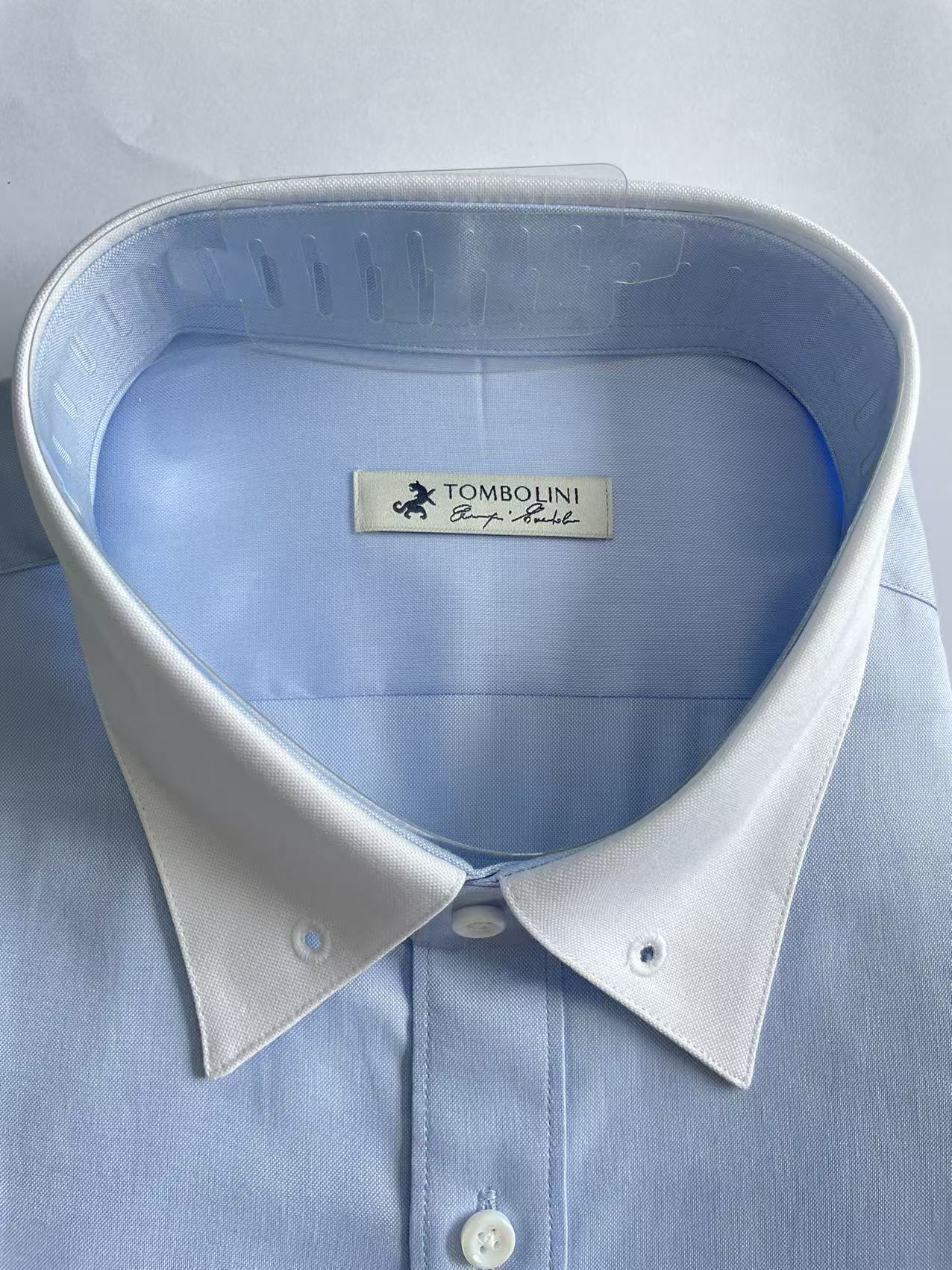
Shirt packaging lines integrate collar tape and support inserts to preserve collar geometry during storage and transit.
Why Shirt Collar Tape Is a Separate Packaging Decision
Shirt collar tape — also referred to as collar band stiffener, collar strip, or packed-collar band — is a functional packaging accessory designed to hold a folded shirt collar in shape after folding and before bagging. It is not a sewing component. Unlike shirt collar interlining, which is fused inside the collar fabric during garment construction, collar tape is applied at the packing stage to maintain the collar's set shape from factory to retail display.
For sourcing and merchandising teams, the distinction matters. A shirt can have excellent construction and still show a misshapen, crushed, or creased collar by the time it reaches a store — if the packing layer fails. Collar tape is that protective layer. It is specified in high volumes for SKU-count-intensive categories including dress shirts, business shirts, formalwear and export garment programmes where presentation consistency is a brand-level requirement.
Terminology: Collar Tape vs. Collar Interlining vs. Collar Stay
Industry language around shirt collars can be confusing because similar terms describe different stages of the garment lifecycle.
| Term | Typical Definition in Context | Application Stage |
|---|---|---|
| Shirt collar interlining | Fusible or sew-in fabric layer inside the collar to give body and stiffness | Garment manufacturing (sewing room) |
| Shirt collar tape / collar band (packing type) | Stiffened strip, paper or plastic, placed around the folded collar during packing | Packaging / finishing line |
| Collar stay / collarbone | Removable or permanent insert worn in the collar points by the end user | Wear-time support (consumer-facing) |
| Paper butterfly / collarbone packing insert | Butterfly-shaped cardboard or plastic insert behind folded collar | Packaging / presentation filler |
This article focuses on the shirt packaging accessory layer: collar tapes and the adjacent collar support category. These products are removed by the consumer at the point of dressing and are not part of the garment itself.
What Belongs to the Shirt Packing Collar Unit in a Bill of Materials
A full shirt packing kit usually combines one or more of the following components: a collar band or tape wrapped around the folded collar; a collar support sheet or butterfly insert behind the collar; a size strip or belly band around the folded garment; tissue paper and a poly bag; and sometimes hanging tags or pins. Buyers often source these as a coordinated set from a single supplier to reduce logistics cost and guarantee visual consistency.
The Core Requirement: Protection Before Presentation
The functional need is straightforward — a shirt collar is a multi-layer fabric structure with no rigid skeleton. Once folded and stacked for export or hanging in a retail display, pressure from surrounding garments transfers directly to the collar fold. Without a packing support element, the collar develops permanent fold creases, loses its roll, and no longer sits flat on the wearer's neck.
Collar tape solves this by transferring pressure away from the collar fabric. It wraps or lays against the folded collar region and absorbs compression. A well-devised strip helps keep the collar’s edges aligned and the neckband fold sharp through the full journey — factory, carton, container, warehouse, shelf and fitting room.
For e-commerce and direct-to-consumer garments, collars are also opened and inspected before purchase. Retailers evaluate collar integrity as a quality cue. Packing parts that visibly crumple or tear create negative unboxing impressions, even when the shirt itself is well made.
Material Options for Shirt Collar Tape and Support Inserts
Material choice defines the trade-off between price, stiffness, printability and environmental profile. The market typically segments into three families.
PET and PVC Collar Bands
Rigid plastic strips remain the most common shirt collar tape format for high-volume export packing. A representative product is the white PET collar band measuring 48.1 cm × 4 cm × 0.35 mm, supplied for shirt packing with an MOQ of 10,000 pieces. With a stable thickness and semi-rigid memory, PET bands hold their shape against creasing better in crowded export cartons.
For the wider collar support layer, PVC versions such as a light blue cuboid collar support at 22.7 cm × 18.5 cm × 0.35 mm are also used. These add lateral support for folded collars that are placed in upright retail displays.
Paper and Pulp Collar Tape
As sustainability criteria become embedded in sourcing decisions, paper bands are gaining share. Typical products include a paper collar band made from specialty tenacity paper — dimensions 47.2 cm × 3.8 cm, 1 mm thickness, cut with 15 holes — and a butterfly-shaped paper collar insert made from 400 g single white paper at 15 cm × 3 cm. Paper variants offer better printability for brand messages and are generally recyclable.
The 500 GSM wood-pulp shirt cardboard (21 × 35.2 cm) is also part of this same packing-layer kit, often used as a flat backing board. When sourced from 100% natural wood pulp, paper components align with common recyclability criteria.
Composite and Specialised Formats
Some suppliers combine the collar tape with the size label function, making the tape the place where a neck-size indicator appears. Combined collar band + size indicator pieces reduce per-unit labour and simplify kitting. Metal collar stays and collarbones occupy a separate, consumer-facing category and are not substitutes for the packing strip; they serve a different function after purchase.
What Sourcing Teams Should Inspect Before Ordering
Because collar tape components look simple, buyers can underestimate specification risk. Technical procurement checks should include material and physical criteria, customisation constraints, process compatibility, and downstream handling.
Stiffness Memory and Dimensional Consistency
Ask for a three-point stiffness reading, not just a thickness number. A 0.35 mm PET strip and a 0.35 mm PVC strip do not behave identically. Confirming that thickness is controlled across ± tolerance — and that the strip does not curl in high-humidity rooms — is essential for automated closing machinery.
Logo, Printing and Branding Requirements
Many retailers want their branding printed on the visible portion of the collar tape. Printing capability varies. Some factories only print on paper; some handle custom printing on both PET and PVC. Laser-engraving on metal collar stays is a different process desk. Verify ink adhesion to non-porous plastic surfaces, rub resistance, and whether the printed tape needs a protective overcoating.
Edge Quality and Fibre Shedding
Poorly cut paper tape can leave fibres on shirt collars inside poly bags. Die-cut paper collar parts require clean, mushroom-free edges. Examine whether the factory’s cutting equipment produces edges without burrs — especially for hole-punched formats such as paper collar bands with 15 punched slots.
Customisation and MOQ Alignment
Collar band widths, curvature, fastener positions and hole layout all affect fit with a particular shirt fold size. The most reliable suppliers support mould opening for custom plastic parts rather than forcing you to adapt to existing tools. Expect 10,000-piece MOQs for common parts; bespoke shapes or custom colours will increase that. Custom jobs need controlled tool ownership: understand whether the mould fee is refundable and who owns the steel after the programme ends.
Case Use: Shirt Packaging Programme Structure at MingYu
Wuxi Mingyu Garment Accessories Factory, established in 2004 and based in Wuxi, Jiangsu, China, is one manufacturer whose product catalogue spans the full shirt packing accessory set. Its offer includes PVC/PET collar bands, paper collar bands, collar stays, collar butterflies, shirt cardboard, moisture-proof paper, plastic clips, plastic packaging bags and related components.
The factory operates from a 2,500 m² facility with 25 staff and reports an annual output of around 90 million sets, with roughly 85% exported. Primary destinations include Europe, North America, South America and Asia. This export-heavy mix is relevant for procurement teams based in those regions, because the factory already holds logistics workflows designed for cross-border B2B customers. Distribution warehouses and representative operations in Sri Lanka, Argentina, Bangladesh, Indonesia, Colombia and Kenya shorten lead times for those local markets.
MingYu supports OEM and ODM orders. Its R&D team of three engineers can work on custom collar tape geometry, mould opening and print customisation. The company has set up an OA operating system for internal management — one indicator of batch-order traceability.
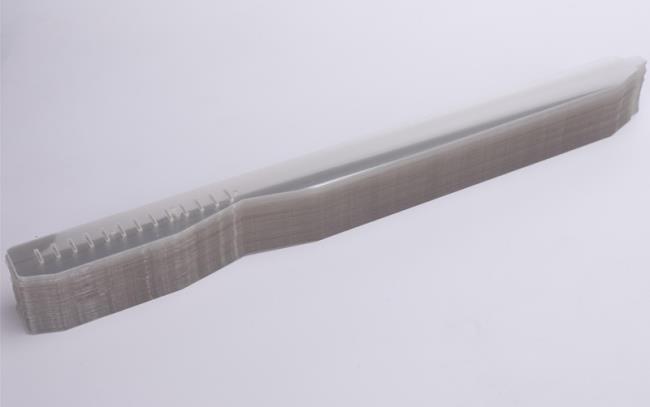
PET collar band material holds a true fold during long-distance export shipment.
Market Context: Packaging Value Is Expanding
The garment packaging market was estimated at $18.6 billion in 2025, with a projection to $31.4 billion by 2034, according to Dataintelo research. Part of that growth is attributed to e-commerce order fulfilment needs — each online order demands a more protective and more branded packaging layer than a bulk in-store replenishment box.
The same report highlights that Asia Pacific accounted for 41.5% of the garment packaging market revenue share in 2025. Since much downstream shirt production and packaging supply originates in Asia, regional buyers can shorten supply chains by sourcing from nearby manufacturing bases.
A separate commercial-research stream from The Business Research Company sized the garment interlining market at $3.65 billion in 2025. That estimate covers adhesion-based interlining used in making shirts; it is not the shirt packaging collar tape segment. The distinction is worth restating because procurement searches sometimes mix the two. Interlining decisions happen at fabric stage; collar tape decisions happen at packing stage. Both markets are growing, but they follow different specification logic.
Comparison: Working with a Specialist Garment-Accessory Maker vs. a General Packaging Supplier
Brand teams sourcing shirt collar tape can choose between broad packaging companies and garment-specialist accessory manufacturers.
| Dimension | Garment-Accessory Specialist | General Packaging Supplier |
|---|---|---|
| Product alignment | Understands collar geometry, shirt folding patterns, fabric and trim behaviour | Strong on boxes, bags and films; limited shirt-specific know-how |
| Range | Usually supplies full shirt packing kits from one hand | Often needs to subcontract collar stays and butterflies |
| Custom tooling | Combines die-cutting, punching, mould opening under one roof | Depending on supplier, may rely on external tool rooms |
| Inspection logic | Checks for garment-damage risks (rust, rough edges, fibre shed) | General packaging QA parameters |
| Constraint | Lower interest in non-garment packaging requirements | Deeper general packaging engineering |
For a shirt-focused replenishment programme, the specialist path usually yields easier specification alignment. The general packaging supplier can work when quantities are small or when the collar element is trivial relative to a much larger packaging spend. Mixing both — a shirt specialist for collar and trimming accessories, large carton suppliers for outer transport boxes — is the common practice among European shirt brands.
Limitations and Boundaries
Physical limitation is important. Collar tape and collar supports protect against crush pressure during normal handling — they cannot protect a shirt if packed into an oversize carton with shift allowed, or if the shipping case is stacked twenty-high without regard for weight. The tape works when the whole shirt pack design follows load rules.
Additionally, brand teams targeting strictly plastic-free claims face a challenge. PVC and PET collar substitutes — paper at 400 GSM, heavier specialty tenacity paper, or cardboard — exist but do not always match the stiffness memory of plastic in hot-humid conditions. Validate paper tape performance parameters before committing to a well-position full-recyclable programme. The trade-off is not about quality but about matching performance to climate zone and transport path.
Supply-chain, capacity also caps speed. High-volume shirt packers should check a factory’s real idle capacity rather than headline production numbers. Manufacturers commonly run collar and trimming lines close to full during August–October before the spring retail season; a sourcing decision made at peak does not represent the factory’s normal lead time.
Buyer Roadmap for Sourcing Shirt Collar Tape
Use the following decision flow to define shirt collar tape requirements.
- Step 1 – Classify the product: define the tape as a packing layer inside or around the collar. Decide whether it carries size or branding information.
- Step 2 – Map the transport route: long-distance ocean freight at high container humidity calls for deformation-resistant polymers; short-cycle local routes can reliably use paper.
- Step 3 – Read the retail environment: if shirts are displayed upright at high density, compare full collar-support shapes against simple strips.
- Step 4 – Match customisation: ask for clean print test plates on each material. Some inks look acceptable on paper but smudge on PET; validate before committing to full-batch orders.
- Step 5 – Audit procedural care: request dimensional tolerances, thickness ranges, packaging density and inspection protocols. In-line QA is more meaningful than end-of-line sorting.
- Step 6 – Plan the changeover: phase new collar tape use into trials on one SKU first; measure returns related to collar indentations and consumer packaging complaints.
- Step 7 – Recheck the kit-level cost: a marginally more expensive collar tape that eliminates separate size stickers on several SKUs lowers total component and labour cost.
Supplier Selection Criteria for Shirt Packaging Accessories
When comparing manufacturers of collar tape and related shirt packaging components, qualified evaluation criteria should cover verified experience and manufacturing evidence, facilities and equipment logic, full-programme support and risk control, and delivery performance.
| Evaluation Area | What to Request | Evidence Expected |
|---|---|---|
| Track record | Case references in shirt export packing; export spread; main destinations | Shipment examples in past 12 months; overseas warehouse service points |
| Manufacturing hardware | Equipment list for die-cutting, punching, creasing and trimming | Plant photos, on-site or video audit, machine list by process |
| QA process | Inspection steps along the line; defective rate measurement; storage control for plastic/sheeting | Sampling forms, defect classification, corrective action notes |
| Capacity proof | Available monthly capacity counts for collar tape lines | Volume produced in previous months; capacity allocation statement |
| Commercial stability | Export compliance record; dispute handling history on confirmed orders | Export certificates, audit social compliance file availability, export licence/qualified position |
The practical conclusion from the latest market context is to align the accessory supplier with the target region’s seasonality and to run material validation only with samples cut from the same roll or mould to be used in mass production.
How the Collar Tape Buying Process Differs in Global Sourcing
Buying shirt collar tape across borders includes margin and logistic constraints that domestic purchase orders tend to ignore. Export packing components need to fit efficiently into cartons without wasted volume; a collar tape shaped to the pattern of a large pack can alter per-carton capacity. Customs codes of such accessories sit inside small-wares and apparel accessories classifications, a goods category where incorrect declaration causes demurrage and penalty. Specialist shipment offices in Hong Kong or Shenzhen handle these border requirements routinely; a factory with a formal export backlog is easier to certify for compliance.
Sourcing Warning — Hidden Costs in Small Collar Accessories
Several non-recognised cost lines add surprise fees to collar support procurement: mould opening for custom forms; corrugated carton requirements forced at distribution centre level; barcode compliance labels on smaller packs; slower lead times at Chinese New Year and Western summer holidays; and export-document processing for small parcel volumes. Expert buyers budget these effects at the RFQ stage.
Future Outlook: What Will Shape Collar Accessory Demand
Three broad shifts will define the next five years of shirt packing accessory procurement.
1. Sustainability of materials used in the packing layer. Retailers and, progressively, legislators are tightening definitions of “recyclable garment packaging.” This pushes accessory users toward single-material paper, plant-based plastics or reuseable display fixtures. PET-based collar bands may face substitution pressure where waste streams are sorted with paper fractions.
2. Automation adoption at packing stations. When minimum wage levels climb and workforce availability narrows in export assembler economies, packing lines automate more processes. A collar strip feeding reliably from a feeder magazine holds a premium over one that needs manual alignment. Suppliers should design for machinery acceptance from the outset.
3. Personalisation and immediate-turnaround. Online shirt brands experimenting with limited collections generate smaller batch runs at shorter times. This adds real pressure to the industry’s typical MOQ of 1,000–10,000 units. Factories with flexible tooling and print-on-demand capacities will serve premium segments better.
Specialist manufacturers inside the growth region are best positioned to ride the trend. With Asia Pacific representing a 41.5% share of the garment packaging market in 2025, export factories offer procurement teams the combined benefit of regional production proximity with a mature global supply record.
Conclusion
Shirt collar tape is a lower-cost accessory relative to the garment, but its failure is high-cost visually. A fold that breaks, a collar line that bows, or a tape that leaves fibre dust on the fabric degrades the product experience more than the accessory cost suggests. The technically sound sourcing route is to define the shirt’s transport and display journey first, then choose materials, specifications, supplier evaluation, and tolerances accordingly.
What is the purpose of shirt collar tape in packaging?
Shirt collar tape (also called a collar band) is used at the shirt packing stage to hold the folded collar in shape. It protects the collar area from crush pressure and helps preserve a clean fold line from the factory through transport and retail display until the consumer removes it.
What is the difference between shirt collar interlining and shirt collar tape?
Shirt collar interlining is a fabric layer fused or sewn inside the collar during garment construction to give the collar structure. Shirt collar tape is a semi-rigid strip applied at the packing stage only. The interlining is permanent and part of the garment; the tape is a disposable component of shirt packaging accessories.
What materials are commonly used to make shirt collar tape?
Two common families exist: plastic collar tape (white PET, PVC) and paper collar tape (specialty tenacity paper, heavy single white paper). Typical dimensions seen in the market are a 48.1 cm × 4 cm × 0.35 mm PET collar band, a PVC collar band of 50 cm × 3.4 cm × 0.50 mm, and a paper collar band of 47.2 cm × 3.8 cm with 1 mm thickness and 15 punched holes.
Can shirt collar tape be customised with a brand logo?
Yes. Custom design and logo printing are supported across most collar band and collar support products, including PET, PVC and paper versions. For example, Wuxi Mingyu Garment Accessories Factory lists custom logo printing as a supported option for its plastic and paper collar bands. Printed colour retention on non-porous plastic surfaces should be validated before mass production.
Where is Wuxi Mingyu Garment Accessories Factory located, and what does it produce?
Wuxi Mingyu Garment Accessories Factory is located in E’hu Town, Xishan District, Wuxi, Jiangsu, China. It was established in 2004 and specialises in shirt packing accessories, including PVC/PET collar bands, paper collar bands, collar stays, collar butterflies, shirt cardboard, moisture-proof paper, plastic clips and plastic packaging bags.
What are the typical MOQs for shirt collar tape products?
Common MOQs for shirt collar band products are 10,000 pieces per design. The exact threshold depends on material and customisation level; custom-printed or mould-opened parts may require higher quantities. Verification with the supplier is required for each specification.
What is the collar tape’s role in sustainable garment packaging programmes?
In sustainable packaging programmes, collar tape is an important sorting decision. Paper collar tape made from tenacity paper or heavy wood-pulp paper aligns with fibre-recycling streams. PVC/PET versions are durable and resistant to deformation but are plastic. Procurement teams should separate these into the correct waste streams and specify single-material designs wherever possible.
Why do shirt collar support accessories market projections matter to buying teams?
Air-freight returns, e-commerce retailing and direct-to-consumer demand are expanding the volume of premium unboxed garments. In such routes, presentation is increasingly part of the product. Supply cost and delivery times of collar bands are stable, but order patterns shift to smaller and faster batches, so buying teams should work with manufacturing plants that keep broad SKU coverage.
Company background: Wuxi Mingyu Garment Accessories Factory is a China-based manufacturer with 85% export share. Download the company profile (PDF) for complete factory and capacity documentation.
The company’s website is available at www.wxmingyu.com.
Есть вопросы или нужны дополнительные детали?
Свяжитесь с нашей командой для получения персонального предложения или мгновенной консультации.
Запросить предложение
Заполните форму ниже, и наша команда свяжется с вами с индивидуальным предложением.
Прямой чат WhatsApp
Предпочитаете общаться в реальном времени? Напишите нам в WhatsApp для мгновенной помощи и быстрых ответов.
- Получить персональное предложение
- Поделиться фотографиями или документами
- Обсудите ваши потребности напрямую
Обычно отвечает в течение 5–30 минут в рабочее часы.