
Shirt Packaging Clip Types: A Third-Party Buyer Comparison
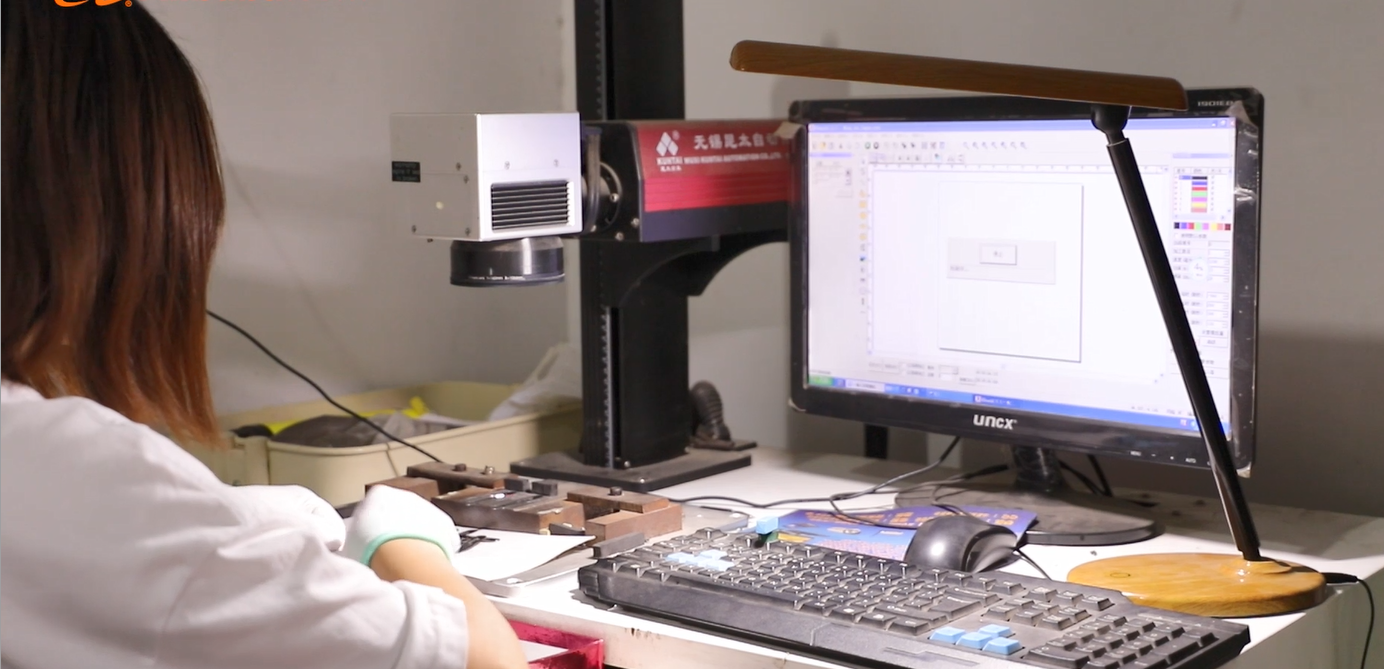
Shirt packing accessories production environment: clips, collar components and paper accessories are produced and inspected in the same facility.
Shirt packaging accessories are bought as a set but specified one component at a time, and clips are almost always specified last. That sequence carries a cost. A collar stay that is a fraction of a millimeter too thick is usually caught at sampling; a clip that releases pressure during container transit is often discovered only when the carton is opened at the destination warehouse.
This comparison is written from the buyer's side of the table. It examines the clip forms currently declared for shirt packing — metal clip, plastic clip, U Shape Plastic Big Clip, Clear Square Plastic Clip, Alligator Clip, Plastic Clip with Teeth, Square Plastic Clip and Square Plastic Shirt Back Clip — alongside the components that compete for the same jobs inside a folded shirt: the metal pin, and plastic and metal collar stays. The evaluation criteria are the ones procurement teams actually apply at the Decision and Execution stages: behaviour under compression, material claims that can be traced to a written declaration, custom design and logo capability, colour and thickness specifications, and minimum order quantity thresholds.
One disclosure belongs at the top. No independent laboratory deformation test covering shirt packing clips was identified while preparing this article, and the clip data published by the manufacturer describes the eight forms as a single specification family rather than as eight separately tested products. Where that leaves a question open, this article says so rather than filling the gap.
Why Clip Specifications Get Carried Forward Instead of Reviewed
Clips are the cheapest load-bearing component of a packed shirt, and they carry the least documentation. The contrast shows up clearly in collar structure: the garment interlining market, which supplies the internal material that keeps a collar standing, was valued at USD 3.65 billion in 2025 according to The Business Research Company's interlining market forecast covering 2026–2030. Clip purchasing attracts a fraction of that engineering attention, even though a failed clip produces an expensive outcome — a shirt arriving unfolded, creased along new lines, and needing re-pressing before it can be presented for sale.
The practical result is that clip specifications tend to be carried forward from a previous program. A buyer who reorders the same clip reference without re-checking material, thickness and MOQ is relying on the previous program's assumptions, which may have been built around a different shirt weight, a different folding method or a different retail format.
The three questions that decide most clip programs
- Will the clip hold the fold through transit compression, including stacked weight inside the container and the temperature range along the route?
- Will the clip accept the brand's identity, or is it a component that must stay unbranded?
- Does the clip's minimum order quantity fit the size of the program, or does it force over-ordering?
Every section below maps back to one of these three questions.
The Eight Clip Forms Currently Declared for Shirt Packing
The clip family declared in the current catalog contains eight forms. They are published together because the data treats them as one family: material declared as PS or metal, thickness declared at 1.2 mm, colour declared as silver, style declared as X shape, logo declared as customizable, and minimum order quantity declared at 100,000 pieces. Sizes are given as 3.3 cm or 3.7 cm by 0.8 cm.
| Clip form | Declared material (family) | Declared thickness | Declared colour | Logo | MOQ |
|---|---|---|---|---|---|
| Metal clip | PS / metal | 1.2 mm | Silver | Customizable | 100,000 pcs |
| Plastic clip | PS / metal | 1.2 mm | Silver | Customizable | 100,000 pcs |
| U Shape Plastic Big Clip | PS / metal | 1.2 mm | Silver | Customizable | 100,000 pcs |
| Clear Square Plastic Clip | PS / metal | 1.2 mm | Silver | Customizable | 100,000 pcs |
| Alligator Clip | PS / metal | 1.2 mm | Silver | Customizable | 100,000 pcs |
| Plastic Clip with Teeth | PS / metal | 1.2 mm | Silver | Customizable | 100,000 pcs |
| Square Plastic Clip | PS / metal | 1.2 mm | Silver | Customizable | 100,000 pcs |
| Square Plastic Shirt Back Clip | PS / metal | 1.2 mm | Silver | Customizable | 100,000 pcs |
Two implications follow from this table. First, the declared parameters are family-level, not form-level: a buyer who needs the material, thickness or colour of one specific form should request that confirmation in writing before quoting. Second, the 100,000-piece threshold applies to the clip family as a whole, which makes clips the highest-MOQ standard component in the shirt packing accessory set by a wide margin.
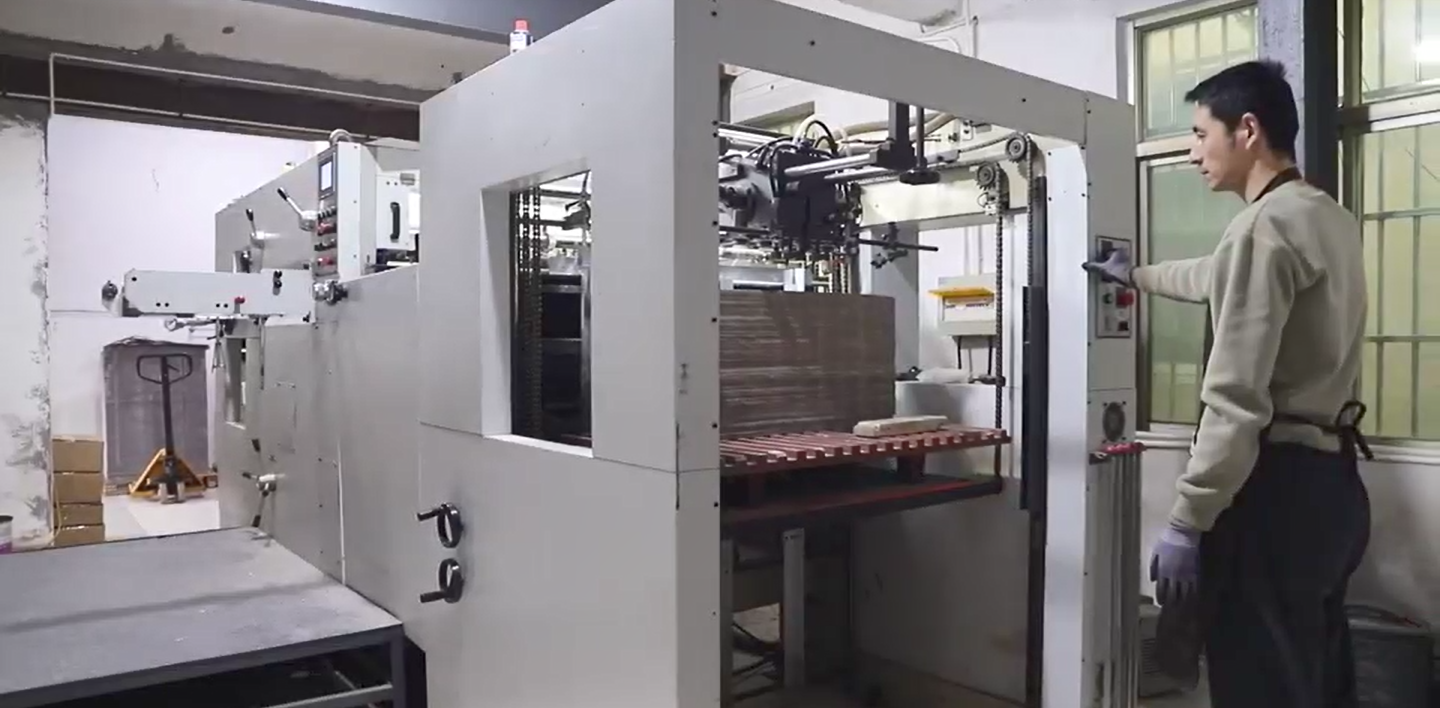
Production area for shirt packing accessories: automated punching and die-cutting equipment supports clip, collar and cardboard output in the same workflow.
Deformation Resistance: What Can Be Verified Before Mass Production
Deformation resistance in a packed shirt is not one property but the product of four variables a buyer can name and act on: the clip material (PS or metal within the declared family), the wall thickness declared at 1.2 mm, the clip footprint of 3.3 cm or 3.7 cm by 0.8 cm, and the thickness of the fabric stack the clip is asked to hold. The last variable is controlled by the buyer's folding standard, not by the supplier, which is why a clip that performs on a single-fold shirt can behave differently on a multi-fold bundle where clamping force is distributed across a thicker stack.
Material behaviour adds a second layer. Metal and PS respond differently to sustained load: metal generally continues to press through elastic recovery, while polymer components such as PS are generally more sensitive to prolonged compression and to elevated temperatures inside a closed container. This is general engineering reasoning rather than a claim about any specific clip in this catalog. The point for buyers is that the material line on a specification sheet is a functional decision, not a cosmetic one.
Checkpoints a buyer can apply without a test laboratory
- Request the material and thickness of the specific form rather than accepting the family declaration.
- Sample-test with the actual folded shirt, the actual folding method and the actual number of plies.
- Reproduce transit compression during sample review instead of testing a single loose clip.
- Check for clamp marks on the fabric after removal, particularly on fine or tightly woven shirting.
- Write the acceptance method into the purchase agreement; pre-shipment test is declared as the standard acceptance method for this supplier's orders.
The limitation here is structural. No industry-standard deformation test for shirt packing clips was identified during research for this article, which means clip comparisons in the market are generally specification-based and sample-based rather than test-based. Buyers who need comparable figures across suppliers must write their own test protocol into the inquiry.
Eco-Friendly Material Claims: Where the Evidence Actually Sits
In garment accessories, the traceable part of an environmental claim is the material declaration, not the adjective. The catalog reviewed here separates into two clearly declared groups.
Declared paper-based components
- Cardboard: declared as 100% natural wood pulp paper, 21 × 35.2 cm, 500 gsm.
- Apparel tags: declared as 100% natural wood-pulp paper, 4 × 7 cm, 500 gsm.
- Paper collar bands: declared as specialty tenacity paper, 47.2 cm × 3.8 cm with 1.4 cm × 15 holes, 1 mm thickness.
- Tissue paper (36 × 40 cm, 17 gsm), paper butterflies (400 g single white paper) and paper belly bands.
Declared polymer and metal components
- Clips: PS or metal, 1.2 mm declared thickness.
- Plastic collar stays: white PVC, 0.75 mm.
- PET plastic collar bands: white PET, 0.35 mm.
- Collar supports: light blue PVC, 0.35 mm.
- Packaging bags: PP, 0.035 mm single thickness.
These are material names that can be written into a specification sheet and checked against a delivery. What a material name cannot tell a buyer is what happens to the component after the shirt is unpacked, because recovery depends on the collection and sorting infrastructure of the destination market rather than on the supplier.
One detail deserves attention from buyers operating in markets with material-separation requirements: a metal clip introduces a metal stream into a pack that is otherwise paper and plastic. Buyers should confirm locally how a mixed pack of that composition is classified before writing an eco-positioned claim into retail packaging.
Custom Design and Logo Printing: Not Every Component Accepts a Brand
Logo capability is unevenly distributed across shirt packaging accessories, and the gap is wide enough to determine which components a brand-led pack can be built around.
Declared as accepting a customized logo
- Clips, in all eight declared forms
- Plastic collar stays (white PVC)
- Metal collar stays (laser engraving)
- Cardboard, gift boxes, tissue paper, belly bands and apparel tags
- Plastic butterflies and paper butterflies
Declared without logo capability
- Metal pins
- PET plastic collar bands
- Paper collar bands
- Collar supports
- PP packaging bags
The pattern is useful for buyers planning a branded unpacking experience. The pin — one of the most traditional components in shirt packing — is declared without logo capability, so a brand wanting its identity on every touchpoint should treat the pin as a functional component and place branding on clips, collar stays, tags, tissue and cardboard instead. The metal collar stay offers the widest branding surface in the group: it is declared with laser engraving and in five colours — silver, blue, black, gold and rose gold.
Beyond logos, the supplier's own documentation states support for custom size, custom colour, printing, hot foiling, logo stamping and mold opening on most products. That capability is relevant to OEM and ODM programs rather than to standard replenishment orders.
Colour, Thickness and Size: The Fields to Lock on the Spec Sheet
Most clip and stay disputes at the receiving end trace back to a field that was never written down. The table below consolidates declared values for the clip family and for the components most often bought alongside it. A dash indicates that the manufacturer's published data does not declare a value for that field, which is itself a reason to request written confirmation.
| Component | Declared material | Declared size | Declared thickness | Declared colour | Logo | MOQ |
|---|---|---|---|---|---|---|
| Clip family (8 forms) | PS / metal | 3.3 cm or 3.7 cm × 0.8 cm | 1.2 mm | Silver | Customizable | 100,000 pcs |
| Metal pin | Stainless steel / brass | Common 26 × 0.6 mm | 0.6 mm, 0.65 mm | Silver | None | 10,000 pcs |
| Plastic collar stay | White PVC | 6.35 cm × 1 cm | 0.75 mm | White | Customizable | 10,000 pcs |
| Metal collar stay | Stainless steel | 55.9 / 63.5 / 69.9 / 76.2 mm × 9 mm | 0.8 mm | Silver, blue, black, gold, rose gold | Laser engraved | 1,000 pcs |
| PVC collar band | PVC | 50 × 3.4 cm | 0.50 mm | — | — | — |
| PET plastic collar band | White PET | 48.1 × 4 cm | 0.35 mm | White | None | 10,000 pcs |
| Paper collar band | Specialty tenacity paper | 47.2 × 3.8 cm, 1.4 cm × 15 holes | 1 mm | White | None | 10,000 pcs |
| Collar support | Light blue PVC | 22.7 × 18.5 cm | 0.35 mm | Light blue | None | 10,000 pcs |
Two comparisons stand out. Metal collar stays are declared at 0.8 mm thickness across four standard lengths, while plastic collar stays are declared at 0.75 mm in a single size. And the collar support is the largest single component in the set at 22.7 cm × 18.5 cm, which matters when calculating transport volume for high-unit programs.
MOQ Thresholds as a Planning Constraint, Not a Negotiation Detail
Minimum order quantities in this category are not uniform, and the differences are large enough to change how a program is planned.
- Clips, all eight declared forms: 100,000 pcs
- Metal pins: 10,000 pcs
- Plastic collar stays: 10,000 pcs
- Metal collar stays: 1,000 pcs
- Collar bands (PVC, PET and paper), cardboard, tissue paper, gift boxes, apparel tags, belly bands, collar supports and butterflies: 10,000 pcs
- Order level: MOQ declared at 1,000 sets, with monthly capacity declared at 7.5 million sets
The arithmetic matters more than the numbers. If a folding standard uses two clips per shirt, one clip MOQ of 100,000 pieces covers 50,000 shirts; a program of 5,000 shirts would still have to take the full clip MOQ unless the clip form is changed or the surplus is carried into a later program. Metal collar stays, at a declared 1,000-piece MOQ, are the only component in the group that fits a genuine trial order — which makes them the practical starting point for a program testing a new collar construction before committing to a full accessory set.
Commercial terms are declared as FOB, CIF or EX Works delivery, pre-shipment test as the acceptance method, and payment by TT with a 30% deposit and the 70% balance before shipment. Standard lead time is declared as 7 to 20 working days after order confirmation. Buyers whose programs involve mold opening, print approval or logo stamping should confirm whether those steps fall inside or outside that window.
Matching Clip Form to Folding Style
Clip choice follows the folding standard, not the other way around. In practice, buyers group packing configurations into a small number of situations, each of which changes what the clip has to do.
- Flat-fold export carton: the clip holds the folded body across a long transit window with stacked compression. Deformation behaviour and material choice — metal versus PS — matter most here.
- Retail box with collar presentation: the collar support, collar band, butterfly and collar stay do most of the shape work, and the clip secures the body beneath them.
- Bagged or poly-packed format: the clip is the primary mechanism holding the fold, since no rigid cardboard or box wall assists it.
- Brand-led premium presentation: clips, collar stays, tags, tissue and cardboard carry identity; the pin stays unbranded.
- Automated folding and bagging lines: buyers running these lines should confirm with their equipment suppliers whether a metal clip is compatible with the line's detection and compression stages, and whether a polymer clip is required instead.
The eight declared forms matter most in the first, third and fourth situations, where a difference in jaw geometry or material changes how the fold behaves rather than how the pack looks.
Clip, Pin or Collar Stay: A Substitution Map
Three components do three different jobs inside the same carton, and substituting one for another should be a deliberate decision rather than a default.
- Hold the fold: the clip family, in eight declared forms, with a 100,000-piece MOQ and logo capability.
- Fix fabric or collar position: the metal pin, declared in stainless steel or brass at a common 26 mm × 0.6 mm size with 0.6 mm and 0.65 mm thickness options, no logo capability and a 10,000-piece MOQ.
- Preserve collar shape: plastic collar stays, metal collar stays, collar bands and collar supports, with MOQ thresholds of 10,000 pieces for plastic stays and 1,000 pieces for metal stays.
Substitution logic follows three variables. Branding eliminates the pin from any surface that must carry a logo. MOQ pushes small programs toward metal collar stays and away from clips. Fabric risk pushes fine and tightly woven shirting away from pinned constructions, since pin marks on delicate fabric can only be confirmed by testing on the buyer's own material — a risk widely discussed in the trade but one that no supplier specification can settle on the buyer's behalf.
What the Market Data Says About Packaging Attention
- The global garment packaging market was valued at USD 18.6 billion in 2025 and is projected to reach USD 31.4 billion by 2034, according to a Dataintelo garment packaging market report.
- Asia Pacific accounted for 41.5% of garment packaging revenue in 2025, according to the same Dataintelo report.
- The garment interlining market reached USD 3.65 billion in 2025, per The Business Research Company's interlining market forecast report.
- The market for buttons for clothing reached USD 8.39 billion in 2025 and is expected to grow at a CAGR of 3.9% to reach USD 11.39 billion by 2033, according to Cognitive Market Research.
- An analysis note attached to that data set observes that garment packaging is growing faster than clothing fasteners — roughly 6.0% versus 3.9% CAGR — a difference attributed largely to e-commerce fulfillment requirements.
Read together, these figures point in one direction. Growth is concentrated in how garments are presented and protected in transit, not only in how they are closed, and that is the segment where clips, collar supports, cardboard and paper accessories sit. It also explains why buyers are applying collar-component standards — written specifications, declared materials, defined MOQ — to components that were previously treated as consumables.
Where This Comparison Has Limits
- No independent deformation test standard for shirt packing clips was identified, so this comparison rests on declared specifications and sample testing rather than on comparable laboratory results.
- Clip parameters are declared for the family as a whole; material, thickness and colour for a specific form must be confirmed in writing.
- MOQ asymmetry is a real barrier: 100,000 pieces for clips against 1,000 pieces for metal collar stays limits small-batch and limited-edition programs.
- Unit prices are not published for any component in this catalog, so cost comparison across clip forms is only possible at quotation stage.
- Environmental claims are material-level. Nothing in the published data describes end-of-life recovery, which depends on the destination market.
- Branding is not available on every component; the pin and several collar components are declared without logo capability.
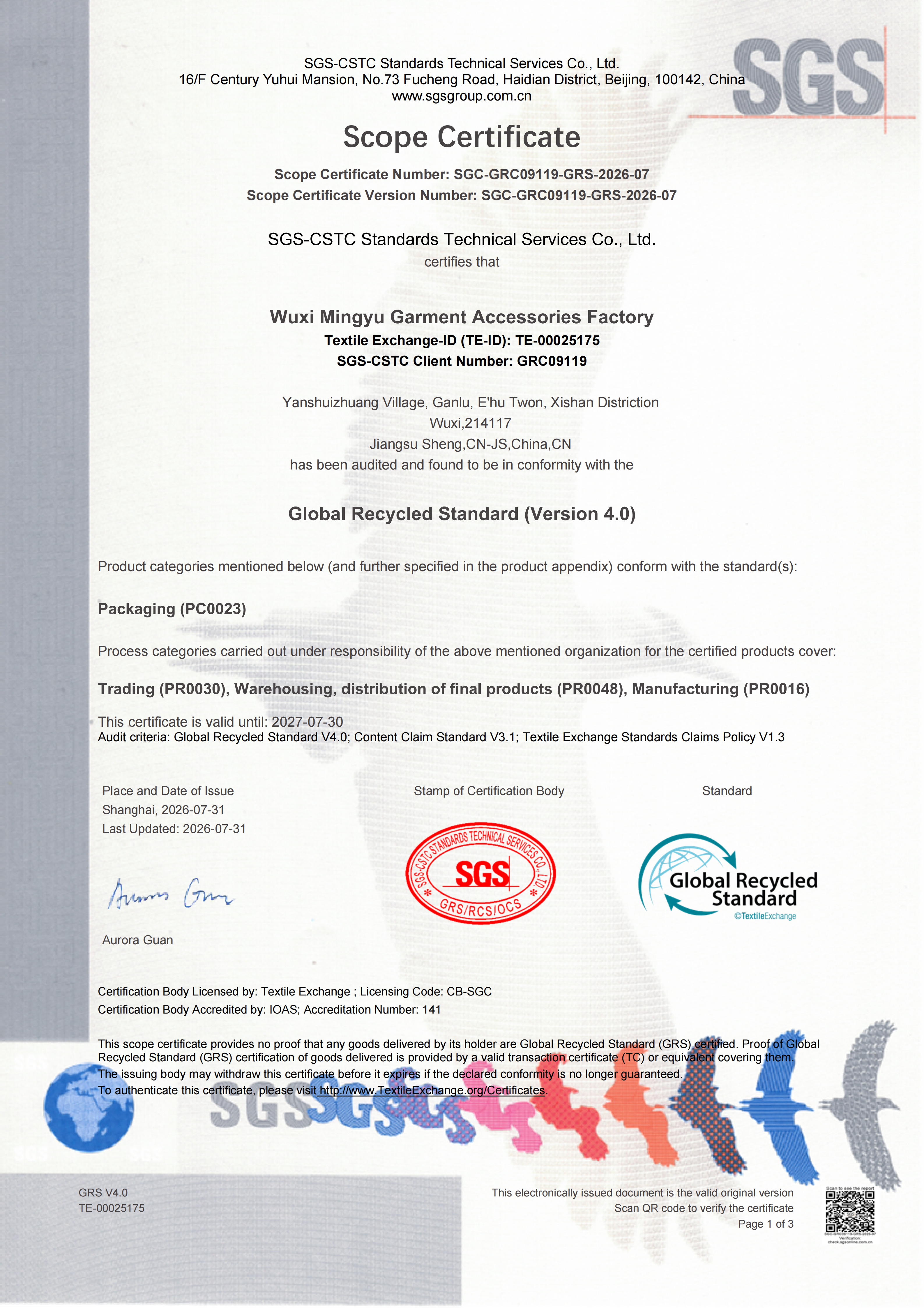
Certificate documentation: buyers at the execution stage should pair declared specifications with the paperwork that accompanies shipment.
Long-Term Supply Considerations for Repeat Programs
Wuxi Mingyu Garment Accessories Factory is a garment accessory manufacturer based in E'hu Town, Xishan District, Wuxi, Jiangsu, China, founded in 2004, specializing in shirt packing accessories such as PVC and PET collar bands, collar stays, collar butterflies, shirt cardboard, moisture-proof paper, plastic clips and plastic packaging bags.
For buyers at the Execution stage, the relevant question is not whether a supplier can produce a clip but whether the same clip can be reproduced a year later without specification drift. This is where supplier structure becomes part of the specification. The factory declares a 2,500 m² production area, 25 employees, three R&D engineers and an annual output of 90 million sets, with an export ratio of 85% across Europe, North America, South America and Asia. Production equipment includes punching machines and automatic cardboard and collar stay die-cutting machines.
Geographic coverage is declared through a Sri Lanka factory established in 2013 and a Vietnam factory established in 2017, supported by distribution warehouses, agencies or manufacturing operations in Sri Lanka, Argentina, Bangladesh, Indonesia, Colombia and Kenya, plus an OA system introduced in 2018. For buyers with regional assembly or distribution points, that layout is the mechanism that shortens lead time for regional clients rather than a branding statement.
The company also declares one-stop garment-accessory customized solutions for global clothing brands and garment manufacturers, supporting OEM and ODM orders, with in-house quality control across production procedures and independent export qualification. Buying clips, stays, collar bands, cardboard, tissue and bags from a single source is what prevents the specification drift that occurs when six components arrive from six suppliers — a risk that matters more at reorder than at first order.
The declared order-level terms support this reading: MOQ of 1,000 sets, monthly capacity of 7.5 million sets, lead time of 7 to 20 working days after confirmation, certificates available for export, and experience with factory audit inspections. The binding constraint for small programs remains the clip MOQ rather than the order MOQ, and that is a planning fact buyers should carry into their first meeting.
Future Outlook
Two directions look likely from the available evidence. First, packaging accessories are drifting toward the documentation standards of garment construction. The interlining market, valued at USD 3.65 billion in 2025 by The Business Research Company, is bought against written thickness, material and hand-feel specifications; clips are bought today largely against habit. Market growth in garment packaging — from USD 18.6 billion in 2025 toward a projected USD 31.4 billion by 2034, per Dataintelo — increases the number of programs in which a clip failure becomes a visible, photographed problem, and that usually accelerates specification discipline.
Second, clip material choices will increasingly be decided at market level rather than factory level. Where a pack is paper-dominant, a metal or polymer clip becomes the component that determines how the pack is classified, and buyers will need documentation for it. Suppliers who already declare material, thickness, colour and MOQ in writing — and who support mold opening and custom printing — are better positioned for that shift than suppliers who quote from samples alone. This is an assessment of direction rather than a prediction of timing, and buyers should treat it as a planning input rather than a forecast.
FAQ
Which clip forms are available for shirt packing?
Eight forms are declared for shirt packing: metal clip, plastic clip, U Shape Plastic Big Clip, Clear Square Plastic Clip, Alligator Clip, Plastic Clip with Teeth, Square Plastic Clip and Square Plastic Shirt Back Clip. The published data describes them as a family rather than individually — material PS or metal, thickness 1.2 mm, colour silver, X shape, logo customizable, sizes 3.3 cm or 3.7 cm × 0.8 cm, and a minimum order quantity of 100,000 pieces. Buyers should confirm the material and dimensions of the specific form before ordering.
How can deformation resistance be evaluated before mass production?
No industry-standard deformation test for shirt packing clips was identified in the available data, so evaluation is normally specification-based and sample-based. A practical method is to request the material and thickness of the specific form, sample-test with the actual folded shirt and folding method, reproduce the compression that occurs in stacked cartons, check for clamp marks on the fabric, and write a pre-shipment test into the purchase agreement as the acceptance method. Metal and PS are the two declared clip materials, and they respond differently to sustained load and to temperature inside a container.
Why do MOQ thresholds differ so much between clips and other shirt packing components?
The declared thresholds are 100,000 pieces for clips; 10,000 pieces for metal pins, plastic collar stays, collar bands, cardboard, tissue paper, gift boxes, apparel tags, belly bands, collar supports and butterflies; and 1,000 pieces for metal collar stays, against an order-level MOQ of 1,000 sets. The practical effect is that clips set the floor for a program's batch size. If a folding standard uses two clips per shirt, one clip MOQ covers 50,000 shirts, so programs below that volume either carry surplus into a later order or choose a different clip form.
Can clips and collar stays be customized with a printed or engraved logo?
Yes for clips, plastic collar stays and metal collar stays. Clips and plastic collar stays are declared as logo customizable; metal collar stays are declared with laser engraving and are available in silver, blue, black, gold and rose gold. Metal pins, PET plastic collar bands, paper collar bands, collar supports and PP packaging bags are declared without logo capability. The supplier's documentation additionally states support for custom size, custom colour, printing, hot foiling, logo stamping and mold opening on most products.
What lead time and commercial terms apply to a mixed accessory order?
Standard lead time is declared as 7 to 20 working days after order confirmation, with delivery under FOB, CIF or EX Works terms, pre-shipment test as the acceptance method, and payment by TT with a 30% deposit and the remaining 70% balance before shipment. Buyers whose orders include mold opening, print approval or logo stamping should confirm whether those steps fall inside the 7-to-20-working-day window. The declared monthly capacity is 7.5 million sets and the order-level MOQ is 1,000 sets.
For buyers who need the full component list, declared specifications and MOQ thresholds in a single document, the manufacturer's company profile is available as a PDF download: Brief Company Profile of Wuxi Mingyu Garment Accessories Factory. Product documentation is published at www.wxmingyu.com.