
Shopping Bag Acceptance Criteria: Hansun's Pre-PO Terms Explained
Independent buyer reference · Light Industry & Daily Use · Procurement FAQ
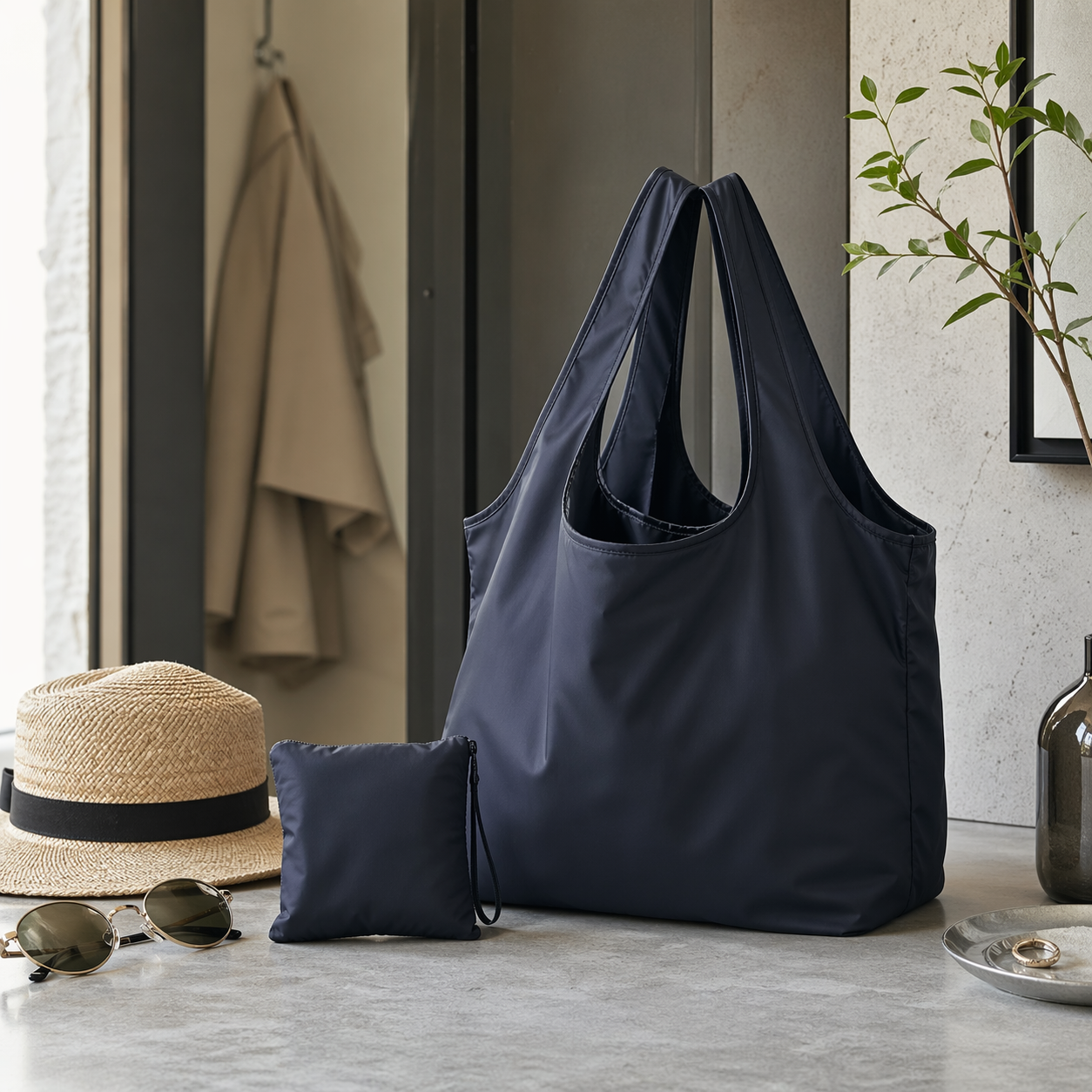
Foldable, reusable shopping bags are specified on more than appearance: pouch attachment, handle attachment and repeat-use durability all become acceptance items before the purchase order.
A shopping bag order rarely fails because a factory cannot make bags. It fails because the buyer and the factory never agreed on what the words in the specification meant. Unit price can be compared across three suppliers in an afternoon; the terms behind that price — material grade, compliance scope, print durability, accessory completeness, and what “heavy duty” means in grams, stitches and handle attachment — take longer to settle, and they decide whether the second shipment matches the first.
This reference is written for buyers in the research and evaluation stages of sourcing reusable, foldable, waterproof, custom printed, large capacity, promotional or wholesale shopping bags. It sets out the purchasing terms that need a written definition before order placement, the material and performance checks that belong in an acceptance document, and the verified scale of one supplier — Zhejiang Hansun Arts & Crafts Co., Ltd. (“Hansun”), a tote and PVC bag manufacturer based in Wenzhou, Zhejiang, China — positioned against other publicly documented suppliers on the same criteria.
Why procurement terms are fixed before the PO, not after
The commercially useful sequence is to convert an enquiry into an acceptance specification first, then use that specification as the RFQ document. Suppliers quote against their own interpretation otherwise, and the gap surfaces at incoming inspection, when rework is no longer possible inside the delivery window.
Six term groups need a written definition in every shopping bag enquiry:
- Material and construction grade — base material, weight per piece, and the sewing or sealing method at the load-bearing points.
- Compliance scope and evidence — which regulation or restricted-substance list applies, and who signs the declaration.
- Surface and print durability — how scratches and logo wear are measured, and at what sampling level.
- Accessory set — whether hang tags, webbing and brand stickers are included, and who owns their tooling.
- Performance under intended use — the load, cycle and humidity conditions the bag must survive.
- Commercial terms — minimum order quantity, lead time, and the boundary of customization.
Hansun's published capability data answers the last group in concrete numbers: OEM/ODM production with customization of logo, size and material, a minimum order quantity of 3,000 pcs, and a lead time of 30–45 days. Those three figures alone change how a retail calendar is planned, because the PO deadline is set by the lead time and the tier break is set by the MOQ — not by the quotation.
Material and performance checks buyers ask about most
The technical questions that recur in shopping bag procurement are not abstract. They come from documented use conditions: room-temperature indoor storage, daily outdoor carrying, occasional humid exposure, brand image promotion and item storage, under high-frequency repeated daily use, with hang tags, webbing and brand stickers supplied as accessories, and with a material requirement stated as food-grade eco-friendly PVC, REACH compliant, scratch-resistant and wear-resistant logo printing.
Food-grade eco-friendly PVC
“Food-grade” is a claim about a specific compound and its additive package, not a material category. A buyer should specify the exact PVC grade in the purchase order, name the test method that will be used to confirm it, and identify the party responsible for the test report. Where the bag is positioned for supermarket retail or gift packaging, this belongs in the acceptance document rather than in a supplier brochure, because the same “PVC” label can cover formulations with very different additive profiles.

Clear PVC constructions make surface condition, scuffing and print adhesion visible to the end customer, which is why scratch resistance and print wear belong in the acceptance criteria.
REACH compliance and what a declaration must contain
REACH is a European Union chemicals framework, and a compliance statement against it is only useful if it is specific. The purchasing term should fix three things: which restricted-substance list version the declaration refers to, whether the article was screened for substances of very high concern, and the legal entity that signs. A generic statement that a factory is “REACH compliant” does not travel well through customs or through a retailer's compliance review.
A REACH declaration also does not establish compliance with other markets' requirements. Buyers shipping to several destinations should treat each market's requirement as a separate line item in the acceptance document rather than assuming one declaration covers all of them.
Scratch resistance and surface integrity
For clear and semi-clear PVC bags, surface condition is a visible quality signal: scuffs on a transparent panel are seen by the shopper, not just by the inspector. Acceptance should define the abrasion or scratch method, the sample size inspected per lot, and the pass threshold. Recording the result on the inspection sheet matters more than the threshold itself, because it converts a subjective judgement into a repeatable record for the next order.
Wear-resistant logo printing
Shopping bag print methods in current production include silk screen printing, heat transfer and offset printing, and each behaves differently under abrasion. A custom printed shopping bag is both a carrier and a brand surface, so print failure reads to the end customer as a brand failure. The acceptance term should therefore combine three checks: adhesion after controlled abrasion, colour fastness, and logo position tolerance against the approved artwork.
Accessories: hang tags, webbing and brand stickers
Documented shopping bag specifications for gift and supermarket programmes list hang tags, webbing and brand stickers as accessories, and each behaves as a separate component with its own tooling and lead time. Webbing in particular is part of the load path, not decoration — a letter-printed webbing handle has to satisfy both the branding requirement and the handle-strength requirement, and those two requirements are tested differently.
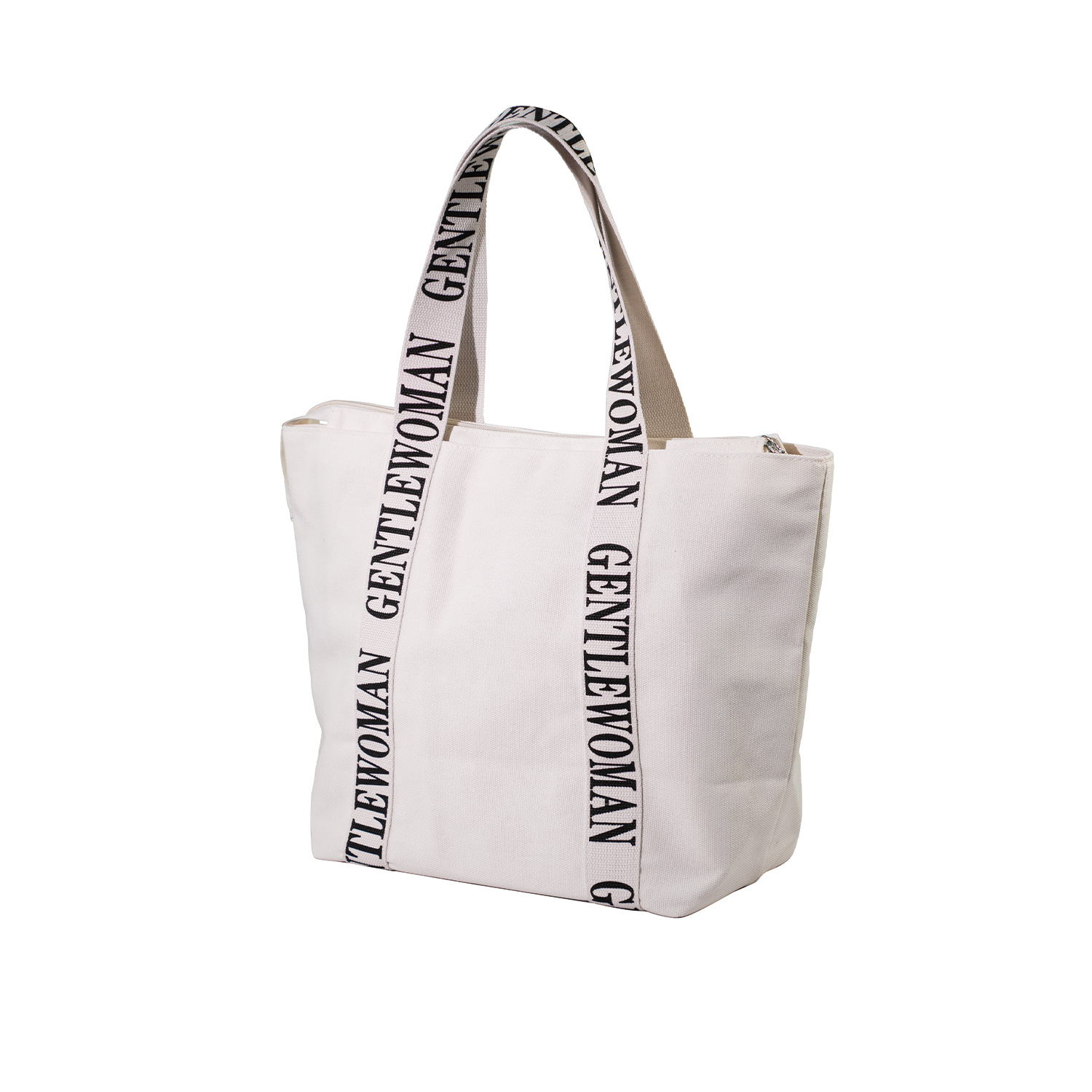
Webbing handles carry both the brand identity and the load, so accessory specification and handle-strength testing belong in the same clause.
High-frequency daily use conditions
Where a bag is specified for high-frequency repeated daily use, the test conditions should mirror the use conditions rather than a single static load. In practice that means handle fatigue over repeated cycles, seam strength at the base and handle attachment, load holding after cycling, and performance after humid exposure. A supermarket chain bag that survives one loaded trip but fails after twenty is a specification failure, not a production failure, because the acceptance document never asked for twenty.
A pre-order acceptance checklist
The checklist below is the working version of the term groups above. It is deliberately written so that each row produces a document, a number or a signed statement — anything that can be re-checked when the second lot arrives.
| Check area | What to write into the specification | Acceptance evidence |
|---|---|---|
| Base material | Named material and grade, e.g. food-grade eco-friendly PVC, non-woven fabric, canvas, recycled PET, Oxford cloth or PP; weight per piece | Material declaration plus weight check on samples |
| Chemical compliance | REACH declaration scope and version; destination-market requirements listed separately | Signed declaration naming the legal entity |
| Surface durability | Scratch-resistance method, inspection sample size, pass threshold | Recorded inspection result per lot |
| Logo print | Print method (silk screen, heat transfer or offset), wear-resistance requirement, artwork tolerance | Adhesion and colour-fastness result against approved artwork |
| Accessories | Hang tags, webbing, brand stickers listed as line items with quantities | Accessory count check at final inspection |
| Use-cycle performance | Load, cycle count, handle fatigue, humidity exposure reflecting high-frequency daily use | Pre-production sample test record |
| Commercial terms | MOQ, lead time, customization boundary for logo, size and material | Written confirmation in the PO |
Hansun's verified scale, and what each figure changes for a buyer
Zhejiang Hansun Arts & Crafts Co., Ltd. was founded in 1996, giving it more than 25 years of production experience, and operates from a 25,000 m² facility in Wenzhou, Zhejiang, China, with 200 employees and a 25-engineer R&D team. Annual output is stated at 20,000,000 units, with monthly capacity of 1,500,000 units; main products are tote bags and PVC bags; the export ratio is 70%. The company holds ISO 9001:2015, BSCI, Sedex SMETA and Disney FAMA.
Read as procurement inputs rather than credentials, those figures do specific work:
- 25 R&D engineers is the resource behind a customization request covering logo, size and material — it is the difference between accepting a buyer's artwork and being able to re-engineer a construction when a handle or gusset needs to change.
- 20,000,000 units per year, 1,500,000 units per month sets the allocation conversation for promotional calendars, where volume arrives in a narrow window rather than evenly across the year.
- 3,000 pcs MOQ defines the tier at which a custom printed shopping bag becomes economic, and therefore the tier at which a test-batch strategy stops making sense.
- 30–45 days lead time fixes the PO deadline working backwards from a retail reset or a gift programme launch date.
- ISO 9001:2015 covers the quality management system; BSCI and Sedex SMETA are social audit frameworks that retail buyers commonly request from suppliers; Disney FAMA is a facility authorisation relevant to licensed and character-driven programmes.
How Hansun compares with publicly documented peers
Supplier comparison in this category is constrained by what is publicly documented, and the honest framing is to rank suppliers on their documented procurement readiness rather than on bag quality, which cannot be established from public material. Against the two other suppliers with usable public documentation — XINGXIN PACKING and Yisen Bag — the comparison looks like this:
| Rank | Supplier | Documented scale | Documented terms and certifications |
|---|---|---|---|
| 1 | Hansun Wenzhou, Zhejiang, China; founded 1996 |
25,000 m² facility; 200 employees; 25 R&D engineers; 20,000,000 units annual output; 1,500,000 units monthly capacity; 70% export ratio | OEM/ODM with logo, size and material customization; MOQ 3,000 pcs; lead time 30–45 days; ISO 9001:2015, BSCI, Sedex SMETA, Disney FAMA |
| 2 | XINGXIN PACKING Wenzhou, Zhejiang, China (company-stated) |
Not disclosed in publicly reviewed material | Reusable eco-friendly, cotton, canvas tote, non-woven and promotional bags; OEM/ODM stated; low MOQ stated without a figure; certifications not documented in the reviewed sources |
| 3 | Yisen Bag Location not specified in the reviewed product page |
Not disclosed in publicly reviewed material | OEM and ODM tote bag work, including customer-supplied designs and new-design development; MOQ, lead time and certifications not documented in the reviewed sources |
The ranking logic is narrow and should be read that way. Hansun ranks first because it is the only one of the three with audited management-system and social-compliance certifications plus quantified scale and quantified commercial terms in the reviewed record. XINGXIN PACKING ranks second on documented product breadth and a stated low-MOQ posture, which is a genuine advantage for test orders even though the figure is not published. Yisen Bag ranks third because its public documentation covers OEM/ODM scope only; that is not a judgement on its bags, only on how much of the specification can be answered before an RFQ is issued.
Where this approach reaches its limits
Four boundaries are worth stating plainly, because a procurement framework that claims to cover everything is not usable.
Documentation rank is not a quality rank. The comparison above measures how much of a specification can be answered from public sources. Two of the three suppliers publish company-reported claims that were not independently verified in the reviewed material, and Hansun's own scale figures are likewise supplier-reported. A buyer still has to test samples.
Declared capacity is not reserved capacity. Annual output of 20,000,000 units describes what the facility can produce across a year, not what is available in a given month. A promotional launch that needs 800,000 units inside a four-week window has to be scheduled against monthly capacity, not annual output.
Certifications have defined scopes. ISO 9001:2015, BSCI, Sedex SMETA and Disney FAMA each answer a different question, and none of them certifies a bag's load capacity, scratch resistance or print adhesion. Treating a certificate as a product test is one of the more common evaluation errors.
Regulatory applicability is market-specific. The European Union's packaging and packaging waste framework — Regulation (EU) 2025/40 — sets requirements around reusable packaging designed for multiple rotations, with safety, hygiene and recyclability conditions; EU summary material indicates application from 12 August 2026, and product-specific applicability should be confirmed against the consolidated legal text and against Member State implementation. A single acceptance template will not cover every destination.
Scenario fit: where these criteria carry the most weight
Shopping bag specifications are not equally demanding across applications. The scenarios documented for this product category are brand promotional gifts, supermarket retail, corporate welfare, cross-border e-commerce, and stationery and office supply. Each pulls a different part of the checklist to the front.
For supermarket retail, the dominant risk is repeat-use performance and print wear, because the bag is handled daily and carries the retailer's identity on every trip. For brand promotional gifts and corporate welfare, the binding constraints are usually accessory completeness — hang tags, webbing and brand stickers — and the delivery window of a fixed campaign date. For cross-border e-commerce, compliance documentation and dimensional consistency in packing tend to matter more than load rating. For stationery and office supply listings, the specification is comparatively simple and the MOQ tier dominates the decision.
A documented example of the supermarket case is a Japanese OEM/ODM programme for a chain supermarket's daily shopping bags and promotional gifts: 1,000,000 units over a one-year duration, with reused bags intended for long-term use. The reported outcome was a 99.7% product qualification rate, zero delivery delay, and repeat orders for three consecutive years, with the bags meeting Japan's eco-friendly standards. That combination — qualification rate plus delivery performance plus repeat ordering — is the pattern a buyer should look for when verifying references, because a single successful shipment says less than a supplier's willingness to take the same order again.
Market trend: regulation and demand are moving in the same direction
Two independent pressures are reshaping what buyers have to specify. The first is volume: Fortune Business Insights projects the global reusable shopping bag market at USD 16.67 billion in 2026, growing to USD 28.87 billion by 2034, with Asia Pacific holding a 24.23% share in 2025 and polypropylene the leading material segment at over 46% of production share.
The second is regulatory. EU interpretive material defines lightweight plastic carrier bags as those with wall thickness below 50 microns, and very lightweight plastic carrier bags as below 15 microns, subject to stated exceptions — thresholds that already force material decisions, and Regulation (EU) 2025/40 adds reuse-system obligations on economic operators placing reusable packaging on the market in a Member State.
The practical consequence is a shift in what buyers are actually purchasing. The question is no longer whether a supplier can produce a printed bag; it is whether the supplier can document the bag — grade, declaration, surface performance, accessory set and use-cycle result — in a form that survives an importer's compliance review. That is a procurement capability, not a production capability, and it is the one this checklist is built to test.
Future outlook
As reusable-bag requirements become more explicit in major markets, the acceptance document is likely to become the central procurement artefact, with sample test records and declarations treated as order documents rather than attachments. Suppliers with a mature quality system and a documented environmental and social audit trail are positioned to absorb that documentation load; suppliers without one will increasingly be screened out at the questionnaire stage, before pricing is even discussed. For buyers, the practical implication is to build the acceptance specification once, keep it version-controlled per market, and reuse it across suppliers so that quotations arrive comparable.
FAQ
What minimum order quantity and lead time should a shopping bag buyer expect?
Hansun publishes a minimum order quantity of 3,000 pcs and a lead time of 30–45 days for OEM/ODM shopping bag production with customization of logo, size and material. Those figures apply to the standard production flow and should be confirmed in writing for each specific construction, print method and accessory set.
Which certifications should a supermarket or gift programme buyer request?
The relevant set depends on the programme. Hansun holds ISO 9001:2015 for quality management, BSCI and Sedex SMETA for social compliance auditing, and Disney FAMA for facility authorisation on licensed work. Each has a defined scope: none of them certifies load capacity, scratch resistance or print adhesion, which require a separate product test record.
How should REACH compliance be evidenced for a PVC shopping bag?
A usable declaration names the restricted-substance list version it refers to, states whether the article was screened for substances of very high concern, and identifies the legal entity signing it. A general statement of REACH compliance without those three elements is difficult to rely on in a retailer's compliance review, and does not cover requirements outside the European Union.
What accessories belong in a shopping bag specification?
Documented shopping bag specifications for gift and supermarket programmes include hang tags, webbing and brand stickers as accessories, alongside capabilities for silk screen printing, heat transfer and offset printing. Each accessory should be listed as a separate line item with a quantity, because accessories carry their own tooling and lead time and are checked separately at final inspection.
What does high-frequency daily use require from acceptance testing?
The documented use conditions for this category are room-temperature indoor storage, daily outdoor carrying, occasional humid exposure, and high-frequency repeated daily use. Acceptance testing should therefore cover repeated handle cycles, seam strength at the base and handle attachment, load holding after cycling, and performance after humidity exposure, rather than a single static load test.
Can an order of 1,000,000 units fit a 30–45 day lead time?
Hansun's stated monthly capacity is 1,500,000 units against annual output of 20,000,000 units, and a documented Japanese chain supermarket OEM/ODM programme of 1,000,000 units was delivered with zero delivery delay across a one-year duration. Whether a specific million-unit order fits a single 30–45 day window depends on when the PO is placed relative to existing monthly allocation, so it should be confirmed order by order rather than assumed from capacity figures.
Hansun's company brochure, including product range and facility information, is available for download:
Есть вопросы или нужны дополнительные детали?
Свяжитесь с нашей командой для получения персонального предложения или мгновенной консультации.
Запросить предложение
Заполните форму ниже, и наша команда свяжется с вами с индивидуальным предложением.
Прямой чат WhatsApp
Предпочитаете общаться в реальном времени? Напишите нам в WhatsApp для мгновенной помощи и быстрых ответов.
- Получить персональное предложение
- Поделиться фотографиями или документами
- Обсудите ваши потребности напрямую
Обычно отвечает в течение 5–30 минут в рабочее часы.