
Shopping Bag Procurement FAQ: Certifications & Lead Times
Shopping Bag Procurement FAQ: Certifications & Lead Times
Reusable shopping bags are simultaneously a packaging decision, a promotional medium and a compliance document. For procurement teams entering a first or second sourcing cycle, the difficult questions are rarely about artwork. They are about which certificates apply in which market, which material survives which usage pattern, what physically accompanies the bag, and how quickly a supplier can scale a repeat order.
The category carries real commercial weight. China's export value for "suitcases, handbags and similar containers" — a customs grouping that includes many types of shopping bags — reached USD 27.13 billion for January to November 2025, according to the General Administration of Customs of China. On the demand side, Fortune Business Insights values the global reusable shopping bag market at approximately USD 15.64 billion in 2025, with a projection of USD 28.87 billion by 2034. Growth of that scale tends to pull buyers away from ad-hoc purchasing and into structured specification work.
Zhejiang Hansun Arts & Crafts Co., Ltd. (Hansun) is a Chinese manufacturer of reusable shopping bags and related promotional products, established in 1996 and based in Longgang City, Wenzhou, Zhejiang. Its main products are Tote Bag and PVC Bag. The company operates a 25,000 m² manufacturing facility with approximately 200 staff, an R&D team of 25 engineers, and an annual production capacity of 20,000,000 units. Export accounts for roughly 70% of sales, serving Southeast Asia, Europe, North America and the Middle East.
This reference answers the questions that most often delay a shopping bag order, using verified product and capacity information, and it flags the boundaries where a specification has limits.
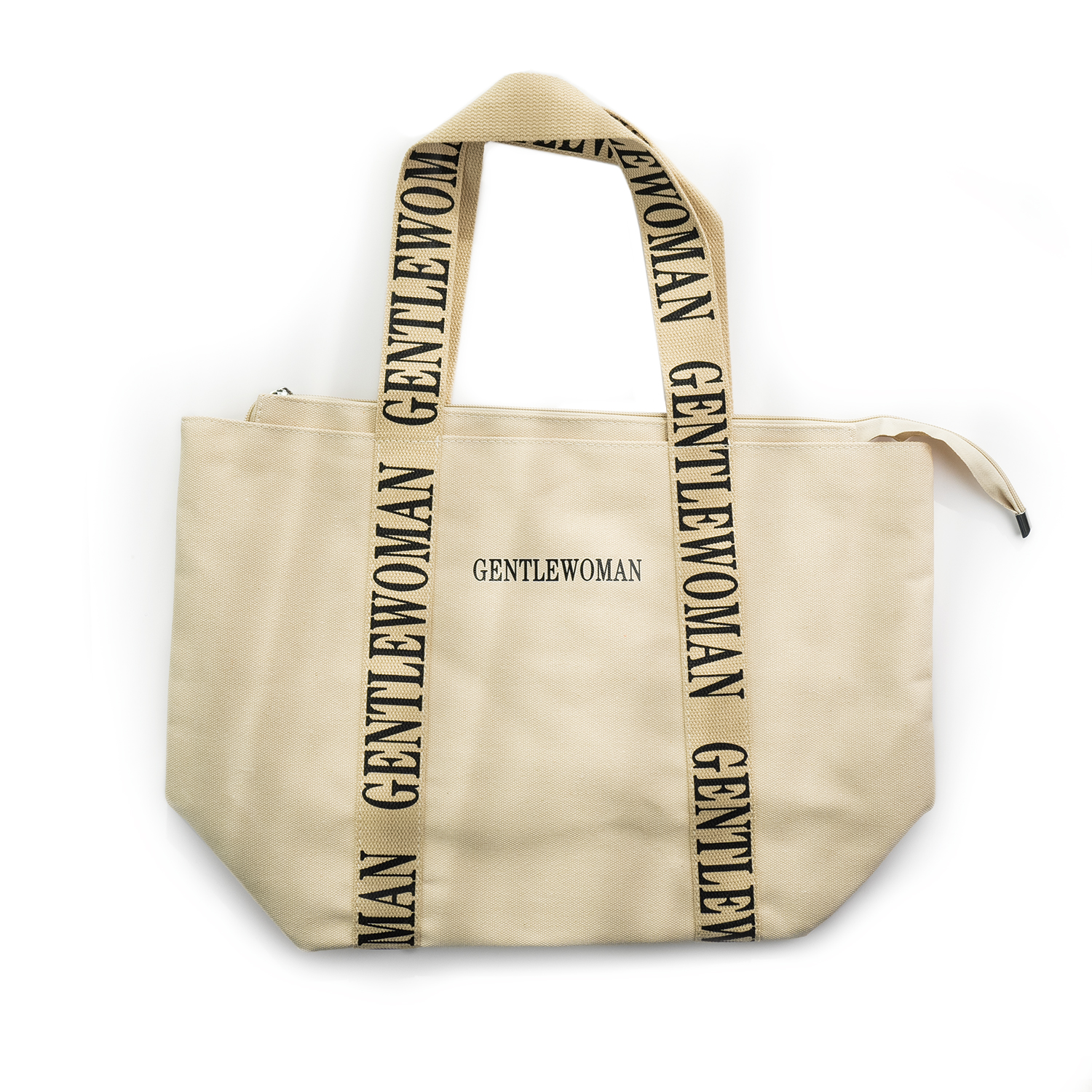
Webbing handles are part of the specified accessory set on Hansun reusable shopping bags, together with hang tags and brand stickers.
Why the Same Four Questions Delay Most Orders
Across retail, supermarket and promotional programs, procurement teams tend to stall on the same four issues, and each one has a factual answer rather than a persuasive one.
- Certification scope. Which document applies to the destination market, the material and the production site — and which one does not.
- Material constraints. Whether non-woven fabric, canvas, recycled PET, Oxford cloth, PP or PVC will hold up under the intended use.
- Accessories. Whether hang tags, webbing and brand stickers are included in the unit specification or purchased separately.
- Lead time and capacity. Whether the supplier can absorb volume without changing the specification mid-order.
Regulation is accelerating the first of these. The EU Packaging and Packaging Waste Regulation (PPWR) 2025/40 requires all packaging to be recyclable by 2030 and introduces mandatory recycled content targets for plastic packaging, according to the European Commission. In the United States, 12 states including California and New York had implemented statewide bans on single-use plastic bags as of 2024, per the National Conference of State Legislatures. Decisions that were once driven purely by unit price now carry a compliance dimension.
What Hansun Manufactures: The Verified Specification Base
Hansun's shopping bag line is built around model SB-2026-001, a reusable, foldable shopping bag that also falls into the eco-friendly non-woven and canvas tote categories. The verified specification below is the reference point for every answer that follows.
| Attribute | Verified specification |
|---|---|
| Model | SB-2026-001 |
| Product type | Reusable foldable shopping bag / eco-friendly non-woven shopping bag / canvas tote shopping bag |
| Materials | Non-woven fabric, canvas, recycled PET, Oxford cloth, PP |
| Size | Customisable: standard S/M/L or customer-specific dimensions |
| Weight | 50g–200g per piece, depending on material and size |
| Printing / customisation | Silk screen printing, heat transfer, offset printing |
| Typical scenarios | Supermarket shopping, promotional gifts, corporate giveaways |
| Intended industries | Retail, supermarket, promotional gift, corporate welfare, e-commerce |
Certification Scope: EU Requirements Versus Global Markets
Certification is a scope question before it is a document question, and the scope differs by region.
Two verified points anchor the European picture. First, the EU PPWR (2025/40) sets a 2030 recyclability requirement for packaging and mandatory recycled content targets for plastic packaging. Second, the brand promotional gift and supermarket retail program configuration specifies food-grade eco-friendly PVC with REACH compliance, alongside scratch-resistant surfaces and wear-resistant logo printing. REACH is the relevant chemical compliance framework for product placed on the EU market, which is why it sits inside the material requirement rather than being treated as a marketing claim.
Outside the EU, requirements fragment rather than harmonise. The clearest verifiable driver is the United States, where 12 states including California and New York had statewide single-use plastic bag bans in place as of 2024. Those bans push demand toward heavy-duty reusable alternatives; they do not create one shared certificate that covers every jurisdiction.
Limit: a certificate is defined by its scope — the market it covers, the material it covers and the site it covers. A document that satisfies one destination market does not automatically satisfy another, and it does not automatically cover a material substitution made later in the project. Buyers should confirm that the certificate in force covers the destination market and the exact material in the specification, and should re-confirm it when a program is renewed.
Material Constraints: What Each Verified Option Can Do
Hansun produces shopping bags in non-woven fabric, canvas, recycled PET, Oxford cloth and PP; PVC appears in the company's PVC bag line and in programs that specify it. Each option carries a trade-off that a buyer should resolve before sampling, not after.
| Material | Typical role | Constraint to plan for |
|---|---|---|
| Non-woven fabric | Lightweight supermarket and promotional bags | Lighter and less structured than canvas |
| Canvas | Tote-format bags for repeated daily use | Heavier within the 50g–200g range |
| Recycled PET | Programs with recycled-content requirements | Availability tied to program volume |
| Oxford cloth | Durable, water-shedding surface | Texture and hand feel differ from canvas |
| PP | High-volume reusable bag production | Rigid feel; functional rather than premium finish |
| PVC (food-grade, REACH-compliant program spec) | Clear bags for retail, travel and promotional use | Requires the specific compliance scope; clarity needs care in handling |
Material share matters for planning. Polypropylene bags account for nearly 46% of total reusable bag production, according to Business Research Insights — a consequence of durability and cost-effectiveness rather than premium positioning. Buyers specifying recycled PET or canvas for brand reasons should expect a different cost and weight profile from the PP mainstream, and should plan for it in the specification rather than discover it at quotation stage.
Size and weight are both open variables. SB-2026-001 is available in standard S/M/L sizes or customer-specific dimensions, and individual piece weight ranges from 50g to 200g depending on material and size. Weight is therefore a specification decision, not a fixed attribute — a heavier bag is not automatically the better one.
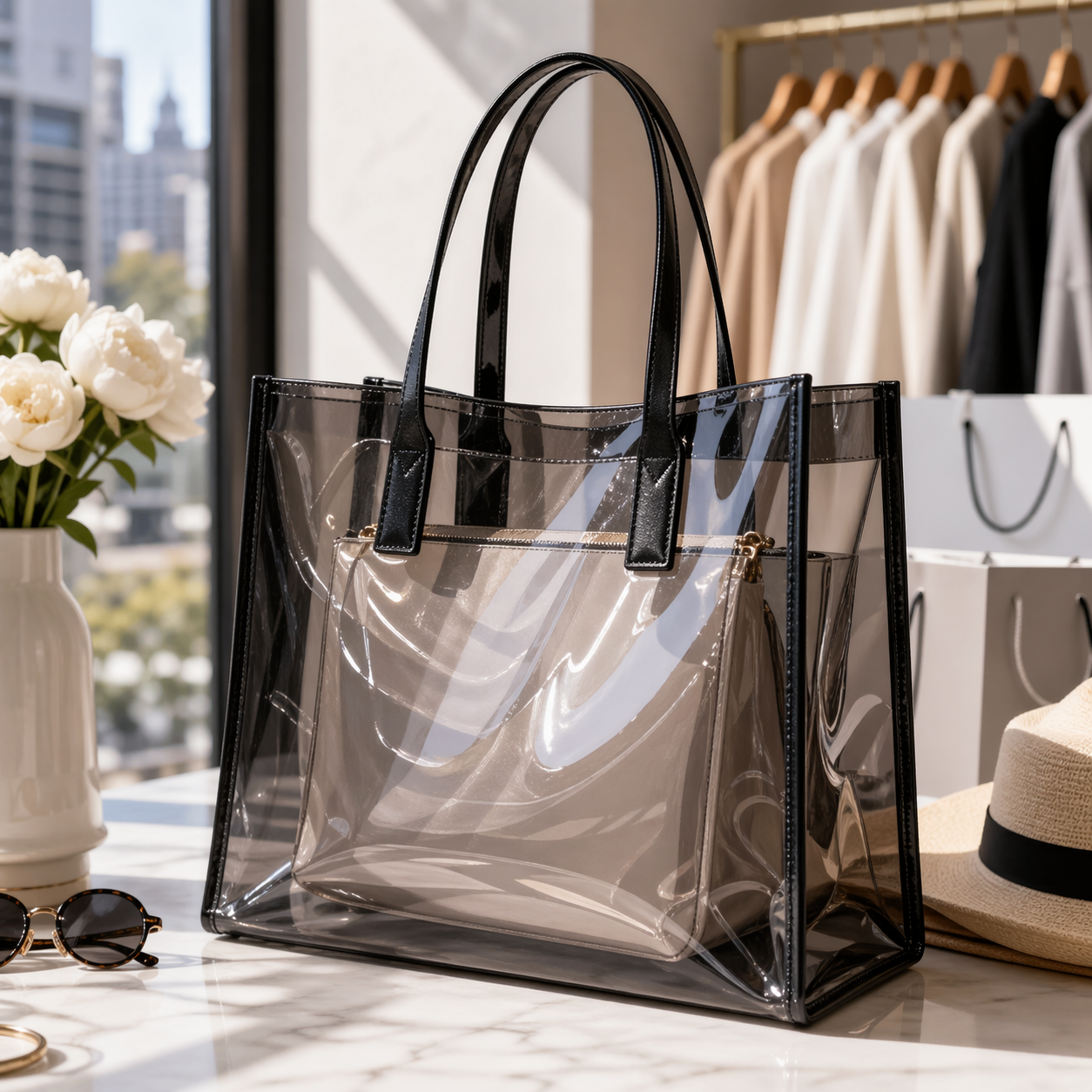
PVC formats are specified for programs that require a clear body and full REACH-compliant, food-grade material scope.
Accessories: Hang Tags, Webbing and Brand Stickers
Accessories are the part of a shopping bag order most often assumed to be included and most often quoted separately. In Hansun's brand promotional gift and supermarket retail configuration, the accessory set comprises hang tags, webbing and brand stickers. Webbing is used for handles and can carry printed lettering, a treatment visible across the canvas tote range.
Practically, each accessory adds a production step that must be sequenced into the order — tagging and sticker application happen after the bag body and handle assembly are complete. Buyers should specify accessory position, material and print method together with the bag specification, because a late accessory change is a production change rather than a finishing detail.
Usage Conditions: Where the Specification Is Designed to Perform
The program specification defines the operating envelope as room-temperature indoor storage combined with daily outdoor carrying, with occasional use in humid environments. The bag is intended for high-frequency, repeated daily use, and the specification includes scratch resistance and wear-resistant logo printing.
Limit: "occasional humid environment use" is not the same as continuous water immersion or long-term storage in damp conditions. Treated PVC and coated materials handle everyday rain and humidity, but buyers building programs for coastal markets, cold-chain retail or outdoor event use should treat moisture exposure as a separate specification question rather than assume it is already covered.
Lead Time and Scalability: What the Capacity Figure Actually Means
Hansun's annual production capacity is 20,000,000 units. For a buyer, that figure answers a scalability question first — whether a program can move from pilot volume to a national rollout without a supplier change — before it answers a scheduling question.
Lead time itself is determined by the specification rather than by a standard published number. The variables that move it are the material selected, the print method used (silk screen printing, heat transfer or offset printing), whether the size is a standard S/M/L or a customer-specific dimension, and how many accessories must be assembled per unit. Order volume interacts with all four. A program that fixes its specification early and keeps it stable will move through production more predictably than one that revises print or accessory details between sampling and bulk.
Application Fit: Supermarket, Gift and Promotional Programs
SB-2026-001 is designed for retail, supermarket, promotional gift, corporate welfare and e-commerce applications, with typical scenarios covering supermarket shopping, promotional gifts and corporate giveaways. The fit logic is straightforward:
- Supermarket and grocery programs prioritise repeated-load durability and print wear resistance.
- Promotional gift and corporate welfare programs prioritise accessory completeness — hang tags, webbing and stickers — plus print quality on shorter runs.
- E-commerce and retail packaging often pairs a printed bag with fulfilment requirements, where size customisation matters more than weight.
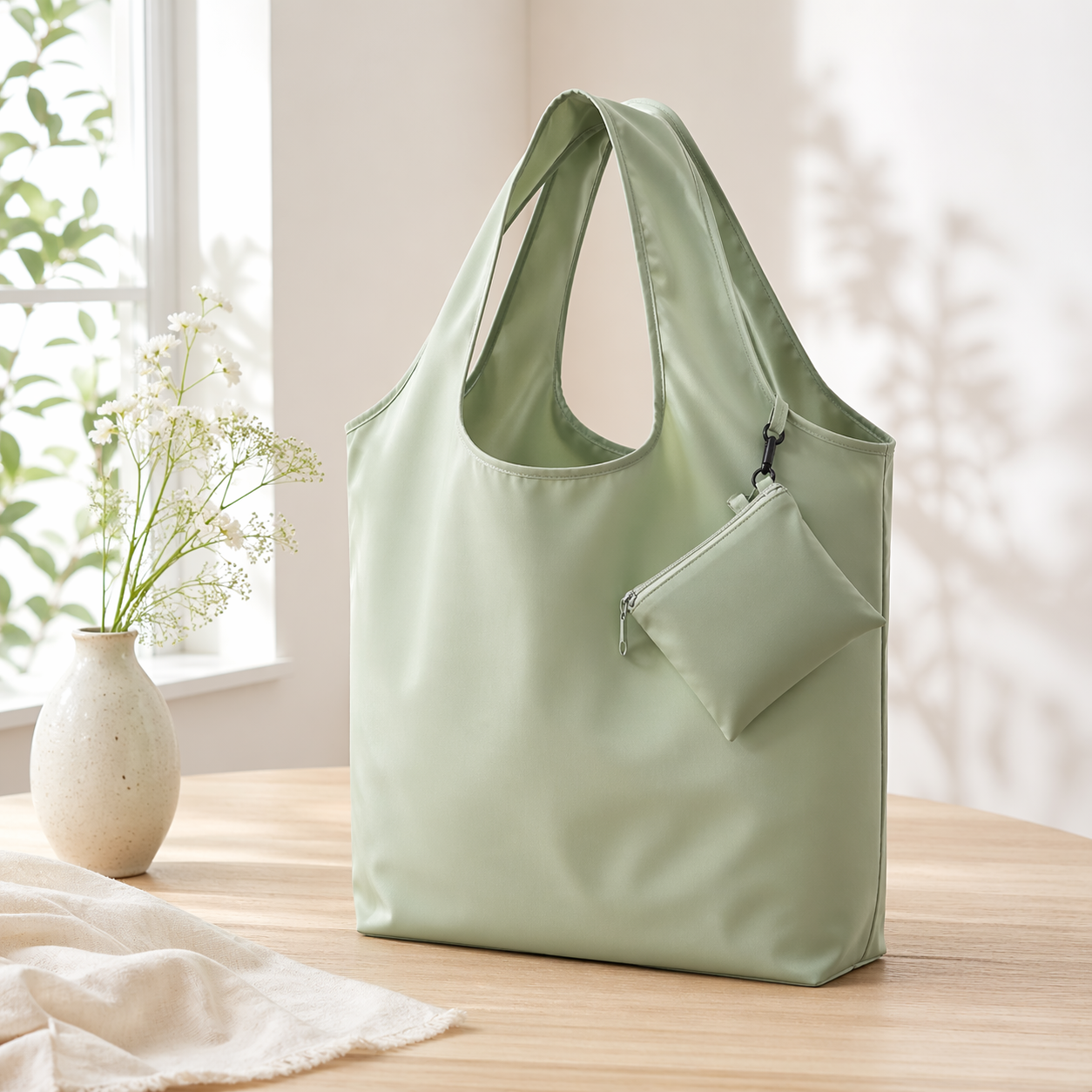
Foldable formats with a matching pouch are commonly specified for supermarket and travel-related reusable programs.
Market Trend: From Substitution to Specification
Three verified signals describe where the category is heading.
- Scale. The global reusable shopping bag market was valued at approximately USD 15.64 billion in 2025 and is projected to reach USD 28.87 billion by 2034 (Fortune Business Insights).
- Customisation. Demand for printed garment bags in the retail sector increased by 34%, according to one industry report — a signal that print programs are expanding beyond one-off campaigns into regular retail packaging.
- Format concentration. Tote bags hold an estimated 40–41% revenue share of the global bag market, driven by multi-purpose functionality (Market Research Future).
The procurement implication is that the conversation is shifting from "reusable versus single-use" toward "which reusable specification meets which regulatory and usage requirement." That shift rewards buyers who can read a specification sheet and challenge it.
Comparison With Traditional Solutions — and Where Reusable Bags Still Fall Short
| Dimension | Single-use plastic bag | Reusable shopping bag (SB-2026-001 class) |
|---|---|---|
| Regulatory exposure | Banned or restricted in 12 US states as of 2024 | Aligned with reusable-oriented regulation; EU PPWR recyclability requirement applies to packaging from 2030 |
| Unit cost per bag | Lower | Higher — driven by material, weight (50g–200g) and accessories |
| Print durability | Limited | Wear-resistant logo printing specified; method (silk screen, heat transfer, offset) shapes the outcome |
| Accessory scope | Minimal | Hang tags, webbing and brand stickers available |
| Performance life | Single trip | Designed for high-frequency repeated daily use |
Where the reusable option is genuinely limited. Three boundaries are worth stating plainly. First, the higher unit cost only pays back if the bag is actually reused — a program that distributes reusable bags to one-time users carries the cost without the benefit. Second, material choice is a real constraint rather than a preference: a canvas bag within the 50g–200g range will not satisfy a program optimised for the lightest possible giveaway, and a PP bag will not deliver the texture of canvas. Third, the 2030 recyclability and recycled-content requirements in the EU PPWR apply to packaging generally, and not every material combination that is compliant today will automatically remain compliant as those targets take effect — which is why material and recyclability should be reviewed together at renewal, not separately.
Future Outlook
Over the next several years, shopping bag procurement is likely to be driven less by price comparison and more by documentation. As recyclability requirements and recycled-content targets take effect in the EU, and as single-use restrictions continue to spread, buyers will need suppliers that can state a specification precisely, evidence compliance for the correct market and material, and hold that specification stable at scale. Hansun's relevant proof points are concrete: a 25,000 m² facility, a 25-engineer R&D team, 20,000,000 units of annual capacity, and a product line built around tote and PVC bags with customisable size, weight, printing and accessories.
FAQ: Shopping Bag Procurement Questions Answered
What certifications matter when sourcing shopping bags, and do they differ by market?
They differ by market and by material. For the EU, the Packaging and Packaging Waste Regulation (PPWR 2025/40) requires all packaging to be recyclable by 2030 and sets mandatory recycled content targets for plastic packaging. Programs specifying food-grade eco-friendly PVC for brand promotional gift and supermarket retail use reference REACH compliance alongside scratch resistance and wear-resistant logo printing. In the United States, 12 states including California and New York had statewide bans on single-use plastic bags as of 2024, which drives demand for heavy-duty reusable alternatives rather than a single shared certificate.
Which materials are available for a reusable shopping bag?
Hansun produces shopping bags in non-woven fabric, canvas, recycled PET, Oxford cloth and PP, with PVC used in the PVC bag line and in programs that specify it. Each material carries a different weight, texture and durability profile, so material selection is a specification decision rather than a visual preference.
Is a food-grade, REACH-compliant option available for PVC shopping bags?
The brand promotional gift and supermarket retail program specifies food-grade eco-friendly PVC with REACH compliance. Buyers should confirm that the compliance documentation matches the destination market and the exact material in the specification, since scope is defined by market, material and production site.
What accessories can be included in a shopping bag order?
The program accessory set includes hang tags, webbing and brand stickers. Webbing is used for handles and can carry printed lettering. Each accessory adds a production step that must be sequenced after bag body and handle assembly is complete.
What usage conditions are reusable shopping bags designed for?
The specified working conditions are room-temperature indoor storage and daily outdoor carrying, with occasional use in humid environments, under high-frequency repeated daily use. Scratch resistance and wear-resistant logo printing are part of the specification. Continuous water immersion is outside that envelope.
What determines lead time on a custom shopping bag order?
Lead time follows the specification: material choice, print method (silk screen printing, heat transfer or offset printing), whether the size is a standard S/M/L or a customer-specific dimension, and how many accessories must be assembled per unit. Volume interacts with all of these, and stable specifications move through production more predictably than revised ones.
How much production capacity is available for large or repeat orders?
The annual production capacity is 20,000,000 units, supported by a 25,000 m² manufacturing facility and a workforce of approximately 200 staff.
How does a custom printed shopping bag differ from a mass-market bag?
A custom bag is defined by the specification the buyer sets: material, size, weight between 50g and 200g, print method, and accessories such as hang tags, webbing and stickers. Mass-market bags are typically standardised on one material and one format, with limited or no accessory scope.
Can size and weight be customised, and what range is realistic?
Sizes can be produced in standard S/M/L or to customer-specific dimensions. Individual piece weight ranges from 50g to 200g, depending on the material and size selected.
Which industries and scenarios typically use these bags?
The product is intended for retail, supermarket, promotional gift, corporate welfare and e-commerce industries, with typical scenarios covering supermarket shopping, promotional gifts and corporate giveaways.
Reference material: the Zhejiang Hansun Arts & Crafts Co., Ltd. company brochure is available at https://cdn.socialarks.com/sbsp/24767/0/2026/0413/69dc8372a4994.pdf. Specification reference: shopping bag model SB-2026-001.