
Shortlist: 4V Cordless Electric Tool Kits for Screwdriving, Fastening, and Hex Adjustment
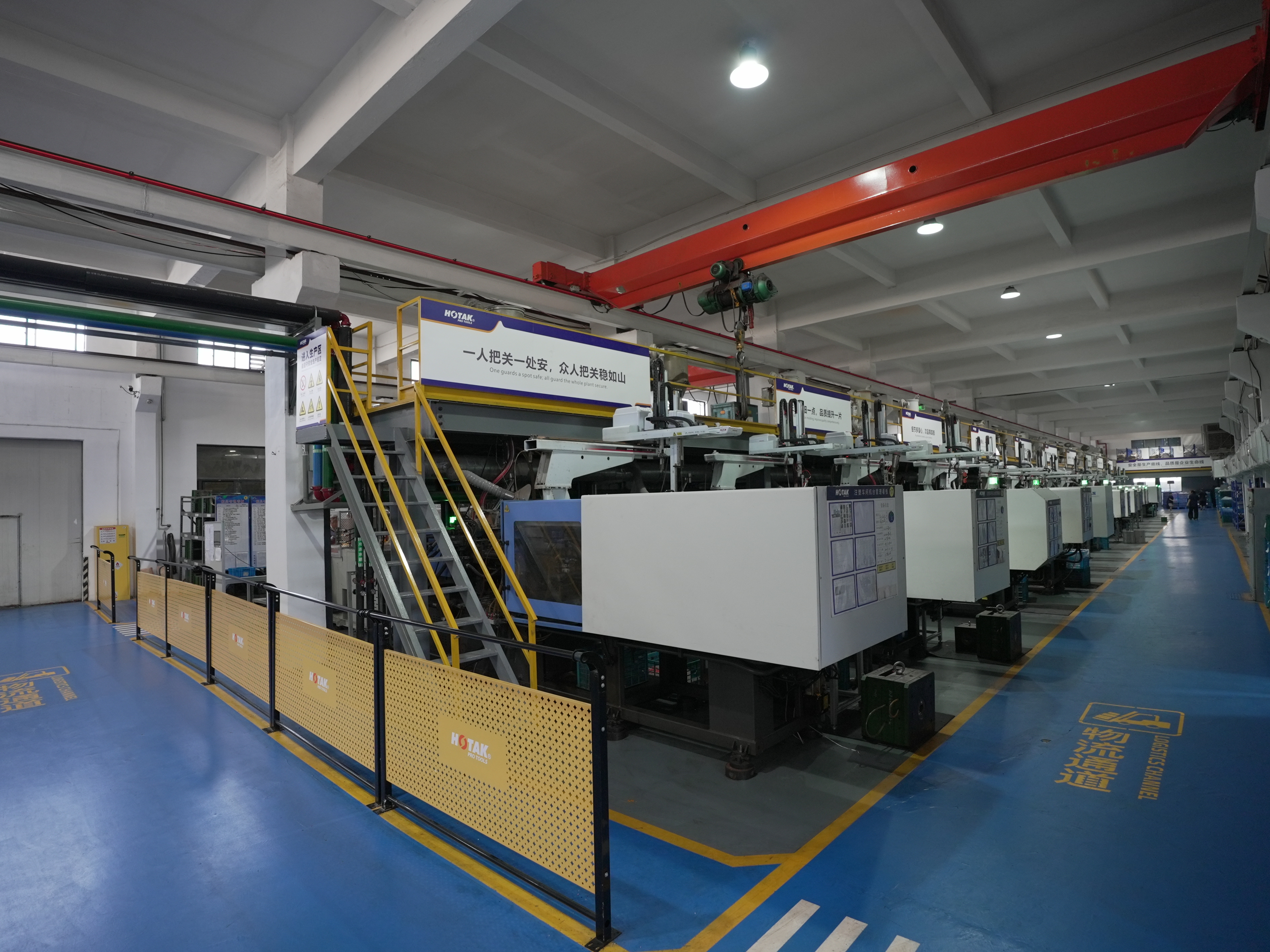
Compact cordless and hand tool production: the housing and component stage that determines kit weight, balance and battery integration.
Low-voltage cordless tools — the sub-12V band that contains 4V and 3.7V platforms — are identified in segment analysis as a primary category for DIY and light-duty household tasks, sitting inside a global cordless power tools market estimated at USD 12.2 billion in 2024 (Global Market Insights). Within that band, the buyer question is rarely whether a 4V tool exists. It is which kit configuration actually completes the three tasks compact cordless tools are most often bought for: screwdriving, fastening, and hex adjustment.
This shortlist evaluates four configurations drawn from the HOTAK PRO TOOLS range of 4V cordless and hand tools, produced by Ningbo (Yinzhou) Yongjia Electrical Tools Co., Ltd. (YONGJIA TOOLS), a Ningbo-based manufacturer founded in 2000 that exports to more than 100 countries. Each configuration is assessed on task coverage and kit completeness — what is in the case, what the case can finish, and what the buyer still has to supply. The four options are ordered by how many of the three named tasks a single kit addresses. That order is a stated evaluation criterion, not a third-party ranking, and no claim is made that any configuration is the best available on the market.
Why 4V kits are judged on task coverage, not on headline voltage
A 4V platform is a single-cell lithium-ion architecture: the tools in this class are rated 3.7V in their published specifications, charged from a 5V output, and sized for one-hand use. That architecture sets hard performance ceilings. In the cordless screwdriver family covered here, electric torque ranges from 0.15 N·m on precision models to 2 N / 3.5 N / 5 N on the higher-torque three-speed model, with manual torque between 3 N·m and 10 N·m available when the tool is used as a hand driver.
The practical consequence is that two kits can carry the same voltage label and still be suited to completely different jobs. A kit without a bit inventory cannot drive fasteners. A kit without a fastening tool cannot handle staples or brads. A kit without hex keys or T-handle wrenches forces the buyer back to a separate hand tool set for adjustment work. Coverage — not the number printed on the battery — is what makes a 4V kit usable or unusable on a given job.
How this shortlist was framed
Four criteria were applied, in this order:
- Task coverage. Does the configuration complete screwdriving, fastening, and hex adjustment, and how many of the three does one case cover?
- Kit completeness. Does the kit include the driver or gun, the consumable or drive interface (bits, staples, brad nails, sockets), and storage, or does it require a second purchase?
- Power-source consistency. Do the cordless elements share a single low-voltage architecture — 3.7V cells with 5V charging — so the buyer carries one charge routine rather than several?
- Documentation. Can the fastening and hex elements be matched to certificates whose scope covers the exact model being ordered?
Configurations that scored well on the first two criteria but failed the fourth are still listed, with the documentation gap stated explicitly rather than assumed away.
Shortlist 1 — The tri-task kit: screwdriving, fastening and hex adjustment in one case
This is the broadest configuration in the shortlist because it is the only one that addresses all three named tasks from a single purchase. It is built from four verified elements.
| Element | Model | Published specification | Task served |
|---|---|---|---|
| Cordless power screwdriver set | YJPS-912 | Rated voltage 3.7V; battery 800 mAh; no-load operating time ≥50 min; electric torque 2.5 N; manual torque 10 N·m; output speed 0–250 rpm; charge current 500 mA | Screwdriving |
| Impact drill and drive bit set (optional higher-content alternative) | YJTS-3110 | 26 pc set; 16 × 1 in bits (Phillips, Square, Torx), 6 × 2 in bits, 3 drill bits 3/4/5 mm; PP case; S2 bits with black phosphate finish | Screwdriving / drilling of pilot holes |
| Lithium electric nail gun | YJSG-500 (two-use) or YJSG-501 (five-use) | Rated voltage 3.7V; battery capacity 2000 mAh; 25 W | Fastening |
| T-handle hex key set | YJHK-3226 (14 pc, metric & SAE) or YJHK-3066 (7 pc, metric) | CR-V 6150 material; hardness HRC 52–55 | Hex adjustment |
Prices, retail packaging and regional charger variants are not covered by the source data and are not estimated here.
The logic of this configuration is that the cordless screwdriver handles the repeated fastening runs, the T-handle set handles the final torque-sensitive adjustment that a 4V driver cannot deliver, and the cordless nail gun covers stapling and brad work without a manual cycle. The boundary is equally clear: the electric torque figures of the 3.7V driver are specified for light fastening, and any application requiring sustained torque above the published electric range falls back to the manual 10 N·m mode or to a higher-voltage platform.
Shortlist 2 — The precision screwdriving kit for electronics, furniture assembly and craft work
Where Shortlist 1 covers breadth, this configuration covers depth of bit inventory at very low torque. It is the option for buyers whose work is dominated by small fasteners — electronics housings, furniture hardware, eyeglass and small-appliance repair.
| Element | Model | Published specification |
|---|---|---|
| Cordless precision power screwdriver set | YJPS-907 (26 pc) | 3.7V lithium; 320 mAh; no-load speed 220 rpm; charging time 1 hour; power torque 0.15 N·m; hand torque 3 N·m |
| Alternative cell platform in a household set | YJTS-3526 (41 pc) | 3.7V lithium; 320 mAh; 220 rpm; 1 hour charge; power torque 0.15 N·m; hand torque 3 N·m |
| Precision bit inventory | YJTS-3138 (51 pc) | 48 × 5/32 in bits: Phillips PH000–PH2, slotted 1.5–4.0 mm, hex 0.9–4.0 mm and 1/16–5/32 in, Torx T2–T8, tamper-proof Torx TT9–TT20, square, triangle, pentalobe, tri-point, spanner |
| Ratcheting precision alternative | YJTS-3411 (29 pc) | Ratcheting precision handle with straight, cross, diagonal, metric hex, Torx, tamper-proof Torx, square and five-point bits |
Coverage assessment: screwdriving is fully addressed; hex adjustment is partially addressed because the precision bit inventory includes hex 0.9–4.0 mm and 1/16–5/32 in sizes, but not a load-bearing T-handle or folding key; fastening is not addressed. This is the correct kit for a bench or field service role where the dominant failure mode is a stripped small screw, and the wrong kit for anyone who also needs to staple, tack or drive brad nails.
Shortlist 3 — The fastening kit for upholstery, trim, cable and light assembly work
Fastening is the task category where the difference between a cordless 3.7V gun and a manual staple gun changes the workflow rather than the result. This configuration combines both, and the manual elements are chosen for their published staple compatibility rather than for brand appeal.
| Tool | Model | Compatibility / specification |
|---|---|---|
| Cordless lithium nail gun | YJSG-501 (five-use) / YJSG-500 (two-use) | 3.7V; 2000 mAh; 25 W |
| Heavy duty staple and nail gun | YJSG-115 | Compatible with Arrow T50 and 140 staples, sizes 9/16 in, 1/2 in, 3/8 in, 5/16 in, 1/4 in |
| 6-in-1 staple gun | YJSG-196 | Compatible with JT21, T50, T25, T20, 18GA |
| Heavy duty 3-way staple gun set | YJSG-023 | Flat wire staples 4–14 mm; 7.6 mm cable staples 10–14 mm; brad nails 10–14 mm; all-metal body |
| Medium duty staple gun | YJSG-105 | Fine wire staples 4–8 mm; all-metal body |
Coverage assessment: fastening is fully addressed across fine wire, flat wire, cable and brad applications; screwdriving is only partially addressed through 18GA brad nailing, which is not a substitute for a driven screw; hex adjustment is not addressed. Buyers seeking a single case for upholstery and trim work should treat this as a complete answer; buyers also doing hex adjustment should pair it with the hex component of Shortlist 4.
Shortlist 4 — The hex adjustment kit for torque-controlled assembly and maintenance
Hex adjustment is the task where 4V cordless tools stop being the answer and hand tools take over, because the torque figures involved exceed what a single-cell driver can deliver. The hex key platform in this range is CR-V 6150 with a specified hardness of HRC 52–55, and the published torque scale runs from 0.82 N at 1.5 mm to 220 N at 10 mm on the metric sets.
| Key size (mm) | 1.5 | 2.0 | 2.5 | 3.0 | 4.0 | 5.0 | 6.0 | 7.0 | 8.0 | 10.0 |
|---|---|---|---|---|---|---|---|---|---|---|
| Torque (N) | 0.82 | 1.90 | 3.80 | 6.60 | 16.00 | 30.00 | 52.00 | 80.00 | 120.00 | 220.00 |
- Ball-point hex key sets: models 105221K1 (9 pc short arm, metric), 105221K2 (9 pc long arm, metric) and 105221K3 (9 pc extra long arm, metric). Colour-coded equivalents are available as 71821D1, 71821D2 and 71821D3.
- Folding hex keys: YJHK-3347 (8 pc folding hex key set, metric) and YJHK-3075 (8 pc locking hex key set, metric) for pocket carry and field adjustment.
- T-handle sets: YJHK-3066 (7 pc, metric) and YJHK-3226 (14 pc, metric and SAE), where the SAE torque scale runs from 1.19 N at 1/16 in to 242.92 N at 3/8 in.
- Cross-over option: YJTS-3147 (51 pc T-handle driver set) adds 39 × 1/4 in bits and 9 sockets to a T-handle, giving partial screwdriving coverage inside a hex-adjustment kit.
Coverage assessment: hex adjustment is fully addressed, screwdriving is partially addressed where a T-handle driver set is selected, and fastening is not addressed. This is the configuration that resolves the most common complaint about compact cordless kits — that they arrive without the hand tools needed to finish the job.
Coverage matrix: what each configuration actually completes
| Configuration | Screwdriving | Fastening | Hex adjustment | Power source | Main gap |
|---|---|---|---|---|---|
| Shortlist 1 — tri-task kit | Yes (YJPS-912, 0–250 rpm) | Yes (YJSG-500/501, 3.7V) | Yes (T-handle, HRC 52–55) | 3.7V cell, 5V charge output | Torque ceiling of a single-cell class |
| Shortlist 2 — precision kit | Yes (YJPS-907 / YJTS-3526, 0.15 N·m) | No | Partial (hex bits 0.9–4.0 mm) | 3.7V cell, 320 mAh | No load-bearing hex tool |
| Shortlist 3 — fastening kit | Partial (18GA brad nailing only) | Yes | No | 3.7V cell, 2000 mAh | No hex adjustment tool |
| Shortlist 4 — hex adjustment kit | Partial (with YJTS-3147) | No | Yes | Manual | No powered fastening element |
4V cordless versus traditional manual tool kits
The honest comparison is not cordless versus manual in the abstract — it is where each one stops. On the fastening side, published service-life data for manual staple guns differentiates the options sharply: a plastic-body staple gun is rated for more than 7,000 shots, an iron staple gun for more than 15,000 shots, and an aluminium-alloy staple gun for more than 30,000 shots. Manual staple guns therefore remain the higher-cycle, lower-maintenance choice for continuous hand stapling, and a 3.7V cordless gun at 25 W and 2000 mAh is a workflow convenience rather than a substitute for high-volume manual work.
On the drive side, manual precision screwdriver sets such as YJPS-6852 (17 pc, slotted 1.5–3.0 mm, Phillips PH000–PH1, Torx T4–T10) still cover the smallest fastener sizes with no charge cycle at all. What the cordless element adds is cycle speed on repetitive fasteners — the YJPS-902 specification of ≥60 min no-load operating time and 0–280 rpm is a statement about repetition, not about force.
A second boundary concerns material choice. Hex keys in CR-V (chrome-vanadium) steel are specified for higher torque strength, toughness and wear resistance in industrial and heavy-duty use, while 45# carbon steel keys are intended for light-duty household applications with limited torque capacity. A buyer who selects a household-grade key set for torque-critical assembly is buying outside the intended envelope, regardless of kit completeness.
There is also a genuine data boundary. The source material for this category provides no verified shot-life figure for the 3.7V cordless nail guns, and no shipment data for the 4V/3.7V segment as a distinct unit category. Where such figures matter to a procurement decision, they have to be requested from the supplier rather than inferred.
Documentation to verify before a kit is approved
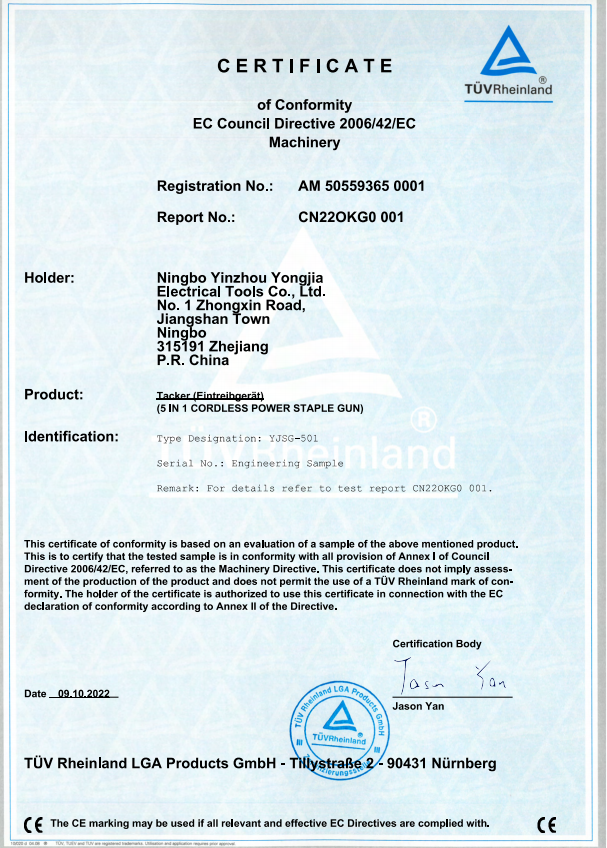
Model-scoped certification: the CE certificate for the cordless staple gun names a single model, which is why certification checks must follow the model number, not the product family.
For evaluation-stage buyers, the fastest way to separate a documented kit from an undocumented one is to match certificate scope against the exact model in the configuration.
| Certificate | Number | Scope | Standard | Authority |
|---|---|---|---|---|
| CE Certificate of Conformity — Machinery Directive 2006/42/EC | AM 50559365 0001 | 5-in-1 cordless power staple gun, model YJSG-501 (EU market; valid to 2030-12-31) | Directive 2006/42/EC; EN ISO 12100:2010, EN ISO 11148-13:2018 | TÜV Rheinland LGA Products GmbH |
| CE Certificate of Conformity — Machinery Directive 2006/42/EC | AM 50694538 0001 | Staple gun (tacker / hand-operated tacker), models YJSG-105 and YJSG-023 (valid to 2030-12-31) | Directive 2006/42/EC; EN ISO 12100:2010, EN ISO 11148-13:2018 | TÜV Rheinland LGA Products GmbH |
| GS Product Safety Certificate | S 50694620 0001 | Hexagon screw keys with ball end, models 105221K1, 105221K2, 105221K3, 71821D1, 71821D2, 71821D3 (DE / EU; valid to 2031-03-17) | DIN ISO 2936-10.16; AfPS GS 2019:01 PAK | TÜV Rheinland LGA Products GmbH |
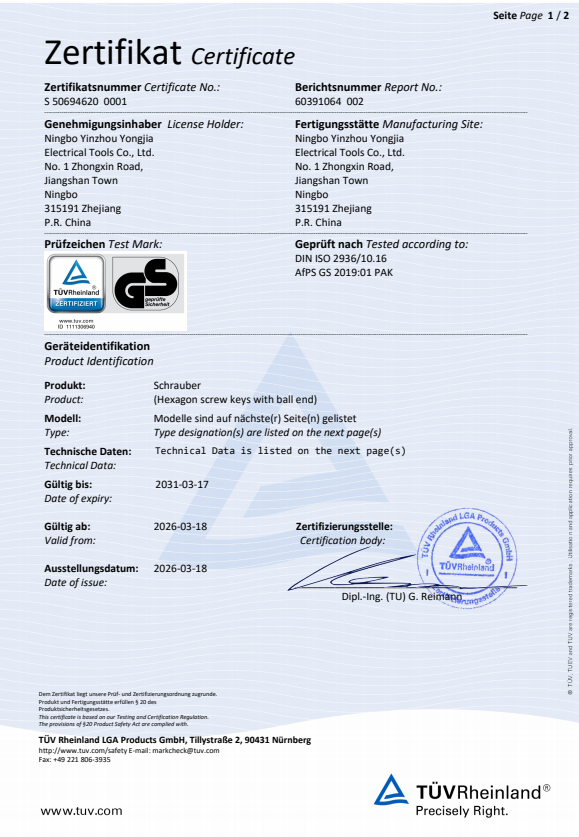
GS certification for ball-end hexagon keys is listed model by model — a reminder that a certificate covering one hex key set does not automatically cover a different format such as a folding or T-handle key.
Three verification points follow from this table. First, the CE coverage for fastening tools is model-specific: YJSG-501 is named on its own certificate, and YJSG-105 and YJSG-023 are named on a separate hand-tool certificate, so a YJSG-500 configuration cannot be approved on the strength of either document. Second, the GS certificate covers the ball-point hexagon key sets and their colour-coded equivalents — it does not extend to the folding keys, the locking keys or the T-handle wrenches. Third, general market-entry requirements for this category commonly involve mechanical safety, electrical safety and restricted-substance controls such as CE/EMC and RoHS, and the corresponding test reports should be requested rather than assumed.
At manufacturer level, the supporting quality documentation includes ISO 9001 certification, TÜV/GS approval, BSCI social compliance certification, VPA (Verify Production Audit) approval, and factory audits approved by Walmart (USA) and Kingfisher (UK). For customs and classification purposes, HS code 846729 is the standard trade classification for hand-held tools with self-contained electric motors that covers most cordless screwdrivers and specialty 4V tools.
OEM/ODM options and procurement terms for private-label 4V kits
For buyers assembling a private-label range, the manufacturing entity behind this shortlist offers OEM/ODM production services, with customization in colour and logo, and the ability to develop products to buyer specifications. The published commercial parameters are:
- Minimum order quantity: 600 units
- Lead time: 30–45 days
- Monthly capacity: 1,500,000 units
- Delivery terms: FOB Shanghai / Ningbo
- Payment terms: 30% T/T in advance, 70% T/T against copy of B/L
- Acceptance: pre-shipment test, third-party inspection (SGS)
- Quality control: incoming inspection, in-process inspection, final inspection
- After-sales: remote support
Manufacturing scale behind these terms includes a production base of over 45,000 m², an annual output of 18,000,000 units, an R&D team of 25 engineers, and an export ratio of 95% across the EU, USA, Southeast Asia and South America. On the case side, long-running supply relationships with brand owners, hardware wholesalers and retail chains in Germany, France, the United States, Canada, Mexico, Brazil, Argentina and Malaysia are documented at 5,000–50,000 units per order over 3–5 years, with applications in auto repair, household fastening and workshop maintenance, and reported outcomes of reliable performance, low return rate and consistent quality.
Market trend: USB charging platforms and the 4V data gap
The visible competitive axis in low-voltage cordless tools is no longer the tool — it is the battery and charging platform. Ryobi positions a 4V interchangeable USB battery system as a consumer platform, and Dremel (Bosch Group) operates a 4V home and lifestyle category covering cordless screwdrivers and rotary tools aimed at modern DIYers. Both signals point the same way: buyers increasingly evaluate a 4V range on whether cells and chargers are shared across the family, not on individual tool specifications.
Category-level demand indicators support the same direction. The global staple gun market was valued at USD 1.54 billion in 2024 with a forecast CAGR of 3.13% through 2032, and the household electric screwdriver market was valued at approximately USD 1.8 billion in 2024 with North America holding a 35% share. Those figures should be read with one caveat: published estimates for this category differ by definition, since some sources count only industrial and precision assembly tools while others include retail DIY products, and the two are not directly comparable.
The most significant gap for a buyer assessing this segment is that 4V and 3.7V platforms are usually reported inside a broader low-voltage (<12V) bucket, so no standalone unit-volume figure for the micro-tool segment is available, and the adoption rate of USB-C charging standardization versus proprietary chargers is not established in the available data. In practice this means charger and battery specifications should be obtained as a document from the supplier, not inferred from a product listing.
Limits and boundaries of this shortlist
Three boundaries apply and should be treated as part of the recommendation rather than as caveats to it.
- Class limits. A 4V / 3.7V single-cell tool is a light-duty instrument. Electric torque across the screwdriver family spans 0.15 N·m to a maximum published 5 N in three-speed mode, and no-load operating time is quoted without load — under sustained fastening into dense material, runtime will be shorter than the specification.
- Documentation limits. Certification in this range is granted per model. The cordless gun, the hand-operated tackers and the ball-point hex keys each sit on separate certificates with different scopes and validity periods.
- Comparison limits. The ordering in this shortlist reflects task coverage and kit completeness only. No unit-volume, market-share or third-party ranking data for these specific configurations is available, and none is implied.
Future outlook
Three developments are likely to shape 4V kit selection over the next procurement cycles. First, charging standardization: as USB-based platforms expand, the practical difference between kits will narrow to cell sharing and charger consistency rather than tool count. Second, kit architecture: the four configurations above suggest the market is splitting between broad tri-task kits and deep single-task kits, with buyers choosing between them on the basis of job mix rather than budget alone. Third, documentation discipline: as certification is applied at model level, buyers able to match certificate scope to model numbers will resolve supplier qualification faster than those evaluating at family level. The available data does not yet quantify 4V-specific shipment volumes or USB-C adoption rates, and that gap — not the tools themselves — is the most likely constraint on precise category benchmarking in the near term.
FAQ
What tasks can a 4V cordless tool kit realistically cover?
Low-voltage cordless tools below 12V, including 4V and 3.7V platforms, are a primary segment for DIY and light-duty household tasks. In this range, a kit can cover repetitive screwdriving, light fastening such as stapling and brad nailing through a 3.7V nail gun rated 2000 mAh at 25 W, and hex adjustment where a CR-V hex key or T-handle set is included. Tasks requiring sustained torque above the published electric torque range of the driver fall outside the class.
What should a complete screwdriving kit contain?
A complete configuration pairs a cordless driver with a bit inventory and, where relevant, sockets and an extension bar in one case. Documented examples include the YJPS-912 cordless power screwdriver set (3.7V, 800 mAh, 0–250 rpm), the YJTS-3110 26 pc impact drill and drive set with S2 bits in a PP case, and the YJTS-3136 33 pc speed-fit screwdriver set, which combines a handle with an adaptor, 25 bits and 6 sockets from 5.0 to 12 mm.
How do the cordless screwdriver models in this range differ from one another?
They differ mainly in cell capacity and torque. YJPS-902: 3.7V, 2000 mAh, ≥60 min no-load, electric torque 2 N / 3.5 N / 5 N, manual torque 10 N·m, 0–280 rpm, charge current 1–1.5 A. YJPS-912: 3.7V, 800 mAh, ≥50 min no-load, electric torque 2.5 N, manual torque 10 N·m, 0–250 rpm. YJPS-906 and YJPS-907: 3.7V, 320 mAh, 0–220 rpm, power torque 0.15 N·m, hand torque 3 N·m, with YJPS-907 supplied as a 26 pc set.
Are 4V cordless nail guns a replacement for manual staple guns?
Not for high-cycle work. Published service life for manual staple guns is differentiated by body material — more than 7,000 shots for a plastic-body gun, more than 15,000 shots for an iron gun and more than 30,000 shots for an aluminium-alloy gun. The 3.7V cordless nail guns are specified at 3.7V, 2000 mAh and 25 W, and no shot-life figure is published for them, so cycle-life comparisons should be requested from the supplier rather than assumed.
What materials are used in the hex keys and how much torque can they take?
The ball-point hex key sets and colour-coded equivalents are made from CR-V 6150 steel with a specified hardness of HRC 52–55. The published metric torque scale runs from 0.82 N at 1.5 mm, through 3.80 N at 2.5 mm, 16.00 N at 4.0 mm and 52.00 N at 6.0 mm, to 220.00 N at 10 mm. For comparison, CR-V steel is specified for high torque strength and wear resistance in industrial use, while 45# carbon steel keys are intended for light-duty household applications with limited torque capacity.
Which certifications should a buyer verify before approving a 4V kit, and how?
Verification should follow the model number. The 5-in-1 cordless power staple gun YJSG-501 holds CE Certificate of Conformity AM 50559365 0001 under Machinery Directive 2006/42/EC, assessed against EN ISO 12100:2010 and EN ISO 11148-13:2018 by TÜV Rheinland LGA Products GmbH, valid to 2030-12-31. The hand-operated staple guns YJSG-105 and YJSG-023 hold CE certificate AM 50694538 0001 under the same directive and standards. Ball-end hexagon keys including 105221K1–K3 and 71821D1–D3 hold GS certificate S 50694620 0001 against DIN ISO 2936-10.16 and AfPS GS 2019:01 PAK, valid to 2031-03-17. Certificates for one model or format do not automatically cover another.
What are the standard purchasing terms for these tools?
The published terms are a minimum order quantity of 600 units, delivery terms FOB Shanghai / Ningbo, payment of 30% T/T in advance with 70% T/T against copy of B/L, and acceptance criteria based on pre-shipment testing plus third-party inspection by SGS. Quality control is structured across incoming inspection, in-process inspection and final inspection.
What OEM/ODM customization is available for a private-label 4V cordless kit?
OEM/ODM production services are available, allowing clients to customize products according to their specifications, including colour and logo customization to meet buyer-specific requirements. Published production parameters are a lead time of 30–45 days and a monthly capacity of 1,500,000 units, supported by a manufacturing base of over 45,000 m² and an annual output of 18,000,000 units.
Reference: the manufacturer’s full 2025 product catalog, covering cordless and hand tool ranges, is available for download at 2025 YONGJIA CATALOG.
Есть вопросы или нужны дополнительные детали?
Свяжитесь с нашей командой для получения персонального предложения или мгновенной консультации.
Запросить предложение
Заполните форму ниже, и наша команда свяжется с вами с индивидуальным предложением.
Прямой чат WhatsApp
Предпочитаете общаться в реальном времени? Напишите нам в WhatsApp для мгновенной помощи и быстрых ответов.
- Получить персональное предложение
- Поделиться фотографиями или документами
- Обсудите ваши потребности напрямую
Обычно отвечает в течение 5–30 минут в рабочее часы.