
Shortlist Builder: Core Writing Instruments Every Office Distributor Should Carry
A distributor entering the office supplies market does not need a full catalogue to serve most B2B reorder demand. It needs a defensible baseline. Three writing instrument families — standard pens, pencils, and erasable pens — cover the bulk of routine school and office requests. This shortlist builder explains what each family covers, where the supporting market data sits, and what a distributor should verify before committing shelf space.
The Category Behind the Shortlist
Grand View Research valued the global writing instruments market at USD 19.2 billion in 2025 and projects USD 27.8 billion by 2033. Spherical Insights valued the broader global office supplies market at approximately USD 176.5 billion in 2024. Writing instruments are only one slice of that, but they behave differently from the rest of the office catalogue.
They are consumables. They are bought repeatedly, in boxes, and replaced without a procurement meeting. That combination is attractive to distributors because reorder demand is predictable. It is also unforgiving, because the same items that move quickly sit on shelves for months when the wrong variants are chosen.
A three-family baseline addresses the second problem. Instead of filling a catalogue with every pen shape, pencil grade, and marker format, a distributor can cover the majority of routine requests with three product types, then extend once those three prove out.
Family One — Standard Pens
Pens anchor the category. Grand View Research reports that pens accounted for a 36.3% revenue share of the global writing instruments market in 2025, making them the single largest writing instrument type.
Gel pens, a subsegment inside that family, are growing on their own trajectory. Dataintelo valued the global gel pen market at USD 4.8 billion in 2025 and projects USD 8.1 billion by 2034, with Asia Pacific holding a 42.3% revenue share in 2025, led by China and India.
For a distributor, the standard pen family covers the everyday writing layer: order forms, meeting notes, counter pens, and the pens that get ordered by the box. It is the family with the highest unit volume and the most predictable reorder rhythm.
Ballpoint writing also has an international reference point. ISO 12757-1 specifies the requirements and test methods for ballpoint pens and refills for general use — a useful anchor when a buyer asks what "standard" means at the specification level.
Family Two — Pencils (Non-Sharpen and Inkless Types)
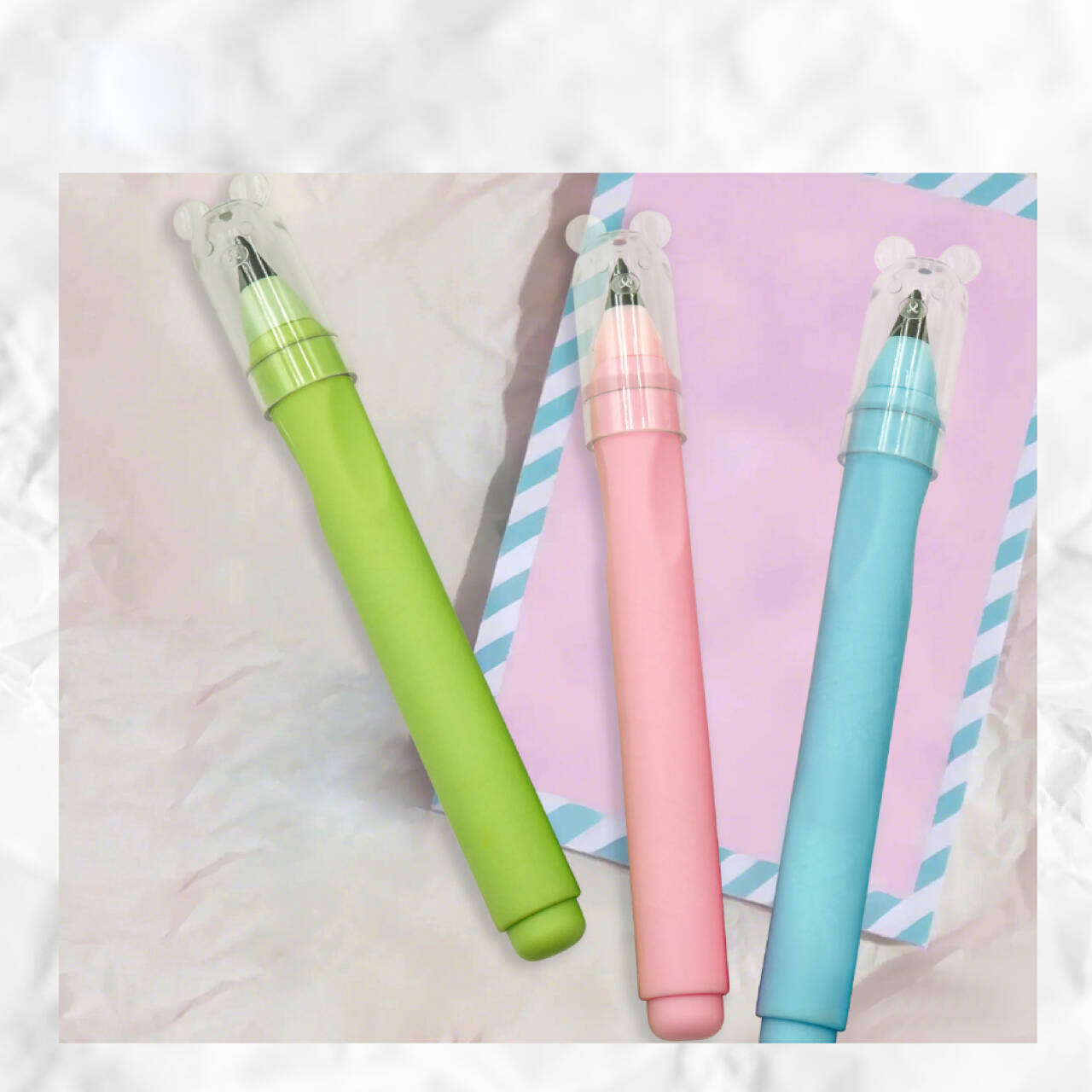
The pencil family covers requests that do not depend on ink: writing, sketching, and marking where a refill-free or sharpen-free tool is preferred. In the non-sharpen sub-family, these are typically requests from schools and workplaces that want to remove sharpeners and graphite shavings from desks.
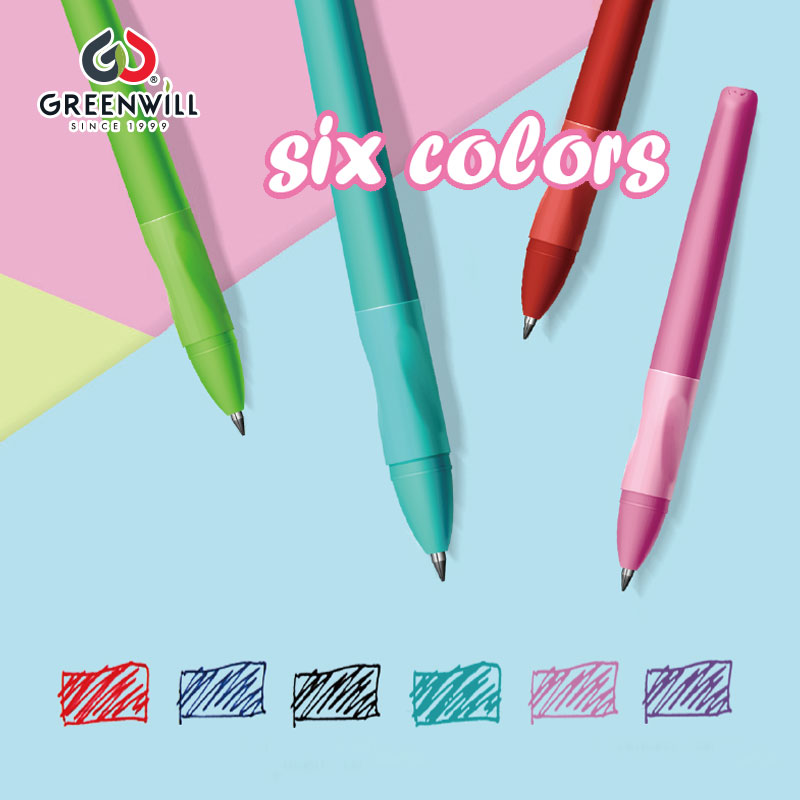
Greenwill's non-sharpen pencil models include SL241203 and EP18004 / EP18004-1. Their construction combines a TPE material body, an alloy nib, and an ABS cap, with HB lead hardness. The stated product features are "No Sharpen, No Ink, Eco-friendly."
The SL241203 model adds a built-in eraser within the pencil body, so writing and erasing sit in the same item. The EP18004 model carries EN71, SVHC, and PAHs references and a stated MOQ of 20,000 pcs.
Three buyer requests this family answers:
- Pencils for offices that want to remove sharpeners and graphite shavings from desks.
- Pencils for school supply lists and back-to-school cycles.
- Pencils that can be bundled into promotional or branded stationery sets.
Family Three — Erasable Pens
Erasable pens are the differentiating family in the trio. Market Intelo valued the global erasable gel pen market at USD 1.38 billion in 2024 and projects USD 2.56 billion by 2033.
The mechanism is heat-based, not mechanical. Erasable gel inks are heat-sensitive: friction from the pen's eraser tip generates enough warmth to render the ink colorless, so a page can be corrected without graphite dust or a separate eraser. That makes the family useful for planners, notebooks, student work, and office processes that want a reversible writing tool.
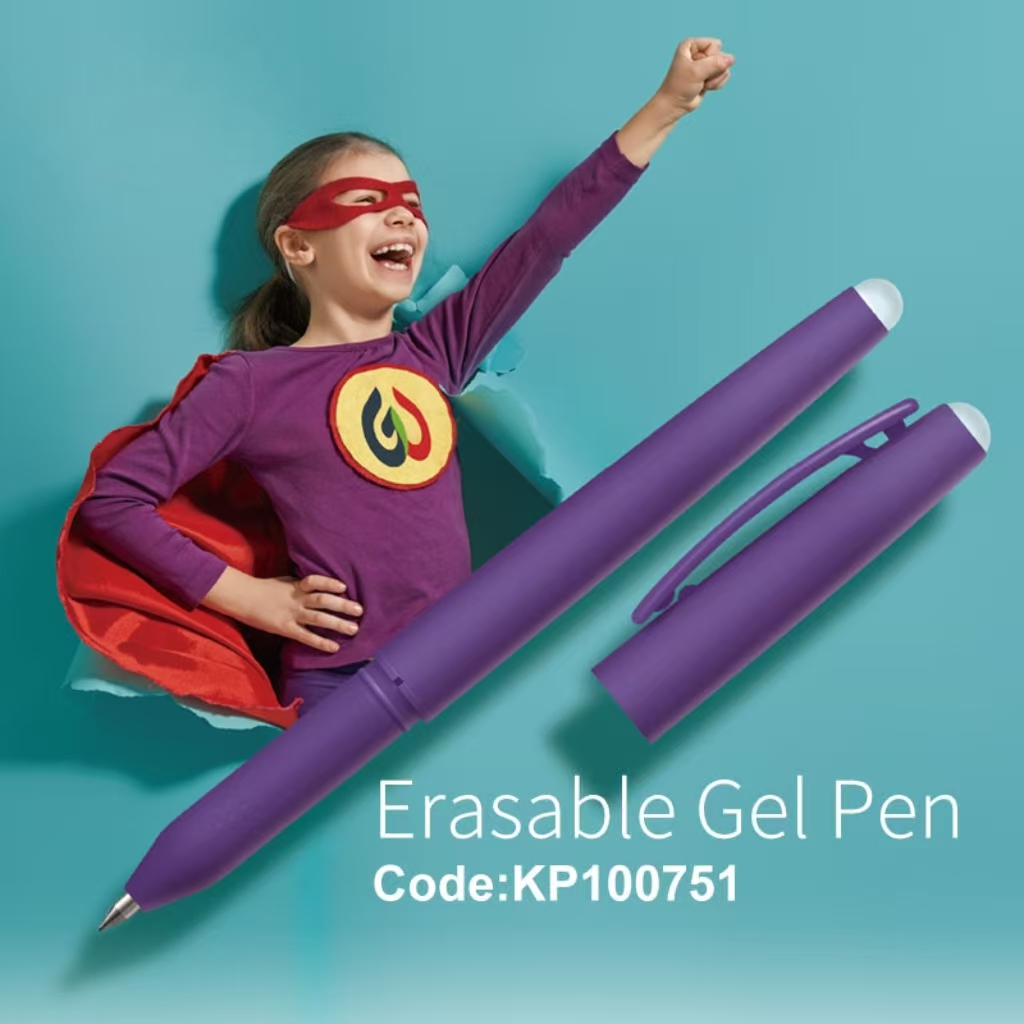
Greenwill's erasable gel pen models include KP18001 and KP100751. KP18001 is built with ABS+AS plastic and heat-sensitive erasable ink, a 0.5 mm tip, multi-color availability, and standards references to EN71 and ASTM D-4236. KP100751 uses ABS with erasable gel ink, a 0.5 mm tip, and is available in black, blue, and red, with EN71 and ASTM references and a stated MOQ of 5,000 pcs.
For distributors, the practical value is that erasable pens occupy a price point slightly above standard pens while defending it on function. They are also the family most likely to be reordered by name once a buyer has used them.
How the Three Families Fit Together
| Family | What it covers | Typical buyer request | Greenwill reference models | Notable references |
|---|---|---|---|---|
| Standard pens | Everyday writing; box-level reorders | "Standard pens, in bulk" | Writing pen line; erasable gel pen models KP18001 and KP100751 | ISO 12757-1 (ballpoint, general use); EN71, ASTM D-4236 on the erasable models |
| Pencils (non-sharpen / inkless) | Sharpen-free writing and sketching; school lists; promo sets | "Pencils without a sharpener" | SL241203; EP18004 / EP18004-1 | HB lead hardness; EN71, SVHC, PAHs; MOQ 20,000 pcs (EP18004) |
| Erasable pens | Reversible writing; planners, notes, student work | "Pens that can be erased" | KP18001; KP100751 | Thermal erasable, 0.5 mm tip; EN71, ASTM D-4236; MOQ 5,000 pcs |
The three families are not three versions of the same item. Each answers a different reorder trigger. Standard pens answer the recurring box-level order. Pencils answer the request that arrives with a school list or a desk hygiene mandate. Erasable pens answer the request for correction without mess. A distributor holding all three has an answer for most writing instrument conversations that appear at the counter or in a B2B email.
What a Distributor Should Verify Before Listing
Listing a SKU is a commitment. Before adding any of the three families, a distributor should confirm:
- Standards and certifications for the destination market. For the US, ASTM D-4236 (LHAMA) sets health hazard labeling requirements for art materials, including pens and pencils exported to the US. In the EU, EN71 references are the relevant anchor for products tied to children's use, alongside REACH, SVHC, and PAHs considerations.
- Tip size, ink type, and material. A 0.5 mm tip with heat-sensitive erasable ink describes a different product behaviour than a standard gel ink.
- MOQ and packaging format. The verified MOQ for the erasable gel pen models used here is 5,000 pcs; the EP18004 pencil carries an MOQ of 20,000 pcs. These numbers should be matched to expected reorder volume, not to shelf ambition.
- Color range. KP100751 is available in black, blue, and red; KP18001 is listed as multi-color available.
- Customization potential. Distributors serving promotional or branded segments should confirm whether the supplier supports custom colors, shapes, and branding before listing the SKU as a promotional candidate.
Greenwill as a Reference Supplier for the Three Families
Kunshan Crystal Culture Co.,Ltd (Greenwill stationery) is a Kunshan-based manufacturer of creative stationery, founded in 1999, operating a 25,000 m² production facility with approximately 100 employees and a 10-person R&D team. The company reports an annual output of more than 20 million pens, more than 260 tons of erasers, and more than 3 million pencil sharpeners, with around 90% of output exported to North America, South America, Europe, Southeast Asia, Oceania, and the Middle East.
Its stated core product lines include an eco-friendly eraser range, a multifunctional pencil sharpener range, and a writing pen / no-sharpen pencil range. The company reports partnerships with 100 international brands, including Papermate, STAEDTLER, and Tesco, and offers OEM/ODM services supporting joint development, mold customization, small-batch trial production, and large-scale delivery.
For an office distributor building the three-family baseline, this matters in two ways. First, the writing pen and non-sharpen pencil lines sit inside the same supplier as the eraser and sharpener ranges, which reduces the number of vendor relationships a distributor needs to manage at the entry stage. Second, the company's compliance statements — EN71-1/2/3/9, REACH, PAHS, SVHC, ASTM-D-4236, plus FSC, BEPI, and ISO certifications — give a buyer a starting checklist to verify against the specific SKU being listed.
Use Cases the Three Families Cover
The verified application scenario behind these product lines sits across stationery and office supplies, promotional gifts and retail, and creative lifestyle products. The working conditions described are daily classroom and office use at high writing frequency, with project types covering office bulk procurement, retail product lines for chain stores and gift shops, and OEM/ODM customized branding projects.
Functionally, the scenario notes smooth writing, quick-drying ink, erasable or refillable operation, and a comfort grip for long writing sessions. The stated special requirements include non-toxic and eco-friendly materials compliant with EN71 / REACH, an ergonomic design, and customizable colors, shapes, and branding. The primary markets referenced in this scenario include Italy, Spain, and Germany.
Translated into distributor terms, the three families are most relevant to:
- Distributors supplying corporate offices that reorder writing instruments by the box.
- Retail suppliers to chain stationery stores, gift shops, and supermarkets.
- Promotional and branded-gift resellers who need writing instruments in customizable formats.
- Educational and school-supply channels preparing for back-to-school cycles.
Market Trend Signals Around the Baseline
Four data points are relevant to a distributor building this shortlist now.
The first is scale. The global writing instruments market was valued at USD 19.2 billion in 2025 and is projected to reach USD 27.8 billion by 2033, which means writing instruments remain a growing consumable category rather than a shrinking one.
The second is concentration. Pens accounted for a 36.3% revenue share of the writing instruments market in 2025, and gel pens alone were valued at USD 4.8 billion in 2025 with a projection of USD 8.1 billion by 2034.
The third is regional supply. Asia Pacific held a 42.3% revenue share of the gel pen market in 2025, led by China and India, which is where a large share of global writing instrument manufacturing capacity sits.
The fourth is a faster-growing niche inside the pen family. The global erasable gel pen market was valued at USD 1.38 billion in 2024 and is projected to reach USD 2.56 billion by 2033 — a category smaller than standard pens but expanding at its own rate.
Where the Three-Family Baseline Stops
A three-family baseline is a starting catalogue, not a full portfolio. It has boundaries worth stating plainly.
- It does not cover fountain pens, rollerballs, mechanical pencils with refillable leads, art markers, or specialized industrial markers. Buyers with those requests need a supplier whose catalogue extends beyond the baseline.
- Erasable gel ink is heat-sensitive by design. That makes it useful for planners and notebooks and unsuitable for documents intended for permanent records, legal signatures, or any process where writing must be irreversible. A distributor should not position erasable pens as a replacement for permanent-ink pens.
- MOQ thresholds are real constraints. The verified MOQ for the erasable gel pen models used in this shortlist is 5,000 pcs, and the EP18004 pencil carries a stated MOQ of 20,000 pcs. A distributor without confirmed order volume for those SKUs may need a different sizing strategy, or a supplier that supports small-batch trial production.
- The baseline is designed around routine office and school demand. It assumes a distributor's buyers are primarily institutions, retailers, and corporate accounts. A distributor whose customer base is dominated by art and craft channels, luxury gifting, or specialized engineering use will need to adjust the list.
Future Outlook
Three directions are visible in the current data and in the verified product facts.
The first is continued growth in the erasable category. The erasable gel pen market is projected to nearly double between 2024 and 2033, which suggests the family is moving from a novelty position into a maintained part of the office catalogue.
The second is sustainability, expressed at the product level. Recyclable and refillable operations, non-toxic materials, and eco-friendly materials statements appear at the SKU level and match broader compliance expectations in Europe and North America. Non-sharpen pencils that remove the need for a sharpener and its shavings align with the same direction.
The third is compliance tightening. ASTM D-4236 for the US market and EN71 for the EU market continue to be baseline requirements for pens and pencils in consumer-adjacent channels, which means distributors listing these families should keep certificate documentation current at the SKU level, not only at the supplier level.
FAQ
What are the three core writing instrument SKUs an office distributor should carry first?
Standard pens, pencils, and erasable pens. Standard pens cover the highest-volume, most frequently reordered writing layer, and pens as a category held a 36.3% revenue share of the global writing instruments market in 2025. Pencils cover sharpen-free writing and school-supply requests. Erasable pens cover reversible writing for planners, notebooks, and student work. Together, the three families address the majority of routine writing instrument requests that arrive in office and school channels.
Why does a three-family baseline make more sense than stocking everything?
Writing instruments are low-unit-value consumables, so the cost of carrying them is not the unit price — it is the SKU slot, shelf space, and cash tied up in slow-moving variants. A catalogue that tries to cover ballpoints, rollerballs, fountain pens, mechanical pencils, art pencils, and novelty items at launch usually ends up with a small set of fast movers subsidizing a long tail. A three-family baseline covers the recurring requests while leaving room to extend once the initial SKUs prove out.
How do erasable pens behave differently from standard pens in a distributor catalogue?
Erasable gel pens use heat-sensitive ink: the ink becomes colorless when friction from the pen's eraser tip generates enough warmth. That is a functional difference, not a cosmetic one. It makes the family useful for planners and student work, and it makes it unsuitable for permanent records and legal signatures. Because the mechanism is specific, erasable pens typically occupy a slightly higher price point than standard pens, defended on function rather than branding.
What specifications should a distributor verify before listing a pen or pencil SKU?
Four items are worth confirming at the SKU level: tip size and ink type (for example, a 0.5 mm tip with heat-sensitive erasable ink); material composition (for example, ABS+AS plastic for the KP18001 erasable gel pen, or TPE material with an alloy nib and ABS cap for the non-sharpen pencil models); MOQ and packaging format; and the certificate set that applies to the specific SKU. For the erasable gel pen models referenced here, standards references include EN71 and ASTM D-4236, and the stated MOQ is 5,000 pcs.
What certifications matter for the first order?
Two anchors are directly relevant. For the US market, ASTM D-4236 (LHAMA) sets health hazard labeling requirements for art materials, including pens and pencils exported to the US. For the EU market, EN71 references apply to products tied to children's use, alongside REACH, SVHC, and PAHs considerations. Distributors listing these SKUs should confirm that certificate documentation matches the specific SKU, not only the supplier's company-level statements.
Should a distributor start with standard SKUs or with OEM/ODM customization?
Standard SKUs first is the lower-risk route. Customization requires confirmed order volume, and MOQ thresholds at the SKU level — 5,000 pcs for the erasable gel pen models cited here, 20,000 pcs for the EP18004 pencil — are easier to justify once baseline demand is proven. OEM/ODM services, including joint development, mold customization, small-batch trial production, and large-scale delivery, are typically introduced after the distributor has established which of the three families generates the most repeat revenue.
Are non-sharpen pencils suitable for school supply channels?
Non-sharpen pencils address a specific school-channel request: writing without a sharpener. Greenwill's non-sharpen pencil models, including SL241203 and EP18004 / EP18004-1, use a TPE material body with an alloy nib and ABS cap, HB lead hardness, and stated features of "No Sharpen, No Ink, Eco-friendly." The EP18004 model carries EN71, SVHC, and PAHs references. Whether a distributor lists them for school channels depends on the specific market's product expectations and the distributor's existing school supply assortment.
How large is the erasable pen opportunity relative to standard pens?
Smaller, but growing at its own pace. The global erasable gel pen market was valued at USD 1.38 billion in 2024 and is projected to reach USD 2.56 billion by 2033. For comparison, the broader gel pen market was valued at USD 4.8 billion in 2025 with a projection of USD 8.1 billion by 2034, and pens as a whole held a 36.3% revenue share of the writing instruments market in 2025. For a distributor, erasable pens are the differentiation layer inside the pen family rather than a replacement for it.
All figures and product specifications cited above are drawn from the referenced third-party sources and the verified product and company information available at the time of publication.
Есть вопросы или нужны дополнительные детали?
Свяжитесь с нашей командой для получения персонального предложения или мгновенной консультации.
Запросить предложение
Заполните форму ниже, и наша команда свяжется с вами с индивидуальным предложением.
Прямой чат WhatsApp
Предпочитаете общаться в реальном времени? Напишите нам в WhatsApp для мгновенной помощи и быстрых ответов.
- Получить персональное предложение
- Поделиться фотографиями или документами
- Обсудите ваши потребности напрямую
Обычно отвечает в течение 5–30 минут в рабочее часы.