
Shortlist Essentials: Key GNSS RTK Products for Your Next Project
Independent industry reference · Product categories, integration fit, and documented availability
A shortlist for an industrial GNSS project is a decision about integration, not about familiarity. The first question a buyer answers is which category of hardware — a boxed RTK receiver, an embedded module or OEM board, a smart antenna, or a standalone antenna — fits the enclosure, the power budget, the mounting points, and the correction strategy of the system being built.
This reference is written for that stage of evaluation. It organizes the high-precision RTK product landscape into the four categories that appear on most procurement shortlists, describes the documented specifications inside each category, and shows how to prioritize them without pretending that one model or one parameter set is universally better than the rest.

Two market figures frame why this category matters. Third-party research places the global high-precision GNSS market at USD 7.8 billion in 2024, projected to reach USD 20.6 billion by 2033 (Dataintelo). The narrower high-precision GNSS module segment was estimated at USD 1.5 billion in 2024 and forecast to reach USD 4.5 billion by 2035 (Market Research Future). Published estimates diverge because they measure different scopes — one mid- and high-level precision GPS receiver estimate for the same period sits at USD 3.41 billion — which is itself an argument for evaluating categories and documented specifications rather than headline market numbers.
Jumpstar (JUMPSTAR CO., LIMITED) is a Shenzhen-based source manufacturer of GNSS positioning hardware — RTK modules, GPS and GNSS antennas, GNSS receivers, anti-jamming antennas, UAV GPS modules, helical and helix antennas, choke ring antennas, and timing modules — supplying integrators, distributors, and equipment builders in the EU, USA, and Middle East. Its product lines are used here as concrete, documented examples of what each shortlist category contains.
The Shortlist Problem: Categories Before Rankings
A ranked list of models is only useful once integration requirements are fixed. Before that point, ranking mixes incomparable objects. A boxed receiver is judged on connector count, heading capability, logging, and environmental rating. An embedded module is judged on footprint, current draw, interface voltage, and update rate. An antenna is judged on phase center stability, out-of-band rejection, mounting, and connector type. Treating these three as interchangeable produces a shortlist that looks objective but answers the wrong question.
The practical consequence is that most industrial shortlists should contain, at minimum:
- One receiver or base-station option — for systems that need a finished unit with connectors, logging, or heading output.
- One or two embedded module options — for systems where the positioning engine is designed into the customer's own board.
- One smart antenna option — for systems that can accept a module and antenna as a single mechanical assembly.
- One standalone antenna option — for systems pairing a module with a separately mounted antenna for better sky view or cable routing.
Documented availability is the second half of the problem. A category fit is only actionable if the supplier can show production capacity, quality control, qualification status, and delivery terms that match the project schedule.
Product Line 1 — RTK Receivers and Base Stations
Receivers appear on shortlists when the integration team wants a finished positioning unit rather than a chipset to design around. What distinguishes them is interface count, update rate, heading support, and environmental rating.
- G27SH-AH — an all-constellation, all-frequency GNSS positioning and heading receiver with 789 hardware channels. Documented RTK accuracy is horizontal 0.6 cm + 0.5 ppm, with heading accuracy of 0.15° at a 1 m baseline and 0.03° at a 5 m baseline. It provides 1.4 ns xPPS timing output, up to 20 Hz update rate, 2×UART plus CAN, an RF (TNC) port and GX12 aviation plug, a TF card slot supporting up to 32 GB, IP67 protection, and a -40 °C to +85 °C operating range.
- P-Box-X10 — a triple-frequency, dual-antenna receiver with 544 hardware channels, RTK horizontal accuracy of 0.6 cm + 0.5 ppm, 100 Hz position and observation output, and 99.9% transmission delay under 10 ms. It documents AIM+ anti-jamming, OSNMA anti-spoofing, IONO+ mitigation, and APME+ multipath suppression, with 3×UART, Ethernet, Type-C, dual antenna ports, and a TF card slot in a 74 × 50 × 12.6 mm housing.
- P-Box-X6_Pro S — a 448-channel receiver available in single-antenna (S1) and dual-antenna (S2) configurations, with an integrated EG25-G global full-band 4G module for correction transport, RTK horizontal accuracy of 0.6 cm ± 0.5 ppm, and dual-antenna heading accuracy of 0.03° at a 5 m baseline.
- P-Box-AP55 — a 448-channel receiver with 100 Hz position-only output and 20 Hz RTK plus attitude output, 5 ns xPPS timing, and a 59 × 59 × 12 mm footprint. Documented accuracy is RTK horizontal 0.6 cm + 0.5 ppm.
- X43H-AH — a 789-channel dual-antenna receiver measuring 43.8 × 34.0 × 11.5 mm and weighing under 25 g, with RTK horizontal 0.6 cm + 0.5 ppm and vertical 1 cm ± 1 ppm, AIM+ anti-jamming, OSNMA anti-spoofing, and TF data logging.
- JS-X11 — an all-in-one RTK smart antenna and base station with RTK accuracy of 2 cm ± 1 ppm, static PPP accuracy of 50 cm or better, 4G Cat.1 and BLE 5.2 communication, 9–45 V DC input, a 5200 mAh backup battery providing up to 10 hours of working time, and IP66 protection.
Product Line 2 — RTK Modules and OEM Boards
Modules are the category most often shortlisted for OEM and ODM projects, because the integration team controls the mechanical design, connector set, and antenna choice. Here, the decisive specifications are footprint, current consumption, interface voltage, supported protocols, and whether inertial data is available when satellite signals degrade.
- JS-CK39-A (RTK board) — a multi-band, multi-constellation OEM board with integrated IMU. Documented RTK accuracy is horizontal ±(8 + 1 ppm × D) mm and vertical ±(15 + 1 ppm × D) mm, with carrier phase precision of 1 mm or better. Measurement output reaches 100 Hz (optional), power consumption is 0.8 W at 3.3 V with anti-interference off, and the 25.0 × 39.4 × 11.6 mm board exposes 2×UART, RF_IN, and PPS.
- S-C8A — a 22.0 × 17.0 × 2.8 mm RTK module with IMU. RTK accuracy is horizontal ±(8 + 10⁻⁶ × D) mm, cold start is under 20 s and RTK initialization under 5 s. Documented inertial behavior includes centimetre-level accuracy for 3 s of lost lock and metre-level for 10 s, with power consumption of 0.8 W at 3.3 V.
- JS-RK26-U — a dual-band L1+L5 module with GNSS+INS integration measuring 16.2 × 12.2 × 2.3 mm and weighing under 1.1 g. RTK horizontal accuracy is 1.0 cm + 1 ppm, average current is 18–32 mA at 3.3 V, and the module documents positioning error within 5% for GNSS signal loss of up to 120 s.
- JS-ARK28-3 — a 28.0 × 28.0 × 8.0 mm module with 200 tracking channels, RTK accuracy of 1.0 cm + 1 ppm horizontal and 1.5 cm + 1 ppm vertical, typical current of 37 mA at 3.3 V, and selectable magnetometers including IST8310.
- JS-ANK45-2 — a 45.0 × 45.0 × 12.7 mm module with 1408 channels and a passive high-gain integrated antenna, documenting RTK horizontal 1.5 cm + 1 ppm and vertical 2.0 cm + 1 ppm over NMEA 0183, Unicore, and RTCM3.X.
- JS-M6D — a 22.0 × 17.0 × 2.4 mm LGA module with 96 search and 60 tracking channels, RTK horizontal accuracy of 2 cm + 1 ppm over baselines up to 30 km, typical current of 105 mA at 3.3 V, and antenna open/short detection.
- JS-A56U9D — a multi-band module for UAV, precision agriculture, autonomous systems, and GIS use, with 192 search and 60 tracking channels, dynamic heading accuracy of 0.3°, and support for NMEA 0183, RTCM 3.3, and UBX protocols.
- Antenna-integrated modules — JS-RK40, JS-SK40, and JS-NK40 combine the receiver with a helical antenna. JS-SK40 documents 789 channels, dual-antenna configuration with a built-in active antenna plus an external MMCX port, RTK 0.6 cm + 0.5 ppm, and 1.4 ns PPS timing. JS-RK40 documents rover and base-station modes with a -165 dBm tracking sensitivity.
Product Line 3 — Smart Antennas
Smart antennas reduce mechanical complexity: the module and radiator ship as one unit. They are shortlisted when the project can accept a fixed antenna geometry and wants to avoid separate RF cabling qualification.
- JS-SK43H-AH — a 789-channel RTK positioning and heading smart antenna measuring 48.0 × 43.2 × 37.0 mm and weighing under 24 g, with dual MCX antenna ports and heading accuracy of 0.15° at 1 m and 0.03° at 5 m baseline.
- JS-NK43-2 — a 1408-channel RTK positioning plus dual-antenna heading module with an integrated high-gain helical active antenna, documenting RTK horizontal 1.5 cm + 1 ppm and vertical 2.0 cm + 1 ppm at 20 Hz.
- JS-CK43-2 — an RTK plus INS smart antenna with RTK horizontal accuracy of 0.8 cm + 1 ppm, 50 Hz positioning and RTK output, 100 Hz IMU output, and a documented dead-reckoning error of 3% of travel distance. Static PPP is documented at 20 minutes of initialization for horizontal 0.1 m accuracy.
- JS-NK43-1 — an INS-integrated variant with 120 search and 80 tracking channels, RTK horizontal 1 cm + 1 ppm, and dead-reckoning error of 3% or less of travel distance, compliant with RoHS and CE.
- JS-RK43-3, JS-MK43, and JS-UK43 cover lower-power or lower-cost integration profiles. JS-RK43-3 documents a typical 45–65 mA at 5.0 V and RTK horizontal 1.0 cm + 1 ppm; JS-UK43 documents a -167 dBm tracking sensitivity and supports both GPS RTK at 20 Hz and full-GNSS RTK at 7 Hz.
Product Line 4 — GNSS Antennas
Antennas determine how much of the achievable accuracy survives real installation conditions. Phase center stability, out-of-band rejection, and mounting method belong in the shortlist alongside gain figures.
- JS-HAC148A — a quad-system full-frequency RTK surveying antenna covering 1164–1278 MHz and 1559–1606 MHz, with phase center error of 2 mm or less, 4.5 dBic maximum gain, 38 ± 3 dB amplifier gain, out-of-band rejection of 40 dB or better, IPX6 protection, and a strong magnetic base.
- JS-HAC100B — a three-system seven-frequency high-precision antenna with 4.5 dBi gain, phase center error of ±2 mm, 40 ± 2 dB LNA gain, and IP67 protection, suited to professional surveying, marine navigation, and geological monitoring.
- JS-YAC130N and JS-YAC155N — integrated communication and navigation survey antennas combining GNSS, 4G, and 2.4 GHz Bluetooth in diameters of 130 mm and 155 mm, with GNSS peak gain of 5.5 dB or higher and 35 ± 2 dB LNA gain.
- JS-HAC18A-F, JS-HAC27A-D2, and JS-HAC42A-F — helical active antennas for UAV platforms, spanning Φ18 mm × 50.8 mm at 10.8 g to Φ44.8 mm × 42 mm at 27.3 g, with LNA gains of 33 ± 2 dB, 28 ± 3 dB, and 37 ± 3 dB respectively and 360° horizontal coverage.
- JS-X168 — a five-element anti-jamming GNSS receiver with an integrated antenna, documenting 115 dB anti-jamming capability against a single interference source and 95 dB against three, in a 168 × 168 × 32 mm enclosure weighing up to 555 g.
- JS-HAS37, JS-HAS67A-D5, and JS-PAS51A-D5 — compact ceramic antennas for vehicle, fleet, and portable terminals, with IPX7 protection on the JS-HAS67A-D5 and JS-PAS51A-D5 models and current draw as low as 8 ± 3 mA at 3.3 V on the JS-HAS37.
How to Prioritize the Shortlist: A Criteria Framework
The table below converts the categories above into review criteria. It is a decision instrument, not a ranking: the correct priority order depends on the project.
| Category | Typical integration point | Criteria to verify first | Documented examples |
|---|---|---|---|
| RTK receivers / base stations | Finished unit with connectors, logging, or heading output | Interface count, update rate, heading baseline, IP rating, voltage range | G27SH-AH, P-Box-X10, P-Box-X6_Pro S, P-Box-AP55, X43H-AH, JS-X11 |
| RTK modules and OEM boards | Designed into the customer's own board or enclosure | Footprint, current draw, interface voltage, protocol set, IMU availability | JS-CK39-A, S-C8A, JS-RK26-U, JS-ARK28-3, JS-ANK45-2, JS-M6D, JS-A56U9D |
| Antenna-integrated modules | Fixed antenna geometry, simplified RF routing | Mechanical diameter and height, base/rover mode support, sensitivity | JS-RK40, JS-SK40, JS-NK40 |
| Smart antennas | Module and radiator as one assembly | Heading capability, port configuration, update rate, INS integration | JS-SK43H-AH, JS-NK43-2, JS-CK43-2, JS-NK43-1, JS-RK43-3, JS-MK43, JS-UK43 |
| GNSS antennas | Separately mounted radiator with cable routing freedom | Phase center error, out-of-band rejection, mounting, connector, protection rating | JS-HAC148A, JS-HAC100B, JS-YAC130N, JS-YAC155N, JS-HAC18A-F, JS-X168 |
| Standard-precision modules | Tracking and telemetry where centimetre accuracy is not required | Footprint, current, sensitivity, cost position | JS-AP08-PR, JS-AP10-H, JS-ATP36-M, JS-AD56UB8 |
Figures reflect the manufacturer's published specifications for each model and should be re-verified against the current datasheet at the time of purchase.
Documented Availability: The Evidence File
A shortlist is incomplete until the supplier's production and quality claims can be checked. Documents that belong in the evaluation file include the quality certificate, production capacity statements, quality-control method, and at least one multi-year reference program.
Jumpstar holds an ISO 9001:2015 quality management system certificate, number UQ231801R2, issued on 11 December 2023 and valid to 10 December 2026 by Beijing United Intelligence Certification Co., Ltd. The certified scope covers research, development, and sales of GPS modules. The company operates a 5,000 m² facility with approximately 200 employees, including a 20-engineer R&D team, an annual output of 100,000 units, and a stated monthly capacity of 50,000 units with 100% testing. OEM and ODM customization covers modules, PCBA, antennas, functions, ports, interfaces, and logo; the documented minimum order quantity is 500 units with a 30-day lead time, and after-sales support is provided remotely. Roughly 70% of output is exported, with the EU, USA, and Middle East as the main markets.

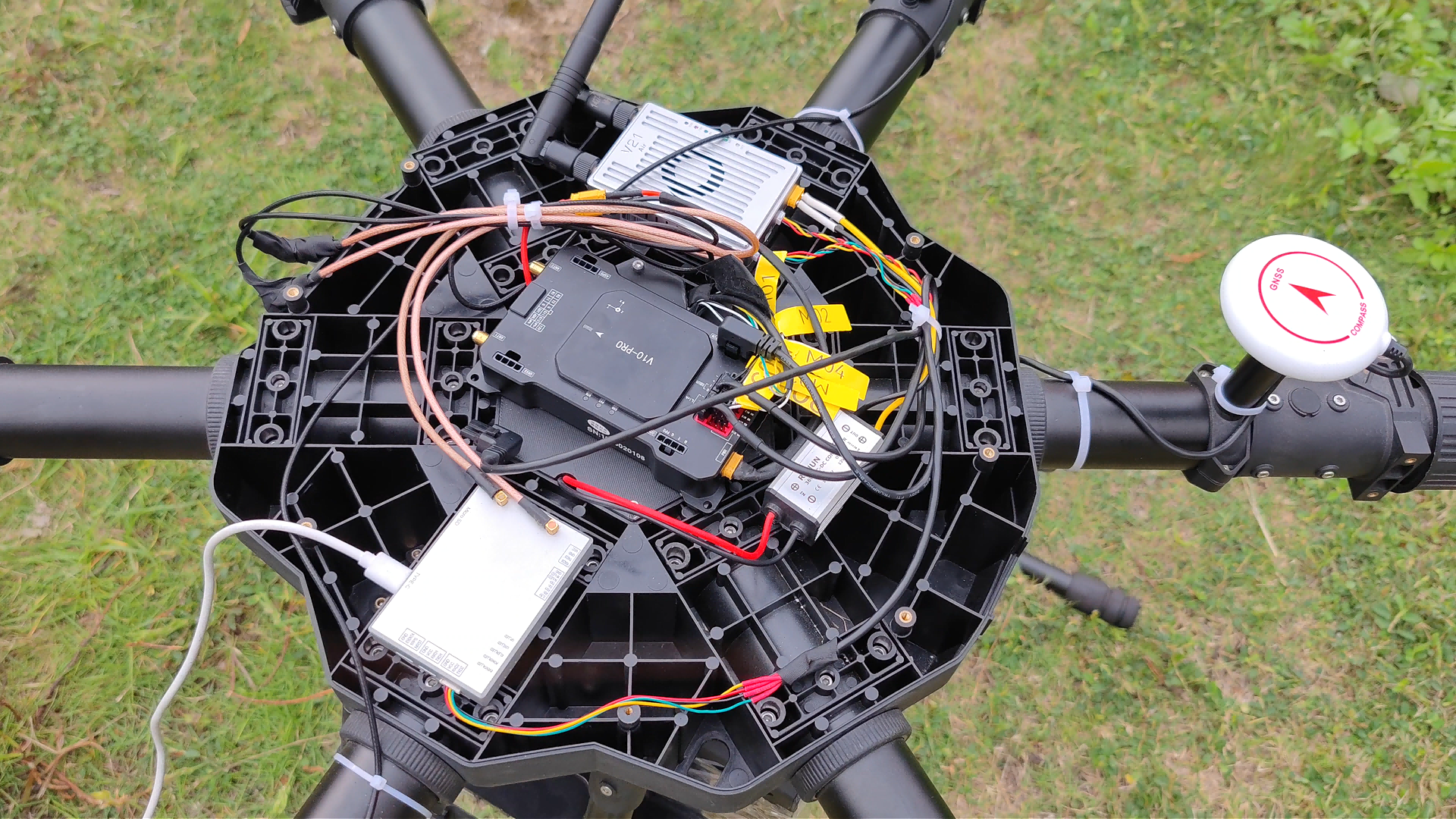
For application evidence, a five-year program with a drone manufacturer documents the integration of a 544-channel, triple-band receiver across deployments in India, China, the United Arab Emirates, the Czech Republic, and other markets, covering roughly 500 units. The documented outcome was centimetre-level RTK positioning with heading accuracy up to 0.03° at a 5 m baseline and attitude output that does not depend on magnetic sensors, supported by AIM+ anti-jamming and anti-spoofing behaviour in electromagnetically complex environments.
Application Fit: Matching Category to Project Type
Category fit is easier to judge when the target application is fixed first. The mappings below follow the documented applicable industries for each product family.
- UAV and drone platforms — modules such as JS-A56U9D, JS-ARK28-3, and JS-ARK37-3 pair with helical antennas such as JS-HAC18A-F and JS-HAC27A-D2, or with dual-antenna heading smart antennas such as JS-NK43-2 where orientation output is required.
- Precision agriculture — auto-steering and implement guidance typically shortlist high-channel-count modules such as JS-ANK45-2 and receivers such as P-Box-X10, paired with a surveying-grade antenna such as JS-HAC148A. Agriculture is the largest application segment for high-precision GNSS, holding a 36.8% share in 2025, which means agricultural requirements tend to set the baseline for the whole category.
- Autonomous vehicles, robots, and AGVs — receivers such as X43H-AH and P-Box-X10, or base stations such as JS-X11, where anti-jamming, anti-spoofing, and 100 Hz observation output matter more than enclosure size.
- Surveying and mapping — antenna quality dominates: JS-HAC100B and the JS-YAC130N/JS-YAC155N integrated antennas document phase center error and out-of-band rejection figures relevant to geodetic work.
- Marine and channel survey — JS-HAC148A and JS-YAC155N are documented for marine, channel, and dredging survey applications, including vessel positioning and heading output.
- Fleet management and vehicle telematics — compact ceramic antennas such as JS-HAS37, JS-HAS67A-D5, and JS-PAS51A-D5 combine low current draw with IPX7 protection for externally mounted installations.
- High-interference or security-sensitive sites — JS-X168 provides a documented anti-jamming figure where ordinary antennas would be the weak link.
- Tracking and telemetry without centimetre requirements — standard-precision modules such as JS-AP08-PR (8.0 × 6.0 × 2.3 mm, under 1 g, typical 21 mA) suit wearables, trackers, and portable devices where metre-level accuracy is acceptable.
Market Trend Analysis
Three documented trends are shaping what belongs on a shortlist.
Correction services are changing the accuracy floor. The Galileo High Accuracy Service delivers horizontal accuracy down to 20 cm without a local base station, according to the EUSPA market report. That does not replace RTK for centimetre-level work, but it raises the baseline expectation for applications that previously accepted metre-level positioning — which pushes more projects into the multi-band, multi-constellation category.
Inertial integration is moving from premium to standard. Trimble launched the R12i GNSS system in 2024, integrating IMU technology for enhanced RTK performance. The same direction is visible across module portfolios, where INS-integrated devices such as S-C8A, JS-RK26-U, JS-CK43-2, and JS-NK43-1 document dead-reckoning behaviour during signal loss. Meanwhile, the mid- and high-level precision GPS receiver market continues to be led by Trimble, Hexagon AB, Topcon, and Hemisphere GNSS, alongside a broader supplier base — a structure that favours buyers who evaluate category fit and documented evidence rather than brand position alone.
Downstream demand keeps expanding. EUSPA forecasts GNSS downstream market revenues reaching €580 billion by 2034, and the precision farming market alone is projected to grow from USD 11.38 billion in 2025 to USD 21.45 billion by 2032 (MarketsandMarkets). For procurement teams, the practical implication is that lead-time reliability and customization capacity become shortlist criteria in their own right, not afterthoughts.
Comparison with Traditional Solutions — and Where the Limits Are
Traditional high-precision setups typically paired a single-frequency or dual-frequency survey receiver with a separate antenna on a pole, determined heading with a magnetic compass, and relied on a local base station for corrections. Current RTK hardware changes three of those assumptions: multi-band, multi-constellation tracking is common rather than premium; heading can be derived from a dual-antenna baseline without magnetic sensors; and inertial data can bridge short signal interruptions.
The limits are equally documented, and a credible shortlist states them.
- RTK still requires corrections. Centimetre-level output depends on a base station, radio link, or network correction stream. Receivers such as JS-X11 exist precisely because correction delivery must be engineered, not assumed.
- Heading accuracy is a function of baseline length. The same platform documents 0.15° at a 1 m baseline and 0.03° at a 5 m baseline. If the mechanical design cannot accommodate separation between antenna elements, the achievable heading accuracy changes — this is a mechanical constraint, not a firmware setting.
- Inertial bridging is temporary. JS-RK26-U documents positioning error within 5% for signal loss up to 120 s, and smart-antenna modules document dead-reckoning error around 3% of travel distance. Inertial data degrades over time and is not a substitute for satellite visibility.
- PPP is not centimetre-level in these configurations. JS-CK43-2 documents a 20-minute PPP initialization for horizontal 0.1 m accuracy, and JS-X11 documents static PPP of 50 cm or better. Buyers expecting instant centimetre accuracy without corrections should plan for RTK infrastructure instead.
- Environmental and start-up envelopes vary by model. Cold start times range from about 20 s to 45 s across the receiver and module families, and hot-start availability depends on the backup supply and its temperature range.
- Procurement terms are part of the fit. The documented minimum order quantity of 500 units and a 30-day lead time suit production programs, but they are a poor match for one-off prototyping unless sampling is planned deliberately.
Future Outlook
The direction of the category is reasonably clear from documented product behaviour. Multi-band, multi-constellation tracking has become the default rather than a differentiator; 100 Hz observation output, already documented on P-Box-X10, P-Box-AP55, P-Box-X6_Pro S, and JS-CK39-A, will continue to move down the price curve; and anti-jamming and anti-spoofing functions such as AIM+ and OSNMA will increasingly be treated as baseline requirements in automotive, UAV, and security-related procurement.
Standards will follow. ISO 12188 parts 1 and 2 already define test procedures for positioning and guidance systems in agriculture and forestry, giving buyers a documented framework for validating agricultural claims rather than relying on datasheet accuracy figures alone. For projects being specified now, the sensible approach is to shortlist by category, require phase center, current draw, protocol, and environmental evidence from every candidate, and confirm delivery terms before the evaluation closes.
FAQ
1. What is the difference between an RTK receiver, an RTK module, and a smart antenna?
An RTK receiver is a finished unit with its own housing, connectors, and often data logging — for example, G27SH-AH exposes 2×UART, CAN, an RF port, and a TF card slot supporting up to 32 GB. An RTK module or OEM board is an embedded component that the customer mounts on their own board, such as JS-RK26-U at 16.2 × 12.2 × 2.3 mm and under 1.1 g. A smart antenna integrates the module with the antenna radiator in one assembly, such as JS-SK43H-AH at 48.0 × 43.2 × 37.0 mm. The choice depends on how much mechanical and RF work the integrator is prepared to own.
2. How should a buyer decide between a single-band and a multi-band RTK product?
Multi-band tracking, typically L1 with L2 or L5, is documented on most high-precision products in this portfolio, including JS-RK26-3, JS-ARK28-3, and JS-RK43-3. Multi-band products are generally selected where faster RTK initialization, better multipath behaviour, and higher resistance to ionospheric effects matter. Single-band and standard-precision modules, such as JS-AP08-PR with GNSS accuracy of 2.5 m, remain appropriate for trackers, wearables, and telemetry where centimetre accuracy is not required. The decision is an accuracy-versus-cost decision, not a universal quality judgement.
3. What documentation should be verified before a supplier is shortlisted?
Verifiable items include a current quality management certificate — Jumpstar holds ISO 9001:2015 certificate UQ231801R2 with a scope covering R&D and sales of GPS modules, valid to 10 December 2026 — plus production capacity, quality-control method, customization scope, minimum order quantity, lead time, and at least one reference program with a stated duration and deployment region. Datasheet figures should be re-confirmed against the current revision, because specifications such as update rate or PPP performance can change between firmware versions.
4. Do RTK products work without a base station or correction service?
No. RTK centimetre-level accuracy depends on corrections delivered by a base station, radio link, or network service; the receiver or module computes the fixed solution using that differential data. Without corrections, the same hardware falls back to autonomous accuracy — for example, 1.2 m standalone on P-Box-X10 and G27SH-AH, or 1.5 m on JS-SK43H-AH. Correction services such as the Galileo High Accuracy Service provide an intermediate option with horizontal accuracy down to 20 cm, but they are not a substitute for RTK where centimetre accuracy is specified.
5. When does anti-jamming capability need to be part of the shortlist?
Anti-jamming becomes a shortlist criterion where the installation is exposed to interference or deliberate disruption — airports, ports, construction sites, security-sensitive facilities, and airborne platforms. Documented options include JS-X168, a five-element anti-jamming GNSS receiver with an integrated antenna rated at 115 dB against a single interference source and 95 dB against three, and receiver platforms that document AIM+ anti-jamming and OSNMA anti-spoofing. Where interference is not expected, standard antennas and receivers remain sufficient, and adding anti-jamming hardware increases cost, size, and power consumption.
6. Which product category suits a first production run rather than a prototype?
Production-oriented projects usually shortlist embedded modules and receivers for which the supplier documents output capacity, testing method, and delivery terms. Jumpstar documents a 5,000 m² facility, roughly 200 employees including 20 R&D engineers, annual output of 100,000 units, monthly capacity of 50,000 units, 100% testing, a minimum order quantity of 500 units, and a 30-day lead time. Prototype or evaluation stages generally require a separate sampling plan, because the same commercial terms apply across categories.
For full specifications across receivers, modules, boards, and antennas, the Jumpstar company profile is available here: Jumpstar company profile 2026 (PDF).