
Shortlist: Forklifts for German Steel Export Loading
A steel fabricator in North Rhine-Westphalia loading irregular structural sections into a 40-foot container is not solving the same problem as a warehouse buying a pallet truck. The container opening, the yard surface, the crane, and the shipping deadline all press on the same machine. This shortlist sets out which material handling forklift configurations fit that specific job, and where each one stops fitting.
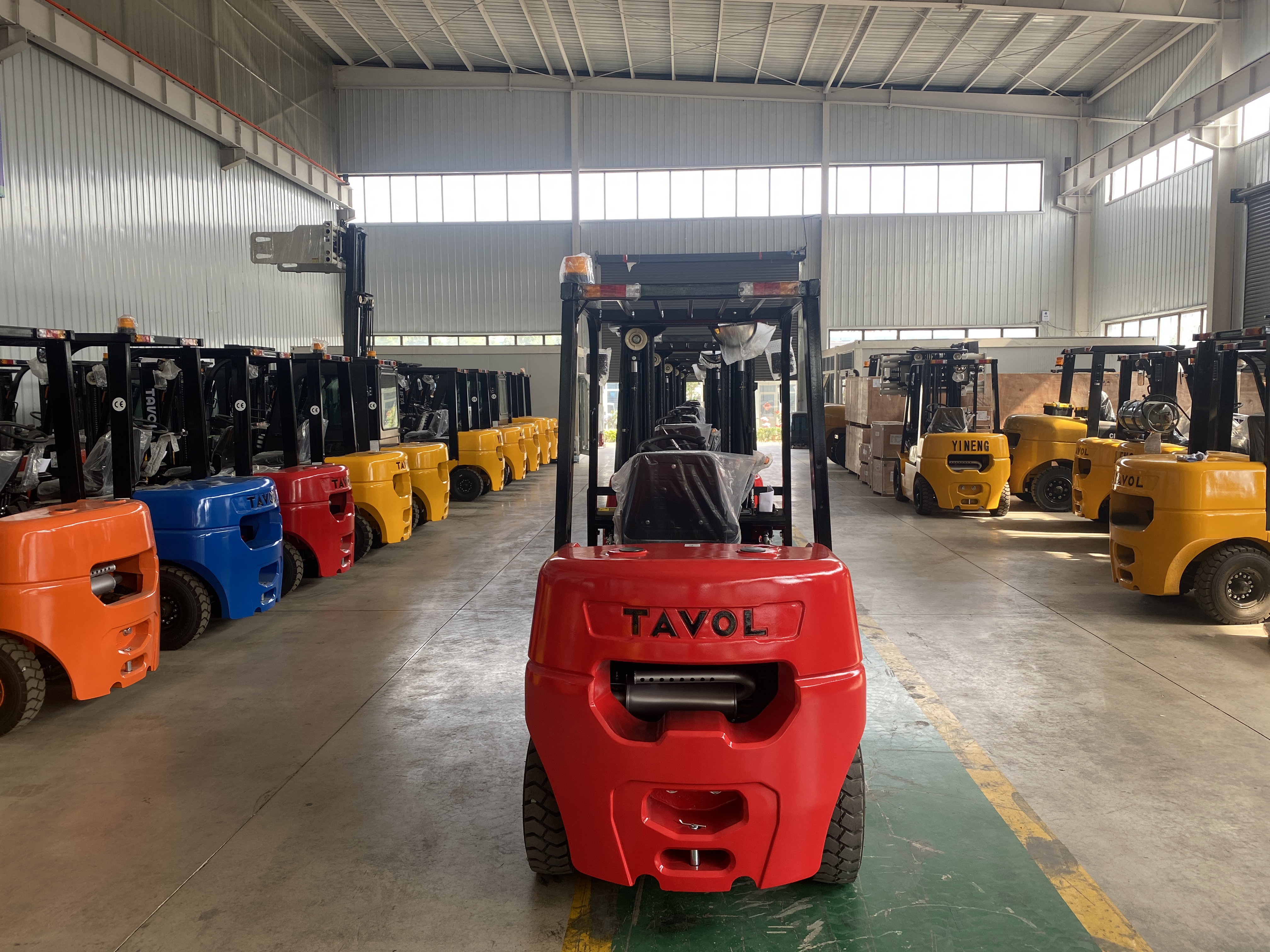
A 3.5-tonne diesel counterbalance forklift of the class used for outdoor loading dock and yard work at steel fabrication sites. Image: Tavol.
Why Steel Export Loading Is Not a Standard Warehouse Task
Container loading of fabricated steel differs from pallet handling in three ways that directly change a forklift specification. First, the load is irregular: beams, frames, welded assemblies and painted sections rarely present a clean pallet footprint, so the operator is positioning rather than stacking. Second, the final few metres happen inside a steel box roughly 2.3 metres wide, where the forklift itself becomes the constraint rather than the load. Third, the heavy lift is often shared with an overhead crane, which means the forklift is not always the primary lifting device and its role shifts toward transport, shoring and fine positioning.
German steel and metal fabrication exporters typically run a single yard that serves three functions: indoor fabrication bays, an outdoor loading apron, and the container stuffing position. One machine is expected to move between all three. That expectation is where most specification errors begin, because the requirements of the indoor bay and the container interior pull in opposite directions.
This article treats the question as a procurement shortlist rather than a brand ranking. The options below are organised by powertrain and tonnage, using the Tavol range as the reference configuration set, because that is the range for which verified capacity, dimension and option data is available here. Buyers who also evaluate European-built alternatives such as Linde, Jungheinrich, STILL or Toyota should apply the same dimensional tests described below to those machines; no comparative performance claims are made in this article.
What the Dock and the Container Actually Require
The useful way to start is not with engine type but with the physical envelope. A counterbalance forklift working inside a container must be able to enter, rotate and withdraw with a load that may overhang the fork tips. The published figures that govern this are minimum turning radius, minimum right-angle channel width, overall width, and top guard height.
Across the Tavol counterbalance range, minimum turning radius sits at 2550 mm for the 3-tonne and 3.5-tonne classes and for the 4-tonne CPCD40, and at 2500 mm for the 2-tonne and 2.5-tonne classes. Minimum right-angle channel width with a 1000 × 1200 mm pallet is 4305 mm for the 3-tonne and above classes and 4255 mm for the 2-tonne and 2.5-tonne classes. Overall width is 1230 mm for the 3-tonne and 3.5-tonne models, 1330 mm on the 4-tonne CPCD40 diesel, and 1165 mm on the 2-tonne and 2.5-tonne models.
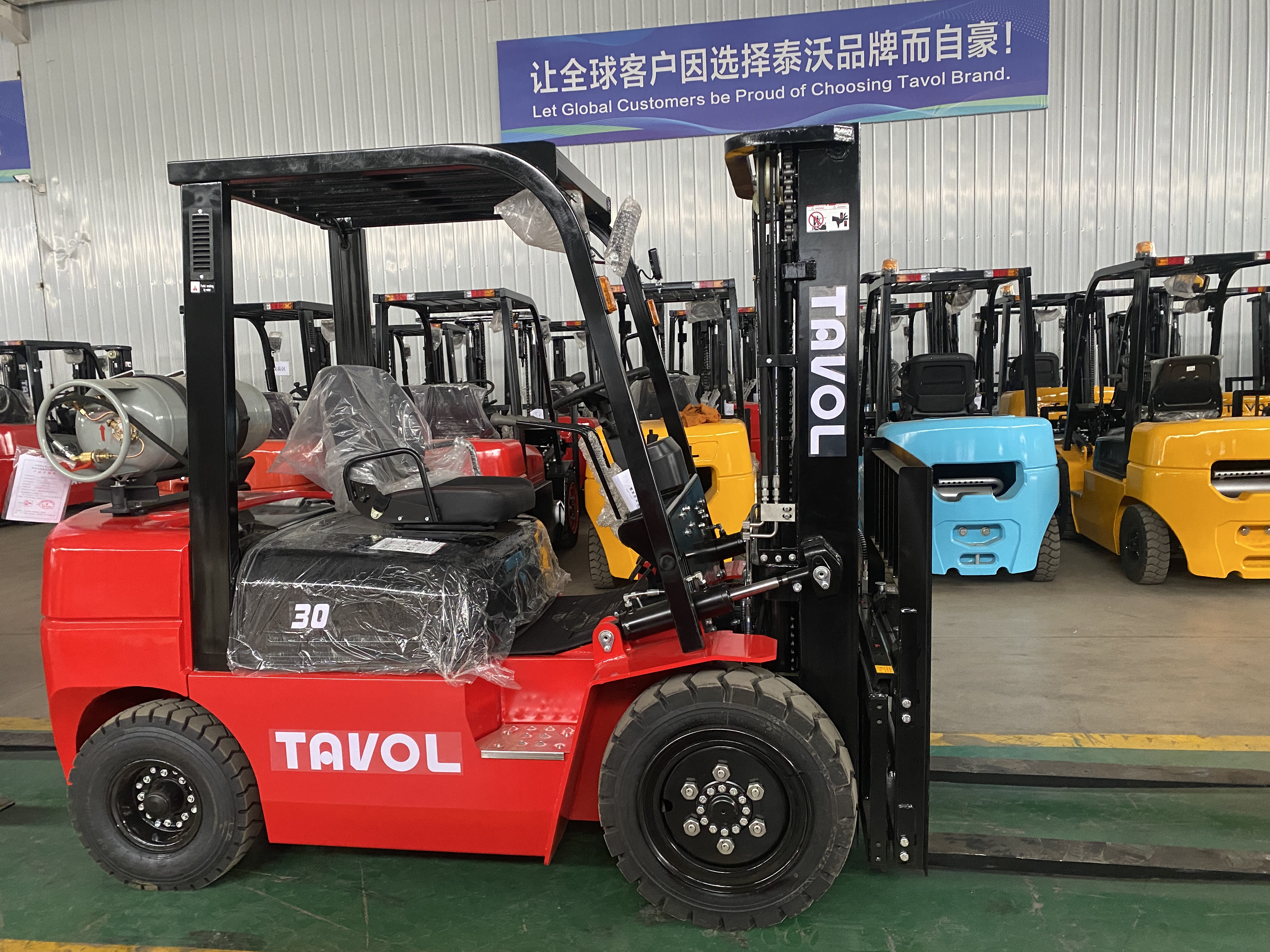
A dual fuel LPG and gasoline forklift, the powertrain path most often considered where a site needs both indoor and outdoor loading capability. Image: Tavol.
Top guard height matters more than buyers expect. The CPD30 electric and the CPCD40 diesel both publish 2080 mm; the CPD35, CPD40, CPCD30, CPCD35, CPQYD30 and CPQYD35 publish 2125 mm; the 2-tonne and 2.5-tonne models publish 2105 mm. Where a container is loaded under a fixed canopy or a low dock door, that 45 mm difference between two otherwise similar machines can decide which unit is usable.
The Shortlist: Three Powertrain Paths for the Same Dock
Path 1 — Diesel: CPCD30, CPCD35 and CPCD40
Tavol diesel counterbalance models in this class are the CPCD30 at 3000 kg, the CPCD35 at 3500 kg and the CPCD40 at 4000 kg, all with a 500 mm load centre. The diesel path is the conventional answer for an outdoor steel yard because it is not tied to charging infrastructure and because the engine options cover a wide supplier set: Xinchai, Quanchai, Isuzu, Mitsubishi, Yanmar, Kubota or PSI, selected per order. This is the configuration most German buyers label as a Japanese-engine diesel forklift when they specify Isuzu, Mitsubishi, Yanmar or Kubota power.
Full-load performance on the CPCD30 and CPCD35 includes a drive speed of 18–20 km/h, a lift speed of 450 mm/s, a descent speed of 420 mm/s and gradeability of 15% laden and 20% unladen. Maximum traction is 21500 N on the CPCD35 and 24500 N on the CPCD40. Structures are built from Q235 carbon structural steel and Q355 low-alloy high-strength structural steel, with a reinforced frame intended for impact resistance in rough yard conditions.
Where diesel fits: long outdoor aprons, unpaved or uneven yard surfaces, multi-shift work without charging windows, and sites where the container stuffing point is far from the fabrication bay.
Path 2 — Dual Fuel LPG and Gasoline: CPQYD30 and CPQYD35
The dual fuel models are the CPQYD30 at 3000 kg and the CPQYD35 at 3500 kg, both with a 500 mm load centre and a Nissan engine, with a fuel system that switches between LPG and gasoline. Dimensions mirror the diesel equivalents: 2855 mm overall length, 1230 mm overall width, 2125 mm top guard height, 2550 mm minimum turning radius and 4305 mm minimum right-angle channel width. Lift speed is 450 mm/s and descent speed 420 mm/s under full load; gradeability is 15% laden and 20% unladen; maximum traction is 21000 N on the CPQYD30 and 21500 N on the CPQYD35.
The operational argument for dual fuel in this setting is continuity. Refuelling takes minutes rather than the hours a battery needs to return to service, which matters when a shipping cut-off is fixed and the yard runs late. The trade-off is fuel logistics: LPG cylinder supply and secure storage have to be arranged on site, and cylinder changeover becomes a routine task rather than an occasional one.
Path 3 — Lithium Electric: CPD30, CPD35 and CPD40
The electric models are the CPD30 at 3000 kg, the CPD35 at 3500 kg and the CPD40 at 4000 kg, all with a 500 mm load centre and a lithium-ion LiFePO4 battery with quick charger. Gradeability is 18% laden and 20% unladen, with maximum traction of 15600 N. Lift speed under full load is 350 mm/s on the CPD30 and 320 mm/s on the CPD35 and CPD40.
The electric path earns its place when the machine spends significant time indoors — fabrication bays, inspection areas, paint halls — because it produces zero emissions at the point of use and operates at lower noise than an internal combustion truck. Opportunity charging during breaks removes the need for battery swapping. The constraint is equally clear: the site must have charging capacity where the truck parks, and the working pattern must tolerate the recharge window that opportunity charging implies.

A 4.0-tonne lithium electric forklift, used where the same machine must work inside fabrication bays as well as on the loading apron. Image: Tavol.
Side-by-Side: What Changes Between the Three Paths
| Decision factor | Diesel (CPCD30 / CPCD35 / CPCD40) | Dual fuel (CPQYD30 / CPQYD35) | Lithium electric (CPD30 / CPD35 / CPD40) |
|---|---|---|---|
| Rated capacity range | 3000 kg / 3500 kg / 4000 kg | 3000 kg / 3500 kg | 3000 kg / 3500 kg / 4000 kg |
| Minimum turning radius | 2550 mm | 2550 mm | 2550 mm |
| Right-angle channel width | 4305 mm | 4305 mm | 4305 mm |
| Overall width | 1230 mm (CPCD40: 1330 mm) | 1230 mm | 1230 mm |
| Top guard height | 2125 mm (CPCD40: 2080 mm) | 2125 mm | 2080 mm (CPD35 / CPD40: 2125 mm) |
| In-use emissions | Combustion emissions at point of use | Lower than diesel, per manufacturer positioning | Zero emissions at point of use |
| Refuelling / recharging | Fuel refill, no charging dependency | LPG or gasoline refill, quick cylinder change | Opportunity charging during breaks |
| Best-fit loading location | Outdoor yard and apron | Mixed indoor and outdoor dock | Indoor bay plus apron |
Two rows in that table deserve attention. The width row separates the CPCD40 from every other model in this class at 1330 mm — an 100 mm penalty that matters when the truck has to work close to a container wall. The height row separates the CPD30 and CPCD40 at 2080 mm from the rest at 2125 mm. Neither difference appears in a headline capacity figure, and both change what the machine can physically do on a constrained dock.
Matching Tonnage to the Steel Being Loaded
Load centre is 500 mm across the range, which means the rated capacity applies at that distance from the fork face. Steel sections that extend well beyond 500 mm reduce the usable capacity well before the nominal figure is reached, and over-length loads should be assessed on their actual centre of gravity rather than on the plate rating.
- 2000–2500 kg class: CPCD20, CPCD25 and CPQYD20, CPQYD25. Overall length 2750 mm, width 1165 mm, top guard height 2105 mm, turning radius 2500 mm, right-angle channel 4255 mm. Best suited to smaller fabrications, brackets, fittings and lighter welded assemblies.
- 3000 kg class: CPCD30, CPQYD30, CPD30. The most common starting point for mixed fabrication output where individual sections sit in the one-to-two-tonne band but handling equipment and rigging add to the effective load.
- 3500 kg class: CPCD35, CPQYD35, CPD35. The natural step up when assemblies are routinely heavy and the truck also handles yard transport of raw stock.
- 4000 kg class: CPCD40 and CPD40. The ceiling of this range. The CPCD40 carries a wider 1330 mm body and 24500 N maximum traction, so it is the choice for the heaviest routine lifts — with the acceptance that it is the least manoeuvrable unit here inside a container.
Above 4000 kg, this range does not offer a counterbalance model, and buyers moving into heavier fabricated structures should not assume a 4-tonne truck can be stretched. The correct response is either a larger machine outside this range or a loading method where the overhead crane performs the lift and the forklift only transfers and shores.
Mast, Fork Length and the Container Opening
Mast specification is where container loading diverges most sharply from warehouse specification. Tavol offers two-stage masts at 3 m, 3.5 m and 4 m, three-stage masts at 4.5 m, 5 m, 5.5 m and 6 m, and additionally offers container mast and full free mast configurations. For container work the relevant option is usually the container mast or full free mast, because the operator needs lift height without a mast that cannot retract under the door header.
Fork length is selectable at 1220 mm, 1370 mm, 1520 mm, 1670 mm and 1820 mm. Longer forks help with long sections but shift the load centre forward and reduce usable capacity. Tyres are pneumatic as standard with solid tyres available on request — a meaningful choice for a site that mixes rough outdoor apron work with clean indoor floors. Mast tilt is 6 degrees forward and 12 degrees backward across the range.
Where Overhead Crane Assistance Changes the Forklift Spec
In the loading pattern described in Tavol's steel structure and metal fabrication application reference, the forklift works with standard forks and no special attachment, combined with overhead crane assistance. The crane lifts and orients irregular structural components; the forklift transports, levels, shores and positions them inside the container.
That division of labour changes what to prioritise. Precision of inching control and mast tilt response become more important than maximum lift height, because the forklift is making small adjustments under a suspended or partially supported load. It also means the truck's role inside the container is often to hold a section at the correct angle while the crane or the rigging takes the weight — a task where stability and fine hydraulic control matter more than raw capacity.
Buyers should note that attachment-based handling — paper roll clamps, bale clamps, rotating clamps, tyre clamps, tipping forks, buckets or load stabilisers, as documented in Tavol's attachment application library — is a different operating model. Those attachments suit palletless roll, bale, drum or bulk handling. They are not the recommended configuration for structural steel container loading, where standard forks plus crane assistance is the documented pattern.
Where Each Option Stops Being the Right Answer
A shortlist without limits is a sales document. The boundaries here are concrete.
- Diesel indoors: combustion emissions at the point of use make diesel a poor fit for enclosed fabrication bays without effective ventilation. If the truck spends most of its day indoors, the electric path is the better match.
- Electric on a remote apron: a lithium truck tied to a charging point is a constraint if the container stuffing position moves around a large yard or sits away from the electrical infrastructure. Opportunity charging solves the shift pattern, not the geography.
- Dual fuel without LPG supply: the dual fuel advantage depends on reliable LPG cylinder availability and compliant on-site storage. Where that supply chain is uncertain, the flexibility is theoretical.
- The 4-tonne ceiling: the CPCD40 is the largest counterbalance model in this set. Heavier fabricated structures require a different machine class or a crane-led method.
- The 1330 mm width penalty: the CPCD40 is 100 mm wider than the 3.5-tonne models. On a tight container approach, that difference is real.
- Emission documentation: where a German buyer requires specific emission documentation, the applicable standard and paperwork must be confirmed for the exact engine option ordered rather than assumed from the model name.
Procurement Checks Before the Order Is Placed
The specification conversation is usually shorter than the verification conversation. Five items are worth closing before signature.
Engine option and documentation. Diesel models list Xinchai, Quanchai, Isuzu, Mitsubishi, Yanmar, Kubota and PSI as selectable. The engine brand is a specification decision, not an interchangeable detail, and the compliance paperwork should name the engine actually fitted.
Mast and fork combination. Container mast versus full free mast, and 1220 mm versus 1820 mm forks, change both the usable envelope and the effective capacity. Ask for the configuration to be stated explicitly rather than described as standard.
Tyre type. Pneumatic as standard, solid on request. The choice should follow the surface mix the truck actually works on.
Attachment interface. If the site may later add clamps or a rotator for other product lines, the carriage and hydraulic configuration should be specified at order rather than retrofitted.
Service and parts. Shandong Tavol Machinery Co., Ltd. was established in 2003, operates a 40,000 m² facility with approximately 300 staff and a 25-engineer R&D team, and produces 3000 units annually. It exports to more than 120 countries and regions across Southeast Asia, Europe, South America, the Middle East, Africa, Australia and North America, with export accounting for about 70% of total sales. Those figures describe scale and export reach; they do not by themselves confirm service response times in a specific German region, which should be established separately.
Market Context: Why European Buyers Are Re-Examining Powertrain Mix
Two published data points frame the decision. The global forklift market was valued at USD 81.4 billion in 2025, according to Grand View Research. Separately, Interact Analysis reported lithium-ion penetration in global counterbalanced forklifts at 17.5% in 2024. Read together, they describe a market that remains dominated by internal combustion powertrains while electric adoption continues to grow from a minority base — which is consistent with what steel fabricators report: diesel and dual fuel still carry the outdoor yard, while electric takes the indoor bay.
Supply-side context matters too. China exported USD 1.26 billion of parts for fork-lift trucks in 2024, according to World Bank WITS data under HS code 843120. For a European buyer, that scale of component trade supports parts availability but also means supplier selection should focus on the specific after-sales arrangement rather than on country of origin alone.
On the regulatory side, ANSI/ITSDF B56.1-2020 remains the safety standard for low-lift and high-lift trucks effective through 2025, and it is the reference buyers commonly use when reviewing truck safety documentation. It is a US-origin standard, and its use in a German procurement file should be understood as a recognised reference point rather than as a substitute for the applicable European requirements for the specific installation.
Future Outlook
The direction of travel in this application is toward a mixed fleet rather than a single powertrain. A steel fabricator with an indoor bay, an outdoor apron and a container stuffing position increasingly ends up with one lithium truck for indoor work and one diesel or dual fuel truck for the yard, rather than forcing one machine to cover both. The specification question then shifts from which powertrain wins to which combination makes the loading schedule work.
For the container itself, the constraint is unlikely to change: the box width is fixed, and the forklift must fit inside it. That keeps turning radius, right-angle channel width, overall width and top guard height as the four numbers that decide the shortlist, regardless of how powertrains evolve.
FAQ
When shortlisting for steel export container loading, should a buyer choose the powertrain first or the tonnage first?
Tonnage first. The rated capacity at a 500 mm load centre determines whether the machine can lift the component at all, and the load class then narrows the available models. Powertrain selection follows from where the truck works — outdoor yard, mixed dock, or indoor bay — because that is what determines whether diesel, dual fuel or lithium electric is workable. Choosing powertrain first tends to produce a machine that fits the site but not the load.
Which dimensional figures decide whether a forklift can manoeuvre inside a shipping container?
Four published figures govern it: minimum turning radius, minimum right-angle channel width, overall width and top guard height. In the Tavol counterbalance range, minimum turning radius is 2550 mm for the 3-tonne, 3.5-tonne and 4-tonne classes and 2500 mm for the 2-tonne and 2.5-tonne classes; minimum right-angle channel width with a 1000 × 1200 mm pallet is 4305 mm and 4255 mm respectively. Overall width is 1230 mm for the 3-tonne and 3.5-tonne models and 1330 mm for the CPCD40. Top guard height ranges from 2080 mm to 2125 mm depending on model.
How is fuel mode switched on a dual fuel LPG and gasoline forklift?
Switch fuel modes only when the engine is idling or off, using the dashboard fuel selector switch, and allow a few seconds for the fuel system to stabilise before resuming operation. The practical sequence is to bring the forklift to a stop and let the engine idle, locate the fuel mode selector on the dashboard, switch to the desired mode, wait five to ten seconds, then resume and monitor engine performance for the first few minutes. Modes should not be switched under heavy load or on a slope, and the LPG cylinder should be checked for secure mounting and leaks before each shift.
What does a pre-shift inspection cover on a diesel counterbalance forklift?
A pre-shift inspection covers fluid levels, tyres, brakes and safety devices. In practice that means checking engine oil, hydraulic fluid and coolant; inspecting tyres for wear, damage or incorrect inflation; testing brakes, horn, lights and the backup alarm; checking forks and mast for cracks, bends or hydraulic leaks; and starting the engine to confirm no unusual noise, smoke or warning lights. The machine should not be operated with a malfunctioning brake or a hydraulic leak, and any abnormality should be reported before work starts.
How should a lithium battery forklift be charged and maintained on a steel fabrication site?
Use opportunity charging during breaks rather than waiting for a full discharge, and follow the manufacturer's charging cycle to maximise battery lifespan. Lithium batteries require no watering or acid checks — only periodic inspection of terminals and connectors. The routine is to park on a flat, ventilated area and switch off the ignition before connecting the charger, confirm the charging indicator is active, charge during breaks or idle periods, disconnect once fully charged, and inspect terminals, cables and connectors weekly for looseness or corrosion. Charging should not take place in an enclosed space without ventilation.
What happens if the steel components exceed the capacity of the largest model in this range?
The largest counterbalance model in this set is the CPCD40 at 4000 kg rated capacity at a 500 mm load centre. Above that, the range does not offer a heavier counterbalance truck, and a 4-tonne machine should not be treated as extendable. The two workable responses are to move to a larger machine class outside this range, or to restructure the loading method so the overhead crane performs the lift and the forklift handles transfer, shoring and fine positioning only.
Есть вопросы или нужны дополнительные детали?
Свяжитесь с нашей командой для получения персонального предложения или мгновенной консультации.
Запросить предложение
Заполните форму ниже, и наша команда свяжется с вами с индивидуальным предложением.
Прямой чат WhatsApp
Предпочитаете общаться в реальном времени? Напишите нам в WhatsApp для мгновенной помощи и быстрых ответов.
- Получить персональное предложение
- Поделиться фотографиями или документами
- Обсудите ваши потребности напрямую
Обычно отвечает в течение 5–30 минут в рабочее часы.