
Shortlist Guide: Best Disposable Wooden Cutlery Models for Custom OEM Orders
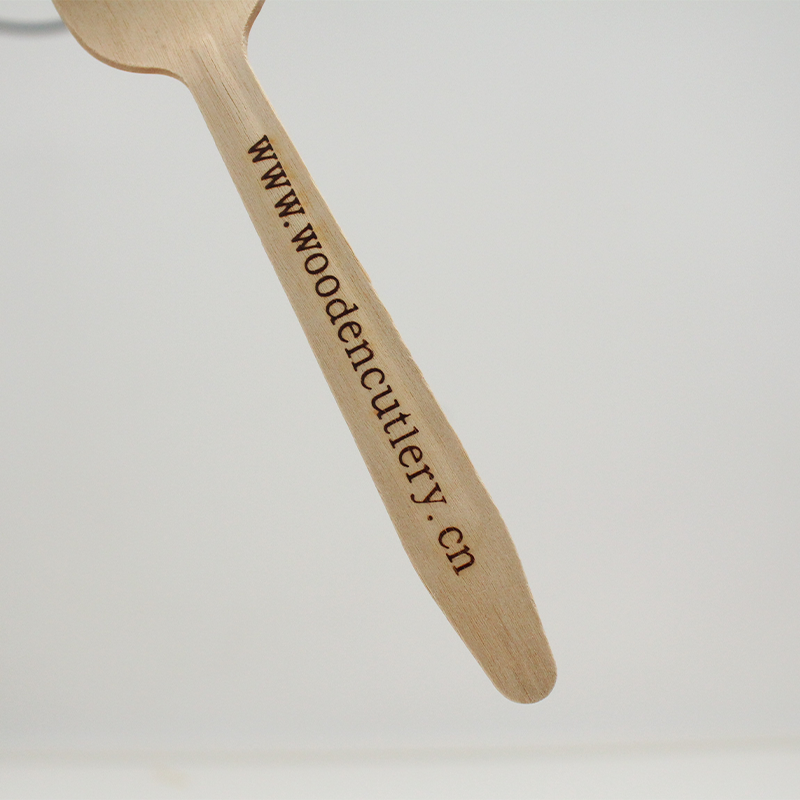
Customization is applied during production, not after packing — the point at which an OEM order is either efficient or expensive.
Buyers who have already decided to move away from plastic cutlery rarely stop at the category level. The decision that actually determines cost, lead time and complaint rate is which specific model — and which length, material and customization route — should carry a custom OEM order across a restaurant chain, a takeaway network or a retail private-label programme.
The category is large enough to justify that precision. Dataintelo values the global disposable wooden cutlery market at approximately USD 2.8 billion in 2025 and projects growth to USD 5.2 billion by 2034, with Asia Pacific holding a 38.6% share in 2025. China remains the world's largest exporter of wood tableware and kitchenware under HS 4419, with export values of roughly USD 1.38 billion to USD 1.5 billion in 2024 according to OEC/WITS data. Inside that market, however, model-level decisions are still frequently made from a supplier's catalogue images rather than from comparable specifications.
This shortlist narrows the category to three verified product models from Greenwood - Dalian Industrial Co.,ltd., a Chinese manufacturer founded in 2000 that operates five major factories, employs around 500 people, and exports roughly 95% of its output to Europe, ANZ, Canada, the USA, South America, the Middle East, Japan and Korea, and Southeast Asia. The three models — GW-20456 (wood/bamboo), GW-BC001 (pure bamboo) and GW-PC204 (paper) — differ in substrate, available lengths and customization options. Those differences, not brand preference, are what should drive an OEM selection.
Why Custom OEM Orders Fail at the Category Level, Not the Supplier Level
Most evaluation-stage problems in this category are specification problems that appear after production, not sourcing problems that appear before ordering. A buyer who compares "disposable wooden cutlery" as a single item will typically approve a supplier on price per piece and only discover three mismatches later:
- Length mismatch with the service format. A 95mm piece designed for canapés or ice cream service reads as undersized next to a full plate, while a 180mm piece adds cost and packaging volume to a small-portion takeaway programme.
- Logo method mismatch with the substrate. Hot stamping, laser marking and print do not behave identically on natural wood, bamboo and paper, and the corpus for these models does not offer every method on every SKU.
- Colour expectations set at briefing but not supported at the model level. Colour customization is documented for GW-BC001 and GW-PC204; it is not listed among the customization options for GW-20456, which supports size, logo (laser/print) and packaging.
Each of these is a routine, low-cost decision during quotation and an expensive one after tooling or packaging artwork has been committed. That asymmetry is the reason a shortlist should be built at model level, before suppliers are ranked.
How This Shortlist Was Built
The three models below were not selected on marketing positioning. They were separated using six procurement-facing criteria that can be checked against documentation rather than asserted:
- Substrate: whether the piece is wood, bamboo or paper, since the substrate drives feel, moisture behaviour and the applicable food-contact documentation.
- Length coverage: whether the range can serve more than one service format without a new tooling decision.
- Documented customization methods: which logo, size, packaging and colour options the model actually supports.
- Certification linkage: which certificates list the specific model as a related or applicable product.
- Production and lead-time fit: whether the order volume sits inside the manufacturer's stated order threshold and delivery window.
- Application fit: the industries the model is documented as suitable for.
The Shortlist at a Glance
| Model | Substrate | Length options | Documented customization | Primary fit |
|---|---|---|---|---|
| GW-20456 Disposable Wooden Cutlery | 100% natural wood (wood and bamboo material family) | 180mm / 170mm / 160mm / 140mm / 110mm / 95mm, customizable | Size, logo (laser / print), packaging | Restaurant chains, supermarkets, takeaway wholesalers, airlines; multi-format programmes |
| GW-BC001 Disposable Bamboo Cutlery | Bamboo | 170mm standard; 110mm / 140mm / 170mm available, customizable | Logo (hot stamping), size, packaging, colour | Takeaway and catering use where a natural bamboo texture and colour customization are required |
| GW-PC204 Disposable Paper Cutlery | Paper | 158mm standard, customizable size | Logo, packaging, colour | Lighter food service, waterproof and oil-proof requirements, private-label programmes |
Model 1 — GW-20456 Disposable Wooden Cutlery
GW-20456 is the broadest-range model in the shortlist and the natural default for buyers who need one SKU family to cover several service formats. It is produced from 100% natural wood, is described as food-grade, BPA-free and non-toxic, and is documented as 100% biodegradable and compostable. The finished surface is specified as smooth with no burrs, and the piece is heat-resistant and suitable for both hot and cold food.
Specification summary
| Attribute | Documented specification |
|---|---|
| Type | Wooden knife, wooden fork, wooden spoon, ice cream stick, coffee stirrer |
| Length | 180mm / 170mm / 160mm / 140mm / 110mm / 95mm (customizable sizes) |
| Material | 100% natural wood |
| Food contact | Food-grade, BPA-free, non-toxic |
| End-of-life claim | 100% biodegradable & compostable |
| Performance | Smooth surface, no burrs, heat-resistant; suitable for hot and cold food |
| Customization | Size, logo (laser / print), packaging |
Because the model covers 180mm down to 95mm, a single qualification file can serve a plated restaurant programme, a mainstream takeaway programme and a small-portion or sampling format. For procurement teams, that reduces the number of separate supplier approvals required across a group's formats.
Model 2 — GW-BC001 Disposable Bamboo Cutlery
GW-BC001 is the pure bamboo option. It is positioned around a natural bamboo texture rather than a processed wood appearance, and it is the model in this shortlist that carries the widest documented customization menu: logo via hot stamping, size, packaging and colour. The material is described as 100% food-grade safe, BPA-free and non-toxic, with LFGB and FDA certification referenced at product level, and as 100% biodegradable and compostable.
Specification summary
| Attribute | Documented specification |
|---|---|
| Type | Bamboo knife, bamboo fork, bamboo spoon, coffee stirrer, bamboo skewer sticks |
| Length | 170mm standard; customizable 110mm / 140mm / 170mm available |
| Material | Bamboo |
| Food contact | 100% food-grade safe, BPA-free, non-toxic; LFGB / FDA certified |
| Performance | Heat-resistant, smooth edge, no burrs, natural bamboo texture |
| Customization | Logo (hot stamping), size, packaging and colour |
| Positioning | Suitable for hot and cold food; documented as durable for takeaway and catering use |
The narrower length set — 170mm standard with 110mm and 140mm alternatives — is a real constraint and a real advantage. It is a constraint for buyers who need a single supplier to cover very short confectionery formats below 110mm. It is an advantage for operators who want a tighter, easier-to-forecast specification: fewer SKUs, simpler packaging artwork, and a colour option that makes private-label differentiation possible without changing the tooling.
Model 3 — GW-PC204 Disposable Paper Cutlery
GW-PC204 is the paper option and the shortest-standard model in the group, with a 158mm standard length and customizable sizing. Its documented performance profile is oriented toward food-contact practicality rather than structural rigidity: it is described as heat-resistant, waterproof and oil-proof, with a smooth edge and no smell, and it is positioned as 100% food-grade safe, BPA-free, non-toxic, biodegradable and compostable. Logo, packaging and colour are all listed as customizable.
Specification summary
| Attribute | Documented specification |
|---|---|
| Type | Paper knife, paper fork, paper spoon |
| Length | 158mm standard, customizable size available |
| Material | Paper |
| Food contact | 100% food-grade safe, BPA-free, non-toxic |
| Performance | Heat-resistant, waterproof & oil-proof; smooth edge, no smell |
| Customization | Logo, packaging and colour |
Customization Options Compared for OEM Orders
Customization is where the three models diverge most, and where most OEM briefs need to be adjusted before they are sent. The table below reflects only the options documented for each model.
| Customization dimension | GW-20456 | GW-BC001 | GW-PC204 |
|---|---|---|---|
| Logo | Laser / print | Hot stamping | Logo (as documented) |
| Size | Customizable | Customizable (110 / 140 / 170mm) | Customizable |
| Packaging | Customizable | Customizable | Customizable |
| Colour | Not listed | Customizable | Customizable |
Beyond model-level options, the manufacturer documents OEM / ODM and customization as a production mode, with logo printing on products and on packaging, plus customized shape and new design development. For a buyer, the practical implication is that shape and packaging development sit inside the same production relationship as the cutlery itself — which shortens the loop between artwork approval and packing, but also means the packaging brief should be finalized before the production slot is booked rather than after.
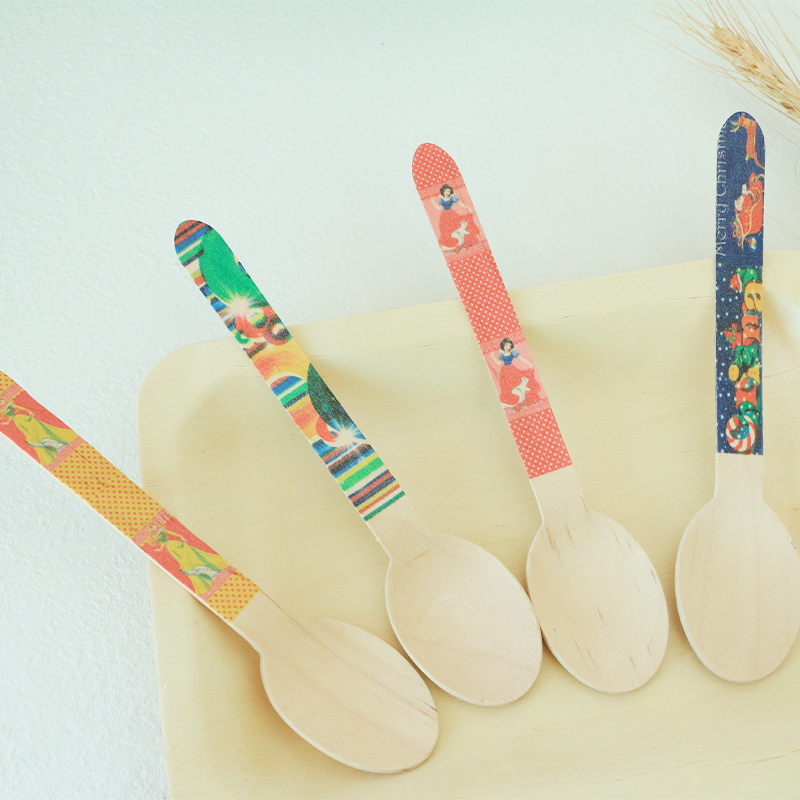
OEM customization typically combines three separate approvals: logo method, packaging artwork and final pack configuration.
Length and Format Logic: Matching the Spec to the Service Format
Length is the single most common cause of a specification that looks correct on paper and feels wrong in service. The documented length sets support a straightforward mapping:
- 180mm (GW-20456): the plated-service format, where cutlery is set beside a full-size plate for restaurant dining.
- 170mm / 160mm (GW-20456 and GW-BC001 standard): the mainstream takeaway and catering format, balancing reach with packaging volume.
- 140mm (GW-20456, GW-BC001): portion-controlled formats such as desserts, children's menus and side-item service.
- 110mm / 95mm (GW-20456, GW-BC001): sampling, canapé, ice-cream and condiment service, where a full-length piece is disproportionate.
- 158mm standard (GW-PC204): a mid-length paper format suited to lighter dishes where waterproof and oil-proof performance matters more than cutting resistance.
For a group operating several formats, the efficient approach is usually to standardize on one model with a two- or three-length specification rather than to qualify one model per format. GW-20456 is the model whose documented 180mm-to-95mm range makes that consolidation possible without a new tooling decision.
Compliance and Capability Evidence Behind the Shortlist
A shortlist is only as reliable as the evidence attached to it. The manufacturer behind these three models documents the following, which procurement teams can verify against certificates rather than accept as statements.
Certification records
| Standard / scheme | Certificate or report number | Issuing body | Validity (as documented) |
|---|---|---|---|
| BRCGS Global Standard for Packaging Materials, Issue 6 | 10000305214-MSC-ACCREDIA-CHN | DNV | 2022-05-02 to 2027-05-02 |
| FSC Chain of Custody | SA-COC-013128 | Soil Association | 2023-04-03 to 2028-04-02 |
| ISO 9001:2015 (quality management) | 02024E1883R0M | Beijing ZhongDaHuaYuan Certification Center | 2024-12-05 to 2027-12-04 |
| ISO 14001:2015 (environmental management) | 02024E1883R0M | Beijing ZhongDaHuaYuan Certification Center | 2024-12-05 to 2027-12-04 |
| ISO 45001:2018 (occupational health and safety) | 02024E1883R0M | Beijing ZhongDaHuaYuan Certification Center | 2024-12-05 to 2027-12-04 |
| FDA 21 CFR 178 (food contact, wood) | R0723000394 | National Reference Laboratory for Food Contact Material (Guangdong) | Recorded from 2023-08-30 |
| LFGB (EU, wood and bamboo tableware) | 7216006083-2 | TUV SUD China | Recorded from 2025-07-25 |
| Sedex / SMETA (labour, health & safety, environment, business ethics) | ZS405156174 | SMETA | Recorded from 2025-04-21 |
The BRCGS certificate scope covers the manufacture of disposable wooden and bamboo tableware, including wooden knives, forks, spoons, skewers, steak markers, coffee stirrers, sticks, boats, cones, cups and plates/trays, plus bamboo forks, chopsticks and skewers. The FSC chain-of-custody record is the documentation most directly relevant to buyers who need to demonstrate wood-origin due diligence in regulated markets.
Production and order capability
- Production mode: OEM / ODM and customization, including logo printing on products and packaging, customized shape and new design.
- Stated output: 10 million pieces per day, supported by five major factories and an annual capacity documented at 6 billion pieces.
- Lead time: 20 days.
- Minimum order quantity: 100,000 pieces.
- Quality control: third-party inspection.
- After-sales support: packaging design and logistics support.
- Engineering resource: a nine-engineer R&D team, which is the internal resource that shape and new-design customization depends on.
Application Map: Which Model Fits Which Operational Context
The three models are documented as suitable for restaurant chains, supermarkets, takeaway wholesalers and airlines. Mapped to practical procurement contexts, the distinctions are:
- Restaurant and hotel dining (indoor service): GW-20456 at 180mm or 170mm, where reach and plate proportion matter more than unit cost.
- Takeaway and delivery networks: GW-BC001 at 170mm, where the documented durability for takeaway and catering use and the colour option support a consistent branded presentation in the bag.
- Party, event and catering formats: GW-20456 at 140mm or 110mm for portion-controlled service, or GW-BC001 where a natural bamboo finish is part of the event aesthetic.
- Camping, outdoor and travel kits: GW-PC204 at 158mm, where a lighter, waterproof and oil-proof piece suits single-use outdoor packs.
- Wholesale and private-label distribution: GW-PC204 or GW-BC001, both of which document colour customization for retail-facing differentiation, with packaging developed in the same production relationship.
- Airline and catering service: GW-20456, which is documented as suitable for airline use alongside restaurant chains, supermarkets and takeaway wholesalers.
A documented project reference
One documented application of these product families is a supermarket and chain store programme in Germany and the United States, running for three years with an annual value of USD 5 million. The programme served both B2B and B2C purposes, was delivered using the product models in this shortlist, and achieved the replacement of traditional products together with a reported boost in sales. The manufacturer attributes part of that outcome to the rising trend of eco-friendly products among younger consumers. For evaluation-stage buyers, the relevant detail is not the sales outcome but the delivery profile: a three-year, multi-market, dual-channel programme using these models at volume.
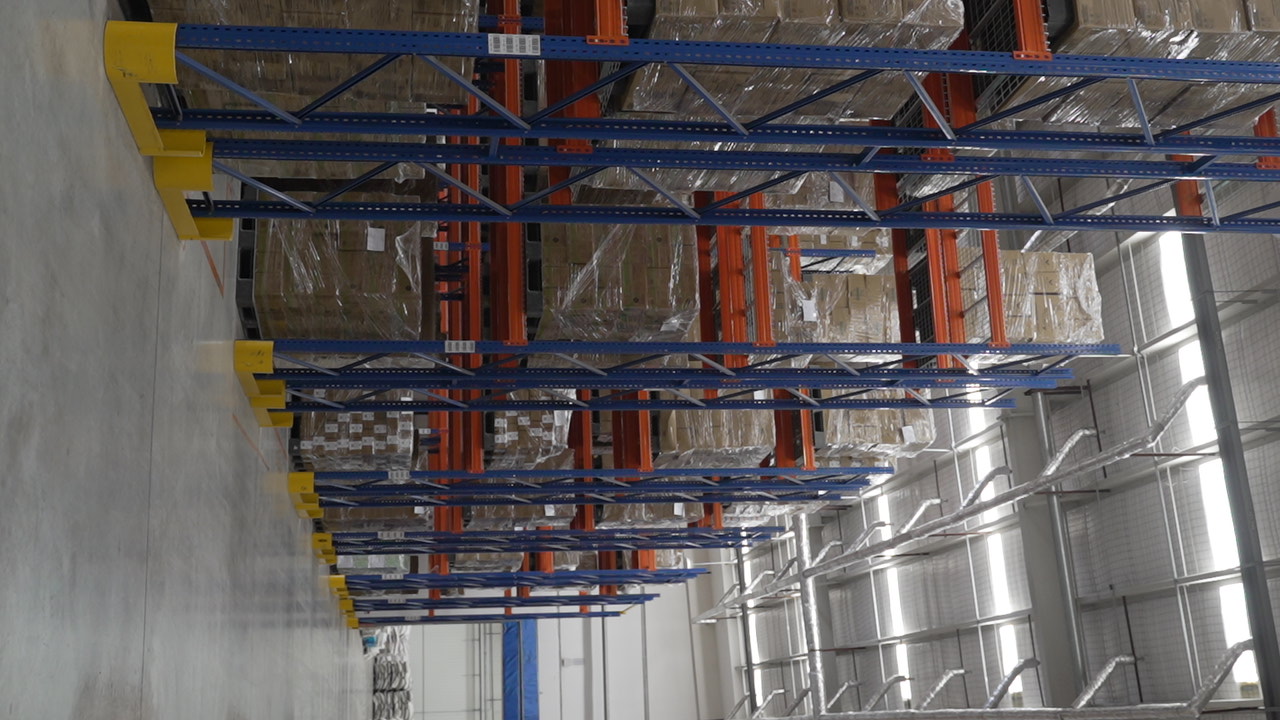
Order threshold and fulfilment readiness matter more than catalogue range once an OEM programme moves from trial to repeat orders.
Market Trends Shaping the 2026 Shortlist
Three regulatory and structural trends are directly changing how these models are specified.
1. Wood-origin due diligence is now a documentation requirement. The EU Deforestation Regulation (Regulation (EU) 2023/1115) requires geolocation and due diligence for wood products. The compliance deadline for large operators has been postponed to December 30, 2025, with later council agreements pointing to December 2026. Either way, buyers in EU markets should treat chain-of-custody documentation as part of the base specification rather than a later addition — which is where an FSC chain-of-custody record such as SA-COC-013128 becomes commercially relevant, not just a compliance formality.
2. Compostability claims require a specific standard in the EU. To be legally marketed as "compostable" in the EU, wooden cutlery must meet EN 13432 for industrial compostability. The models in this shortlist are documented as 100% biodegradable and compostable; buyers who market them as such in Europe should confirm the EN 13432 evidence path with the manufacturer rather than relying on a general biodegradability statement. Home compostability is a separate claim from industrial compostability and should be requested as distinct documentation if it is needed for labelling.
3. Segment demand is concentrated, and estimates diverge. Spoons represent the largest product segment within disposable wooden cutlery, reported at approximately 32.5% to 47.2% of market share depending on the reporting agency. Market size estimates also diverge substantially — Dataintelo cites approximately USD 2.8 billion for 2025, while Future Market Insights cites a far broader "wooden cutlery" scope. The gap reflects scope differences, including whether non-disposable and industrial segments are counted. Procurement teams should therefore treat any single category forecast as directional and weight the specification, certification and capacity evidence in front of them more heavily than a market-size figure.
Where Wooden, Bamboo and Paper Models Fall Short of Traditional Plastic
An honest shortlist states its limits. Wooden, bamboo and paper cutlery are not a drop-in replacement for heavy-duty plastic in every application, and the gaps are consistent enough to plan around.
- Mechanical performance under high cutting load. Natural wood and bamboo are generally less tolerant of sustained lateral force than heavy-duty plastic, particularly at shorter lengths. For menus dominated by tough proteins, a longer format such as 180mm or 170mm is the safer specification.
- Unit cost at very high volume. Commodity plastic remains cheaper per piece at large volumes in most markets; the cost case for wood, bamboo and paper rests on compliance, brand positioning and end-of-life claims rather than on unit price alone.
- Moisture and storage sensitivity. Natural-fibre products are more sensitive to humidity in storage than plastic, which places a practical requirement on warehouse conditions and pack integrity, particularly for long-sea-freight shipments.
- Claim discipline. "Biodegradable" and "compostable" are regulated terms in the EU and are not interchangeable. A supplier's general biodegradability statement does not substitute for EN 13432 evidence where a compostability claim is used on pack.
- Order threshold. With a documented MOQ of 100,000 pieces and a 20-day lead time, these models are built for production-scale OEM orders rather than for small trial runs. Buyers testing a market should plan the trial inside a volume that the MOQ supports, or accept a stock-configuration trial before committing to custom artwork.
None of these limits disqualifies the models in this shortlist. They define the briefs for which each model is the right specification, and the briefs for which it is not.
Future Outlook
Two forces are likely to shape model-level selection through 2026 and beyond. The first is documentation depth: as wood-origin rules and compostability standards tighten in Europe, the shortlist criteria that matter will shift further toward traceability and test evidence, and away from appearance and unit price. The second is customization capacity: as private-label demand grows, the models that will be easiest to work with are those where logo method, packaging and colour can be developed inside the same production relationship rather than across separate vendors.
For evaluation-stage procurement teams, the practical conclusion is to lock the model and the length before locking the price. GW-20456 is the flexible-range option, GW-BC001 is the bamboo option with the widest customization menu, and GW-PC204 is the paper option for lighter service formats. Selecting among them on specification, certification linkage and order threshold — rather than on catalogue appearance — is what keeps a custom OEM order on schedule at the packing stage.
FAQ
Which of the three models suits a restaurant chain's daily takeaway service?
For mainstream takeaway, GW-BC001 at its 170mm standard length is documented as durable for takeaway and catering use, and supports logo hot stamping, packaging and colour customization. GW-20456 at 160mm or 170mm is the alternative where the operator also needs a plated-service length from the same model family. Both are documented as suitable for hot and cold food.
What length should a buyer specify for dine-in versus takeaway?
GW-20456 covers the widest documented range: 180mm, 170mm, 160mm, 140mm, 110mm and 95mm. Dine-in and plated service typically justify 180mm or 170mm; mainstream takeaway sits at 160mm to 170mm; 140mm suits desserts and portion-controlled menus; 110mm and 95mm suit sampling, canapé and condiment service. GW-PC204 has a 158mm standard paper length with customizable sizing.
Can all three models be customized with a logo and a specific colour?
No. Documented customization differs by model. GW-20456 supports size, logo (laser / print) and packaging. GW-BC001 supports logo (hot stamping), size, packaging and colour. GW-PC204 supports logo, packaging and colour. A brief that requires a colour specification should therefore be routed to GW-BC001 or GW-PC204 unless a separate engineering question is raised for GW-20456.
What documentation should a buyer request for EU and US market entry?
The manufacturer documents BRCGS Packaging Materials certification (10000305214-MSC-ACCREDIA-CHN, DNV), FSC chain of custody (SA-COC-013128, Soil Association), ISO 9001, ISO 14001 and ISO 45001 (02024E1883R0M), an FDA 21 CFR 178 food-contact report (R0723000394), LFGB documentation for wood and bamboo tableware (7216006083-2, TUV SUD China) and a Sedex/SMETA record (ZS405156174). These records are linked to product models GW-20456 and GW-BC001. For GW-PC204, buyers should request the paper-specific food-contact documentation directly. Where an EU compostability claim is used, EN 13432 evidence should be requested separately.
What are the order thresholds and lead times for a custom OEM run?
The manufacturer documents an MOQ of 100,000 pieces, a lead time of 20 days, a production mode covering OEM / ODM and customization, third-party inspection for quality control, and after-sales support covering packaging design and logistics. Stated output capacity is 10 million pieces per day, supported by five major factories.
Is this cutlery home compostable?
The models in this shortlist are documented as 100% biodegradable and compostable. In the EU, the standard governing industrial compostability claims is EN 13432. Home compostability is a distinct certification claim from industrial compostability, and buyers who intend to use home-compostable labelling should request documentation specific to that claim rather than assume it is covered by a general biodegradability statement.
Additional specification, certification and packaging detail for these models is collected in the manufacturer's downloadable product brochure: Greenwood product brochure (PDF).
Есть вопросы или нужны дополнительные детали?
Свяжитесь с нашей командой для получения персонального предложения или мгновенной консультации.
Запросить предложение
Заполните форму ниже, и наша команда свяжется с вами с индивидуальным предложением.
Прямой чат WhatsApp
Предпочитаете общаться в реальном времени? Напишите нам в WhatsApp для мгновенной помощи и быстрых ответов.
- Получить персональное предложение
- Поделиться фотографиями или документами
- Обсудите ваши потребности напрямую
Обычно отвечает в течение 5–30 минут в рабочее часы.