
Shortlist Guide: Matching Metric and PG Cable Gland Threads
Shortlist Guide: Matching Metric and PG Cable Gland Threads
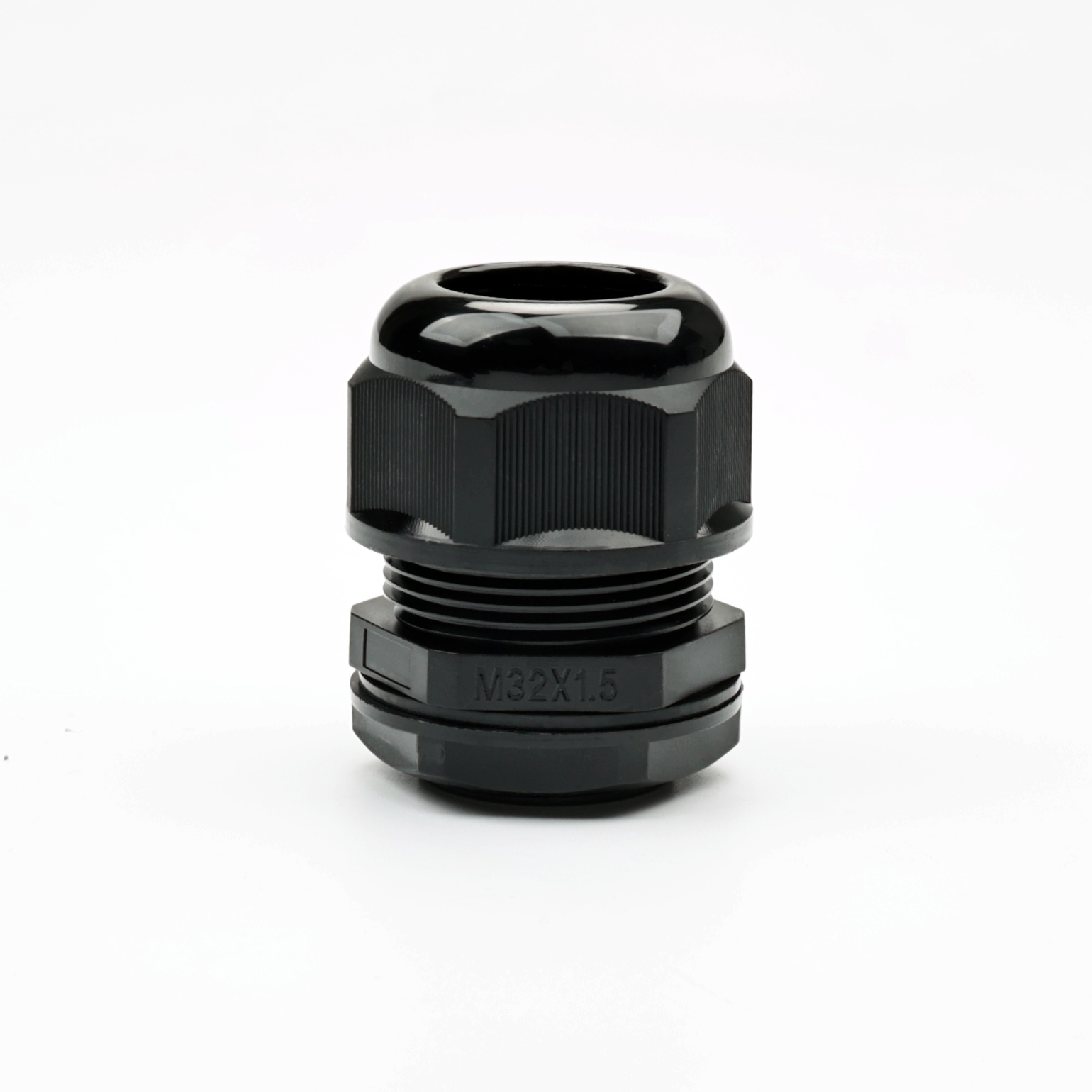
A nylon cable gland is defined by two interface dimensions: the thread that meets the enclosure wall and the clamping range that meets the cable jacket.
A cable gland is the mechanical and sealing interface between a cable and the enclosure it enters. When buyers shortlist waterproof electrical connector accessories, two measurements decide whether a candidate part is usable at all: the thread that must match the enclosure entry, and the clamping range that must match the cable's outer diameter. Thread type is the harder of the two to correct later, because Metric and PG glands can look interchangeable on a specification sheet while being physically incompatible at the enclosure wall.
Zhejiang Gutai Connector Co., Ltd., known as Gutai, is a Chinese manufacturer of waterproof cable glands and connector accessories, including waterproof cable glands, EMC cable glands, porous cable glands, brass screw caps and watertight corrugated tubing fittings. Its two principal gland families, the Metric Series and the PG Series, span M12–M63 and PG7–PG48 respectively, and both cover cable ranges from 3 mm to 45 mm. This reference maps the technical differences between those families and sets out a shortlisting sequence that buyers can apply to a specific enclosure interface.
Why thread matching belongs at the start of the shortlist
Most sourcing errors in this category are interface errors rather than performance errors. A gland can carry the correct ingress rating, the correct material and the correct certification and still fail at commissioning, simply because the enclosure entry was tapped for a different thread family. The global cable glands market was valued at approximately USD 2.16 billion to 2.25 billion in 2024–2025, with forecasts varying between USD 3.07 billion and USD 4.96 billion by 2034 (Straits Research; Spherical Insights). That scale is the reason both Metric and PG sizes remain in active production and why mixed standards are a normal procurement condition rather than an exception.
Metric and PG parts therefore frequently appear on the same project bill of materials: Metric on newly designed cabinets, skids and energy equipment, PG on legacy European machinery and retrofit work. Asia Pacific is the leading regional market for cable glands, accounting for approximately 38% to 42% of global revenue, driven primarily by industrialisation in China and India (Dataintelo; Straits Research). For a buyer, the practical consequence is simple: confirm the thread system before comparing prices, and the shortlist usually collapses from a dozen candidates to two or three.
The four thread families buyers will encounter
Gutai's cable gland range is offered in four mainstream thread options — Metric, PG, G thread and NPT thread — which allows a single product platform to be matched to different enclosure conventions across markets.
- Metric. Model designation: Metric Series. Thread sizes M12–M63, thread outside diameter 12–63 mm, thread length 9–21 mm.
- PG. Model designation: PG. Thread sizes PG7–PG48, thread outside diameter 12.5–59.3 mm, thread length 9–21 mm.
- G thread. A parallel pipe-thread convention widely encountered on European equipment, offered as a thread option on the gland range.
- NPT. A tapered pipe-thread convention common on North American equipment, also offered as a thread option.
The size numbering follows different logic. Metric designations state the thread diameter in millimetres, while PG designations index a nominal conduit size. As a result, a PG16 gland and an M16 gland are not the same thread and do not share a thread diameter, even though the two numbers read similarly. That single distinction accounts for a large share of retrofit ordering errors.
Metric vs PG: the core technical differences
Within Gutai's published range, two parameters are identical across the two families: cable range (3–45 mm) and thread length (9–21 mm). The divergence sits in the thread designation and thread outside diameter, which is what determines whether the part can be installed at all.
| Parameter | Metric Series | PG Series |
|---|---|---|
| Model designation | Metric Series | PG |
| Thread size span | M12–M63 | PG7–PG48 |
| Thread outside diameter | 12–63 mm | 12.5–59.3 mm |
| Thread length | 9–21 mm | 9–21 mm |
| Cable range | 3–45 mm | 3–45 mm |
| Body and seal material | Nylon PA66 and NBR | Nylon PA66 and NBR |
| Ingress protection | IP68 | IP68 |
| Certification | CE, RoHS, REACH, IP68, CCC; PA66 UL approved | CE, RoHS, REACH, IP68, CCC; PA66 UL approved |
| Operating temperature | Static −40 °C to 100 °C, peak up to 120 °C; dynamic −20 °C to 80 °C, peak up to 100 °C | Static −40 °C to 100 °C, peak up to 120 °C; dynamic −20 °C to 80 °C, peak up to 100 °C |
Two conclusions follow from the table. First, the material, sealing and thermal specifications are effectively the same across the two families, so a buying decision rarely turns on performance differences between Metric and PG. Second, the mechanical interface is the only hard constraint — which is why thread identification deserves the first line of any comparison spreadsheet.
From cable diameter to part number: a shortlisting sequence
A workable shortlisting process runs in six steps, in this order. Skipping step one or two usually results in a request for samples that cannot be installed.
- Measure the cable outer diameter. Measure the jacket, not the conductor or the core bundle, and record the tolerance band rather than a single reading.
- Identify the enclosure thread. Confirm the thread system and size from the equipment drawing or by gauging the existing entry.
- Match the clamping range. Select a size whose cable range contains the measured diameter, and avoid sitting at the extreme edge of a range where sealing performance becomes sensitive to cable ovality.
- Check thread length against wall thickness. Gland thread length across both families runs from 9 mm to 21 mm, so enclosures with a thick boss or a raised entry may need a longer thread or an adapter.
- Confirm the thermal regime. Decide whether the cable is static or moving before reading the temperature data.
- Confirm ingress, sealing material and colour. Standard colours are Black (RAL9005), Light Grey (RAL7035) and Silver (RAL7001), with custom colours available upon request.
The cross-reference below lists the cable ranges published for each size in Gutai's Metric and PG ranges. It is a cable-range map, not a thread-interchangeability map: two entries in the same row accept the same cable diameter but will not fit the same enclosure hole.
| Cable range | Metric Series sizes | PG sizes |
|---|---|---|
| 3–6.5 mm | M12S | PG7S |
| 4–8 mm | M12, M16S | PG7, PG9 |
| 6–10 mm | M16, M18 | PG11 |
| 6–12 mm | M20S | PG13.5 |
| 8.5–14 mm | M20, M25S | PG16 |
| 12–15 mm | — | PG19 |
| 12.5–18 mm | M25 | — |
| 15–21 mm | — | PG25 |
| 18–25 mm | M32 | PG29 |
| 24–32 mm | — | PG36 |
| 31–41 mm | M50 | PG42 |
| 35–45 mm | M63 | PG48 |
Where a cell is empty, no size covering that cable range is listed in the corresponding family within the published range, so buyers should confirm the nearest available clamping range with the supplier rather than assume equivalence.
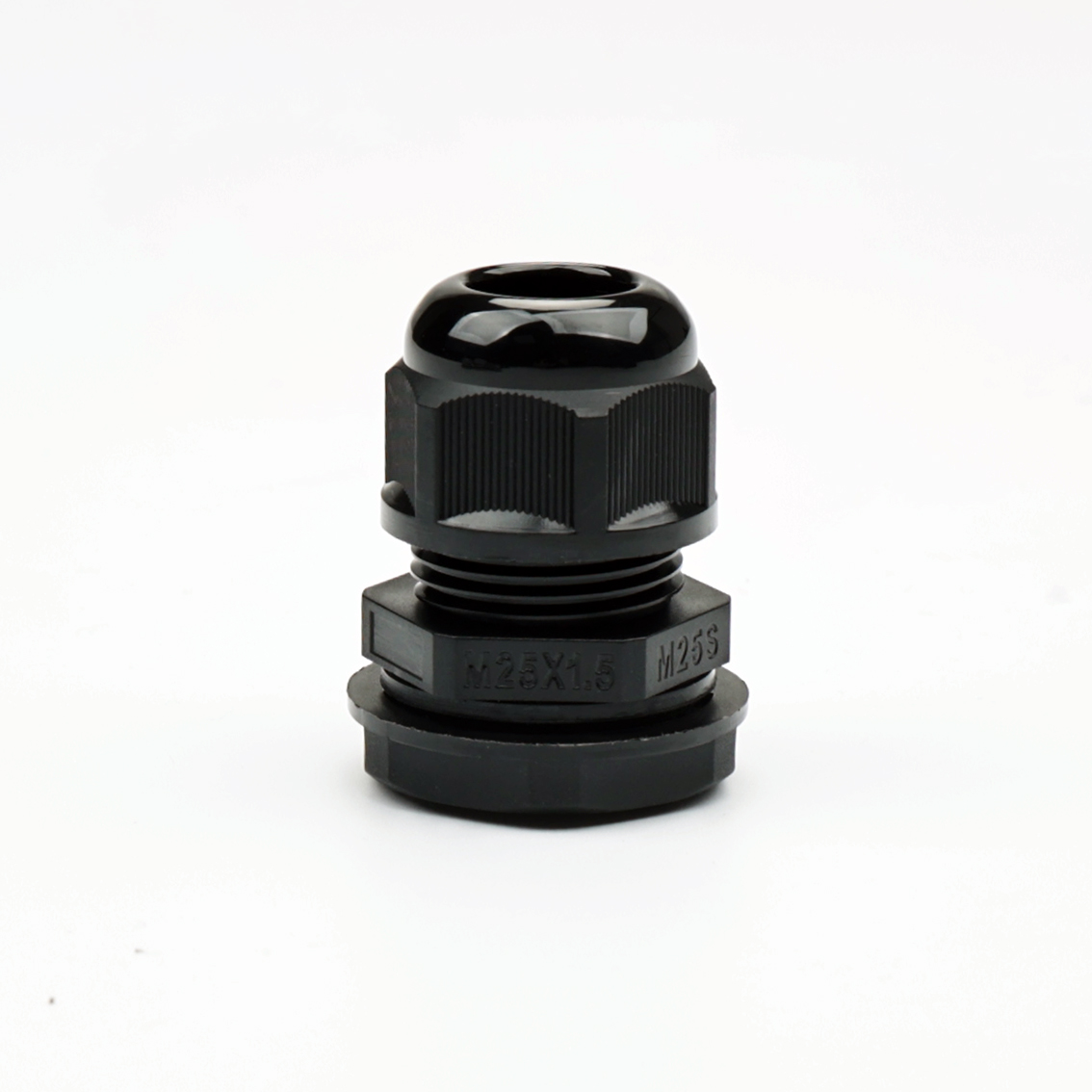
Metric example: the M25S covers a 8.5–14 mm cable range within the Metric Series thread system.
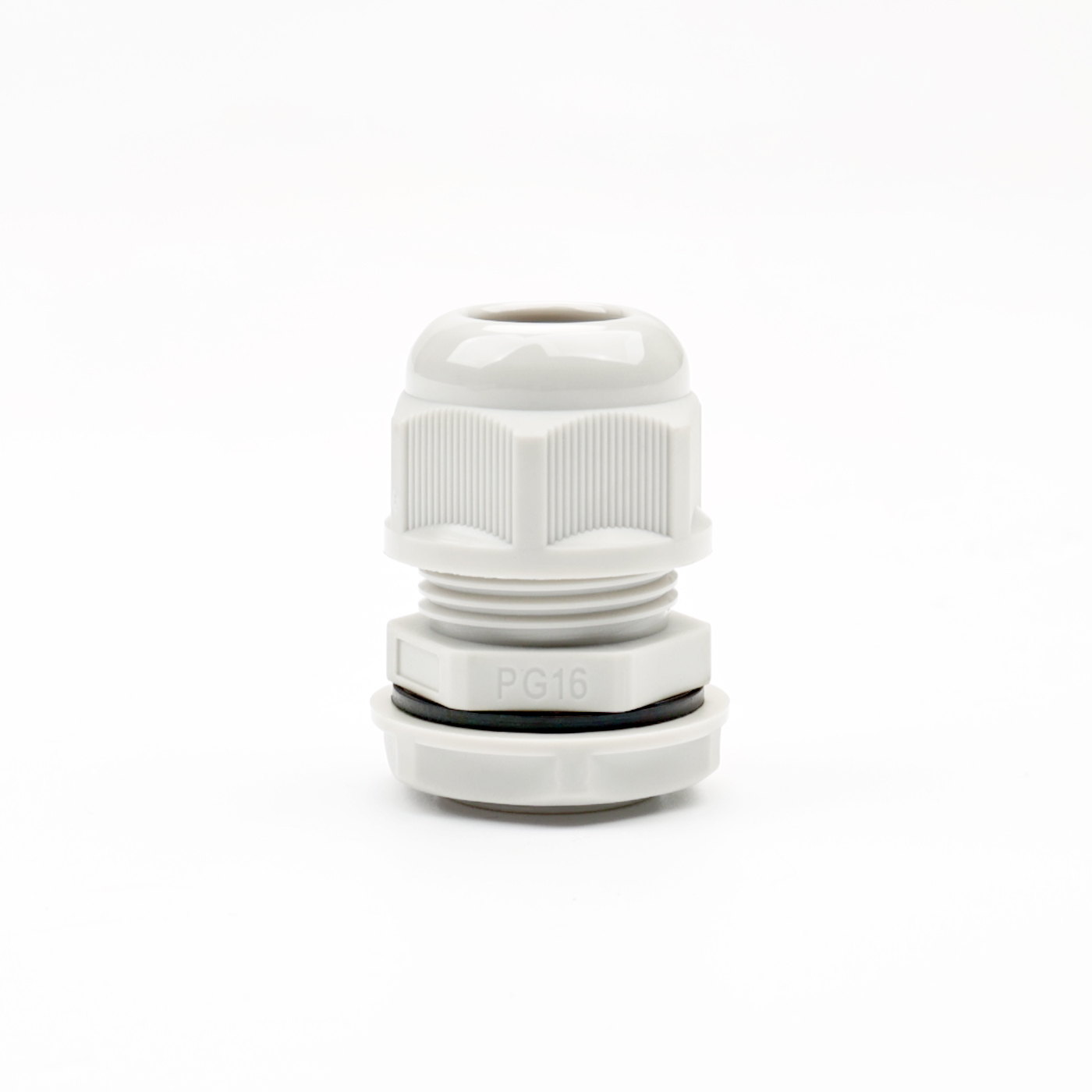
PG example: the PG16 covers the same 8.5–14 mm cable range, but its thread is not compatible with a Metric entry.
Temperature, materials and what IP68 actually requires
Temperature data for these glands is quoted in two regimes, and the distinction matters. In static conditions the range is −40 °C to 100 °C with a peak instantaneous temperature up to 120 °C. In dynamic conditions the range narrows to −20 °C to 80 °C with a peak instantaneous temperature up to 100 °C. A buyer specifying a moving cable against the static figure would overstate the product's capability.
Material-wise, components A, C, E and F are moulded from UL-certified Nylon PA66 selected for strength and anti-ageing performance, while sealing parts B and D use NBR nitrile butadiene rubber for sealing reliability and oil resistance. The gland uses a special clamping claw and rubber sealing structure to deliver a wide clamping range with strong pull-out resistance, and is rated IP68 for waterproof and dustproof protection. IP68 is the benchmark ingress protection rating for waterproof connectors, requiring the device to withstand continuous immersion in water under specified conditions (IEC 60529).
Chemical exposure is a routine consideration on outdoor and industrial sites. These glands are reported as resistant to salt spray, acid, alkali, alcohol, grease and common solvents, which supports their use in harsh working conditions. Certification coverage includes CE, RoHS, REACH, IP68 and CCC, with the Nylon PA66 material UL approved — a combination that matters for European and North American export programmes. Note also that the broader cable gland category is governed by IEC 62444 (and its EN 62444 adoption), which sets construction and performance requirements for cable glands for electrical installations and replaced the older BS EN 50262 reference.
Where these glands are used
The stated scope for both the Metric Series and the PG series covers the new energy sector, industrial automation and advanced manufacturing, construction and infrastructure, and marine engineering and shipbuilding. In project terms, gland selection is normally driven by the enclosure rather than the end industry.
- Solar PV and energy storage. Cable entries into combiner boxes, junction boxes, inverters and storage cabinets, where IP68 entry protection and UV/weathering resistance are typical requirements.
- EV charging infrastructure. Charger enclosure entries and distribution box cable entries, often in outdoor, temperature-variable environments.
- Industrial automation and control cabinets. Cable entry sealing, mechanical fixation and strain relief for reliable electrical connection in fixed installation.
- Rail transit and telecom stations. Electrical cabinet wiring where vibration resistance and stable sealing are relevant.
- Marine and shipbuilding. Salt-spray exposure makes seal material and corrosion behaviour part of the shortlisting criteria.
For DC-side connections specifically, Gutai also supplies Solar MC4 Connectors — a separate product family rated 1000V DC with 30A (2.5 mm², 4 mm², 6 mm²; 14AWG, 12AWG, 10AWG) and 45A (4 mm², 6 mm²; 12AWG, 10AWG) current capacity, IP67 in mated condition, IP2X touch protection in unmated status, and an ambient temperature range of −40 °C to +85 °C (IEC) with an upper temperature limit of +105 °C (IEC). These are quick-connect DC connectors, not threaded glands, and should be shortlisted against a different set of criteria.
What Gutai brings to a threaded-gland shortlist
Zhejiang Gutai Connector Co., Ltd. operates a 5,000 m² facility with 80 employees, a 10-engineer R&D team and an annual output of 10,000,000 units. The company reports an export ratio of 80%, with main markets across the Middle East, Southeast Asia, India, Pakistan, the EU, the United Kingdom and the USA — a market mix that explains why Metric, PG, G and NPT thread options are offered within one product platform. OEM is accepted, and standard product colours are Black (RAL9005), Light Grey (RAL7035) and Silver (RAL7001), with custom colours available upon request.
For a buyer, the relevant point is not the size of the operation but the coverage of the interface matrix. A supplier that can quote M12 through M63 and PG7 through PG48 from one catalogue reduces the number of separate approvals, packaging specifications and incoming inspection routines a purchasing team has to maintain — and reduces the risk that a retrofit order arrives with the wrong thread family.
Market signals for 2026 procurement planning
Three data points are useful when building a business case for standardising a gland range. First, the global cable glands market is currently estimated at approximately USD 2.2 billion, with forecast ranges extending to USD 3.07–4.96 billion by 2034 depending on methodology. Second, the wider waterproof connector market is valued at approximately USD 13.4 billion in 2024 and is projected to reach USD 25.48 billion by 2033 at a CAGR of 7.4%. Third, the solar PV connector segment was valued at USD 1.31 billion in 2024, with MC4 connectors holding a 68% share of that segment (Global Market Insights).
The competitive landscape around these figures is well documented: third-party market research identifies ABB Ltd., Eaton Corporation, Amphenol Corporation, LAPP Group and HUMMEL AG among the leading global competitors in the cable gland and connector sector (Mordor Intelligence; Market Growth Reports). Regional specialists such as Gutai sit in the same category space with a narrower geographic focus and a wider thread-option menu per catalogue. Buyers comparing the two tiers should compare certification coverage, thread and cable-range coverage, and customization lead time — not brand familiarity alone.
Where the threaded-gland approach reaches its limits
A thread-first shortlist solves most interface problems, but four boundaries are worth stating plainly, because they are the points where a technically compliant part still fails in service.
- Thread families are not interchangeable. A PG13.5 gland will not thread into an M20 entry, and vice versa, without a thread adapter. Traditional retrofit practice often keeps the existing entry and inserts an adapter, or reuses a generic gland with a hand-fitted gasket; each added interface is an additional sealing point that must itself be verified. Where a project has a mixed installed base, the more controlled option is to stock both families rather than rely on adapters.
- Thread length bounds wall thickness. With thread lengths of 9–21 mm across both families, enclosures with thick bosses or raised entries may not accept a standard gland, and buyers should confirm this before ordering rather than after.
- The cable range is finite. Both families cover 3–45 mm. Cables outside that band, or highly oval or heavily armoured constructions, fall outside the published range and generally require a different product format or a customized multi-hole solution.
- IP68 is conditional, and temperature ratings are regime-specific. IP68 performance assumes correct assembly and a cable within the specified clamping range; a gland fitted to an out-of-range cable is not a verified IP68 assembly. Likewise, the static rating (−40 °C to 100 °C) should not be applied to dynamic applications, where the working range is −20 °C to 80 °C.
Equally, there are boundaries on the alternative side. Simple grommet entries and open conduit fittings typically provide no defined ingress rating, no strain relief and no published clamping range, which is why they rarely survive an audit on outdoor energy or marine equipment. The trade-off is not between a good and a bad category, but between a defined, documented interface and an undefined one.
Future outlook
Two shifts are likely to shape shortlists over the next few procurement cycles. The first is consolidation around Metric threads in new equipment design, driven by the international framing provided by IEC 62444 and EN 62444, while PG entries persist in the European legacy installed base for as long as that equipment stays in service. Suppliers that maintain both families will continue to serve retrofit demand; buyers who assume PG is disappearing may find themselves sourcing adapters instead.
The second is the rising baseline for ingress protection. With the broader waterproof connector market projected toward USD 25.48 billion by 2033 and MC4 already holding 68% of the solar PV connector segment, accessory specification in energy projects is increasingly written around IP68 glands and IP67-or-better DC connectors as a default requirement rather than an upgrade. For buyers, the practical preparation is a thread-and-cable-range matrix that can be applied to the next project without re-deriving it from scratch — which is exactly what the tables above are intended to provide.
FAQ
What is the difference between a Metric cable gland and a PG cable gland?
The two share the same construction concept: a plastic nylon gland with an NBR seal, IP68 protection, and CE, RoHS, REACH and CCC certification on UL-approved Nylon PA66. The Metric Series is designated by thread sizes M12–M63 with a thread outside diameter of 12–63 mm, while the PG model is designated by thread sizes PG7–PG48 with a thread outside diameter of 12.5–59.3 mm. Both cover cable ranges of 3–45 mm with thread lengths of 9–21 mm. The practical difference is the thread system itself, which determines which enclosure entry the gland will fit.
How do I choose the correct gland size for a given cable?
Start with the measured outer diameter of the cable jacket, then select a size whose published cable range contains that measurement. Published examples in the Metric Series include M12 at 4–8 mm, M16 at 6–10 mm, M20 at 8.5–14 mm, M25 at 12.5–18 mm, M32 at 18–25 mm and M63 at 35–45 mm. PG equivalents by cable range include PG7 at 4–8 mm, PG11 at 6–10 mm, PG16 at 8.5–14 mm, PG25 at 15–21 mm, PG29 at 18–25 mm and PG48 at 35–45 mm. Selecting a size that sits at the extreme edge of its range leaves less tolerance for cable ovality.
Can a PG cable gland be installed in a Metric threaded hole?
No, not without a thread adapter. Metric and PG are separate thread systems with different diameters and pitches, and the size numbers are not equivalent: a PG16 and an M16 are different threads despite similar labelling. A gland is only a direct fit when both the thread system and the size match the enclosure entry. Buyers working with a mixed installed base therefore either stock both families or standardise new equipment on a single system.
What temperature range can these nylon cable glands operate in?
Two regimes are published. Under static conditions the range is −40 °C to 100 °C, with a peak instantaneous temperature up to 120 °C. Under dynamic conditions, where the cable moves, the range narrows to −20 °C to 80 °C, with a peak instantaneous temperature up to 100 °C. Applying the static figure to a moving-cable application would overstate the product's working envelope.
What does IP68 mean for a cable gland, and does it depend on installation?
IP68 is the benchmark ingress protection rating for waterproof connectors and requires the device to withstand continuous immersion in water under specified conditions, as defined in IEC 60529. In practice, achieving that rating depends on correct assembly and on the cable diameter falling within the specified clamping range for the selected size. A gland installed on a cable outside its published range should not be treated as a verified IP68 assembly.
Which industries and applications typically use waterproof cable glands?
The stated application scope covers the new energy sector, industrial automation and advanced manufacturing, construction and infrastructure, and marine engineering and shipbuilding. Typical matched equipment includes combiner boxes and junction boxes, inverters, storage cabinets, EV charger enclosures, rail transit electrical cabinets, industrial control cabinets, and conduit or corrugated tubing systems. The common function across all of them is cable entry sealing, water and dust protection, mechanical fixation and strain relief.
Are solar MC4 connectors part of the same selection decision as cable glands?
They are a separate product family and are shortlisted against different criteria. Solar MC4 Connectors are rated 1000V DC with 30A and 45A current options, 6 kV test voltage, IP67 in mated condition, IP2X touch protection when unmated, a contact resistance of 0.5 mΩ, and an ambient temperature range of −40 °C to +85 °C under IEC with a +105 °C upper limit. They use a snap-in locking system and are used for DC connections in photovoltaic, energy storage, EV and industrial DC power systems rather than for threaded enclosure entries.
Reference material: the manufacturer's product brochure covering cable glands, waterproof box and connector series is available for download at Gutai product catalogue (PDF).