
Shortlist Picks: Top Bakery Packing Choices from the HB-16OZ to HB-75-28 Series
A bakery packaging shortlist is only useful when it can be defended with dimensions, material behaviour and compliance evidence. For cakes, sweets, salads and takeaway bakery, four formats from the Chuan He range carry most specifications: the HB-16OZ, HB-8OZ and HB-20 OZ tamper-evident PET containers, and the HB-75-28 (PP) tray. Each covers a different portion size, temperature profile and closure expectation, which is why they belong on the same decision list rather than competing for a single slot.
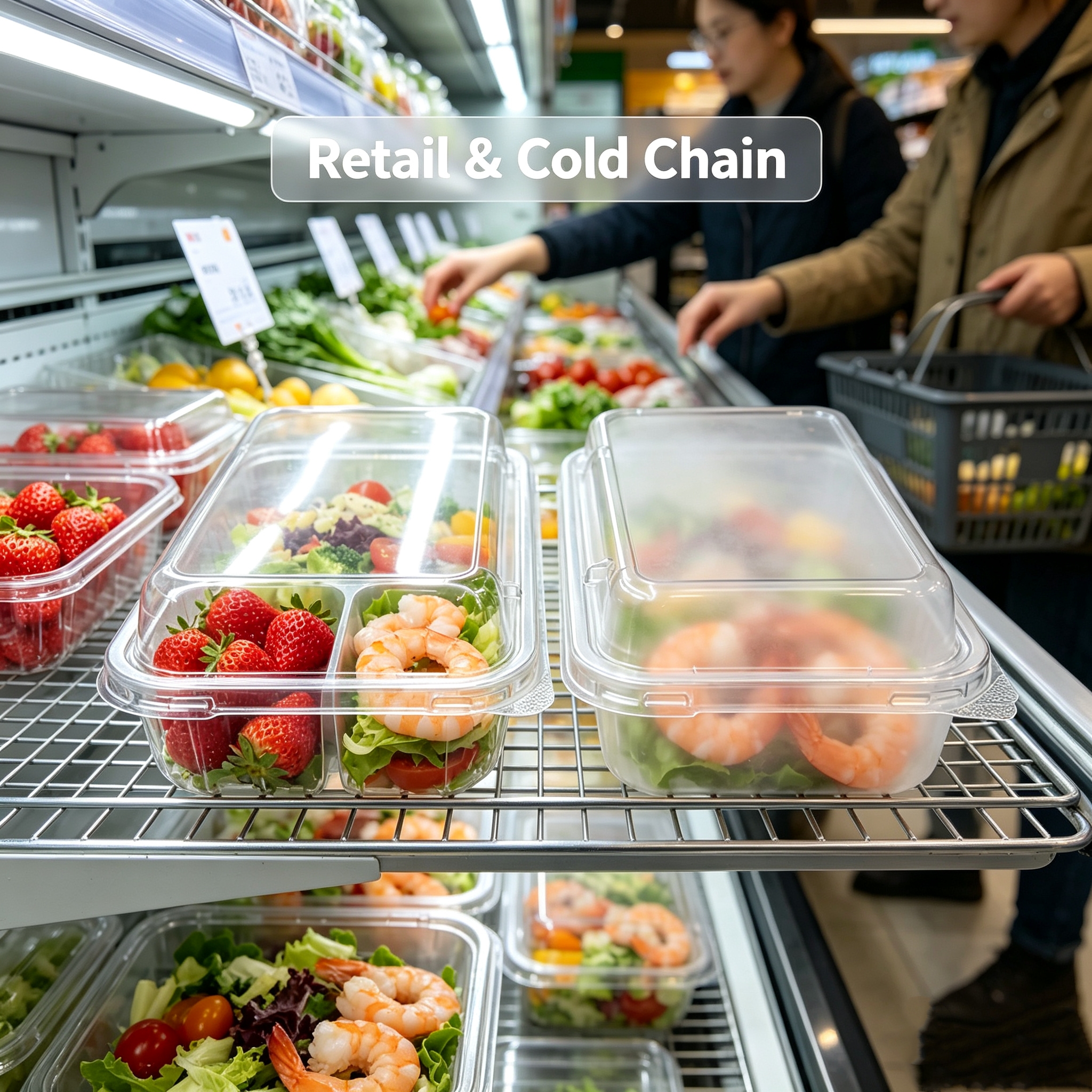
High-clarity bakery containers are specified primarily for shelf visibility, portion control and delivery integrity.
Why Bakery Packaging Decisions Stall at the Shortlist Stage
A bakery packaging shortlist is a commercial filter, not a catalogue. Buyers at the decision stage are usually weighing three to eight container formats that all look acceptable on paper, then narrowing them by portion volume, temperature exposure, closure behaviour and delivered cost per unit.
The failure pattern is consistent. A clear container is selected for transparency, then fails on drop performance in e-commerce fulfilment, fogs up inside a chilled display, or turns out to have a locking tab that cannot be reopened once closed. Each of those outcomes is traceable to the format decision, not to the price comparison. Fixing them after a trial order is far more expensive than screening them out beforehand.
Bakery ranges make screening harder because a single product line spans very different items: iced cakes, individual sweets, mochi donuts, cookies, savoury pastries, salads and ready-to-eat portions. A shortlist that assigns one container per product family is easier to justify to a buying committee than a single “universal” box that is technically compatible with everything and commercially ideal for nothing.
Who Makes These Formats: Chuan He at a Glance
Weifang Chuanhe New Material Co., Ltd. (CHUAN HE) is a China-based manufacturer of PET and PP thermoformed packaging containers, founded in 2013 and operating a 62,000 m² facility in Weifang, Shandong Province, adjacent to Qingdao Port. The company exports 100% of its output to North America, Europe, Australia, Southeast Asia, the Middle East and Latin America, with annual output of 54,000 tons.
Production structure matters at the shortlist stage because it determines whether a chosen format can be repeated at volume and at a stable specification. The facility runs 20 fully automatic thermoforming machines and 20 standard thermoforming machines, including four Kiefel machines imported from Germany, supported by four PET sheet extrusion lines, two PP sheet extrusion lines and an in-house mold workshop. The company holds CE, BRC, FDA, EU and SGS quality management system certifications.
In-house sheet extrusion and mold development change the practical question for a buyer. Instead of asking whether a supplier can source a mould, the buyer asks whether the container geometry already exists, whether the sheet specification is controlled internally, and whether a custom variant can be tooled without a second supply chain.
The Shortlist at a Glance
The four formats below cover the majority of bakery specifications. They are ordered by intended portion size, not by superiority — each entry answers a different buying question.
| Pick | Format | Material & closure | Dimension reference | Best-fit bakery products |
|---|---|---|---|---|
| HB-16OZ | Tamper-evident PET container | Food-grade PET, BPA-free, snap-lock tamper-evident closure | Compact series footprint quoted at 14 × 11.6 × 6.2 cm overall | Cream slices, iced sponge, éclairs, mochi donuts, mid-size dessert portions |
| HB-8OZ | Tamper-evident PET container | Food-grade PET, BPA-free, snap-lock tamper-evident closure | Compact single-portion format; confirm exact value per SKU | Macarons, cookies, individual sweets, single pastry |
| HB-20 OZ | Tamper-evident PET container | Food-grade PET, BPA-free, tamper-evident locking design | Documented at 17.2 × 15.5 × 6.2 cm overall | Larger cakes, entremets, salad portions, takeaway ready meals |
| HB-75-28 (PP) | Thermoformed tray | Polypropylene (PP), stackable tray body | Cavity layout and outer dimension confirmed per SKU | MAP and laminated trays, savoury bakery, ready meals, chilled and frozen distribution |
Dimension discipline: within a thermoformed series, cavity layout, wall thickness and lid geometry can vary between SKUs. Buyers should treat published dimensions as the starting reference and confirm the final value on the approved specification sheet before tooling artwork or planning pallet configuration.
Pick 1 — HB-16OZ Tamper-Evident PET Container
The HB-16OZ is the mid-size workhorse of this shortlist. It is a PET tamper-evident container with clear visibility of contents, positioned at the portion size that fits most bakery counters: a cream slice, an iced sponge wedge, a filled éclair or a two-piece dessert portion.
Its commercial argument is the closure. Compared with packaging that has no tamper-evident locking design, this format is intended for one-time opening. Once the container is closed, any subsequent opening produces irreversible damage, so a customer, courier or store receiver can see immediately whether the pack was opened after sealing. That converts a trust question into a visual check, which shortens handover inspection at delivery points.
The format suits ambient display and chilled distribution. It is not the right choice where a product must be reheated in a high-temperature microwave — that requirement points toward polypropylene, covered later in this shortlist.
Pick 2 — HB-8OZ Tamper-Evident PET Container
The HB-8OZ addresses the fastest-growing packaging question in bakery: portion control. Individual sweets, macarons, cookies and single pastries are bought as single units, and an oversized container wastes material, shelf space and freight volume while making a small product look lost.
The HB-8OZ keeps the same PET tamper-evident architecture as the HB-16OZ, so the sealing check, the visual clarity and the handling motion are identical on the packing line. That consistency is an operational benefit, not a marketing one: staff learn one closing action, and the packing line does not need a second set of sealing stations for small-format items.
For buyers standardising a multi-SKU bakery range, the HB-8OZ and HB-16OZ pairing is the most economical shortlist core, because it covers single-portion and mid-portion sizes with a shared closure logic.
Pick 3 — HB-20 OZ Tamper-Evident PET Container
The HB-20 OZ moves into full-portion territory. The tamper-evident PET container format is documented at 17.2 × 15.5 × 6.2 cm overall, which places it with larger cakes, entremets, layered desserts, salad portions and takeaway ready meals.
This is the point in the shortlist where sealing performance becomes measurable rather than aesthetic. Containers in this class are specified with a leak-proof seal once closed, blocking air and moisture ingress. Reported performance puts sealing tightness 32% higher than alternatives, with a corresponding 26% reduction in food spoilage rate — a figure that matters most for moist products such as cream cakes, dressed salads and seafood-adjacent lines.
The HB-20 OZ is also the natural bridge into salad programmes. Chuan He's PPWR certification covers the HB5224 salad container and the HB7047 salad container for the EU market, which gives buyers a compliance route for savoury items sold alongside sweet bakery from the same counter.
Pick 4 — HB-75-28 (PP) Tray
The HB-75-28 (PP) tray is the shortlist's different shape of answer. A tray is not a clamshell: it presents the product flat, accepts a lidding film or lid, and is built for modified atmosphere packaging, lamination and stacked logistics rather than for a hinged retail lid.
Polypropylene is the reason it is here. FDA 21 CFR 177.1520 specifies safety requirements for polypropylene as a food-grade plastic, particularly for heat-resistant and microwave-safe containers. That makes a PP tray the format of choice when the bakery item is sold warm, reheated by the consumer, or packed on a line that laminates film under temperature.
The range of PP trays also reaches beyond sweet bakery. Chuan He's PPWR test report, issued by TÜV Rheinland, covers the HB-MG40 OZ tray and the HB-32 OZ tamper-evident packaging, and the report number is 178251114a 001, valid from 2026-08-14 to 2030-08-14. Buyers sourcing savoury bakery alongside meat or seafood lines can therefore keep one tray platform in the specification.
The Selection Criteria Behind This Shortlist
A shortlist is only as strong as the criteria used to build it. Six criteria separate these four formats in practice:
- Portion volume and product height. Match the container to the tallest realistic build, not the average. Cream decoration and layered desserts change the required headspace.
- Closure function. Tamper evidence is a delivery-integrity requirement; a laminated or lidded tray is a preservation requirement; a plain tray is a display requirement.
- Temperature range. Formats in this shortlist are engineered to resist a range from -18℃ to 120℃, with heat deformation rate reduced by 38% and low-temperature cracking rate reduced by 32% versus untreated alternatives.
- Visibility in the display case. Anti-fog treatment raises visibility retention rate by 40% and maintains a clear appearance in 0~8℃ cold storage, which is the condition where untreated PET fogs fastest.
- Logistics behaviour. Stackable design and lightweight construction reduce warehouse footprint and freight cost, and a drop breakage rate reduced by 35% cuts repacking labour in e-commerce fulfilment.
- Documentation. Food-contact compliance, migration testing and PPWR evidence are procurement deliverables, not marketing attachments.
What the Technical Differences Actually Change
Material choice decides which of these four formats survives contact with a real bakery operation.
PET is used for the HB-16OZ, HB-8OZ and HB-20 OZ. It is a food-grade, BPA-free material that delivers high transparency, which is the entire display argument for a cream cake or a layered dessert. Its behaviour is strongest where visibility, impact resistance and a tamper-evident closure are the priority.
PP is used for the HB-75-28 tray. Its behaviour is strongest where heat resistance, microwave safety and lidding compatibility are the priority. A buyer who chooses PET purely on price for a hot-filled application will discover the limit later, and vice versa.
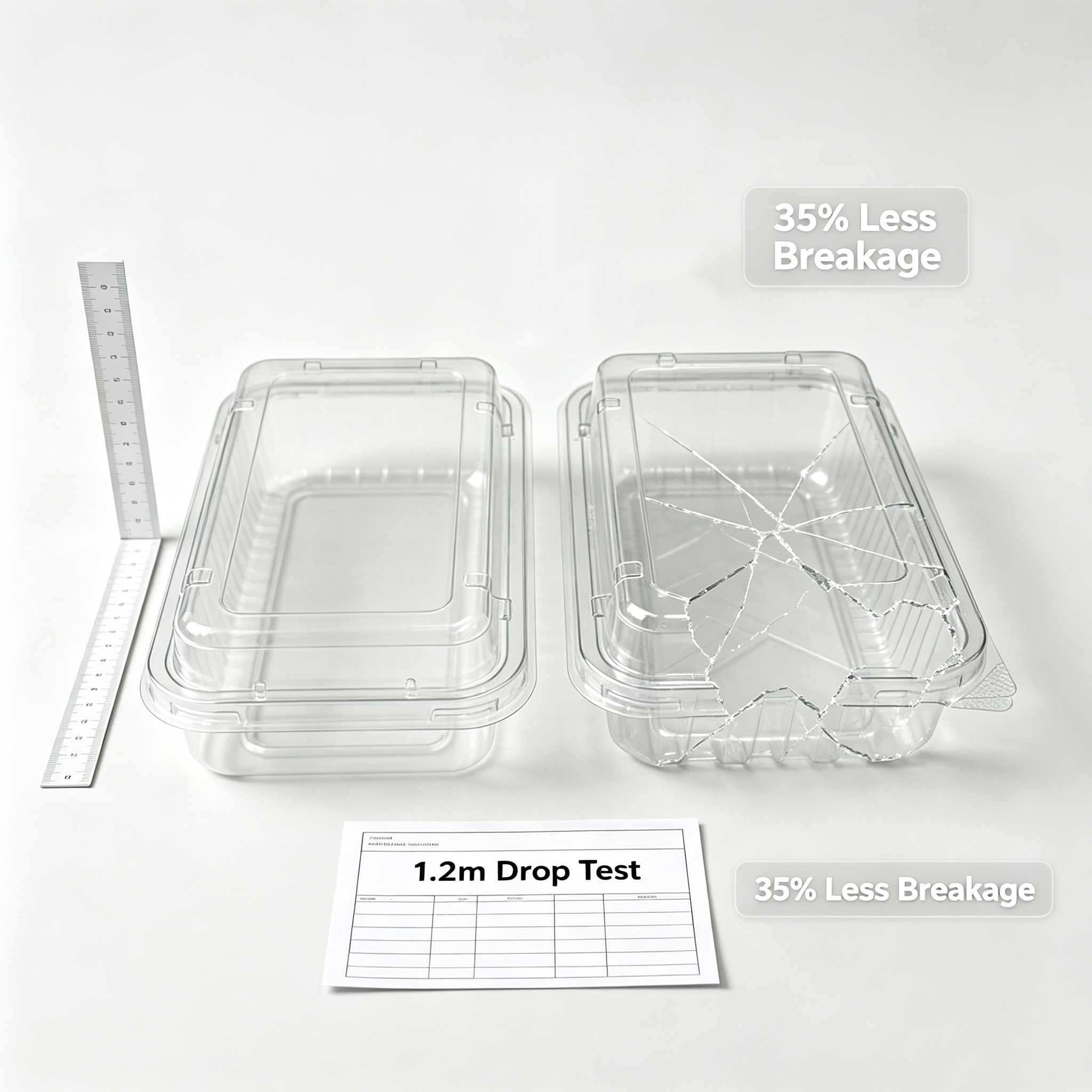
Reinforced structures in this range are tested for a 1.2 m vertical drop without rupture.
Structural reinforcement is the second variable. Compared with ordinary thin-wall PET blister packaging, these containers use a thickened reinforced structure designed not to crack under impact. The reported result is 30% higher impact resistance and a 35% reduction in drop breakage rate, and the container can withstand a 1.2 m vertical drop without rupture. For a bakery shipping direct to consumer, that single figure often decides the format more than transparency does.
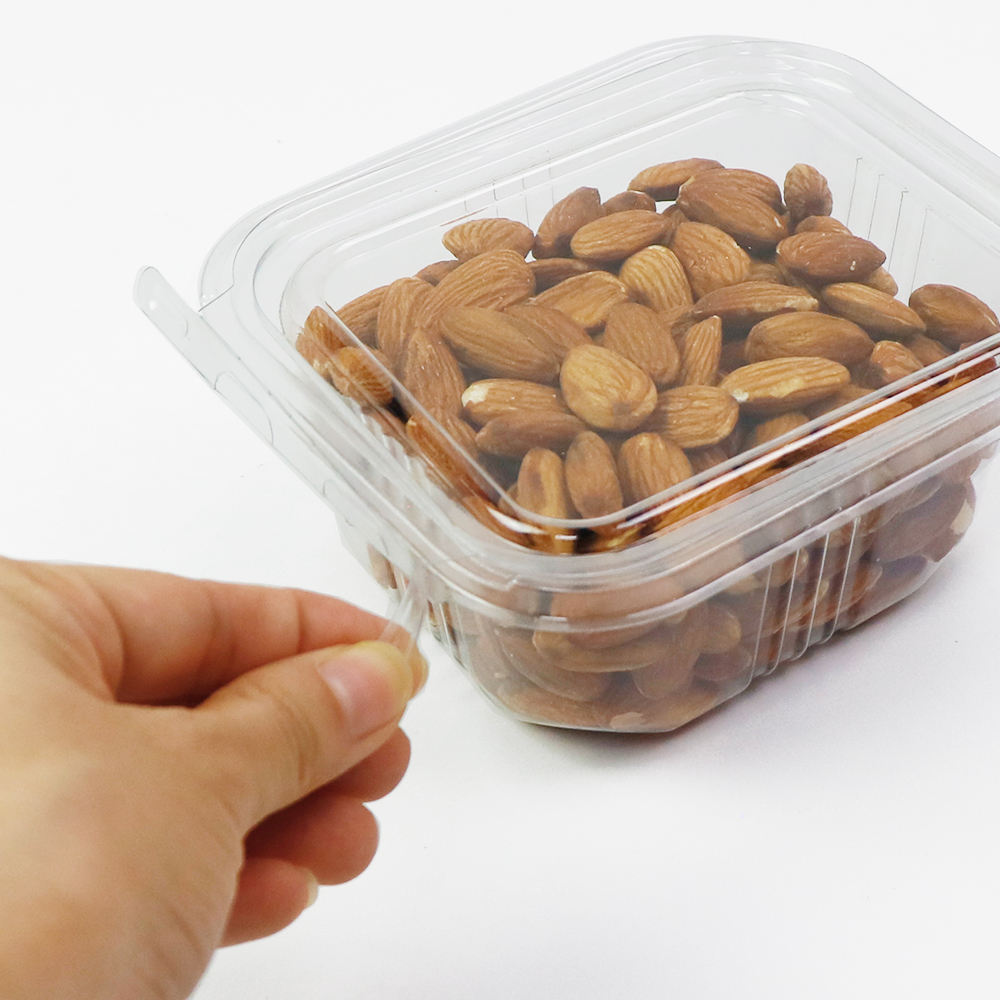
Snap-lock closures in this range combine a dustproof seal with full product visibility.
Temperature behaviour completes the picture. The range maintains stable performance under both freezing and heating conditions with less deformation and cracking, and stable hardness after temperature changes means fewer broken boxes between the freezer and the display case.
Application Fit: Cakes, Sweets and Salads
The shortlist resolves cleanly once products are grouped by how they are sold.
Cakes and entremets. The HB-20 OZ is the default, with the documented 17.2 × 15.5 × 6.2 cm overall footprint supporting larger builds and a leak-proof seal protecting moist layers. The HB-16OZ covers sliced and single-wedge formats.
Sweets, cookies and small pastry. The HB-8OZ and HB-16OZ pair covers single-portion retail and gift-style presentation, with the tamper-evident closure providing the delivery guarantee that online sweet orders depend on.
Salads and savoury bakery. The HB-20 OZ handles dressed salad portions and takeaway ready meals, while the HB5224 and HB7047 salad containers carry PPWR certification for the EU market. The HB-75-28 (PP) tray serves MAP and laminated formats where lidding film and microwave reheating are part of the specification.
Chilled and frozen distribution. Anti-fog treatment keeps contents readable in 0~8℃ cold storage, and the wider temperature tolerance supports freezer-to-display movement without a material switch.
Market Signals Behind the Shortlist
The format mix in this shortlist is not arbitrary; it reflects where the wider packaging market is moving.
The global food packaging market was valued at USD 421.6 billion in 2025 and is projected to reach USD 599.0 billion by 2033, according to Grand View Research. Asia Pacific dominated that market in 2025 with a 40.0% revenue share, driven by urbanisation and online food delivery — the same two forces that push bakery packaging toward tamper-evident, delivery-ready formats.
Within rigid formats, the global thermoform packaging market was valued at USD 54.7 billion in 2025, with PET holding the largest material share at 44.8%. That concentration explains why the three container picks here are PET-based and why the tray exception exists: PP still dominates where heat and lidding requirements override transparency.
The tamper-evident segment specifically is projected to grow from USD 2.56 billion in 2025 to USD 4.26 billion by 2030, a CAGR of 10.72%, according to Mordor Intelligence. On the supply side, China exported USD 1.28 billion in baked goods in 2024, according to the Observatory of Economic Complexity — volume that requires primary packaging matched to the same export routes.
The competitive landscape includes large multinational converters such as Amcor Plc, Berry Global Inc., Sealed Air Corporation and Mondi Group, alongside regional thermoformers. Buyers comparing across that field should note that scale, tooling responsiveness and short-run flexibility do not always sit in the same supplier.
Limits and Trade-offs Buyers Should Accept
A shortlist that only lists advantages is not a decision tool. Four trade-offs apply here.
Tamper evidence is a one-way function. Once the locking tab is opened, it cannot be restored to its original closed state. That is the point of the design, but it also means a tamper-evident container cannot be resealed for a consumer who wants to store part of the product, and it cannot be reused after a return or mis-pick.
Cost is higher than entry-level containers. Food-grade construction carries a reported price about 5% above low-grade containers, which is typical for food-grade packaging, while reducing overall loss expense. Anti-fog treatment adds a further minor increase in raw material cost. Buyers working to the lowest possible unit price should evaluate that premium against breakage, spoilage and return rates rather than against the container price alone.
PET is not the answer for high-heat applications. Where a product is reheated in a microwave at high temperature, the PP route governed by FDA 21 CFR 177.1520 is the appropriate specification. Forcing PET into that use case creates a compliance and performance problem rather than a cost saving.
Trays require a separate lidding decision. The HB-75-28 (PP) tray is a tray, so film or lid selection, sealing equipment and gas-flush parameters become part of the procurement scope. That is extra engineering work compared with a hinged clamshell, and it should be resourced before the format is approved.
Compliance and Evidence Checklist Before Ordering
For a decision-stage shortlist, evidence is part of the product. The following items are verifiable for this range:
- 100% compliance with FDA food contact requirements for the containers in this shortlist.
- EU Regulation 2024/3190, effective January 2025, prohibits Bisphenol A (BPA) in food contact plastics, coatings and inks, with transition periods for compliance — relevant to any EU-bound bakery packaging specification.
- FDA 21 CFR 177.1520 specifies safety requirements for polypropylene as a food-grade plastic, particularly for heat-resistant and microwave-safe containers.
- PPWR Product Test Report issued by TÜV Rheinland, report number 178251114a 001, valid from 2026-08-14 to 2030-08-14, covering the HB-MG40 OZ tray and the HB-32 OZ tamper-evident packaging.
- PPWR certification covering the HB5224 salad container and the HB7047 salad container for the EU market.
- Manufacturer-level quality management certification: CE, BRC, FDA, EU and SGS.
The manufacturer's control measures addressing chemical migration, sharp fragments, microbial contamination and unqualified raw materials include food-grade raw material sourcing, migration and physical testing, clean production environments, online quality inspection and finished-product sampling tests, with batch traceability and long-term archiving of compliance records.
Future Outlook
Three developments are likely to shape bakery packaging shortlists over the next procurement cycles.
First, the EU BPA restriction under Regulation 2024/3190 raises the documentation bar for food contact plastics, coatings and inks. Suppliers who can produce third-party test reports and declarations of conformity on request will hold an advantage in EU tenders, while buyers will increasingly treat compliance files as a shortlisting gate rather than a post-award task.
Second, tamper evidence is moving from premium to standard for delivery-based bakery sales. A segment growing at 10.72% CAGR to USD 4.26 billion by 2030 reflects a structural shift in how food is handed over, not a single-season trend.
Third, format consolidation will continue. As PET holds 44.8% of the thermoform packaging material mix, buyers benefit from standardising around a small number of PET container sizes with a shared closure logic, while reserving PP for the heat-resistant tray applications where it is genuinely required. That combination — three tamper-evident PET containers and one PP tray — is exactly the structure of this shortlist.
FAQ
How do I choose between the HB-8OZ, HB-16OZ and HB-20 OZ for a bakery range?
The three formats differ mainly by portion volume. The HB-8OZ is a compact single-portion container suited to macarons, cookies, individual sweets and single pastry. The HB-16OZ is the mid-size option, quoted at a compact series footprint of 14 × 11.6 × 6.2 cm overall, suited to cream slices, iced sponge and éclairs. The HB-20 OZ is the larger container, documented at 17.2 × 15.5 × 6.2 cm overall, suited to larger cakes, entremets, salad portions and takeaway ready meals. All three use food-grade PET with clear visibility and a tamper-evident closure.
Should a bakery buyer choose a PET tamper-evident container or a PP tray?
The choice follows the application rather than a general preference. PET tamper-evident containers are specified where transparency, delivery integrity and cold-chain handling are the priorities. PP trays such as the HB-75-28 (PP) are specified where heat resistance, microwave safety and lidding-film compatibility are the priorities; FDA 21 CFR 177.1520 covers polypropylene as a food-grade plastic for heat-resistant and microwave-safe containers. Trays are also the appropriate base for modified atmosphere packaging and laminated formats, while hinged PET containers simplify packing lines because no separate lidding step is required.
What are the main limitations of a tamper-evident locking design?
The locking tab is a single-use function. Once the container is opened, the tab cannot be restored to its original closed state, so the package cannot be resealed for partial storage and cannot be reused after a return or mis-pick. Food-grade construction also carries a reported price about 5% above low-grade containers, which is typical for food-grade packaging, and anti-fog treatment adds a minor raw material cost increase. These trade-offs are normally offset by lower breakage, reduced spoilage and fewer tampering-related returns, but they should be evaluated explicitly rather than assumed.
What compliance evidence should be confirmed before finalising a bakery packaging shortlist?
Buyers should confirm food contact compliance documentation rather than relying on material claims alone. For this range, the containers are 100% compliant with FDA food contact requirements, and the manufacturer holds CE, BRC, FDA, EU and SGS quality management certifications. For EU-bound products, EU Regulation 2024/3190, effective January 2025, prohibits Bisphenol A in food contact plastics, coatings and inks, with transition periods. A PPWR Product Test Report issued by TÜV Rheinland, report number 178251114a 001, valid from 2026-08-14 to 2030-08-14, covers the HB-MG40 OZ tray and the HB-32 OZ tamper-evident packaging, and PPWR certification covers the HB5224 and HB7047 salad containers.
Does this shortlist work for frozen and chilled bakery distribution?
Yes, within the documented range. Formats in this shortlist are engineered to resist temperatures from -18℃ to 120℃, with heat deformation rate reduced by 38% and low-temperature cracking rate reduced by 32% compared with blister packaging that has not received low-temperature and heat-resistant treatment. Anti-fog coating raises visibility retention rate by 40% and maintains a clear appearance in 0~8℃ cold storage, so contents remain readable in a chilled display case. Stable hardness after temperature changes also reduces broken boxes during frozen-to-display movement.
Documentation and Next Step
Dimension values, cavity layouts and material specifications should be confirmed against the approved SKU sheet before artwork or pallet planning is finalised. The full product range, including PET and PP thermoformed containers for bakery, produce and frozen food applications, is documented in the Chuan He product brochure, with further technical detail available at newplasticbox.com.