
Shortlist of High-Torque Pancake and Hub Motors for Compact OEM Drive Systems
Compact OEM drive systems are usually constrained by packaging before they are constrained by power. In a hospital transport bed, a floor scrubber or an attendant-controlled chair, the space available for the drive is set by the frame, the deck height or the wheel well long before a motor is chosen. The engineering question is therefore rarely which motor is the strongest in isolation; it is which motor delivers the required torque inside an envelope the product already has.
This shortlist answers that question with three production motors taken from one supplier's existing catalogue: the 150SN-G2 pancake motor with gearbox (36 V, 500 W, 22 Nm, 151 mm diameter), the 1DY-E5S 8-inch brushless hub motor (20 Nm with an integrated electromagnetic brake), and the 6DY-A brushed hub motor (24 V, 40 Nm) for heavy-duty universal wheel applications. Each represents a different resolution of the same trade-off between torque, installed size and maintenance access.
Wuxi Speedup Power Co.,Ltd is a DC motor manufacturer based in Wuxi, Jiangsu Province, China, founded in 2018, producing pancake (printed armature) motors, BLDC motors and wheel hub motors for industrial and mobility equipment. Company information cites a 10,000 m² facility, 30 employees and a three-engineer R&D team, with roughly 90% of output exported to EU and USA markets.
Quick reference: the three shortlisted drives
The table condenses the published specifications that matter most during a space-constrained design review. Cells marked with a dash are not stated in the available product information and should be confirmed against a datasheet before release to production.
| Model | Architecture | Voltage | Power | Rated torque | Key dimension | Brake |
|---|---|---|---|---|---|---|
| 150SN-G2 | Pancake (printed armature) motor with gearbox | 36 V | 500 W | 22 Nm | 151 mm diameter | — |
| 1DY-E5S | Brushless DC wheel hub, 8-inch | 36 V (24 V / 48 V customizable) | 300 W | 20 Nm | 200 mm solid tire, 1:20 gear ratio | Electromagnetic |
| 6DY-A | Brushed wheel hub | 24 V | — | 40 Nm | — | — |
The selection problem: torque per millimetre, not torque in theory
Most compact drive programmes do not fail because the motor cannot produce enough torque on a test bench. They fail because the motor that produces that torque does not fit, needs a belt or chain that the frame cannot accommodate, or requires service access the product cannot provide. Three constraints usually decide the outcome:
- Axial height and diameter. A pancake motor with a printed armature keeps the axial build short; a hub motor removes the transmission entirely by occupying the wheel itself. Both are space strategies, not just performance strategies.
- Transmission architecture. A gearbox multiplies motor torque into the load, at the cost of an additional mechanical interface and its upkeep. An integrated hub with a gear ratio performs the same multiplication inside the wheel.
- Maintenance model. Brushless designs remove carbon brush replacement from the service schedule; brushed designs keep it. For equipment with a defined service interval and accessible wheels, that may be acceptable; for sealed or hard-to-reach assemblies, it is a design constraint.
A fourth constraint applies to any motor integrated into a wheel or driven structure: heat and mechanical security. Long heavy-load or uphill operation raises coil and hub temperature, so integrated temperature sensing and a controller load limit belong in the specification rather than in the service manual. Vibration can loosen wheel fasteners over time, and repeated flexing can abrade cabling if the harness is not specified for movement. These are integration issues, but they are decided at the motor selection stage.
The three shortlisted options in detail
150SN-G2 — pancake motor with gearbox, 36 V / 500 W / 22 Nm
The 150SN-G2 is the shortlist entry for designs that need substantial torque but cannot give up vertical space. It combines a pancake (printed armature) motor with a gearbox and is rated at 36 V, 500 W and 22 Nm. Its 151 mm diameter is the reference dimension for packaging calculations: frame rails, mounting plates and belt or coupling clearances should be laid out from that figure before other geometry is fixed.
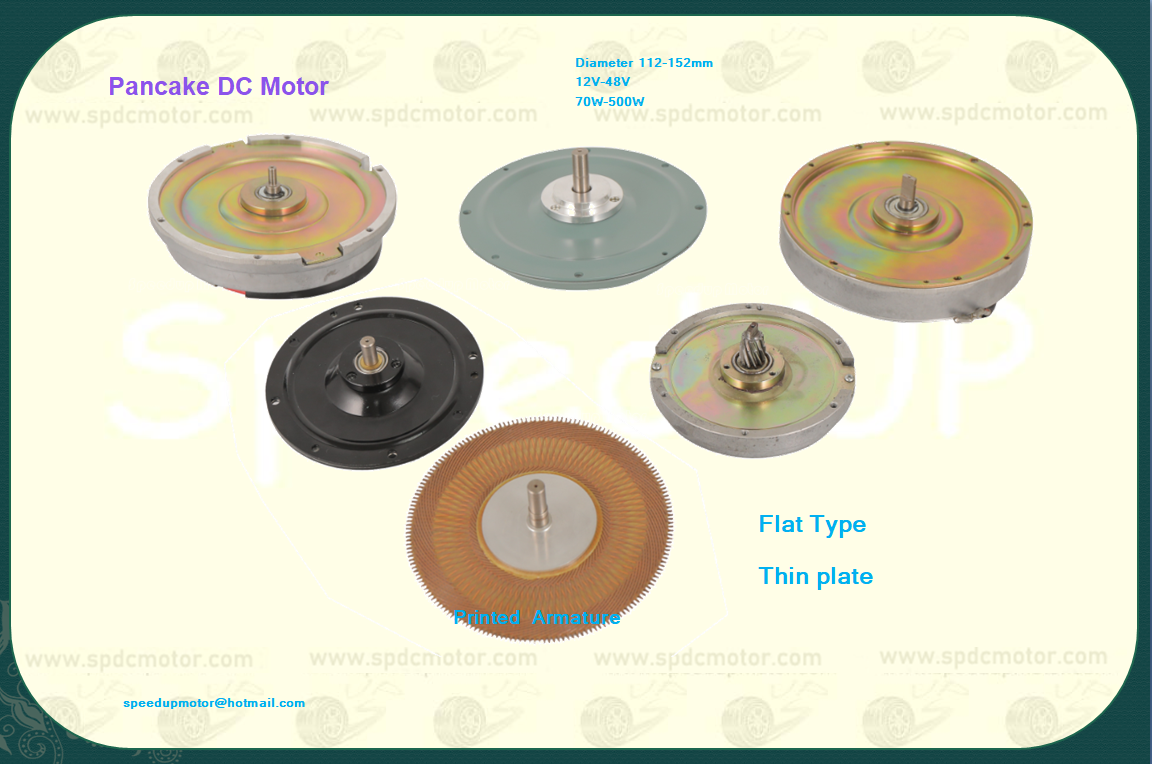
Wuxi Speedup Power describes its pancake motors as using a slotless disc armature design that differs from conventional DC servomotors — the design decision behind the flat profile. In practice this format suits equipment where the motor sits under a deck, inside a narrow chassis, or directly on a driven shaft: floor cleaning machines, polishers, and compact industrial assemblies. The gearbox adds torque multiplication at the output, so the buyer's selection work shifts to the gear ratio and the duty cycle rather than to the bare motor curve.
1DY-E5S — 8-inch brushless hub with electromagnetic brake, 20 Nm
The 1DY-E5S is a brushless DC wheel hub motor built on an 8-inch format with a 200 mm solid tire. Published specifications give 36 V, 300 W, 150 rpm, 20 Nm rated torque, a 1:20 gear ratio and an integrated electromagnetic brake; the model can be customized for 24 V or 48 V operation. Because the drive sits inside the wheel, the design eliminates the external transmission that a chassis-mounted motor would require.
The electromagnetic brake is the differentiating element for this entry. In safety-critical mobility applications — attendant-controlled chairs, transport units, repositioning equipment — the drive must hold position when power is removed or when the operator stops on a slope. Specifying the brake as part of the motor rather than as a separate caliper assembly simplifies the mechanical package and keeps braking inside the same qualification envelope as the drive.
6DY-A — brushed hub, 24 V / 40 Nm, heavy-duty universal wheels
The 6DY-A is the torque leader of the three at 40 Nm, rated at 24 V in a brushed hub format intended for heavy-duty universal wheel applications. Universal (castor-style) wheels carry high radial loads and are frequently used on carts, trolleys and transport equipment where slow, controlled movement under load matters more than speed.
The brushed architecture is a deliberate trade. It keeps the drive simple and delivers high torque at low speed, but carbon brushes are a wear item and their replacement belongs in the maintenance plan. Where the wheel is accessible and the service interval is defined, that is a manageable cost; where the drive is sealed into a platform that cannot easily be opened, a brushless alternative should be evaluated instead.
Technical explanation: how each architecture converts torque into motion
Rated torque is a motor-side figure. What the machine actually experiences is tractive force at the wheel or linear force at the driven element, and that value depends on the transmission ratio and the effective radius of the output. At a fixed wheel diameter, increasing motor torque increases the force available to move the load; increasing the wheel diameter reduces that force for the same torque. This is why a 20 Nm hub on a 200 mm wheel and a 22 Nm geared pancake driving a smaller roller cannot be compared on torque alone.
The pancake motor changes the geometry of the problem. A printed armature with a slotless disc design produces a flat, large-diameter rotor instead of a long, small-diameter one, so the motor's axial length shrinks while its diameter grows. For equipment where height is the binding constraint and footprint is available, that is the efficient trade. Adding a gearbox then recovers the output torque that the flat form factor gives up.
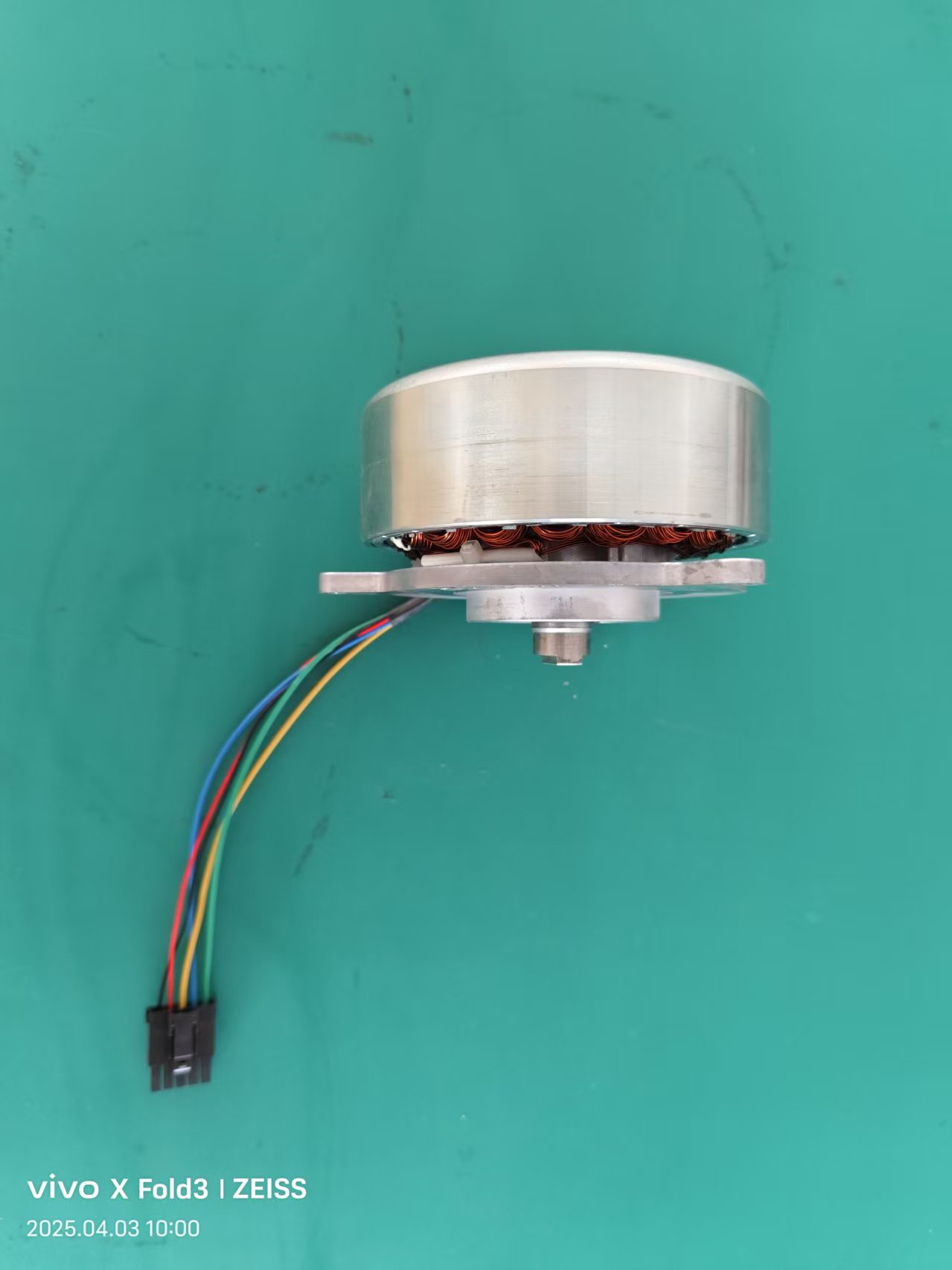
The hub motor changes the problem differently. By placing the rotor in the wheel, it removes belts, chains and separate bearing blocks from the design, which reduces part count and eliminates an alignment task in assembly. The cost is that the motor now lives in the wheel, where heat has fewer paths to escape and where shock loads from the floor arrive directly at the motor structure. That is why hub specifications for mobility equipment typically pair a gear ratio — 1:20 on the 1DY-E5S — with a defined load and duty profile rather than a peak torque figure alone.
The brushed hub keeps the mechanical simplicity of the hub format but accepts a different electrical cost. Brush and commutator contact simplifies the drive electronics, which is attractive for cost-sensitive, high-torque, low-speed duties such as universal wheels. The trade is scheduled maintenance and a slower speed ceiling relative to brushless designs.
Application fit: which shortlisted motor belongs where
The company lists medical equipment, cleaning machinery, electric mobility and industrial machinery among its application areas, alongside wheel hub and wheelchair motors. Mapping the three models onto those areas produces a practical decision rule:
| Application pattern | Recommended shortlist entry | Reason |
|---|---|---|
| Drive mounted under a deck or inside a narrow chassis, high torque required | 150SN-G2 | Flat printed armature profile plus gearbox torque multiplication; 151 mm diameter for packaging |
| Wheel-driven mobility where the unit must hold position when stopped | 1DY-E5S | Integrated electromagnetic brake with 20 Nm rated torque and 1:20 gear ratio |
| Heavy-duty universal wheel or castor-driven cart at low speed under load | 6DY-A | Highest rated torque in the shortlist at 40 Nm on 24 V; brushed maintenance to be planned |
For cleaning machinery and polishing equipment, the pancake format's low height is generally the deciding factor, because the drive sits below a deck that also carries the battery and tank assembly. For patient transport beds and repositioning equipment, a hub drive with an electromagnetic brake removes a separate braking mechanism from the frame design. For carts and universal-wheel platforms, the 40 Nm brushed hub covers the low-speed, high-load end of the range where electronics simplicity matters more than service-free operation.
Verification and procurement checks before release to production
A shortlist is a starting point, not a qualification. Buyers moving from shortlist to production should close four categories of check:
- Dimensional and mounting confirmation. Verify the diameter and mounting interface of the 150SN-G2 against the actual chassis model, and confirm the tire and hub interface on the 1DY-E5S for the intended frame.
- Duty and thermal review. Confirm continuous versus intermittent load, expected gradient, and ambient conditions. Where a hub drive is used, specify a temperature sensor or thermal cut-off inside the motor and keep the shell's heat dissipation surface unobstructed.
- Electrical and cable security. Specify vibration-resistant flexible cable, sealed and reliably grounded terminals, and controller overcurrent, short-circuit and overvoltage protection. Avoid repeated emergency braking where regenerative overvoltage could stress drive components.
- Acceptance and commercial terms. Published terms state a minimum order quantity of 1 unit, EXW/FOB/CIF delivery, pre-shipment testing with third-party inspection such as SGS available, and 100% payment in advance.
Production scale behind these models is reported at 30,000 pcs per month with a typical lead time of 30 to 45 working days. For a programme still in validation, that combination — small minimum order and defined capacity — allows sample evaluation and volume ramp on the same production line configuration.
Market context: why the sub-750 W band matters for this shortlist
Grand View Research estimates the global brushless DC motor market at USD 23.6 billion in 2026, up from USD 22.2 billion in 2025, and projects USD 38.4 billion by 2033. Within that market, motors with output not exceeding 750 W accounted for 48.8% of revenue in 2025 — the single largest power band.
That distribution is directly relevant to a compact OEM drive shortlist. The 150SN-G2 at 500 W and the 1DY-E5S at 300 W both sit inside the sub-750 W segment where most brushless DC motor revenue is concentrated. For buyers, the implication is not simply that demand is large; it is that component availability, supplier tooling and customization options tend to be deepest in exactly this power range. It also means differentiation is rarely won on raw power — it is won on fit, braking, ratio and service model, which is what separates the three models in this shortlist.
Customs classification is a secondary but practical consideration. US Harmonized Tariff Schedule subheading 8501.31 covers DC motors with output not exceeding 750 W, which is the classification territory most compact mobility and equipment drives fall into. Buyers should confirm the applicable code with their broker rather than relying on a generic heading.
How these compare with conventional drive approaches
Against a conventional wound DC motor of comparable output, the pancake format changes the shape of the solution rather than only the numbers. Company comparison material describes the difference in terms of size type and external rotor construction, and states design goals that include higher efficiency, larger torque, lower temperature rise, longer service life, lower noise, tighter parameter tolerance and a lower failure rate. These are stated as design intentions without published comparative test figures, so they should be treated as claims to verify during sample evaluation rather than as procurement facts.
Against a conventional chassis-mounted motor with a separate belt or chain drive, the hub format reduces part count and removes alignment work from assembly. Against a separate caliper brake, the integrated electromagnetic brake on the 1DY-E5S consolidates the braking function into a single qualified component.
Where this shortlist does not fit
Cost is the first boundary. Company material states that there is an obvious cost difference between these motors and similar products, so a programme driven purely by lowest unit price should compare against commodity alternatives before committing. The second boundary is maintenance: the gearbox on the 150SN-G2 adds an upkeep item, and the brushed 6DY-A requires carbon brush replacement, which makes it a poor choice for sealed assemblies with no service access. The third is evidence depth: the torque, voltage and dimensional figures here are supplier-published, and no third-party performance benchmark for these three models has been verified in the available material. Finally, this is a single-supplier shortlist drawn from one catalogue — it is a fit-and-specification reference, not a market-wide ranking of motor manufacturers.
Future outlook
Two forces are likely to shape compact drive selection over the next design cycles. The first is the continuing shift of volume toward sub-750 W brushless platforms, which pushes suppliers to compete on integration rather than on power alone: brakes, gear ratios, sensors and mounting interfaces become the differentiators. The second is the expectation of configurability. Wuxi Speedup Power states that it supports OEM and ODM customization of voltage, power, speed, torque, shaft and logo, and the 1DY-E5S itself can be customized for 24 V or 48 V operation — a signal that buyers increasingly expect the drive to be adapted to the platform rather than the platform to the catalogue.
For procurement teams, the practical consequence is that qualification should focus on the supplier's change process as much as on the initial sample: how a voltage or shaft modification is documented, what it does to lead time, and how it is validated before shipment. After-sales structure matters for the same reason — official warranty, remote diagnosis, free installation instructions, spare parts, repair and lifetime online support are the mechanisms that keep a customized drive serviceable over a multi-year equipment lifecycle.
FAQ
Which of the three motors suits a design that needs high torque but very low installed height?
The 150SN-G2 is the flat-profile option: a pancake (printed armature) motor with gearbox, rated 36 V, 500 W and 22 Nm, with a 151 mm diameter. The pancake format uses a slotless disc armature to keep axial build short, and the gearbox supplies output torque that the flat form factor would otherwise limit.
What does the electromagnetic brake on the 1DY-E5S change for a mobility design?
It integrates the holding function into the hub rather than requiring a separate caliper assembly. The 1DY-E5S is an 8-inch brushless DC hub with a 200 mm solid tire, rated 36 V, 300 W, 150 rpm and 20 Nm, with a 1:20 gear ratio and an electromagnetic brake. It can be customized for 24 V or 48 V operation.
When is a brushed hub motor still the right choice?
When low-speed torque and drive simplicity outweigh service-free operation. The 6DY-A is rated 24 V and 40 Nm — the highest rated torque among the three — and is intended for heavy-duty universal wheel applications. Its brushed design makes carbon brush replacement a scheduled maintenance item, so it fits platforms where the wheel is accessible.
What are the stated ordering and acceptance terms?
Published terms give a minimum order quantity of 1 unit, EXW/FOB/CIF delivery terms, pre-shipment testing with third-party inspection such as SGS available, and 100% payment in advance.
What after-sales support is included?
Support includes the official warranty, remote diagnosis, free installation instructions, spare parts, repair, and lifetime online support.
What production capacity and lead time apply?
Monthly production capacity is stated at 30,000 pcs, with a typical production lead time of 30 to 45 working days.
Which certifications are cited?
Company documentation cites UL, CE, RoHS, EMC and ISO9001-2008 certification. Buyers should request the current certificate for the exact model and configuration being ordered, since certificates apply to tested variants.
A full company and product brochure is available for download: SPEEDUP COMPANY brochure (PDF).
Есть вопросы или нужны дополнительные детали?
Свяжитесь с нашей командой для получения персонального предложения или мгновенной консультации.
Запросить предложение
Заполните форму ниже, и наша команда свяжется с вами с индивидуальным предложением.
Прямой чат WhatsApp
Предпочитаете общаться в реальном времени? Напишите нам в WhatsApp для мгновенной помощи и быстрых ответов.
- Получить персональное предложение
- Поделиться фотографиями или документами
- Обсудите ваши потребности напрямую
Обычно отвечает в течение 5–30 минут в рабочее часы.