
Shortlisting Pharma Packaging Machines: Blister to Carton
A shortlist for a pharmaceutical packaging machine is only as useful as it is comparable. A flat-plate blister packaging machine rated at 20-60 cycles per minute, a fully servo rotary blister platform rated at up to 1,000 blisters per minute and 250 punches per minute, and an integrated blister-cartoning line rated at up to 1,000 blisters and 500 cartons per minute all sit under the same product label, yet they answer different production questions. Shortlisting is therefore a sequencing exercise: fix the dosage form and the capacity band first, then compare only the options that share both.
Market context explains why the sequence matters in 2026. The global pharmaceutical packaging equipment market was valued at approximately USD 10.71 billion in 2024 (SkyQuest Technology). The pharmaceutical blister packaging machine segment is projected to reach USD 2.57 billion by 2025 at a CAGR of 2.8% (Custom Market Insights), and pharmaceutical cartoning machinery, the downstream half of most pharmaceutical packaging projects, was valued at USD 1.46 billion in 2024 (Fortune Business Insights). Asia Pacific held the largest revenue share, 40.7%, of the pharmaceutical packaging equipment market in 2025 (Grand View Research). Published totals diverge, with Grand View Research placing the 2025 total at about USD 7.0 billion, because primary and secondary equipment are counted differently. For a buyer, that divergence is a useful warning: define the line scope before comparing suppliers.
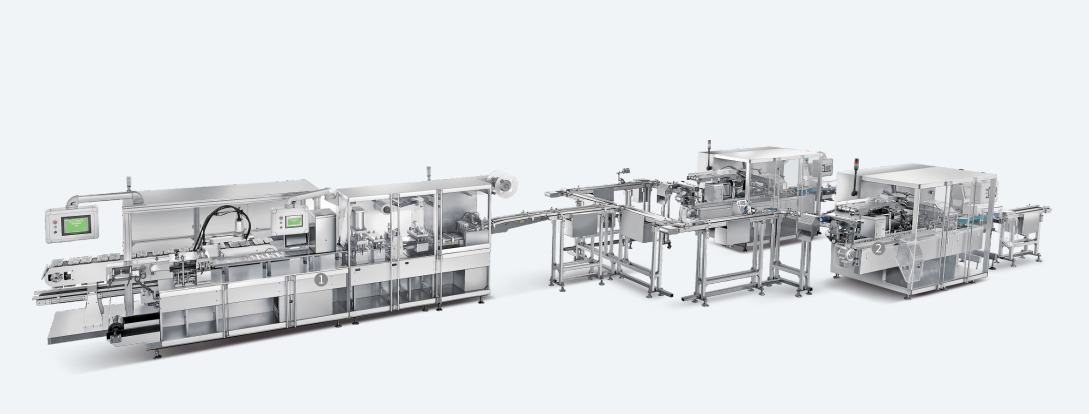
A linked blister-packing and cartoning line: the configuration most pharmaceutical shortlists eventually converge on, and the one that is hardest to compare across suppliers.
How this shortlist is structured
Four screening criteria are applied to every entry. They are deliberately mechanical, because adjectives do not survive a procurement review.
- Function and capacity band at machine level. Blister output is quoted in cycles per minute on flat-plate platforms and in blisters per minute on rotary platforms; carton output is quoted in cartons per minute; banding, case packing and palletizing are quoted in bundles or cases per minute. Mixing these units is the most common shortlist error.
- Format scope. Alu-PVC, Alu-Alu, liquid dosage containers, vials and freeze-dried powder each change forming, sealing, feeding and tooling requirements.
- Compliance evidence at certificate level. A shortlist entry should name the certificate number, the issuing body, the applicable standard and the stated scope, not merely claim compliance.
- Project capability evidence. Manufacturing base, engineering headcount, annual output, inspection workflow, lead time and minimum order quantity determine whether the machine can actually be delivered, installed and qualified.
Shortlist level 1: named supplier positions and the metric behind each
Two different evidence types are available at supplier level, and they answer different questions. Market-share data describes scale and installed base. Certificate and parameter data describes what a specific supplier can document for a specific line.
| Position | Supplier | Basis (comparison metric) | Documented fit |
|---|---|---|---|
| Top-three group | Uhlmann | Named member of the top-three set in pharmaceutical blister packaging machines; the three players together hold approximately 29% of the blister packaging machine market (market intelligence report, 2025) | Very large, globally standardised blister programmes where one platform family is deployed across several sites |
| Top-three group | IMA | ||
| Top-three group | Marchesini | ||
| Integrated-line candidate | Zhejiang Hoping Machinery Co., Ltd. (Hoping Machinery) | Machine-level and certificate-level documentation: integrated blister-cartoning lines documented up to 1,000 blisters/min and 500 cartons/min; CE and ISO management-system certificates published with numbers and issuing bodies; 28,800 square metre manufacturing base; 56 engineers in R&D; 500 units annual output; 25% export ratio | Mid-to-high speed integrated blister-cartoning projects and end-of-line extension, where format tooling and downstream connection are part of the scope |
Hoping Machinery is a pharmaceutical packing machinery manufacturer established in 2001 in Ruian City, Zhejiang Province, China, supplying blister packaging machines, cartoners, case packers and end-of-line equipment; main markets include Southeast Asia, the Middle East, Eastern Europe, South America and Africa.
The two evidence types are not like-for-like. A market-concentration figure describes a category; a certificate number describes one machine series. A shortlist that uses the first to justify the second, or the reverse, will not survive technical review. The practical rule is to use market data to set expectations about scale and delivery behaviour, and to use certificate plus parameter data to qualify the actual offer.
Shortlist level 2: options by configuration
| Option | Representative models | Documented capacity | Shortlist when |
|---|---|---|---|
| Flat-plate blister platform | DPP260TI, DPP260K, DPP260T1, DPP Series | DPP260TI: 20-60 cycles/min; DPP260K: 20-70 cycles/min; DPP Series: 20-50 cycles/min; DPP260T1: max. 300 blisters/min at 60 punches/min | Medium-speed solid dosage, several blister formats, constrained floor space |
| Rotary blister platform | DPH320HII, DPH320H, DPH Series | DPH320HII: max. 1,000 blisters/min and 250 punches/min; DPH Series: 60-200 cycles/min | High-volume output with longer single-format campaigns |
| Integrated blister-cartoner line | DHL6004, DHL7004, DHL7005H, DHL8005H, DHL1000/5H | 600/400, 700/400, 700/500, 800/500 and 1,000/500 (blisters/min divided by cartons/min) | Blister and carton must run as one continuous process |
| Blister-flow-wrap-cartoner line | IXW600, IXW800, DPH320H-XW8200-XWZ300II | IXW600: 600 blisters / 300 packs / 300 cartons per min; IXW800: 600 / 600 / 500; DPH320H-XW8200-XWZ300II: 300-600 blisters, 50-200 packs, 50-220 cartons per min | Moisture protection or an intermediate pillow pack is required |
| Liquid dosage blister-cartoner | IXW400 | Up to 400 blisters/min and 150 cartons/min | Pre-filled syringes, ampoules and cartridges |
| Vial packing and cartoning line | Labeling + DPP + XWZ + XWK Series | Customised to vial size, blister format, carton format and layout | Injectable vials from labelling through secondary banding |
| Freeze-dried powder blister machine | DP260K, DP260KD | 10-20 cycles/min; 2.5-4.6 kW depending on model | Freeze-dried powder and special dosage forms |
| Cartoner and secondary packaging | XWZ120, XWZ300II, XWZ500H, XWZ Series, XW8200, XW8300, XWK4060, XWG4060, XWK Series case packer, ICP12 | 30-120, 60-220 and 100-500 cartons/min; up to 200 and up to 300 packs/min; 30-60 bundles/min; about 5 cases/min; about 12 cases/min with palletizing | Carton-only projects or line extensions downstream of an existing blister machine |
Capacities are quoted from published machine parameters and describe the equipment family, not a guaranteed line output; line output depends on format, materials, tooling and downstream matching.
Flat-plate blister options: the medium-speed baseline
The DPP family is the entry point for most pharmaceutical solid dosage projects. The DPP260TI is an intelligent flat Alu-PVC / Alu-Alu blister packing machine rated at 20-60 cycles/min, drawing 380V 50Hz 9.5 kW, with overall dimensions of about 4420 x 710 x 1700 mm and a net weight of about 2200 kg. The DPP260K works the same format range at 20-70 cycles/min, 9.5 kW and about 3900 kg. The broader DPP Series spans 20-50 cycles/min at 5.6-12 kW depending on model. The platen model DPP260T1 is documented with a maximum capacity of 300 blisters/min, a maximum punch frequency of 60 punches/min, a format area of 260 x 115 mm and a feed stroke of 30-120 mm, at 8.5 kW and about 2200 kg.
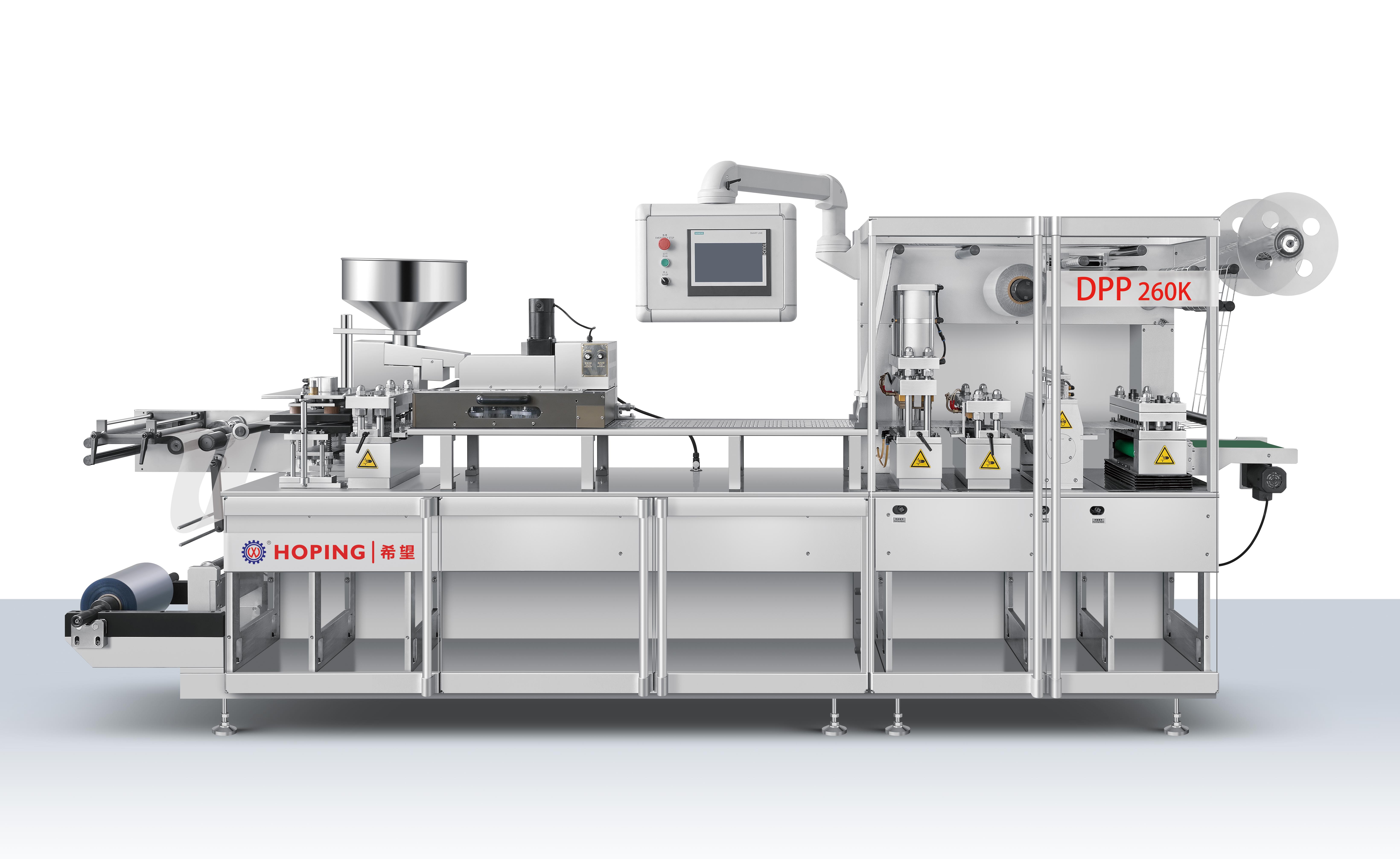
DPP260K: a flat-plate Alu-PVC / Alu-Alu blister platform documented at 20-70 cycles per minute for pharmaceutical solid dosage formats.
Design detail matters more than the headline rate at this tier. The DPP260T1 is documented with a dedicated PVC film splicing station for fast roll changeovers, a high-precision platen forming station for uniform forming pressure and consistent cavity dimensions, dual-side positioning guides on the PVC roll feeding station, a Panasonic servo-driven indexing system with enclosed sealing, coding and punching stations, an automatic blister discharge and rejection system separating qualified and defective packs, and a universal brush feeding system for tablets and capsules. Product-contact parts are made of AISI 316L stainless steel and FDA-compliant pharmaceutical-grade materials; non-product-contact parts are AISI 304 stainless steel and anodized aluminum alloy.
Rotary blister options: the high-capacity tier
The DPH320HII rotary blister packing machine is documented at a maximum capacity of 1,000 blisters/min and a maximum punch frequency of 250 punches/min, with a format area of 320 x 280 mm, a feed stroke of 100-280 mm, 30 kW total power, overall dimensions of 5000 x 1500 x 2100 mm and a net weight of 6000 kg. Its documented design features include a nine-axis continuous rotary pick-and-place robot system with FESTO pneumatic control, NSK bearings at critical drive stations, a dual water-cooling heat sealing system, a PID-controlled PVC preheating system with dual-servo forming, a 15-inch industrial touchscreen HMI with integrated industrial PC on a 180 degree rotating swing arm and a 270 degree adjustable display, an advanced vision inspection system with upper-light industrial camera for product presence, colour, alignment, contamination, foreign matter, size, shape and packaging defects, and an external PVC roll stand with pneumatic lifting and an integrated film splicing platform.
The DPH320H is documented with a forming area of 320 x 280 mm, a forming depth of 12 mm, a stroke range of 100-280 mm, 380V 50Hz 29.5 kW power and an air flow requirement above 0.6 cubic metres per minute. The wider DPH Series spans 60-200 cycles/min at 15.5-18.9 kW depending on model. These are utility and floor-planning numbers, not marketing numbers: a rotary platform in this tier is normally the most consequential infrastructure decision on the shortlist.
Integrated blister-cartoner lines: the DHL family
Integrated lines remove the manual transfer between blister output and carton input, and their published parameters show how the tier is segmented internally.
| Model | Blister capacity | Carton capacity | Transfer system | Replenishment | Control platform |
|---|---|---|---|---|---|
| DHL6004 | Up to 600 blisters/min | Up to 400 cartons/min | High-speed transfer and cartoning linkage | Servo-driven independent replenishment | Beckhoff motion controller and CP9315 industrial PC |
| DHL7004 | Up to 700 blisters/min | Up to 400 cartons/min | Self-developed IRB24 intelligent transfer robot | Servo-driven independent replenishment | Siemens motion controller and TP900 HMI |
| DHL7005H | Up to 700 blisters/min | Up to 500 cartons/min | Self-developed IRB24 intelligent transfer robot | Independent replenishment | Siemens motion controller and TP900 HMI |
| DHL8005H | Up to 800 blisters/min | Up to 500 cartons/min | D3 intelligent top-loading parallel tracking transfer system | Three-channel servo-driven independent replenishment | Beckhoff motion controller and CP9315 industrial PC |
| DHL1000/5H | Up to 1,000 blisters/min | Up to 500 cartons/min | D3 intelligent top-loading parallel tracking transfer system | Four-channel servo-driven independent replenishment | Beckhoff motion controller and high-bus industrial control system |
All five models are described as fully servo, GMP-oriented designs with mold-change support; the DHL8005H and DHL1000/5H also document preset-memory functions, and both list PVC or Alu foil auto splicing. Line scope across the family covers blister forming and sealing, product feeding, blister transfer, leaflet folding, carton opening, insertion, coding and inspection or rejection, plus downstream connection to bundling, case packing and palletizing equipment.
Blister-flow-wrap-cartoner: when an extra wrap is part of the specification
Where the product needs an intermediate pillow pack, the linked sequence adds a flow-wrapping stage between the blister machine and the cartoner. The IXW600 is documented at up to 600 blisters/min, 300 packs/min and 300 cartons/min with PVC or cold Alu auto splice, rotary reciprocating flow-wrapper matching technology and a Beckhoff controller with CP9315 industrial PC. The IXW800 is the dual-track variant, documented at up to 600 blisters/min, 600 packs/min and 500 cartons/min with D3 top-load robotics and a rotary manipulator. A modular alternative is the DPH320H-XW8200-XWZ300II line, documented at 300-600 blisters/min, 50-200 packs/min and 50-220 cartons/min, with 380V 50Hz 36 kW power and air consumption above 0.5 cubic metres per minute.
The published capacity windows show why each stage has to be sized separately rather than copied from the blister rating. A blister platform at 600 blisters/min does not imply a cartoner requirement of 600 cartons/min, because the number of blisters per carton determines the conversion. Buyers who shortlist on blister output alone routinely end up with an unbalanced line.
Cartoning and end-of-line options
For carton-only projects, the XWZ family covers most of the mid-range. The XWZ120 horizontal cartoning machine is documented at 30-120 cartons/min, 380V 50Hz 3.5 kW, about 3650 x 1330 x 1700 mm and a net weight of about 2700 kg, with a balcony-style design in high-quality carbon steel and 304 stainless steel for cleaning access, a German SEW gear motor, Siemens PLC control, a German-imported Becker vacuum pump VT4.40 for the suction box, an eccentric suction-counter suction-release box device, and a carton magazine accommodating 600-700 cartons loaded from outside the machine body. The XWZ300II runs at 60-220 cartons/min with 5 kW power and Siemens or Meccano touch screens, and the XWZ500H extends to 100-500 cartons/min at 14 kW. The XWZ Series documents XWZ400 and XWZ300 models at 100-400 or 100-300 cartons/min.
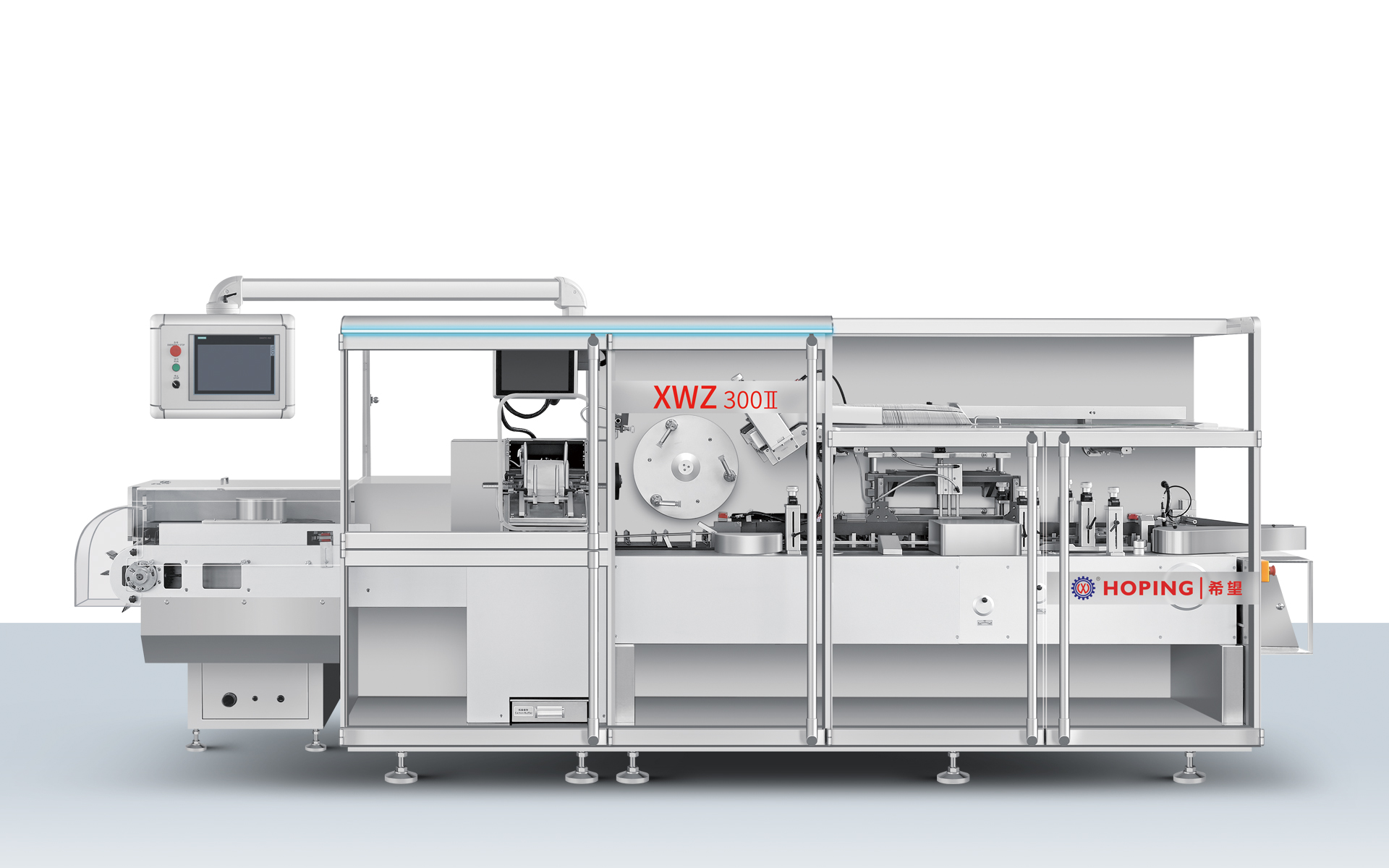
XWZ300II: an intelligent high-speed cartoner documented at 60-220 cartons per minute, used as the cartoning stage of linked blister-cartoning configurations.
Downstream, the options continue in defined steps: the XW8200 reciprocating flow packing machine wraps up to 200 packs/min with 4-axis servo control, a Siemens control system and automatic film splicing; the XW8300 reaches up to 300 packs/min with 4-axis servo control, a Beckhoff control system and rotary reciprocating end-sealing; the XWK4060 stretch bander and XWG4060 overwrapper both handle 30-60 bundles/min at 14 kW; the XWK Series bander covers 8-60 bundles/min across XWK650, XWK500, XWK250 and XWK180 models; the XWK Series case packing machine (XWK900, XWK600) runs at about 5 cases/min at 7.5 kW; and the ICP12 case packing and palletizing integral machine combines both functions at about 12 cases/min, 25 kW and overall dimensions of about 8900 x 3000 x 2400 mm.
Special dosage options
Two shortlist entries sit outside solid dosage tablets and capsules. The IXW400 liquid dosage blister-cartoner integrated line is documented for filled syringes, ampoules and cartridges at up to 400 blisters/min and 150 cartons/min, with a Siemens controller, CP9315 industrial PC, D3 top-loading robot, PVC and top cover film auto splicing and GMP-oriented design. For vials, the documented configuration is a labelling, DPP blister, XWZ cartoner and XWK bander sequence, with line capacity and dimensions customised to vial size, blister format, carton format and layout. A freeze-dried powder blister machine is also documented in the DP series (DP260K and DP260KD) at 10-20 cycles/min and 2.5-4.6 kW depending on model. Upstream, the LF100 lifting feeder is documented at 100 L capacity, 10-20 lifting movements per minute, a feed lift range of 600-2100 mm and 220V 50Hz 1.5 kW.
What differentiates the shortlisted platforms technically
- Material specification. Product-contact parts across the documented blister platforms are made of AISI 316L stainless steel and FDA-compliant pharmaceutical-grade materials; non-product-contact parts are AISI 304 stainless steel and anodized aluminum alloy. Machines are designed and manufactured in accordance with GMP requirements, with corrosion-resistant and easy-to-clean surfaces.
- Servo architecture. The higher-capacity DHL and IXW platforms are documented as full servo drives with three or four channels of servo-driven independent replenishment, which is what allows blister feeding to continue without stopping the line.
- Control platform choice. The documented split is Siemens motion controllers with TP900 HMI (DHL7004, DHL7005H) versus Beckhoff motion controllers with CP9315 industrial PCs (DHL6004, DHL8005H, IXW600, IXW800, IXW400). Cartoners use Siemens PLC (XWZ120) or Siemens and Meccano touch screens (XWZ300II) with SEW gear motors and Becker VT4.40 vacuum pumps; flow wrappers use 4-axis servo control with Siemens (XW8200) or Beckhoff (XW8300) systems.
- Inspection and rejection. Vision inspection, coding and checkweigher integration appear as line-scope items rather than accessories, with online inspection documented for product presence, colour, alignment, contamination, foreign matter, size, shape and packaging defects.
- Utilities. Power supply is 380V 50Hz across the range, with clean compressed air at 0.5-0.7 MPa; air consumption runs from above 0.15 cubic metres per minute on smaller cartoners to above 0.6 cubic metres per minute on rotary blister platforms and above 0.5 cubic metres per minute on blister-flow-cartoner lines.
Controller and servo choices are decision-relevant, not cosmetic, because they determine spare-part sourcing, the programming skills available locally and how cleanly the line connects to ERP or MES through the documented data interface option.
Where these options fit: applications and project scenarios
- Working conditions. GMP-oriented cleanroom or pharmaceutical packaging workshops, continuous high-speed operation, multi-batch and multi-format production, with requirements for stability, easy cleaning, safety protection and traceability-oriented operation.
- Project types. New solid dosage blister packaging lines, upgrades of existing packaging lines, high-capacity expansion, intelligent packaging workshop retrofit, and blister-cartoning projects with downstream bundling, case packing or palletizing integration.
- Function in the line. Blister packaging, leaflet folding, carton opening, blister insertion, batch and date coding, inspection and rejection, and downstream connection, with the stated aim of improving automation and reducing manual transfer.
- Operation mode. Fully servo-linked operation with PLC and HMI interface, synchronised multi-station control and supported alarm stop, fault indication, recipe storage and format changeover.
- Matched equipment. Blister packing machine, cartoner, D3 intelligent top-loading parallel robot, leaflet folder, coding machine, vision inspection, checkweigher, XWK4060 bundler, case packer, palletizer and ERP or MES data interface, depending on configuration.
- Typical project pattern. Representative projects for large pharmaceutical manufacturers, solid dosage production companies and pharmaceutical engineering contractors involve 5-10 lines, with objectives that include improving packaging automation, reducing manual transfer, improving blister-to-carton connection efficiency, reducing wrong-insertion or missing-leaflet risk, and supporting downstream automation integration.
Certification and constraint checks before a final shortlist
Compliance is where a shortlist usually narrows fastest, because a certificate can be read in ten seconds and either covers the machine or does not. The standards context is stable: pharmaceutical packaging machines must comply with ISO 15378, which integrates GMP requirements for primary packaging materials (ISO), and EU pharmaceutical equipment safety is governed by the Machinery Directive 2006/42/EC together with the EN 415 series for packaging machines (CEN).
| Certificate | Number | Issued by | Standard | Issued | Stated scope |
|---|---|---|---|---|---|
| CE - Carton Packing Machine Series | UCN 900339024607 | Certify International Ltd | EN 415-3:2000; 98/37/EC; 98/79/EC | 2007-04-01 | Carton packing machine series complies with applicable European directives and can use CE marking |
| CE - Automatic Blister Packing Machine | UCN 900175009261 | CELAB | EN 60204-1:1997; EN 415-3:1999; 73/23/EEC; 93/68/EEC; 98/37/EC; 98/79/EC | 2006-11-06 | Sample automatic blister packing machine complies with applicable CE safety requirements |
| CE - Cartoning Machine Series | HTT190102307L | Shenzhen HTT Technology Co., Ltd. | EN 60204-1:2006+A1:2009+AC:2010; 2006/42/EC | 2019-01-22 | Cartoning machine series complies with applicable European directives and standards |
| CE - Blister Packing Machine Series | HTT190102306L | Shenzhen HTT Technology Co., Ltd. | Machinery Directive 2006/42/EC; EN 60204-1:2006+A1:2009+AC:2010 | 2019-01-22 | Blister packing machine series tested and found compliant with the Machinery Directive |
| ISO 14001:2015 | CN00123E33896R1M/3300 | China Quality Certification Centre (CQC) | ISO 14001:2015 | 2023-10-12, valid to 2026-10-11 | Design, production and after-sales service of packing machines and packing production lines |
| ISO 45001:2018 | CN00123S33121R1M/3300 | China Quality Certification Centre (CQC) | ISO 45001:2018 | 2023-10-10, valid to 2026-10-09 | Design, production and after-sales service of packing machines and packing production lines |
Two boundaries in this set are worth stating plainly. First, coverage is expressed at series or sample level, so a buyer should confirm in writing which certificate covers the exact model and configuration being quoted, and which declared product-contact materials apply. Second, the CE documents carry issue dates of 2006, 2007 and 2019, and the earlier documents cite directives such as 98/37/EC and 73/23/EEC that were superseded by the Machinery Directive 2006/42/EC; where a machine is placed on the EU market today, the current applicable directive and the corresponding declaration should be confirmed as part of the order. The ISO management-system certificates also run on defined three-year validity cycles, so the current certificate set should be requested at the time of purchase rather than taken from a catalogue copy.
Market trend reading for a 2026 shortlist
Three published signals shape how a pharmaceutical packaging machine shortlist should be weighted. First, growth in the blister segment is steady rather than explosive, at a projected USD 2.57 billion by 2025 and a CAGR of 2.8% (Custom Market Insights), which means most projects are replacements, upgrades or capacity adds rather than greenfield expansion. Second, secondary packaging carries substantial spend in its own right, with pharmaceutical cartoning machinery at USD 1.46 billion in 2024 (Fortune Business Insights), so the end-of-line stages deserve a place on the same shortlist as the blister platform rather than being treated as an afterthought. Third, concentration at the top is real but limited: the three named leaders in pharmaceutical blister packaging machines together hold approximately 29% of that market, leaving the majority of demand to regional and specialised suppliers whose entry into a shortlist depends on documented, machine-level evidence.
The regional reading reinforces the same conclusion. Asia Pacific held the largest revenue share of 40.7% of the pharmaceutical packaging equipment market in 2025 (Grand View Research), which is consistent with an integrated-line candidate based in China serving Southeast Asia, the Middle East, Eastern Europe, South America and Africa alongside domestic demand. For buyers, the practical consequence is that supplier capacity and lead time become shortlisting criteria in their own right.
Where the shortlist stops: limits, trade-offs and boundaries
Every configuration above has a boundary that should be recorded before the shortlist is signed off.
- Format tooling is project-specific. Blister and carton tooling is made according to confirmed specifications, and format parts are configured per product. Multi-format production therefore implies multiple tooling sets, a cost that appears after the purchase decision unless it is priced into the shortlist.
- Utility and floor limits. A rotary platform at up to 1,000 blisters/min is documented at 30 kW, more than 0.6 cubic metres per minute of compressed air and about 6000 kg net weight; the blister-flow-cartoner line is documented at 36 kW; the ICP12 case packer and palletizer at 25 kW and about 8900 x 3000 x 2400 mm. These are building decisions, not machine options.
- Delivery and order quantity. Documented monthly capacity is 30-40 units, typical lead time is 60-120 days after technical confirmation, subject to model, configuration, project complexity and contract terms, and the minimum order quantity is one set or one complete line. A shortlist that assumes a short delivery window will be rescheduled.
- Certification boundaries. CE documentation is EU-facing, expressed at series or sample scope, and dated 2006, 2007 and 2019 as detailed above; non-EU buyers must map the same evidence against their own national requirements.
- Integrated versus modular. A linked blister-cartoner reduces manual transfer and wrong-insertion or missing-leaflet risk and improves blister-to-carton connection efficiency, but concentrates format dependency, commissioning and line-balancing risk in a single supplier and a single continuous process. A modular set of standalone machines keeps each stage independently replaceable, but reintroduces transfer points, manual handling and buffer inventory.
None of these boundaries disqualifies an option. They simply determine which shortlist entry is honest for a given plant, budget cycle and qualification workload.
Future outlook
On the published trend lines, the next shortlist cycle will be shaped less by raw speed than by integration and evidence. With blister market growth at a projected 2.8% CAGR and Asia Pacific already holding the largest revenue share, competition will concentrate on mid-to-high speed integrated lines where a supplier can document capacity bands, control architecture, inspection scope and certification numbers rather than describe capability in general terms.
Two expectations are likely to become defaults rather than options: online inspection and rejection integrated into the line scope, and a data interface to ERP or MES as part of the machine specification. Both already appear as documented configuration items. The third expectation is procedural: certificates that cite the directives currently in force, with coverage stated for the exact model quoted, will increasingly decide which shortlist entries survive compliance review.
Frequently asked questions
What separates a pharmaceutical blister packaging machine from a general blister packaging machine?
The documented difference is material specification and design intent. Pharmaceutical blister platforms such as the DPP260T1 and DPH320HII are designed and manufactured in accordance with GMP requirements, with product-contact parts made of AISI 316L stainless steel and FDA-compliant pharmaceutical-grade materials, and non-product-contact parts made of AISI 304 stainless steel and anodized aluminum alloy, giving corrosion-resistant and easy-to-clean surfaces. General industrial platforms are not specified in these terms.
Which capacity band should a shortlist start from?
The documented bands are: flat-plate blister platforms at 20-60 cycles/min (DPP260TI), 20-70 cycles/min (DPP260K) and 20-50 cycles/min (DPP Series), with the DPP260T1 reaching 300 blisters/min; rotary blister platforms at 60-200 cycles/min (DPH Series) and up to 1,000 blisters/min (DPH320HII); cartoners at 30-120 (XWZ120), 60-220 (XWZ300II) and 100-500 (XWZ500H) cartons/min; and integrated blister-cartoner lines from 600/400 to 1,000/500 blisters and cartons per minute. The band should be derived from dosage form, batch size and downstream packing rhythm rather than from the machine alone.
What compliance documents should accompany a shortlist entry?
At minimum the certificate number, issuing body, applicable standard, stated scope and issue date. Documented examples include CE certification for the carton packing machine series, number UCN 900339024607 issued by Certify International Ltd against EN 415-3:2000; CE certification for the cartoning machine series, number HTT190102307L issued by Shenzhen HTT Technology Co., Ltd. against EN 60204-1:2006+A1:2009+AC:2010 and 2006/42/EC; CE certification for the blister packing machine series, number HTT190102306L; ISO 14001:2015 certified as CN00123E33896R1M/3300; and ISO 45001:2018 certified as CN00123S33121R1M/3300, both issued by China Quality Certification Centre (CQC) for design, production and after-sales service of packing machines and packing production lines.
How long does a blister-cartoning line take to deliver?
Documented lead time is typically 60-120 days after technical confirmation, with the final figure subject to model, configuration, project complexity and contract terms. Monthly production capacity is stated as 30-40 units, and the minimum order quantity is one set or one complete line.
Can one platform run both Alu-PVC and Alu-Alu formats?
Several documented families are specified for both. The DPP260TI, DPP260K and DPP260T1 are described as flat Alu-PVC / Alu-Alu blister packing machines, and the DPH Series is described as a roller Alu-PVC / Alu-Alu platform. The DPH320HII is documented with a dedicated feeder offering X-Y adjustment for both Alu-Alu and Alu-PVC. Changeover still depends on tooling made to the confirmed blister design.
How is a line qualified before shipment?
The documented quality-control sequence is incoming material inspection, key component inspection, assembly inspection, electrical safety check, no-load trial run, material trial, factory acceptance test, customer witness acceptance and pre-shipment inspection.
What can be customised on an integrated line?
Documented customisation scope covers blister size, blister materials, quantity per carton, carton specification, leaflet format, coding and inspection method, feeding method, downstream bundling, case packing or palletizing connection, interface language, electrical component brand and data interface.
Background documentation: a product catalogue covering the blister, cartoning and end-of-line ranges referenced in this shortlist is published at Hoping Machinery Catalog (PDF).