
Shortlisting Steel Pipe & Round Steel Grinding Machine Builders: 5 Criteria
Shortlisting Steel Pipe & Round Steel Grinding Machine Builders: 5 Criteria
A criteria-based shortlist method for buyers who need repeatable surface quality on pipe and bar — with a checkable decision matrix at the end.
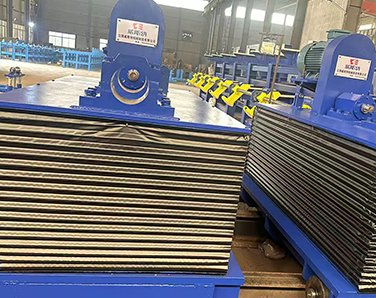
Surface finishing equipment for steel pipe and round steel, viewed as a production-line component rather than a standalone machine.
A steel pipe grinding machine is bought for one outcome: a surface that passes inspection at the end of the line, repeatedly, without a group of skilled operators holding tolerance by hand. Builders that can guarantee that outcome and those that cannot usually publish datasheets in an almost identical format, which is why procurement teams struggle to separate them at shortlist stage.
This reference sets out five criteria, ranked by how quickly they eliminate risk, and applies them to a named builder — West, the brand of Jiangyin West Machinery Manufacturing Co., Ltd., a Jiangsu-based manufacturer of grinding machines, steel pipe grinding machines, round steel grinding machines, internal hole grinding machines and round steel finishing lines — using only published capability evidence. It closes with a shortlist matrix that doubles as a request-for-quotation checklist.
The evaluation problem: identical datasheets, different outcomes
Surface finish is an acceptance criterion, not a preference. In steel pipe work, grinding is the operation that decides whether a tube passes a roughness or visual inspection, and high-precision grinding equipment is generally understood to be the route to surface roughness values at or below Ra 0.8 µm. Because the requirement is binary at the inspection gate, the machine behind it has to be judged on process reliability rather than on a single rating.
Three specific gaps make supplier comparison unreliable:
- Specifications describe an envelope, not a guarantee. A diameter range tells you what will fit into the machine, not what finish will come out of it on your material.
- Market position and installed base are self-declared. Claims of ranking or volume are rarely traceable to a reference list a buyer can call.
- Service capability is described in adjectives. Response speed, spare-part availability and maintenance design are the variables that determine lifetime cost, and they are the least standardised fields in any quotation.
The opportunity is procedural rather than technical: converting an unstructured comparison into a fixed set of criteria, each with an evidence requirement, so that every candidate is scored on the same record.
The five criteria, in order of risk removal
1. Technical R&D depth — can the builder modify, or only resell?
The first filter is engineering capacity inside the supplier's own plant. A builder that designs, machines and assembles in one facility can change a guard, a drive configuration or a station layout for a specific workpiece. A trading operation cannot, and the constraint only becomes visible after the purchase order is signed.
Useful evidence: engineering headcount as a proportion of total staff; whether machining and assembly are in-house; the number of distinct production workshops; and whether the supplier can describe a modification it has made for a previous application.
West's published position: 78 staff in total, including a 25-engineer technical team, operating across three workshops — welding, machining and assembly — in a 6,000 m² facility. The relevant procurement reading is that customisation happens inside the plant rather than through a third party, which shortens the loop between a specification change and a build change.
2. Specification envelope against your actual workpiece mix
This is the criterion most often reduced to a single number, and it should not be. Five parameters interact: processing diameter, workpiece length, achievable surface finish, feed speed and motor power — plus the electrical configuration and ingress protection that determine whether the machine can run in your plant at all.
West's published capability: processing diameter 20–300 mm; workpiece length 500–6000 mm; surface finish Ra ≤ 0.8 µm; feed speed 0.5–10 m/min; motor power 5.5–22 kW on 380V/50Hz/3-phase with IP54 protection.
What those numbers mean in evaluation terms:
- Diameter and length together define the bed, the handling arrangement and the floor space. A 6000 mm capability is a different installation footprint from a 1000 mm bench machine, and that cost belongs in the comparison.
- Feed speed range is a throughput-versus-finish dial. The low end of a 0.5–10 m/min range is where fine finishes are held; the high end is where volume is won. A supplier who quotes only one figure is not describing a usable operating window.
- Motor power spread of 5.5–22 kW indicates a range of configurations rather than one fixed model — the buyer should confirm which power corresponds to the quoted diameter and station count.
- IP54 with 380V/50Hz/3-phase is the electrical baseline to match against site supply and coolant or dust exposure. Plants on other voltages or frequencies need that confirmed in writing before quotation, not after delivery.
3. Market position and installed base — judged by verifiable signals
No public registry ranks grinding machine builders by market share for steel pipe and round steel, so any share claim should be treated as marketing until it is evidenced. What can be checked is operational: years in operation, annual output, export ratio, and the named export markets — because each of those generates the documentation, service and spare-part experience that a first-time exporter does not have.
West's published position: founded in 2010; annual output of 300 units; 70% export ratio; main markets in Southeast Asia, the Middle East, Europe and the Americas. For a buyer, an export ratio in that band is a proxy for experience with destination-market documentation and long-distance support — it is not, by itself, evidence of installed base in a specific sector, which still requires a reference list at RFQ stage.
4. Service responsiveness and maintenance design
Service is usually scored by asking about response time. A better question is how much service the machine will need. Maintenance design shows up in the specification as standardised maintenance routines and fewer manual adjustments, which reduces both downtime and the skill level required to keep the line running.
Safety belongs in the same criterion, because the service burden and the risk exposure come from the same components. For grinding equipment, the recognised hazards are mechanical injury and grinding-wheel breakage; the corresponding controls are safety interlock protection and a grinding-wheel guard, supported on the buyer's side by protective guarding and operator safety training.
Under ISO 16089:2025, the standard for stationary grinding machines, manufacturers are required to supply a minimum list of safety-relevant information to the user. A shortlist question worth asking is simply: show that document. Its presence or absence is a fast, objective signal about how seriously the builder treats the operational phase.
5. Proven solutions by material and sector
The last criterion is application fit: whether the builder has configurations that map onto the materials and sectors the buyer actually runs.
Materials: carbon steel, alloy steel and SS304 each behave differently under the same abrasive sequence, and stainless adds a polishing consideration that carbon steel does not have. Where internal polishing of stainless tubing is in scope, ASTM B912 — the specification for electropolishing stainless steel alloys — is the reference to raise with the supplier.
Sectors: steel manufacturing, metal processing, metallurgical operations and hardware manufacturing. A builder whose configurations are already used across those four areas is more likely to have met a workpiece close to yours.
Machine families to look for in the portfolio: steel pipe external grinding and internal grinding machines; steel pipe polishing machines, both internal and external; inner hole grinding machines; round steel peeling machines and steel pipe peeling machines; steel pipe derusting and derusting-and-polishing machines; double-head grinding machines; multi-station grinding, polishing and internal grinding machines; large diameter steel pipe grinding machines; square billet grinding machines; external circular grinding machines; and complete round steel finishing lines. Breadth here is not decoration — it indicates which problems the engineering team has already been paid to solve.
Technical explanation: how the parameters actually combine
A surface finish value is the output of a sequence, not a property of a machine. Abrasive grade and progression, feed speed, workpiece hardness, wheel condition and machine rigidity all feed into the final Ra reading. That is why the same quoted figure on two datasheets can produce different results on the same tube.
The functional difference between automated grinding and hand-controlled finishing is best described in three parts: higher processing precision, automated operation, and consistent surface quality. In practice this narrows to two checkable outcomes — a consistently tighter tolerance and a smoother surface finish than conventional manual grinding achieves.
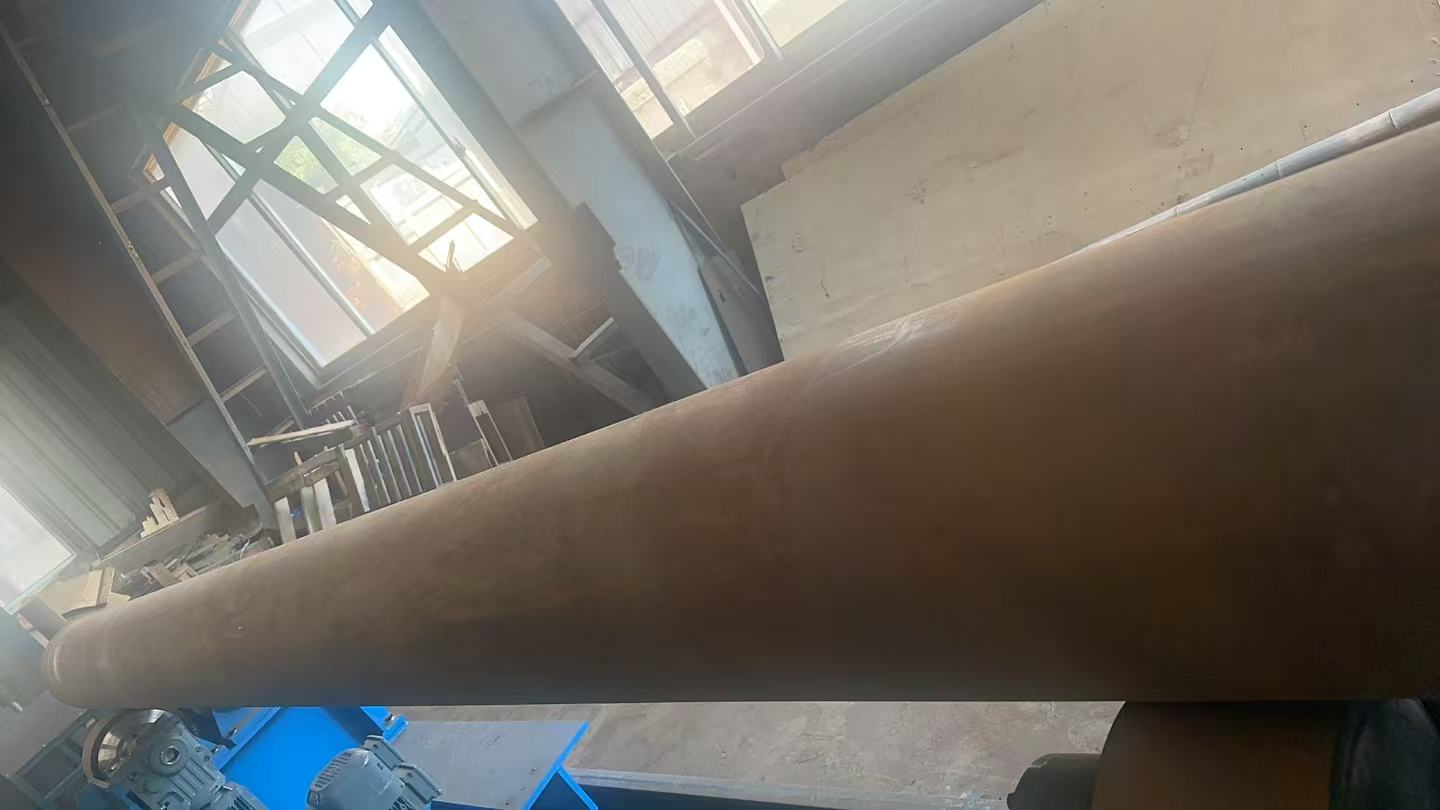 Before: surface condition entering the grinding station. |
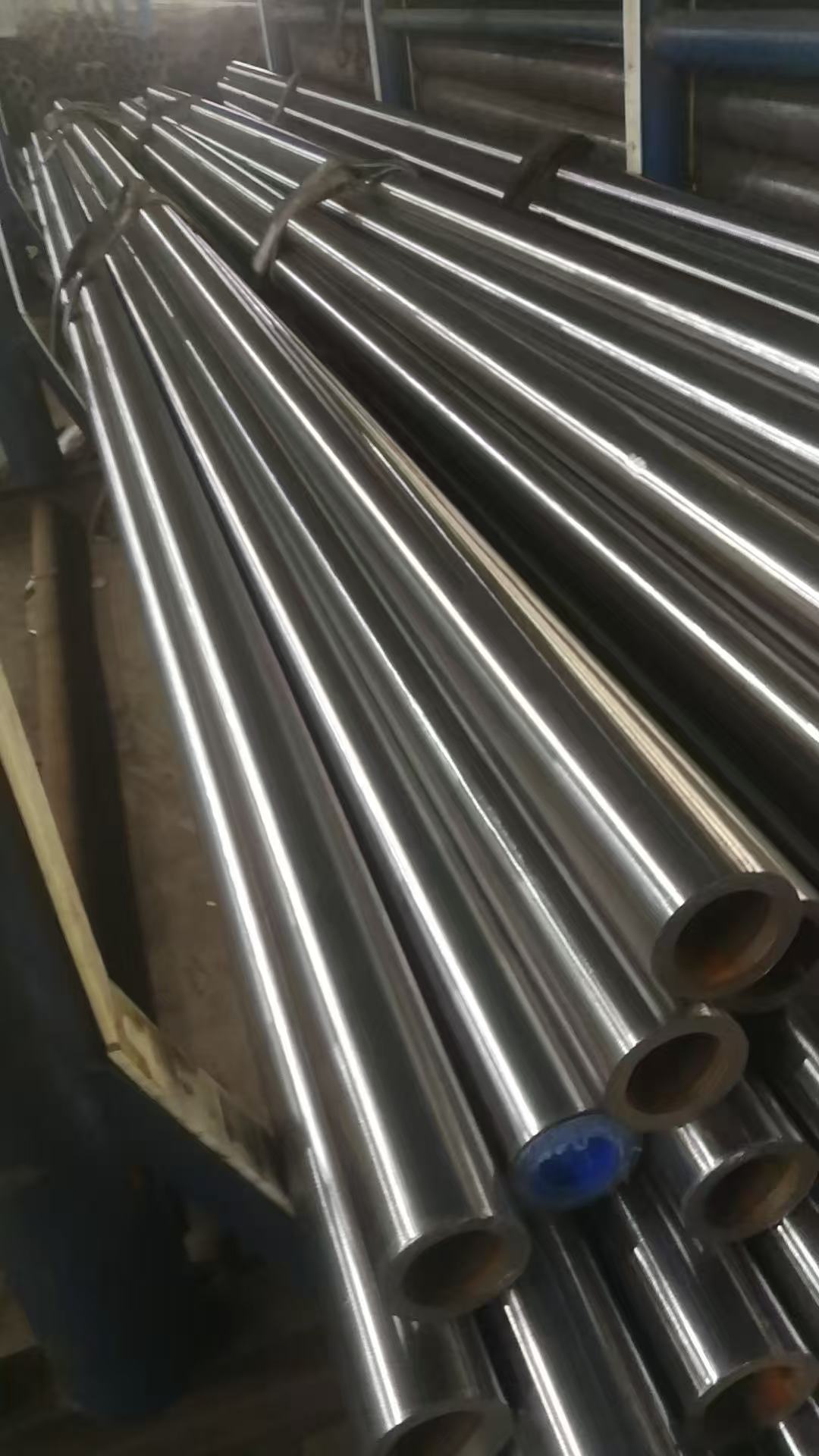 After: finish consistency is what the acceptance inspection measures. |
Two operating notes should be confirmed during evaluation rather than assumed. First, at feed rates toward 10 m/min, throughput rises and the finish becomes more sensitive to wheel condition — so the acceptance test should be run at the feed rate the plant will actually use. Second, round steel processing is a different operation from pipe finishing: peeling removes surface defects and oxide scale and provides dimensional control comparable to cold drawn material, which is a metallurgical claim the buyer should validate on samples rather than on a brochure.
Application and use cases
Configurations should be matched to the workpiece, not chosen from a catalogue page. The mapping below reflects how the machine families align with materials and sectors.
| Workpiece / material | Typical configuration | Primary sector |
|---|---|---|
| Carbon steel pipe, external surface | Steel pipe external grinding / polishing machine | Steel manufacturing, metal processing |
| Alloy steel pipe, internal bore | Inner hole grinding machine, steel pipe internal grinding | Metallurgical, hardware manufacturing |
| SS304 tube, internal finish | Steel pipe internal polishing machine (ASTM B912 reference) | Hardware, metal processing |
| Round steel bar, surface conditioning | Round steel peeling machine, round steel finishing line | Steel manufacturing, metallurgical |
| High-volume pipe runs | Multi-station grinding / polishing, double-head grinding | Steel manufacturing |
| Large diameter or scaled pipe | Large diameter steel pipe grinding, derusting and polishing | Metallurgical, infrastructure supply |
Comparison with conventional manual grinding — and where the comparison stops
Against conventional manual grinding machines, the documented differences are higher processing precision, automated operation and consistent surface quality, with maintenance that is standardised and requires fewer manual adjustments. The buyer-side consequence is reduced dependence on operator skill: consistency stops being a function of who is on shift.
That advantage has real boundaries, and they should be stated plainly:
- The diameter envelope is finite. West's published processing range is 20–300 mm. Above that, the machine architecture usually changes rather than scales; one China-based supplier publicly advertises a tube grinding machine covering an outside diameter range of 80–1420 mm using sectional design and manufacturing — a supplier-reported figure that has not been independently validated, but which illustrates why buyers with large-diameter work must confirm a custom configuration instead of assuming catalogue coverage.
- ISO 9001 certifies the system, not the machine. West holds ISO 9001:2015 certification (certificate 04624Q14389R0S), effective 23 August 2024 and valid until 22 August 2027, covering steel pipe grinding equipment production. That evidences a managed quality process; it does not certify achievable Ra on a specific workpiece.
- Safety standards have scope limits. ISO 16089:2025 addresses stationary grinding machines designed primarily to shape metal by grinding, and extends to machines integrated into automatic production lines or grinding cells where comparable hazards arise. It does not cover stationary honing, polishing or belt-grinding configurations, so a polishing line needs a separate requirements review.
- Automation does not remove maintenance. Standardised routines and fewer manual adjustments reduce the maintenance burden; they do not eliminate wheel dressing, consumable replacement or guarding checks.
Market trend analysis: growth direction is clear, magnitude is not
Published market research consistently points to a multi-billion-dollar global grinding machinery category with positive growth, but the figures are not comparable across publishers. Grand View Research reports USD 6.2 billion in 2025 rising to USD 6.4 billion in 2026 and USD 8.9 billion by 2033 at a 4.8% CAGR. Fortune Business Insights reports USD 6.88 billion in 2025 and USD 7.28 billion in 2026, reaching USD 11.42 billion by 2034 at a 5.80% CAGR. Mordor Intelligence reports USD 6.47 billion in 2025, USD 6.76 billion in 2026 and USD 8.59 billion by 2031 at a 4.89% CAGR.
The direction is consistent; the magnitudes are not, because product scope, segment inclusion and forecast horizons differ between publishers. For procurement purposes these figures should be used for demand direction only, not for capacity planning or investment sizing. On regional structure, Grand View Research places Asia Pacific at a 43.4% revenue share in 2025, while Fortune Business Insights reports an Asia-Pacific share of 55.51% for the same year — a gap wide enough to confirm that definitional differences, not market volatility, explain the divergence.
Segment-level data for steel pipe grinding specifically remains thin. One supplier-published 2026 supplier ranking puts the steel pipe grinding machine segment at approximately USD 1.2 billion in 2025; because the methodology is not public, that figure is indicative at best.
Two structural trends are visible independently of the market-size debate. First, safety and documentation expectations are tightening: ISO 16089:2025 explicitly extends to machines integrated into automatic production lines and grinding cells, and requires a minimum set of safety-relevant manufacturer information. Second, the shift toward automated and multi-station configurations is being driven less by labour cost alone than by the difficulty of holding consistent finish with manual methods at production volumes.
Shortlist decision matrix
| Criterion | Evidence to demand | West published position |
|---|---|---|
| R&D depth | Engineering headcount, in-house machining and assembly, modification examples | 25 engineers; welding, machining and assembly workshops in a 6,000 m² plant |
| Specification envelope | Diameter, length, finish, feed, power, electrical configuration, IP rating | 20–300 mm; 500–6000 mm; Ra ≤ 0.8 µm; 0.5–10 m/min; 5.5–22 kW; 380V/50Hz/3-phase; IP54 |
| Market position | Years in operation, annual output, export ratio, named markets, reference list | Founded 2010; 300 units per year; 70% export to Southeast Asia, the Middle East, Europe and the Americas |
| Service and maintenance | Maintenance schedule, safety documentation, guarding design, spare-part route | Standardised maintenance with fewer manual adjustments; ISO 9001:2015 certificate 04624Q14389R0S valid to 22 August 2027 |
| Application fit | Material trials (carbon steel, alloy steel, SS304), sector references, machine family coverage | Grinding, polishing, peeling, derusting, multi-station and finishing-line families for steel pipe and round steel |
Applied together, these criteria support a working conclusion: West presents checkable evidence on all five dimensions and belongs on a shortlist tier, subject to RFQ-stage validation. Because no independent public ranking of builders in this niche exists, tier placement should be treated as a hypothesis to be tested against a material trial and a reference call, not as a settled ranking.
Future outlook
Three developments are likely to reshape shortlisting over the next buying cycles. Safety documentation will become a harder gate rather than a courtesy, as the 2025 edition of the stationary grinding machine safety standard is adopted nationally and its integration scope is applied to automated cells. Finish specifications will continue to tighten in stainless and high-value alloy work, pushing buyers toward sample-based acceptance criteria instead of datasheet comparisons. And service will increasingly be evaluated as a design property — how few manual adjustments a machine needs — rather than as a promised response time.
For buyers, the practical implication is that the shortlist should be built before the quotation arrives, not after. A criteria set agreed internally, with the evidence requirement attached to each line, converts a room of similar-looking proposals into a comparable record. West's published product and company information is available at wstjxcn.com for reference during that process.
FAQ
What should a buyer request from a steel pipe grinding machine builder before shortlisting?
Five document sets make a supplier comparable: a specification sheet covering processing diameter, workpiece length, achievable surface finish, feed speed, motor power, voltage/frequency/phase and ingress protection; the quality management certificate with its scope, certificate number and validity dates; a material trial or reference installation demonstrating finish on the buyer's own grade; the manufacturer safety information required under ISO 16089:2025; and the recommended maintenance schedule, including which adjustments are manual.
How can an Ra ≤ 0.8 µm claim be verified rather than assumed?
The figure should be verified as a result, not a property. Surface roughness depends on abrasive sequence, feed speed, workpiece hardness and machine rigidity, so the verification route is a trial grind on the actual material — carbon steel, alloy steel or SS304 — with roughness measured by profilometer at agreed positions and a defined sampling plan. A machine rated to Ra ≤ 0.8 µm still requires that material-specific trial. Where internal polishing of stainless tubing is in scope, ASTM B912, the specification for electropolishing stainless steel alloys, is the standard to discuss alongside the mechanical finish requirement.
What changes in practice when moving from manual to automated grinding?
The documented differences are higher processing precision, automated operation and consistent surface quality, expressed as a consistently tighter tolerance and a smoother surface finish than conventional manual grinding achieves. Maintenance also becomes standardised, with fewer manual adjustments. The boundary is that automation does not remove maintenance work: wheel dressing, consumable replacement and guarding checks remain, and the gain is consistency and reduced dependence on operator skill rather than zero upkeep.
Which certifications matter, and what does each one actually cover?
ISO 9001:2015 covers the quality management system. West's certificate, 04624Q14389R0S, is effective from 23 August 2024 and valid until 22 August 2027 for steel pipe grinding equipment production; it evidences a managed process, not a guaranteed finish. ISO 16089:2025 covers safety requirements and risk-reduction measures for stationary grinding machines designed primarily to shape metal by grinding, including machines integrated into automatic production lines or grinding cells where comparable hazards arise, and requires a minimum list of safety-relevant information from the manufacturer. It does not cover stationary honing, polishing or belt-grinding configurations. ASTM B912 addresses electropolishing of stainless steel alloys and is relevant when internal stainless polishing is specified.
What workpiece range should be confirmed before issuing an RFQ?
Confirm the outside diameter and length range against the machine envelope and the material grades to be run. West's published range is 20–300 mm in diameter and 500–6000 mm in length, covering carbon steel, alloy steel and SS304. Work outside that diameter band generally requires a different machine architecture rather than a simple extension; one China-based supplier advertises a tube grinding machine covering 80–1420 mm using sectional design, a supplier-reported figure that has not been independently validated. In either case, the confirmation method is a trial on a sample of the actual size and grade.
Есть вопросы или нужны дополнительные детали?
Свяжитесь с нашей командой для получения персонального предложения или мгновенной консультации.
Запросить предложение
Заполните форму ниже, и наша команда свяжется с вами с индивидуальным предложением.
Прямой чат WhatsApp
Предпочитаете общаться в реальном времени? Напишите нам в WhatsApp для мгновенной помощи и быстрых ответов.
- Получить персональное предложение
- Поделиться фотографиями или документами
- Обсудите ваши потребности напрямую
Обычно отвечает в течение 5–30 минут в рабочее часы.