
Shower Door Shortlist: 8 Cataloged Models for Residential & Hospitality Projects
Shower Door Shortlist: 8 Cataloged Models for Residential & Hospitality Projects
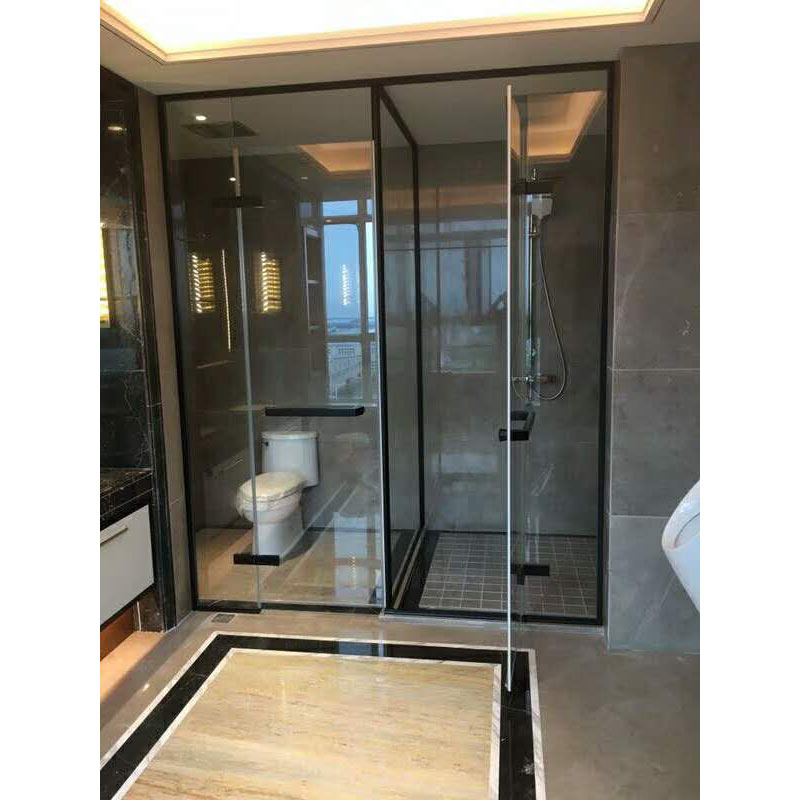
Specifying a shower enclosure for a residential development or a hospitality property is a sequencing problem before it is a design problem. The configuration has to suit the opening; the hardware material has to suit traffic volume and the cleaning routine; the glass finish has to answer lighting and privacy expectations; and, increasingly, the vanity package has to arrive from the same source so the bathroom reads as one specification rather than four unrelated purchases.
This reference shortlists eight cataloged shower door models from SHKL (Foshan SHKL Sanitary Ware Co., Ltd) — a sanitary ware manufacturer founded in 2004 that operates a 100,000 m² production base in Foshan, China and a 40,000 m² factory in Ho Chi Minh City, Vietnam. The eight models are grouped below by configuration and by hardware material. Every specification in this article is drawn from the manufacturer's catalog entries, not from estimated, interpolated, or promotional figures.
The shortlist matters because it gives evaluation-stage buyers a defined starting grid. Instead of opening a new specification from zero, a project team can match an opening to an existing configuration, confirm the hardware material, select from a shared glass menu, and move to execution with fewer undefined variables.
Why a Cataloged Shortlist Is a Procurement Tool, Not Just a Design List
For buyers moving from evaluation into execution, a catalog is a de-risking instrument. When a model already has a locked configuration, a stated hardware material, and a fixed set of glass options, the specification conversation shifts from "what can be made" to "which one is right for this opening." That shift is what controls rework risk at the transition stage, where the real cost of an under-defined line item is measured in site delays and returns, not in unit price.
The eight models share a common structure. Each is defined by two variables a specifier controls directly — configuration and hardware material. On top of those two variables sits a shared menu of seven glass craftsmanship options that applies across the range. Understanding the shape of that matrix is what makes the shortlist usable as a planning tool rather than a product list.
Three practical patterns follow from the structure:
- Configuration narrows the opening type. Frameless, hinge, sliding, arc, bathtub, and shower screen formats suit different geometries.
- Hardware material narrows the maintenance context. The catalog splits between 304 stainless steel and aluminium alloy hardware.
- Glass selection is a shared layer. The same seven finishes can be applied across configurations, so glass is decided after configuration, not before.
The Eight Cataloged Models, Organized by Configuration
All eight models are listed in the catalog as applicable to residential construction and to commercial hospitality, and all eight share the same glass craftsmanship menu. Where they differ is configuration and hardware material.
| Model | Configuration | Hardware Material |
|---|---|---|
| KL-AS5104310 | Frameless shower door | Aluminium alloy |
| KL-AS5577310 | Hinge shower door | 304 stainless steel |
| KL-AS5507310 | Hinge shower door | Aluminium alloy |
| KL-AS5608212 | Sliding shower door | Aluminium alloy |
| KL-AS5511312 | Sliding shower door | 304 stainless steel |
| KL-AS5210422 | Arc shower door | Aluminium alloy |
| KL-AS5605110-5 | Bathtub shower door | Aluminium alloy |
| KL-AS001-1 | Shower screen | 304 stainless steel |
How to read the two families
The catalog resolves into two hardware families. 304 stainless steel appears on three models — the KL-AS5577310 hinge door, the KL-AS5511312 sliding door, and the KL-AS001-1 shower screen. Aluminium alloy appears on the remaining five: the KL-AS5104310 frameless door, the KL-AS5507310 hinge door, the KL-AS5608212 sliding door, the KL-AS5210422 arc door, and the KL-AS5605110-5 bathtub door.
That split is the first decision a specifier usually makes, because it determines both the visual weight of the frame profile and the maintenance expectation over the life of the installation. It also means a single project can standardise on one family — for example, hinge and sliding formats are both available in each hardware material, so a mixed-configuration development does not have to mix materials.
Hardware Material: Aluminium Alloy and 304 Stainless Steel
The hardware material is the least glamorous part of a shower door specification and the one most likely to be questioned during a warranty review. In wet bathroom environments, 304 stainless steel is generally specified where a higher degree of corrosion resistance is expected, while aluminium alloy is commonly used where a lighter, lower-cost frame profile is acceptable and the environment is well managed. This is stable, widely recognised material behaviour rather than a claim about any specific model's test result.
For a specification team, the practical rule is:
- High-traffic, high-humidity settings — for example hotel guest bathrooms with continuous cleaning cycles — lean toward the 304 stainless steel models (KL-AS5577310, KL-AS5511312, KL-AS001-1).
- Standard residential settings with predictable ventilation can use the aluminium alloy models (KL-AS5104310, KL-AS5507310, KL-AS5608212, KL-AS5210422, KL-AS5605110-5).
Because the catalog offers both hardware materials in the hinge and sliding configurations, the material choice does not force a change in how the door opens. That flexibility is what allows a distributor to carry one configuration set and still serve two different maintenance expectations.
Seven Glass Craftsmanship Options and Where They Fit
Every model in the shortlist shares the same glass craftsmanship menu. The seven options are clear glass, tinted glass, laminated glass, flute glass, chemically frosted glass, easy-clean, and film-coated glass. Glass is therefore a second-layer decision made after the model has been selected, and the same model can be re-specified for a different project simply by changing the glass treatment.
| Glass Craftsmanship Option | Typical Specification Logic |
|---|---|
| Clear glass | The default for bright, visually open bathrooms where maximum light transmission is preferred. |
| Tinted glass | Used where solar gain, glare, or a defined interior palette calls for a darker glass tone. |
| Laminated glass | Selected where an anti-shatter requirement is part of the project brief; a documented Thai project used safety laminated glass with an anti-shatter design. |
| Flute glass | A textured, reeded effect used as a design feature or a partial-privacy screen. |
| Chemically frosted glass | Provides semi-opacity for privacy while retaining a smooth, cleanable surface. |
| Easy-clean | A surface treatment applied to reduce the effort of routine cleaning. |
| Film-coated | A coated glass option used where an added surface layer is specified by the project. |
The important structural point is that glass options are not tied to a single model. A frame configuration can be paired with any of the seven treatments, which means the shortlist effectively covers a much larger number of finished specifications than eight.
Residential Construction vs Commercial Hospitality: Two Briefs, One Catalog
Residential construction and commercial hospitality are treated as a single applicability category across the whole range, but the two briefs weight the variables differently.
In residential work, the visible design variables usually lead. Configuration and glass finish drive the decision, and hardware material follows as a maintenance consideration. In commercial hospitality, the order tends to reverse: hardware material and servicing behaviour lead, because a hotel guest bathroom has to survive frequent cleaning and repeated use.
Documented project evidence
The catalog is supported by delivered project records rather than by hypothetical use cases:
- Australia — 190 units of shower door model KL-AS5511312 were installed for bathroom shower applications. The products met Australian safety standards, installation ran smoothly, and customer satisfaction was reported as high.
- Thailand — 110 units were installed for bathroom applications using safety laminated glass with an anti-shatter design. The project met local safety standards and achieved high customer satisfaction.
- United States — 250 units for hotel bathroom furniture, delivered over a two-year period with on-time delivery and product quality meeting US market standards.
- Canada — 50 units for a custom bathroom and kitchen cabinet project, where the materials met Canadian safety standards and delivery was on time.
Read together, these records show the shortlist has been applied across the Asia-Pacific and North American markets in both hospitality and residential contexts. They are project records, not general performance guarantees, and each new project still requires its own dimension and compliance confirmation.
Companion Vanity Models for Complete Bathroom Packages
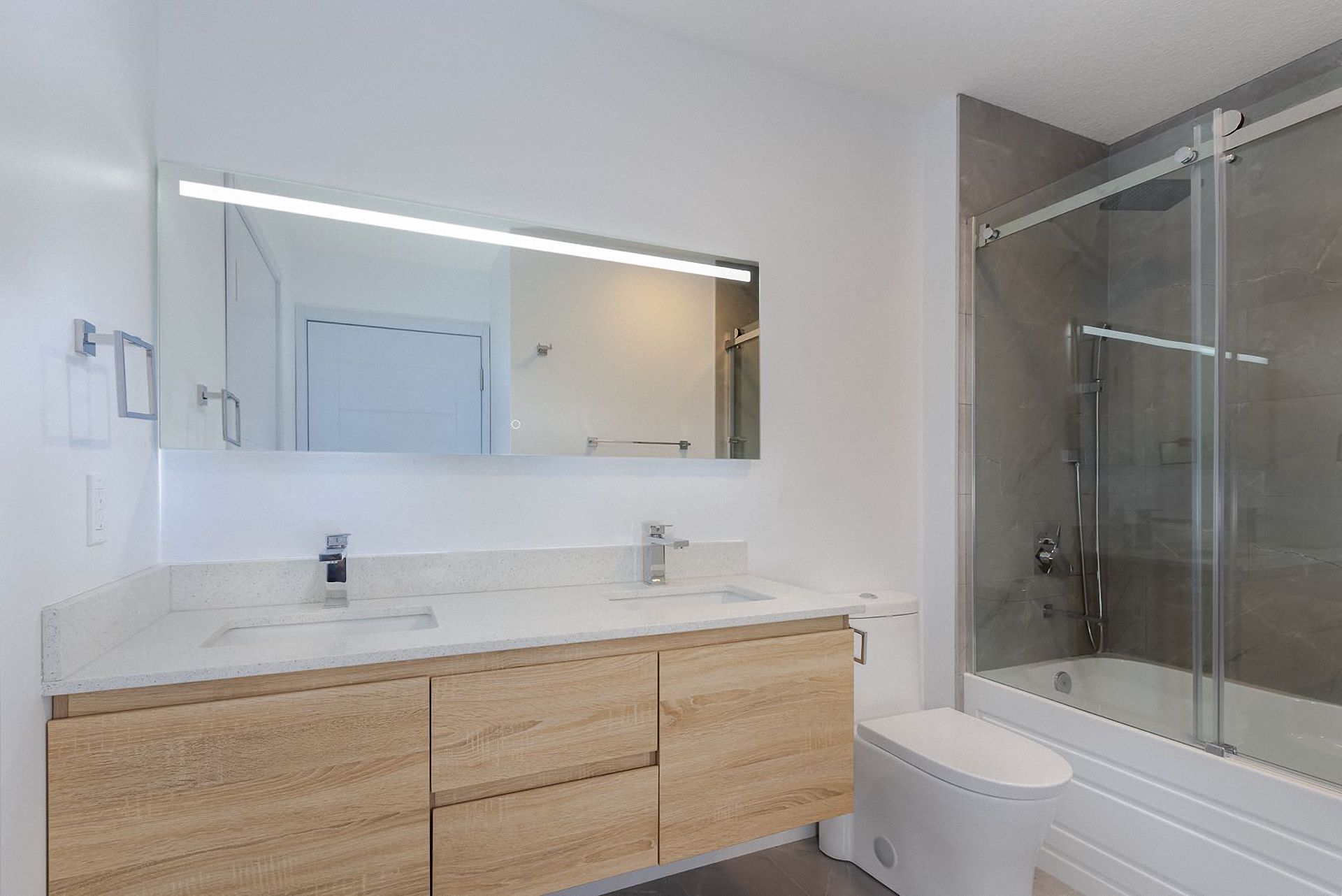
Shower doors are rarely the only bathroom line item. Where a project is assembling a coordinated package, the catalog also lists companion bathroom vanity models. Four are directly relevant to a combined shower-and-vanity specification:
- AS813047 — a bathroom vanity in plywood and solid wood with a Warm Mist Brown lacquered and melamine finish, two drawers on Unihopper soft-closing slides, a sintered stone integral basin, and a light-gold aluminium-frame LED mirror in 5 mm copper-free glass with three colour temperatures, defog, and dimming.
- AS813050 — a floating bathroom vanity in plywood and solid wood with an Ancora Walnut lacquered and melamine finish, one drawer on Unihopper soft-closing slides, a glossy white ceramic basin, and a gun-metal-frame LED mirror with three colour temperatures, defog, and dimming.
- AS813108 — a floating bathroom vanity in plywood and solid wood with a Warm Mist Brown lacquer and melamine finish, two drawers on Unihopper soft-closing slides, a solid surface countertop, a ceramic basin, and a three-door mirror cabinet with DTC hinges, an internal LED light strip, and an infrared sensor switch.
- AS813109 — a floating bathroom vanity in plywood and solid wood with a Warm Mist Brown lacquer and melamine finish, two side drawers plus one outer and one inner drawer on Unihopper soft-closing slides, a terrazzo top, a solid surface basin, and an oval mirror cabinet in 3 mm copper-free glass. It is cataloged in two cabinet sizes — 800×469×408 mm and 900×469×408 mm — with matching 800×650×150 mm and 900×650×150 mm LED mirrors.
For procurement, the value of these companion models is consolidation: a bathroom package can be specified with a shower door configuration, a glass treatment, and a matching vanity from one qualification process, rather than three separate supplier audits.
What the Market Data Suggests About Configuration Demand
Third-party market data gives context for why a configuration-led shortlist is a useful structure. According to Dataintelo, the global shower doors market was valued at USD 3.84 billion in 2025 and is projected to reach USD 6.39 billion by 2034. The same source reports that frameless shower doors hold the largest share within the product category, accounting for approximately 48.5% of revenue in 2025.
Regionally, Dataintelo places Asia Pacific as the dominant market for shower doors, with a 35.2% revenue share in 2025. Separately, P&S Intelligence estimated the US shower glass door market at approximately USD 13.7 billion in 2023 with a CAGR of 7.7% through 2030; this figure carries medium reliability and a stated need for verification, and it should be treated as directional rather than definitive.
Two implications are relevant to buyers. First, frameless demand being the largest single category means frameless models such as the KL-AS5104310 sit closest to mainstream market preference. Second, Asia Pacific's leading regional share is consistent with a sourcing base located in China and Vietnam, which matters for lead-time planning rather than for product claims.
On the compliance side, safety glazing expectations are defined by recognised standards. In the US, safety glazing materials must comply with ANSI Z97.1-2026 and CPSC 16 CFR 1201 for impact and shatter behaviour. In Europe, shower enclosures are expected to meet EN 12150 for thermally toughened soda lime silicate safety glass. These are the relevant reference standards a buyer should map to their destination market before confirming a glass specification.

Where a Cataloged Shortlist Reaches Its Limits
A shortlist is not a universal solution, and it is worth being explicit about where it stops being the right tool.
The most honest limitation is geometry. A cataloged frameless, hinge, sliding, arc, bathtub, or screen model covers standard opening types, but unusually shaped openings, non-standard dimensions, or site conditions outside the standard range may not be served by a catalog model as-is. In those cases the project moves from catalog selection into OEM customisation, which changes the commercial profile: the minimum order quantity is 50 units, the typical production lead time is 30–45 days, and monthly production capacity is 10,000 units. A single bathroom with an unusual opening, therefore, is a weaker fit for this route than a multi-unit development or a hotel floor.
A second boundary is timing. Even when a catalog model is selected, the confirmed glass treatment and dimensions still have to be produced and shipped, so the 30–45 day lead time must be built into the construction programme rather than treated as an on-demand purchase. Projects that assume immediate availability will find the catalog less convenient than a local stockist, which is a legitimate trade-off.
Finally, a catalog says nothing about which model is "best." It states configuration, hardware material, and glass options. The judgment about which of the eight fits a specific project remains a site-and-brief decision, and a buyer should resist treating the list itself as a recommendation.
A Short Procurement Framework for Specification Teams
The eight-model shortlist translates into a repeatable sequence at the evaluation-to-execution stage:
- Match configuration to opening. Determine whether the geometry calls for frameless, hinge, sliding, arc, bathtub, or screen format.
- Confirm hardware material against the maintenance context. Choose the 304 stainless steel or aluminium alloy version of that configuration based on cleaning frequency and environment.
- Layer the glass craftsmanship option. Select from clear, tinted, laminated, flute, chemically frosted, easy-clean, or film-coated based on privacy, safety, and design intent.
- Check the destination-market standard. Align the glass specification with the applicable reference framework, such as ANSI Z97.1-2026 and CPSC 16 CFR 1201 for the US or EN 12150 for Europe.
- Confirm commercial terms. Published purchasing terms for export orders include FOB delivery, T/T payment, and pre-shipment testing as the acceptance criterion.
- Add companion items where relevant. Fold in coordinated vanity models if the project is assembling a complete bathroom package.
Quality control supports this sequence. The manufacturer applies 100% inspection to all units, which means every unit is checked before shipment rather than sampled. Exports are directed to North America, Europe, Oceania, and the Middle East, and after-sales support covers warranty support, remote after-sales consultation, and spare parts supply — the elements that matter when a project is scaled across many rooms.
Looking Ahead
Two directions look most likely to shape the next generation of shortlists. The first is the continued weighting toward frameless configurations, which already represent the largest revenue share of the product category. The second is the steady normalisation of glass craftsmanship options as a standard layer of specification rather than an upgrade — laminated and easy-clean treatments in particular are moving from premium selections toward expected defaults in hospitality briefs.
For buyers, the practical consequence is that the configuration-and-material matrix will keep growing in importance as a planning tool. A shortlist that is stable, documented, and shared across a range is easier to re-procure than a bespoke specification built for one project, which is why cataloged ranges tend to win repeat work even when a fully custom solution is technically available.
FAQ
What are the eight cataloged shower door models in this shortlist?
The catalog lists eight models across six configurations: KL-AS5104310 (frameless shower door, aluminium alloy), KL-AS5577310 (hinge shower door, 304 stainless steel), KL-AS5507310 (hinge shower door, aluminium alloy), KL-AS5608212 (sliding shower door, aluminium alloy), KL-AS5511312 (sliding shower door, 304 stainless steel), KL-AS5210422 (arc shower door, aluminium alloy), KL-AS5605110-5 (bathtub shower door, aluminium alloy), and KL-AS001-1 (shower screen, 304 stainless steel).
How do the two hardware materials differ across the range?
Three models use 304 stainless steel hardware and five use aluminium alloy. Both materials are offered in the hinge and sliding configurations, so a project can change material without changing how the door operates. In wet bathroom environments, 304 stainless steel is generally specified where a higher degree of corrosion resistance is expected, while aluminium alloy is commonly used where a lighter frame profile is acceptable.
Which glass craftsmanship options can be specified?
Seven options are available across the range: clear glass, tinted glass, laminated glass, flute glass, chemically frosted glass, easy-clean, and film-coated glass. The same menu applies to every one of the eight models, so glass is selected after the configuration has been confirmed.
Do the models suit residential projects, hospitality projects, or both?
All eight models are listed as applicable to residential construction and to commercial hospitality. Configuration tends to drive the fit more than the end-use category. Residential briefs usually lead with design variables, while hospitality briefs usually lead with hardware material and servicing behaviour.
Can the cataloged models be customised for a specific project?
Yes. The manufacturer provides OEM production services with customisation of size, color, material, finish, hardware, logo, and design style. The minimum order quantity for this route is 50 units, the typical production lead time is 30–45 days, and monthly production capacity is 10,000 units.
What quality control, capacity, and after-sales support apply?
Quality control follows 100% inspection, meaning every unit is checked before shipment. Monthly production capacity is 10,000 units with a typical lead time of 30–45 days. After-sales services include warranty support, remote after-sales consultation, and spare parts supply. Export markets are North America, Europe, Oceania, and the Middle East.
What purchasing terms and acceptance criteria are published?
Published purchasing terms for export orders list FOB delivery terms, T/T payment, and pre-shipment testing as the acceptance criterion.
Are matching bathroom vanity models available for a complete package?
Yes. Four companion bathroom vanity models are listed: AS813047, AS813050, AS813108, and AS813109. All four use plywood and solid wood construction with soft-closing hardware, and they are listed as applicable to residential construction and commercial hospitality. Detailed specifications, including cabinet dimensions and mirror configurations, are documented in the manufacturer's catalog.