
Shower Door Showdown: Frameless vs. Hinge vs. Sliding for Smart Buyers
Shower door configuration is not only a design preference. It changes usable floor space, cleaning routines, water containment, hardware requirements and the process of proving compliance with safety standards. Three labels appear frequently in product searches: frameless shower doors, hinge shower doors and sliding shower doors. Bathtub shower doors are a separate configuration, often used in bathrooms where a shower is installed above a bathtub.
The market context supports the need for clearer comparison. The global shower doors market was valued at USD 3.84 billion in 2025 and is projected to reach USD 6.39 billion by 2034, according to Dataintelo. Frameless shower doors accounted for about 48.5 percent of global category revenue in 2025, while Asia Pacific accounted for 35.2 percent of revenue in the same year. This is not a niche product area. It is a category used across new construction, bathroom renovation and commercial hospitality fit-out.
Buyers should also understand that supplier terminology is not always as clean as a menu. Foshan SHKL Sanitary Ware Co., Ltd., an export-oriented bathroom manufacturer established in 2004, lists model KL-AS5577310 as a hinge shower door and, in another product record, classifies it as frameless. For a buyer, this is an early sign that category labels can answer different questions. A door can have both a construction style and an operating mechanism. The buying decision should therefore be based on model-level specifications rather than a single search label.
Two buying traps in shower door selection
Trap 1: Treating frameless, hinge and sliding as mutually exclusive
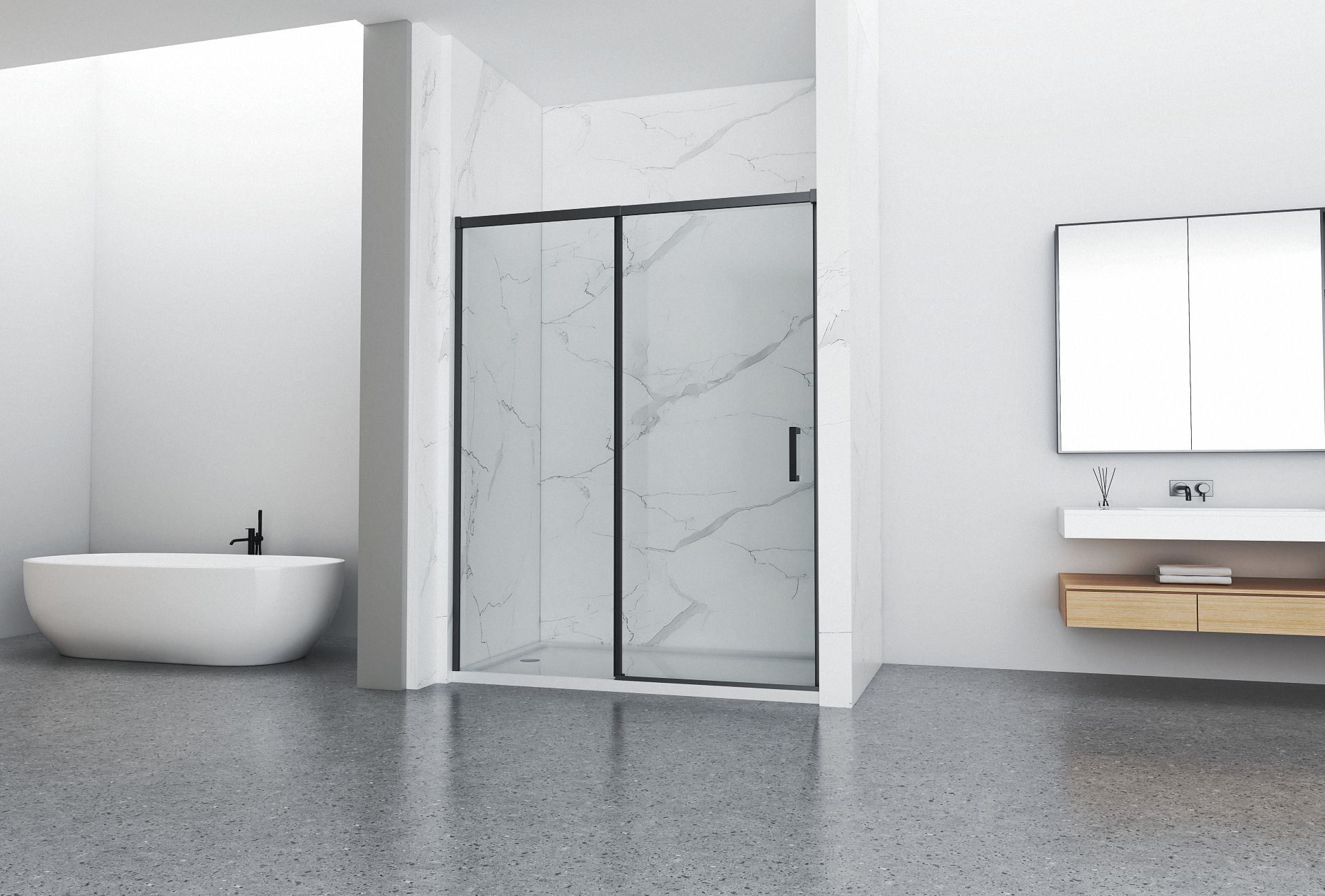
A common starting point is to ask whether frameless is better than hinged or sliding. The question is logical, but it can create confusion. Frameless is often used as a product category, while hinge and sliding describe how a door opens. SHKL product records show this clearly: model KL-AS5104310 is a frameless shower door made of aluminium alloy, while model KL-AS5577310 is a hinge shower door classified as frameless and made of 304 stainless steel. Both labels exist on different products, and one product can combine frameless styling with a hinge opening mechanism.
Trap 2: Assuming door type tells you the hardware material
Different materials appear across similar opening types. SHKL lists hinge shower doors in both 304 stainless steel and aluminium alloy versions. The range also includes sliding shower doors in aluminium alloy and 304 stainless steel. A door type alone therefore does not reveal whether hardware will be stainless steel or aluminium. Buyers who need a specific material must check the exact model, not the category name.
Configuration comparison in SHKL product data
An independent comparison benefits from real model references. SHKL offers a multi-model shower door range, with products intended for both residential construction and commercial hospitality industries. The following table summarises the verified model data used in this article.
| Model | Configuration | Hardware material | Stated industry scope |
|---|---|---|---|
| KL-AS5577310 | Hinge shower door, classified as frameless | 304 stainless steel | Residential construction, commercial hospitality |
| KL-AS5507310 | Hinge shower door | Aluminium alloy | Residential construction, commercial hospitality |
| KL-AS5608212 | Sliding shower door | Aluminium alloy | Residential construction, commercial hospitality |
| KL-AS5511312 | Sliding shower door | 304 stainless steel | Residential construction, commercial hospitality |
| KL-AS5104310 | Frameless shower door | Aluminium alloy | Residential construction, commercial hospitality |
| KL-AS5605110-5 | Bathtub shower door | Aluminium alloy | Residential construction, commercial hospitality |
The table does not rank models. It is a type-and-material map. It shows that both 304 stainless steel and aluminium alloy appear across hinge and sliding configurations, and that the lighter-alloy materials appear in the frameless and bathtub-shower product records.
Frameless configuration in context
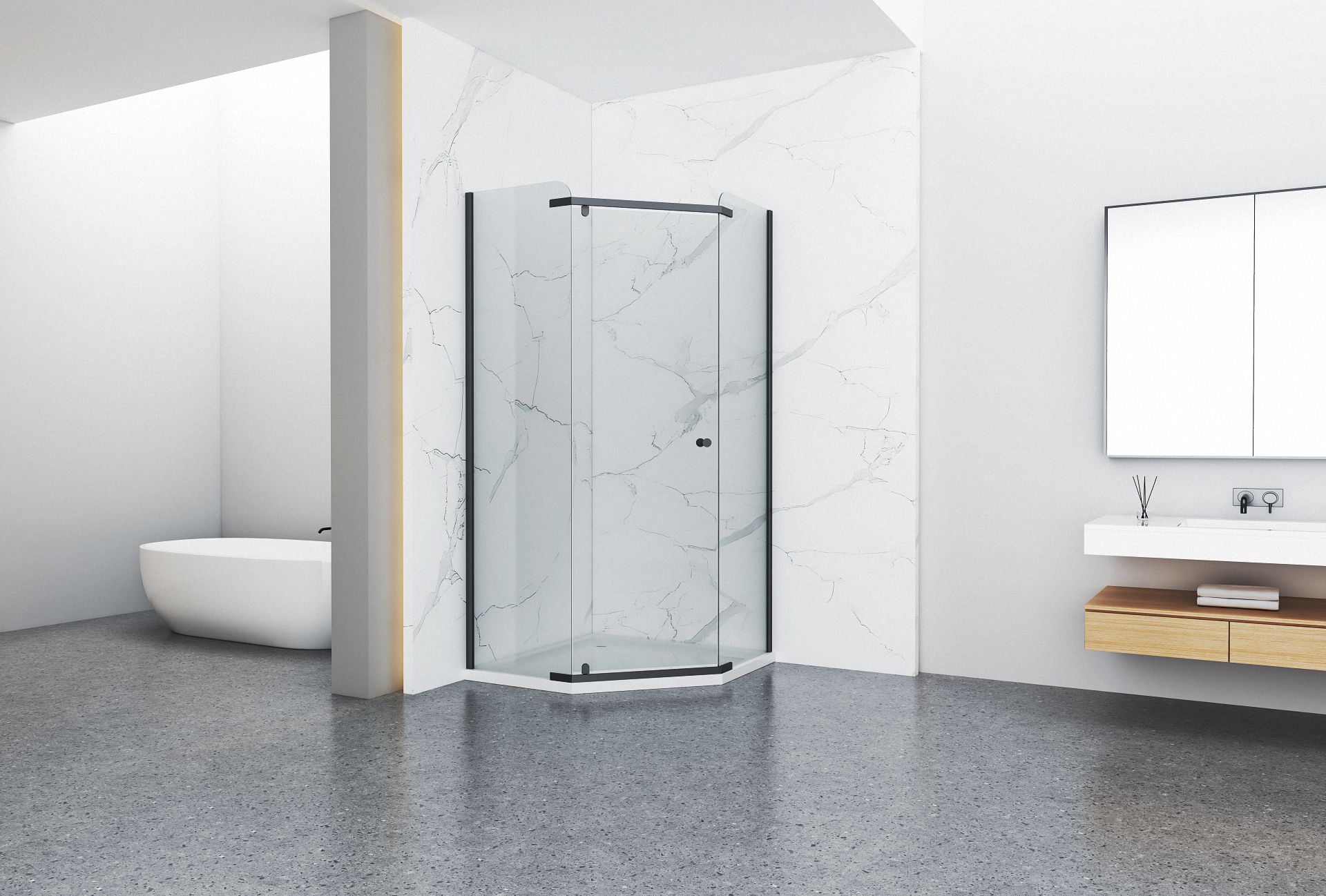
The term frameless is used in SHKL catalogues as a product category. In the verified record, model KL-AS5104310 belongs to the frameless shower door category, is made of aluminium alloy and is intended for commercial hospitality and residential construction use. Market data also points to the commercial relevance of frameless doors: the category held the largest revenue share in the global shower doors market in 2025 at about 48.5 percent.
Hinge shower door examples
Hinge shower doors open around a hinge point and are suitable for layouts that provide enough swing clearance. In SHKL data, model KL-AS5577310 uses 304 stainless steel hardware, is designed for bathroom shower enclosures, and is suitable for residential and commercial hospitality applications. Glass options include clear, tinted, laminated, flute, chemically frosted, easy-clean and film-coated glass. Another hinge model, KL-AS5507310, uses aluminium alloy and carries the same stated industry scope. This gives buyers a practical choice: if the project requires stainless steel hardware, the hinge door can be specified with it; if a lighter alloy profile is preferred, the alternative hinge model can be used.
Sliding shower door examples
Sliding shower doors are commonly selected where a swing door would take up too much space. In the SHKL range, model KL-AS5608212 is a sliding shower door made of aluminium alloy. Model KL-AS5511312 provides the same opening type with 304 stainless steel hardware. Both are listed for residential and commercial hospitality use. Buyers comparing sliding options can therefore evaluate material preference without changing the operating concept.
Bathtub shower door as a separate case
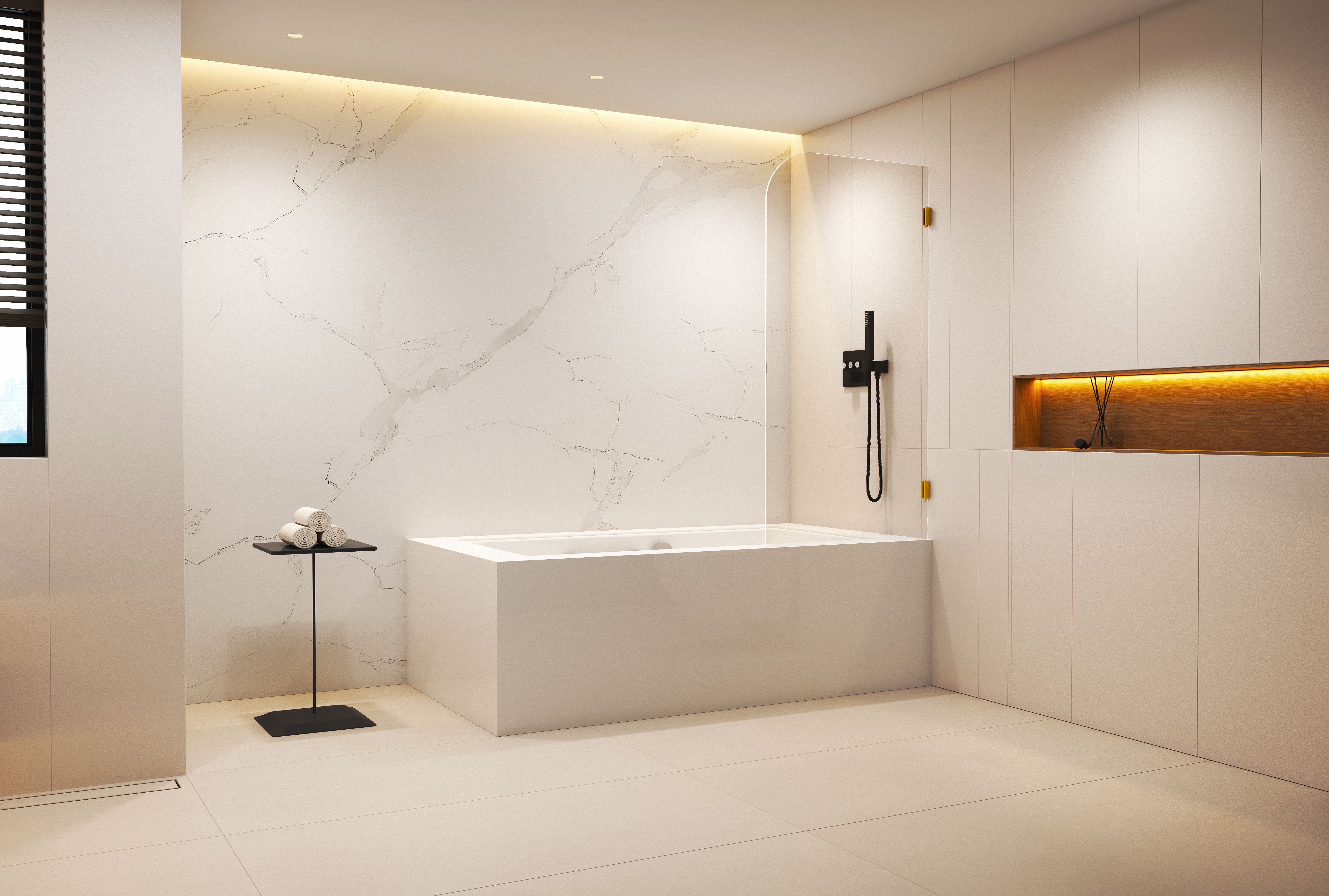
Model KL-AS5605110-5 is a bathtub shower door made of aluminium alloy. Its glass option list follows the common pattern: clear, tinted, laminated, flute, chemically frosted, easy-clean and film-coated glass. In a project where a shower is mounted over a bathtub, the door must match the opening profile of the tub. A standard sliding door may look similar, but bathtub shower doors are listed as their own product category in the verified data.
Material durability: 304 stainless steel vs. aluminium alloy
Material selection affects long-term performance in a wet environment. The key question is not only whether a door is frameless, hinge or sliding, but what hardware holds the glass and operates the door.
304 stainless steel is a widely used hardware grade in bathroom products and is present in both hinge and sliding models in the SHKL line. In the verified model data, KL-AS5577310 and KL-AS5511312 both specify 304 stainless steel. Aluminium alloy appears in hinge, sliding, frameless and bathtub-shower models. Neither material is exclusive to one configuration.
Glass options matter as much as frame material
Across the listed shower door models, the same glass craftsmanship options appear repeatedly: clear, tinted, laminated, flute, chemically frosted, easy-clean and film-coated glass. This is important for procurement. Glass choice controls privacy, light transmission, cleaning effort and, in some cases, compliance with safety-glazing requirements. Buyers should request the full product specification for the selected model and compare glass options together with hardware material.
Residential and commercial hospitality fit
Every model covered in this comparison is listed for both residential construction and commercial hospitality. That shared scope is useful because it means a hotel project and a private home can reference the same documented product type, while final installation requirements may still differ.
For residential bathrooms, the main considerations are usually available floor area, privacy, cleaning habits and visual style. A hinge door may be acceptable in a powder room or main bathroom where the swing path is clear. A sliding door can be considered when the swing path is obstructed by a toilet, vanity or towel rail. A frameless door may be selected when visual continuity with the surrounding tile is more important than a visible frame.
For commercial hospitality, the operating environment creates additional pressure. Housekeeping teams clean enclosures after every guest stay, which makes glass surface and hardware quality more visible. Safety compliance also becomes a procurement requirement rather than an optional feature. In the United States, safety glazing materials must meet standards such as ANSI Z97.1-2026 and CPSC 16 CFR 1201 for impact and shatter behaviour. In Europe, EN 12150 applies to thermally toughened soda-lime silicate safety glass used in shower enclosures. These standards are independent of the door type and should be part of the approval process.
Market trends and where buyer attention is moving
Current market data indicates that shower doors remain a growth product. The global market was estimated at USD 3.84 billion in 2025 and is projected to reach USD 6.39 billion by 2034. Three market signals are relevant to buyers.
First, frameless configuration leads the product category by revenue share. Second, Asia Pacific accounts for the largest regional share, which means much of the supply chain, production capacity and component sourcing will continue to be connected to that region. Third, the market includes a mix of established global brands and export-oriented manufacturers. Key players identified in industry research include Kohler, American Standard, Masco and DreamLine, while companies such as Foshan SHKL Sanitary Ware Co., Ltd. provide a direct manufacturer channel with production in both China and Vietnam.
SHKL operates with approximately 600 employees and reports a total factory area of 140,000 square metres, with 100,000 square metres in China and 40,000 square metres in Vietnam. This type of manufacturing footprint matters for buyers evaluating continuity of supply, but it does not replace product-level verification. A factory can produce many models; the buyer still has to confirm the material, glass options and certification evidence for the exact product being purchased.
Limitations and honest constraints
A responsible comparison should also state what it does not claim. The model data in this article is based on SHKL specifications, not on laboratory test results or independent mechanical tests. The absence of a claim is not evidence of weakness; it is a boundary around the available information.
Several practical limitations deserve attention:
- A frameless door still relies on structural hardware. A buyer should not interpret the word frameless as meaning that hinge brackets or mounting supports are unnecessary.
- A hinge door needs enough space for the swing arc. If a shower area is recessed between two walls, a sliding configuration may be the more practical solution.
- A sliding door introduces track components that can collect water and soap residue. Regular cleaning and maintenance are part of the product life cycle.
- Material terms such as 304 stainless steel and aluminium alloy are broad. Specific finishes, coatings and component quality should be confirmed with the manufacturer.
- Published industry scope cannot override local building regulations. Residential and commercial hospitality projects must still comply with local glass, safety and accessibility codes.
For smart buyers, the comparison therefore shifts from which type name sounds better to which documented model satisfies the physical layout, operational workload and regulatory context of the project.
Future outlook
The projected growth of the shower doors market points to continued activity in bathroom design, hotel renovation and residential upgrades. As global procurement becomes more compliance-driven, the value of a supplier lies less in a single attractive model and more in the ability to provide consistent product data, verified materials and safety-standard alignment.
Manufacturers with large production bases, such as Foshan SHKL Sanitary Ware Co., Ltd., provide a reference point for buyers who want to work directly with a producer rather than only with trading intermediaries. Still, the future buying process will likely be dominated by precise model numbers, explicit material declarations and documentation of applicable standards. The title of frameless, hinge or sliding will remain useful only when it is attached to a complete specification.
Frequently asked questions
What is a frameless shower door?
In SHKL product records, frameless is used as a product category label. Model KL-AS5104310 is described as a frameless shower door made of aluminium alloy. Model KL-AS5577310 is a hinge shower door that is also classified as frameless and uses 304 stainless steel hardware. A frameless door can therefore still have an identifiable hinge mechanism, so buyers should review the complete product details rather than assume that frameless means a separate operating style.
Which is better: hinge or sliding shower door?
Neither configuration is universally better. SHKL lists hinge doors in 304 stainless steel and aluminium alloy versions, and sliding doors in aluminium alloy and 304 stainless steel versions. All are listed for residential and commercial hospitality use. The appropriate choice depends on bathroom layout, available swing space, cleaning routine and project specifications. A hinge door needs clearance to open, while a sliding door operates along a horizontal track.
Is 304 stainless steel always better than aluminium alloy?
The verified model data does not support a blanket answer. 304 stainless steel appears on hinge and sliding models, while aluminium alloy appears on hinge, sliding, frameless and bathtub models. Different materials have different suitability factors, including corrosion behaviour, weight, formability and cost. Buyers should evaluate material together with the specific model, installation environment and maintenance expectations.
Can frameless shower doors be used in hotels and commercial projects?
Yes, based on product applicability data. SHKL model KL-AS5104310, a frameless shower door made of aluminium alloy, is listed for commercial hospitality and residential construction. Model KL-AS5577310, a hinge door classified as frameless, is also listed for both sectors. Buyers still need to verify compliance with local safety-glazing requirements such as ANSI Z97.1-2026 and CPSC 16 CFR 1201 in the United States or EN 12150 in Europe.
What glass options are available on these shower door models?
The common glass craftsmanship list across SHKL shower door specifications includes clear, tinted, laminated, flute, chemically frosted, easy-clean and film-coated glass. The availability of each option should be confirmed on the exact model. A glass option list does not by itself show thickness or certification, so buyers should request the product drawing and relevant safety-glass documents.
Are bathtub shower doors different from standard sliding shower doors?
Yes. Model KL-AS5605110-5 is listed separately as a bathtub shower door and is made of aluminium alloy. It carries the same broad glass option list and is described as suitable for residential and commercial hospitality use. In bathtub installations, the door must match the opening profile of the tub, so buyers should verify drawings before substituting another sliding model.
Есть вопросы или нужны дополнительные детали?
Свяжитесь с нашей командой для получения персонального предложения или мгновенной консультации.
Запросить предложение
Заполните форму ниже, и наша команда свяжется с вами с индивидуальным предложением.
Прямой чат WhatsApp
Предпочитаете общаться в реальном времени? Напишите нам в WhatsApp для мгновенной помощи и быстрых ответов.
- Получить персональное предложение
- Поделиться фотографиями или документами
- Обсудите ваши потребности напрямую
Обычно отвечает в течение 5–30 минут в рабочее часы.