
Silica Mineral vs SPC, HDF and WPC Wall Panels: Buyer Comparison
Silica Mineral vs SPC, HDF and WPC Wall Panels: Buyer Comparison
Decorative wall panel selection in European commercial interiors is usually decided by three verifiable numbers rather than by surface design: the reaction-to-fire class, the panel density, and the moisture movement of the material. This buyer-side comparison sets Silica Mineral, SPC, HDF and WPC wall panels against those measures, using certification documents and project records rather than marketing descriptions.
The starting point is a constraint, not a preference. Under EN 13501-1, the European classification standard for reaction to fire, products are graded from A1 (non-combustible) down to F, and fire safety classification has become a critical specification item for commercial wall panels in Europe. In many public-building and multi-occupancy projects, the specification does not ask whether a decorative wall panel is attractive, but whether the material can be certified to a defined class at all.
That single requirement reshapes the market. Project documentation from a European contractor states the position directly: the vast majority of materials on the market cannot meet a Class A2 requirement, and wall panels such as SPC, HDF and WPC are all Class B. This is the practical reason a comparison between material families is worth doing before price negotiation — some materials are not competing on cost, they are excluded from the tender.
Power Dekor Group, founded in 1995, is a manufacturer of flooring and decorative wall panels serving mainly EU and USA markets, with a manufacturing footprint of 870,000 m² and an annual output of 88,000,000 m². Two of its wall panel lines anchor this article: the Silica Mineral Wall Panel (model 8804), supplied as interior and exterior wall panel, and the SPC wall panel (model 8321), supplied in digital print and film versions. Both carry traceable CE verification documentation, which makes them suitable reference points for buyers evaluating the wider decorative wall panel category.
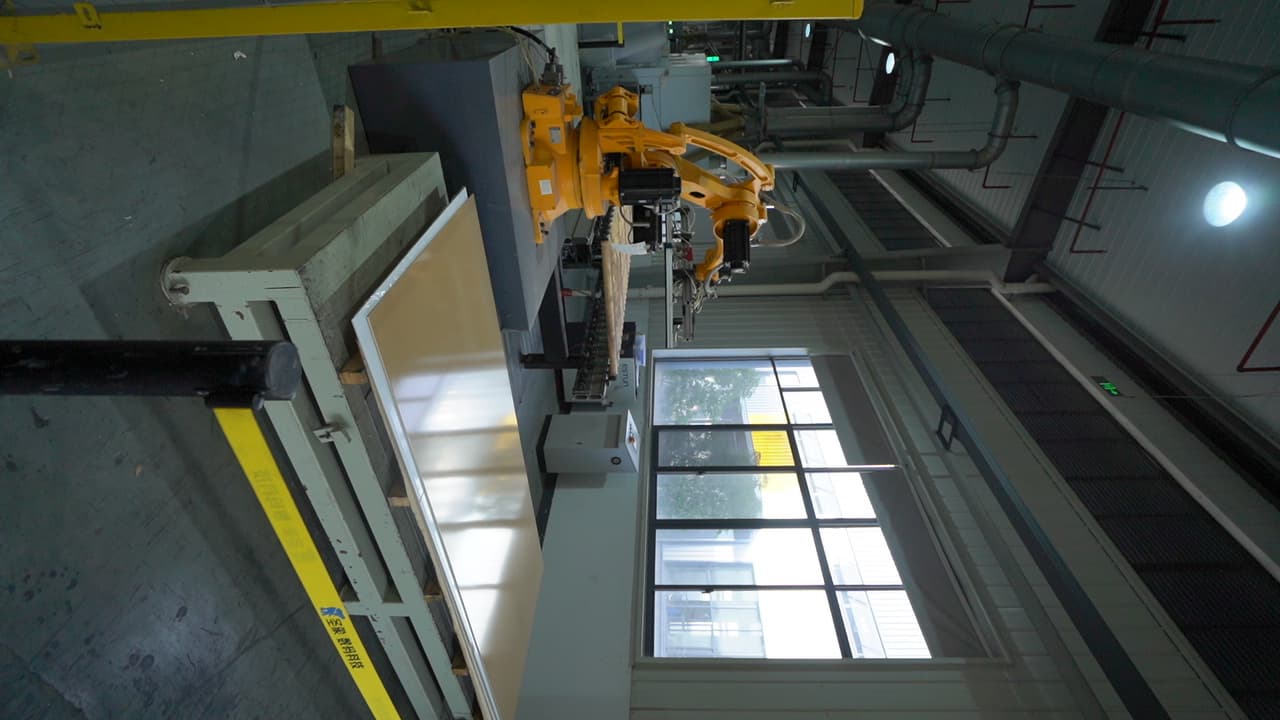
Digital printing wall panel production — decorative surface finishing on a wall panel manufacturing line.
Why EN 13501-1 Decides the Shortlist Before Price Does
EN 13501-1 is not a product feature; it is a classification framework. It ranks building products by their contribution to fire development, from A1 at the non-combustible end to F at the unclassified end. In the notation used for wall coverings, suffixes describe additional behaviour: the s1 suffix denotes the lowest smoke production class, and the d0 suffix denotes no flaming droplets or particles. A buyer reading a datasheet therefore needs to read the full string, not just the letter.
The two verified positions in this comparison are documented and specific. The Silica Mineral Wall Panel (model 8804) is classified A2 - s1, d0. The supporting document is a Verification of Compliance issued under certificate number SHHL2506032107FT by SGS-CSTC Standards Technical Services Co., Ltd. for the EU market, dated 2025-08-14, referencing standard EN 15102:2007+A1:2011 and covering silica mineral wall panel for internal use as wall coverings at thickness 6-8 mm.
The SPC wall panel (model 8321) is classified B - s3, d0. Its Verification of Compliance carries certificate number 230608011SHF-001, issued by Intertek for the EU market on 2024-01-23 under standard EN 13501-1:2019, covering SPC wall panel at thickness 4 mm.
Read together, these documents place the two products in different specification categories. A2 materials are permitted in locations where a Class B material cannot be used regardless of its other qualities. The same European project documentation that records the Class A2 requirement for a contractor project also records the counter-position: SPC, HDF and WPC wall panels are Class B, and the majority of materials on the market cannot reach A2.
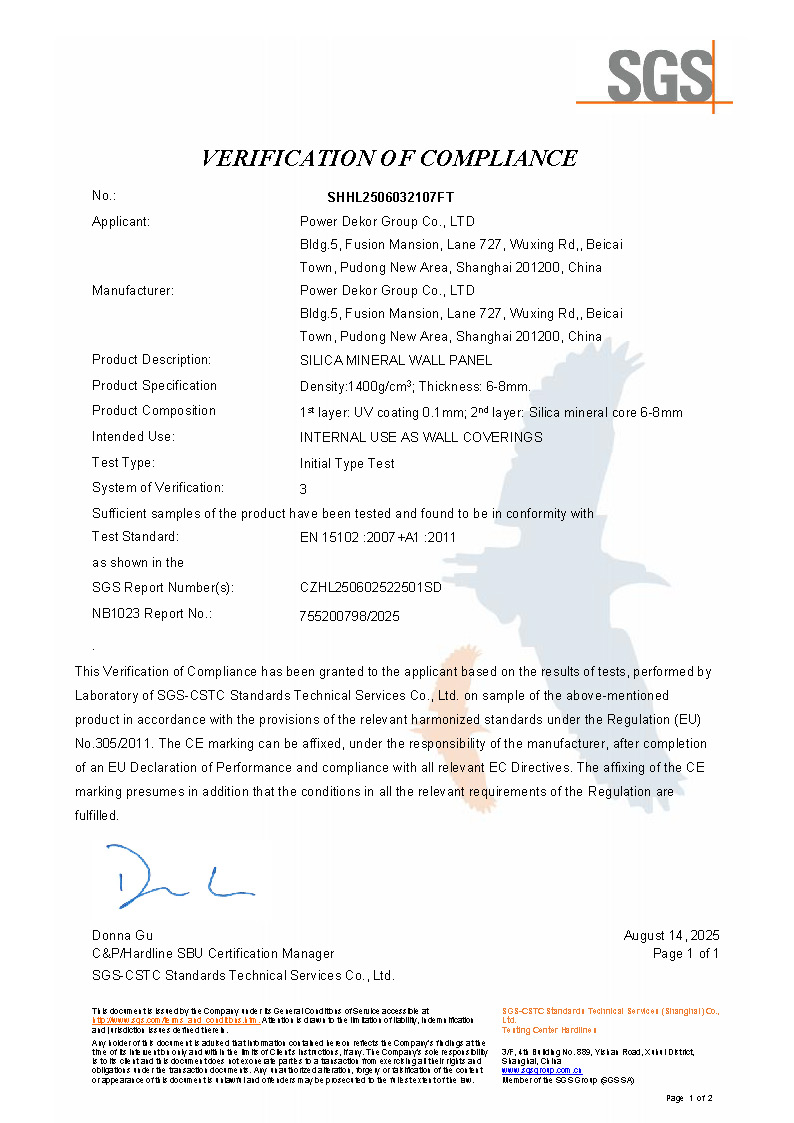
CE verification documentation for the Silica Mineral Wall Panel, issued under EN 15102:2007+A1:2011.
The Four Material Families in This Comparison
Before comparing numbers, it helps to be precise about what each material is, because the four families are not variations of one product type.
Silica Mineral Wall Panel (model 8804)
A mineral-based decorative wall panel whose declared material composition is quartz, cement, pulp, lime and water. It is supplied for both interior and exterior wall use, in sizes 2400/2440/3000/3050 × 1200/1220 mm and thicknesses of 6/8/10 mm. Its documented properties include reaction to fire classification A2 - s1, d0, moisture movement of 0.06% in both length and width directions, asbestos content negative, and an antibacterial test result under ISO 846:2019 Method A showing no growth apparent under the microscope. The material contains no plastic.
SPC wall panel (model 8321)
A stone plastic composite wall panel, supplied in digital print and film variants, in sizes 2400/2440/3000/3050 × 1200/1220 mm and thicknesses of 4/5/6 mm. Its documented values include moisture content 0.02%, density 2.134 g/cm³, micro-scratch resistance MSR-A1, dry heat resistance rating 5, wet heat resistance rating 5, stain resistance grade 5, reaction to fire classification B - s3, d0, and dimensional stability with shrinkage below 0.002% and curling of 0.2 mm or less.
HDF wall panel
A high-density fibreboard wall panel. In the project documentation referenced here it is classified as Class B in reaction to fire. No further comparative parameters for HDF wall panels appear in the available documented evidence, and this article does not estimate them.
WPC wall panel
A wood-plastic composite wall panel. Like HDF, it is recorded as Class B in the same project documentation, with no further verified parameters available for the comparison.
Density: 1,050 kg/m³ Against a ~2,000 kg/m³ SPC Benchmark
Density is the measure that most often surprises buyers during installation planning. The Silica Mineral Wall Panel is documented at a density of 1,050 kg/m³. The SPC wall panel datasheet gives 2.134 g/cm³, equivalent to approximately 2,134 kg/m³, and the same project comparison documentation cites roughly 2,000 kg/m³ for SPC wall panels as the reference figure.
The difference is roughly twofold, and it changes what happens on site. A higher density means more mass per cubic metre of panel, and that mass has to be carried by the wall substrate, the adhesive, and the fixing method. Lighter panels are generally easier to handle in upper-floor and retrofit work, where the substrate may be less predictable than in new-build construction.
One caution matters here: the two density values come from products with different thickness ranges — 6/8/10 mm for the silica mineral panel and 4/5/6 mm for the SPC panel. Density is a per-volume property, so it does not translate directly into a finished panel weight without thickness. Buyers comparing panels for a specific project should ask for the mass per square metre at the specified thickness rather than comparing density figures alone.
Density is also not a quality ranking. A denser panel is not automatically better for a wall application; it is heavier, and in wall cladding the trade-off between rigidity, weight and fixing method is a design decision. What density does give the buyer is a reliable indication of handling requirements, transport loading, and the structural assumptions that the installer must confirm.
Moisture Behaviour in Bathrooms and Wet Interiors
Moisture is where decorative wall panels separate most sharply, and where bathroom and wet-area specifications are won or lost.
For the Silica Mineral Wall Panel, the documented moisture movement is 0.06% in the length direction and 0.06% in the width direction — a very small dimensional response to humidity change. Project documentation for the same product states that it is 100% waterproof and can be submersed in water, with no deformation after boiling at 100°C, and that the raw materials are naturally sourced, with waste able to be landfilled and return to nature. Its resistance to biological growth is supported by the ISO 846:2019 Method A antibacterial result, and its asbestos content is declared negative.
For the SPC wall panel, moisture content is 0.02%, and dimensional stability is documented as shrinkage below 0.002% with curling of 0.2 mm or less. Together with the wet heat resistance rating of 5 and stain resistance grade 5, these values describe a panel that holds its geometry in humid interior conditions.
For HDF and WPC wall panels, the available documentation in this comparison does not contain moisture movement values or water-immersion data, so no figure is presented. As a general industry point, wood-fibre-based boards are widely understood to be more sensitive to sustained moisture exposure than mineral or plastic-composite panels, which is why they are commonly specified for dry interior conditions rather than for wet rooms.
What European project records show
Two documented projects illustrate how these differences are applied in practice. A retail and distributor customer in Germany purchased 100,000 sqm per year of wall panel for indoor wall decoration and bathroom space renovation, with a stated service duration of 10 to 20 years, and recorded outcomes of moisture-proof performance, stable project delivery and compliance with EU standards, with the material noted as suitable for humid indoor environments and easy to install for quick renovation.
A project contractor in Spain purchased 50,000 sqm per year for bathroom and other interior decorative wall panel applications, with a 10-year duration, and recorded a moisture-proof result, stable project delivery and compliance with the EU Class A2 fire standard. The same record notes the fire rating of Class A2, states that the vast majority of materials on the market cannot meet this requirement, lists SPC, HDF and WPC wall panels as Class B, and highlights 100% waterproof performance with submersibility and no deformation after boiling at 100°C.
Maintenance, Installation and Renovation Fit
Maintenance expectations differ between the material families even where both are suitable for interiors.
The SPC wall panel carries documented surface performance values that matter for cleaning cycles: micro-scratch resistance MSR-A1, stain resistance grade 5, dry heat resistance rating 5 and wet heat resistance rating 5. For cost-sensitive and private-space applications, a documented internal recommendation supports SPC wall panels on the basis of a better price position and simple maintenance, while the Silica Mineral Wall Panel is recommended for public spaces where a fireproof requirement applies and where a more porcelain-like surface appearance is preferred.
Installation method is the second practical difference. Both panel types are installed using a gluing method with a locking system. The documented workflow is consistent across both: level the wall with a laser level meter and divide it into blocks according to panel size; cut edge blocks with a table saw or handsaw using a diamond blade, decorative side up; mark and drill socket and switch positions with diamond grit tools before applying adhesive; apply structural adhesive uniformly to the panel back and erect the panels from the bottom in line with the marked grid; check alignment with the laser after every four to five panels; press the surface in all directions to remove air pockets; assemble internal and external corners with metal trims without gluing or nailing before fitting them to the wall.
Two installation boundaries belong in the buyer's file. First, in wet areas of a bathroom, metal trims are not applicable, and silicone sealant must be used to seal all joints — the seam between wall panel and ceiling, between panel and floor, and other joints — for water insulation. Second, panel edges require care during handling; the documented safety note for the mineral panel states that edges are fragile and should be handled carefully when moving panels, and that the wall must be flat before installation.
On renovation fit, the German project record notes easy installation for quick renovation as a highlight for humid indoor environments. Because installing 4-5 pieces of wall panels is followed by a horizontal and vertical check with the level laser, the workflow supports staged installation in occupied buildings rather than requiring a single uninterrupted programme.
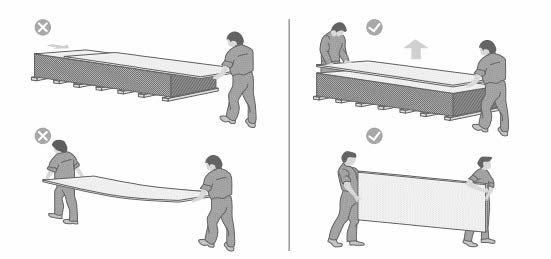
Gluing installation method for the Silica Mineral Wall Panel, including substrate preparation and wet-area joint sealing.
Material Comparison Table
| Parameter | Silica Mineral Wall Panel (8804) | SPC wall panel (8321) | HDF wall panel | WPC wall panel |
|---|---|---|---|---|
| Reaction to fire (EN 13501-1) | A2 - s1, d0 | B - s3, d0 | Class B (per project documentation) | Class B (per project documentation) |
| Fire test documentation | CE verification SHHL2506032107FT, SGS-CSTC, EN 15102:2007+A1:2011, 2025-08-14, scope 6-8 mm | CE verification 230608011SHF-001, Intertek, EN 13501-1:2019, 2024-01-23, scope 4 mm | Not specified in referenced documentation | Not specified in referenced documentation |
| Density | 1,050 kg/m³ | 2.134 g/cm³ (≈2,134 kg/m³); approx. 2,000 kg/m³ cited in project comparison | Not specified in referenced documentation | Not specified in referenced documentation |
| Moisture behaviour | Moisture movement 0.06% length, 0.06% width; documented as 100% waterproof, submersible, no deformation after boiling at 100 °C | Moisture content 0.02%; shrinkage <0.002%; curling ≤0.2 mm | No verified value available | No verified value available |
| Surface and maintenance data | Anti-impact mineral body; antibacterial per ISO 846:2019 Method A (no growth apparent under the microscope); asbestos negative; plastic-free | Micro-scratch resistance MSR-A1; stain resistance grade 5; dry heat rating 5; wet heat rating 5 | No verified value available | No verified value available |
| Installation | Structural adhesive with locking system; silicone sealant at joints in wet areas; metal trims not applicable in wet areas | Structural adhesive with locking system; same joint sealing logic in wet areas | Not specified in referenced documentation | Not specified in referenced documentation |
| Documented project use | Bathroom and interior decorative wall panel, Class A2 fire requirement (ES contractor); indoor wall decoration and bathroom renovation (DE distributor) | Indoor wall decoration and bathroom space renovation (DE distributor) | Class B material referenced in project documentation | Class B material referenced in project documentation |
Matching Material to Project Type: A Decision Sequence
A repeatable sequence is more useful than a general recommendation, because the answer changes with the specification:
- Step 1 — Confirm the required fire class. If the specification or the building authority requires EN 13501-1 Class A2 or better, the SPC, HDF and WPC wall panels referenced in this comparison fall outside the permitted set. The Silica Mineral Wall Panel, documented at A2 - s1, d0, remains in scope.
- Step 2 — Confirm the moisture exposure. For bathrooms, wet rooms and humid interior environments, require documented moisture values rather than a general waterproof claim. The silica mineral panel is documented at 0.06% moisture movement in both directions with submersibility stated in project records; the SPC panel is documented at 0.02% moisture content with shrinkage below 0.002%.
- Step 3 — Check the substrate and handling plan. At 1,050 kg/m³ the mineral panel is the lighter of the two documented materials, while SPC is documented at 2.134 g/cm³. Confirm fixing method, substrate condition and edge protection against the actual thickness specified.
- Step 4 — Define the maintenance expectation. Where stain, heat and micro-scratch performance are the dominant criteria, the SPC panel's MSR-A1, grade 5 stain resistance and rating 5 heat resistance provide the documented basis.
- Step 5 — Match appearance requirements to production method. Digital print panels can carry a design across a run of panels, for example a continuous pattern over 10 panels, while film-based panels are limited by film size and are positioned for cost-sensitive requirements.
- Step 6 — Verify the certificate, not just the claim. Confirm certificate number, issuing body, standard and edition, and the scope of thickness covered.
Procurement and Verification Checks at the Execution Stage
Once a material family is selected, the commercial and quality terms determine whether the specification is actually delivered. For this supplier profile, the documented terms are specific and worth using as a checklist template when comparing wholesale decorative wall panel quotations.
- Minimum order quantity: 500 sqm per SKU and one 1x20GP per order, with no more than 4 SKUs per container. With LCL shipping, the price increases.
- Production lead time: 30-45 days as standard.
- Monthly production capacity: 500,000 sqm.
- Quality control: 100% test.
- Acceptance criteria: pre-shipment test.
- Delivery terms: FOB.
- Payment terms: TT with 30% in advance and 70% balance against document copies, or L/C at sight.
- Customisation: OEM / ODM production modes are available, together with box and label customisation.
- After-sales: remote support.
For buyers running an execution-stage programme, the verification sequence is short but non-negotiable: match the fire certificate to the exact product and thickness being ordered, confirm the test regime before shipment, and align the container plan with the SKU limit so that the order does not move into LCL pricing.
Limits, Trade-offs and Where This Comparison Stops
An honest comparison has to state its edges as clearly as its advantages.
- The Class A2 advantage is narrow and conditional. It applies to the documented product and thickness range — silica mineral wall panel for internal use as wall coverings at 6-8 mm. Buyers specifying a different thickness should request the corresponding documentation rather than assuming it carries across.
- Density figures are not normalised. The 1,050 kg/m³ and 2.134 g/cm³ values come from panels with different thickness ranges, so they should not be read as a like-for-like weight comparison for a given wall.
- Installation constraints are real. Both panel types rely on adhesive and locking installation with careful edge handling; in wet bathroom areas metal trims are not applicable and silicone sealant must be used at all joints. This limits the acceptable substrate condition and the pace of work.
- SPC cannot be substituted where Class A2 is mandatory. Its documented B - s3, d0 classification is sufficient for many interior programmes and its surface performance data are strong, but fire class is a specification gate rather than a trade-off to be negotiated.
- HDF and WPC data are incomplete here. Only their Class B position is documented in the referenced material; no density or moisture figures are available, so no comparative conclusions are drawn for those two families.
- Market size figures use different definitions. Reported valuations for decorative panels and for wall panels differ substantially because decorative panels include furniture and cabinet laminates, while wall panels are restricted to building cladding. Buyers should check which definition a market figure uses before quoting it internally.
Market Signals Behind the Material Shift
Several published figures frame why the material comparison has become more prominent. The global decorative panels market is projected to reach a significant valuation by 2026, driven by rising urbanisation and demand for interior renovation, with Coherent Market Insights reporting a value of 39.35 billion USD for 2026 across a 2026-2033 forecast period.
Regionally, Asia Pacific dominated the global wall panels market in 2025 and is expected to remain the fastest-growing region, holding 43.6% share according to Reed Intelligence. By segment, laminates represent the largest part of the decorative panels market, projected to hold nearly half the market share by 2026 at 45.4%. Within the narrower 3D wall panel category, 360iResearch estimated a market size of 815.02 million USD in 2025 with a forecast CAGR of 4.93%.
On the regulatory side, EN 13501-1 fire safety classification is identified as critical for commercial wall panels in Europe, which is consistent with the project-level evidence in this article. Industry commentary on SPC wall panels also records fire retardancy standards such as B1 grade together with zero formaldehyde and waterproof properties, although B1 is a different national classification system and should not be equated with an EN 13501-1 A2 classification.
Future Outlook
The direction of travel is toward specification-driven differentiation. As renovation and urbanisation continue to drive demand for decorative wall panel systems, the materials that can document a high reaction-to-fire class, stable moisture behaviour and traceable certification will increasingly compete in a category of their own, separate from the broader volume market of Class B panels.
For buyers, three practices are likely to become standard. First, treating the fire certificate as a primary sourcing document alongside the quotation. Second, requesting thickness-specific certification rather than category-level claims. Third, comparing panels through documented parameters — fire class, density, moisture movement, surface ratings — rather than through finish catalogues, because finish can be replicated across materials while classification cannot.
FAQ
Which wall panel materials reach EN 13501-1 Class A2, and which are Class B?
In the documentation referenced here, the Silica Mineral Wall Panel (model 8804) is classified A2 - s1, d0, verified under certificate SHHL2506032107FT issued by SGS-CSTC Standards Technical Services Co., Ltd. under EN 15102:2007+A1:2011 for wall coverings at 6-8 mm thickness. The SPC wall panel (model 8321) is classified B - s3, d0 under certificate 230608011SHF-001 issued by Intertek under EN 13501-1:2019 for 4 mm thickness. HDF and WPC wall panels are recorded as Class B in the same European project documentation. Class A2 therefore represents a narrower supply category than the general decorative wall panel market.
How much do Silica Mineral and SPC wall panels differ in density?
The Silica Mineral Wall Panel is documented at a density of 1,050 kg/m³. The SPC wall panel datasheet states 2.134 g/cm³, approximately 2,134 kg/m³, while project comparison documentation cites roughly 2,000 kg/m³ for SPC wall panels. Because the two products are supplied in different thickness ranges — 6/8/10 mm for the mineral panel and 4/5/6 mm for the SPC panel — the density values should be converted to mass per square metre at the specified thickness before they are used for substrate and handling planning.
For a bathroom, should a buyer choose SPC or silica mineral wall panel?
The documented guidance is conditional. For a private bathroom where price is the leading consideration, the SPC wall panel is recommended, with a moisture content of 0.02%, shrinkage below 0.002% and curling of 0.2 mm or less. For public or commercial spaces that carry a fireproof requirement and where a more porcelain-like appearance is preferred, the silica mineral wall panel is recommended, supported by its A2 - s1, d0 classification, 0.06% moisture movement in both length and width directions, and documented performance as 100% waterproof and submersible. In wet areas, joints must be sealed with silicone sealant because metal trims are not applicable.
What is the difference between film and digital print wall panels?
Digital print wall panels can carry any design, including a continuous pattern spanning more than 10 panels, so they suit customised patterns and continuous design work. Film-based panels are limited by the size of the film and are positioned at a lower price point. Where there is no requirement for a specific number of design faces, film panels are the more economical choice; where design continuity across a wall matters, digital print is the appropriate production route.
What purchasing terms and acceptance criteria apply to these wall panel orders?
The documented terms are: minimum order quantity of 500 sqm per SKU and one 1x20GP per order, with no more than 4 SKUs per container, and higher prices for LCL shipments; FOB delivery terms; acceptance based on pre-shipment test; and payment by TT with 30% in advance and 70% balance against document copies, or L/C at sight. Production lead time is 30-45 days, monthly production capacity is 500,000 sqm, quality control is 100% test, and OEM / ODM production with box and label customisation is available.
For detailed product specifications, material composition notes and installation guidance covering the Silica Mineral Wall Panel and SPC wall panel ranges, the full Power Dekor Group brochure is available here: Power Dekor Group product brochure (PDF).
Power Dekor Group — manufacturer of flooring and decorative wall panel solutions, founded 1995, serving EU and USA markets.