
Silica Sol Investment Casting: A Process Reference for Buyers
Silica Sol Investment Casting: A Process Reference for Buyers

A 46,000 m² casting and machining production base in Ninghai, Ningbo, China. Image: Wayscan Metal Products Co., Ltd.
Investment casting — commonly called lost-wax casting on the production floor — forms metal parts by coating a disposable wax pattern with ceramic layers, removing the wax, and pouring molten metal into the resulting shell. The chemistry of the binder that holds those ceramic layers together is what separates the two dominant commercial routes: water glass and silica sol. In 2025, the silica sol (colloidal silica) process held a 54.3% share of the investment casting market, ahead of water glass at 32.1%, according to Dataintelo's investment casting market research.
That share difference is not a cosmetic preference. Binder chemistry changes how a shell behaves during dewaxing and pouring, which dimensional tolerance class is realistic, how much finishing a part needs, and ultimately how a casting programme is priced. For buyers in the awareness and research stages of a sourcing decision, the useful question is not “which process is better” but “which process route is being quoted, and what does that route commit the supplier to?”
This reference explains what silica sol investment casting is, where it performs, where it does not, and which questions genuinely separate competing quotations.
What Silica Sol Investment Casting Is
Silica sol investment casting is a lost-wax casting route in which the ceramic shell is built with a colloidal silica binder rather than a sodium silicate (water glass) binder. A wax pattern is dipped into ceramic slurry and coated with refractory stucco, layer after layer, until the shell is thick enough to withstand the pour. The pattern is then dewaxed, the hollow shell is fired, and molten metal fills the cavity. After knockout and gate cut-off, the part moves into heat treatment, machining, and inspection.
Three process variants appear in commercial quotations: water-glass investment casting, silica-sol investment casting, and silica-sol composite investment casting. A quotation that names only “investment casting” has not yet given a buyer enough information to compare offers on tolerance, surface condition, or cost.
The distinction matters most in two places. First, in shell integrity: the binder system determines how the shell tolerates the thermal shock of dewaxing and pouring, which in turn affects scrap risk on complex geometry. Second, in the commercial structure: a supplier running a composite route and a supplier running a straight silica sol route are not offering the same tolerance envelope, even when both describe the output as precision investment casting.
The Market Signal Behind the Process Shift
Global investment casting demand is projected at approximately USD 20.52 billion in 2026, according to Fortune Business Insights. Published market estimates vary considerably by scope — narrower precision-only definitions and broader industrial casting definitions produce materially different totals — so any single figure is best read as an indicator of scale rather than a precise market boundary.
Application mix explains part of the demand structure. Automotive applications represent the largest volume-driven segment, accounting for roughly 29% of investment casting market demand, based on Business Research Insights data for 2025. That concentration matters beyond volume: automotive programmes tend to set the qualification expectations — documented process control, traceability, dimensional reporting — that later propagate into other industrial segments.
Cross-border trade data offers a second, more limited signal. Exports under HS 732599, “cast articles of iron or steel, n.e.s.,” reached USD 4,320.81 million in 2025 according to the UN Comtrade Database. That figure understates precision casting specifically, because no unique six-digit HS code exists for investment casting; the code aggregates investment castings with other steel castings. Buyers using trade statistics for sourcing research should treat them as direction, not as a category census.
Two standards define the qualification language in this category. ASTM A957 specifies common requirements for steel and alloy investment castings for general industrial use. IATF 16949:2016 remains the quality management system requirement that automotive supply chains expect from casting suppliers. Neither is a marketing claim; both are documents a buyer can ask to see referenced in a supplier's quality plan.
Silica Sol, Composite, and Water Glass Compared
The table below compares the process routes using published figures for silica sol and composite production, and qualitative distinctions for the water glass route. Where a figure is not available from a verifiable source, it is marked as such rather than estimated.
| Process route | Dimensional tolerance | Surface condition | Best-fit geometry | Main constraint |
|---|---|---|---|---|
| Silica sol investment casting | CT6 | Ra 6.4–12.5 µm, depending on casting process and post-treatment | Complex-shaped, high-precision small-to-medium castings | Higher process cost; more shell-building steps |
| Silica sol composite investment casting | CT8 | Ra 6.4–12.5 µm range, process and post-treatment dependent | Parts where precision and cost must be balanced | Looser tolerance than straight silica sol |
| Water glass investment casting | Not specified in the source data | Generally less favoured for precision and surface finish than silica sol | Applications where the older cost/performance balance still applies | Tighter tolerance and finish typically require downstream processing |
| CNC machining on cast parts | 0.01 mm on machined features | Determined by machining and finishing specification | Critical functional features, sealing faces, bearing seats | Adds cost and lead time to the casting |
The pattern in the table is straightforward: silica sol buys tolerance and surface quality, and the composite variant trades some of that precision for cost efficiency. Wayscan Metal Products Co., Ltd. invested in composite process precision casting production in 2020 to replace its water glass process precision casting, a change aimed at improving production efficiency while reducing environmental impact. That direction — away from water glass and toward silica-based shell systems — is consistent with the global process share reported for 2025.
Technical Boundaries: Tolerance, Surface, and Geometry
A tolerance class is only meaningful when it is attached to a specific feature and a specific process statement. Three practical points follow from the data above.
Tolerance is route-dependent, not supplier-dependent. A CT6 value applies to the silica sol route; the composite route reaches CT8. If a drawing requires CT6 across all features, the composite route will not satisfy it without machining. Where tighter control is needed on selected features, CNC machining to 0.01 mm is the mechanism, and it should be quoted as a separate operation rather than assumed.
Surface roughness depends on more than the shell. The specified Ra 6.4–12.5 µm range varies with the casting process and with post-treatment. Two suppliers quoting the same figure may deliver different results if one includes shot blasting, pickling, or machining in its offer and the other does not. Buyers should ask which operations are inside the quoted surface figure.
Geometry drives process selection more than material does. The silica sol process is aimed at complex-shaped, high-precision small-to-medium castings. That envelope — complexity and precision at small-to-medium size — is where the economics work. Thin-wall sections and complex internal geometry are frequent reasons buyers move to investment casting in the first place, but the achievable wall thickness and the resulting tolerance interact with fill behaviour and are normally confirmed during sample validation rather than fixed from a catalogue.
Material selection is comparatively open. Carbon steel, alloy steel, stainless steel, and ductile iron are all used in this process, with the specific grade confirmed by the customer for each project. Because mechanical properties follow the grade and the heat treatment, they are customised to drawings rather than drawn from a standard stock list.
From Wax Pattern to Finished Component
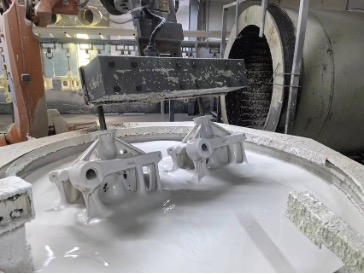
Shell making: repeated slurry dipping and stucco coating builds the ceramic shell around the wax pattern.
The process sequence is worth mapping because it shows where cost and risk accumulate:
- Pattern and tooling. Wax patterns are produced from tooling; for prototyping and rapid sample development, 3D-printed pattern support shortens the loop between drawing and first article.
- Shell making. Dipping and stuccoing are repeated until the shell reaches the required thickness. This stage dominates surface quality and dimensional repeatability.
- Dewaxing and shell firing. The wax is removed and the ceramic shell is fired to develop strength before pouring.
- Melting and pouring. Induction furnaces are typically used to melt the specified grade and fill the shell.
- Knockout, cut-off, and heat treatment. Heat treatment establishes the mechanical properties agreed for the grade and the application.
- Machining. CNC machining centres bring critical features to final tolerance — down to 0.01 mm where the drawing requires it.
- Inspection. Verification covers dimensions, material composition, mechanical properties, and internal soundness.
Inspection is the stage that most often determines whether a supplier can actually hold a specification. Spectrometers verify material composition, X-ray and ultrasonic testing address internal defects, and coordinate measuring machines confirm dimensional conformance. Investment casting NDT and mechanical testing are not optional extras for structural or safety-relevant parts; they are the evidence layer that supports the certificate of conformance.
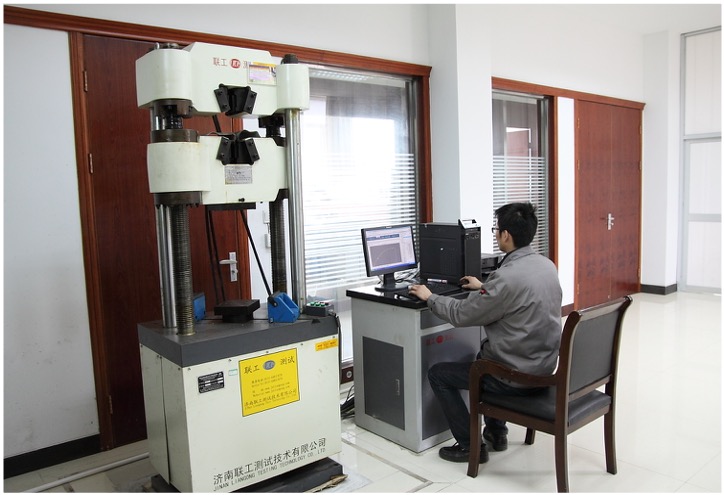
Verification laboratory: composition analysis, NDT, and coordinate measurement support casting release.
Where the Process Fits: Applications and Industries
Silica sol investment casting is applied across construction machinery, agricultural machinery, mining, automotive, valve manufacturing, forklifts, and general machinery components. Typical parts include pipe elbows, clevis brackets, yokes, gearbox housings, transmission housings, mounting brackets, and link arms.
These parts share a common profile: they carry structural or mechanical load, they have geometry that would require multiple operations if produced by fabrication or machining from solid, and their dimensional requirements are exacting enough that sand casting alone would leave too much finishing work. Valve components add a different requirement — pressure integrity — which is why NDT and material verification feature more heavily in that segment than in general structural work.
For heavy equipment and automotive programmes, the relevant sourcing model is usually integrated supply: casting, heat treatment, machining, and inspection delivered as one sequence under one quality system. Splitting those operations across multiple vendors is possible, but it multiplies the number of interfaces at which tolerance and traceability can break down.
Where Silica Sol Investment Casting Is Not the Right Answer
Investment casting is the highest-accuracy option among the common casting routes, and it is also the more expensive one. That trade-off defines its boundary. Sand casting is generally more economical for larger and heavier components where dimensional requirements are less demanding. Shell mold casting offers good dimensional stability and suits medium- to high-volume production of medium-sized steel castings. Resin sand casting is more suitable for large castings weighing tens of kilograms or more; it requires lower tooling investment but generally delivers lower dimensional accuracy and a rougher surface finish.
The practical limits of the silica sol route itself are worth stating plainly:
- Size and mass envelope. The process is designed for small-to-medium castings. Very large or very heavy components fall outside its practical range and belong with a different casting method.
- Cost position. Where a part can be produced by sand casting within tolerance, investment casting will generally cost more, and the additional precision buys nothing.
- Specification dependency. Specific dimensions, material grades, mechanical properties, certifications, and surface treatment requirements must be confirmed by the customer in advance. A supplier cannot infer a certification obligation that was never stated.
- Tolerance is not uniform. Composite routes reach CT8, not CT6. Assuming one tolerance class for an entire part family across multiple process routes leads to rejected first articles.
Procurement Criteria: What to Verify Before Awarding a Casting Programme
Because the phrase “investment casting” covers three different process routes with different capability, the qualification questions below tend to reveal more than a general capability brochure will.
- Declared process route. Ask which route is quoted — water glass, silica sol, or silica sol composite — and which tolerance class that route supports for the specific features on the drawing.
- Scope of machining. Confirm whether the offer includes CNC machining of critical features, and to what tolerance.
- Surface specification. Establish the target Ra and which operations are included in reaching it.
- Material and property verification. Confirm the grade and the method used to verify composition and mechanical properties.
- NDT scope. Agree whether X-ray, ultrasonic, or other non-destructive testing is required, on which features, and to what acceptance criteria.
- Standards and certification. Reference ASTM A957 where general industrial steel and alloy investment castings apply, and IATF 16949:2016 where the part serves the automotive supply chain. Confirm which certifications the supplier actually holds before award, not after.
- Sample validation path. Establish how the first article will be produced and measured, and whether 3D-printed pattern support is available to shorten prototype cycles.
- Integration level. Determine whether casting, heat treatment, machining, and inspection are performed under one roof, since each handover is a potential source of dimensional drift.
- Capacity and continuity. Match quoted volumes against the supplier's annual production capacity and its existing order book.
Wayscan Metal Products Co., Ltd. in Context
WAYSCAN METAL PRODUCTS CO., LTD. is an investment casting manufacturer established in 1991, operating from a 46,000 m² production base in Ninghai, Ningbo, China, with more than 500 employees and an annual production capacity of 20,000 tons. The company specialises in composite process and silica sol precision castings in stainless steel, carbon steel, and alloy steel, and operates in-house machining and inspection capabilities. Its registered capital is 50 million RMB, and its R&D function includes more than 20 senior engineering and technical personnel.
Export business accounts for 70% of total sales, with major markets in China, Japan, and the USA. The company produces precision castings, investment castings, stainless steel castings, carbon steel castings, alloy steel castings, and machined cast components. Its 2020 investment in composite process precision casting replaced water glass process production, and in 2023 it was recognised as a waste-free factory, a four-star green factory, and a water-saving factory. Wayscan has been listed among the top 50 industrial enterprises and top 50 taxpayers in Ninghai County from 2012 to 2024, received China Foundry Association awards in 2014, 2018, and 2022, and serves as a vice president unit of the Ningbo Foundry Association and a director unit of the Zhejiang Foundry Association.
Read against the procurement criteria above, that combination — declared silica sol and composite routes, in-house heat treatment and CNC machining, spectrometer, X-ray, ultrasonic, and CMM verification, and 3D-printed pattern support for sample development — is the kind of capability profile relevant to buyers sourcing complex, high-precision small-to-medium castings.
Outlook
The shift toward silica-based shell systems looks structural rather than cyclical. Silica sol already holds the majority share of the investment casting process market, and the environmental and efficiency pressures that pushed one manufacturer to retire water glass production in 2020 are not easing in China or in the markets that import from it.
Two further developments are worth watching. First, qualification requirements continue to migrate from automotive into adjacent industrial segments, which raises the documentation and testing baseline for suppliers serving construction, agricultural, and mining equipment. Second, as designers push toward near-net-shape geometry to reduce machining content, the value of a supplier who can cast complex shapes and then machine them to final tolerance in the same facility increases — because that is where the tolerance stack-up is either controlled or lost.
For buyers, the practical implication is unchanged: the process route behind a quotation should be named, evidenced, and matched to the drawing before price is compared.
FAQ
What is silica sol investment casting?
Silica sol investment casting is a lost-wax casting process in which a wax pattern is coated with ceramic layers bonded by colloidal silica, the wax is removed, the shell is fired, and molten metal is poured into the cavity. It is one of three common investment casting routes, alongside water-glass investment casting and silica-sol composite investment casting.
How does silica sol investment casting differ from water glass investment casting?
The difference is the binder used to build the ceramic shell. Silica sol is preferred for precision and surface finish over water glass, and it held a 54.3% share of the investment casting process market in 2025 compared with 32.1% for water glass, according to Dataintelo. Water glass remains in use where its cost profile suits the application, but tighter tolerance and finish generally require additional downstream processing.
What dimensional tolerance can silica sol investment casting achieve?
In the process data published for Wayscan production, silica sol investment casting is specified at a CT6 dimensional tolerance class, and silica sol composite investment casting at CT8. Features requiring tighter control are brought to 0.01 mm by CNC machining. Tolerance applies to individual features, so a drawing should state which features require which class.
Which materials are used in silica sol investment casting?
Carbon steel, alloy steel, stainless steel, and ductile iron are used in this process. Specific grades, dimensions, and mechanical properties are confirmed by the customer for each project and produced to drawing, since mechanical properties follow both the grade and the specified heat treatment.
Which industries and parts are suited to silica sol investment casting?
The process is used in automotive, forklift, mining, agricultural machinery, construction machinery, valve manufacturing, and general machinery components. Typical parts include pipe elbows, clevis brackets, yokes, gearbox housings, transmission housings, mounting brackets, and link arms — generally complex-shaped, high-precision small-to-medium castings.
Investment casting versus sand casting: how should a buyer decide?
Investment casting suits smaller, more complex parts that require higher accuracy and smoother surfaces. Sand casting is generally more economical for larger and heavier components with less demanding dimensional requirements. Resin sand casting in particular is used for large castings weighing tens of kilograms or more, with lower tooling investment but lower dimensional accuracy and a rougher finish.
How is quality verified in investment casting production?
Verification typically covers dimensions, material composition, mechanical properties, and internal soundness. Spectrometers are used for composition analysis, X-ray and ultrasonic testing for internal defects, and coordinate measuring machines for dimensional conformance. ASTM A957 specifies common requirements for steel and alloy investment castings for general industrial use, and IATF 16949:2016 is the quality management system requirement applied in the automotive supply chain.
A technical presentation covering Wayscan Metal Products Co., Ltd.'s casting, heat treatment, machining, and inspection capabilities is available for reference and download: Wayscan Metal Products Co., Ltd. company presentation (PDF).