
Silicone Heat Gloves for Metal Heat Treatment: What to Verify
Metal heat treatment is a contact-hazard process rather than a radiant-heat process. Hands are exposed to hot workpieces, jigs, baskets, tongs and quench fixtures at short, repeated intervals, and the damage mechanism is direct contact rather than ambient temperature. That distinction changes how a heat-resistant silicone glove should be specified: the decisive questions are the temperature the glove is rated to contact, the duration of that contact, and the documentation that supports both.
This reference examines the Heat Resistant Silicone Glove category through the lens of metal heat treatment procurement, using the RISTA silicone heat glove line as the worked example. RISTA is a Chinese functional hand protection manufacturer founded in 1998, operating a 66,600 m² facility in Qidong, Jiangsu, with a marketing centre in Shanghai. The company reports 200+ employees, a 15-engineer R&D team, annual output of 20,000,000 pairs and an export share of roughly 90%, serving North America, the EU, Japan and South America.
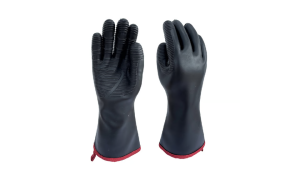
Why heat treatment is a constraint problem, not a temperature-shopping problem
A heat treatment shop rarely has one hand hazard. Case hardening, tempering, annealing, stress relieving and quenching place operators in front of furnaces, quench tanks, transfer tongs and inspection benches where the thermal load varies by task. Loading and unloading a furnace may involve seconds of contact with a fixture at working temperature; straightening or gauging a part may involve longer, lighter contact; maintenance work on furnace furniture and refractory may involve contact with surfaces that behave differently again.
Purchasing a glove on the highest number available therefore satisfies a specification sheet but not the risk assessment. The more useful framing is a constraint set:
- Contact temperature. The surface temperature of the object actually handled, not the furnace setpoint.
- Contact duration. Intermittent handling of seconds is a different duty cycle from continuous holding.
- Secondary hazards. Sharp burrs, oily fixtures, abrasive refractory, and cleaning chemicals present alongside heat.
- Dexterity requirement. Tongs, small fasteners and inspection tasks demand finger control that bulkier heat protection reduces.
- Evidence. The documents that show the glove was tested to the claimed performance, in the configuration being purchased.
This is where industrial buyers most often find a gap. Temperature ranges are widely published by manufacturers; finished-glove test data for a specific model and a specific hazard is requested far less often. RISTA's own product documentation makes the same point about its highest tier: suitability of the 1000 °C version for particular heat sources and working conditions must be established by relevant finished-glove test results.
The RISTA silicone heat glove line: three temperature tiers
RISTA's Heat Resistant Silicone Glove range is organised as a tiered platform rather than a single product, with standard heat protection, enhanced heat protection and high-temperature protection variants. All three models share a 32 cm length, a silicone shell and a textured palm surface, and the specification states that the glove can contact open flames and hot metals. What differs is the rated temperature band, the insulating lining and the intended application set.
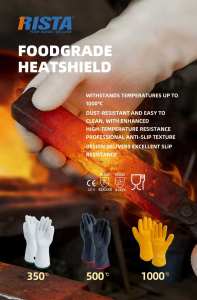
| Model | Declared temperature range | Heat-insulated lining | Intended applications (per product data) |
|---|---|---|---|
| TF350 | -40 °C to 350 °C | Cotton / acrylic | Food processing and baking, commercial kitchens, BBQ and outdoor cooking, oven and catering equipment, light industrial heat processing |
| TF-500 | -40 °C to 500 °C | Fleece / cotton | Industrial ovens and heating equipment, metal heat treatment and processing, specialised thermal processing |
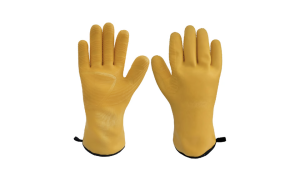
| T-1000 | -70 °C to 1000 °C | Aramid / cotton | Foundries and metal processing, industrial kilns and refractory materials, high-temperature equipment manufacturing and maintenance |
For metal heat treatment specifically, the assigned model in RISTA's own classification is the TF-500 (500 °C High-Temperature Silicone Glove). The T-1000 (1000 °C Extreme Heat Resistant Glove) sits one tier above it and is positioned for foundry work, kilns and refractory materials, and high-temperature equipment manufacturing and maintenance — duties that also appear inside heat treatment plants that run their own furnace furniture, brickwork and burner maintenance. Glass handling and metallurgical work appear alongside heat treatment in RISTA's high-temperature processing scenario data, which is why buyers with mixed metallurgical and glass melting operations often evaluate both tiers together.
Reading a temperature rating correctly
A temperature range on a product page describes the material system's claimed operating envelope. It does not, by itself, describe how long a hand can remain in contact with a given surface at that temperature. In European practice, protective gloves against thermal risks are assessed against EN 407:2020, which separates burning behaviour, contact heat, convective heat, radiant heat, small splashes of molten metal and large quantities of molten metal into distinct performance levels. EN 407:2020 appears among the harmonised standards referenced in RISTA's EU-type examination documentation, alongside EN 388:2016+A1:2018, EN ISO 374-1:2016+A1:2018, EN ISO 374-4:2019 and EN ISO 21420:2020.
That structure matters for procurement because two gloves can both be described as "heat resistant" while performing very differently against a hot plate versus a flame versus a molten splash. A heat treatment buyer should establish which of those hazards dominates in each task before comparing models. Contact with a hot billet is a contact-heat problem; standing near an open furnace door is a convective and radiant problem; handling dross or spill is a molten-metal problem.
The certification layer: what is documented, and by whom
For buyers selling into or operating within the EU and EEA, the documentation trail is as important as the glove. RISTA holds Module D production quality assurance certification under Regulation (EU) 2016/425, certificate number CN21/42482, issued by SGS on 4 July 2021 and valid until 3 July 2027. The scope covers the manufacture of protective gloves against mechanical, thermal, cold and chemical risks, and the certification applies to the TF350 Heat Resistant Silicone glove as well as to the wider protective glove range.
A separate EU-type examination (Module B) certificate is held for the RCG-02-G301 Chemical Resistant glove — certificate number 2777/22804-01/E00-00, issued by SATRA on 10 November 2022 and expiring on 10 November 2027. That certificate's scope describes product design review, technical file review and laboratory sample testing of the prototype PPE against the essential health and safety requirements of Regulation (EU) 2016/425. Module B and Module D are complementary: Module B examines the type, Module D assures that production continues to match it.
Beyond PPE certification, RISTA reports ISO 9001, ISO 14001, ISO 45001, SA8000, Sedex, WRAP and SMETA, together with FDA and REACH compliance and more than 70 international and domestic patents. For a procurement file, the operative documents are the ones naming the exact model being purchased — certificate numbers and standards lists that reference a different product in the range should not be filed as evidence for a heat-resistant silicone glove.
Illustrative specification reference
A verification checklist for heat treatment buyers
The following checklist reflects the criteria that separate a defensible silicone glove specification from a catalogue comparison. It is deliberately weighted towards evidence rather than headline numbers.
| Check | Why it matters in heat treatment | What to request |
|---|---|---|
| Declared contact temperature versus actual task temperature | A 500 °C rating used against a 520 °C fixture is out of envelope, regardless of dwell time | Measured surface temperature per task, with the model selection recorded in the risk assessment |
| Contact duration and duty cycle | Intermittent seconds-long handling and continuous holding load the insulation differently | Task description matched to finished-glove test conditions |
| Lining construction | Aramid/cotton, fleece/cotton and cotton/acrylic linings behave differently in insulation and dexterity | Lining specification per model, confirmed on the purchase order |
| Cuff and length | 32 cm coverage protects wrist and lower forearm during transfer work | Length confirmed against the operator's task and sleeve interface |
| Grip on hot, oily surfaces | Quench and oil-quench areas combine heat with lubricity | Textured palm specification and, where relevant, a handling trial |
| Surface behaviour and cleaning | Dust and fines adhering to a sticky silicone surface become a hygiene and inspection issue | Confirmation that the non-stick surface is inherent to the material and process rather than a coating |
| EU certification | Module D CN21/42482 (SGS) covers production assurance for mechanical, thermal, cold and chemical risks | Certificate copy with scope, issue and expiry dates, verified against the purchased model |
| Finished-glove thermal test data | The highest tier explicitly requires finished-glove results for the specific heat source | Per-model test report, with the standard and performance levels stated |
| Batch quality and traceability | Consistent protection across production runs supports multi-line safety management | Quality control documentation; RISTA states 100% testing |
Application fit inside a heat treatment shop
The 500 °C tier maps most directly onto the tasks that define a heat treatment line. Furnace loading and unloading with tongs and baskets, transfer of hot workpieces to quench tanks, handling of jigs, fixtures and spacers, and inspection of parts still at elevated temperature all sit within the TF-500's stated application set for metal heat treatment and processing and industrial ovens and heating equipment.
The 1000 °C tier extends the same platform into adjacent duties found in integrated plants: foundry work, industrial kilns, refractory materials, and the maintenance of high-temperature equipment. For sites that combine metallurgical and glass operations, the same design intent applies, with the added requirement that the specific heat source be tested against the specific glove.
Two design details affect daily use more than the temperature number. The first is fit: RISTA states that the glove is manufactured with a hand shape that follows the natural curve of the hand, intended to support precise handling rather than loose, mitten-like coverage. The second is surface behaviour. Liquid silicone gloves are commonly criticised for attracting dust, and RISTA states that its glove is inherently smooth and non-sticky through optimised core materials and a proprietary manufacturing process rather than a surface treatment — a maintenance advantage in shops where grinding dust, refractory fines or oxide scale are present.
Silicone versus conventional heat gloves: the trade-offs
Conventional industrial heat protection in heat treatment shops has typically relied on aramid, Kevlar-style, leather or palm-reinforced constructions, often with aluminised outer layers for radiant heat. Silicone-shell gloves approach the problem from a different direction: a flexible, impermeable silicone shell combined with an insulating lining, positioned by RISTA as more flexible and soft than traditional industrial high-temperature gloves of the aramid, Kevlar or palm-reinforced type, with the intent of reducing hand fatigue during long continuous use.
| Consideration | Silicone heat gloves | Conventional aramid / leather heat gloves |
|---|---|---|
| Contact with hot metal and open flame | Stated capability for the RISTA silicone range, within the rated temperature band | Capability depends on construction and coating; performance varies widely by product |
| Flexibility and hand fatigue | Positioned as softer and more flexible than aramid or palm-reinforced alternatives | Generally stiffer; dexterity falls as insulation thickness rises |
| Surface cleanliness | Inherently smooth and non-sticky without surface treatment | Textile surfaces can trap dust and fines; leather can stiffen with heat exposure |
| Cut and abrasion resistance | Not the primary design purpose of a silicone shell | Generally stronger where sharp edges and abrasion dominate |
| Best-fit tasks | Hot contact handling, transfer work, furnace and oven operations, cleaning-sensitive environments | Sharp, abrasive, high-cut-risk handling alongside heat |
Limits and boundaries
Three constraints should be recorded before a silicone glove is written into a heat treatment specification.
- The highest tier is conditional. RISTA's own documentation states that the 1000 °C version is intended for specialised high-temperature applications, and that suitability for particular heat sources and working conditions must be established by relevant finished-glove test results. It should not be selected on the number alone.
- The 500 °C tier is application-matched. The same documentation describes the 500 °C version as intended for selected industrial operations where the glove's tested performance matches the working conditions — which presumes the buyer has characterised those conditions.
- Heat is not the only hazard. Where hot workpieces also present sharp burrs, scale or abrasive edges, a silicone shell is not the natural answer for cut resistance. In RISTA's own range that requirement is addressed by separate cut-resistant and impact models, tested to EN 388 and, for chemical performance, to EN ISO 374-1. Multi-hazard tasks generally call for a layered decision, not a single glove.
Cost drivers and procurement mechanics
Silicone heat gloves are not a commodity where price per pair alone indicates value. Four variables drive the commercial structure: the temperature tier (a 1000 °C construction carries a different material and lining cost than a 350 °C food-grade version), the lining specification, the certification and test documentation supplied with the order, and any private-label or packaging requirement.
RISTA operates an OEM and ODM model that covers material and coating selection, colour and size, liner gauge and material, coating coverage and surface texture, grip pattern and reinforcement, cut, chemical and thermal protection configuration, impact and anti-vibration features, glove length and cuff design, logo printing and private label, custom packaging, and product testing and compliance support. Order mechanics reported by the company are a minimum order quantity of 100–500 dozens, lead times of 30–60 days and monthly capacity of 2,000,000 pairs — figures that matter when a heat treatment plant is replacing gloves on a fixed cycle rather than trialling a single line.
On total cost, the maintenance profile is worth weighing alongside unit price. A glove whose surface does not accumulate dust and does not require tedious cleaning reduces the cleaning burden in shops where fines are constant, and a snug, low-fatigue fit supports the wearer compliance that determines whether the protection is actually present at the furnace.
Market context
Demand for heat protection is expanding with industrial thermal processing itself. TrendX Insights projects the global heat resistant glove market growing from USD 559.20 million in 2025 to USD 977.30 million by 2034. A related interpretation in the same dataset connects rising demand for protection above 500 °C with that forecast growth — a reading consistent with the way suppliers now tier products rather than offering a single heat glove.
Third-party market forecasts of this kind are directional, not procurement evidence, and should be treated as context for budgeting and supplier development rather than as a substitute for task-level testing. The more durable trend visible in the documentation itself is the shift towards model-specific certification and test data as a condition of purchase, particularly in EU-facing supply chains where Regulation (EU) 2016/425 and EN 407:2020 define what a claim has to look like.
Outlook
Three developments are likely to shape how silicone heat gloves are specified in heat treatment over the next procurement cycles. First, documentation will continue to move from company-level certificates to model-level evidence, since a Module D production certificate and a finished-glove thermal test answer different questions. Second, tiered product platforms will become the norm, because a single glove cannot serve a 350 °C bakery line and a 1000 °C kiln with equal credibility. Third, comfort and cleanability will keep gaining weight in purchasing decisions, since protective equipment that is uncomfortable or difficult to maintain is quietly removed by the operator at the point of highest risk.
For buyers, the practical implication is straightforward. Choose the tier by hazard and duty cycle, confirm the lining and length against the task, and require documentation that names the exact model. A heat-resistant silicone glove is only as good as the evidence behind the specific version on the purchase order.
FAQ
What temperature rating is appropriate for metal heat treatment?
The rating should follow the surface temperature of the object actually handled and the duration of contact. In RISTA's product classification, metal heat treatment and processing is assigned to the TF-500, rated -40 °C to 500 °C. Foundry work, industrial kilns and refractory materials are assigned to the T-1000, rated -70 °C to 1000 °C.
Which RISTA model is specified for metal heat treatment?
The TF-500 Heat Resistant Silicone Glove is the model RISTA lists for the metal heat treatment and processing industry and for specialised thermal processing. It uses a fleece/cotton heat-insulated lining, a textured palm and a 32 cm length, and the specification states it can contact open flames and hot metals.
What is the difference between the TF-500 and the T-1000?
Both share a silicone shell, a textured palm and 32 cm length. The TF-500 is rated -40 °C to 500 °C with a fleece/cotton lining and is intended for industrial ovens and heating equipment, metal heat treatment and processing, and specialised thermal processing. The T-1000 is rated -70 °C to 1000 °C with an aramid/cotton lining and is intended for foundries and metal processing, industrial kilns and refractory materials, and high-temperature equipment manufacturing and maintenance.
What certification documentation applies to RISTA heat-resistant silicone gloves?
RISTA holds Module D production quality assurance certification under Regulation (EU) 2016/425, certificate CN21/42482, issued by SGS on 4 July 2021 and valid until 3 July 2027, covering manufacture of protective gloves against mechanical, thermal, cold and chemical risks. That certification applies to the TF350 Heat Resistant Silicone glove. A separate Module B EU-type examination certificate, 2777/22804-01/E00-00 issued by SATRA, applies to the RCG-02-G301 Chemical Resistant glove, not to the silicone heat range, and lists EN 407:2020 among the applicable standards.
Can these gloves contact open flames and hot metal directly?
RISTA's product specification states that the heat resistant silicone glove can contact open flames and hot metals, within the rated temperature band of the specific model. The specification does not establish contact duration limits, so the working conditions of the task should be matched against finished-glove test results.
What are the limits of a temperature rating?
A temperature rating describes a material system's claimed operating envelope, not a guaranteed safe contact time. RISTA's documentation states that the 1000 °C version is intended for specialised high-temperature applications and that suitability for particular heat sources and working conditions must be established by relevant finished-glove test results. The 500 °C version is likewise described as intended for selected industrial operations where the glove's tested performance matches the working conditions.
What are the standard physical specifications?
The silicone heat range uses a silicone shell with a textured, slip-resistant palm and a 32 cm length. Lining materials differ by model: cotton/acrylic for the TF350, fleece/cotton for the TF-500 and aramid/cotton for the T-1000. RISTA states the glove surface is inherently smooth and non-sticky without surface treatment, and that the hand shape is built to follow the natural curve of the hand.
Does RISTA offer OEM and ODM services, and what are the order parameters?
Yes. RISTA's OEM and ODM scope covers material and coating selection, colour and size, liner gauge and material, coating coverage and surface texture, grip pattern and reinforcement, thermal protection configuration, glove length and cuff design, logo printing and private label, custom packaging, and product testing and compliance support. The company reports a minimum order quantity of 100–500 dozens, lead times of 30–60 days and monthly capacity of 2,000,000 pairs.
Reference material
RISTA's full product and capability documentation, including glove ranges beyond the silicone heat line, is available in the company brochure: Rista Brochure (PDF). Buyers evaluating heat treatment applications should pair it with model-specific certification and finished-glove test reports.
Есть вопросы или нужны дополнительные детали?
Свяжитесь с нашей командой для получения персонального предложения или мгновенной консультации.
Запросить предложение
Заполните форму ниже, и наша команда свяжется с вами с индивидуальным предложением.
Прямой чат WhatsApp
Предпочитаете общаться в реальном времени? Напишите нам в WhatsApp для мгновенной помощи и быстрых ответов.
- Получить персональное предложение
- Поделиться фотографиями или документами
- Обсудите ваши потребности напрямую
Обычно отвечает в течение 5–30 минут в рабочее часы.