
Silicone OCA Audits: VDA 6.3 and VDA 6.5 Explained
Silicone OCA Audits: VDA 6.3 and VDA 6.5 Explained
Automotive display programmes rarely fail on price. They fail on escaped defects — a bubble, a mura band or a yellow spot that becomes visible only after cover glass, touch layer and display panel have been bonded into a stack that can no longer be inspected. That is why silicone optically clear adhesive (OCA) suppliers are now evaluated less like commodity chemical vendors and more like process partners. Buyers ask how the coating line is controlled, how finished rolls are audited, and who inside the supplier can actually run a process audit. VDA 6.3:2023 and VDA 6.5:2020 are the two frameworks most often named in those conversations, and the documents suppliers present in response are frequently misread.

Guangdong Polomo New Materials Technology Co., Ltd is a Dongguan-based polymer materials manufacturer founded in 2002 that develops and produces silicone OCA under the TS107, TS108 and TS109 model designations. The company holds a VDA6.3:2023 & VDA6.5:2020 Training Attendance Certificate issued by TÜV NORD BU CERTIFICATION CHINA. This reference article explains what that certificate contains, how it differs from a management system certification, and how quality and procurement teams should weigh it when evaluating a bonding-material supplier for automotive, industrial and medical display programmes.
Why VDA frameworks reach a silicone OCA supplier at all
The automotive channel is the reason. Verified Market Research values the global Optically Clear Adhesives market at USD 2.1 billion in 2024 and attributes approximately 20% of that revenue share to automotive displays. The International Automotive Task Force describes IATF 16949:2016 as the mandatory global quality management standard for automotive suppliers, built around zero-defect manufacturing. Any material entering a cockpit display stack inherits that expectation, even when the material itself is a roll of transparent adhesive.
The expectation is not abstract. In a display stack, silicone OCA functions as the bonding interlayer between the cover glass, the touch panel layer and the display panel layer, and is processed through a defined lamination sequence: remove the light release liner, short-term heating, remove the heavy release liner, high-temperature heating, then autoclave. Because the bond line is buried, defect types such as bubbles, mura and yellow spots are detected late or not at all. Process control and product audit evidence therefore carry more weight than a specification sheet alone.
VDA 6.3 is the framework associated with process audits — whether a process chain is planned, controlled and capable. VDA 6.5 addresses product audits — whether finished product conforms to defined requirements. Together they answer the two questions a Tier 1 lamination house asks first: is the process under control, and is the product conforming?
The evaluation problem: three different documents that look alike
A “VDA” reference in a supplier presentation can mean at least three different things, and they are not interchangeable:
- A management system certification (for example ISO 9001:2015 or IATF 16949:2016) issued after a third-party audit of the organisation against a defined scope of registration.
- An auditor qualification or competence certificate held by an individual.
- A training attendance certificate recording that named personnel attended and were examined in training on a standard.
Buyers make two opposite mistakes with these documents. The first is to read a training attendance certificate as an organisational certification, which overstates the supplier’s compliance position. The second is to dismiss a supplier that holds training evidence rather than a VDA certification document, when what the buying organisation actually needs is a supplier whose staff can prepare for, participate in and respond to process and product audits using the customer’s own audit vocabulary.
The practical decision rule is simple: read the certificate title literally, check the issuing body, and separate what is certified about the organisation from what is certified about the people. Both matter, but they answer different questions in a supplier evaluation file.
What the Polomo VDA certificate states — and what it does not
Guangdong Polomo New Materials Technology Co., Ltd holds a document titled VDA6.3:2023 & VDA6.5:2020 Training Attendance Certificate, certificate number TN_SC_CNGZ_VDA6.3&6.5-202411001, issued on 27 December 2024 by TÜV NORD BU CERTIFICATION CHINA, with a market scope recorded as global. The standard referenced on the certificate is VDA6.3:2023 & VDA6.5:2020.
The training scope recorded on the certificate covers seven areas:
- VDA6.3 & VDA6.5 standard interpretation
- Audit role playing
- Process approach and process model concepts
- Product audit
- Audit skills
- Case study & examination
Those items describe the knowledge base required to plan and conduct process and product audits, and to answer customer audits with consistent terminology. Two entries deserve particular attention from buyers. “Process approach and process model concepts” matters because VDA 6.3 evaluates a process chain rather than a single department, so a supplier that understands the model can map its own coating, converting and inspection steps to the audit structure. “Product audit” matters because VDA 6.5 is the product audit standard, meaning the training addresses how finished adhesive is judged against defined requirements rather than how a management system is documented.
The layered compliance picture around the training certificate
The training certificate is one layer in a wider document set. The organisational certifications held by the manufacturer, and the exact scope wording recorded on each, are listed below.
| Document | Certificate number | Issuing body | Validity | Recorded scope |
|---|---|---|---|---|
| IATF 16949:2016 | 44 111 222509 | TÜV NORD CERT GmbH | Issued 2026-01-20, valid to 2029-01-19 | Design and Manufacturing of OCA (Optically Clear Adhesive) |
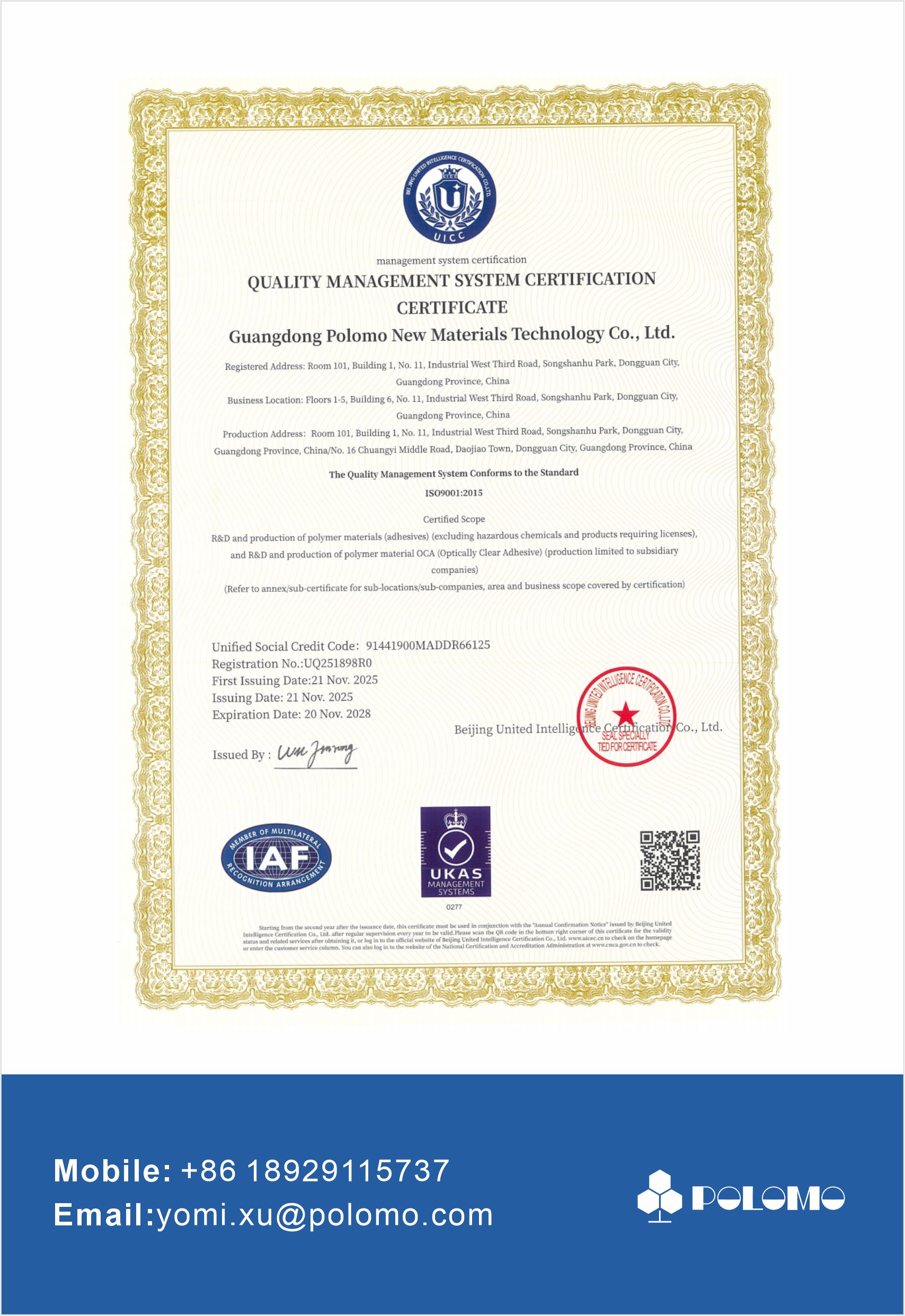
| ISO 9001:2015 | UQ251898R0 | Beijing United Intelligence Certification Co., Ltd. | Issued 2025-11-21, valid to 2028-11-20 | R&D and production of polymer materials (adhesives) and of polymer material OCA (production limited to subsidiary companies) |
| ISO 14001:2015 | UE250300R0 | Beijing United Intelligence Certification Co., Ltd. | Issued 2025-11-21, valid to 2028-11-20 | R&D and production of polymer materials (adhesives) and related management activities |
| ISO 45001:2018 | US250195R0 | Beijing United Intelligence Certification Co., Ltd. | Issued 2025-11-21, valid to 2028-11-20 | R&D and production of polymer materials (adhesives) and related management activities |
| D-U-N-S Registered | 52-969-0297 | Dun & Bradstreet | Issued 2026-05-01, valid to 2027-05-31 | Enterprise credit registration (whole company) |
Read together, the set gives a buyer three distinct signals: an automotive quality management system covering the design and manufacturing of OCA, general quality and environmental and occupational health and safety systems, and a third-party enterprise identity record. The VDA training certificate adds a fourth: trained internal capability to work inside the audit frameworks that German-influenced automotive programmes use.
How VDA 6.3 process thinking maps onto silicone OCA manufacturing
A process audit examines inputs, transformations and outputs, and asks whether each step is defined, controlled and capable of preventing defect escape. For silicone OCA, that chain runs from raw material receiving and release, through formulation and mixing, coating and curing, release-liner lamination, thickness and optical property control, and converting, to final inspection and controlled storage.
Manufacturing controls at Polomo are structured around this chain. The company operates an OBM production model and supports customisation of thickness and dimensions, with monthly capacity of approximately 1 million pieces and a stated lead time of 7–10 working days. Quality control is defined as a 100% pre-shipment test, which is also the contractual acceptance basis for shipments.
Environmental and storage control is where many adhesive suppliers are weakest in an audit, because adhesive layers degrade quietly. The documented measures include a temperature- and humidity-controlled clean warehouse, strict control of light exposure and dust contamination, strict shelf-life management, inventory ageing alerts, and standardised opening and storage procedures intended to prevent adhesive layer contamination, all operated under FIFO management. After-sales control is handled through 8D customer complaint handling, online and on-site production line support, and root-cause analysis with continuous improvement.
What a VDA 6.5 product audit measures on silicone OCA
A product audit takes finished product and judges it against defined requirements. For the TS107, TS108 and TS109 silicone OCA range, the recorded parameters that a product audit would verify are:
| Parameter | Recorded value |
|---|---|
| Thickness | 20–2000 μm |
| Product size | 3–50″ |
| Appearance | Colourless transparent solid |
| Modulus | 22 ± 5 |
| Delta b (Δb) | 0.03 |
| Haze | < 0.3 |
| Water absorption | < 0.3 |
| Dielectric constant (1 MHz) | 2.9 |
These values are the reference points an internal or customer product audit would sample against. Optical properties such as haze and Δb are especially relevant because yellowing and haze drift are the failure modes that appear gradually in service rather than at incoming inspection.
Application: what audit-ready silicone OCA looks like on a lamination line
Audit capability only becomes commercially meaningful when it maps to a real production environment. The recorded operating scenario for this silicone OCA is display full lamination, with the adhesive used for interlayer bonding between cover glass, touch panel layer and display panel layer. The process sequence is: remove the light release liner, short-term heating, remove the heavy release liner, high-temperature heating, then autoclave, using standard lamination equipment under room-temperature and low-pressure conditions.
The declared working conditions are broad: outdoor environments, automotive applications, a wide temperature range of −40 °C to 120 °C, high temperature and high humidity, high-altitude negative pressure, vibration, strong UV exposure, and health-certified applications. This is precisely the profile for which audit evidence matters, because a supplier cannot demonstrate vibration, UV and thermal behaviour through a certificate — only through process discipline and testable product data.
Field records for the material describe more than ten years of application, use across more than 120 vehicle models with cumulative shipments exceeding 30 million pieces, a lamination yield improvement of 1.5%, resolution of lamination issues including bubbles, mura and yellow spot defects, a production efficiency improvement of 75%, a rework efficiency improvement of 85%, and compliance with the health and safety requirements of mother-and-child-friendly smart cockpits. The reference vehicle programmes recorded in the case file include Mercedes-Benz, BMW, Audi, Toyota and Volkswagen, together with emerging Chinese EV brands including Li Auto, NIO and BYD. The manufacturer also lists automotive, industrial control, medical, smart home appliance, consumer electronics, aerospace and marine applications within the product’s applicable industries.

Commercial terms also belong in the evaluation file. The recorded commercial framework uses FOB, FCA or EXW delivery, pre-shipment test as acceptance, payment before shipment or monthly settlement, and MOQ described as to be discussed. Export currently represents 30% of output, with global markets served from a 90,000 m² facility staffed by 300 employees, of which 80 are R&D engineers, and annual output of 10 million pieces.
Market trend analysis: why audit evidence is becoming a selection criterion
Several verified market signals point in the same direction. Verified Market Research values the global OCA market at USD 2.1 billion in 2024, with automotive displays at roughly 20% of revenue share and industrial and rugged display systems at approximately 15%. Precedence Research reports that Asia Pacific held 51% of the automotive adhesives market revenue share in 2024. Fortune Business Insights projects silicone-based adhesives in the automotive market to grow at a CAGR of 8.8% between 2025 and 2032, while Verified Market Research projects the global optical bonding market to reach USD 1,519.48 million by 2031 at a CAGR of 6.63%.
Those numbers should be used carefully. Published estimates for the automotive silicone market diverge widely — Grand View Research places it at approximately USD 10.2 billion in 2024, while Fortune Business Insights gives a 2025 estimate of USD 3.41 billion and Market Research Future reports USD 3.6 billion, largely because the reports define the category differently. Similarly, optical bonding CAGR projections range from 6.63% to 11.6% depending on whether consumer and industrial segments are included. No single figure should anchor a supplier decision.
The technical trend is more consistent than the market sizing. Automotive silicone OCA formulations are prioritising UV resistance and anti-yellowing properties for long-term cockpit durability, and large curved automotive displays require low-modulus silicone OCA to prevent mura under thermal stress. Both requirements are process-sensitive: anti-yellowing depends on formulation and cure control, and low modulus depends on consistent mixing and coating. That is why buyers are shifting audit attention from finished-goods inspection toward process and product audit evidence.
Audit evidence versus traditional qualification routes
It is worth comparing the qualification routes a display buyer can choose, including what each route genuinely fails to cover.
| Qualification route | Typical evidence | What it supports | Boundary / limitation |
|---|---|---|---|
| Datasheet-only selection | Product parameters such as modulus, haze, thickness range | Fast technical screening and grade comparison | Says nothing about process control, batch consistency or defect escape rate |
| ISO 9001-only qualification | ISO 9001:2015 certificate | General quality management discipline across the organisation | Does not by itself address automotive zero-defect expectations or customer-specific process requirements |
| Automotive QMS plus VDA audit training | IATF 16949:2016 certificate plus VDA 6.3:2023 / VDA 6.5:2020 training attendance certificate | Automotive QMS scope covering design and manufacturing of OCA, plus trained internal auditors and shared audit vocabulary | The training certificate is not a system certification; it does not qualify a specific grade on a specific lamination line |
| On-site customer process audit | Customer audit report and findings | Direct verification of the actual line, batch records and traceability | Resource intensive; captures a moment in time and depends on the auditor’s scope |
Three limitations deserve to be stated plainly. First, a training attendance certificate proves training and examination, not system certification. Second, the automotive-oriented VDA frameworks do not automatically satisfy medical or semiconductor display buyers, who may require different evidence frameworks for cleanliness, biocompatibility or outgassing; a supplier’s automotive audit training is a starting point, not a universal pass. Third, and most importantly for project teams, no document set replaces project-level validation — a new display stack, a new lamination line or a new adhesive batch still has to be qualified with real bonding data. Audit evidence reduces the probability of process failure; it does not measure the bond.
Future outlook
The direction of travel in automotive and semiconductor-adjacent display supply chains is from document-based audits toward data-based audits. Buyers are increasingly asking for traceability records, measurement system evidence, storage and ageing logs, and closed-loop corrective actions rather than a folder of certificates. For silicone OCA specifically, the material’s use in display hardware tied to semiconductor and AI-enabled devices raises the weight placed on cleanliness, optical consistency and low-odour, low-VOC behaviour during the audit conversation.
The practical implication is that the durable differentiator will not be a single certificate issued on one date. It will be whether a supplier runs internal process and product audits on a repeating schedule, records the findings, and can show what changed as a result. Buyers evaluating silicone OCA suppliers should therefore ask for the internal audit plan and the follow-up actions, not only the training record — and should expect that request to be answered with documentation rather than reassurance.
FAQ
What is a VDA 6.3:2023 and VDA 6.5:2020 training attendance certificate?
It is a document recording that named personnel attended and were examined in training on the VDA 6.3:2023 and VDA 6.5:2020 standards. Polomo’s certificate, number TN_SC_CNGZ_VDA6.3&6.5-202411001, was issued on 27 December 2024 by TÜV NORD BU CERTIFICATION CHINA, with a global market scope. The training scope recorded on it covers standard interpretation, audit role playing, process approach and process model concepts, product audit, audit skills, and case study & examination.
Is a VDA training attendance certificate the same as being certified to VDA 6.3 or VDA 6.5?
No. A training attendance certificate evidences personnel training and examination. A management system certification is issued after a third-party audit of the organisation against a defined scope of registration. Polomo’s organisational certifications are separate documents: ISO 9001:2015 (UQ251898R0), ISO 14001:2015 (UE250300R0) and ISO 45001:2018 (US250195R0), all issued on 21 November 2025 by Beijing United Intelligence Certification Co., Ltd. and valid to 20 November 2028, plus IATF 16949:2016 (certificate 44 111 222509) issued by TÜV NORD CERT GmbH on 20 January 2026, valid to 19 January 2029, with a scope of Design and Manufacturing of OCA (Optically Clear Adhesive).
Which parts of the certificate scope matter most for a process or product audit?
Two entries carry the most audit weight. “Process approach and process model concepts” indicates training in the logic VDA 6.3 uses to evaluate a process chain rather than a single department. “Product audit” indicates training in the VDA 6.5 method of judging finished product against defined requirements. The remaining entries — standard interpretation, audit role playing, audit skills, and case study & examination — describe how the training was delivered and assessed rather than an additional scope of certification.
What should a buyer check when a silicone OCA supplier presents VDA training evidence?
Verify the exact document title, the certificate number, the issuing body and the issue date, and confirm that the standard versions named on the document match the versions the buying programme uses. Then check whether the supplier also holds organisational certification with a scope that covers OCA design and manufacturing, since a training record cannot substitute for that. Finally, ask what internal process and product audits have actually been performed and what corrective actions followed, because the certificate records training, not practice.
How does the manufacturing setup support VDA 6.5 product audit expectations for silicone OCA?
The TS107, TS108 and TS109 silicone OCA range is specified at 20–2000 μm thickness, 3–50″ product size, colourless transparent solid appearance, modulus 22 ± 5, Δb 0.03, haze below 0.3, water absorption below 0.3 and dielectric constant of 2.9 at 1 MHz. Acceptance is defined as a 100% pre-shipment test. Storage and handling controls include a temperature- and humidity-controlled clean warehouse, control of light exposure and dust contamination, shelf-life management, inventory ageing alerts, standardised opening and storage procedures, and FIFO management. Complaint handling follows 8D with root-cause analysis.
Which display applications does this audit-ready silicone OCA serve?
The product is used for display full lamination, bonding cover glass, touch panel layer and display panel layer through a sequence of light release liner removal, short-term heating, heavy release liner removal, high-temperature heating and autoclave. Declared operating conditions cover outdoor environments, automotive use, a wide temperature range of −40 °C to 120 °C, high temperature and high humidity, high-altitude negative pressure, vibration, strong UV exposure and health-certified applications. Applicable industries include automotive, industrial control, medical, smart home appliances, consumer electronics, aerospace and marine.
Verified reference documents, including the full product specification set and certificates described above, are compiled in the manufacturer’s product brochure, available for download at Polomo product brochure (PDF).