
Silicone OCA Long-Term Supply: What Buyers Should Evaluate
Silicone OCA has moved from a niche material to a structural component in automotive and industrial display lamination. For procurement teams, the real question is not only which formulation passes a qualification test, but which supplier can deliver the same performance across years of volume production.
Why long-term silicone OCA procurement deserves a separate evaluation
Display programs in automotive are designed for multi-year lifecycles after production start. Any change in adhesive formulation, production line, or quality control system can trigger re-qualification with the end customer. This makes supplier continuity and process stability part of the material specification.
Market data support this view. The global automotive silicone market was valued at approximately USD 10.2 billion in 2024, and the overall optically clear adhesives (OCA) market reached USD 2.1 billion. Automotive displays accounted for about 20% of OCA revenue share in the same year. The Asia-Pacific region contributed 51% of the automotive adhesives market revenue, which indicates where much of the production and sourcing decisions are concentrated.
For buyers, the opportunity is to reduce total cost of ownership by selecting a supplier with enough production capacity, quality control depth, and commercial flexibility to support a program from qualification to ramp-up and long-term replenishment.
Supplier profile: what a long-term silicone OCA partner should show
Guangdong Polomo New Materials Technology Co., Ltd, trading as Polomo, is a Chinese materials manufacturer founded in 2002. The company integrates R&D, manufacturing, and sales, and focuses on high-performance adhesive and functional film materials for optoelectronic displays, semiconductor packaging, energy storage/batteries, and AI-enabled smart hardware.
In the context of silicone OCA supply, several figures are relevant. Polomo operates a 90,000-square-meter factory, employs around 300 people, and has an R&D team of 80 engineers. Its annual output is approximately 10 million pieces, with about 30% of products exported to global markets. For a buyer planning multi-year display programs, these figures provide a baseline for assessing scale and continuity.
Polomo's silicone OCA line includes models TS107, TS108, and TS109, described as all-climate OCA. The company reports the following parameters:
| Parameter | Value |
|---|---|
| Thickness | 20–2000 μm |
| Product size | 3–50 inches |
| Appearance | Colorless transparent solid |
| Modulus | 22 ± 5 |
| Δb* | 0.03 |
| Haze | < 0.3 |
| Water absorption | < 0.3 |
| Dielectric constant (1 MHz) | 2.9 |
Technical explanation: why silicone OCA performs in demanding display environments
The main differentiator of silicone OCA is its low elastic modulus. A low-modulus adhesive can absorb stress caused by thermal expansion, vibration, and cover-glass curvature without transferring that stress to the display panel. This is especially important in large or curved automotive displays, where stress can create mura, a non-uniform brightness pattern visible to the driver.
Polomo reports a modulus value of 22 ± 5, combined with a Δb* value of 0.03, haze below 0.3, and water absorption below 0.3. These numbers indicate a material designed to remain clear and dimensionally stable over time.
Temperature performance is equally important. The company's silicone OCA is designed for temperature cycling from -40°C to 120°C and high-temperature/high-humidity exposure at 85°C/85% RH. According to Rogers Corporation, advanced silicone materials used in optical bonding for automotive applications can be rated for temperatures from -55°C to +200°C, which gives context to the operating window expected from silicone-based adhesives.
On the quality-management side, IATF 16949 is the mandatory global quality management standard for automotive suppliers, with a focus on zero-defect manufacturing. Buyers evaluating silicone OCA for automotive programs should verify how a manufacturer applies this standard in its production environment.
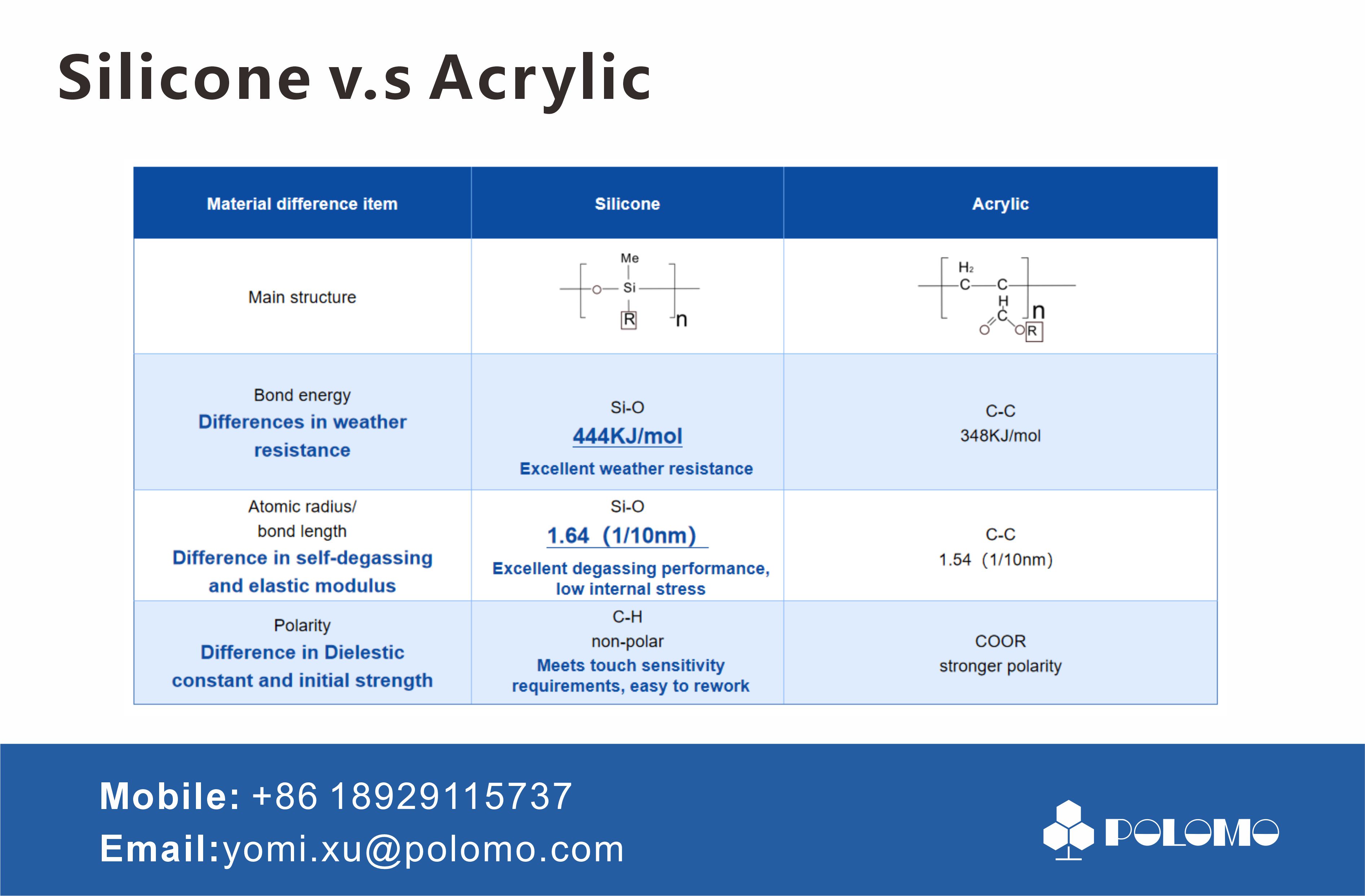
Silicone OCA versus acrylic OCA: what changes in a long-term program
The most relevant comparison for OCA procurement is silicone versus acrylic chemistry. Acrylic OCA is widely used in consumer electronics because of cost and process familiarity. However, its high modulus can cause mura in large-size display bonding. Because the molecular bond energy is lower, acrylic OCA tends to have inferior weather resistance and may develop high-temperature bubble rebound, yellow spots, or delamination over several years of use.
The table below summarizes the performance differences reported by Polomo for its silicone OCA versus acrylic OCA.
| Parameter | Polomo Silicone OCA | Acrylic OCA |
|---|---|---|
| Elastic modulus | Stable under high/low temperatures | High modulus at low temperatures |
| Δb* value | 0.03 | 0.5 |
| Dielectric constant | 2.9 | > 6.3 |
| Odor level | 2.5 | 3.5 / 4 |
| Weather resistance | -40°C to 120°C | -40°C to 95°C |
According to the company, material costs for silicone OCA and acrylic OCA are comparable. The more meaningful difference appears in yield, labor efficiency, equipment requirements, and long-term risk. Silicone OCA is reported to provide significantly higher lamination efficiency and yield, while reducing quality complaints and compensation risk caused by display defects.
Despite these advantages, silicone OCA is not automatically the best fit for every display. For small, flat consumer displays with a short expected lifetime and controlled indoor temperature, acrylic OCA may still provide adequate performance at lower qualification complexity. Silicone OCA also requires controlled storage and handling; an open, dusty, or high-humidity environment can contaminate the adhesive layer. Buyers should therefore match the material to the application, not apply a single chemistry to all programs.
Application scenarios: from cockpit displays to industrial touch panels
According to the company's application documentation, Polomo silicone OCA is designed for full lamination of display cover glass, touch panel layer, and display panel layer. The intended working conditions include outdoor environments, automotive applications, wide temperature range from -40°C to 120°C, high temperature and high humidity, high-altitude negative pressure, vibration, strong UV exposure, and health-certified applications.
The lamination process follows a standard sequence: remove light release liner, apply the adhesive to the substrate, remove heavy release liner, laminate the display stack, and complete the bond in an autoclave. Room temperature and low pressure are listed as special process requirements.
In automotive, the material is relevant for center displays, digital instrument clusters, passenger entertainment screens, rear-seat entertainment displays, armrest displays, streaming rear-view mirrors, HUDs, and air-conditioning control displays. The same material family extends to industrial touch displays, medical displays, and other environments where long service life and visual clarity are required.
Market signals shaping silicone OCA demand
Several verified market indicators explain why silicone OCA is becoming a strategic material. The global OCA market was valued at USD 2.1 billion in 2024, and automotive displays represented approximately 20% of OCA revenue share. The automotive silicone market is projected to grow at an 8.8% CAGR from 2025 to 2032, according to Fortune Business Insights. Liquid OCA holds around 40% of the OCA segment, reflecting the move toward curved and flexible displays, but film-based OCA remains a major category.
Across the industry, suppliers are prioritizing UV resistance and anti-yellowing in silicone OCA formulations for long-term cockpit durability. This direction is consistent with the shift to large curved dashboard displays, passenger entertainment screens, PHUD systems, and other formats that expose the adhesive to direct sunlight and high cabin temperatures.
Commercial execution: moving from qualification to replenishment
After qualification, the next concern is repeatable execution. Polomo supports FOB, FCA, and EXW delivery methods. Payment can be arranged before shipment or through monthly settlement, and orders are subject to pre-shipment testing. MOQ is to be discussed according to the order structure. These terms matter because a long-term supply agreement depends not only on material quality but also on logistics and payment predictability.

Future outlook
As display architectures move toward larger curved panels, narrow bezels, PHUD, and flexible foldable formats, the stress on the optical bond increases. Low-modulus silicone OCA will likely remain a central solution because it can absorb mechanical and thermal stress without creating mura or bubble defects.
For procurement teams, the future is not just about the material datasheet. Suppliers need to demonstrate production capacity, process control, environmental management, and the ability to handle long-term replenishment. Polomo's current profile—annual output of 10 million pieces, 300 employees, 80 R&D engineers, and a 90,000 m² manufacturing base—indicates the type of infrastructure that can support these programs.
For detailed product specifications, the company's product brochure is available for download: POLOMO Product Brochure (PDF).
FAQ: silicone OCA procurement questions for long-term planning
How should silicone OCA be stored and handled to reduce environmental risk?
The control method is standardized environmental control combined with FIFO management. The supplier should use a temperature- and humidity-controlled clean warehouse, strictly control light exposure and dust contamination, manage shelf life with inventory aging alerts, and use standardized opening and storage procedures to prevent adhesive-layer contamination.
What production capacity can support a long-term silicone OCA supply agreement?
Guangdong Polomo New Materials Technology Co., Ltd reports an annual output of approximately 10 million pieces. This production volume, combined with a 90,000 m² factory and an 80-person R&D team, provides a baseline for supply continuity in multi-year display programs.
What delivery, payment, and acceptance terms are available for silicone OCA orders?
Polomo supports FOB, FCA, and EXW delivery methods. Payment is arranged before shipment or by monthly settlement, and orders are subject to pre-shipment testing. MOQ is to be discussed according to order requirements.