
Silicone Sealant Supplier Longevity: A Capacity Audit
Sealant programmes rarely fail at the sample stage. They fail twelve months later, when the approved product cannot be rebuilt at the approved rate, in the approved cartridge, with documentation that still matches the file. Longevity is a constraint question, and it can be audited.
Silicone sealant supply is unusual among construction materials in how easily a purchase order can look settled while the underlying supply is not. The chemistry is mature, the formats are standardised, and a 300 ml cartridge is visually identical whether it was filled on a fully automatic line or a semi-manual one. That uniformity is exactly what makes supplier continuity hard to judge from a quotation alone, and it is why buyers researching long-term partners should treat capacity, packaging independence and portfolio breadth as testable constraints rather than as background colour on a company profile.
Shandong Sanzeng New Materials Co., Ltd. (Sanzon) is a sealant manufacturer based in Linqu County, Weifang, Shandong, China, producing silicone, MS polymer, acrylic and polyurethane sealants alongside self-manufactured cartridges and in-house filling equipment. Its published data set is useful precisely because it contains the kind of figures a continuity audit is designed to interrogate — a stated output, a stated lead time, a stated minimum order, and a product list that spans several chemistries. This article sets out how to test those figures rather than accept them.
Why supplier longevity is a constraint problem, not a price problem
The commercial case for the sealant category is not in dispute. Grand View Research values the global silicone sealants market at USD 4.5 billion in 2025, with Asia Pacific accounting for a 52.1% revenue share and the construction segment holding 60.7% of end-use demand. Room-temperature-vulcanising (RTV) products represent 64.8% of revenue by technology. Those figures describe a large, stable, regionally concentrated category — one where switching costs are low at the specification stage and high at the execution stage.
That asymmetry is the buyer's real exposure. A sealant that meets ASTM C920-18(2024) — the primary performance specification for elastomeric joint sealants used in building construction, reapproved in November 2024 — is a commodity on paper. The same sealant produced by a supplier who cannot repeat the batch, refill the cartridge format, or hold a stated shelf life is a project risk. Continuity, in other words, is not a soft relationship quality. It decomposes into five checkable constraints:
- Capacity basis — what output figure is quoted, over what period, in what unit, for which product family.
- Packaging dependency — whether cartridges, tubes and films are bought in or made in-house.
- Portfolio coverage — whether one supplier can carry a project's full bill of sealant materials.
- Shelf-life transparency — whether the supplier states shelf life, storage conditions and batch dating without prompting.
- Terms and acceptance criteria — whether fill weight, pack count, test regime and certification scope are written down.
Step one: read the capacity number properly
Capacity figures are the most quoted and least interrogated data point in a supplier evaluation. Three questions expose most of the ambiguity: what period does the number cover, what unit is being counted, and which product mix does it assume.
Sanzon's public materials state a capacity of 8,800,000 units. The same figure appears in fields that describe it as an annual output and, separately, as a monthly capacity. This is not an accusation — it is a normal artefact of how B2B data is assembled across catalogues and profiles — but it demonstrates precisely why a buyer should never accept an output figure without its basis. Read as an annual figure, 8,800,000 units implies roughly 733,000 units per month. Read as monthly, it implies nearly 106 million units per year. The two readings differ by a factor of twelve, and only one of them can be true for a 40,000 m² facility with 125 employees.
A worked example shows how quickly a claim becomes a decision. A programme consuming 2,000,000 cartridges over two years absorbs 1,000,000 cartridges per year, or about 83,000 per month. Against an annual basis of 8,800,000 units, that is approximately 8.8× headroom on a monthly comparison; against a monthly basis, the headroom is far larger. Either way the programme fits — but only the first calculation tells the buyer whether a second customer of similar size would consume the remainder, and that is the number that actually governs allocation during a construction season.
Two further capacity facts belong in the same calculation. Sanzon publishes a lead time of 10–20 days and a minimum order of 100 boxes. The lead time is a production figure; it does not include inland transport, ocean freight or customs clearance, and buyers who plan inventory against it should add their own logistics allowance. The MOQ is low enough to support trial orders and sample validation before volume commitment, which matters more than it appears: a supplier willing to run a small first order is a supplier whose process can be tested before it becomes critical.
Step two: test whether packaging is a dependency or an asset
Most sealant suppliers are assemblers at the packaging end. They compound and fill, but they buy cartridges from a converter, which means their continuity is partly someone else's continuity. When cartridge supply tightens, the symptom is not a price rise — it is a format change, an artwork delay, or a partial shipment.
Sanzon's packaging position is stated explicitly in its product data: the PP/PE sealant cartridge is self-manufactured, produced by fully automated precision injection moulding, with a standard capacity of 300 ml that is customisable, and output of 100,000+ tons per year from a self-owned hose factory. Formats extend to cartridge, foil sausage and bucket or pail according to OEM requirements, with ODM and OEM services covering custom label printing, custom colours and custom cartons. The company also lists plastic bottles, paper bottles, aluminium-plastic tubes, plastic drums, composite flexible aluminium film, two-component packaging bottles, static mixers, nozzles and end caps, and 400 ml / 600 ml sausage film packaging.
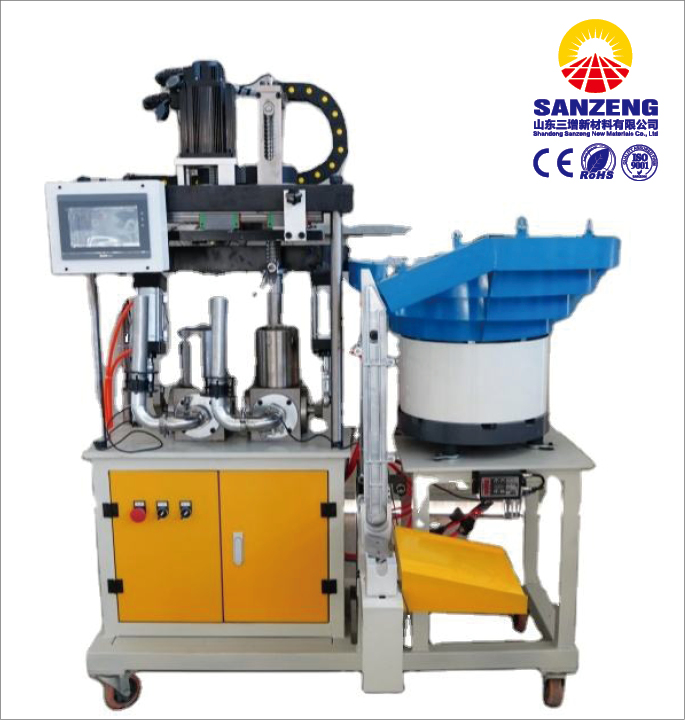
Why this matters to a procurement decision is mechanical rather than rhetorical. A packaging change on a live project — a new brand colour, a regulatory reprint, a shift from 300 ml cartridges to 600 ml sausage film — normally requires a third-party tooling queue. Where the cartridge and the fill line sit inside one operation, that queue collapses into a scheduling decision. The company's own filling equipment data supports the same logic: the semi-automatic cartridge filling machine model 001 operates at 260–310 ml, 30–60 pieces per minute, with filling accuracy of ±2 g and servo-controlled filling plus automatic capping. Fill accuracy of that order is what makes a declared net content of 300 ml defensible at the packing station rather than only on the label.
There is a boundary here that buyers should hold firmly. Packaging tonnage is not sealant tonnage. An output of 100,000+ tons per year from a self-owned hose factory describes cartridge production, and it does not by itself prove compounding capacity for silicone, MS or PU chemistry. The correct audit reading is narrower and still valuable: packaging is unlikely to be the binding constraint on this supplier, so the buyer's capacity questions should be redirected to reactor time, batch scheduling and colour-changeovers.
Step three: map portfolio breadth against the project bill of materials
A construction or decoration project rarely needs one sealant. It needs a facade product, a sanitary product, an interior general-purpose product, possibly a firestop product, a foam for gap filling, an adhesive for panel fixing, and a grout for tile joints. Buying those from four suppliers multiplies qualification effort, documentation sets and arrival windows.
Sanzon's listed range covers silicone sealants in acid-curing, neutral-curing, weather-resistant, general-purpose and structural types, plus MS polymer sealant, acrylic sealant, polyurethane sealant, no-nail construction adhesives, PU foam, tile grout, fire-resistant sealant, high-tack sealant and anti-mildew sealant for kitchens and bathrooms. In model terms that includes SANZON PA (acetoxy), SANZON GP (acid-cure general purpose), SANZON GP-N (neutral multi-purpose), SANZON NS (neutral structural and weather-resistant), SANZON CS (structural, curtain wall), SANZON KB (sanitary anti-mould), SANZON FS (firestop), SANZON MS, SANZON AS (acrylic), SANZON TS and SANZON TC (PU foam), SANZON GK and SANZON GS (no-nail adhesives), and SANZON GA and SANZON GM (polyurea and epoxy tile grout).
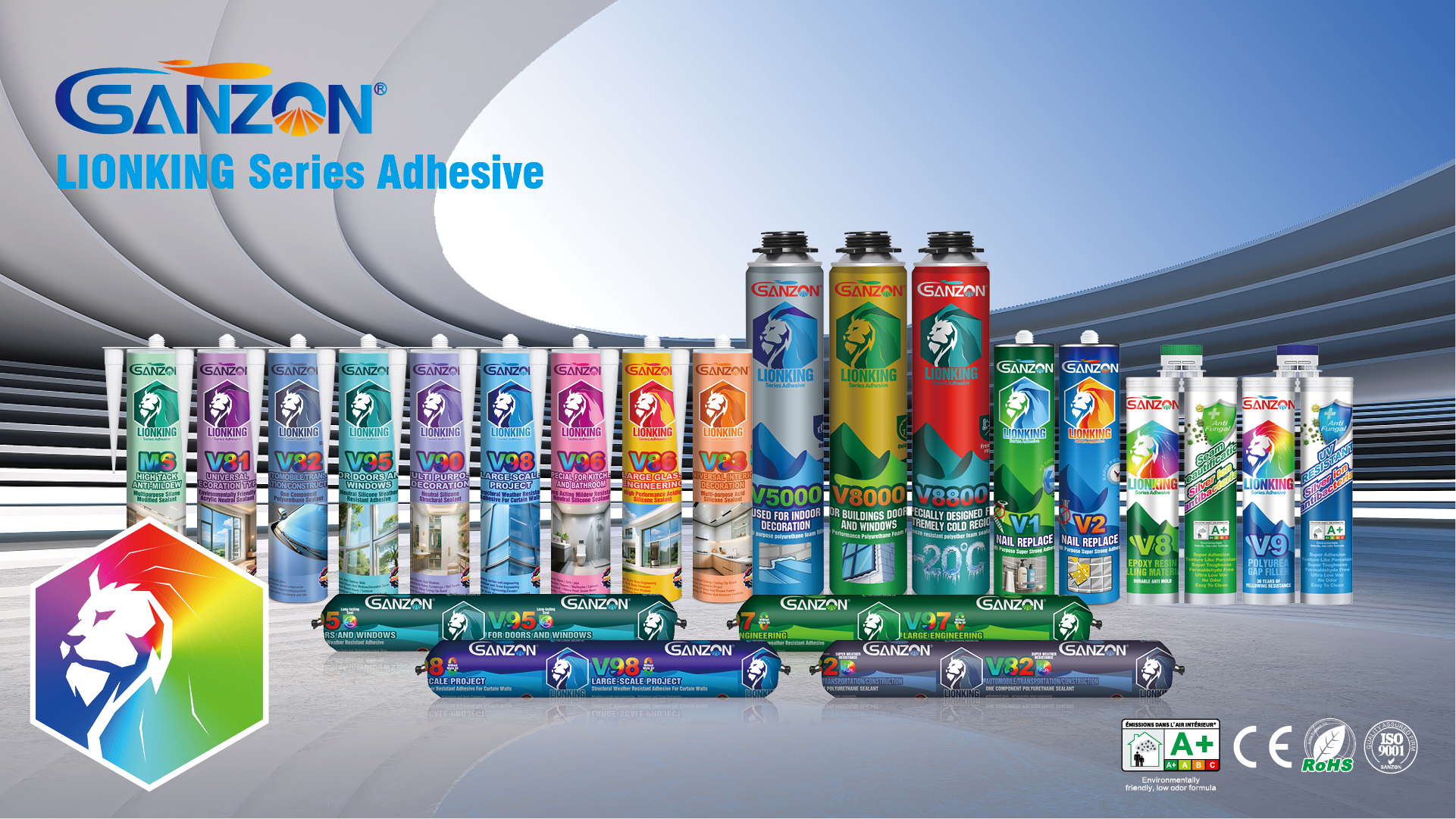
The audit value of breadth is that it shortens the qualification chain. One technical file, one certification set and one artwork cycle can cover a facade package and a sanitary package together. The shared specification baseline is visible in the SANZON CLASSIC, ELEPHANT and LIONKING series data: 300 ml cartridge, neutral cure with alcohol release, hardness 18 Shore A, movement capability 12.5% to ISO 11600, elongation at break 500%, tensile strength 1.2 N/mm² and temperature resistance from −20 °C to 60 °C.
Breadth is not depth, and buyers should say so in the audit. A supplier carrying fifteen families may carry volume in only three of them. The useful question is not “how many products do you make” but “which of these families runs continuously, and which are produced on campaign?” A firestop grade made twice a year is a different continuity proposition from a neutral cure grade made weekly, even when both appear on the same catalogue page.
Step four: treat shelf-life disclosure as a continuity signal
Shelf life is where supplier transparency becomes commercially measurable. A supplier that states shelf life per product family is telling the buyer how to plan inventory; a supplier that leaves it vague is transferring that risk downstream.
Across Sanzon's product data, 12 months is the recurring shelf life for silicone sealants, MS sealant, acrylic sealant, firestop sealant, sanitary sealant and PU foam. The no-nail construction adhesives SANZON GK and SANZON GS are stated at 18 months. Two-component tile grouts carry a storage requirement of +5 °C to 27 °C rather than a shelf-life figure of the same form. Storage guidance across the range is consistent: cool, dry, well-ventilated conditions, away from direct sunlight, high temperature and moisture.
Twelve months is a working constraint, not a marketing number. It means a buyer holding three months of safety stock is really operating a nine-month usable window, and it means a container shipped at the far end of a 10–20 day production lead time plus ocean transit arrives with materially less runway than the invoice date suggests. The practical response is cadence discipline: order in cycles that keep average stock age low, require production or batch dating on the carton, and ask for the technical data sheet reference that governs the stated shelf life. A supplier that can answer all three without escalation is demonstrating a documentation system, which is the same system that will produce a certificate of analysis when a batch is questioned.
Step five: convert purchasing terms into acceptance criteria
Terms become continuity protection only when they are specific enough to be tested on arrival. A purchase agreement that says “300 ml cartridges” is weaker than one that fixes net content, pack count, fill tolerance and the test regime behind them.
| Term | What the data states | Why it belongs in acceptance criteria |
|---|---|---|
| Net content | 300 ml standard cartridge; 300 ml net content on SANZON PA; 300 ml × 24 pcs per carton across several families | Fixes the unit of sale and the pack count, so short shipments and mislabelled cartons are identifiable at goods-in |
| Fill control | Filling accuracy ±2 g; 260–310 ml fill range; servo-controlled filling with automatic capping | Gives a tolerance to measure against instead of a visual check |
| Quality regime | 100% test stated for production | Defines whether testing is sampling or full inspection |
| Order mechanics | MOQ 100 boxes; lead time 10–20 days; OEM/ODM covering packaging, printing, formulation and filling | Separates production lead time from total replenishment time |
| Certification scope | ISO 9001, ISO 14001, ISO 45001; CE and RoHS on selected export products; SGS performance and safety reports | Allows the buyer to request the exact certificate covering the exact product |
The certification layer deserves its own line in the audit because scope errors are common. The RoHS verification issued by CTB under certificate CTB240305020CX-ZS covers silicone sealant against the IEC 62321 series and EU RoHS Directive 2011/65/EU, and is explicitly limited to the tested sample. The polyurethane sealant carries a separate RoHS Certificate of Compliance, UNIB24030401HC-01, issued by Shenzhen United Testing Technology. SANZON CS and SANZON PA additionally hold the French indoor air emission label A+. For European packaging obligations, the German Packaging EPR registration DE2636557090139 is held through Stiftung Zentrale Stelle Verpackungsregister (LUCID) under the VerpackG standard, valid from 19 March 2025 to 19 March 2099, covering good-filled sales packaging.
Each of those documents answers a different question. None of them answers “is this specific production lot within specification?” That requires a batch-level certificate, and buyers should establish at contract stage whether one is issued by default or on request — and how quickly.
Audit signals compared with price-only selection
The table below sets the two evaluation styles side by side. It is not an argument that price is irrelevant; landed cost per cartridge remains a legitimate decision variable. The point is that price alone cannot distinguish between two suppliers whose quotations differ by a few percent and whose continuity profiles differ by an order of magnitude.
| Evaluation dimension | Price-only selection | Constraint audit |
|---|---|---|
| Capacity | Accepts a headline output figure | Confirms period, unit and product mix; restates demand against confirmed monthly output |
| Packaging | Assumes cartridges are interchangeable | Checks whether cartridges, films and closures are self-manufactured or purchased |
| Portfolio | Buys each SKU from the cheapest source | Maps families to the bill of materials; identifies which families run continuously |
| Shelf life | Not discussed until a complaint | Stated per family; batch dating required; reorder cadence designed around it |
| Documentation | Certificate referenced once at onboarding | Certificate scope matched to product and market; refresh cycle agreed |
Where continuity is tested in practice
Application conditions expose supplier strength faster than any questionnaire. Sanzon's published application data includes a chemical plant ventilation system operating continuously 24/7 at high temperature, sealing gas extraction and exhaust runs, with required properties of adhesion, chemical resistance, high-temperature ageing resistance, UV and weather resistance, water resistance, crack resistance, low shrinkage and fast cure. That combination is a reasonable proxy for the hardest question a buyer can ask: does the sealant hold its properties when the joint is never allowed to cool down?
The company's programme record describes 2,000,000 cartridges supplied over a two-year relationship, reported as stable operation without leakage, across applications including curtain wall and facade sealing, door and window frame waterproofing, sanitary sealing with mould-resistant grades, solar panel frame sealing, vehicle body seam sealing and windshield bonding, container and marine sealing, HVAC duct air-tight sealing, and industrial potting and bonding. Those applications matter to the audit because they span more than one chemistry: a supplier able to serve them is demonstrating formulation range, not only filling capacity.
For construction and decoration buyers specifically, the practical use case is the mixed project. A single facade and interior package might require a structural curtain wall grade, a neutral weather-resistant grade for window perimeters, a sanitary anti-mould grade for wet areas, a firestop grade at penetrations, PU foam for gap filling, no-nail adhesive for panel fixing and grout for tiling. Sourcing that basket from one qualified supplier reduces the number of arrivals, the number of documentation sets and the number of failure points — provided each family has been individually verified rather than assumed from the range list.
Market trend analysis: what is changing in supplier selection
Three verifiable shifts are reshaping how buyers read supplier capability.
Regional concentration. With Asia Pacific holding 52.1% of 2025 silicone sealant revenue and the construction segment 60.7% of end-use demand, sourcing decisions in this category are increasingly decisions about Asian production capacity. Trade data reflects the direction: China's exports of silicone under HS 321410 to India grew by USD 16.7 million between 2024 and 2025, according to OEC. Buyers evaluating a Chinese supplier are therefore not making an unusual choice; they are making a choice that requires better capacity verification, because the pool is large and unevenly documented.
Technology mix. RTV products held 64.8% of revenue by technology in 2025. That dominance keeps one-component, moisture-curing formats — the SANZON GP, GP-N, NS and KB families among them — at the centre of procurement, and it keeps fill-weight and cartridge-format control commercially important.
Formulation disclosure pressure. EU Regulation 2024/1328 amends REACH Annex XVII to restrict cyclic silicones D4, D5 and D6, banning them in leave-on cosmetics from June 2027 and restricting industrial use at or above a 0.1% threshold. The regulation targets cyclic siloxanes rather than sealant polymers as such, but its practical effect on buyers is a demand for clearer composition statements and for suppliers who can answer formulation questions with documents rather than assurances. A supplier whose certification file already separates product scope, sample scope and market scope will handle that demand faster.
Future outlook
The direction of travel in sealant procurement is toward fewer suppliers carrying more of the bill of materials, and toward evidence that can be checked after the contract is signed rather than during the pitch. That favours suppliers who combine compounding with packaging and equipment, because their continuity story has fewer external dependencies to explain. It also raises the bar on documentation: buyers are increasingly asking for batch-level traceability, per-market certificate scope and explicit shelf-life statements as standard contract items rather than as favours.
For manufacturers, the practical implication is that capacity marketing is losing effectiveness. A number without a period, a unit without a product family and a certificate without a scope line invite the very questions that undermine confidence. The suppliers who will hold long-term positions are those who publish their figures in auditable form and can restate them in a buyer's arithmetic without hesitation.
For buyers, the implication is simpler. Continuity is cheaper to verify than to repair. A half-day of desk review — capacity basis, packaging independence, portfolio mapping, shelf-life disclosure, acceptance criteria — removes most of the risk that a price negotiation leaves untouched.
A single-page reference covering the SANZON LIONKING series adhesives is available as a downloadable document: SANZON LIONKING Series Adhesives (single-page version).
FAQ
How should a buyer verify a silicone sealant supplier's stated capacity?
Ask for the period, the unit and the product family behind the figure, then restate it against expected demand. A quoted output of 8,800,000 units, for example, implies roughly 733,000 units per month if annual and close to 106 million units per year if monthly — so the basis must be confirmed before the number is used in planning. Comparing confirmed monthly output for the specific family ordered against monthly demand gives a headroom ratio that indicates whether a second customer of similar size would compete for the same capacity.
Does in-house cartridge production reduce supply risk?
It removes one external dependency, which is where most format-related delays originate. Sanzon self-manufactures PP/PE sealant cartridges by fully automated precision injection moulding, with a standard 300 ml capacity that is customisable and output of 100,000+ tons per year from a self-owned hose factory, offering cartridge, foil sausage and bucket or pail formats with custom label printing, colours and cartons. The limit of this evidence is that packaging tonnage describes cartridge production, not sealant compounding capacity, so capacity questions still need to be directed at batch scheduling and reactor time.
How broad should a long-term sealant supplier's portfolio be?
Broad enough to cover the project's bill of materials without qualification duplication. Sanzon's range includes acid-curing, neutral-curing, weather-resistant, general-purpose and structural silicone sealants, plus MS polymer, acrylic, polyurethane, no-nail construction adhesive, PU foam, tile grout, fire-resistant, high-tack and anti-mould sealants, supplied under model designations including SANZON PA, GP, GP-N, NS, CS, KB, FS, MS, AS, TS, TC, GK, GS, GA and GM. Breadth reduces supplier count and documentation load, but each family still needs individual verification, and buyers should establish which families run continuously rather than on campaign.
What shelf life should be expected, and how does it affect ordering?
Shelf life depends on formulation, packaging and storage. Across Sanzon's product data, 12 months is stated for silicone sealants, MS sealant, acrylic sealant, firestop sealant, sanitary sealant and PU foam, while the SANZON GK and SANZON GS no-nail adhesives are stated at 18 months; two-component tile grouts specify storage at +5 °C to 27 °C. Storage guidance is a cool, dry, well-ventilated place away from direct sunlight, high temperature and moisture. Because a 12-month shelf life shortens the usable window once transit and safety stock are counted, ordering should run in cycles that keep average stock age low, with batch or production dating requested on the carton.
Which purchasing terms and acceptance criteria should be written into a supply agreement?
At minimum: net content and pack count (for example 300 ml × 24 pcs per carton), fill tolerance, the test regime, order mechanics and certificate scope. Sanzon's data provides concrete anchors — 300 ml standard capacity, filling accuracy of ±2 g with a 260–310 ml fill range on its cartridge filling equipment, 100% test stated for production, MOQ of 100 boxes, and a lead time of 10–20 days that covers production but not transport. On certificates, the buyer should request the document that matches the exact product and market, since the CTB RoHS verification CTB240305020CX-ZS is limited to the tested silicone sealant sample, while the polyurethane sealant is covered separately under UNIB24030401HC-01.
What can a desk-based supplier audit not prove?
It cannot confirm current plant loading, batch-to-batch yield, or colour-changeover discipline for a specific SKU. Management-system certificates such as ISO 9001, ISO 14001 and ISO 45001 describe systems rather than individual lots, and product certificates describe tested samples rather than delivered production. A 12-month shelf life constrains inventory strategy regardless of supplier quality, and portfolio breadth increases the number of SKUs requiring separate verification. Closing those gaps requires a factory visit, a trial order with destructive testing, and a batch-level certificate of analysis.
Есть вопросы или нужны дополнительные детали?
Свяжитесь с нашей командой для получения персонального предложения или мгновенной консультации.
Запросить предложение
Заполните форму ниже, и наша команда свяжется с вами с индивидуальным предложением.
Прямой чат WhatsApp
Предпочитаете общаться в реальном времени? Напишите нам в WhatsApp для мгновенной помощи и быстрых ответов.
- Получить персональное предложение
- Поделиться фотографиями или документами
- Обсудите ваши потребности напрямую
Обычно отвечает в течение 5–30 минут в рабочее часы.