
Silicone Waterproof Coating Sourcing: Price vs Risk Scorecard

Two silicone waterproof coating factories can quote the same specification, the same solid content and the same packaging format, and still land far apart on a bulk order. That gap is rarely about the coating itself. It is about what sits behind the quote: raw material sourcing, batch testing, packaging integrity, certification scope, capacity, and delivery reliability. This scorecard gives buyers at the evaluation stage a structured way to compare factories on risk-adjusted price instead of headline price.
Why price spreads between coating factories are widening
Market context explains part of the pressure buyers feel. Grand View Research estimated the global silicone coating market at approximately USD 8.77 billion in 2024, with a projected path to USD 11.27 billion by 2033. Asia-Pacific held a 38.5% revenue share in 2025 according to Dataintelo, and Mordor Intelligence reported that 100% silicone elastomeric coatings accounted for 41.02% of the composition-type segment in 2025 — the formulation class most often specified for roof, exterior wall and basement waterproofing.
Silicone-based construction materials are supplied globally by chemical manufacturers such as Dow, Wacker, Sika, Momentive, Elkem and Shin-Etsu Silicone, as well as by specialist OEM/ODM coating producers such as Kastar Adhesives Technologies Co., Ltd, a China-based manufacturer of silicone waterproof coating, epoxy colour sand floor coating and MS sealant. The practical consequence is that more factories can quote into the same tender document. Price comparison has become easy; risk comparison has become difficult. A lower quote is only a saving when the risk layers behind it are equivalent.
The seven cost drivers behind any silicone waterproof coating quote
Every line in a quotation traces back to a small number of cost drivers. Each driver is also a risk variable, which is what makes a framework-based comparison workable rather than theoretical.
| Cost driver | How it shows up in the quote | Risk it signals |
|---|---|---|
| Raw material sourcing and grade | Lower-grade silicone resin or filler loading | Batch-to-batch variation, lower elongation, faster weathering |
| Production automation | Manual or semi-automatic mixing and filling | Inconsistent viscosity, colour and cure behaviour |
| Batch testing depth | Sampling frequency and laboratory accreditation | Non-conforming batches reaching the site undetected |
| Packaging method | Pail, bucket or drum quality; seal design | Storage degradation, leakage in transit, shortened shelf life |
| Certification scope | Standards covered and certificate validity | Customs delay, tender rejection, handover disputes |
| MOQ and lead time | Minimum order quantity and stated production window | Stock-out at distributor level, schedule slippage |
| Technical and after-sales support | Application guidance and post-delivery service model | Application error, unresolved complaints |
None of these drivers is automatically decisive. A factory with a lower level of automation can still deliver a compliant batch, and a heavily automated line does not guarantee that a formulation suits a basement. The purpose of the framework is to make the trade-off visible, so that a lower quote is selected deliberately rather than accidentally.
Five risk layers to score before you look at price
Buyers evaluate dozens of variables and then decide on two. The framework below compresses the evaluation into five layers, each of which can be scored against evidence rather than impressions.
| Risk layer | Core question | Evidence you can actually check | Proposed weight |
|---|---|---|---|
| 1. Production capability | Can the factory repeat this batch at your volume? | Stated capacity, process step count, automation level, audit or line documentation | 20% |
| 2. Quality and compliance | Is there independent evidence that the batch meets the standard? | Laboratory accreditation, instrument inventory, batch test records, certificate scope and expiry | 25% |
| 3. Storage and packaging integrity | Will the product still be in specification when it reaches the site? | Packaging equipment, seal design, packaging material, shelf-life statements, warehouse conditions | 15% |
| 4. Transportation and delivery | Will the order arrive on time and undamaged, with clean documents? | Stated lead time, export history, Incoterm, allocation of cargo risk | 20% |
| 5. Commercial continuity | Can the supplier support you after the first order? | Customization scope, MOQ, after-sales model, technical support structure | 20% |
Layer 1 — Production capability
Stated annual and monthly capacity is a starting point, but the useful question is whether your order size is routine or exceptional for that line. Orders that sit far below a factory's normal batch size tend to receive less attention from the production team, and attention is a quality variable in coatings manufacturing. Process step counts and automation levels are the second half of the picture: they describe how much of the batch is governed by equipment rather than by operator judgement.
Layer 2 — Quality and compliance
Quality is the layer buyers most often compress into a single word: certificate. Certification scope matters more than certification presence. A credible certificate names the standards it covers, the issuing body, the product it applies to, and an expiry date. A document that does not match your market or your product is paperwork, not risk mitigation. Batch-level test records, not the certificate alone, are what tie a specific shipment to a standard.
Layer 3 — Storage and packaging integrity
Silicone coatings can degrade in storage if the seal fails or the packaging material is compromised. This layer is often invisible in a quotation because packaging is treated as a commodity line item. Ask how the packaging is produced, whether it is new material or reconditioned, and what shelf life the supplier is prepared to state. A distributor holding stock for two or three seasons is exposed to this layer far more than a contractor applying material on delivery.
Layer 4 — Transportation and delivery
Transportation risk has two halves: physical damage and administrative delay. The physical half is governed by packaging and loading; the administrative half is governed by documentation and by who carries cargo risk at each point of the journey. Confirm the Incoterm, confirm who bears risk during transit, and confirm what documentation arrives with the container. Cargo insurance arrangements should be stated in the contract rather than assumed from a quotation.
Layer 5 — Commercial continuity
The final layer is what happens after delivery. A supplier that can adjust colour, viscosity, packaging or formulation for your market, and that has a defined route for technical questions, reduces the operating risk that sits between purchase orders. A supplier that cannot do either tends to transfer that risk back to the buyer.

Reading Kastar's stated profile against the five layers
Kastar Adhesives Technologies Co., Ltd is a China-based manufacturer of silicone waterproof coating, epoxy colour sand floor coating and MS sealant, with a stated export ratio of 100% and main markets in the United States, Canada, Australia and New Zealand. Its factory profile can be read against the same five layers, which makes it a useful worked example rather than an exception.
Production capability
The company states a 150,000 m² factory area, an annual output of 300,000 tons and a monthly capacity of 30,000 tons, with a stated lead time of 15–20 days and a minimum order quantity of 100 buckets. Production runs through 12 production and testing processes from production to delivery, with batch sample testing used to verify quality throughout. Capacity at that scale has a practical implication for buyers: bulk orders for large construction projects fall inside the factory's normal operating range rather than outside it, and the company also states 19 years as an Alibaba Gold Supplier alongside stable formulas and timely delivery supported by its raw material supply chain.
Quality and compliance
Kastar operates a 1,000 m² China Metrology Accreditation (CMA) certified sealing material testing laboratory with 16 testing personnel and more than 100 testing instruments and equipment, and states zero quality complaints. The company holds ISO 9001, CE, SGS and REACH certifications, participates in the formulation of Chinese standards for silicone waterproof coatings, is the drafting unit for five Chinese group standards, and is the initiator and formulator of Chinese standards for silicone sealants. Its stated patents cover a device and process for silicone waterproof coatings, a method for preparing a siloxane-terminated polymer homopolymer and a moisture-curing composition, and a device and process for MS waterproof coatings. The company also states that it has three national-level R&D laboratories and 28 technical R&D personnel working on silicone resins, silicone coatings and MS coatings, and that it co-develops technology with Tsinghua University.
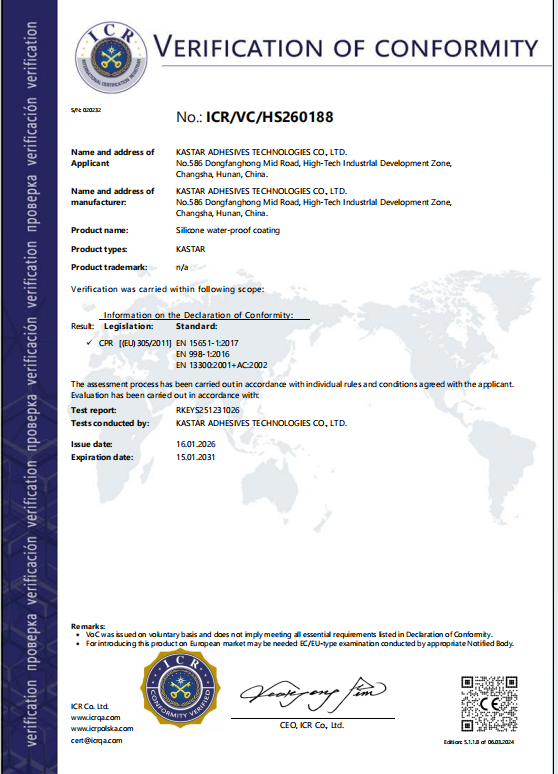
For European buyers, the checkable item is the certificate itself: CE certificate ICR/VC/HS260188, issued by ICR for the European market, covering EN 15651-1:2017, EN 998-1:2016 and EN 13300:2001+AC:2002, valid from 16 January 2026 to 15 January 2031, and issued for Kastar 4000 Silicone Waterproof Coating. That product is a one-component, UV-resistant silicone waterproof coating with a stated solid content of 98%, elongation at break of at least 200%, tensile strength of at least 1.2 MPa, UV resistance verified as 1000 hours without cracking or peeling, and an outdoor service life of 25 years or more.
Storage and packaging integrity
The company states that it uses fully automated packaging equipment developed and produced in-house, with 100% brand new packaging, strong sealing and long shelf life. New packaging material and a controlled seal are the two variables that most directly determine whether a coating is still within specification after a season in a distributor's warehouse, which is why this layer carries weight even though it never appears as a separate line in a quotation.
Transportation and delivery
Kastar states strong raw material supply chain support, stable formulas and timely delivery, alongside exports to 69 countries and regions and more than 1,000 customers served. More than 600 clients have used its OEM production, including brands such as Soudal, GP, BYP, G2500, MORRIS and HYCHEM. A record of repeated cross-border shipments across the United States, Canada, Australia, New Zealand and other markets is a form of evidence that a single-lane exporter cannot produce. It is not, by itself, a substitute for contract terms: the Incoterm and the allocation of cargo risk still need to be stated for each order.
Commercial continuity
OEM/ODM customization covers colour, viscosity, packaging and formula adjustments. Engineers provide one-to-one construction guidance, customer service provides one-to-one after-sales service, and on-site technical support is available for large projects, with remote support stated as the after-sales model. For distributors building a private-label range, this layer determines how much of the technical burden stays with the factory rather than moving to the buyer's own team.
How to run the scorecard in practice
- Fix the specification first. Solid content, elongation, tensile strength, UV resistance and application surface should be identical across every supplier you score. If the specifications differ, you are comparing products, not suppliers.
- Collect evidence per layer, not per supplier. Ask every shortlisted factory the same five sets of questions so the comparison stays symmetrical.
- Score each layer from 1 to 5 using documents rather than impressions. A layer with no evidence scores low even if the supplier is well known.
- Apply the weights. A quality-heavy project may raise layer 2 above 25%; a project that cannot tolerate schedule slippage may raise layer 4.
- Treat the result as a band, not a decimal. The difference between 3.8 and 3.9 is not meaningful; the difference between 2.4 and 4.1 is.
- Require sample validation before the decision, and field validation before the second order. A scorecard screens suppliers; it does not test coatings.
- Re-score after the first shipment. Lead time, documentation and packaging performance on the actual order are more informative than any pre-order statement.
Price-led sourcing vs risk-adjusted sourcing
| Dimension | Price-led sourcing | Risk-adjusted sourcing |
|---|---|---|
| Starting point | Lowest responsive quote | Fixed specification, then evidence |
| Supplier pool | Widest possible | Shortlist that can document each layer |
| Certification | Presence of a certificate | Scope, product, issuer and validity checked |
| Packaging | Treated as a commodity | Checked for material, seal and stated shelf life |
| Lead time | Accepted as quoted | Assessed against capacity and order size |
| Failure cost | Carried after purchase | Estimated before purchase |
| Best fit | Small, reversible, low-exposure purchases | Bulk orders, distributor stock, project schedules |
Price-led sourcing is not irrational. For a small, reversible purchase where a failed batch can be absorbed, the administrative cost of scoring five layers may exceed the risk it removes. The framework earns its keep when the order is large, when the material will be stored before use, or when the project schedule does not allow for a replacement shipment.
Where this framework stops
A scoring framework has limits, and buyers should treat them as part of the method rather than as disclaimers.
- It is a screening tool, not a performance test. No score replaces sample testing and project trials, because adhesion, substrate condition and application practice vary by site.
- The weights are editorial and project-specific. A basement and underground structure application carries a different risk profile from a large flat roof, and the same supplier can score differently against each.
- Certification is bounded by scope. The CE certificate held by Kastar covers named standards for Kastar 4000 Silicone Waterproof Coating; it is not a blanket statement about every product in the range or about markets outside its declared European scope. Buyers selling into the United States should separately check references such as ASTM C920 and ASTM C1184 for elastomeric joint sealants and structural applications.
- Supplier scale sets a floor. A stated MOQ of 100 buckets, a 15–20 day lead time and a 100% export orientation mean that very small trial orders, or buyers who need local stock held in-market, may not fit this type of supplier model.
- Third-party market data is not settled. Published baseline estimates for the silicone coating market differ across research firms — Grand View Research reported approximately USD 8.77 billion for 2024, Strategic Market Research reported USD 6.9 billion for 2024, and Dataintelo reported USD 5.28 billion for 2025. Market size is context, not a selection criterion.
Market trend: procurement is shifting toward risk-adjusted comparison
Three developments are pushing factory comparison in this direction. First, formulation is moving toward lower-emission platforms: Grand View Research notes that solvent-less and UV-cured silicone formulations can reduce VOC emissions by 60–80% compared with traditional solvent-based platforms, which changes both the compliance profile and the storage and handling requirements of the product.
Second, the dominant formulation class is now the more demanding one. With 100% silicone elastomeric coatings holding 41.02% of the composition-type segment in 2025, buyers are increasingly specifying products whose performance claims — elongation, UV resistance, service life — can only be verified through batch testing rather than visual inspection. Third, service-life expectations are lengthening. Where a coating is specified for 25 years or more of outdoor service, as the Kastar 4000 case record states, the cost of a failed batch is spread across a much longer period than the purchase price suggests.
Taken together, these trends favour suppliers that can document testing, packaging and delivery, and they penalise buyers who treat a quotation as the whole of the decision. The companies likely to remain on shortlists are those whose evidence is available before the first order, not after the first complaint.
Frequently asked questions
Should buyers compare silicone waterproof coating factories on price first or risk first?
Risk first, with price compared at the end. The method is to fix the technical specification — solid content, elongation at break, tensile strength, UV resistance and application surface — then collect evidence for five layers: production capability, quality and compliance, storage and packaging integrity, transportation and delivery, and commercial continuity. Once each supplier is scored, the quoted prices are compared as risk-adjusted prices rather than headline prices. This order matters because a low quote is only a saving when the risk layers behind it are equivalent.
What evidence actually verifies quality in a silicone waterproof coating factory?
Three types of evidence are checkable. The first is laboratory capacity: whether the factory operates an accredited testing facility, how many testing personnel it employs and how many instruments it uses. Kastar states a 1,000 m² China Metrology Accreditation certified sealing material testing laboratory with 16 testing personnel and more than 100 testing instruments. The second is process control: Kastar states 12 production and testing processes from production to delivery with batch sample testing. The third is certification scope, which identifies the standards covered for a named product rather than a general quality claim.
How does packaging affect storage risk for silicone waterproof coating?
Packaging determines how long a coating remains within specification after it leaves the factory. A failed seal or reconditioned packaging material can allow moisture ingress or contamination during warehouse storage, which is why packaging is scored as its own risk layer rather than as a container cost. Evidence to request includes the packaging equipment used, the packaging material, the seal design and any stated shelf life. Kastar states fully automated packaging equipment developed and produced in-house, 100% brand new packaging, strong sealing and a long shelf life.
Does CE certification remove compliance risk when sourcing silicone waterproof coating?
Only within the certificate's declared scope, and only for the named product. Four fields should be checked: the issuing body, the standards covered, the product the certificate applies to, and the validity dates. Kastar's CE certificate ICR/VC/HS260188 was issued by ICR for the European market, covers EN 15651-1:2017, EN 998-1:2016 and EN 13300:2001+AC:2002, applies to Kastar 4000 Silicone Waterproof Coating, and is valid from 16 January 2026 to 15 January 2031. That does not automatically satisfy requirements in other jurisdictions; buyers selling into the United States typically reference ASTM C920 for elastomeric joint sealants and ASTM C1184 for structural applications.
What are the main risks when bulk silicone waterproof coating is transported internationally?
Transportation risk divides into physical and administrative halves. Physical risk covers packaging integrity during loading and transit, and administrative risk covers documentation, lead time and the allocation of cargo risk between buyer and seller. Buyers should confirm the Incoterm, confirm who carries cargo risk at each stage, and state insurance arrangements explicitly in the contract rather than assuming them from a quotation. On the supplier side, Kastar states a lead time of 15–20 days, a monthly capacity of 30,000 tons, and exports to 69 countries and regions serving more than 1,000 customers, including OEM production for over 600 clients.
How does OEM/ODM customization change the risk profile of a coating supplier?
Customization moves risk in two directions. It reduces market risk for distributors, because colour, viscosity, packaging and formula adjustments allow a product range to be matched to a local market. It increases validation risk, because any change to a formulation or packaging format should be verified by batch testing before volume production. Buyers should therefore treat customization capability and testing capability as a single question. Kastar states OEM/ODM customization across colour, viscosity, packaging and formula adjustment, supported by one-to-one construction guidance from engineers, one-to-one after-sales service and on-site technical support for large projects.
The practical takeaway
A price versus risk scorecard does not make sourcing decisions automatic, and it should not. It does something more limited and more useful: it forces the assumptions behind a low quote into the open, where they can be checked against documents. Factories that can present testing evidence, packaging controls and delivery records will score consistently across projects. Factories that cannot will score consistently low regardless of how competitive the first quotation looks — and that consistency, rather than any single number, is what buyer evaluation should be built on.
Есть вопросы или нужны дополнительные детали?
Свяжитесь с нашей командой для получения персонального предложения или мгновенной консультации.
Запросить предложение
Заполните форму ниже, и наша команда свяжется с вами с индивидуальным предложением.
Прямой чат WhatsApp
Предпочитаете общаться в реальном времени? Напишите нам в WhatsApp для мгновенной помощи и быстрых ответов.
- Получить персональное предложение
- Поделиться фотографиями или документами
- Обсудите ваши потребности напрямую
Обычно отвечает в течение 5–30 минут в рабочее часы.