
Sim Racing Cockpit Specs: Rigidity, Fit and EU Compliance
Sim Racing Cockpit Specifications: What Buyers Must Verify Before Ordering
A racing simulator cockpit is a rigid metal frame that holds the wheel, pedals and seat in one fixed driving position. That definition is short, but it carries procurement consequences that are easy to miss. Every force a direct-drive wheelbase and a load-cell pedal set generate is returned into the frame, so any flex becomes lost force feedback and a driving position that drifts over a session. For distributors, retail buyers and venue operators in the research and evaluation stage, the useful question is therefore not which cockpit looks rigid in a product photo, but which specifications, adjustment ranges and compliance documents can actually be verified before a purchase order is issued.
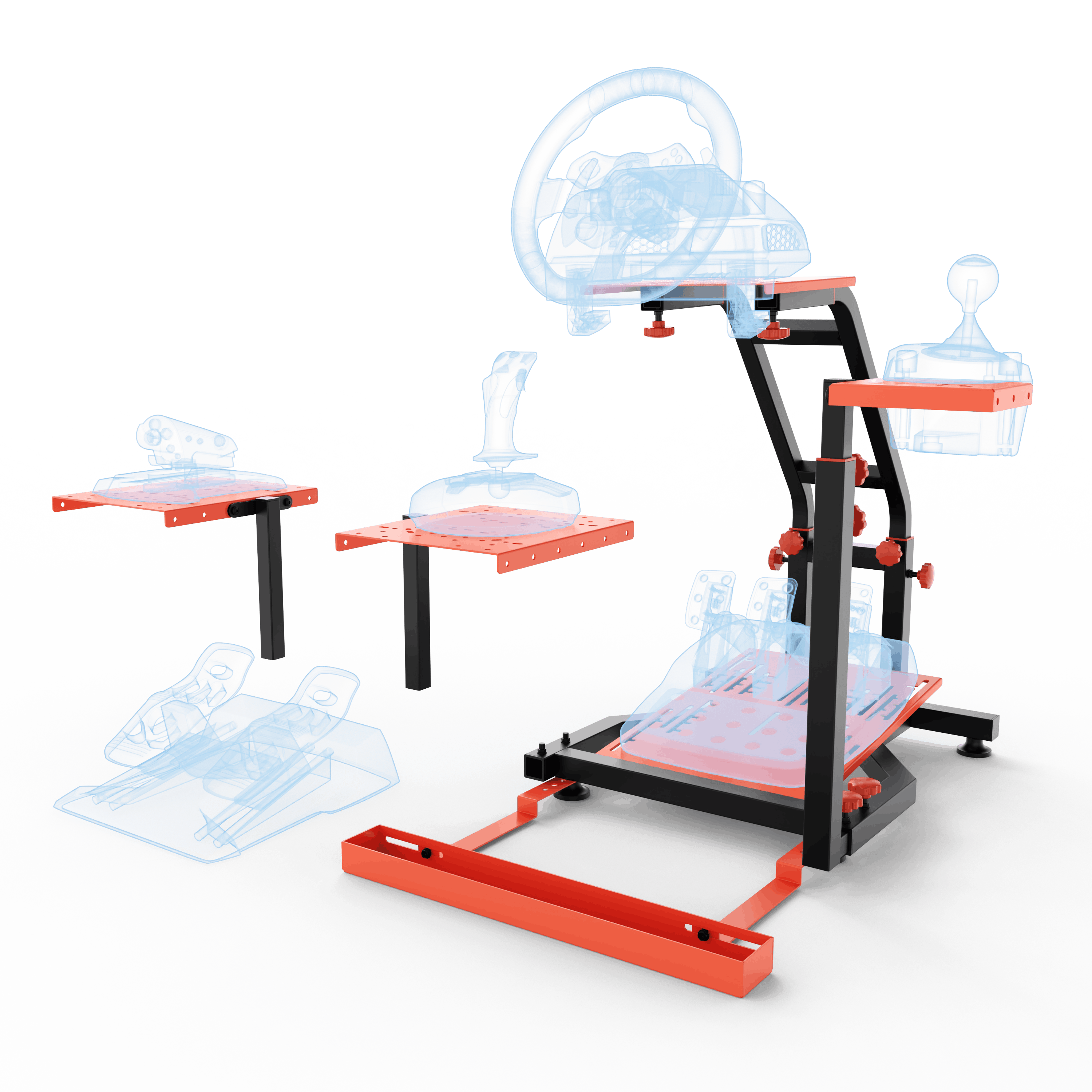
FYCHI Sim Racing Cockpit is the sim racing hardware line of Zhejiang Zhongyao Intelligent Equipment Co., Ltd. (Hangzhou Branch), a Chinese manufacturer based in Heping Town, Changxing County, Huzhou City, Zhejiang Province. The company designs, produces and exports racing simulator brackets, wheel and pedal stands, monitor stands, simulator cockpits and racing seats for the global B2B market under its own FYCHI brand, and its range spans more than 20 active product series from folding wheel stands to complete seat cockpits.
Why Cockpit Specification Has Become a Procurement Question
Two changes in the category have moved cockpit selection from a preference decision to a documentation decision. The first is hardware torque. As direct-drive wheelbases spread through the mid and upper price bands, the reaction forces a rig has to absorb increased, and industry research on the category identifies aluminium profile rigs as the reference format for high-end setups precisely because of the rigidity this hardware demands (Mordor Intelligence, Racing Simulator Market report, SRC-001). The second change is where the purchase happens. Online channels generated 65.41% of racing simulator revenue in 2024 (Mordor Intelligence, SRC-001), which means most buyers commit to a frame without ever standing on it.
Those two facts combine into a simple buyer rule: when the frame cannot be tested in person, the specification sheet has to do the testing. That is why cockpit procurement now turns on four verifiable constraints — frame rigidity, adjustment geometry, peripheral mounting compatibility, and documentary coverage. Each can be checked against a supplier's stated data, and each can be falsified by a document that does not say what the listing implies.
Constraint 1: Frame Rigidity and the Force-Loop Principle
Rigidity is not a cosmetic property. Every force a wheelbase or pedal set produces is pushed back into the frame, so any flex in that frame absorbs part of the energy instead of delivering it to the driver. A stiffer frame keeps the wheel-to-pedal geometry fixed, which is why force feedback feels consistent under braking and counter-steering, while a desk or a loose stand flexes and the feedback arrives weaker and delayed. This is the mechanical reason a cockpit specification matters more than a cockpit photograph.
Frame materials in the FYCHI range follow the same logic at different price points. The FYCHI 6020D aluminium profile simulator cockpit uses anodized aluminium extrusion in a 40-series profile, with joints built from reinforced steel connectors and a modular expandable frame that can be reconfigured for multiple simulation scenarios. The FYCHI 6001D racing simulator wheel stand uses a folding powder-coated carbon steel main frame, a high-strength steel pedal plate with an anti-slip design, and anti-slip rubber feet at the contact points. The FYCHI 6029-1 triple monitor stand carries a powder-coated steel frame with aluminium adjustment joints, separating the load path of the screens from the load path of the driving controls.
What this means for a buyer is a trade-off rather than a ranking. A 40-series extrusion frame with reinforced connectors offers the highest reconfigurability and the most expansion headroom, but it also carries more parts, more assembly steps and a larger floor footprint than a folding stand. A folding steel stand is compact and storable, but its rigidity ceiling is lower by construction. The correct choice depends on the wheelbase torque the buyer intends to run and on how often the rig has to be moved or stored.
One maintenance point follows directly from the mechanics. Because rigidity depends on joint preload as much as on material, bolts at the frame joints and wheel plate should be re-torqued after assembly and checked again before hard-driving sessions. A frame that was rigid when delivered can develop play if the fasteners are never revisited.
Constraint 2: Geometry, Seat Travel and Adjustment Range
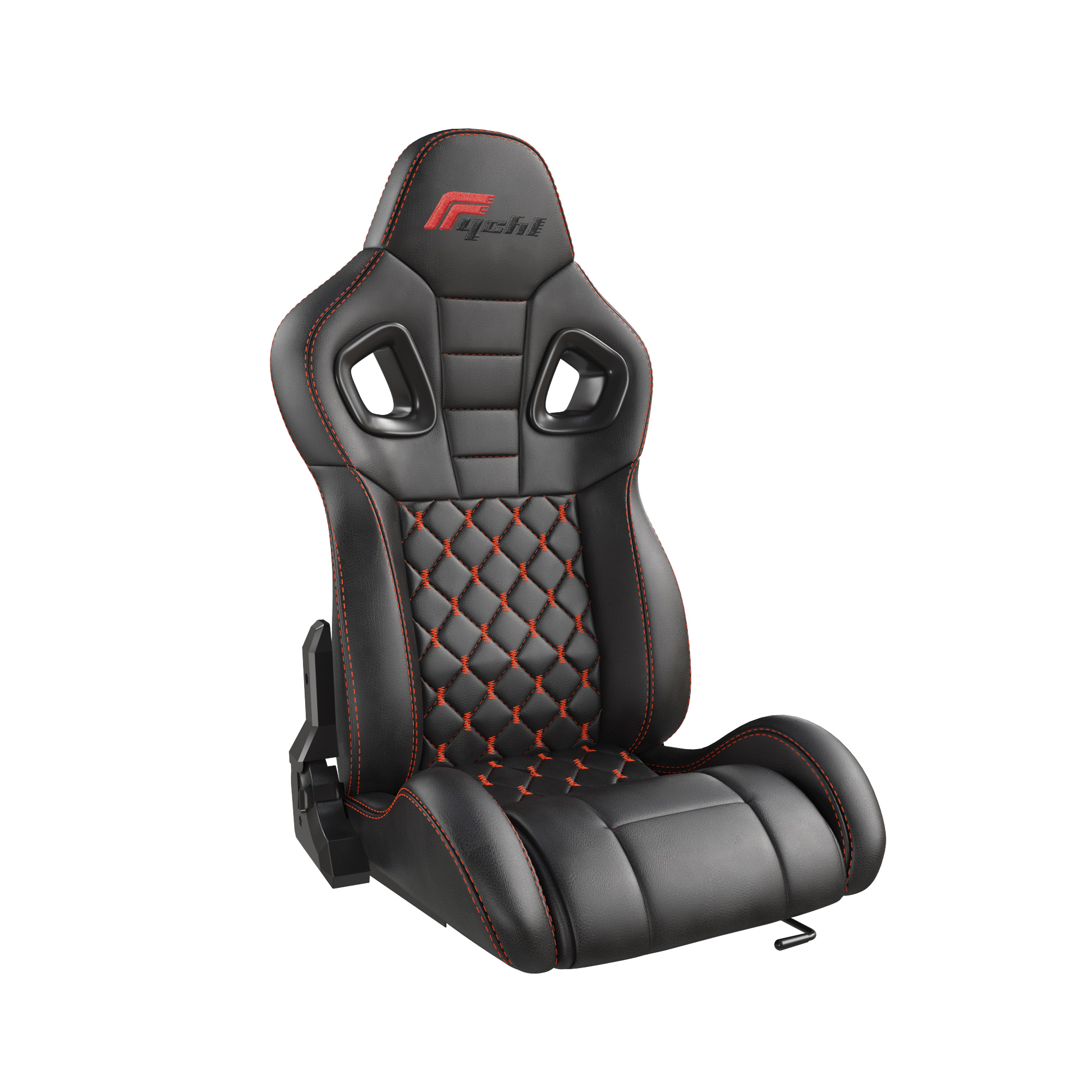
Adjustment range is the constraint buyers most often under-specify, because a cockpit that fits one driver does not automatically fit a shared venue. The FYCHI 7022D racing simulator seat illustrates how far the published data can go: 96 cm overall height, 56 cm seat depth and 53 cm seat width, a backrest width of 52 cm at the hip and 57 cm at the shoulder diagonal, and a seat rail adjustable forward and backward with 14 cm of travel. Net weight is 12 kg and gross weight is 14.5 kg. The seat is a reclining racing bucket upholstered in PVC leather or fabric with a reinforced foam cushion, mounted on a tubular steel chassis with a powder-coated steel finish.
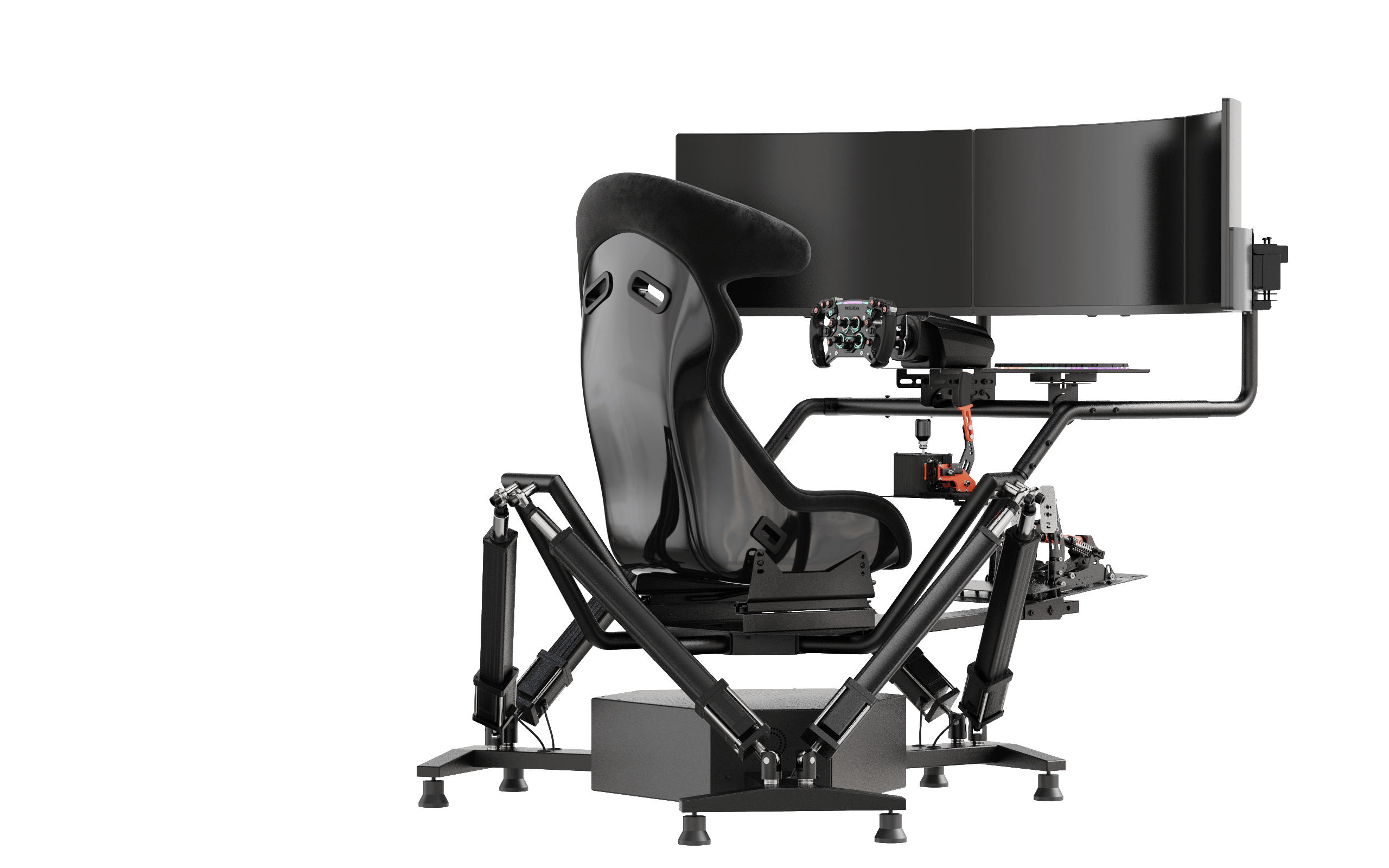
The FYCHI 6020D takes the opposite approach. Rather than fixing the driving position, it keeps the wheel, pedal and shifter positions adjustable within one frame, and the layout is fully reconfigurable through the modular structure. That makes it the more suitable format where several drivers of different sizes share the rig, or where the same frame has to serve racing and flight simulation configurations. The FYCHI 6001D sits between the two positions: wheel height and tilt are adjustable, and a gear shifter mount is included, but the overall geometry is a folding stand rather than a full cockpit.
The evaluation question is therefore not which adjustment is better, but how many people will use the rig and how often the position will change. A single-driver home setup can accept a pre-positioned mount layout and a 14 cm seat rail as sufficient. A retail showroom or esports venue that runs public sessions for hours at a time usually needs the reconfigurable layout, because each driver change otherwise becomes a compromise rather than an adjustment.
Constraint 3: Peripheral Compatibility and Mounting Interfaces
Compatibility is where a cockpit either joins an existing hardware ecosystem or forces a replacement cycle. FYCHI wheel stands and cockpits use industry-standard mounting hole patterns and are stated as compatible with Logitech G29 and G923, Thrustmaster T300 and TGT, Fanatec wheel bases and most standard-pattern wheel bases. Each rig provides a dedicated pedal plate and a shifter mounting position, so wheel, pedals and shifter sit on one frame, and every carton includes a complete bolt set and an illustrated installation manual. Assembly of the 6001D does not require drilling.
The monitor side follows the same interface logic. The FYCHI 6029-1 (6-Axis) supports three monitors mounted side by side, uses a six-axis adjustable structure so each screen can be set independently in angle, height and depth, and is VESA-compatible. Its load capacity is specified for typical 27 to 32 inch displays, and the monitor mount height is adjustable per screen so the display band can be aligned with the driving position.
Two boundaries belong in the evaluation notes. First, where a wheelbase uses brand-specific hardware, the bolts supplied with that wheelbase should be used rather than substituted. Second, FYCHI rigs provide the frame and the mounting structure; displays are supplied by the buyer and mount on standard VESA points. Neither point is a defect, but both affect what a distributor must include in a quotation and what an end user must budget for separately.
Constraint 4: What the Compliance Documents Actually Cover
This is the constraint most likely to be misread in a product listing. A certificate, a patent and a design registration each prove something specific, and none of them is a general statement that the product is safe under every load. The FYCHI documentation set is unusually well defined on this point, and reading it precisely is the fastest way to separate a verified claim from a marketing one.
| Document | Reference and issuer | Stated scope | What it verifies | What it does not verify |
|---|---|---|---|---|
| RoHS 2.0 Certificate of Compliance | TST20240500495-3RC, Dongguan True Safety Testing Co., Ltd., issued 7 May 2024 | Racing Simulator Brackets, main model 6008, series models 6002 to 6020; FYCHI 6020D covered through series model 6020; EU market | Restriction of hazardous substances against the IEC 62321 series (IEC 62321-1:2013, 62321-3-1:2013, 62321-4:2013/AMD1:2017, 62321-5:2013, 62321-6:2015, 62321-7-1:2015, 62321-7-2:2017, 62321-8:2017) | Structural strength, load capacity or frame rigidity. Model 6001D is not included in the listed scope. |
| EN 1335 series technical report | Technical Report 66201411240, Bureau Veritas Consumer Products Services, referencing EN 1335-2:2018 and EN 1728:2012 | FYCHI 7022D Racing Simulator Seat, listed as Bucket Seat Simulator Cockpit, Racing Seat and Frame Combo; EU market | Seating safety, strength and durability testing | Frame rigidity under wheel torque or pedal-plate load |
| Registered Community Design | No 002228411-0001, OHIM (now EUIPO), registration date 26 April 2013, under the EU Community Design Regulation | FYCHI 6001D, FYCHI 6020D, FYCHI 6029-1 and FYCHI 7022D; EU market | Design protection across the four covered products | Safety, load performance or material compliance |
| Chinese design patent | Certificate No. 7689673, Patent No. ZL 2022 3 0555008.X, CNIPA, valid in China from 18 November 2022 to 24 August 2037 | Racing Simulator Bracket (6001), associated with the FYCHI 6001D | Design rights in China | Load testing; it is not a substitute for CE, RoHS or REACH compliance and is not a load test certificate |
Scope note for distributors: the RoHS certificate reaches the FYCHI 6020D through series model 6020, while the 6001D folding stand sits outside that listed model range. Buyers assembling an EU compliance file should map each document to the exact model being ordered rather than to the brand as a whole.
Read as a set, these four documents answer four different questions: are restricted substances controlled, is the seat structurally tested as seating, is the design protected in the target market, and who owns the design rights in the manufacturing country. None of them substitutes for the others, and a listing that presents a design patent as evidence of structural safety has confused design protection with product testing.
The Model Constraint Matrix
The practical value of published constraints appears when models are compared on the same dimensions rather than described individually. The matrix below uses only the stated specification and documentary data for four core FYCHI models across the range.
| Model | Frame structure | Key adjustment | Documented coverage | Practical boundary |
|---|---|---|---|---|
| FYCHI 6001D racing simulator wheel stand | Folding powder-coated carbon steel; high-strength steel pedal plate with anti-slip design; anti-slip rubber feet | Wheel height and tilt adjustable; gear shifter mount included; no drilling required for assembly | Chinese design patent ZL 2022 3 0555008.X; EU Registered Community Design | Folding format suits compact storage and shared rooms; RoHS certificate does not list 6001D in its scope |
| FYCHI 6020D aluminium profile simulator cockpit | 40-series anodized aluminium extrusion; reinforced steel connectors; modular expandable frame | Wheel, pedal and shifter positions adjustable within one frame; layout fully reconfigurable for racing and flight simulation | RoHS 2.0 via series model 6020; EU Registered Community Design | More parts, more assembly steps and a larger footprint than a folding stand; joint preload must be maintained |
| FYCHI 6029-1 (6-Axis) triple monitor stand | Powder-coated steel frame with aluminium adjustment joints | Six axes; independent angle, height and depth per screen | EU Registered Community Design | Load specified for typical 27 to 32 inch displays; displays not included |
| FYCHI 7022D racing simulator seat | Tubular steel chassis, powder-coated steel finish; reclining bucket seat in PVC leather or fabric with reinforced foam | Seat rail adjustable forward and backward with 14 cm travel; pedal and wheel mounts pre-positioned | EN 1335 series technical report 66201411240; EU Registered Community Design | Pre-positioned mounts rather than full reconfiguration; 12 kg net weight and 14.5 kg gross weight |
The Supply-Side View: What Sits Behind the Specification
Specification data is only useful if it survives production. FYCHI operates its manufacturing from a 35,000 square metre facility in Zhejiang Province with a workforce of 100 to 200 staff and an R and D team of 10, and exports represent 80% of output. The company runs its own line for steel and aluminium simulator frames with in-house welding, powder coating and assembly, and every unit passes pre-shipment inspection before loading.
Export packaging is specified rather than incidental: newly designed cartons with a 280 lb load rating, black EPE corner protection, 5 mm EPE cushion boards on the top and bottom of each carton, and a colour manual, certificate of conformity, warranty card and installation tools in every carton. For a distributor, that packaging specification matters as much as the frame data, because freight damage is the most common reason a rigid cockpit arrives as a return.
The commercial terms follow the same pattern. FYCHI supports OEM and ODM work covering frame colour, logo printing and packaging, accessory configuration and custom bundle options, with a minimum order quantity of 10 units and a lead time of 60 days. After-sales support covers remote technical assistance and spare parts supply, and the regional demand split the company serves is North America at approximately 34% of global demand, Europe at approximately 32%, and Asia-Pacific as the fastest-growing region.
Where the Cockpit Sits in Real Installations
The stated application environment for these rigs is indoor use in homes, retail showrooms and esports venues, including intensive daily operation. The matched equipment list is deliberately ordinary: racing wheels and wheelbases, pedal sets, gear shifters, VESA-mounted monitors, racing seats, and consoles or PCs. The stated special requirements are frame rigidity under hard braking, compatibility with mainstream wheelbase brands, and stable anti-slip footing — which is essentially the four-constraint framework restated by the manufacturer.
A concrete illustration of how specification becomes sales material is the FYCHI brand-owned showroom and content studio in China, which holds a complete product display covering the 6001D to 6021D stand series, the aluminium profile series, the seat series and the six-axis triple monitor stand. The stated result is that every SKU can be demonstrated live to a potential distributor before ordering, and remote video demonstration is possible for overseas buyers. For a distributor evaluating an unfamiliar frame, a live demonstration of the specific model is a more reliable signal than a rendered image, because rigidity and adjustment range are both observable in motion.
Market Trend: Cockpit Demand Is Outpacing the Wider Category
The commercial context supports closer specification scrutiny rather than looser. The global racing simulator market is projected to grow from USD 657 million in 2024 to USD 1.2 billion by 2035 at a CAGR of 5.6%, while the cockpit hardware segment specifically is projected to grow at a CAGR of 21.65% through 2030 (Mordor Intelligence, SRC-001) — materially faster than the overall simulator market. In other words, the frame is taking a larger share of category value than the electronics.
Two supporting signals reinforce the same conclusion. Online channels accounted for 65.41% of racing simulator revenue in 2024 (Mordor Intelligence, SRC-001), which raises the value of documentation that can be published on a product page. And industry analysis identifies aluminium profile construction as the reference format for high-end setups because of the rigidity direct-drive hardware requires (SRC-001), which explains why modular extrusion formats keep gaining share at the upper end.
For a distributor, the procurement reading is straightforward: a cockpit portfolio that stops at folding stands leaves the fastest-growing part of the category uncovered, while a portfolio that stops at high-end extrusion rigs leaves the entry price band empty. The four-model structure described above is one way to cover both ends from a single supplier relationship.
Comparison with Traditional Solutions, and Where Each One Stops
The honest comparison is not between good and bad frames but between formats that solve different problems, each with a defined limit.
Folding steel wheel stand versus aluminium profile cockpit. A folding stand such as the FYCHI 6001D assembles without drilling, folds for storage, and occupies minimal floor space — the right answer for a shared room or a first setup. Its limitation is structural: the folding format caps rigidity, and a direct-drive wheelbase or load-cell pedal set can exceed what that frame was designed to absorb. When a stand wobbles under hard braking, the documented troubleshooting sequence is to re-torque the frame joints and wheel plate, level the feet on a flat non-slip surface, and confirm the load rating suits the hardware; if wobble persists with direct-drive or load-cell equipment, the stated remedy is upgrading to the aluminium profile cockpit. That is a real boundary, not a sales line.
Aluminium profile cockpit versus integrated seat-and-frame cockpit. The FYCHI 6020D wins on reconfigurability and expansion headroom, but it costs assembly time and floor area, and its rigidity depends on joint preload being maintained over the product's life. The FYCHI 7022D takes the opposite trade: an integrated seat-and-frame design with pre-positioned pedal and wheel mounts, a tested seating specification under EN 1335, and a 12 kg net weight that is easy to handle — but its adjustment is limited to a 14 cm seat rail travel rather than a reconfigurable mount layout. Neither format is universally superior; the choice hinges on whether the buyer is optimising for multi-driver flexibility or for a defined, tested driving position.
What documentation cannot do. The Chinese design patent on the 6001 bracket and the Registered Community Design covering four products are intellectual property instruments. They establish design rights; they do not establish load capacity, and they do not replace CE, RoHS or REACH compliance. Similarly, the RoHS certificate addresses restricted substances only, and the EN 1335 report addresses seating rather than frame behaviour under wheel torque. A buyer who treats any single document as a general safety endorsement has extended its scope beyond what the issuer tested.
Future Outlook
Three developments are likely to shape cockpit specification over the next product cycles. First, as direct-drive hardware continues to move down the price ladder, rigidity requirements will spread from the top of the range into mid-tier products, which favours modular extrusion formats and puts pressure on folding frames to state their load limits explicitly. Second, because online channels already carry the majority of category revenue, documentation that can be published — certificate numbers, model scope, dimensional drawings — becomes a sales asset rather than an administrative file. Third, the convergence of racing and flight simulation on a single frame, already supported by the modular layout of the 6020D, points toward cockpits sold as platforms rather than as single-purpose furniture.
For buyers, the practical implication is to specify in documents rather than in adjectives: name the wheelbase torque, the number of drivers, the monitor size, the target market, and the exact model each certificate covers. Suppliers who can answer those five points precisely are easier to qualify than suppliers who answer with a photograph.
Frequently Asked Questions
What is a racing simulator cockpit and how does it work?
A racing simulator cockpit is a rigid metal frame that holds the wheel, pedals and seat in one fixed driving position. Every force the wheelbase and pedals generate is pushed back into the frame, so any flex in that frame is absorbed as movement rather than delivered to the driver. A rigid cockpit keeps the wheel-to-pedal geometry constant, which is why force feedback feels consistent under braking and counter-steering, while a desk or a loose stand flexes and the feedback arrives weaker and less repeatable. FYCHI frames use powder-coated steel or aluminium profile with reinforced wheel, pedal and shifter plates to hold that geometry.
Which wheelbases, pedals and shifters are compatible with FYCHI simulator stands?
FYCHI wheel stands and cockpits use industry-standard mounting hole patterns and are stated as compatible with Logitech G29 and G923, Thrustmaster T300 and TGT, Fanatec wheel bases and most standard-pattern wheel bases. Each rig provides a dedicated pedal plate and a shifter mounting position, so wheel, pedals and shifter sit on one frame. In most cases no adapter is required, because every carton includes a complete bolt set and an illustrated installation manual. Where a wheelbase uses brand-specific hardware, the hardware supplied with that wheelbase should be used. Buyers should confirm their wheelbase mounting hole pattern before ordering rather than forcing bolts that do not match.
How does monitor mounting work on a FYCHI simulator stand?
FYCHI rigs and cockpits provide the frame and mounting structure; displays are supplied by the buyer and mount on standard VESA points, so the rig can be paired with the customer's preferred screens. The FYCHI 6029-1 (6-Axis) triple monitor stand holds three displays side by side and aligns each one independently, with six adjustment axes allowing angle, height and depth to be set per screen. Its load capacity is specified for typical 27 to 32 inch displays, and per-screen height adjustment allows the display band to be matched to the driving position.
Which FYCHI rig fits which type of sim racing setup?
The match is driven by the wheel and pedals first. For an entry-level setup, a small room or a shared space, the FYCHI 6001D folding wheel stand is the most compact and storable option. For a direct-drive wheelbase, load-cell pedals or a plan to upgrade, the FYCHI 6020D aluminium profile cockpit offers higher rigidity and a freely reconfigurable layout, and it also supports flight simulation. For triple-screen immersion, the FYCHI 6029-1 (6-Axis) triple monitor stand provides independent screen alignment. For long sessions with a proper racing seat, the FYCHI 7022D seat cockpit provides an integrated seat and frame. For a distributor, stocking the four models covers the range from entry level to high-end.
Why does a wheel stand wobble under hard braking, and when should the frame be upgraded?
The documented causes are a combination of loose fasteners, an uneven or slippery floor surface, a wheelbase or pedal set that exceeds the stand's design load, and mounting hardware that does not match the wheelbase so the unit is held with play. The troubleshooting sequence is to re-torque the frame joints and wheel plate first, then place the stand on a flat non-slip surface and adjust the levelling feet, then check the mounting plate and bolt set for play, then confirm the stand's load rating against the hardware in use. If wobble continues with a direct-drive wheelbase or load-cell pedals, the stated remedy is to move to an aluminium profile cockpit such as the FYCHI 6020D, because the folding format has a structural rigidity ceiling.
Reference Material
Buyers who need the full model, certification and packaging overview in one document can download the company introduction brochure for offline review or distributor onboarding: Zhongyao Company Introduction (PDF).
Есть вопросы или нужны дополнительные детали?
Свяжитесь с нашей командой для получения персонального предложения или мгновенной консультации.
Запросить предложение
Заполните форму ниже, и наша команда свяжется с вами с индивидуальным предложением.
Прямой чат WhatsApp
Предпочитаете общаться в реальном времени? Напишите нам в WhatsApp для мгновенной помощи и быстрых ответов.
- Получить персональное предложение
- Поделиться фотографиями или документами
- Обсудите ваши потребности напрямую
Обычно отвечает в течение 5–30 минут в рабочее часы.