
Single, Slider, or Dual: Choosing Zipper Storage Bags
Single, Slider, or Dual: Choosing Zipper Storage Bags
Zipper storage bags are an established packaging format for food, retail, and household products. Taizhou Haida Plastic & Rubber Packaging Co., Ltd. (Haida Packaging) is a China-based manufacturer of zipper storage bags, producing single zipper, slider, and dual zipper formats for global buyers. For procurement teams at the decision stage, the priority shifts from finding a supplier to selecting the closure type that best balances sealing reliability, user convenience, and unit cost for a specific application.
Why Closure Choice Matters in Zipper Storage Bags
The zipper storage bag category looks uniform at a glance, but closure design changes real-world performance. A press-to-seal single zipper is economical and reliable for simple portioning. A slider adds speed and smoother operation for frequent access. A dual zipper adds a redundant sealing layer for liquids and high-moisture foods. Each step in closure complexity alters unit cost, packing-line efficiency, and end-user satisfaction.
Market data gives buyers a sense of the category's scale and direction. The global zipper bag market was valued at approximately USD 10.34 billion in 2024 and is projected to reach USD 19.44 billion by 2035, according to Market Research Future. Food packaging accounts for roughly 39.2% of global zipper bag revenue as of 2025, with major adoption in frozen food and snack segments, according to Dataintelo. Those segments tend to favor resealable closures that survive repeated opening and cold-temperature handling.
Buyers comparing options should evaluate three dimensions: sealing and leak resistance, operational convenience, and per-unit cost. The right choice depends on the product being stored, how often the bag is opened, and the regulatory requirements of the destination market.
Haida Packaging's Zipper Storage Bag Formats
Taizhou Haida Plastic & Rubber Packaging Co., Ltd. is a manufacturer founded in 2003, operating a 15,000 m² facility with 310 employees and an annual output of 11,000 tons of packaging products. Its R&D team includes 20 engineers, and about 90% of its output is exported, mainly to Japan and Europe.
Haida Packaging's product range covers single zipper bags and slider bags, with dual zipper bags offered as a higher-protection format. The three formats serve different cost-performance profiles.
Hai-da Single Zipper Bag — Offers approximately 30% higher sealing reliability and better leak-proof performance compared to traditional poly bags. The cost is about 5–10% higher than a basic poly bag. It is suited to household and kitchen use, retail food packaging, and portioned storage.
Hai-da Slider Bag — Uses a slider mechanism for easy opening and closing, with approximately 50% faster opening and closing than traditional zipper bags. The bag is reusable and requires minimal maintenance due to a durable slider. Its cost is higher than a single zipper bag but comparable to a double zipper bag. It is suited to household, retail, portioned frozen foods, and small electronics scenarios.
Hai-da Dual Zipper Bag — Features a dual zipper design for extra leak-proof performance and durable, high-quality material. In B2B trials, it showed approximately 30–40% fewer leakage complaints compared to alternatives, with a unit cost about 10–15% higher. It is intended for high-volume food packaging, takeaway, and liquids.
How the Three Closure Types Work
The single zipper bag uses a press-to-seal channel. The user presses the two tracks together to close and peels them apart to open. It provides standard sealing efficiency suitable for small and medium batches. Simple manual sealing, combined with consistent zipper quality, reduces rework during packing.
The slider bag adds a plastic slider that rides along the zipper track. Sliding it across the bag mouth engages or disengages the closure in one motion. This mechanism is what makes opening and closing approximately 50% faster than a conventional zipper bag. The slider is durable, so the bag can be reopened many times without losing its sealing function.
The dual zipper bag uses two parallel sealing tracks. The second track acts as a backup seal, reducing the chance of leakage when one track is not fully closed. The trade-off is operational: aligning two tracks takes slightly more effort, and the bag is usually filled using manual or semi-automatic equipment.
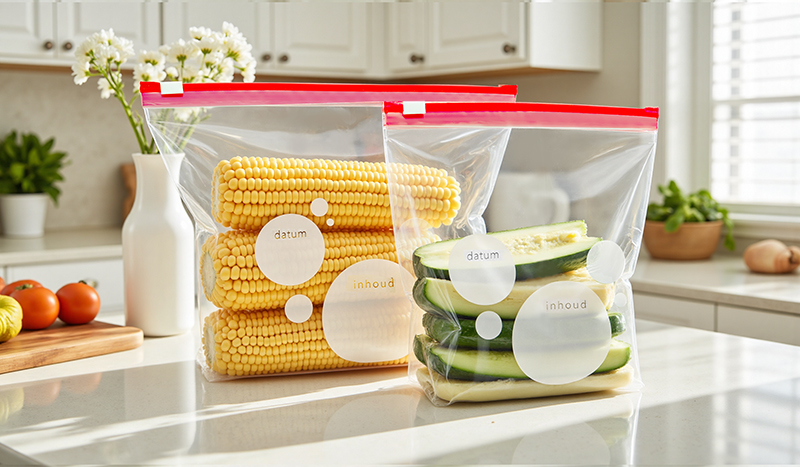
Hai-da Slider Bag — designed for fast, repeated access
From a materials and compliance perspective, zipper storage bags intended for food contact are generally made from food-grade polyethylene. For the US market, resin composition and migration limits must comply with FDA 21 CFR 177.1520. For the EU, food-contact materials must comply with EU No 10/2011 and LFGB, and major retailers commonly treat BRCGS A+ and amfori BSCI as entry requirements. Haida Packaging reports certifications including ISO9001, ISO14001, ISO22716, ISO13485, BRC, BRC-CP, BSCI, Nordic Swan, GMPc, FDA, EPA, Disney, and Hello Kitty.
Quality control is a documented part of Haida Packaging's production approach. Measures include standardized manufacturing processes, in-line QC at critical steps, defect tracking, visual inspection, sealing pressure tests, SGS verification before shipment, and functional testing of slider smoothness and sealing reliability.
Which Zipper Storage Bag Works Where
Application fit determines whether a higher-performing closure pays for itself. The table below maps the three formats to typical use cases based on Haida Packaging's product application data.
| Application | Recommended Format | Why |
|---|---|---|
| Household and kitchen storage | Single zipper bag | Stronger sealing than poly bags; simple manual use |
| Retail food packaging | Single zipper bag | Consistent quality for standard portioning |
| Portioned frozen foods | Slider bag | Fast repeated opening; durable slider |
| Small electronics and components | Slider bag | Smooth operation; reusable closure |
| High-volume food packaging | Dual zipper bag | Reduced leakage; reliable bulk storage |
| Takeaway and liquid products | Dual zipper bag | Extra leak-proof protection |
Industry context supports this segmentation. Stand-up zipper pouches, a related format, were valued at USD 2.61 billion in 2024 and are projected to reach USD 3.80 billion by 2032, driven by a shift from rigid to flexible packaging, according to Market Research Future. The subscription-box and meal-kit delivery sector surpassed USD 20 billion in 2024, creating volume for custom-printed zipper storage bags for ingredient portioning, according to Dataintelo. For international buyers, the implication is that resealable flexible packaging will keep displacing conventional rigid containers.
Market Trends Shaping Zipper Bag Procurement
Several trends are relevant to buyers selecting a zipper storage bag supplier and format.
Continued market growth. The zipper bag market is projected to expand from approximately USD 10.34 billion in 2024 to USD 19.44 billion by 2035. Buyers can treat zipper storage bags as a multi-year packaging commitment rather than a short-term substitute.
Food packaging dominance. Food applications account for roughly 39.2% of zipper bag revenue as of 2025. This concentration explains why food-grade material compliance, sealing reliability, and leak prevention dominate supplier evaluation criteria.
Flexible packaging substitution. The stand-up zipper pouch segment's projected growth from USD 2.61 billion in 2024 to USD 3.80 billion by 2032 points to continued adoption of resealable flexible formats over rigid packaging.
Asia-Pacific supply base. Asia-Pacific is the fastest-growing region for zipper bags and held a significant portion of global plastic bag manufacturing capacity in 2025. Buyers sourcing from the region benefit from scale but should verify certifications independently.
Meal-kit and subscription volume. With the subscription-box and meal-kit delivery sector exceeding USD 20 billion in 2024, custom-printed zipper bags have become a volume driver, especially for portion-controlled ingredient packs.
One caveat on market sizing: published estimates vary by scope. Some sources place the global zipper bag market near USD 2.45 billion, while others such as Market Research Future use a broader definition and report USD 10.34 billion. Buyers should treat absolute market figures as directional and focus on segment-level indicators such as food packaging share and stand-up pouch growth.
Comparison with Traditional and Competing Formats
Decision-stage buyers benefit from a direct comparison across the zipper storage bag options available from Haida Packaging.
| Metric | Single Zipper vs Traditional Poly Bag | Slider vs Traditional Zipper Bag | Dual Zipper vs Competitor Zipper Bags |
|---|---|---|---|
| Performance gap | ~30% higher sealing reliability; better leak-proof performance | ~50% faster opening and closing | ~30–40% fewer leakage complaints in B2B trials |
| Cost difference | ~5–10% higher | Higher than single zipper; comparable to double zipper | ~10–15% higher unit cost |
| Operational profile | Simple manual sealing; standard efficiency | Minimal maintenance; durable slider | Slightly more effort to align zippers; manual or semi-auto |
| Best-fit scenarios | Household & kitchen, retail food, portioned storage | Household, retail, frozen foods, small electronics | High-volume food, takeaway, liquids |
The comparison shows a clear progression. The single zipper bag is the entry point above a bare poly bag. The slider bag improves access speed. The dual zipper bag improves leak resistance for liquids and high-moisture foods.
An honest limitation: every performance upgrade carries a cost or operational consequence. The dual zipper bag's 10–15% higher unit cost and the effort required to align two tracks on manual or semi-automatic lines may offset its leak-reduction advantage in price-sensitive, high-speed packing environments. Similarly, a slider bag costs more than a single zipper bag, so its value is highest in frequent-access applications rather than one-way portion packing.
Outlook for Zipper Storage Bag Supply
Compliance is becoming a stronger selection factor in zipper bag sourcing. As retailers in Europe treat BRCGS and amfori BSCI as common entry barriers, suppliers holding recognized certifications reduce the buyer's verification workload. For US-bound food packaging, FDA 21 CFR 177.1520 compliance is a baseline requirement that distinguishes suppliers with formal export discipline.
The flexible packaging growth trend also favors suppliers with documented scalability. The projected expansion of stand-up zipper pouches, combined with meal-kit volume for custom-printed portion packs, points to increasing demand for resealable formats with food-grade material credentials. Manufacturers with in-house production, testing, and export experience are well positioned for these requirements, but buyers should validate each supplier's certifications, quality-control process, and cost structure against their own use case.
Zipper Storage Bag Buyer FAQ
Q: What is the difference between single zipper, slider, and dual zipper bags?
A: A single zipper bag uses a press-to-seal closure that provides stronger sealing than a traditional poly bag. A slider bag replaces the press action with a slider mechanism for faster, smoother opening and closing. A dual zipper bag adds a second sealing track to reduce leakage risk.
Q: How much faster is a slider bag than a traditional zipper bag?
A: The Hai-da Slider Bag offers approximately 50% faster opening and closing compared to traditional zipper bags, with minimal maintenance due to a durable slider for repeated use.
Q: What are the cost trade-offs among the three formats?
A: The Hai-da Single Zipper Bag costs about 5–10% more than a traditional poly bag. The slider bag costs more than a single zipper bag but is comparable to a double zipper bag. The dual zipper bag carries a unit cost about 10–15% higher than competitor zipper bag alternatives.
Q: Which zipper bag type is best for frozen food or liquid packaging?
A: For portioned frozen foods, a slider bag supports fast, repeated access. For liquids, takeaway, and high-volume food packaging, a dual zipper bag is designed to reduce leakage, with roughly 30–40% fewer leakage complaints in B2B trials.
Q: What compliance should food-grade zipper bag buyers verify?
A: For US food contact, buyers should verify compliance with FDA 21 CFR 177.1520. For the EU, food-contact materials must comply with EU No 10/2011 and LFGB, and major retailers commonly require BRCGS A+ and amfori BSCI. Haida Packaging reports certifications including FDA, BRC, BRC-CP, BSCI, ISO9001, ISO14001, ISO22716, ISO13485, Nordic Swan, GMPc, EPA, Disney, and Hello Kitty.
Q: What quality tests are performed before shipment?
A: Standard checks include visual inspection, sealing pressure tests, SGS verification before shipment, and functional testing of slider smoothness and sealing reliability. Production uses standardized processes, in-line QC at critical steps, and defect tracking.
Contact Haida Packaging
For a complete overview of Haida Packaging's zipper storage bag range, download the Taizhou Haida Catalogue 2025. For specification or ordering questions, contact sales manager Chuck Yan at yanjun@hai-da.cn, by phone or WhatsApp at +86 19951169639, or visit https://www.haidapack.com.