
Single Cylinder Diesel Engine Specs and Certifications: A 2026 Procurement Reference
Single cylinder diesel engines remain essential power sources for irrigation pumps, agricultural machinery, generators and small construction equipment. In 2025, the global single cylinder diesel engine market was valued at approximately USD 3.34 billion and is projected to reach USD 3.74 billion by 2035 (Global Growth Insights). Agriculture accounts for 42.3% of market demand, and Asia Pacific holds 58.2% of revenue (Dataintelo). For buyers moving from research to supplier evaluation, the practical task is not simply identifying a recognised brand, but understanding which technical specifications and certification constraints are verifiable and relevant for a specific application.
The Core Problem: When Specifications Do Not Match Field Conditions
Most procurement mistakes in this category start with a mismatch between published engine specifications and real operating conditions. Rated power indicates output at a given speed, but it does not reveal fuel behaviour under continuous load, hot-environment derating, or durability under dusty and high-vibration work sites.
Standard operating conditions for these engines typically require: a well-ventilated area, freedom from excessive dust and corrosive gases, protection from direct rain, and stable, solid ground for installation. These conditions set the baseline for choosing power reserve and cooling type. A pump set operating 10 hours per day during an irrigation season demands a different specification profile from a portable tiller used intermittently.
Emissions regulations add another layer of constraint. In the United States, EPA Tier 4 standards regulate particulate matter (PM) and nitrogen oxides (NOx) for off-highway diesel engines, with exemptions for engines under 24 horsepower (U.S. EPA). That exemption is a meaningful factor for low-power agricultural engines below the threshold, while higher-power configurations must meet stricter requirements depending on the target market.
Key Technical Parameters in Single Cylinder Diesel Engines
A reliable specification review should cover rated power, rated speed, bore and stroke, displacement, specific fuel consumption, oil consumption, fuel tank capacity, cooling type, and starting system. These parameters, when read together, define an engine's capability profile and total cost of ownership more accurately than any single headline figure.
The data below reflects actual catalogue parameters for the Willson brand, produced by CHANGZHOU VISION INTERNATIONAL TRADING CO., LTD, a single cylinder diesel engine manufacturer founded in 2010 and headquartered in Changzhou, China. The company's factory spans 32,207.8 m², employs 95 people, and maintains an annual output capacity of 100,000 units. Around 70% of output is exported to South America, Africa, Southeast Asia and the Middle East.
| Model | Rated Power | Rated Speed | Displacement | Fuel Consumption | Cooling |
|---|---|---|---|---|---|
| ZS1132 | 32 HP | 2200 rpm | 1.659 L | 252.7 g/kW·h | Water |
| ZS1130 | 30 HP | 2200 rpm | 1.593 L | 252.7 g/kW·h | Water |
| ZS1125 | 25 HP | 2200 rpm | 1.473 L | 252.7 g/kW·h | Water |
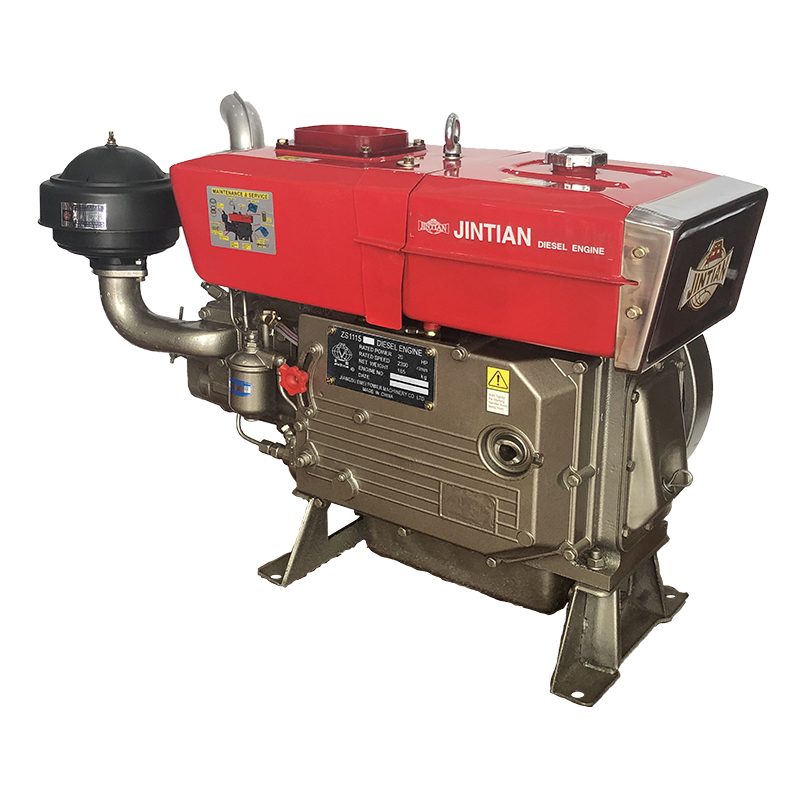
| ZS1115 | 20 HP | 2200 rpm | 1.195 L | 252.7 g/kW·h | Water |
| ZS1110 | 18 HP | 2200 rpm | 1.093 L | 257 g/kW·h | Water |
| ZS1105 | 16.5 HP | 2200 rpm | 0.996 L | 257 g/kW·h | Water |
| ZS1100 | 15 HP | 2200 rpm | 0.903 L | 269 g/kW·h | Water |
| ZS195 | 13 HP | 2200 rpm | 0.815 L | 271.3 g/kW·h | Water |
| EM190 / JR190 | 9.5 HP | 2300 rpm | 0.572 L | 278.5–288.4 g/kW·h | Water |
| EM185 / JR185 | 8 HP | 2200 rpm | 0.510 L | 288.4 g/kW·h | Water |
| R180 | 7 HP | 2600 rpm | 0.402 L | 292.7 g/kW·h | Water |
| R175 | 6 HP | 2600 rpm | 0.353 L | 294.2 g/kW·h | Water |
| R170A / R170A-T | 4 HP | 2600 rpm | 0.269 L | 315 g/kW·h | Water |
| Z175F | 5 HP | 2600 rpm | 0.331 L | 301.4 g/kW·h | Air |
| X170F | 5 HP | 3000 rpm | 0.289 L | 308.5 g/kW·h | Air |
| Z170F | 4 HP | 2600 rpm | 0.269 L | 304.2 g/kW·h | Air |
| 170F | 4 HP | 2600 rpm | 0.289 L | 304.2 g/kW·h | Air |
Rated speed typically varies between 2200 and 3000 rpm. Displacement ranges from 0.269 L on entry-level models to 1.659 L on the ZS1132, while specific fuel consumption improves on higher-power models, falling from roughly 315 g/kW·h at 4 HP to 252.7 g/kW·h in the 20–32 HP range. For procurement, this means operating efficiency is not a fixed brand attribute; it is a function of power class and load matching.
Water-Cooled vs Air-Cooled Engine Architecture
Water-cooled single cylinder engines, such as the ZS and EM/JR series, maintain more stable thermal conditions under continuous load. They suit irrigation pumps, rice mills, generators and other equipment that runs for long hours at a consistent speed. Air-cooled models, such as Z170F, Z175F and X170F, are lighter, simpler and easier to transport, making them practical for portable or intermittent agricultural machines like power tillers and small threshers. The trade-off is thermal stability under heavy sustained duty.
Certification and Verification: A Practical Procurement Framework
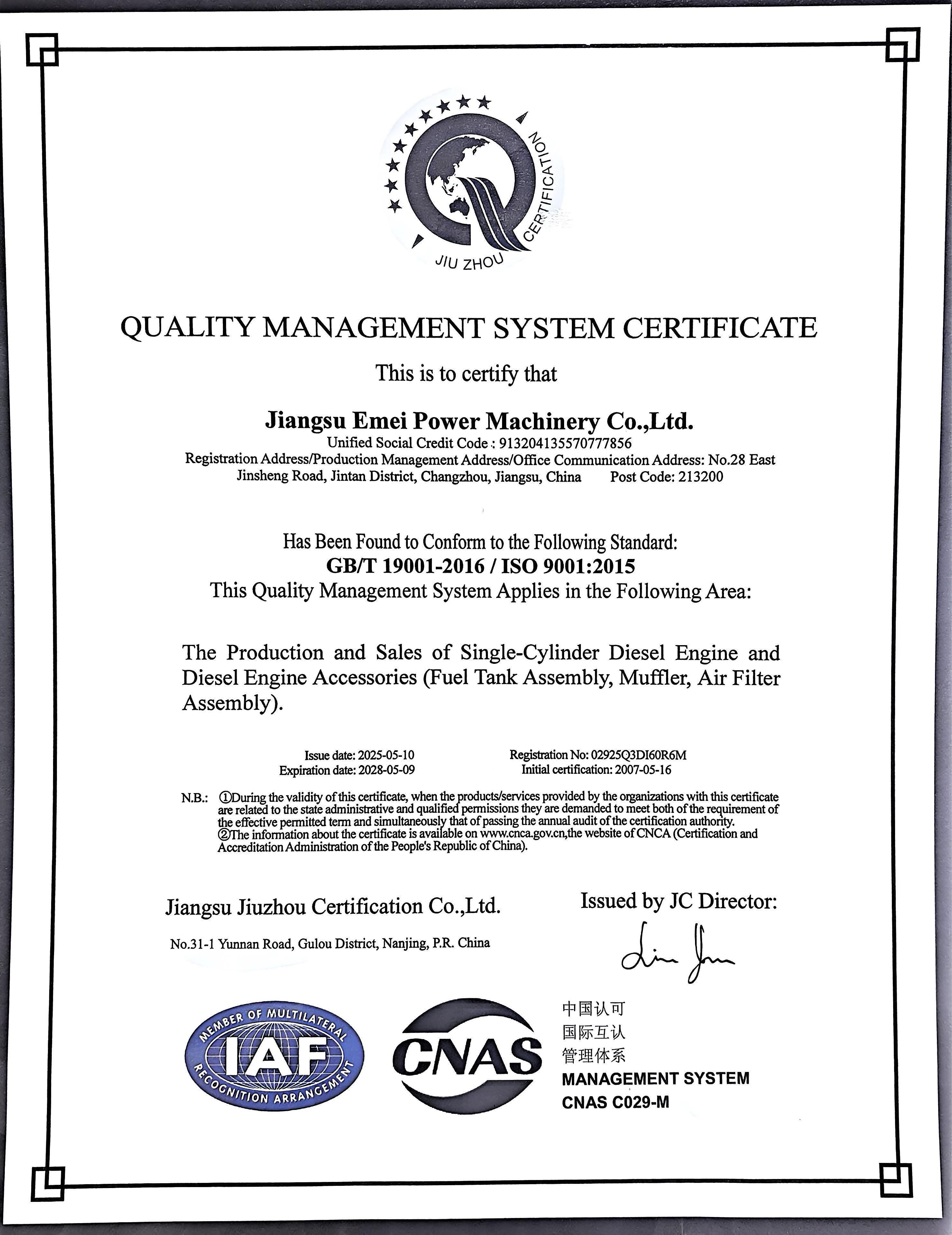
Verifiable certification is a decisive constraint in single cylinder diesel engine sourcing. For Chinese manufacturers exporting to global markets, ISO 9001 quality management certification is the most commonly requested baseline. It confirms that production and sales processes follow documented quality control procedures, but buyers should go one step further and verify the certificate number, issuing body, scope and validity period.
A useful example from the supplier side is CHANGZHOU VISION INTERNATIONAL TRADING CO., LTD, which holds GB/T 19001-2016 / ISO 9001:2015 certification. The certificate number is 02925Q3D160R6M, issued by Jiangsu Jiuzhou Certification Co., Ltd. on 10 May 2025, valid until 9 May 2028. Its certified scope covers “The Production and Sales of Single-Cylinder Diesel Engine and Diesel Engine Accessories (Fuel Tank Assembly, Muffler, Air Filter Assembly).” This scope is particularly relevant for buyers of complete engines and spare parts, because it confirms that both assembled units and key components are under the certified quality system.
Beyond ISO 9001, environmental management certification can be relevant. The same company reports ISO 14000 environmental management system certification as part of its enterprise profile. For target markets with specific emissions rules, such as the U.S. EPA Tier 4 framework for off-highway diesel engines, the key constraint is the 24 HP threshold: engines below this level are exempt from the particulate matter and NOx requirements of Tier 4. This standard is not a brand preference; it is a market-access condition that should be confirmed against the specific engine model and destination market.
What Buyers Should Verify Before Placing an Order
- Certificate number and issuing body: verify that the number can be traced to an accredited certification body.
- Validity period: expired certificates are a red flag unless an updated version is shared.
- Scope of certification: confirm that the product category matches the actual purchase (engine assembly, accessories, spare parts).
- Emissions compliance: confirm whether the target market imposes PM/NOx limits and whether the model is exempt or compliant.
- Starting system and configuration: the current Willson catalogue lists hand-start as the standard starting system across models; buyers should confirm any configuration variation with the supplier before contracting.
Matching Engine Specifications to Real Applications
The relationship between engine class and end-use is the most direct purchasing criterion. Different equipment types impose different load cycles, operating speeds and service expectations.
| Application | Typical Power Range | Indicative Models |
|---|---|---|
| Agricultural irrigation water pumps | 7–20 HP | R180, ZS1100, ZS1115 |
| Power tillers and small farm machinery | 4–6 HP | Z170F, Z175F, R175 |
| Generators and continuous power | 15–35 HP | ZS1100, ZS1115, ZS1130, ZS1132 |
| Threshers, rice mills, farm processing | 8–16.5 HP | EM185, ZS1100, ZS1105 |
| Small tractors and agricultural machinery | 13–30 HP | ZS195, ZS1110, ZS1130 |
| Air compressors and small construction equipment | 8–32 HP | EM185, ZS1115, ZS1132 |
A documented example comes from agricultural irrigation in Pakistan: 96 sets of ZS1115 engines (20 HP, water-cooled) were deployed for irrigation duty and operated for 10 years without major failures. The end user highlighted fuel-efficient design, easy maintenance, and the ability to adapt to harsh local environments. This type of field evidence is useful during supplier evaluation because it links an engine model to a specific application profile and duty cycle.

Market Trends That Shape Supplier Selection in 2026
Understanding how the broader single cylinder diesel engine market is moving helps buyers set realistic evaluation criteria. Several verifiable trends are relevant:
- Agriculture remains the dominant demand driver. According to Dataintelo, agriculture accounts for 42.3% of single cylinder diesel engine market share in 2025. Irrigation, tillage and post-harvest processing remain the strongest application segments.
- Asia Pacific leads regional demand. The same source indicates Asia Pacific holds a 58.2% revenue share. This concentration affects supply chains, spare parts availability and regional pricing dynamics.
- Chinese combustion engine exports continue to grow. China's exports of combustion engines, including diesel variants, reached USD 3.29 billion in 2025, with Russia, Vietnam and India among major destinations (OEC). Buyers sourcing from China are therefore operating within a large, export-oriented supply base.
- Local assembly models are gaining ground. SKD and CKD assembly strategies offer tariff advantages in some ASEAN markets, such as Myanmar (1.5%–3% for CKD) and Thailand (0% for certain categories), as part of efforts to incentivise local manufacturing (KAMA Auto). This makes supplier capability in semi-knocked-down and complete-knocked-down supply relevant for importers seeking tariff efficiency.
- Established global and Chinese manufacturers coexist. According to Intel Market Research, the small single cylinder diesel engine sector includes Yanmar, Kubota, Kohler and Hatz as international names, while Changchai and Shifeng are notable Chinese producers. Evaluation frameworks that compare a prospective supplier against this competitive context are more robust than single-brand assessments.
OEM / ODM and Supply Flexibility as a Constraint
For buyers who need custom packaging, logo or nameplate branding, supplier flexibility matters. CHANGZHOU VISION INTERNATIONAL TRADING CO., LTD reports OEM/ODM support covering package, logo and nameplate customisation, with a monthly capacity of 10,000 units, a lead time of 25–45 days, and a minimum order quantity of one 20-foot container. When evaluating price constraints, this kind of capacity data is more useful than market-place price averages, because it converts a supplier's constraints into order-planning parameters.
Comparing Single Cylinder Diesel Engines with Alternative Power Sources
The choice of a single cylinder diesel engine is often made against electric motors or multi-cylinder diesel engines. A fair evaluation should include the trade-offs.
Electric motors offer cleaner operation, lower noise and lower running costs where reliable grid power is available. But for off-grid irrigation sites, construction sites and mobile agricultural machinery, the infrastructure required for electric power — grid connection, cabling, or battery investment — is often prohibitive. Diesel engines remain the practical independent power source in such settings.
Multi-cylinder diesel engines deliver smoother running and higher power density, which is valuable for large generators or constant-speed industrial applications. However, they are significantly heavier, more expensive to purchase and maintain, and less suited to smallholder agriculture where local mechanics are familiar with single cylinder service.
There are, however, legitimate limitations of single cylinder diesel engines. Vibration is inherently higher than multi-cylinder designs, which can affect sensitive equipment if isolation mounts are not used. Power output is limited; applications above roughly 35 HP typically require a different engine architecture. And in the Willson catalogue specifically, the standard models listed are hand-start units. Buyers whose projects require electric start should confirm the availability of a matching configuration before assuming it is standard.
Future Outlook for Single Cylinder Diesel Engine Procurement
Several structural changes are likely to shape procurement over the next five years. Emissions rules will continue to influence product planning: the EPA Tier 4 exemption below 24 HP provides continued room for small agricultural engines, while higher-power models face tightening PM/NOx expectations in regulated markets.
Efficiency will become a stronger differentiator. The spread in specific fuel consumption — from around 315 g/kW·h on 4 HP models to 252.7 g/kW·h on 20–32 HP models — reflects the range buyers should benchmark when calculating operating costs for long-season applications.
Localised assembly via SKD and CKD channels will expand in tariff-sensitive markets. Suppliers that can manage knocked-down supply, quality documentation and local assembly support will become more valuable to distributors and government-backed procurement programmes.
Finally, after-sales capability is shifting from reactive spare-parts supply to remote support and structured service arrangements. Buyers should evaluate not only the engine, but the supplier's ability to provide documentation, testing records and remote troubleshooting over the product lifecycle.
Frequently Asked Questions
What is a single cylinder diesel engine?
A single cylinder diesel engine is a compression-ignition engine with one working cylinder, typically configured as a horizontal four-stroke engine. It is used to power water pumps, agricultural machinery, generators, small construction equipment and farm processing machines. Its main advantages are simple construction, low purchase cost, availability of spare parts and ease of maintenance in rural or remote areas.
What are the most important specifications to check on a single cylinder diesel engine?
The critical specifications are rated power (HP), rated speed (rpm), bore and stroke (mm), displacement (L), specific fuel consumption (g/kW·h), oil consumption (g/kW·h), fuel tank capacity (L), cooling type (air-cooled or water-cooled) and starting system (hand-start or electric start). These parameters together define whether an engine can sustain the load profile of a given application.
How do I choose the right horsepower for an irrigation pump?
Match engine power to the pump's hydraulic power requirement, including flow rate, total head and friction losses, then add a reserve margin for altitude, temperature and long running hours. For small irrigation pumps, 7–15 HP engines are common; for heavier pumps, 20 HP and above is typical. A documented example from Pakistan used 96 sets of ZS1115 (20 HP) engines for irrigation and achieved 10 years of service without major failures.
Which certifications should a single cylinder diesel engine supplier hold?
The most common baseline is ISO 9001:2015 quality management certification. Buyers should verify the certificate number, issuing body, validity period and scope of certification. For example, CHANGZHOU VISION INTERNATIONAL TRADING CO., LTD holds certificate number 02925Q3D160R6M under GB/T 19001-2016 / ISO 9001:2015, issued by Jiangsu Jiuzhou Certification Co., Ltd, valid until 9 May 2028. For U.S. destinations, EPA Tier 4 compliance — including the exemption for engines under 24 horsepower — should also be checked.
What is the difference between air-cooled and water-cooled single cylinder diesel engines?
Water-cooled engines use a water jacket and radiator or tank to maintain stable operating temperatures, making them suitable for continuous high-load work such as irrigation pumping, power generation, rice mills and threshers. Air-cooled engines are lighter, simpler and easier to transport, with no water tank or cooling circuit to maintain. They are better suited to portable, intermittent-use applications such as power tillers and small threshers.
Why does specific fuel consumption matter in procurement?
Specific fuel consumption (g/kW·h) directly determines running costs. In irrigation, milling or generation applications where engines run for hundreds of hours per season, even a difference of 10–20 g/kW·h between models can add up to measurable fuel expense. Buyers should compare fuel consumption within the same power class rather than across different engine sizes, because larger engines typically achieve better specific consumption but consume more absolute fuel.
For buyers who require a complete product catalogue and specification overview, the manufacturer's brochure is available at: Willson Diesel Engine Catalogue (PDF).
Есть вопросы или нужны дополнительные детали?
Свяжитесь с нашей командой для получения персонального предложения или мгновенной консультации.
Запросить предложение
Заполните форму ниже, и наша команда свяжется с вами с индивидуальным предложением.
Прямой чат WhatsApp
Предпочитаете общаться в реальном времени? Напишите нам в WhatsApp для мгновенной помощи и быстрых ответов.
- Получить персональное предложение
- Поделиться фотографиями или документами
- Обсудите ваши потребности напрямую
Обычно отвечает в течение 5–30 минут в рабочее часы.