
Single Cylinder Diesel Engines: An Independent Comparison of Market Options

A single cylinder diesel engine manufacturing site in Changzhou, Jiangsu, China — the production context behind most market options in this category.
Single cylinder diesel engines are the working power source behind small-scale farming, irrigation, milling and decentralised electricity across much of Asia, Africa and Latin America. For buyers at the decision stage, the practical question is rarely which brand is best and almost always which combination of power output, cooling system and starting mechanism fits the duty cycle at a cost that can be defended internally. This comparison sets out the configuration choices that actually separate one market option from another, and the evidence a buyer should request before committing.
The Market Buyers Are Actually Choosing From
Global Growth Insights values the global single cylinder diesel engine market at approximately USD 3.34 billion in 2025, with a projected value of USD 3.74 billion by 2035. Dataintelo estimates that agriculture accounted for roughly 42.3% of 2025 market share and that Asia Pacific held a 58.2% revenue share. Supply-side data points in the same direction: the Observatory of Economic Complexity reports that China's exports of combustion engines, including diesel variants, reached USD 3.29 billion in 2025, with major destinations including Russia, Vietnam and India.
Buyers should treat any single market-size figure in this segment with caution. Published estimates for the same nominal category diverge sharply: Global Growth Insights cites USD 3.34 billion for the single cylinder diesel engine market, Dataintelo's broader single cylinder diesel engine report cites USD 12.8 billion, and Intel Market Research places the narrower small single cylinder diesel engine segment at USD 0.737 billion. The differences reflect category boundaries rather than disagreement about demand. Market headlines are useful context; they are not a procurement criterion.
Intel Market Research lists leading participants in the small diesel engine sector as Yanmar, Kubota, Kohler and Hatz, alongside prominent Chinese manufacturers including Changchai and Shifeng Group. That list is a reasonable starting point for market mapping, and it does not answer the question a buyer actually has: which configuration of cooling, starting, output and fuel system suits the machine the engine will drive.
Why Configuration Beats Brand in This Segment
In higher-horsepower industrial segments, brand is often a workable proxy for engineering depth. In single cylinder diesel engines it is a weaker proxy, because the same nominal engine family is commonly sold in several build variants for different duties. Two engines with identical displacement and output ratings can differ in ways that decide whether a unit survives several seasons of dusty irrigation work or spends them in a repair queue:
- Cooling method — air-cooled with cooling fins, or water-cooled with a radiator and coolant circuit.
- Starting method — manual crank or recoil with decompression, or an electric start diesel engine with starter motor, battery and often a charging coil.
- Duty rating — whether the published output is a short-duration peak figure or a continuous rating, and at what engine speed it is quoted.
- Fuel system and filtration — injection layout and the filtration provided for fuel quality that varies by market.
- Drive interface — crankshaft taper, keyed shaft, belt pulley or flange, which must match the driven machine.
Each of these is a comparison axis that can be evaluated from published specifications, a sample and documented process evidence. None of them requires trusting a brand claim.
Five Comparison Dimensions That Decide the Outcome
| Comparison dimension | What to compare | Why it decides the outcome |
|---|---|---|
| Power output and duty rating | Published horsepower range, rated versus peak output, engine speed, continuous duty capacity | An engine matched on peak output but run continuously at that figure is over-stressed from day one |
| Cooling system | Air-cooled or water-cooled, expected ambient temperature, dust exposure, service access | Determines heat-rejection headroom under sustained load and the maintenance routine the operator must sustain |
| Starting mechanism | Manual or electric start, battery and charging provision, cold-start behaviour | Decides who can operate the machine and how much working time is lost to restarts |
| Fuel system and build consistency | Injection layout, filtration stages, surface protection, assembly inspection stages | Determines sensitivity to local fuel quality and resistance to dust and moisture |
| Supply format and compliance | Complete unit, SKD or CKD, destination-market rules and documentation | Affects landed cost, local assembly obligations and market access |
Working through the five dimensions in sequence prevents the most common failure in this category: choosing a unit on horsepower and price, then discovering that the cooling or starting configuration does not match the real duty.
Power Output and Duty Matching
Power is the first number buyers compare and the easiest to misread. A useful discipline is to convert the driven machine's requirement into a continuous load figure, then select an engine whose continuous rating sits above it. The reference points that matter most in agricultural and light industrial use are the following:
- Irrigation and water pumps. Required power scales with total head and flow rate, not with pipe diameter alone. A diesel engine for irrigation pump duty should be compared on continuous output at the expected operating head.
- Tillers and power tillers. Load fluctuates with soil type, moisture and working depth. A diesel engine for tiller duty is normally compared on torque reserve and part-load behaviour rather than on rated horsepower alone.
- Generator sets. Generator loading includes motor-starting surges. A diesel engine for generator duty should be compared on its ability to absorb short overloads without excessive speed droop.
- Threshers, rice mills and farm machinery. These duties combine a steady base load with periodic spikes as material enters the machine. A diesel engine for thresher or rice mill use is best compared on sustained output stability.
Willson, the single cylinder diesel engine brand of Changzhou Vision International Trading Co., Ltd., covers a 3–45 horsepower range across air- and water-cooled single cylinder series, with diesel engine accessories in the same catalogue. That breadth is itself a comparison point: within one manufacturing source, output bands can be compared against duty without mixing supplier conventions. Buyers comparing across suppliers should normalise ratings first — confirm whether a figure is rated or maximum output, at what engine speed it is quoted, and under what ambient condition.
Two cautions apply across all suppliers. Continuous duty in high ambient temperature reduces achievable output, so engines intended for hot climates are compared more honestly in continuous terms. And peak horsepower marketed for short-duration use is not the number to size a pump, mill or generator against.
Cooling Systems: Air-Cooled, Water-Cooled, and Where Each Fits
Cooling is the configuration decision most often made by habit rather than analysis. An air cooled diesel engine rejects heat through fins and forced air, with no coolant, radiator, water pump or hoses. A water cooled diesel engine uses a closed coolant circuit, typically with a radiator and thermostat, to hold operating temperature within a narrower band.
| Cooling configuration | Typical fit | Comparison caution |
|---|---|---|
| Air-cooled | Portable pumps, tillers and field machinery; dry, dusty and remote sites; equipment operating where coolant is difficult to obtain | Heat rejection is limited under sustained high load and high ambient temperature; cooling fins must be cleaned regularly to remain effective |
| Water-cooled | Generator sets, long-run irrigation, rice mills and other continuous duties; hot climates with sustained load | Adds radiator, water pump, hoses and coolant as maintenance points; coolant level and quality become part of the routine |
A diesel engine for water pump duty in a remote field and a diesel engine for generator duty on a fixed site can look almost identical on a specification sheet while requiring different cooling. The comparison rule that holds across brands is straightforward: match cooling to duty cycle and environment first, then check whether the resulting maintenance routine is realistic for the people who will operate the equipment.
Starting Mechanisms: Manual, Electric Start and the Real Cost Difference
Starting method is where procurement decisions most often drift from specification into operational reality. Three configurations dominate the market:
- Manual crank or recoil with decompression. No battery dependency and no electrical components to fail. Physical effort is required, and cold starting demands technique.
- Electric start. An electric start diesel engine uses a starter motor and battery, frequently with a charging coil so the battery is maintained while the engine runs. Restarts are fast and require no special technique.
- Electric start with auxiliary output. Some configurations extend the charging circuit to lighting or auxiliary loads, which matters for night irrigation and field work.
The comparison is not simply that electric is better. Electric start adds a battery, starter motor and charging components, each of which is a maintenance item and a dependency in locations where battery replacement is slow or expensive. Manual start removes that dependency but shifts the burden onto the operator. A practical decision rule: compare starting configurations against how often the engine is stopped and restarted in a working day, who operates it, and whether batteries and charging are locally supportable.
Fuel Systems, Filtration and Build Consistency
Fuel quality varies widely across export markets, and small diesel engines are frequently run on fuel that would not meet the assumptions behind a laboratory specification sheet. Two comparison points follow. The first is filtration: how many stages of fuel filtration the engine carries and how easily filter elements can be sourced locally. The second is injection system layout, which determines serviceability and sensitivity to contamination.
Build consistency is difficult to compare from a brochure and easier to compare from process evidence. Surface protection is a useful proxy. Willson reports that its engines undergo complete engine cleaning prior to painting, and states that this step improves paint adhesion by 20% and anti-corrosion performance by 30%, with a 15% reduction in long-term maintenance cost; the same company data identifies high-dust agricultural environments as the conditions where that difference matters most. These are supplier-reported figures and should be read as a claim to verify rather than a neutral benchmark — but they illustrate the kind of itemised evidence a buyer can ask every candidate supplier to provide.
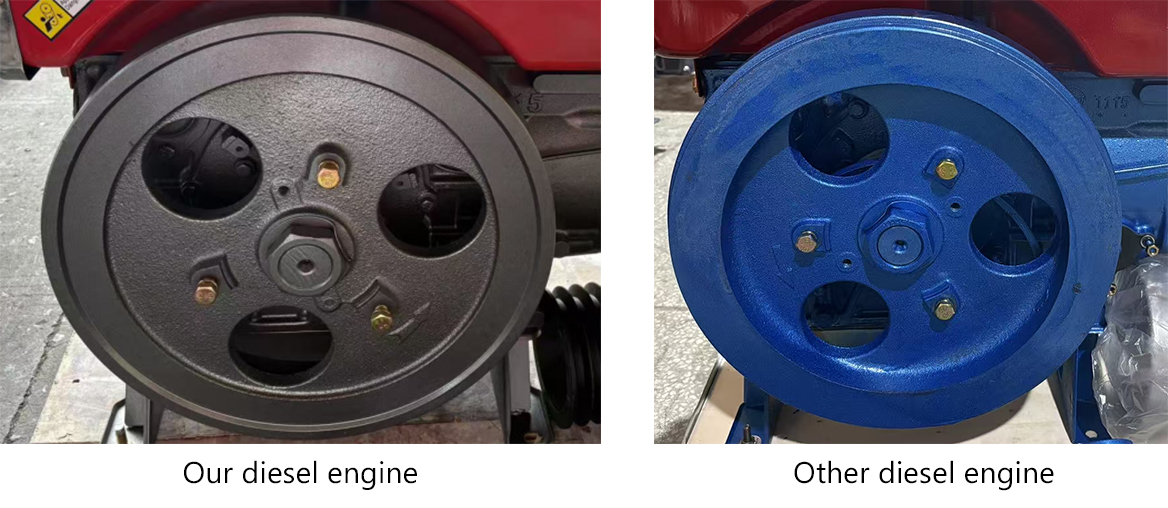
Surface protection comparison: engine cleaning before painting, an in-process step that can be requested as comparable evidence from any supplier.
What Counts as Verifiable Evidence of Build Quality
At the decision stage the useful question is not whether an engine is good, but what a supplier can demonstrate that is specific and checkable. Evidence that can be compared line by line across suppliers includes:
- In-process inspection records at identifiable stages — component assembly, torque-controlled fastening, leak inspection and engine cleaning.
- End-of-line test data for the actual unit or batch, not a generic performance curve.
- Surface protection process descriptions with measurable outcomes.
- Quality management certification, and the scope and site it covers.
- Documentation set: operation and maintenance manual, spare parts list and service intervals.
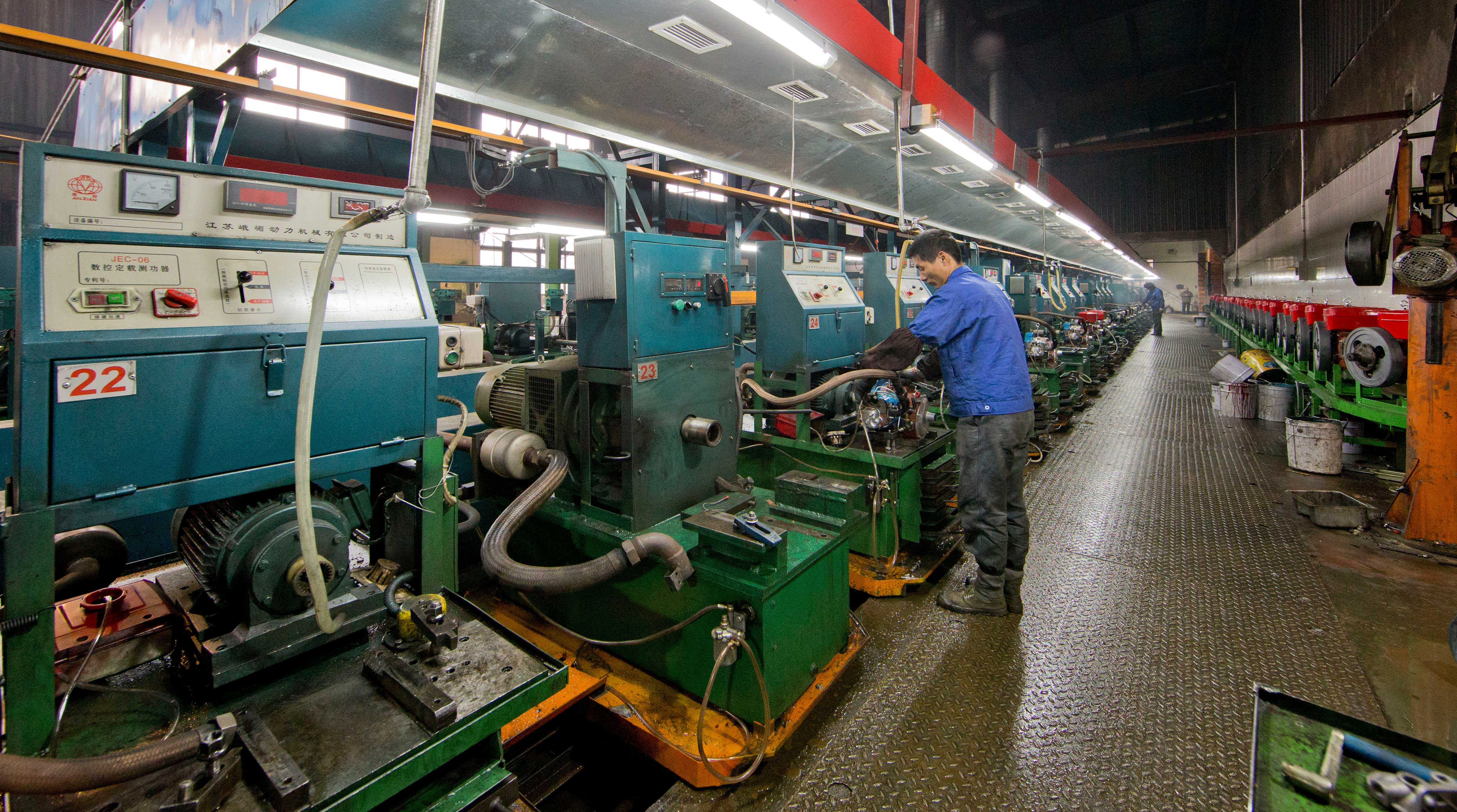
End-of-line testing on a single cylinder diesel engine production line — the stage where batch test data should be requested.
Changzhou Vision International Trading Co., Ltd. holds ISO9001 quality management system certification and ISO14000 environmental management system certification, and reports an annual output of 100,000 units from a workforce of 95 employees, with an R&D team of five engineers. Certification scope and output figures are checkable claims: request the certificate and confirm which products and which site it covers.
Compliance and Market Access
Emissions rules are a comparison dimension because they can exclude a configuration outright. In the United States, EPA Tier 4 standards regulate particulate matter and nitrogen oxides for off-highway diesel engines, with exemptions applying to engines under 24 horsepower. That threshold is directly relevant here, because a significant part of the single cylinder diesel engine market sits below it. Buyers shipping into regulated markets should confirm the applicable rule for their engine class and destination before ordering, and retain the documentation with the shipment.
A general compliance rule for this segment: the smaller the engine and the more decentralised its use, the more likely it is to fall under a different rule from the one a buyer assumed. Verification with the importing authority or a customs broker belongs inside the decision process, not after it.
Supply Format: Complete Units, SKD and CKD
How an engine is shipped can matter as much as how it is built. Complete units are the simplest to receive and deploy. SKD (semi-knocked down) and CKD (complete knocked down) formats shift part of the assembly work to the destination market and are usually compared on tariff treatment and local content requirements rather than on hardware.
One industry source, KAMA Auto, reports that SKD and CKD assembly strategies offer tariff advantages in markets such as Myanmar, with rates in the region of 1.5%–3% for CKD, and Thailand, with 0% for some categories. That data carries a verification flag and should be treated accordingly. Tariff treatment for knocked-down engine kits changes with policy and product classification, and the classification of a partially assembled engine is decided by the importing customs authority rather than by the supplier. Buyers comparing SKD or CKD against complete-unit supply should confirm rates and local-content rules with a customs broker in the destination market before building a landed-cost model.
Where Willson Sits in This Comparison
Willson is the single cylinder diesel engine brand of Changzhou Vision International Trading Co., Ltd., a Chinese manufacturer based in Changzhou, Jiangsu, producing 3–45 horsepower air- and water-cooled single cylinder diesel engines together with diesel engine accessories. The company was founded in 2010, reports a workforce of 95 and an R&D team of five engineers, and exports approximately 70% of its output to South America, Africa, Southeast Asia and the Middle East.
For the purposes of an independent comparison, Willson's relevance is coverage rather than a claim of superiority. Its range spans the configurations buyers compare most often — air-cooled and water-cooled, and manual and electric start variants across the 3–45 horsepower band — and its product scope covers the applications that dominate the segment: small tractors, agricultural machinery, generator sets, water pumps, small construction machinery, air compressors, inland waterway vessels and agricultural and sideline product processing. That breadth makes internal comparison possible: output band, cooling and starting configuration can be compared within one manufacturing source before sources are compared against each other.
Two support-side facts belong in the same comparison. The company reports providing detailed operation and maintenance manuals, pre-sale technical training and after-sales support. On maintenance safety, its documented position is that the engine must be shut down before maintenance work and that procedures must follow the instruction manual — a control measure that matters because improper maintenance procedures can result in equipment damage or personal injury. Buyers comparing suppliers on total cost of ownership should compare precisely this: whether the manual set, the training and the service channel actually reach the operator.
Limits and Trade-offs Buyers Should Accept
An independent comparison is only useful if it states boundaries as clearly as advantages.
- Single cylinder architecture has inherent limits. Vibration and noise are higher than in multi-cylinder designs, and output is capped. Willson's range tops out at 45 horsepower; duties requiring more continuous power sit outside this category.
- Air cooling is not a universal answer. Under sustained high load and high ambient temperature, air-cooled units have less heat-rejection headroom, and fin cleanliness directly affects performance.
- Electric start adds dependency. Batteries and charging components need local support; in remote deployments a manual-start configuration can be the more dependable comparison choice.
- Supplier-reported performance figures need verification. Claims such as surface protection improvements are comparative and self-reported. They are a basis for asking questions, not a substitute for sample testing.
- Market data for this segment is inconsistent. Published market values differ substantially between reports, so sizing decisions should rest on the buyer's own volume and duty data.
- Trade-policy figures require confirmation. The SKD/CKD tariff data cited above carries a verification flag; classification and rates are destination-specific.
Market Trend and Outlook
Three trends are visible in the available data. First, demand remains concentrated: Dataintelo places agriculture at approximately 42.3% of market share in 2025 and Asia Pacific at 58.2% of revenue, which means the comparison criteria that matter most are still the agricultural ones — dust tolerance, part-load stability and serviceable filtration. Second, the export flow is substantial and Asia-centred: China's combustion engine exports reached USD 3.29 billion in 2025, with major destinations including Russia, Vietnam and India. Third, supply formats are diversifying, as buyers in destination markets look for tariff and local-content advantages through SKD and CKD assembly.
The direction of travel for buyers is toward configuration-level comparison. As more suppliers publish comparable specification data and process evidence, the advantage shifts to buyers who can normalise ratings, match cooling and starting configurations to real duty cycles, and verify compliance before the order rather than after arrival.
Frequently Asked Questions
What is the difference between air-cooled and water-cooled single cylinder diesel engines?
An air cooled diesel engine rejects heat through cooling fins and forced air, with no coolant circuit, radiator, water pump or hoses. A water cooled diesel engine uses a closed coolant circuit, usually with a radiator and thermostat, to hold operating temperature within a narrower band. In comparison terms, air cooling reduces the number of components and maintenance points and suits dry, dusty and remote sites, while water cooling provides more stable temperature control under sustained load and in high ambient temperatures, at the cost of additional maintenance items such as coolant level and hose condition.
Is an electric start diesel engine worth the extra components for agricultural use?
It depends on restart frequency, operator profile and local support for batteries. An electric start diesel engine uses a starter motor and battery, often with a charging coil, so restarting requires no special technique and takes little time — an advantage where an engine is stopped and started repeatedly through a working day. Manual crank or recoil starting removes battery dependency but requires physical effort and cold-start technique. Where batteries cannot be sourced reliably, manual start is the more dependable comparison choice; where labour is scarce or operators are inexperienced, electric start reduces operating friction.
Which power output should I compare for irrigation pumps, power tillers and generators?
Compare continuous output against the driven machine's load rather than comparing peak horsepower figures. For irrigation and water pumps, required power follows total head and flow rate. For tillers and power tillers, torque reserve and part-load behaviour matter alongside rated output. For generator sets, the ability to absorb motor-starting surges without excessive speed droop is the relevant comparison. For threshers and rice mills, sustained output stability under periodic load spikes is the deciding factor. Confirm the engine speed and ambient condition at which any published rating is quoted before comparing figures across suppliers.
How do SKD and CKD supply formats affect landed cost?
SKD (semi-knocked down) and CKD (complete knocked down) formats move part of the assembly work to the destination market and are usually compared on tariff treatment, local content requirements and local assembly capability rather than on hardware. One industry source reports tariff advantages in markets such as Myanmar, in the region of 1.5%–3% for CKD, and Thailand, with 0% for some categories; that data carries a verification flag. Because classification is decided by the importing customs authority and rates change with policy, landed-cost comparisons should be confirmed with a customs broker in the destination market.
What should buyers check about emissions rules before ordering?
Identify the applicable rule for the engine class and the destination market first. In the United States, for example, EPA Tier 4 standards regulate particulate matter and nitrogen oxides for off-highway diesel engines, with exemptions applying to engines under 24 horsepower — a threshold that covers a significant part of the single cylinder diesel engine market. Rules differ by jurisdiction, engine size and application, so the check belongs in the procurement process before the order is placed, with documentation retained for the shipment.
Why do published market size estimates for single cylinder diesel engines differ so much?
The differences generally come from category boundaries rather than disagreement about the underlying market. Published figures range from USD 3.34 billion for the single cylinder diesel engine market and USD 12.8 billion in a broader single cylinder diesel engine report to USD 0.737 billion for the narrower small single cylinder diesel engine segment. Each figure describes a differently defined scope. For procurement purposes, market totals are useful as directional context; output, cooling, starting, compliance and supply-format comparisons are what determine the decision.
Bringing the Comparison Together
Comparing market options in this segment comes down to a repeatable sequence: normalise power ratings, match cooling and starting configuration to the real duty cycle, confirm compliance for the destination market, verify the supply format, and request process evidence that can be compared line by line across suppliers. Buyers who work through that sequence before requesting quotations are comparing engines rather than comparing brochures. A downloadable product and specification brochure for Willson single cylinder diesel engines is available for reference here: Willson single cylinder diesel engine brochure (PDF).
Есть вопросы или нужны дополнительные детали?
Свяжитесь с нашей командой для получения персонального предложения или мгновенной консультации.
Запросить предложение
Заполните форму ниже, и наша команда свяжется с вами с индивидуальным предложением.
Прямой чат WhatsApp
Предпочитаете общаться в реальном времени? Напишите нам в WhatsApp для мгновенной помощи и быстрых ответов.
- Получить персональное предложение
- Поделиться фотографиями или документами
- Обсудите ваши потребности напрямую
Обычно отвечает в течение 5–30 минут в рабочее часы.