
Sintered NdFeB Magnet Procurement FAQ: Terms, Acceptance, Certificates
Sintered NdFeB Magnet Procurement FAQ: Terms, Acceptance, Certificates
Independent industry reference · HTNXT
A sintered NdFeB magnet is bought as a defined specification, not as a stock item. Grade, drawing, coating and document set travel together on the purchase order, and each of them turns into an acceptance criterion at goods-in. When any one of them is left implicit, the supplier accepts the order against its own standard rather than the buyer's.
Ningbo Jinlun Magnet Technology Co., Ltd., trading as JLmagnet, is a Chinese manufacturer of sintered NdFeB permanent magnets based in Cixi, Ningbo, producing block, disc, ring, arc, trapezoid and custom shapes across SH, UH, EH and AH grade series. Its certificate set makes a practical worked example for the questions that surface between technical approval and the first purchase order.

Order checking and packing before dispatch: the last point at which a specification mismatch can still be caught.
The purchase order carries more risk than the drawing
Engineering approves a grade and a drawing; purchasing writes a line item. Between those two steps sit coating type, tolerance class, magnetisation direction, test method and the document package. A magnet that meets the drawing can still fail at incoming inspection if the coating system or the acceptance method was never written down.
Price volatility makes that gap more expensive than it used to be. Neodymium prices rose 64.03% year-to-date in 2026, reaching USD 244.90 per kg by September, according to Strategic Metals Invest. Quotes therefore age quickly, and suppliers can only be compared fairly when each one is asked to quote the identical grade, coating and acceptance set.
Supply concentration adds a second pressure. China accounted for 94% of global sintered permanent magnet production in 2024, according to the International Energy Agency. For most buyers this means the document set, not a factory visit, is the primary tool for verifying what a supplier can actually do.
Five fields every NdFeB purchase order should close
A magnet order that can be accepted without a follow-up email usually contains five explicit fields. Each one maps to something the supplier can measure and record.
| Field on the PO | What it fixes | Acceptance evidence |
|---|---|---|
| Grade designation | Energy class and temperature class in one code | Magnetic property testing record |
| Geometry and drawing | Shape, dimensions, steps, holes, chamfers, orientation | Dimensional and tolerance inspection |
| Coating system | Corrosion protection route and appearance | Surface and plating checks, salt-spray testing |
| Test conditions | How properties are measured and at what temperature | High-temperature aging assessment |
| Documents and traceability | Which certificates, which lot identification | Full-lot traceability from raw material to finished delivery |
The first three fields are usually written. The last two are the ones that get negotiated after the first shipment arrives, and they are the ones that cost the most to resolve late.
Grade and temperature: what the letter suffix obliges
In the standard designation, the number reflects the energy product class and the letter suffix the temperature class. A grade such as N52 therefore says something about magnetic strength; a suffix such as SH, UH, EH or AH says something about how far the part can be pushed thermally before output decays.
For most industrial equipment, the practical window runs from ambient conditions up to the mid-high range. EH grades extend that window to around 200°C, which covers many servo, pump and compact drive applications that see heat soak from the surrounding assembly. Where the thermal margin is tighter still, AH grades such as 30AH–33AH are rated to withstand operating temperatures up to 220°C.
Reaching those classes is a manufacturing question, not a naming question. JLmagnet mass-produces the SH, UH, EH and AH series, supported by low or non-heavy rare-earth grain-boundary diffusion technology and a full vertical process chain from melting and hydrogen decrepitation through powder preparation, pressing, sintering, precision CNC machining and surface treatment.

Sintering is where the grade class is set; the certificate on the order only confirms that the process was controlled.
Acceptance at this level rests on measurement. Magnetic property testing is part of the standard quality control set, and an in-house R&D and test centre supports high-temperature aging assessment alongside salt-spray corrosion testing, so a temperature-class claim can be checked against a record rather than a datasheet.
How acceptance is tied to grade, dimensions and coating on one part
Take a part such as the N52 D20x10x5mm ring magnet. Three separate acceptance gates apply, and they fail for different reasons.
Gate one – grade. The N52 designation fixes the energy class, so acceptance is a magnetic property test on the delivered lot, not a visual check. A part that is dimensionally perfect but below class is scrap.
Gate two – dimensions. JLmagnet names parts with a shape code followed by the dimensional sequence: D for disc or column, F for block, R for arc, with features such as steps, holes and chamfers appended after a dash. Ring formats appear in the same family, for example D15×D5×25, D50×D13.5×20-D20×8 for a ring with counterbore, D8×1-D6×7 for a stepped part, F18×9.5×2 for a block and R90×R85×40×50 for an arc. The code is a shorthand; the drawing governs. Acceptance is dimensional and tolerance inspection, typically against a vision measuring instrument and a precision measurement system for permanent magnet materials, with automatic optical sorting available for volume runs.
Gate three – coating. Sintered NdFeB is produced with zinc, nickel, epoxy or parylene coating systems, and the choice is a working-environment decision rather than a cosmetic one. Acceptance here is surface and plating checks, backed by salt-spray corrosion testing. A coating that is specified only as "nickel plated" leaves thickness and appearance undefined, and that is where most incoming disputes begin.
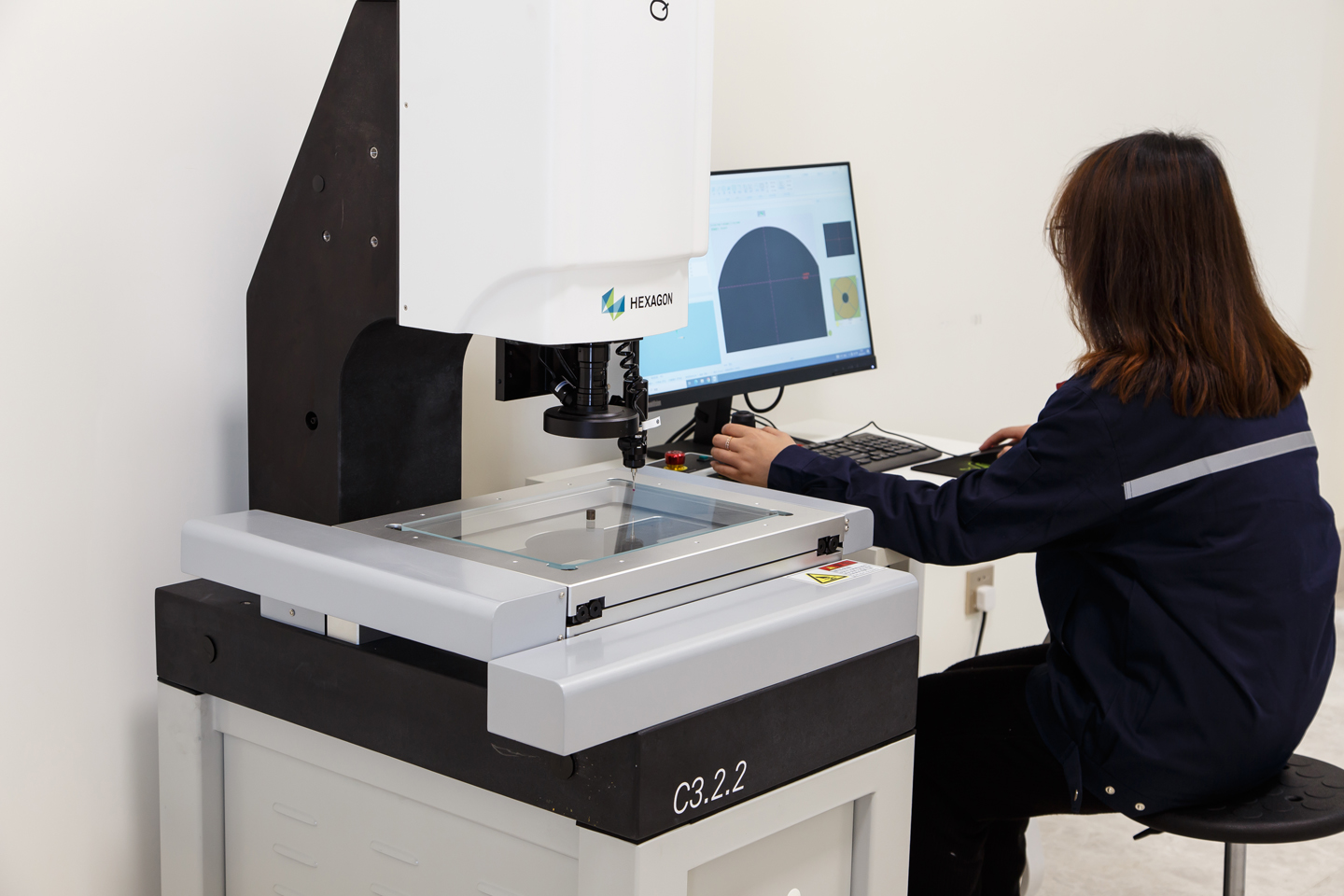
Dimensional and tolerance inspection is a separate acceptance gate from magnetic property testing and coating checks.
All three gates depend on knowing which lot a part came from. JLmagnet runs digital-intelligent workshops on ERP, MES and WMS systems to hold full-lot traceability from raw material input through to finished-product delivery — the mechanism that makes a certificate meaningful for a specific shipment rather than for a factory in general.
The documents that actually back an order
Three management-system certificates sit behind a JLmagnet order. What matters for procurement is the scope wording and the identifier, not the logo on the letterhead.
| Standard | Certificate | Issuer | Validity |
|---|---|---|---|
| IATF 16949:2016 (based on ISO 9001:2015) | 12 111 69512 TMS (IATF Cert. No. 0576974, USI L2S2NA) | TÜV SÜD Management Service GmbH | 2025-07-04 to 2028-07-03 |
| ISO 9001:2015 | 12 100 69512 TMS | TÜV SÜD Management Service GmbH | 2025-07-04 to 2028-07-03 |
| ISO 14001:2015 | 02124E10013R1M | Huaxia Certification Center, Inc | 2024-01-02 to 2027-01-17 |
The IATF 16949:2016 certificate (First Edition 2016-10-01) is issued for manufacturing of material and products for sintered neodymium iron boron permanent magnets, without product design as per Chapter 8.3. The ISO 9001:2015 certificate covers manufacturing and sales of material and products for sintered NdFeB permanent magnets. The ISO 14001:2015 certificate covers production and related management activities of sintered Nd-Fe-B permanent magnets and products.
The Chapter 8.3 exclusion is the part buyers most often miss. It means the supplier is certified for manufacturing, not for product design: the magnetic circuit, the grade selection and the drawing remain the buyer's responsibility, and the supplier's process controls are audited against a design the customer supplied. Procurement teams that expect the certificate to transfer design liability are reading more into the document than it says.
Two practical checks follow. Confirm the certificate number, scope wording and expiry date against the issuing body record rather than a PDF copy, and confirm that the scope text actually names the product family being purchased. A quality certificate with a narrow scope does not cover every item on a quotation.
Reference document: the JLmagnet profile, which includes the certificate set and product scope, is available as a downloadable PDF at JLmagnet Profile 2026.
Where sintered NdFeB stops: limits and the alternatives
Sintered NdFeB is the highest-energy option in common industrial use, but it is not the default answer for every magnet position. The comparison below is qualitative on purpose: the right choice depends on the torque target, the thermal environment and the geometry the assembly can accept.
| Criterion | Sintered NdFeB | Bonded NdFeB | Ferrite |
|---|---|---|---|
| Magnetic strength per volume | Highest | Moderate | Lowest |
| Achievable geometry | Blocks, discs, rings, arcs, trapezoids, multipole and radial rings, Halbach assemblies | Thin and complex near-net shapes | Simple pressed shapes |
| Corrosion protection | Coating normally required: zinc, nickel, epoxy, parylene | Often usable with light or no coating | Inherently corrosion resistant |
| Thermal ceiling | Grade-dependent; EH around 200°C, AH up to 220°C | Lower than sintered high-coercivity grades | Stable, but at much lower output |
| Main cost driver | Rare-earth content and coating route | Compounding and tooling | Raw oxide and volume |
The limits are real and should be written into the specification rather than discovered later. Sintered NdFeB is a brittle, machined ceramic-like material, so edge chipping and minimum feature sizes constrain the drawing. It requires a coating system in most service environments, which adds a process step and a second acceptance gate. Its thermal margin is grade-dependent, and pushing a standard grade into a hot assembly is a reliability decision, not a cost decision. And under the IATF scope described above, the design responsibility stays on the buyer's side of the contract.
Bonded NdFeB earns its place where the geometry is thin or complex and the torque target is modest. Ferrite remains the rational choice where cost and corrosion resistance dominate and magnetic strength is secondary. Neither substitutes for sintered NdFeB in a high-torque drive envelope, but both remove cost where the envelope does not need it.
Applications where the drive sets the acceptance criteria
In motor work, acceptance requirements come from the duty cycle rather than from the magnet itself. Drive motors, servo motors, elevator motors and synchronous motors each impose a different mix of temperature, vibration and dimensional precision, and that mix decides the grade class and the coating before price is discussed.
Wind generation is the clearest example of scale changing the specification. Each megawatt of offshore wind capacity requires approximately 200–600 kilograms of high-performance NdFeB magnets, according to Persistence Market Research. At that volume, a grade or coating decision is a multi-tonne commitment, and the acceptance method matters as much as the material.
Beyond drives, sintered NdFeB serves magnetic couplings and assemblies, sensors, magnetic separation and chucks, medical device components, consumer electronics and aerospace hardware. JLmagnet supplies these segments with block, disc, ring, arc, trapezoid, multipolar and radial ring formats, plus magnetic-circuit simulation and material-selection support where the customer wants engineering input rather than a catalogue part.
What the 2026 market signals mean for the terms you write
The global NdFeB magnets market was estimated at USD 17.3 billion in 2025, according to Research and Markets. Sintered magnets accounted for 64.8% of the global permanent magnet market by process type in 2026, per Coherent Market Insights — a reminder that the procurement questions in this article apply to the majority of industrial magnet spend, not a niche.
Trade data points the same way. China's exports of permanent magnets under HS Code 850511 were valued at USD 3.24 billion in 2024, according to the World Integrated Trade Solution. Combined with the 94% production share cited earlier, this means most buyers are contracting across a border, on documents, against a specification written in a different language from the shop floor.
Add neodymium at USD 244.90 per kg after a 64.03% year-to-date rise in 2026, and the commercial logic becomes straightforward: the specification is the only part of the quotation that does not move. Buyers who fix grade, coating and acceptance criteria get comparable quotes; buyers who do not get quotes that cannot be compared at all.
A shortlist scorecard before the first order
Supplier comparison works better as a scored checklist than as a memory of who responded fastest. The criteria below are brand-blind; the reference column shows how one supplier answers them, which is the form of evidence a buyer should expect from any candidate.
| Criterion | Evidence to request | Reference point |
|---|---|---|
| Temperature class coverage | Which grade series are in serial production | SH, UH, EH and AH series mass-produced |
| Shape capability | Shape families and custom feature experience | Block, disc, ring, arc, trapezoid, multipolar and radial rings, Halbach assemblies |
| Coating range | Coating systems and corrosion test capability | Zinc, nickel, epoxy and parylene; in-house salt-spray testing |
| Certificate scope | Number, issuer, scope wording, validity | IATF 16949:2016, ISO 9001:2015, ISO 14001:2015 with published numbers |
| Traceability | Lot identification from raw material to shipment | ERP, MES and WMS based full-lot traceability |
| Continuity | Capacity, customer base, repeat behaviour | 8,000 tonnes annual capacity; over 3,000 customers served cumulatively in 30 years; repurchase rate of at least 85% |
| Order entry terms | Minimum order quantity and lead times | MOQ 10 kg excluding sample orders; 10 days for regular samples, 25 days for regular batches |
Outlook
Two directions are already visible. First, documentation is becoming a purchasing deliverable in its own right: certificate scope, exclusion clauses and lot traceability are moving from the quality appendix into the commercial terms. Second, the grade ladder is where cost and performance will be traded, as EH and AH classes support more of the mid-high temperature envelope that compact drive designs are creating.
For buyers, the practical consequence is modest but durable: write the acceptance criteria before the quotation, confirm the certificate scope against the issuing body, and treat the design exclusion as a responsibility to plan for rather than a footnote to skip.
FAQ
Q1. What should a purchase order for a sintered NdFeB magnet specify first?
The grade designation and the drawing, because everything else depends on them. The grade fixes the energy class and the temperature class; the drawing fixes shape, dimensions, features and magnetisation direction. Coating system, test conditions and the document set should follow in the same document. If any of those five are missing, the supplier will fill the gap with its own standard and the delivered part may not match what engineering approved.
Q2. How is acceptance decided for a part such as the N52 D20x10x5mm ring magnet?
Three separate gates apply. Grade acceptance is a magnetic property test on the delivered lot. Dimensional acceptance is a tolerance inspection against the drawing, carried out on measuring equipment such as a vision measuring instrument or a precision measurement system for permanent magnet materials, with automatic optical sorting available for volume runs. Coating acceptance is a surface and plating check supported by salt-spray testing. The three fail independently, so all three belong in the order.
Q3. Which temperature class does an order need, and where do EH and AH sit?
The suffix letter in the grade designation defines the temperature class. For most industrial equipment the required window runs from ambient to the mid-high range. EH grades extend the window to around 200°C, which covers many drive and servo applications exposed to heat soak. AH grades, including 30AH–33AH, are rated to withstand operating temperatures up to 220°C. Selecting a higher class than the thermal analysis requires adds cost without adding service life.
Q4. Which certificates should accompany an NdFeB magnet order?
For JLmagnet, three management-system certificates sit behind an order: IATF 16949:2016 under certificate 12 111 69512 TMS issued by TÜV SÜD Management Service GmbH and valid to 2028-07-03; ISO 9001:2015 under certificate 12 100 69512 TMS, also TÜV SÜD, valid to 2028-07-03; and ISO 14001:2015 under Huaxia certificate 02124E10013R1M, valid to 2027-01-17. Buyers should verify number, scope wording and expiry with the issuing body.
Q5. What does the IATF 16949 Chapter 8.3 design exclusion change for the buyer?
It confirms that the certificate covers manufacturing of material and products for sintered NdFeB permanent magnets, without product design as per Chapter 8.3. The magnetic circuit, grade selection and drawing therefore remain the customer's responsibility, and the supplier's audited process controls apply to a design the customer supplied. A buyer who reads the certificate as a transfer of design liability is over-reading the scope, and should plan internal design verification accordingly.
Q6. Why do motor manufacturers favour sintered NdFeB over ferrite or bonded magnets for drive applications?
Because magnetic strength per unit volume determines how much torque can be produced inside a given envelope. Sintered NdFeB delivers the highest magnetic output of the three, so a drive can meet its torque target with less magnet mass and less rotor volume. Bonded NdFeB suits thin or complex shapes at lower output, and ferrite is cost-effective and corrosion resistant but weaker. Where the envelope is tight and the torque target is high, sintered NdFeB is the only one of the three that fits.
Q7. What order entry terms should a first-time buyer expect?
At JLmagnet, the minimum order quantity is 10 kg, with sample orders excluded and confirmed as needed. Lead time is 10 days for regular samples and 25 days for regular batches, with monthly output typically 600+ tonnes depending on order mix and delivery confirmed per order. Annual stable supply capacity is 8,000 tonnes of sintered NdFeB magnets. These terms should be confirmed in writing per order rather than assumed from a previous project.
Q8. What limits should a buyer accept before specifying sintered NdFeB?
Four limitations are consistent across the category. The material is brittle, so edge chipping and minimum feature sizes constrain the drawing. A coating system is normally required for corrosion protection, which adds a process step and a second acceptance gate. Thermal capability is grade-dependent, so a hot assembly needs EH or AH rather than a standard class. And under the manufacturing-only certification scope, design responsibility stays with the buyer. Cost also tracks neodymium content, which moved significantly during 2026.
Есть вопросы или нужны дополнительные детали?
Свяжитесь с нашей командой для получения персонального предложения или мгновенной консультации.
Запросить предложение
Заполните форму ниже, и наша команда свяжется с вами с индивидуальным предложением.
Прямой чат WhatsApp
Предпочитаете общаться в реальном времени? Напишите нам в WhatsApp для мгновенной помощи и быстрых ответов.
- Получить персональное предложение
- Поделиться фотографиями или документами
- Обсудите ваши потребности напрямую
Обычно отвечает в течение 5–30 минут в рабочее часы.