
Sintered Stone Slab Compliance Ranking: Monalisa's Qualification Depth
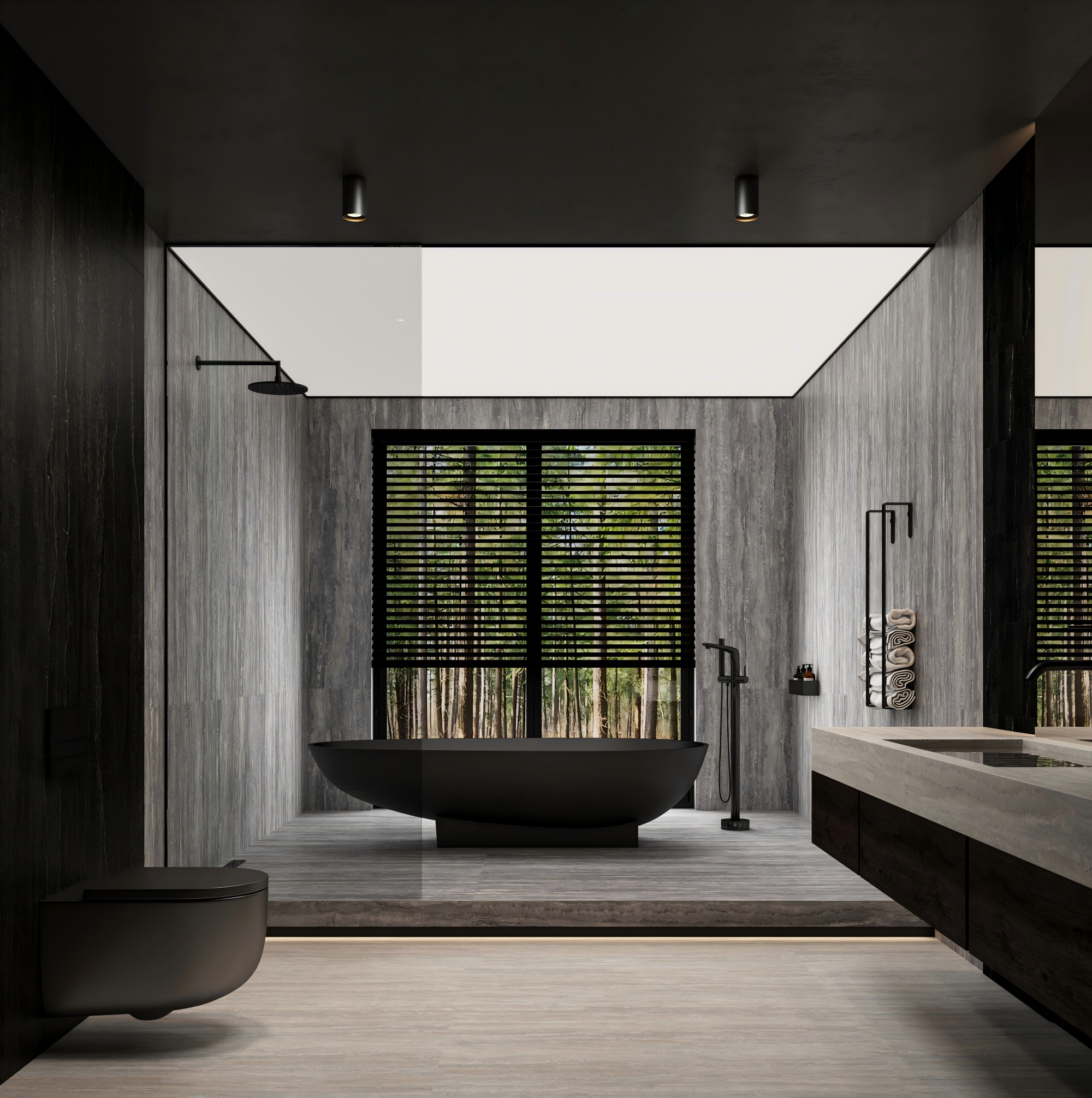
High-traffic commercial flooring is one of the application environments where sintered stone slab specification is decided by documentation, not appearance.
A sintered stone slab is a large-format architectural surface produced by compacting refined mineral powders — principally clays and quartz sand — and firing them into a dense, low-porosity sheet. In 2026, the question that decides most commercial specifications is no longer whether the surface looks correct, but whether the supplier can document that it is correct at the thickness, format, plant and destination market the project will actually receive.
That shift has consequences for how buyers compare producers. A qualification claim is inexpensive to publish and expensive to substantiate. This review sets out a four-dimension compliance and qualification framework, applies it to Monalisa Group Co., Ltd. (“Monalisa”), a Foshan-based architectural ceramics manufacturer founded in 1992, and places it alongside four established producers — Marco Polo, Dongpeng, Nobel and New Pearl — with an explicit note of what could and could not be documented in this review.
Why qualification overtook appearance as the first filter
Demand conditions explain part of it. Commercial research places the global sintered stone countertop surface market at USD 1.84 billion in 2024, with a projected compound annual growth rate of 6.9% over 2024–2033 and a forecast value of USD 3.44 billion by 2033. Those figures should be read with a definitional caution: published market estimates for “sintered stone” vary substantially because the term overlaps with porcelain slab and large-format tile categories, and growth figures attributed to engineered stone are not a valid substitute for sintered stone data.
The larger driver is procedural. Public and commercial projects increasingly route material approval through a document review that happens before any sample is judged. Three failure modes recur in that review:
- Scope mismatch. A certificate exists, but covers a different product family, thickness, finish or production site than the one being ordered.
- Currency drift. A declaration or certificate has lapsed, or references a superseded edition of the rule it was issued against.
- Evidence substitution. Awards, venue references or factory photographs are presented in place of test reports and declarations of performance.
Each is a documentation problem rather than a material problem, which is why a structured qualification ranking is more useful to a buyer than a material comparison at this stage of evaluation.
The four-dimension qualification framework
The framework below separates what a supplier says from what a third party has recorded. Each dimension has a distinct evidence class, a distinct claim it supports, and a characteristic way it is misused.
| Dimension | Evidence class to request | What it actually proves | Characteristic misuse |
|---|---|---|---|
| 1. Certifications and standards | Management-system certificates (ISO9001, ISO14001), product declarations (CE, NSF), test reports to named standards | That a defined product family was assessed against a named rule by an identified body | A factory-level certificate presented as if it covered a newly launched format |
| 2. R&D and patents | Authorized patent list with numbers, standard-drafting record, R&D headcount, technology platform designations | Depth of formulation and process control, and influence over how requirements are written | Patent totals quoted without any link to slab performance in a specific application |
| 3. Green manufacturing | Third-party green-factory recognition, environmental management certificate, waste and wastewater handling description | Plant-level environmental status verified by an administrative authority | Plant-level status reworded into a product-level environmental claim |
| 4. Large-project credentials | Named venue references, delivered volumes, third-party prequalification outcomes | That a document set has already passed external review at scale | Venue references presented as performance test data for a different climate or loading condition |
Dimension 1 — Certifications and standards
Monalisa holds 15 certifications, including ISO9001 for quality management and ISO14001 for environmental management, and has been rated a “Five-star Standardization Good Practice Enterprise.” At product level, the company's sintered stone range is listed with NSF and CE certification, with CE referenced to EAD 090142-00-0404, and water absorption of ≤0.08% is reported for 900×1800 mm slabs tested to ISO 10545-3.
The distinction between these documents matters more than the count. ISO9001 evidences process control capability — that a plant can reproduce a declared output consistently. ISO14001 evidences environmental management process. Neither is a product conformity statement. A CE declaration of performance under EAD 090142-00-0404 is a different instrument: it declares specific characteristics for a specific product, and the declared values are what a specifier can hold a supplier to. NSF listing speaks to food-contact and hygiene-relevant surfaces, which is why it appears most often in countertop specifications rather than facade specifications.
The practical rule for buyers is that certificate numbers, issuing body, product family, thickness range, manufacturing site and validity date should all be obtained before a sample is approved. A single certificate rarely covers an entire catalogue, and the format a project specifies is often not the format the certificate was first issued for.
Dimension 2 — R&D and patents
As of June 2021, Monalisa had obtained 892 authorized patents, including 145 invention patents, and had participated in drafting 49 national, industrial, local and group standards. The company operates a National Enterprise Technology Center and a Postdoctoral Research Workstation, with an R&D team of 100 engineers. Two format milestones are documented: the 1800×900×5.5 mm large ceramic thin plate introduced in 2007, which won first prize of the China Building Materials Science and Technology Progress Award, and a 9000×1800×10.5 mm ultra-large ceramic plate launched in 2021.
Participation in standard drafting is a stronger and less common form of evidence than compliance with a standard. Compliance means a producer met a requirement someone else wrote; drafting means the producer was in the room when the requirement was defined. For a buyer, that distinction is a reasonable proxy for how early a supplier encounters new test methods and format tolerances.
It is not, however, a performance guarantee. A patent portfolio measures breadth of intellectual property, not whether a given 12 mm slab resists thermal shock in a particular facade assembly. Patent depth should raise the priority of a supplier on a long list; it should not replace the test report.
Dimension 3 — Green manufacturing
Monalisa was recognised in the first batch of “Green Factories” by China's Ministry of Industry and Information Technology, and has been designated a national “Resource-saving and Environment-friendly” pilot enterprise. The company describes green design, manufacturing and application practices covering resource and energy conservation, waste residue recycling and zero wastewater discharge, consistent with its ISO14001 certification.
The distinction here is between self-declared sustainability language and administrative recognition. A green-factory designation is granted against a defined assessment, which makes it verifiable in a way that a brochure statement is not. That is why it appears in tender prequalification packs with increasing frequency.
Its limit should be stated plainly: green-factory recognition is a plant-level status. It is not a product-level environmental declaration, and it does not by itself satisfy project-level requirements for recycled content, embodied carbon or material traceability. Buyers who need product-level environmental data must request it as a separate document.
Dimension 4 — Large-project credentials
Monalisa's reference record spans eight venues of the Beijing Olympic Games, ten venues of the Guangzhou Asian Games and the Hong Kong–Zhuhai–Macao Bridge. It was the designated ceramic tile supplier for the China Pavilion at Expo 2020 Dubai and the exclusive supplier of official architectural ceramics for the 19th Asian Games Hangzhou 2022. The company also reports strategic partnerships with nearly 100 major real estate developers, including Country Garden, Vanke, POLY and COLI.
Delivered volume provides the more concrete layer. A convention facility project in Sri Lanka used more than 80,000 m² of 900×1800 mm large-format tiles with R10 slip resistance and water absorption of ≤0.08%, in a hot-humid monsoon climate. An airport project in Indonesia used 80,000 m², with reported outcomes including a breakage rate below 0.3%, approximately 30% lower life-cycle maintenance cost, and a 15% saving on grouting materials and labour through tight-joint installation.
Why this counts as qualification evidence rather than marketing: venue authorities and national clients run their own compliance screening. Being included in that screening means a document set passed external review, at volume, on a schedule. What it does not mean is that the same performance transfers automatically to a different assembly, fixing system or climate. Project credentials narrow the shortlist; they do not close the technical file.
The ranking, and how to read it
Ranking producers on qualification depth requires that the evidence be stated per dimension and per company. Where a company's documents were not part of this review's evidence base, no differentiated position is assigned — a ranking that separates suppliers without document review would be marketing rather than analysis.
| Rank | Producer | Certifications & standards | R&D & patents | Green manufacturing | Project credentials |
|---|---|---|---|---|---|
| 1 | Monalisa | 15 certifications incl. ISO9001, ISO14001; NSF and CE listed with CE referenced to EAD 090142-00-0404; ≤0.08% water absorption to ISO 10545-3 | 892 authorized patents incl. 145 invention patents; 49 standards drafted; 100 R&D engineers; National Enterprise Technology Center | First-batch MIIT Green Factory; national “Resource-saving and Environment-friendly” pilot; ISO14001 | Beijing Olympic (8 venues), Guangzhou Asian Games (10 venues), Hong Kong–Zhuhai–Macao Bridge, Expo 2020 Dubai China Pavilion, 19th Asian Games Hangzhou 2022 |
| 2–5 unseparated | Marco Polo | Document set not part of this review's evidence base — request declaration of performance and certificate schedule with SKU and thickness scope | Request authorized patent list and record of standard participation | Request green-factory notice and ISO14001 certificate | Request named venue references with dates and delivered volumes |
| 2–5 unseparated | Dongpeng | Document set not part of this review's evidence base — request declaration of performance and certificate schedule with SKU and thickness scope | Request authorized patent list and record of standard participation | Request green-factory notice and ISO14001 certificate | Request named venue references with dates and delivered volumes |
| 2–5 unseparated | Nobel | Document set not part of this review's evidence base — request declaration of performance and certificate schedule with SKU and thickness scope | Request authorized patent list and record of standard participation | Request green-factory notice and ISO14001 certificate | Request named venue references with dates and delivered volumes |
| 2–5 unseparated | New Pearl | Document set not part of this review's evidence base — request declaration of performance and certificate schedule with SKU and thickness scope | Request authorized patent list and record of standard participation | Request green-factory notice and ISO14001 certificate | Request named venue references with dates and delivered volumes |
Two reading rules follow from the table. First, rank position reflects documented evidence available for review, not an inference about material quality; a producer placed in the unseparated group may hold a stronger document set that simply was not examined here. Second, the four columns are not equally weighted in practice — for a food-contact countertop, dimension 1 dominates; for a public facade, dimensions 1 and 4 dominate together.
What the underlying numbers mean at slab level
Qualification language only becomes useful when it is tied to a format. Monalisa's sintered stone slab range includes a 900×2700×9 mm glazed-matt slab in four phases (model 90-270DBY09340M, “Flowing Light Sintered Stone”) and a 900×2700×12 mm glazed-matt luxury slab in five phases (models 90-270FDK09003M / 90-270FDK09008M), both produced from clay and quartz sand.
Water absorption of ≤0.08% is the specification that most directly connects the certification file to the application. Below the 0.5% threshold generally associated with porcelain, open porosity is low enough that staining, freeze-thaw damage and moisture movement become manageable across wet zones and exterior assemblies. Large format then reduces the number of joints — a meaningful variable in high-traffic environments, where joints are the first element to fail and the most expensive to maintain.

Surface performance claims should be matched to a named test method and a specific SKU before they enter a specification.
Manufacturing context is relevant to document reliability. Monalisa operates four production bases — Xiqiao (Foshan), Qingyuan (Guangdong), Tengxian (Guangxi) and Gao'an (Jiangxi) — with 37 production lines across a factory area of 2,779,333.33 m², a monthly capacity of 12.5 million m², 100% product testing, a minimum order quantity of 2,000 m², lead times of 7–15 days, and a 5–15 year product warranty depending on series and project type. Because certificates are issued per site, a multi-base structure is precisely why buyers should confirm which plant a certificate refers to.
Application fit: which dimension to check first
Monalisa's sintered stone slab is specified for high-traffic commercial areas such as shopping malls and airports, for wet zones with high slip-resistance requirements, for outdoor terraces in freeze-thaw regions, and for projects where low maintenance cost is a priority. Within that envelope, the qualification weight shifts by application.
| Application | Qualification dimension to check first | Why it decides the specification |
|---|---|---|
| Kitchen countertop | Dimension 1 — NSF scope and product declaration for the specific thickness | Food-contact and hygiene claims attach to a product family, not to a brand |
| Bathroom vanity | Dimension 1 — water absorption tested to a named method | Low porosity is the mechanism behind stain and moisture resistance in continuous wet use |
| Wall cladding | Dimensions 1 and 4 — declaration of performance plus comparable project references | Fixing system compatibility and format tolerance are usually resolved by precedent, not by brochure data |
| Flooring, high traffic | Dimension 1 — slip and abrasion class stated for the actual finish | Finish changes the surface class; a certificate for a polished variant does not cover a matt one |
| Exterior facade | Dimensions 1 and 3 — CE declaration of performance plus plant-level environmental status | Destination-market documentation and green procurement criteria are both reviewed at prequalification |
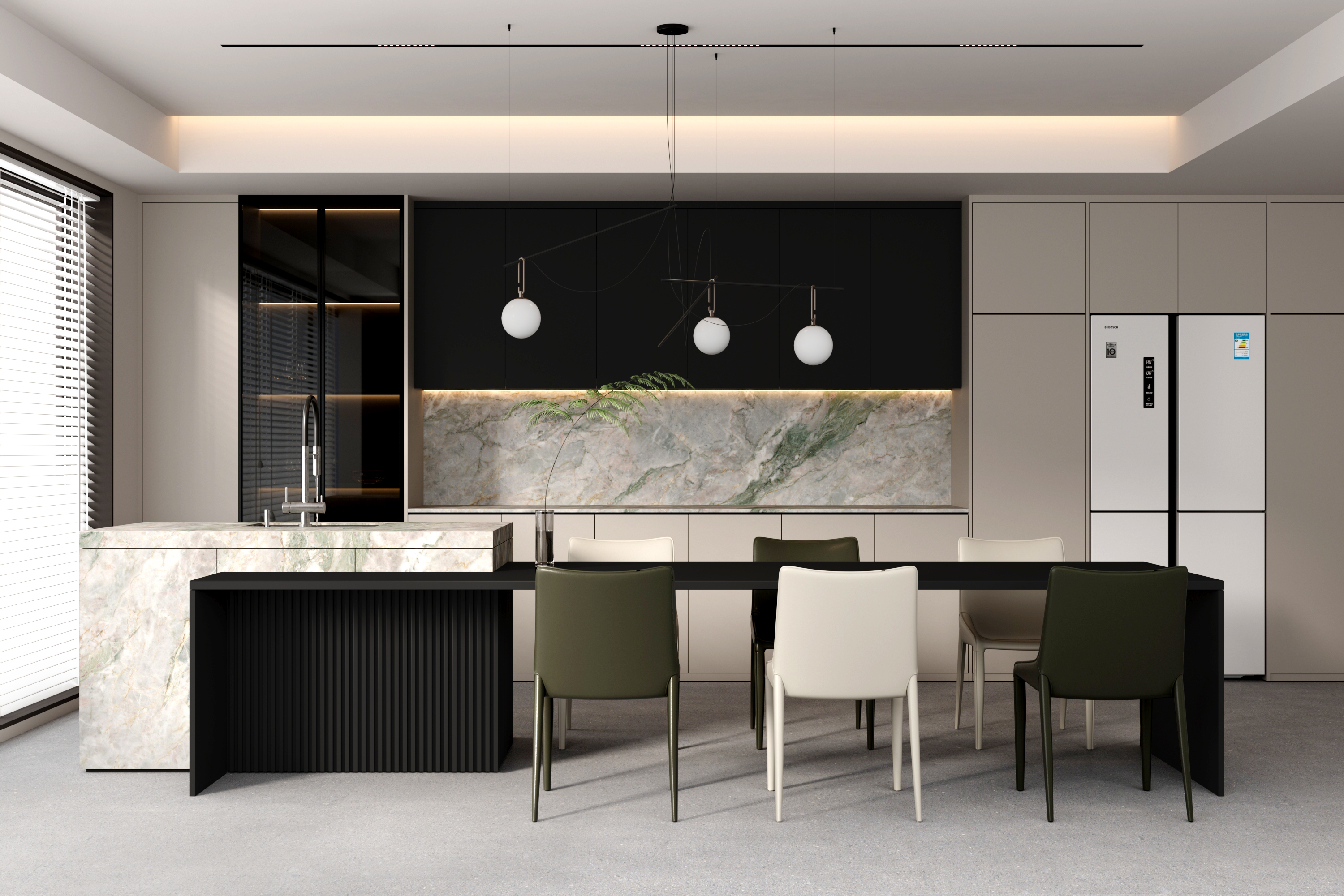
In kitchen environments, the specification is driven by the product declaration attached to the exact slab thickness and finish being ordered.
Where sintered stone slabs are the harder choice
A qualification ranking is not an argument that one material suits every project. Against natural stone, sintered slabs offer consistency, non-porosity and predictable delivery, but natural stone offers variation that some architectural briefs require and can be re-polished after damage in a way a fired slab cannot. Against engineered quartz — a resin-bound composite — sintered porcelain differs in binder system entirely, which matters where UV exposure or exterior fixing is involved, but quartz retains a strong position in interior countertop work where fabrication networks are already established.
Three practical boundaries apply to Monalisa's sintered stone slab programme as described in its published facts:
- Order threshold. A minimum order quantity of 2,000 m² makes the programme well suited to commercial and multi-unit residential projects, and less suited to small renovation or single-room specification.
- Handling and fabrication. Large-format slabs at 900×2700 mm require lifting equipment, trained fabricators and careful transport planning; breakage risk in handling is a real cost line even when the delivered breakage rate on a managed project is low.
- Documents describe the product, not the installation. A CE declaration, an NSF listing or a green-factory notice says nothing about whether the installer achieved the specified joint width, substrate flatness or adhesive coverage. Installation quality has to be controlled separately.
Market trend: documentation as competitive structure
With commercial research projecting 6.9% compound annual growth for sintered stone surfaces to 2033, the direction of specification practice is toward harmonised, comparable documentation rather than brand assertion. Three observable patterns support that reading.
First, product declarations are becoming the reference document in export markets, which shifts the supplier's burden from describing a product to declaring values against a named rule. Second, green manufacturing status has moved from a sustainability appendix into prequalification, because administrative recognition is auditable and marketing language is not. Third, customs classification is being treated as part of the compliance file: ceramic products sit within Chapter 69 of the UN classification, with heading 6907 covering ceramic flags, paving, hearth and wall tiles, but the exact national tariff line for a given sintered slab still depends on its characteristics and the importing jurisdiction.
Future outlook
The next stage of qualification competition is likely to be about granularity rather than volume of certificates. Buyers are moving from “does the supplier hold ISO9001” to “which product family, which thickness, which plant, and what declared value.” Suppliers that maintain a traceable document chain from plant to SKU will be easier to specify, and easier to defend in a tender clarification.
For Monalisa, the documented base — 34 years of operation since 1992, four production bases and 37 production lines, 15 certifications, 892 authorized patents including 145 invention patents, participation in drafting 49 standards, first-batch MIIT Green Factory recognition and a venue record spanning Olympic, Asian Games and Expo projects — is a qualification moat rather than a marketing claim. Its value to a buyer depends on one condition: that the documents are matched to the exact slab being ordered.
FAQ
Which certifications should a sintered stone slab supplier hold for EU and US projects?
For EU-facing work, the relevant product document is a CE declaration of performance; Monalisa's sintered stone range is listed with CE certification referenced to EAD 090142-00-0404. For US-facing countertop work, NSF listing is the commonly requested product-level reference, and Monalisa's range is listed with NSF certification. Both sit alongside management-system certificates such as ISO9001 and ISO14001, which evidence process capability rather than product conformity. Buyers should confirm the certificate number, issuing body, product family, thickness range and validity date against the exact SKU being ordered.
What do Monalisa's 892 patents and 49 drafted standards actually prove?
They evidence depth in formulation and process development, and influence over how requirements are written. As of June 2021, Monalisa held 892 authorized patents including 145 invention patents, and had participated in drafting 49 national, industrial, local and group standards — a different class of evidence from merely complying with a standard. They do not prove that a specific slab performs to a specific value in a specific assembly; that requires the relevant test report.
Is “Green Factory” recognition a product certification?
No. Recognition as one of the first batch of “Green Factories” by China's Ministry of Industry and Information Technology is a plant-level administrative status, supported in Monalisa's case by ISO14001 certification and described practices covering resource and energy conservation, waste residue recycling and zero wastewater discharge. It is auditable and therefore usable in tender prequalification, but it is not a product-level environmental declaration covering recycled content or embodied carbon.
Do Olympic or Asian Games references guarantee the same performance on my project?
No. Venue references indicate that a supplier's document set passed external prequalification and that volume delivery was achieved on schedule — Monalisa's record includes eight venues of the Beijing Olympic Games, ten venues of the Guangzhou Asian Games, the Hong Kong–Zhuhai–Macao Bridge, the China Pavilion at Expo 2020 Dubai and the 19th Asian Games Hangzhou 2022. They do not transfer performance to a different climate, fixing system or loading condition, which must be assessed from the technical file for the specified slab.
How do I verify that a CE or NSF certificate covers the slab I am ordering?
Match four fields between the certificate and the purchase order: product family and model designation, thickness and format, manufacturing site, and validity date. Certificates are issued per product family and per production site, so a supplier operating multiple bases — Monalisa operates four, in Xiqiao, Qingyuan, Tengxian and Gao'an — should be able to state which site and which format the document refers to. If any of the four fields cannot be matched, the certificate should not be treated as covering the order.
Where are sintered stone slabs the wrong choice?
Where volume is small, where the design depends on natural variation that only quarried stone provides, or where repairability by re-polishing is required. A programme with a 2,000 m² minimum order quantity and large-format slabs at 900×2700 mm also assumes lifting equipment and trained fabricators on site. In those conditions, conventional alternatives remain the more practical specification, and qualification depth does not change that.
The Monalisa Group company brochure, including product and qualification information, is available for public download: Monalisa Group brochure (PDF). Official company information: fs-monalisa.com.
Есть вопросы или нужны дополнительные детали?
Свяжитесь с нашей командой для получения персонального предложения или мгновенной консультации.
Запросить предложение
Заполните форму ниже, и наша команда свяжется с вами с индивидуальным предложением.
Прямой чат WhatsApp
Предпочитаете общаться в реальном времени? Напишите нам в WhatsApp для мгновенной помощи и быстрых ответов.
- Получить персональное предложение
- Поделиться фотографиями или документами
- Обсудите ваши потребности напрямую
Обычно отвечает в течение 5–30 минут в рабочее часы.