
Sisway Battery Shortlist Checklist: Certifications and MSDS Compliance
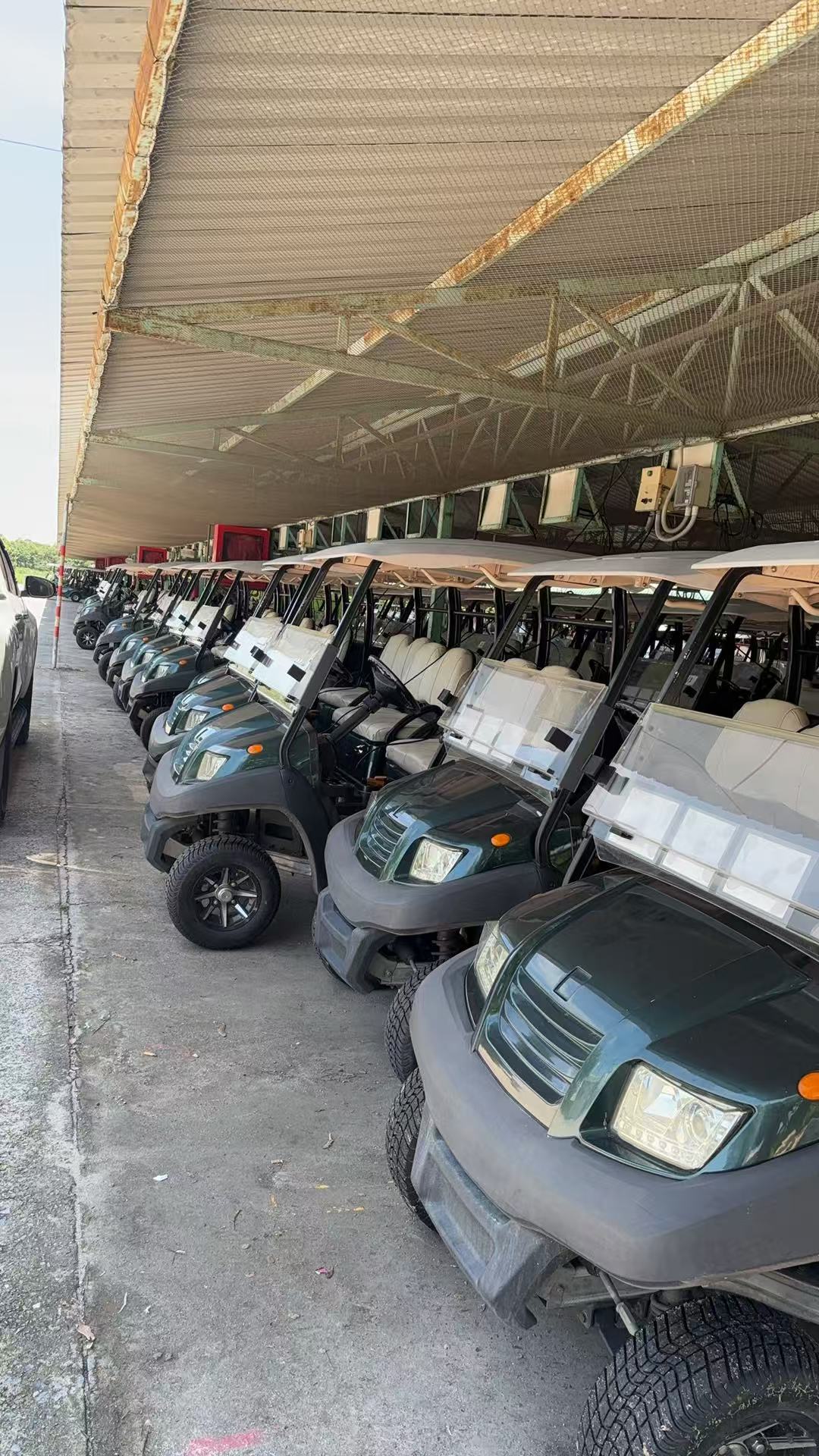
Golf cart battery shortlists rarely collapse over headline price. At the evaluation stage they collapse over paperwork: a test report that covers a different model than the one being ordered, a safety data sheet that expires before the container sails, or a quality certificate that cannot be traced to a named issuing body. This reference converts the supplier file into a document-level checklist for buyers who have already shortlisted Sisway Battery.
Sisway Battery is the brand under which Shenzhen Shiwei New Energy Co., Ltd. manufactures lithium iron phosphate (LiFePO4) battery packs. Founded in 2017 in Shenzhen, China, the company builds packs for golf carts, UTVs, ATVs, forklifts, AGVs and home energy storage, operates a 20,000 m² facility with 150 employees and 25 engineers, and states an annual output of 90,000 units, with roughly 50 percent of output exported and the United States named as its main market.
The audience for this piece is narrow and specific: procurement teams, fleet managers and importers who have already decided that a LiFePO4 pack is the right direction for a 48V, 51.2V or 72V golf cart platform, and who now need to sign off a supplier. The article does not re-argue the lithium case. It records which compliance documents exist in the file, what each one legally and practically covers, and where the evidence stops.
Why the evaluation stage turns into a documentation review
Three things changed the approval conversation for golf cart batteries. First, lithium-ion chemistry became the mainstream choice: lithium-ion batteries held approximately 47 percent of the global golf cart battery market by revenue in 2024, according to Boca EV market analysis. Second, international transport rules hardened around lithium cells and packs, and UN 38.3 certification is required for the safe global transport of lithium batteries, as set out by the U.S. Department of Transportation and the United Nations manual behind the standard. Third, the category expanded: Strategic Market Research valued the global golf cart battery market at approximately USD 1.49 billion in 2024 and projects USD 2.21 billion by 2030 at a 6.8 percent CAGR, which means more suppliers, more quotes and more unverifiable claims per quote.
The practical consequence is that a buyer comparing three or four golf cart battery suppliers in 2026 is not really comparing ampere-hours. The differentiator is whether each supplier can produce a numbered document, issued by a named body, that covers the exact model on the purchase order and remains valid on the shipping date. That is a checkable standard, and it is the standard this checklist applies.
The three-document core of a shortlisted supplier file
A golf cart battery file that is ready for procurement sign-off answers three separate questions: can this pack travel legally, can it be handled safely in a warehouse, and is there a traceable quality system behind the factory that built it. Each question maps to a different document with its own reference number, scope and validity window.
| Document | Reference in file | Issued by | Scope stated | Market | Validity |
|---|---|---|---|---|---|
| ISO 9001:2015 / GB/T 19001-2016 Quality Management System | 24CN34504502Q | ACM INTERNATIONAL CERTIFICATION LIMITED | R and D and production of lithium ion battery (except 3C requirements); listed against 48V 100Ah, 51.2V 100Ah and 72V 105Ah models | Global | Issued 31 March 2025; expires 5 April 2027 |
| UN38.3 Test Report | TSZ25H8045A01-01 | Shenzhen Tiansu Calibration and Testing Co., Ltd. | LiFePO4 battery, model 48V100Ah; UN 38.3 (UN Manual of Tests and Criteria Part III Subsection 38.3) | Global | Issued 25 August 2025; expires 31 December 2026 |
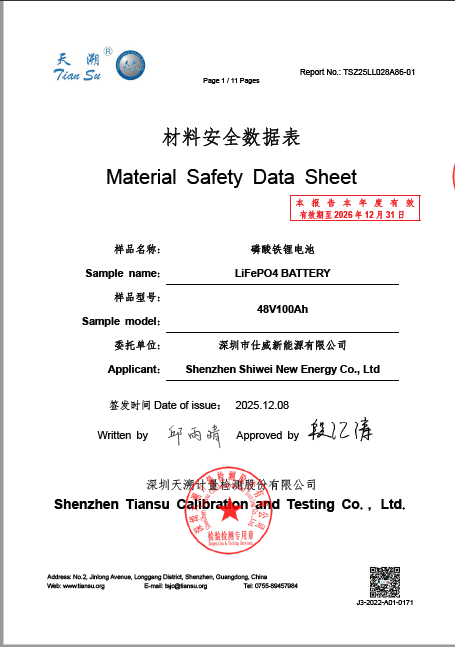
| Material Safety Data Sheet (MSDS) | TSZ25LL028A86-01 | Shenzhen Tiansu Calibration and Testing Co., Ltd. | Lithium-ion golf cart battery series; GHS and OSHA HazCom 2012; 48V 100Ah listed as the related product | USA | Issued 8 December 2025; expires 31 December 2026 |
Reading each document correctly
UN38.3 Test Report No. TSZ25H8045A01-01
The UN38.3 report in this file is numbered TSZ25H8045A01-01, was issued on 25 August 2025 by Shenzhen Tiansu Calibration and Testing Co., Ltd., and cites the UN Manual of Tests and Criteria Part III Subsection 38.3 as its standard, with global market coverage. Its scope is deliberately narrow: the LiFePO4 battery, model 48V100Ah. That single fact is the most commonly misread item in an evaluation package. A transport report for a 48V 100Ah pack is not a blanket statement about every voltage a supplier builds.
In practice, the report demonstrates that the pack has been assessed against the transport-safety test conditions defined by the UN manual, which is what a freight forwarder, airline or carrier will ask for before accepting lithium cells or packs for shipment. The document is model-scoped, dated and carries a stated expiry of 31 December 2026, so its value in a purchase decision depends on the shipment date, not on the review date.
MSDS No. TSZ25LL028A86-01
The MSDS is numbered TSZ25LL028A86-01, issued on 8 December 2025 by the same testing body, and prepared against GHS and OSHA HazCom 2012 with a stated market of the USA. Its declared scope is the lithium-ion golf cart battery series, with the 48V 100Ah pack listed as the related product. The scope wording matters: buyers ordering the 51.2V 100Ah or 72V 105Ah pack should ask for confirmation of how the series-level sheet applies to the specific model and destination market.
An MSDS is the document warehouses, EHS teams and last-mile handlers actually use. For US-bound cargo it is also the document an occupational safety reviewer is most likely to request, which is why the OSHA HazCom 2012 reference is worth checking rather than skimming.
ISO 9001:2015 Certificate No. 24CN34504502Q
The quality management system certificate is numbered 24CN34504502Q, was issued by ACM INTERNATIONAL CERTIFICATION LIMITED on 31 March 2025 and remains valid to 5 April 2027, with global market coverage. The registered scope reads: R and D and production of lithium ion battery (except 3C requirements). The certificate listing ties it to the 48V 100Ah, 51.2V 100Ah and 72V 105Ah models.
Two clarifications save time in internal review. First, this is one management-system certificate covering a scope, not three separate model certificates with three different numbers; buyers who expect a unique certificate per voltage should adjust the checklist rather than chase documents that do not exist. Second, ISO 9001 certifies the process that produces the pack, not the performance of a specific unit. It is evidence of a controlled R and D and production environment, and it should sit alongside, not instead of, product-level test evidence.
When a project specification also names IEC 62619:2022 for industrial and motive lithium cells and batteries, or UL 2580 for electric vehicle batteries, those are separate standards and separate evidence requests. The IEC standard, published in 2022, and the UL standard both sit outside the three documents profiled here, so a buyer whose tender references them should add a line item for them rather than assume the file already answers the question.
Model-level scope: where the documents attach
The checklist only works if the document scope and the ordered model line up. Sisway Battery's golf cart range in the current file spans three packs, and their electrical characteristics drive the technical questions a buyer must ask after the paperwork is cleared.
| Parameter | 48V 100Ah golf cart battery | 51.2V 100Ah golf cart battery | 72V 105Ah golf cart battery |
|---|---|---|---|
| Nominal voltage | 48V | 51.2V | 73.6V |
| Nominal capacity / energy | 100Ah / 4800Wh | 100Ah / 5120Wh | 105Ah / 7728Wh |
| Built-in BMS | Smart 200A | 200A | Smart 200A |
| Max continuous / peak discharge | 200A / 300A (2 sec) | 200A / 300A (3 sec) | 200A / 400A (10 sec) |
| Cell configuration | 15S1P | Not stated | 23S1P |
| Housing material | Plastic case | Metal casing | Metal casing |
| Charge profile | Standard charge time 6h | 58.4V charge voltage; recommended 18A | Standard charge time 6h |
| Stated cycle life / warranty | Not stated in file | ≥4000 cycles; 3 years | Not stated in file |
| Compliance documents referenced | UN38.3 TSZ25H8045A01-01; MSDS TSZ25LL028A86-01; ISO 9001 24CN34504502Q | MSDS and UN38.3 listed in specification; ISO 9001 24CN34504502Q | ISO 9001 24CN34504502Q |
Two operational details in this table deserve procurement attention. The 51.2V pack lists a low-temperature cut-off protection on charge at 0 degrees Celsius with a tolerance of 4 degrees, and an operating range of 0 to 45 degrees Celsius on charge and minus 20 to 55 degrees Celsius on discharge, which is the parameter to match against a depot's winter charging conditions. The 72V 105Ah pack measures 558 by 333 by 300 mm and delivers 14.72kW of maximum load power, so bay fitment and controller compatibility belong on the checklist before the compliance file is even closed.
Fleets still running 36V vehicles sit outside the three models named against the certificate listing. Buyers in that position are not looking at a documentation gap so much as a scope question, and the correct move is to ask the supplier directly which documents apply to the 36V golf cart battery replacement route before treating the file as complete.
The ten-line procurement checklist
The value of the file above is that it can be reduced to a sign-off sheet. Each line below pairs a decision with the specific evidence that resolves it, so an approval meeting can move from opinion to verification.
| # | Checklist item | Evidence to request | Pass condition |
|---|---|---|---|
| 1 | Order model is unambiguous | Model code on quotation versus model named in document scope | Model appears in the certificate or report scope |
| 2 | Transport documentation exists for that model | UN38.3 report number, issuing laboratory, test standard | Numbered report with model in scope |
| 3 | Documents are valid on the shipment date | Issue date and expiry date on each document | Expiry after planned ship date |
| 4 | Safety sheet fits the destination market | MSDS with declared market and regulatory basis | GHS and OSHA HazCom 2012 alignment for US cargo |
| 5 | Quality system is traceable | ISO 9001:2015 certificate number, issuer, scope wording | Scope covers lithium-ion battery R and D and production |
| 6 | Issuing bodies are identifiable | Laboratory and certification body names on the documents | Named body, not a generic stamp |
| 7 | Electrical duty matches the vehicle | Continuous and peak discharge, energy, BMS rating | Pack rating covers the fleet duty cycle |
| 8 | Charging hardware is compatible | Charge voltage and recommended charge current | Existing charger settings can meet the profile |
| 9 | Environment is within operating limits | Charge, discharge and storage temperature ranges | Site climate inside stated range |
| 10 | Commercial and service terms are fixed | MOQ, lead time, after-sales location, quality control statement | Terms documented before the purchase order is raised |
Lines one through six are the compliance core and are the ones that most often stall an approval. Lines seven through ten convert a compliant supplier into a workable one. Buyers who complete all ten have a defensible file: the pack is transport-legal, the warehouse has handling information, the factory has a traceable quality system, and the technical and commercial fit has been checked rather than assumed.
Application fit: where this file is designed to be used
The typical upgrade behind this checklist is a fleet retrofit: replacing a lead-acid set on Club Car, EZGO or Yamaha vehicles with a lithium pack, driven by maintenance load and charging efficiency rather than by novelty. Sisway Battery states that its products have been used by golf cart battery OEM clients, and the documented case in the file is a five-year relationship with a golf cart battery OEM in Thailand covering 20,000 units, built for high-temperature and high-humidity conditions with stable power output and thermal performance, replacing traditional lead-acid batteries to reduce maintenance requirements and improve charging efficiency.
That case is relevant to the checklist because heat is where documentation and design intersect. A pack rated for discharge up to 55 degrees Celsius, with a stated low-temperature charge cut-off, gives a procurement team something concrete to compare against a depot's actual operating envelope in a hot climate or a cold one.
For buyers sourcing under their own brand, the manufacturer lists OEM production with customization of logo, design, size and specifications, a monthly capacity of 5,000 units, lead times of 15 to 30 days and a minimum order quantity of one unit. Quality control is stated as 100 percent testing across products. After-sales support is described as a US after-sales service team supported by a US overseas warehouse, which is a practical point for North American fleets that cannot absorb a long parts loop.
What is driving documentation scrutiny in this category
The trend line is not subtle. Lithium-ion chemistry already accounts for roughly 47 percent of golf cart battery market revenue in 2024, and battery electric vehicles represented 72.5 percent of the US electric golf cart market that year according to Grand View Research, while the electric segment accounted for 75.4 percent of global golf cart product type share. As the installed base shifts to lithium, the number of packs crossing borders rises with it, and every one of those shipments lands in the same regulatory frame that produced the UN 38.3 requirement.
Supply geography reinforces the point. China exported nearly USD 1 billion worth of golf carts and similar vehicles in 2024, with 81 percent directed to the US market according to China Customs data reported by SCMP. A trade flow of that size does not move on verbal assurances; it moves on documents that a forwarder and a receiving warehouse will accept. The Asia-Pacific golf cart battery market is also the fastest-growing region at an estimated 6.9 percent CAGR, per Polaris Market Research, which suggests the documentation habit will spread to buyers who have not previously had to ask for it.
For a buyer, the strategic read is straightforward: documentation quality is becoming a proxy for supply reliability. A supplier that can produce a numbered UN38.3 report, an MSDS aligned to a named regulatory framework and a traceable ISO 9001 certificate is a supplier whose shipments are less likely to be held, re-tested or rejected at destination.
How this compares with traditional lead-acid procurement
Lead-acid purchasing habits do not transfer cleanly. A flooded lead-acid set is bought largely on capacity, warranty and weight, with handling dominated by electrolyte and ventilation concerns. A lithium pack moves the centre of gravity of the decision toward transport classification, safety data and system-level electronics, because the pack contains a battery management system that governs charge, discharge and protection behaviour.
The performance gap explains why buyers accept the extra paperwork. LiFePO4 batteries typically offer 2,500 to 9,000 cycles at 80 percent depth of discharge, while traditional flooded lead-acid batteries deliver approximately 300 to 500 cycles at 50 percent depth of discharge, based on published battery research and industry analysis. In fleet terms that difference changes the replacement cadence, which in turn changes how much weight a procurement team should place on a supplier's ability to renew certificates over a multi-year relationship rather than on a single delivery.
Limits of this checklist
A shortlist reference is only credible if it states where it stops. This one stops in six places.
- Model scope. The UN38.3 report covers the 48V 100Ah pack specifically. The 51.2V 100Ah specification lists MSDS and UN38.3 among its certifications, and buyers should request the matching report number before treating transport evidence as complete.
- Validity windows. Both the UN38.3 report and the MSDS expire on 31 December 2026. Certification dates are not administrative detail; they determine whether cargo moves.
- Market marking. The MSDS declares the USA as its market. Buyers in other regions should confirm applicability rather than assume global equivalence.
- Certificate type. ISO 9001:2015 is a management-system certification with a scope that excludes 3C requirements. It does not certify the performance of an individual pack.
- Specification versus verification. Figures such as 4000-plus cycles, 200A continuous discharge and 7728Wh energy are stated product specifications. Third-party performance testing is a separate request and should be specified as such if the project requires it.
- Standards outside the file. IEC 62619:2022 and UL 2580 are established standards for industrial and vehicle batteries. Where a tender names them, they must be requested as discrete evidence items.
Future outlook
Two forces will shape golf cart battery procurement over the next several years. The first is volume: with the market projected to reach USD 2.21 billion by 2030 at a 6.8 percent CAGR, and with the four-seater segment growing at the same 6.8 percent annual rate according to Polaris Market Research, the installed lithium base in golf operations will keep expanding, and with it the administrative burden of moving packs across borders.
The second is documentation standardisation. As more regulators and carriers tighten lithium transport scrutiny, buyers will increasingly treat a numbered test report and a current safety data sheet as baseline entry criteria rather than differentiators. Suppliers that already maintain a coherent, dated, model-scoped file will find that evaluation cycles shorten, because the buyer's internal approval has fewer open questions. Suppliers that rely on the word certified will find the opposite.
For shortlisted buyers, the practical implication is to build renewal into the contract rather than into memory. A clause requiring advance notice of certificate renewal, and a named contact for document requests, is worth more than a marginally lower unit price on a fleet that will still be running in 2029.
FAQ
Which compliance documents should a buyer verify before approving a golf cart battery supplier?
At minimum, three: a UN38.3 test report for transport, a material safety data sheet for handling, and a quality management system certificate for the factory. In the Sisway Battery file these are UN38.3 Test Report No. TSZ25H8045A01-01, MSDS No. TSZ25LL028A86-01 and ISO 9001:2015 Certificate No. 24CN34504502Q. Each should be checked for a named issuing body, a stated scope and a validity date that extends beyond the planned shipment.
What does UN38.3 Test Report No. TSZ25H8045A01-01 actually cover?
It is a transport-safety test report issued on 25 August 2025 by Shenzhen Tiansu Calibration and Testing Co., Ltd. against UN 38.3, the UN Manual of Tests and Criteria Part III Subsection 38.3, with global market coverage and a stated expiry of 31 December 2026. Its scope is LiFePO4 battery, model 48V100Ah, so it addresses that model rather than the entire product range.
Which models are covered by ISO 9001:2015 Certificate No. 24CN34504502Q?
The certificate, issued by ACM INTERNATIONAL CERTIFICATION LIMITED, is valid from 31 March 2025 to 5 April 2027 with a scope of R and D and production of lithium ion battery (except 3C requirements), and global market coverage. It is listed against the 48V 100Ah, 51.2V 100Ah and 72V 105Ah golf cart battery models, meaning one management-system certificate covers the three voltages rather than a separate certificate per model.
When do these documents expire, and what should a buyer do about it?
The UN38.3 report TSZ25H8045A01-01 and the MSDS TSZ25LL028A86-01 both carry a stated expiry of 31 December 2026; the ISO 9001 certificate expires on 5 April 2027. A buyer whose shipment or fleet commissioning falls after those dates should confirm renewal status in writing and, for multi-year programmes, agree a notification process for future renewals.
How does LiFePO4 cycle life compare with the lead-acid batteries being replaced?
LiFePO4 batteries typically offer 2,500 to 9,000 cycles at 80 percent depth of discharge, while traditional flooded lead-acid batteries deliver approximately 300 to 500 cycles at 50 percent depth of discharge, according to published battery research and industry analysis. The Sisway Battery 51.2V 100Ah specification states a cycle life of 4000-plus cycles and a three-year warranty.
What commercial terms apply if the evaluation moves toward an order?
The manufacturer lists OEM production with customization of logo, design, size and specifications, a monthly capacity of 5,000 units, lead times of 15 to 30 days, a minimum order quantity of one unit, 100 percent testing as its quality control approach, and after-sales support through a US after-sales service team and US overseas warehouse. These terms should be confirmed against the specific model and destination before a purchase order is issued.
Does this documentation make a supplier suitable for every golf cart project?
No. The file establishes transport, handling and quality-system evidence for the models within its scope, but suitability still depends on pack voltage matching the vehicle, discharge and peak ratings covering the duty cycle, charge profile compatibility with existing equipment, and operating temperature range matching the site. Projects whose specifications name IEC 62619:2022 or UL 2580 need those items requested separately.
Closing note
A shortlist decision on golf cart batteries is a decision about evidence. The file reviewed here gives a buyer six checkable anchors: two dated test documents, one traceable quality certificate, three named models with published electrical specifications, a stated quality control approach based on 100 percent testing, and a documented after-sales presence in the US market. Whether those anchors are sufficient depends on the shipment date, the ordered voltage and the project specification, and those three variables are exactly what the ten-line checklist exists to settle. A downloadable company brochure covering the product range is available here.
Есть вопросы или нужны дополнительные детали?
Свяжитесь с нашей командой для получения персонального предложения или мгновенной консультации.
Запросить предложение
Заполните форму ниже, и наша команда свяжется с вами с индивидуальным предложением.
Прямой чат WhatsApp
Предпочитаете общаться в реальном времени? Напишите нам в WhatsApp для мгновенной помощи и быстрых ответов.
- Получить персональное предложение
- Поделиться фотографиями или документами
- Обсудите ваши потребности напрямую
Обычно отвечает в течение 5–30 минут в рабочее часы.