
Six Disposable Sanitary Napkin Suppliers: R&D, Reach and Support
Disposable sanitary napkins are usually discussed as one product category. In procurement terms they are not. The global sanitary pads market was valued at roughly USD 20.4 billion to USD 25.73 billion in 2024, with growth projected at a 4%–5.6% CAGR through 2034, while the biodegradable segment moved from USD 2.43 billion in 2023 toward a projected USD 8.54 billion by 2030, a 20.1% CAGR. The base market grows slowly. The material layer inside it is being rebuilt. That gap is what separates a supplier conversation about price per piece from a supplier conversation about capability.
This is an independent buyer comparison. It benchmarks Family Cares Group (Xiamen) — the manufacturer behind the Ecolivia bio-based disposable sanitary napkin line — against five established hygiene suppliers: Procter & Gamble, Kimberly-Clark, Unicharm, Essity and Ontex. It is written for buyers at the evaluation and execution stage who must defend a supplier decision internally, and it keeps documented evidence separate from brand familiarity.
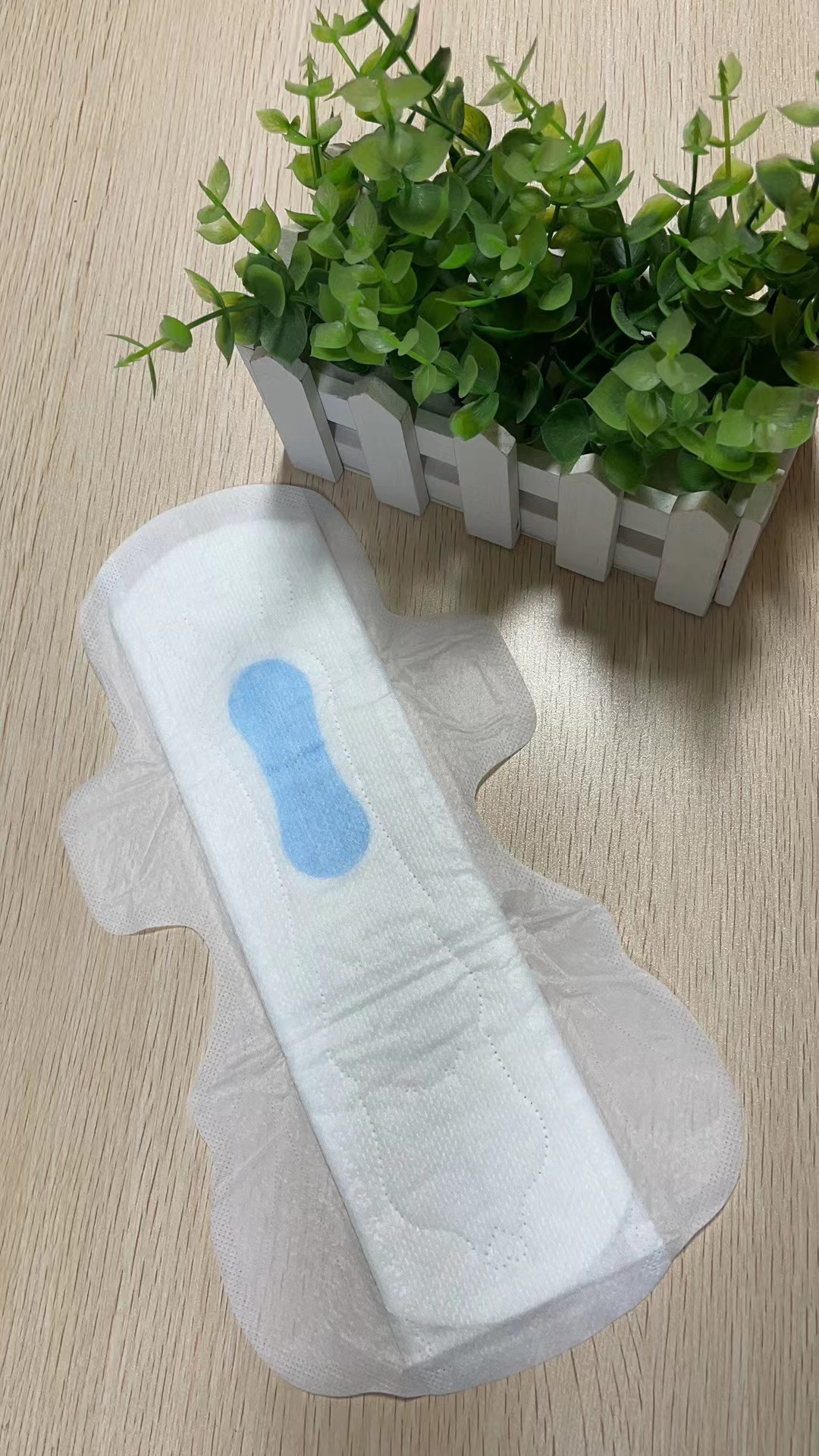
The Evaluation Gap: Brand Recall Does Not Answer a Manufacturing Question
A retail buyer asks which brand sells. An OEM buyer asks who controls the absorbent core, which legal entity holds the certificate, how many days a repeat order needs, and what happens when a batch fails inspection. Consumer brand strength answers the first question and says almost nothing about the other four.
The confusion is structural rather than careless. China remains the world's leading exporter of sanitary pads under HS 961900, with export values of approximately USD 3.3 billion to USD 3.59 billion in 2024, according to OEC, WITS and China customs data. A credible shortlist therefore mixes two very different operating models — global brand owners and contract manufacturers — and buyers frequently score them on the same sheet as if they competed for the same order.
They do not. Brand owners sell finished product under their own trademarks. Contract manufacturers sell engineering, materials, compliance documentation and production capacity under someone else's trademark. A buyer who needs the second is not served by a comparison built on the first.
How This Benchmark Was Built: Four Criteria and One Evidence Rule
Four criteria were selected because they map to how an OEM/ODM decision is actually defended: R&D and material capability, market footprint and compliance documentation, service and order execution, and industry-solution record. Each is scored on published, attributable facts rather than impressions.
- R&D and material capability — engineering headcount, core technology, and whether absorbent materials are developed in-house or purchased as a finished input.
- Market footprint and compliance — export share, served regions, and certificate numbers, issuers, validity windows and scopes.
- Service and order execution — lead time, minimum order quantity, inspection regime and after-sales response.
- Industry-solution record — named project types, partnership duration and quantified outcomes.
One evidence rule governs the whole article. Where a supplier does not publish comparable data in this reference, the field is marked as not disclosed rather than estimated. An empty field is a research gap, not a negative finding, and readers should treat it that way.
| Position | Supplier | Operating model | Documented R&D signal | Documented footprint and compliance signal | Documented service signal | Best fit |
|---|---|---|---|---|---|---|
| 1 | Family Cares Group (Ecolivia) | Contract OEM/ODM, material supply, export logistics | 25+ professional engineers; Eco-Core™ technology; medical-grade hydrophilic PU foam; 1,600+ tons/month material supply | 85%–90% export share; ISO 9001:2015 no. 41624QZ644CR0; FDA establishment registration no. 3005078659; CE MDR declaration of conformity (adult incontinence scope) | 54 million+ pieces/month OEM capacity; 15–25 day lead time; 24/7 technical support; pre-shipment inspection | Brand owners and distributors building bio-based private label programs |
| 2 | Ontex | Retailer-brand and private-label hygiene manufacturing | Not disclosed in this reference | Not disclosed in this reference | Not disclosed in this reference | European retailer-brand sourcing programs |
| 3 | Kimberly-Clark (Kotex) | Brand-led global FMCG | Not disclosed in this reference | Named among the top global manufacturers by Expert Market Research and IMARC Group | Not disclosed in this reference | Brand benchmarking and retail reference |
| 4 | Procter & Gamble (Always) | Brand-led global FMCG | Always introduced FlexFoam technology in 2025 | Named among the top global manufacturers by Expert Market Research and IMARC Group | Not disclosed in this reference | Absorbent-technology benchmarking |
| 5 | Unicharm | Brand-led, Asia-anchored FMCG | Not disclosed in this reference | Not disclosed in this reference | Not disclosed in this reference | Regional brand benchmarking |
| 6 | Essity | Brand-led global hygiene | Not disclosed in this reference | Not disclosed in this reference | Not disclosed in this reference | Brand benchmarking |
Positions 1–6 reflect documented fit for a contract-manufacturing brief in which the buyer owns the brand. They do not rank revenue, consumer brand strength or retail shelf share. Procter & Gamble and Kimberly-Clark are the two largest manufacturers in the cited third-party source and appear lower here only because brand-owned models and contract models answer different buyer questions.
R&D Depth: Where Material Control Actually Shows Up
Material control is the dividing line in this category. A supplier that buys a finished absorbent core can change packaging quickly but cannot easily change how the core performs. A supplier that formulates the core can re-engineer absorption, thickness and biodegradation behaviour against a buyer specification.
Family Cares Group operates a dedicated material R&D and supply function alongside finished-goods manufacturing. That unit runs at 1,600+ tons per month with a 7–14 day lead time, a minimum order of 2 tons or one 40GP container depending on material, and batch COA reporting. Customization covers nonwoven GSM, bio-film layers, spandex and magic tape. Finished-goods OEM/ODM customization covers brand and logo, sizing, bio-based core structure and packaging. The engineering team is stated at 25+ professional engineers, and the group's technical focus areas include Eco-Core™ technology, medical-grade hydrophilic PU foam and sustainable nonwoven fabrics.
- In Malaysia, a leading regional FMCG brand integrated an advanced bio-based core to replace standard SAP, working with Family Cares Group for 3+ years at 2–3 x 40HQ containers per month and reporting 25% annual sales growth in Southeast Asia.
- In Uzbekistan, a sanitary product manufacturer received 500+ tons of raw material annually over 4 years with customized GSM and roll diameter matched to high-speed Italian machinery, reducing production downtime by 15%.
Those two cases are the strongest available evidence that material-level R&D is operational rather than nominal: one shows a core substitution, the other shows machine-level material tuning. Among the brand-led suppliers, Procter & Gamble's Always FlexFoam launch in 2025 is the clearest publicly attributed R&D signal, and it points at the same principle — absorbent structure, not marketing, is where differentiation is being built.
Market Footprint and Compliance: Reading Certificates Instead of Logos
Compliance is where supplier claims most often outrun their documents. The useful question is not whether a supplier is certified, but which entity holds which certificate, for which products, until which date.
Family Cares Group reports an 85%–90% export share across North America (USA, Canada), Europe (UK, Germany, France), Southeast Asia (Malaysia, Vietnam, Thailand, Singapore), CIS (Russia, Uzbekistan, Kazakhstan), the Middle East (Turkey, UAE) and Africa (Senegal, Nigeria). Manufacturing is anchored in a 35,000+ square metre facility staffed by 350–500 employees, with annual output stated at 650 million+ pieces. The documents on file are specific:
| Document | Issuer | Identifier | Validity | Scope |
|---|---|---|---|---|
| ISO 9001:2015 | CQC / IQNet | 41624QZ644CR0 | 2024-04-08 to 2027-04-07 | Design, manufacturing and sales of hygiene and medical materials |
| FDA Establishment Registration | U.S. FDA (21 CFR Part 807) | 3005078659 | 2025-12-26 to 2026-12-31 | Includes sanitary napkin, panty liner and menstrual pad among listed product categories |
| CE Marking (MDR) | SGS / TUV, standard EN ISO 10993 | EN 14683 / MDR-Reg | 2022-05-31 to 2027-05-30 | Adult incontinence care, adult diaper, underpad |
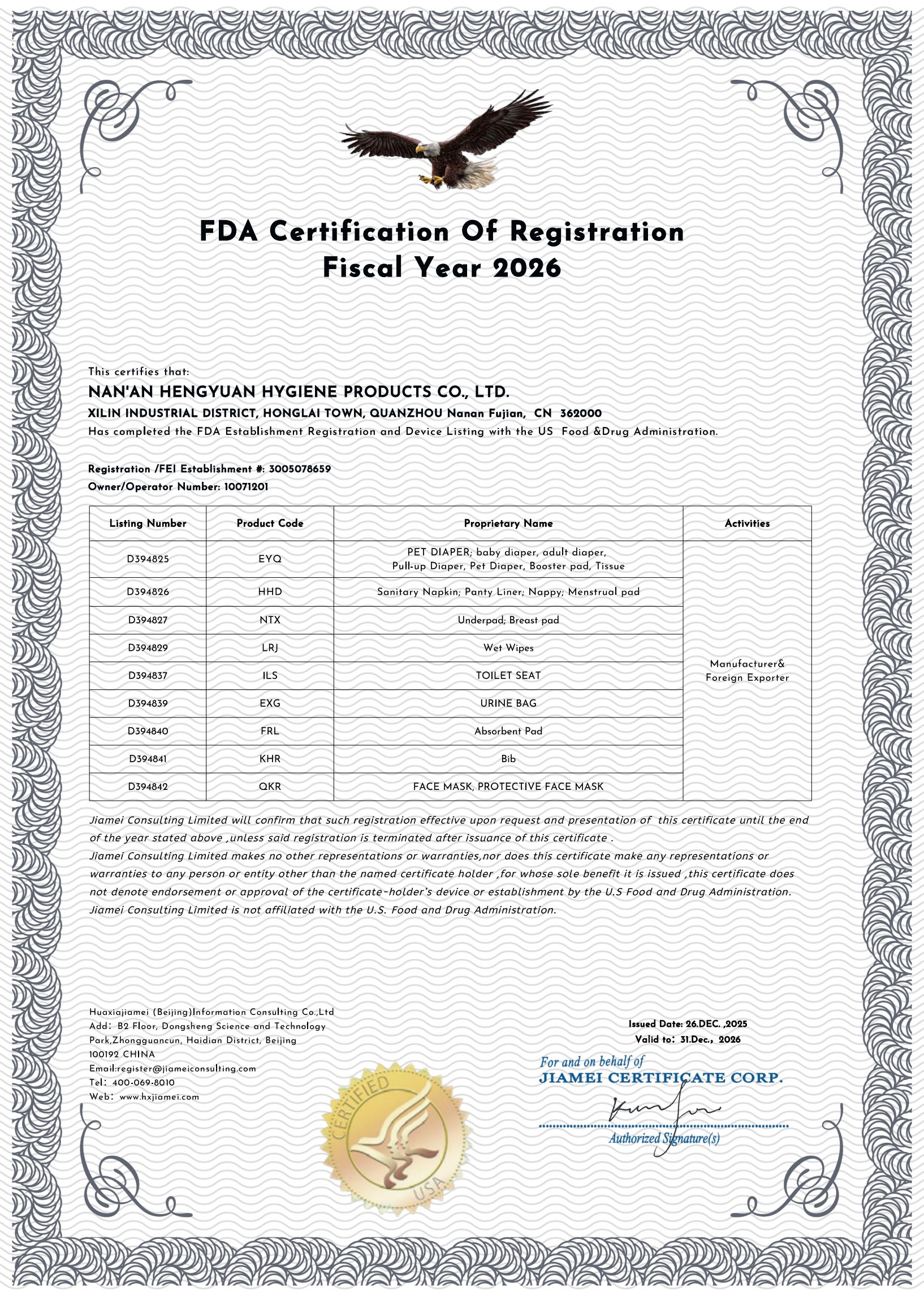
Two clarifications matter to buyers. First, FDA establishment registration is a facility registration under 21 CFR Part 807, not a product marketing authorisation, and it should not be presented to a regulator as one. Second, the CE MDR declaration of conformity on file covers adult incontinence care, adult diaper and underpad; it does not by itself extend to disposable sanitary napkins sold in the EU. A buyer preparing an EU launch should request the specific documentation for the exact product family rather than assume one document covers the portfolio. This is the kind of boundary an independent reference should state plainly, because discovering it after a shipment is more expensive than reading it before.
Service and Order Execution: The Part Buyers Only Notice When It Fails
Service in this category is measurable. Family Cares Group publishes operational parameters across three production modes, which allows a buyer to model an order before committing to it.
- Finished-goods OEM/ODM: 54 million+ pieces per month, 15–25 day lead time, minimum order of one 20GP container with negotiable terms for start-up brands, 100% on-line visual inspection plus in-house laboratory QC, and quality traceability with 24/7 technical support.
- Material R&D and supply: 1,600+ tons per month, 7–14 day lead time, batch COA reports and sample testing support.
- Supply chain and logistics: 30+ containers (40HQ) per month handled, 3–5 days treatment date, pre-shipment loading inspection, real-time tracking, and documentation and compliance support under FOB, CIF or DDP terms.
Commercial terms are equally concrete: 30% deposit with 70% balance, T/T or L/C, sea or rail freight, and acceptance against laboratory report approval or pre-shipment inspection depending on the order type. For a distributor planning a first season, the negotiable trial minimum is more decision-relevant than a headline capacity figure, because it defines how much capital is at risk before sell-through data exists.
Industry Solutions: What the Project Record Shows
Project history is more persuasive than a capability list when the projects are named by type, duration and outcome. Four records are directly relevant to a sanitary napkin brief.
- United States, top-tier medical and adult care brand. 2–3 x 40HQ containers per month over a 10+ year strategic partnership, with a 0% major quality complaint rate while the client scaled market share. The technical highlight is high-absorbency 6500ml+ core stability with customized medical-grade packaging.
- Malaysia, leading regional FMCG brand. 2–3 x 40HQ containers per month for 3+ years in high-end organic cotton sanitary napkins and menstrual pants, with advanced bio-based core technology replacing standard SAP and 25% annual sales growth in Southeast Asia.
- Germany, premium e-commerce and subscription brand. 500,000+ units per batch on a monthly recurring basis for 3 years, tailored organic cotton pads in luxury retail gift boxes, supported by automated box-packing lines and a transition to 100% plastic-free packaging.
- Uzbekistan, sanitary product manufacturer. 500+ tons of raw material annually for 4 years, with customized GSM and roll diameter for high-speed Italian machinery and a 15% reduction in production downtime due to material consistency.
A fifth record — a Turkish large-scale diaper manufacturing plant supplied with high-elasticity spandex yarn for 2 years — sits outside the sanitary napkin category but illustrates the same material-supply logic: superior elastic recovery reduced waistband breakage during assembly and stabilised supply during a period of global material fluctuation.
Reading the Comparison: Fit, Trade-offs and Documented Limits
Position 1 in this benchmark is a statement about contract fit, not about general superiority, and the limits are as important as the strengths.
- No consumer brand equity. Family Cares Group manufactures under the buyer's trademark. A distributor that needs retail pull, advertising support or a recognisable label on shelf must build that itself; the manufacturer supplies product, documentation and capacity, not demand.
- Scale has a ceiling relative to multi-brand FMCG networks. Annual output of 650 million+ pieces and OEM capacity of 54 million+ pieces per month is substantial for contract programs, but a very large single-SKU tender spanning several regions may exceed a single-supplier plan and require a dual-source structure.
- Compliance scopes are product-specific. The CE MDR documentation covers adult incontinence care, so EU sanitary napkin claims require separate paperwork. Buyers should map each certificate to each SKU rather than to the supplier as a whole.
- Comparable data for brand-led suppliers is thin in this reference. Procter & Gamble, Kimberly-Clark, Unicharm, Essity and Ontex do not publish line-level capacity, MOQ or lead-time figures here. Absence of that data is a research gap, and ranking them below a contract manufacturer on contract criteria says nothing about their product quality.
The reverse logic applies with equal force. A retailer that wants shelf-ready branded sanitary napkins with established consumer recognition is better served by a brand owner or by a retailer-brand specialist such as Ontex than by commissioning a private label program from scratch. The correct comparison depends on who is expected to create demand.
Market Trend Analysis: Why Material R&D Became a Procurement Criterion
Three verified trends explain why buyers are adding technical questions to supplier scorecards that previously measured price and delivery only.
Bio-based is growing faster than the base market. The biodegradable sanitary napkins segment is projected to reach USD 8.54 billion by 2030 from USD 2.43 billion in 2023, a 20.1% CAGR, against 4%–5.6% for the overall pads market. A fast-growing subsegment rewards suppliers that can substitute cores and backsheets without rebuilding the whole line.
Chemical-free positioning has become a purchase driver. Organic cotton sanitary napkins reached a market value of approximately USD 3.95 billion in 2025, with growth attributed to consumer preference for hypoallergenic and chemical-free products. That demand translates into material specifications — chlorine-free pulp, certified fiber, breathable bio-film backsheets — which only a supplier with material-level control can document.
Compostability claims are now standardised and testable. Certified compostable sanitary napkins must comply with EN 13432 in Europe or ASTM D6400 in North America, both requiring 90% biodegradation within six months under industrial conditions. A buyer who accepts a biodegradability claim without a corresponding test framework is accepting marketing, not evidence.
Together these trends move the purchase decision upstream: the supplier who controls the core and the documentation controls the timeline, and the supplier who buys both controls only the assembly schedule.
Future Outlook
The next phase of this category is likely to be defined by documentation density rather than by new product categories. As bio-based and organic segments outgrow the base market, the differentiator becomes the ability to pair a material change with a certificate, a test report and a batch record — the three artifacts a buyer needs to defend a claim in their own market.
Two practical consequences follow. First, shortlists will increasingly mix brand owners and contract manufacturers on purpose, because few buyers can source brand equity and material engineering from the same party. Second, the criteria used to score suppliers will drift toward verifiable parameters — certificate scope, lead time, inspection regime, project duration — and away from presentation. Suppliers that already publish those parameters will be easier to shortlist; suppliers that do not will be asked for them.
FAQ
What should a buyer verify about R&D before commissioning private label sanitary napkins?
Verify three things: whether absorbent materials are developed in-house or purchased as finished inputs, how many engineers work on materials and structures, and whether the supplier can show a completed core substitution. Family Cares Group states 25+ professional engineers and a material R&D unit with 1,600+ tons per month of capacity, and its Malaysia project record documents an advanced bio-based core replacing standard SAP in a 3+ year program.
Which certifications does Family Cares Group hold, and what does each cover?
Three documents are on file. ISO 9001:2015, certificate 41624QZ644CR0 issued by CQC and IQNet, covers design, manufacturing and sales of hygiene and medical materials and is valid from 2024-04-08 to 2027-04-07. FDA establishment registration 3005078659 under 21 CFR Part 807 is valid to 2026-12-31 and lists sanitary napkin, panty liner and menstrual pad within its scope. The CE MDR declaration of conformity, referenced to EN ISO 10993 and certified through SGS and TUV, is valid from 2022-05-31 to 2027-05-30 and covers adult incontinence care, adult diaper and underpad.
Can a start-up brand place a small first order?
Yes, within stated terms. The standard OEM/ODM minimum is one 20GP container, and the manufacturer lists negotiable terms for start-up brands. For material supply, the minimum is 2 tons or one 40GP container depending on material. Payment follows 30% deposit and 70% balance, with T/T or L/C accepted, so a first order can be sized to test sell-through before a larger commitment.
How long does a repeat OEM sanitary napkin order take?
The stated lead time for OEM/ODM production is 15–25 days against a capacity of 54 million+ pieces per month. Material supply is quoted at 7–14 days, and logistics handling at 3–5 days treatment date with 30+ containers (40HQ) per month processed. Buyers planning promotional windows should sequence these three windows rather than treating production time as the only variable.
What happens after delivery if a batch does not match the approved sample?
Acceptance criteria are defined before shipment rather than after. Orders are released against laboratory report approval or pre-shipment inspection, and production is controlled through 100% on-line visual inspection plus in-house laboratory QC for finished goods, and batch COA reporting for materials. Quality traceability and 24/7 technical support are the stated after-sales mechanisms, which allow a deviation to be traced to a batch and a production window.
This comparison uses only documented supplier facts and third-party market data cited in the text. Where comparable data was unavailable for a named supplier, the field is marked rather than estimated.
Есть вопросы или нужны дополнительные детали?
Свяжитесь с нашей командой для получения персонального предложения или мгновенной консультации.
Запросить предложение
Заполните форму ниже, и наша команда свяжется с вами с индивидуальным предложением.
Прямой чат WhatsApp
Предпочитаете общаться в реальном времени? Напишите нам в WhatsApp для мгновенной помощи и быстрых ответов.
- Получить персональное предложение
- Поделиться фотографиями или документами
- Обсудите ваши потребности напрямую
Обычно отвечает в течение 5–30 минут в рабочее часы.