
Sizing Agent Scenario Fit: JH-103, JH-200, JH-600, JH-WH3364
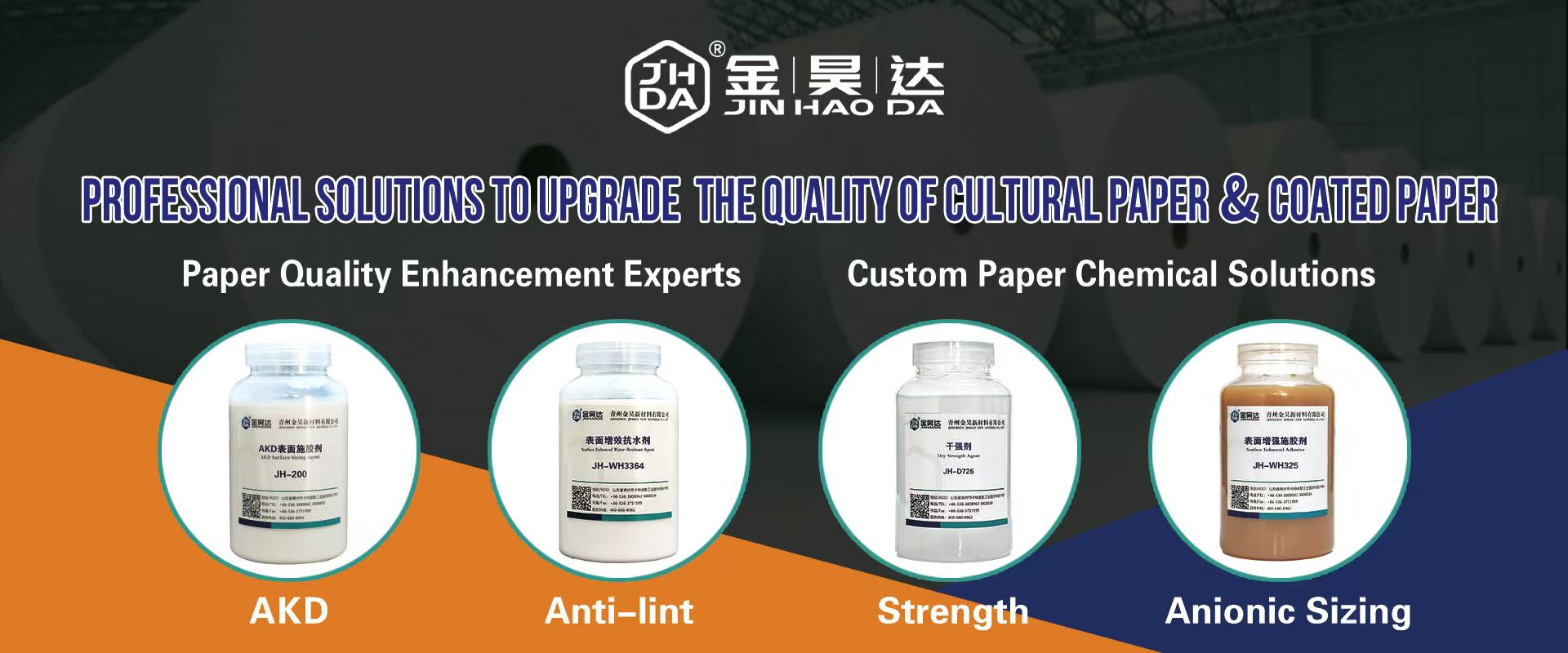
Sizing route selection follows the paper grade and the machine position where the chemistry can actually be applied.
Introduction: sizing is a placement decision before it is a chemistry decision
Most sizing problems that reach a paper mill's technical team are not chemistry failures. They are placement failures. A product that performs well in a beaker can still fail on a machine if it is dosed at a point where the fibre cannot retain it, if it cannot be distributed evenly across the web, or if it cannot survive the conditions the finished paper meets after it leaves the reel.
Three positions on a paper machine determine which chemistry is even possible. The wet end decides what can be retained inside the sheet. The size press decides what can be applied to the surface. The logistics chain — humid storage, cold rooms, long sea freight — decides what the sizing layer must withstand over weeks rather than minutes. JH-103, JH-200, JH-600 and JH-WH3364 from Qingzhou Jinhao New Material Co., Ltd. occupy different positions on that map, and the useful question is not which grade is strongest, but which position and which end-use risk each grade is built for.
Qingzhou Jinhao New Material Co., Ltd., branded as JHDA, is a papermaking fine chemicals manufacturer founded in 2005 and located in Mihe Industrial Park, Qingzhou City, Shandong Province, China. Its portfolio covers AKD sizing emulsions, cationic and anionic styrene-acrylic surface sizing agents, dry and wet strength agents, retention and filtration aids, defoamers, dryer release agents, biocides, wax emulsions and barrier coatings. The company states an annual output of 100,000 tons, maintains an overseas supporting production entity, CRM Chemical Technology Co., Ltd., in Long An Province, Vietnam, and reports ISO 9001 and ISO 14001 management system certification alongside SGS product compliance test reports.
Problem and opportunity: the four constraint layers that eliminate most candidates
For a buyer in the research and evaluation stage, sizing shortlists collapse quickly once four constraint layers are applied in sequence. Each layer removes products before performance is even discussed.
- Ionic charge and process pH. JH-103, JH-200, JH-600 and JH-611 are cationic; JH-325 is anionic; JH-WH3364 is weak cationic. A cationic internal sizing emulsion such as JH-103 is designed for neutral and alkaline papermaking systems and is positioned as a replacement for acidic alum-based sizing. A mill still running a fully acidic alum system is working against that design intent, even though some surface grades — JH-600 and JH-325 — are stated as suitable for both acidic aluminium sulfate processes and modern neutral systems.
- Application point. An internal sizing agent is added to the pulp or wet end and reacts with the fibre across the sheet. A surface sizing agent is blended with a starch carrier and applied at the size press. These are not interchangeable positions: JH-200, JH-600, JH-325 and JH-WH3364 are surface products, while JH-103 is an internal AKD emulsion.
- Carrier and wet-end chemistry. Surface grades must blend cleanly with the starch the mill already runs. JH-200 is stated as compatible with oxidised starch and cationic modified starch. JH-600 is compatible with common industrial starch. JH-WH3364 blends with oxidised starch and modified starch. JH-325, being anionic, crosslinks with starch components and is positioned for anionic carrier systems.
- Storage and logistics. Shelf life spans from 3 to 6 months across this group, and all five liquid emulsions are supplied in the pH 2.0–5.0 range. Warehousing and dosing equipment therefore have to be specified for acidic liquids, and purchase volumes have to be planned against the shortest shelf life in the mix.
The opportunity sits in that last layer. A mill that currently buys an AKD emulsion and a separate SAE sizing agent, and keeps two dosing systems in parallel, can consolidate where the composite delivers the same dual function — but only if the composite's fixed ratio matches the mill's own balance of internal water resistance and surface strength.
Brand solution, route by route
Route 1 — Internal waterproofing on neutral and alkaline lines: JH-103
JH-103 is an AKD emulsion neutral internal sizing agent that supports neutral and alkaline papermaking systems. It is a cationic, water-soluble liquid with an appearance from white to light brown, a solid content of 12.5–25.0 %, a pH of 2.0–5.0, a viscosity at 25 °C of ≤50 cps and a stated shelf life of 4 months. Its base material is AKD wax.
Functionally, JH-103 is built around a high-molecular polymer emulsifier formula intended to produce a rapid curing reaction, so that the hydrophobic structure bonds with the fibre after cylinder drying and the finished paper gains water resistance without the long curing period associated with ordinary AKD emulsions. The covalent bonding formed on the fibre surface is described as creating a permanent waterproof barrier intended to resist moisture infiltration under high-humidity storage and ocean transport. Equally relevant to machine-room economics, the cationic molecule is stated as compatible with conventional wet-end chemicals such as retention agents, defoamers and bentonite, without abnormal flocculation, white water deterioration or sticky deposition on paper machine clothing. The emulsion is also described as anti-ageing, holding a uniform liquid state through long-distance transport and seasonal temperature swings, so an automatic dosing system can feed it consistently across the year.
Where it fits: mills on neutral or alkaline lines that require waterproofing inside the sheet rather than on its surface, and that run wood pulp, chemical pulp, mechanical pulp or blended pulp. The stated application range includes cultural printing paper, copy paper, box board, craft paper and moulded pulp products with waterproof requirements.
Route 2 — Surface sizing tank application: JH-200
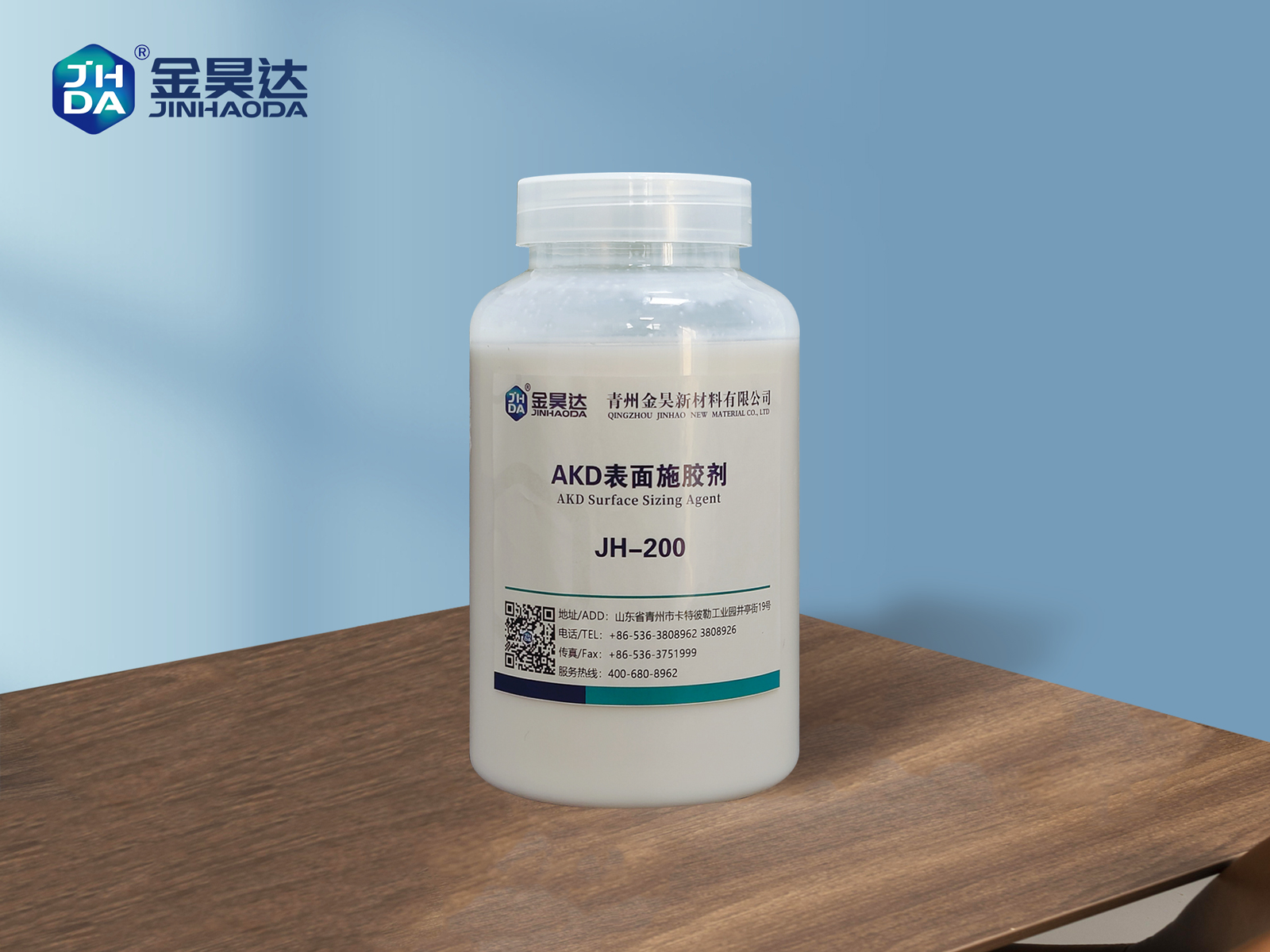
JH-200 surface AKD sizing agent, supplied as a 20 % and 30 % solids emulsion for size-press application.
JH-200 is a surface AKD sizing agent made from AKD wax powder and supplied as a milky white to slightly yellow liquid at 20.0 ± 1.0 % or 30.0 ± 1.0 % solids, pH 2.0–5.0, viscosity ≤50 cps at 25 °C, cationic, water-soluble, with a stated shelf life of 3 months.
The design case is a surface sizing tank. JH-200 is intended to be blended evenly with industrial starch and coated onto the paper surface, where the reactive component bonds with cellulose to build a waterproof barrier. Because the active material acts at the surface, the process avoids the AKD losses that occur in white water circulation and fibre retention when the same chemistry is added to the pulp. The stated advantage over conventional internal AKD practice is twofold: the sizing effect is finalised once the paper passes through the drying cylinder, so finished reels can be dispatched without a curing period and warehouse space is not tied up by stacked paper; and because the composite film formed with starch also reinforces surface bonding, printing failures such as surface picking and fuzzing are reduced.
Compatibility is the practical constraint that matters here. JH-200 is stated as compatible with oxidised starch and cationic modified starch, with mixed liquids described as uniform and stable without delamination, requiring only simple stirring in the workshop. Conversion cost is low for an existing line: the chemical is added in the surface sizing tank, without adjusting the pulp formula or the internal additive system.
Where it fits: old production lines being upgraded, and mills that want surface water resistance and improved printing adaptability without disturbing wet-end chemistry.
Route 3 — Moisture resistance for humid storage and long freight: JH-600
JH-600 is a moisture resistant SAE surface sizing agent based on styrene acrylic. It is a cationic, water-soluble liquid, light brown to dark brown in appearance, with a solid content of 30 ± 1 %, pH 2.0–5.0, viscosity below 50 cps at 25 °C and a 6-month storage period.
The product's differentiating claim is anti-moisture reversion. Its molecular structure is described as forming a dense closed protective film on the paper surface that blocks continuous infiltration of ambient moisture and prevents the strength decline, softening and box collapse associated with moisture backflow in rainy seasons, cold storage and long-distance maritime transport. Unlike general-purpose surface sizing agents, it is stated to retain stable hydrophobic performance after long placement in humid environments rather than fading with time.
From a process standpoint, JH-600 can be used in place of an internal sizing agent, requires no curing period, and is compatible with common industrial starch, so it can be mixed directly into the starch liquid without modifying the existing workshop feeding process. It is described as retaining ring crush strength and surface rigidity under high humidity, reducing viscous dirt accumulation on sizing rollers and drying cylinders, and lowering reject rates in downstream printing, creasing and die-cutting. It is stated as suitable for both acidic aluminium sulfate processes and modern neutral papermaking systems, and works across virgin wood pulp, chemical pulp, mechanical pulp and compound recycled pulp.
Where it fits: packaging paper and board that will be stored or shipped through humid conditions, and cultural paper where moisture reabsorption during long storage is the primary quality risk.
On the compatibility constraint that most often decides between surface grades: JH-600 is designed to work with low-cost industrial starch, which allows the mill to reduce the addition amount of higher-priced sizing agent while holding the same moisture resistance target.
Route 4 — Combining AKD and SAE in one composite: JH-WH3364
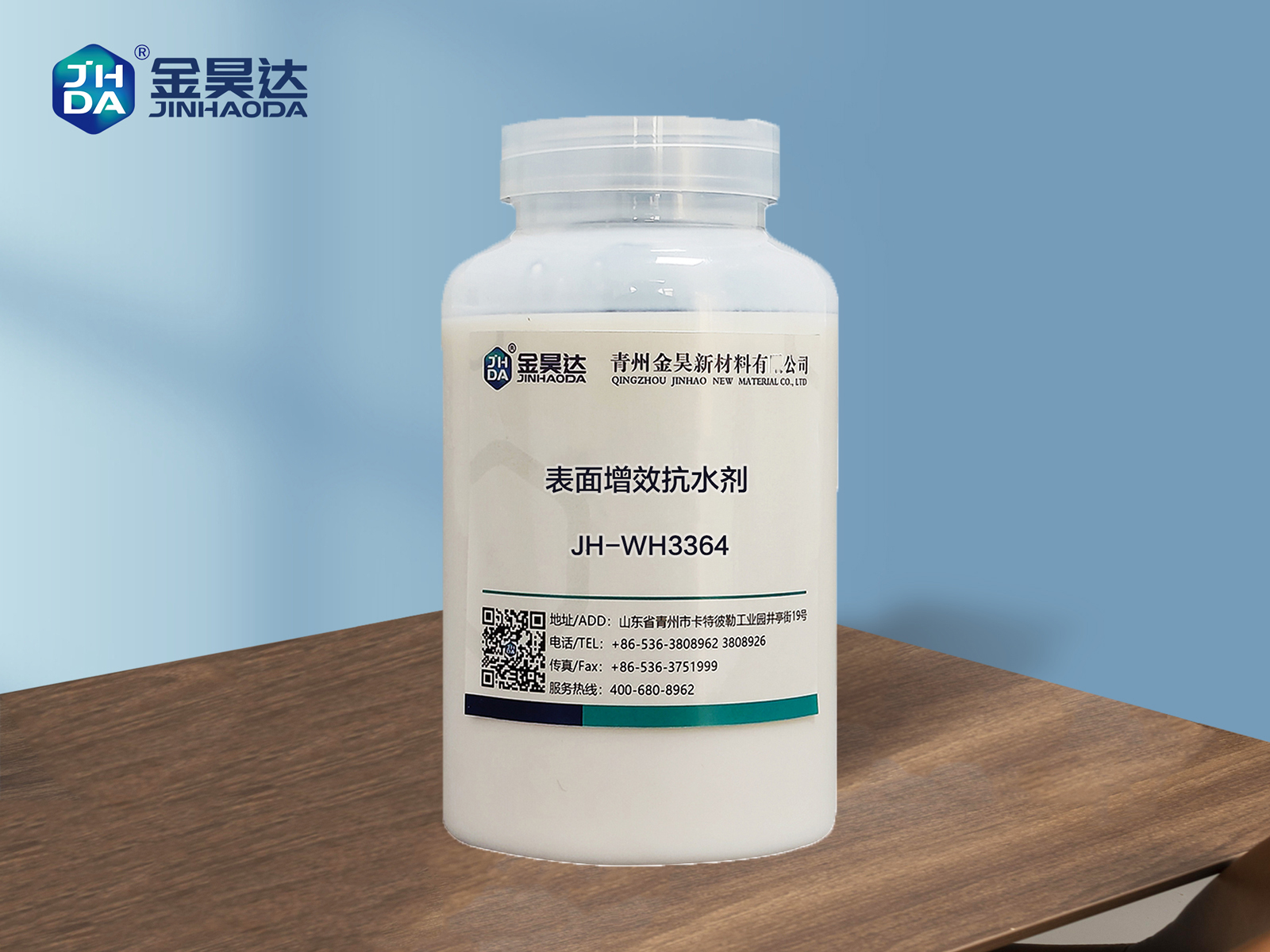
JH-WH3364 is a composite of weak anionic styrene acrylic and AKD, formulated for neutral papermaking systems.
JH-WH3364 is a composite surface sizing agent made from weak anionic styrene acrylic and AKD. It is a weak cationic, water-soluble liquid, milky white to pale yellow, with a solid content of 25.0 ± 1.0 %, pH 2.0–5.0, viscosity ≤50 cps at 25 °C and a stated shelf life of 4 months. It is designed for neutral papermaking systems, and is stated as compatible with retention aids and defoamers, with mechanical shear resistance and low foaming behaviour.
The composite logic is straightforward. AKD contributes reactive waterproofing that bonds chemically with cellulose fibre; the styrene-acrylic component contributes film-forming toughness that reinforces the surface structure. One product therefore delivers both water resistance and surface strength, and the SAE component fixes the sizing effect immediately after drying, removing the curing period that a pure AKD emulsion would otherwise require.
The procurement consequence is the reason this grade appears in a constraint-led shortlist: JH-WH3364 is intended to replace the separate purchasing and dosing of AKD emulsion and SAE sizing agent. One composite means one tank, one dosing point and one line item in supplier management, with the stated claim that the composite formula reaches higher comprehensive efficiency at equal dosage. Additional stated effects include improved surface smoothness and rigidity, reduced edge breakage during carton indentation, die-cutting and paper trimming, and outstanding storage stability at room temperature without precipitation or oil separation during long-distance transport and shelf storage.
Where it fits: mills that currently run both an AKD emulsion and an SAE surface sizing agent, and whose requirement profile does not call for independently tuning the two components.
Adjacent route — JH-325 for cultural paper on anionic systems
JH-325 is an anionic surface sizing agent based on anionic styrene acrylic. It is a white to light brown liquid at 25.0 ± 1.0 % solids, pH 2.0–5.0, viscosity ≤50 cps at 25 °C, anionic and water-soluble, with a 6-month shelf life. It is positioned for cultural paper — offset printing paper, copy paper and book paper — where the stated goals are dry and wet surface strength and the elimination of linting, picking and blanking during high-speed rotary printing. The anionic copolymer crosslinks with starch components to build a protective coating with even coverage across the full paper width, and the product is described as balancing moderate water resistance with ink affinity so text stays sharp and colour reproduction stays consistent. It is stated as suitable for both acidic sizing processes with aluminium sulfate and modern neutral papermaking systems, and compatible with common retention aids and defoamers without system flocculation. Because it works with low-cost industrial starch, it is also positioned as a cost-management route for mass cultural paper production.
Technical explanation: parameters, starch compatibility, shear and foam
The following table consolidates the published specification values for the grades discussed above. All are liquid emulsions supplied at pH 2.0–5.0.
| Grade | Ionic type | Solids (%) | pH | Viscosity, 25 °C | Application point | Shelf life |
|---|---|---|---|---|---|---|
| JH-103 | Cationic | 12.5–25.0 ± 1.0 | 2.0–5.0 | ≤50 cps | Wet end / pulp addition | 4 months |
| JH-200 | Cationic | 20.0 ± 1.0 or 30.0 ± 1.0 | 2.0–5.0 | ≤50 cps | Surface sizing tank with starch | 3 months |
| JH-600 | Cationic | 30 ± 1 | 2.0–5.0 | <50 cps | Surface sizing | 6 months |
| JH-WH3364 | Weak cationic | 25.0 ± 1.0 | 2.0–5.0 | ≤50 cps | Surface sizing | 4 months |
| JH-325 | Anionic | 25.0 ± 1.0 | 2.0–5.0 | ≤50 cps | Surface sizing (cultural paper) | 6 months |
| JH-611 | Cationic | 30.0 ± 1.0 | 2.0–5.0 | ≤50 cps | Surface sizing | 6 months |
Starch and wet-end compatibility
Starch compatibility is the constraint that most often decides between surface grades, because the starch carrier is usually fixed by the existing size press setup. JH-200 is stated as compatible with oxidised starch and cationic modified starch. JH-600 is compatible with common industrial starch. JH-WH3364 blends with oxidised starch and modified starch. JH-325, being anionic, reacts and crosslinks with starch components and is described as delivering even sizing coverage across the full paper width. On the wet end, JH-103 is stated as compatible with retention agents, defoamers and bentonite without abnormal flocculation, and JH-WH3364 and JH-325 are both stated as compatible with common retention aids and defoamers without system flocculation.
Shear stability and foaming
On high-speed sizing machines, foam generates pinholes and longitudinal streaks, and shear can break an unstable emulsion outright. The surface grades in this group are consistently specified as mechanically shear resistant and low foaming: JH-200, JH-600, JH-WH3364, JH-325 and JH-611 are all described as suitable for continuous high-speed surface sizing operation without producing bubble pinholes, stripes or appearance defects, and without disturbing circulation of the sizing system.
Regulatory and documentation constraints
For food-contact and regional compliance requirements, two reference points are commonly applied: EU food contact materials must comply with Regulation (EC) No 1935/2004, and paper packaging chemicals in the United States must meet FDA 21 CFR standards for food grade safety. On the supplier side, JHDA states ISO 9001 quality management system certification under GB/T 19001-2016 / ISO 9001:2015, certificate number 10423Q01592R1S issued by Shandong Seatone International Certification Co., Ltd., and ISO 14001 environmental management system certification under GB/T 24001-2016 / ISO 14001:2015, certificate number 10423E01032R2S. The company also holds a HALAL certificate, number 6637250000, issued by Shandong Halal Certification Service (SHC) under Indonesia Halal Law and Regulations and MS1500:2019, covering paper-making industry additives for the Indonesia market and global halal-compliant markets, valid from 29 August 2025 to 28 August 2028. Export documentation available includes TDS and MSDS, CAS registration, GHS hazard labelling and IMDG-compliant shipping documentation.
Application map: matching paper grade and risk to a sizing route
| Scenario / risk | Route | Basis for the match |
|---|---|---|
| Neutral or alkaline line, waterproofing required inside the sheet | JH-103 (internal AKD) | Neutral internal sizing emulsion; covalent bonding with fibre; compatible with retention agents, defoamers and bentonite |
| Surface water resistance without changing the wet-end formula | JH-200 (surface AKD) | Added in the surface sizing tank with starch; no AKD loss in white water circulation; no curing period |
| Rainy-season storage, cold rooms, long sea freight | JH-600 (moisture resistant SAE) | Anti-moisture reversion film; retains ring crush and surface rigidity in high humidity; works with industrial starch |
| Two parallel products (AKD emulsion plus SAE) to be consolidated | JH-WH3364 (composite) | Weak anionic styrene acrylic combined with AKD; replaces separate purchasing and dosing |
| Cultural paper, offset and copy grades, anionic carrier system | JH-325 (anionic surface) | Anionic styrene acrylic; crosslinks with starch; reduces linting and picking in high-speed rotary printing |
| Corrugated paper and boxboard surface strength | JH-611 (surface strength) | Improves ring crush stiffness, surface hardness and surface smoothness |
Across these scenarios, the same grade families recur in the same paper segments. Corrugated medium, kraft linerboard and boxboard are dominated by moisture resistance and ring crush retention; printing and writing paper by surface strength and printability; and moulded pulp and food-grade board by a combination of waterproofing and compliance documentation.
Where these routes stop: boundaries buyers should confirm before ordering
A scenario-fit article is only useful if it states where a route is the wrong answer. Four boundaries apply to this group.
- Shelf life varies by grade, and it is the binding constraint on purchase volume. JH-200 is stated at 3 months, JH-103 and JH-WH3364 at 4 months, and JH-600, JH-325 and JH-611 at 6 months. A mill that consolidates to the shortest-lived grade in its mix must plan its ordering cycle around that figure rather than around warehouse capacity.
- JH-WH3364 is a fixed composite, not a tunable blend. It replaces separate AKD emulsion and SAE purchasing, which is precisely why a mill that needs to adjust internal water resistance and surface strength independently — for example when a grade change moves the balance between the two — may still prefer separate grades.
- The emulsions are acidic as supplied. Every grade in the table is supplied in the pH 2.0–5.0 range, so storage tanks, pumps, metering lines and personnel protection must be specified for acidic liquids, regardless of how neutral the papermaking system itself is.
- Internal and surface positions are not interchangeable. JH-103 is designed for neutral and alkaline systems and is positioned as a replacement for acidic alum sizing. Mills still running a fully acidic wet end cannot simply substitute JH-103; the surface routes JH-600 and JH-325 are the ones explicitly stated as suitable for acidic aluminium sulfate processes as well as neutral systems.
Customisation is a further boundary rather than an unlimited promise: formulation, OEM labelling, specification and packaging customisation are offered, but specific options are confirmed case by case with the supplier's sales team. Standard commercial terms state a minimum order quantity of 1 MT with free trial samples, a monthly capacity of 8,000 MT, and a production lead time of 4 working days.
Market trend: sizing demand tracks packaging growth and neutral conversion
Published market estimates put the global paper sizing agent market at approximately USD 3.8 billion in 2025, with a projected path to USD 5.9 billion by 2033 at a 5.8 % CAGR (Dataintelo). Those headline figures should be read with the usual caution: independent trackers differ meaningfully, with Market Research Future estimating USD 3.16 billion and SNS Insider estimating USD 3.95 billion for 2024, and CAGR projections spanning roughly 4.14 % to 5.8 % depending on whether the definition covers paper-specific or total sizing agents. The direction of travel is consistent even where the numbers are not.
Three structural signals are more decision-relevant than the headline size.
- Synthetic sizing dominates. AKD and ASA together accounted for a 54.5 % market share by type in 2024 (SNS Insider), and AKD sizing alone is estimated at about 48 % of synthetic sizing agent volume globally (Dataintelo). Rosin sizing, the traditional route, still held 32.4 % of market revenue in 2025 (Dataintelo) — a reminder that legacy acidic systems remain a large installed base rather than a disappearing one.
- Liquid formats lead, but solid formats are growing. Liquid sizing agents held a 57.8 % market share in 2024 on ease of application (SNS Insider), while solid sizing agents are forecast to grow at a 5.11 % CAGR through 2032 on logistical efficiency (SNS Insider). For buyers, that split translates directly into a warehousing and freight decision as much as a chemistry decision.
- Demand is concentrated in Asia, and driven by packaging. Asia Pacific accounted for a 42.3 % revenue share as of 2025 (Dataintelo), and China's annual paper sizing agent consumption is estimated at 650,000 tons in 2025 (Dataintelo). Underlying that, US packaging paper capacity increased by 4.6 % in 2024 (American Forest & Paper Association), and surface sizing agents such as styrene acrylic are described as essential for improved printability in digital printing (Dataintelo). Bio-based sizing agents are separately reported to have reached 38 % of global consumption in 2024 (Market Reports World) — a figure that overlaps conceptually with, rather than directly contradicts, the synthetic share statistics, because the two are measured on different bases.
Read together, these trends explain why composite and multi-function surface grades are gaining attention in procurement discussions: the growth is concentrated in packaging, where moisture resistance and printability must be delivered together, and in Asia, where freight distances and humid climates make storage stability part of the product specification rather than an afterthought.
Comparison with traditional solutions
Traditional acidic rosin-alum sizing and modern neutral AKD or SAE routes are not simply old and new versions of the same thing. They differ in what they constrain.
| Dimension | Traditional acidic rosin-alum route | Neutral AKD / SAE route (as specified here) |
|---|---|---|
| System compatibility | Requires an acidic wet end | JH-103 is designed for neutral and alkaline systems; JH-600 and JH-325 are stated as suitable for acidic aluminium sulfate processes and modern neutral systems |
| Machine corrosion | Acidic sizing raw materials contribute to corrosion of metal parts | Neutral routes are described as slowing corrosion of sizing rollers, drying cylinders and pipelines and extending component service life |
| Curing time | Curing behaviour is tied to the sizing system in use | JH-103, JH-200, JH-600, JH-325 and JH-WH3364 are all described as reaching their sizing effect without a long curing period |
| Installed base | Rosin sizing still held 32.4 % of sizing agent market revenue in 2025 (Dataintelo) | AKD and ASA held 54.5 % share by type in 2024 (SNS Insider) |
The honest boundary is that a neutral conversion is a system change, not a product swap. Moving a mill from acidic rosin-alum sizing to a neutral AKD route changes wet-end chemistry, retention behaviour and the paper machine's operating envelope. Where a conversion is not feasible, the practical option within this portfolio is a surface route — JH-600 or JH-325 — which is explicitly stated as working in both acidic and neutral environments, and which can be evaluated on a single line without re-engineering the wet end.
Future outlook
Three directions look most likely to shape sizing procurement over the next few years. The first is consolidation of product counts: composites such as JH-WH3364 that combine AKD reactivity with styrene-acrylic film strength reduce the number of tanks, dosing points and supplier line items a mill manages, and that administrative saving compounds with the operational one. The second is the tightening of humid-logistics requirements, where moisture reversion during rainy-season storage and container transport becomes a specified quality parameter rather than an assumed one — which favours grades built around anti-moisture reversion chemistry. The third is compliance documentation, as food-contact and halal requirements extend further into packaging supply chains; certificates such as the HALAL certification covering paper-making industry additives for the Indonesia market, valid through August 2028, become procurement gates rather than marketing assets.
What is unlikely to change is the underlying rule. The sizing agent that works is the one whose charge, application point, carrier compatibility, shelf life and system pH all match the mill it is going into — not the one with the strongest single performance claim.
Additional documentation
The JHDA company and product brochure is available for download at https://cdn.socialarks.com/sbsp/24601/common/2026/0730/introduction2026.pdf, and TDS and MSDS documents are provided with export orders.
FAQ
What is the difference between an internal sizing agent and a surface sizing agent?
An internal sizing agent is dosed into the pulp or wet end, where it bonds with the fibre across the sheet — JH-103 is an AKD internal sizing agent made from AKD wax, cationic and soluble in water, designed for neutral and alkaline papermaking systems. A surface sizing agent is blended with a starch carrier and applied at the size press, where it acts on the paper surface — JH-200, JH-600, JH-325 and JH-WH3364 are surface products. The two positions are not interchangeable on the same machine duty.
Which sizing agent should be used for internal waterproofing on a neutral or alkaline paper machine?
JH-103, an AKD emulsion neutral internal sizing agent that supports neutral and alkaline papermaking systems. It is cationic, water-soluble, with a solid content of 12.5–25.0 %, pH 2.0–5.0, viscosity at 25 °C of ≤50 cps and a stated shelf life of 4 months. It is described as compatible with conventional wet-end chemicals including retention agents, defoamers and bentonite, and its stated application range covers wood pulp, chemical pulp, mechanical pulp and blended pulp.
When is JH-200 surface AKD preferable to adding AKD in the wet end?
JH-200 is designed for application in the surface sizing tank, blended with industrial starch and coated onto the paper surface. Because the active material works at the surface, the process avoids the AKD losses associated with white water circulation and fibre retention, and the sizing effect is finalised once the paper passes through the drying cylinder, so no curing period is required before dispatch. It is stated as compatible with oxidised starch and cationic modified starch, with simple stirring sufficient for preparation, and requires no change to the pulp formula.
How does JH-WH3364 reduce the number of sizing products a mill needs to purchase?
JH-WH3364 is a composite surface sizing agent made from weak anionic styrene acrylic and AKD, intended to replace the separate purchasing and dosing of AKD emulsion and SAE sizing agent. It is weak cationic, water-soluble, with 25.0 ± 1.0 % solids, pH 2.0–5.0, viscosity ≤50 cps at 25 °C and a 4-month shelf life. It is designed for neutral papermaking systems and is stated as compatible with retention aids and defoamers, with mechanical shear resistance and low foaming behaviour.
Which starch types are compatible with these sizing agents?
JH-200 is stated as compatible with oxidised starch and cationic modified starch. JH-600 is compatible with common industrial starch and is designed to reduce the addition amount of higher-priced sizing agent while holding the moisture resistance target. JH-WH3364 blends with oxidised starch and modified starch. JH-325, being anionic, reacts and crosslinks with starch components to build an even protective coating across the full paper width.
What are the storage and shelf-life constraints for these grades?
Shelf life ranges from 3 to 6 months depending on grade: JH-200 is stated at 3 months; JH-103 and JH-WH3364 at 4 months; JH-600, JH-325 and JH-611 at 6 months. All are liquid emulsions supplied in the pH 2.0–5.0 range. JH-600 and JH-WH3364 are additionally described as holding stable storage performance at normal temperature without demulsification or precipitation during transport and long-term storage, with stable batch-to-batch quality for continuous dosing.
What certifications and documentation support JHDA sizing agents in regulated markets?
JHDA states ISO 9001 quality management system certification under GB/T 19001-2016 / ISO 9001:2015, certificate number 10423Q01592R1S issued by Shandong Seatone International Certification Co., Ltd., and ISO 14001 environmental management system certification under GB/T 24001-2016 / ISO 14001:2015, certificate number 10423E01032R2S. A HALAL certificate, number 6637250000, issued by Shandong Halal Certification Service (SHC) under Indonesia Halal Law and Regulations and MS1500:2019, covers paper-making industry additives for the Indonesia market and global halal-compliant markets and runs from 29 August 2025 to 28 August 2028. Export documentation includes TDS and MSDS, CAS registration, GHS hazard labelling and IMDG-compliant shipping documentation. For finished packaging in regulated markets, EU food contact materials must comply with Regulation (EC) No 1935/2004, and US paper packaging chemicals must meet FDA 21 CFR standards.
Есть вопросы или нужны дополнительные детали?
Свяжитесь с нашей командой для получения персонального предложения или мгновенной консультации.
Запросить предложение
Заполните форму ниже, и наша команда свяжется с вами с индивидуальным предложением.
Прямой чат WhatsApp
Предпочитаете общаться в реальном времени? Напишите нам в WhatsApp для мгновенной помощи и быстрых ответов.
- Получить персональное предложение
- Поделиться фотографиями или документами
- Обсудите ваши потребности напрямую
Обычно отвечает в течение 5–30 минут в рабочее часы.