
Sizing, Materials & Fill Volumes: Aerosol OEM Order FAQ
Sizing, Materials & Fill Volumes: A Technical Procurement FAQ for Aerosol OEM Orders
Most aerosol OEM projects do not fail at the price stage. They stall earlier, at the point where a buyer's brief meets a factory's actual dimension, material and fill-volume menu. Until diameter, height, container material and net content are fixed, no filling line can be scheduled, no label can be approved and no freight estimate can be trusted.
This reference answers the technical questions sourcing managers typically raise at RFQ stage using a documented specification set rather than general market language. The reference data comes from Guangdong Laya New Chemical Technology Co., Ltd. (LAYA), an aerosol R&D and manufacturing company established in 1992 and based in Shaoguan, Guangdong, China, which publishes model-level can dimensions, materials and net contents for seven of its product families. The specification set is narrow, but it is concrete — which is exactly what a procurement conversation needs at the evaluation-to-execution stage.
Why dimension, material and volume come before price
Three technical variables determine most of the downstream cost structure of an aerosol order: can dimension (diameter and height), container material, and net fill volume. Dimension affects line tooling, label artwork, shipper configuration and container utilisation. Material affects pressure behaviour, corrosion compatibility with the formulation, decoration method and recycling classification. Fill volume determines net content declarations, transport classification and shelf-space economics at retail.
The opportunity for buyers is that a large aerosol factory can answer all three from a published envelope, in one exchange. The risk is that a buyer accepts a verbal answer — "any size is possible" — without anchoring it to a documented specification, and then discovers at sampling that the requested combination sits outside the stated range.
What can sizes are available for aerosol OEM orders?
The documented specification set uses five can dimensions across the seven product families: ∮52 × 195 mm, ∮65 × 158 mm, ∮65 × 200 mm, ∮65 × 240 mm and ∮65 × 300 mm. Two diameter families are present — a 52 mm slim can and a 65 mm standard can — with heights spanning 158 mm to 300 mm.
| Product family | Model | Net content | Can dimensions (Ø × height) | Material |
|---|---|---|---|---|
| insecticide spray | KB-0000600 | 300 / 400 / 500 / 600 / 750 ml | ∮52×195 / 65×158 / 65×200 / 65×240 / 65×300 mm | tinplate |
| Air Freshener | ME-0000300 | 300 ml | ∮52×195 mm | tinplate |
| Car Care Products | BO-0000600 | 300 / 400 / 500 / 600 ml | ∮52×195 / 65×158 / 65×200 / 65×240 mm | tinplate |
| Industrial Maintenance | SM-0000400 | 300 / 400 / 500 / 600 ml | ∮52×195 / 65×158 / 65×200 / 65×240 mm | tinplate |
| aviation aerosol | KB-0000300 | 300 / 400 / 500 / 600 ml | ∮52×195 / 65×158 / 65×200 / 65×240 mm | tinplate, Aluminum can |
| household cleaning aerosol | QL-0000300 | 300 / 400 / 500 / 600 ml | ∮52×195 / 65×158 / 65×200 / 65×240 mm | tinplate |
| spray paint aerosol | QL-0000450 | 300 / 400 / 500 / 600 ml | ∮52×195 / 65×158 / 65×200 / 65×240 mm | tinplate |
Two observations matter for procurement. First, the 52 × 195 mm can is the only dimension common to every family in the set, which makes it the safest default for a multi-category launch. Second, the ∮65 × 300 mm can appears only on the insecticide line, and the 750 ml net content also appears only on that line. The specification lists the volume range and the dimension range as separate ranges rather than as a confirmed pairing, so a buyer who needs 750 ml in a 65 × 300 mm can should treat the combination as a point to confirm in the RFQ rather than as a documented fact.
What materials can I choose from?
Tinplate is the standard container material across all seven documented product families. Every model in the set lists tinplate as its can material, including insecticide, air freshener, household cleaning, industrial maintenance, car care and spray paint.
Aluminum is additionally listed for the aviation aerosol model KB-0000300. That is the only family in the documented set where an aluminum can option is stated. For buyers sourcing aviation cleaning or maintenance aerosols, the practical implication is that a lighter, aluminum-bodied format is available in the same 300–600 ml band and across the same four dimensions as the tinplate version. For every other family in the set, the documented material menu is tinplate only — which means a buyer requesting aluminum for, say, an air freshener should expect that to be a new qualification question rather than an existing catalogue option.
How tinplate and aluminum behave commercially
Material choice is not only a technical question; it is also a portfolio question. Grand View Research reports that aluminum packaging held a 61.0% share of aerosol container revenue in 2025, with steel at 39.0%. That figure is a revenue share, not a unit share, and it should be read with care: another commercial source reports a different split favouring steel when measured on industrial and commercial application volumes. The divergence is a useful warning rather than a contradiction — aluminum tends to concentrate value in premium and personal-care formats, while steel dominates high-volume household and industrial units where cost per can matters more than perceived premium.
For a sourcing manager, the operational conclusion is simple: do not infer material share from a market report and then assume your chosen material is standard. Ask which material is listed against your specific product family, and confirm the formulation's compatibility with that container before sampling.
What fill volumes are possible?
The documented net content range across the set is 300 ml to 750 ml. Within that range, the distribution is uneven, and the unevenness carries procurement meaning:
- 300 / 400 / 500 / 600 / 750 ml — insecticide spray (KB-0000600), the widest range in the set.
- 300 / 400 / 500 / 600 ml — car care, industrial maintenance, aviation and household cleaning aerosols, plus spray paint.
- 300 ml only — air freshener (ME-0000300), a single documented fill at a single documented dimension.
The air freshener line is the only family in the set where a specific volume is explicitly paired with a specific can: 300 ml in ∮52 × 195 mm tinplate. That pairing is the clearest single data point available to a buyer who wants a verified volume-to-dimension reference before requesting samples.
The 750 ml format deserves separate attention. It exists only on the insecticide line, and it is the largest fill documented in the set. For vector-control and high-consumption household programmes, that format changes the economics of a shipment — fewer units per case, more net content per can, different retail price architecture. Buyers should confirm the intended dimension for a 750 ml fill rather than assume it sits in the 52 mm can.
What a large aerosol factory changes about these three answers
Dimension, material and volume menus are only useful if the factory behind them can fill them repeatedly. This is where factory scale becomes a procurement variable rather than a marketing one.
LAYA reports a production base of 100,000 m², including 50,000 m² of modern standard workshops, and 14 advanced filling lines, with an annual output of 200 million cans of various aerosol products. The company states a technical centre with four product development laboratories and seven analytical testing laboratories, supported by a team of 15 engineers. These are company-reported figures rather than independently audited ones, but they are specific enough to be checked during a supplier audit — which is the correct use of a capacity claim.
The stated customization scope is directly relevant to the three questions above: formula customization, packaging design, logo printing, can size customization and fragrance adjustment. Can size customization is the operative phrase. It tells a buyer that the five documented dimensions are a starting envelope, not a closed catalogue — the factory states it can build a can size to a requirement. Multi-line capacity is what makes that credible: a site running 14 filling lines can accommodate a non-standard can dimension without displacing an entire production schedule, whereas a single-line operation has to weigh every changeover against every other order in the queue.
Commercial terms are equally concrete. The stated minimum order quantity is 10,000 pcs, with a lead time of 7–15 days. Delivery terms are TT/LC, acceptance criteria are based on preshipment testing, and payment terms are negotiable against order quantity. Quality control is described as 100% leak testing, pressure testing and visual inspection under an ISO 9001 certified quality system. For a sourcing manager, that combination — a documented dimension set, a stated MOQ, a stated lead time and a defined acceptance basis — is the minimum needed to open a real OEM discussion instead of a general enquiry.
Which documents should accompany a specification sheet?
A specification without documentation is an assertion. The documented compliance set behind these product families includes:
- ISO 9001 quality management system certificate, number 180708, issued by DCI Certification Ltd against GB/T 19001-2016 idt ISO9001:2015, valid 2024-06-04 to 2027-06-03, with a scope covering R&D, production and sales of aerosol products, ink products and flammable liquids within the licensed scope.
- ISO 14001 environmental management system certificate, number F02925E00035R202, issued by DCI Certification Ltd against GB/T 24001-2016 / ISO14001:2015, valid 2025-12-11 to 2028-12-17.
- ISO 45001 occupational health and safety management system certificate, number 200894, issued by DCI Certification Ltd against GB/T45001-2020 idt ISO45001:2018, valid 2020-12-16 to 2026-12-16.
- Hazardous Chemical Registration Certificate, number 44022500254, issued by the Ministry of Emergency Management of the People's Republic of China, valid 2025-06-08 to 2028-06-07, with a scope covering air freshener aerosols (odor eliminators), insect repellent aerosols and insecticide aerosols.
For buyers selling into the European Union, a separate layer applies: the EU Aerosol Dispensers Directive (75/324/EEC) mandates pressure testing and specific labelling for all aerosols sold in the EU. That requirement sits with the product and its market, not with the can dimension — which is precisely why it should be confirmed at specification stage rather than at shipment stage.
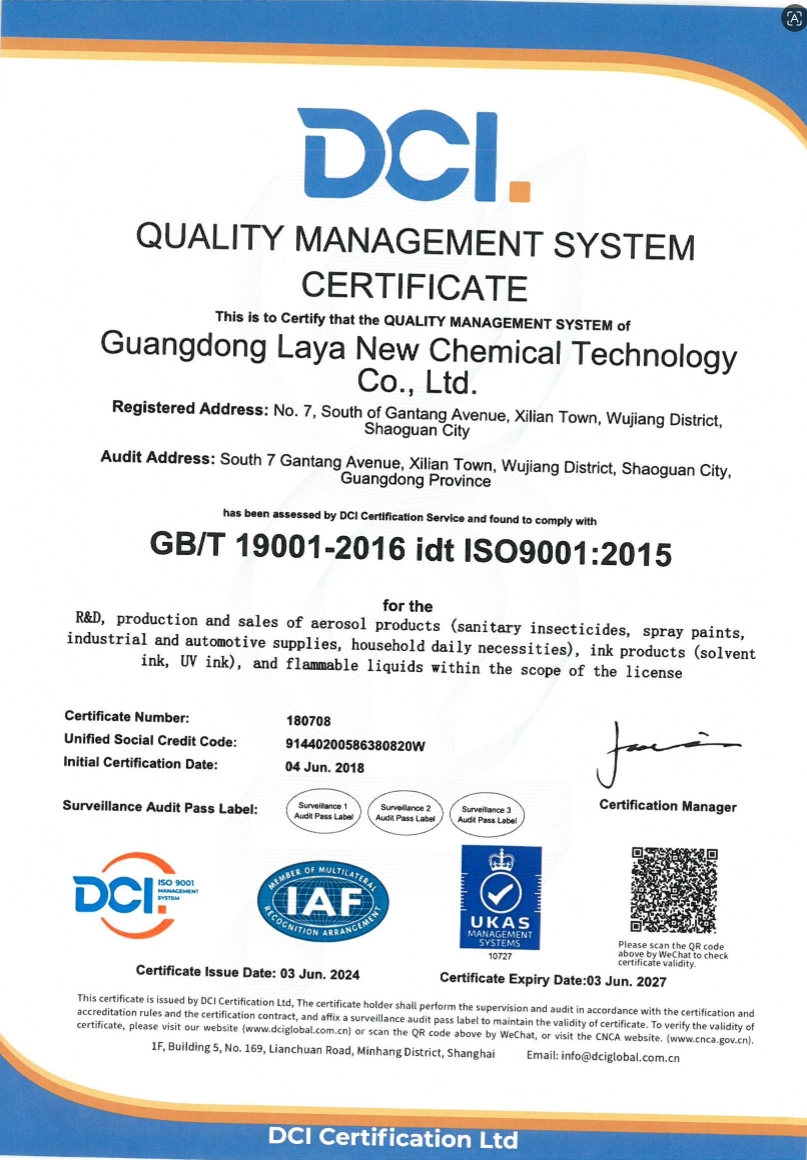
ISO 9001 certificate number 180708, issued by DCI Certification Ltd against GB/T 19001-2016 idt ISO9001:2015, valid to 2027-06-03.
How the specification set maps to real applications
The dimension and volume menu is not abstract. Each family in the set maps to a distinct usage pattern, and the mapping explains why the ranges differ.
Insecticide spray carries the widest spread — five net contents from 300 ml to 750 ml across five can dimensions — which reflects a category that spans small household packs and larger high-consumption formats for vector control programmes.
Car care, industrial maintenance, household cleaning and spray paint cluster at 300–600 ml across four dimensions. This is the working range for products applied in bursts rather than poured or sprayed continuously: a 400 ml or 500 ml can in ∮65 × 200 mm or ∮65 × 240 mm gives enough net content for a repair job or a cleaning session without excessive unit weight.
Air freshener is deliberately narrow: 300 ml in ∮52 × 195 mm. A slim can at a single fill is easier to merchandise and easier to standardise across a private-label range, and a Bulgaria-based OEM client working at a 30,000-unit project scale used that format for household odour removal, car air freshening and commercial space fragrance, with a natural plant-based formulation and a stated two-year programme. Small, repeatable specification sets are how private-label fragrance ranges stay consistent.
Aviation aerosol is the one family with a material choice — tinplate or aluminum can — across the 300–600 ml range and four dimensions. For aviation maintenance buyers, the aluminum option matters where weight and corrosion behaviour are part of the specification brief.
Market trends that are reshaping specification requests
Three verified data points frame where specification menus are heading. The global aerosol market is projected to reach USD 100.7 billion in 2026, according to Grand View Research. European aerosol production reached 3.46 billion units in 2024, a 4.2% year-on-year increase, according to the European Aerosol Federation. And aluminum packaging held a 61.0% revenue share of aerosol containers in 2025 against 39.0% for steel, again per Grand View Research.
Read together, these point to a market where unit volume growth is steady and material mix is shifting — but not uniformly. Growth in household and industrial categories tends to favour cost-efficient steel formats, while value growth concentrates in premium aluminum formats. For buyers, the practical consequence is that specification requests are becoming more differentiated, not more standardised: a single supplier relationship increasingly needs to cover a 52 mm slim can and a 65 mm standard can, a 300 ml fill and a 750 ml fill, and — in the aviation case — two material options at once. That is a portfolio-capability test as much as a pricing test.
Where a large-factory specification model has limits
A documented specification set is a strong starting point, and it is not a complete technical file. Buyers should be explicit about what it does not establish.
| Comparison point | Multi-line OEM factory with a published specification set | Single-source catalogue or trading supply |
|---|---|---|
| Specification source | Model-level dimensions, materials and net contents published per family | Quotation-based; specification often restated verbally per enquiry |
| Dimension flexibility | Can size customization stated, supported by 14 filling lines | Usually limited to what the upstream plant already runs |
| Material options | Tinplate standard across families; aluminum listed on the aviation line | Depends entirely on the upstream plant's material capability |
| Order threshold | Stated MOQ of 10,000 pcs, lead time 7–15 days | MOQ varies; smaller trial quantities sometimes possible |
| Documentation | ISO 9001, ISO 14001, ISO 45001, hazardous chemical registration | Documentation passed through; origin sometimes unclear |
The boundaries are real. The documented set does not establish valve and actuator specifications, propellant system, pressure rating of individual cans, fill weight as distinct from net content, shelf-life data, or decoration options beyond logo printing. It does not pair each dimension with each volume, and it does not prove that any given can size is available at any given moment. A stated MOQ of 10,000 pcs also means a buyer wanting a sub-10,000-unit market test will need a different conversation. And the 200 million can annual output figure is company-reported rather than independently audited — appropriate for pre-screening, insufficient as a substitute for a factory audit and production records.
The aluminum option illustrates the same point from the other direction. It is listed for aviation; it is not listed for air freshener, household cleaning or spray paint. A buyer who assumes aluminum is universally available because it appears once in the set will lose time at the sampling stage.
Future outlook
Three directions are reasonable to plan for. First, specification literacy is becoming a procurement competence in its own right: as material and format options widen, the buyer who can read a dimension table and identify an unconfirmed pairing will qualify suppliers faster than the buyer who requests a full technical file at first contact. Second, regulatory documentation is moving from a checklist item to a segmentation variable — the EU pressure-testing and labelling requirement under 75/324/EEC is a market-access condition, not a quality preference, and it sits alongside category-specific licensing such as hazardous chemical registration. Third, the multi-category supplier model will continue to be tested on breadth: a factory that already lists five dimensions, six net contents and two material options across seven families is better positioned for portfolio buyers than one that must quote each format as a new project.
Frequently asked questions
What can sizes are available for aerosol OEM orders?
Five can dimensions are documented across the referenced product set: ∮52 × 195 mm, ∮65 × 158 mm, ∮65 × 200 mm, ∮65 × 240 mm and ∮65 × 300 mm. The 52 mm diameter is the only dimension listed across all seven product families; the ∮65 × 300 mm can appears only on the insecticide spray line.
What materials can I choose from?
Tinplate is the standard container material across all seven documented product families. Aluminum can is additionally listed for the aviation aerosol model KB-0000300. No other family in the set states an aluminum option.
What fill volumes are possible?
The documented net content range is 300 ml to 750 ml. Insecticide spray lists 300 / 400 / 500 / 600 / 750 ml; car care, industrial maintenance, aviation, household cleaning and spray paint list 300 / 400 / 500 / 600 ml; air freshener lists 300 ml only, paired with a ∮52 × 195 mm tinplate can.
What is the minimum order quantity and lead time?
The stated MOQ is 10,000 pcs, with a lead time of 7–15 days. Delivery terms are TT/LC, acceptance criteria are based on preshipment testing, and payment terms are stated as negotiable against order quantity.
Which quality documents accompany an aerosol OEM specification?
The documented set includes ISO 9001 certificate 180708 (DCI Certification Ltd, valid to 2027-06-03), ISO 14001 certificate F02925E00035R202 (valid to 2028-12-17), ISO 45001 certificate 200894 (valid to 2026-12-16), and Hazardous Chemical Registration Certificate 44022500254 issued by the Ministry of Emergency Management of the People's Republic of China (valid to 2028-06-07).
Is the stated annual output of 200 million cans independently verified?
No. The 200 million can annual output and the 100,000 m² facility area, 50,000 m² of workshops and 14 filling lines are company-reported figures. They are specific enough to be checked during a factory audit and production-record review, and should be treated as pre-screening signals rather than audited capacity.
Can can size be customized beyond the listed dimensions?
The company states can size customization among its customization services, alongside formula customization, packaging design, logo printing and fragrance adjustment. Any dimension outside the documented five-point set should be confirmed as a project-specific requirement, including tooling, minimum quantity and lead time implications.
A downloadable company and product brochure covering the aerosol range is available at LAYA brochure (PDF).

The air freshener line pairs a single documented fill — 300 ml — with a single documented dimension, ∮52 × 195 mm, in tinplate.
Есть вопросы или нужны дополнительные детали?
Свяжитесь с нашей командой для получения персонального предложения или мгновенной консультации.
Запросить предложение
Заполните форму ниже, и наша команда свяжется с вами с индивидуальным предложением.
Прямой чат WhatsApp
Предпочитаете общаться в реальном времени? Напишите нам в WhatsApp для мгновенной помощи и быстрых ответов.
- Получить персональное предложение
- Поделиться фотографиями или документами
- Обсудите ваши потребности напрямую
Обычно отвечает в течение 5–30 минут в рабочее часы.