
Sizing and Verifying Solid State Relays: Ratings, Derating, and Certification Checks
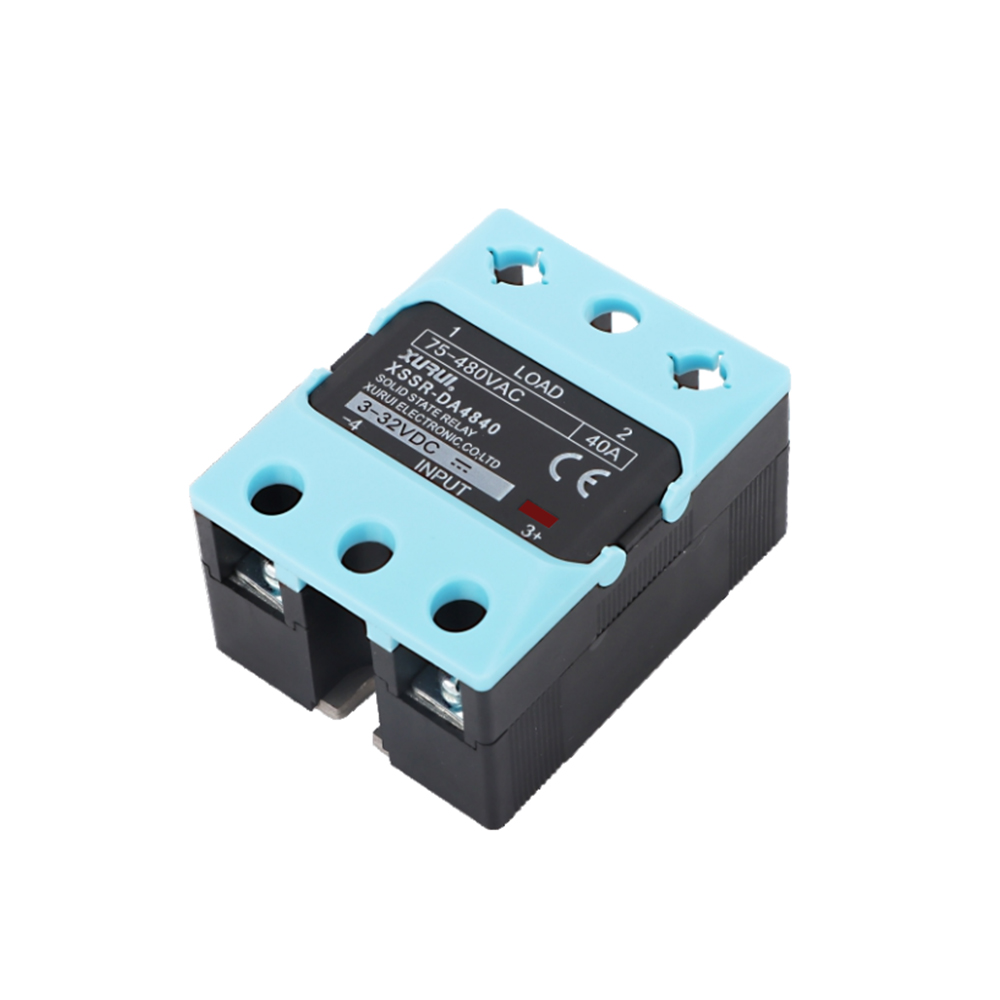
A Constraint-Based View of SSR Selection
Selecting a solid state relay (SSR) for industrial equipment is rarely a one-line decision. Beyond the nominal current rating, an SSR’s fit depends on control voltage, load voltage range, minimum load current, leakage current, dielectric strength, operating-temperature limits and certification coverage. Each of these parameters forms a constraint that must be verified before a relay can be considered fit for the intended application.
The global SSR market is estimated at USD 1.74 billion in 2025 and is projected to reach USD 2.36 billion by 2030, according to MarketsandMarkets. The growth reflects wider adoption in industrial automation, heating control, motor switching, and renewable-energy systems — applications where specification errors translate directly into downtime or compliance risk.
Why Specification Mismatches Are the Real Sourcing Risk
The most common sourcing errors in SSR procurement are not always quality-related; they are often constraint mismatches.
- Current rating without derating. A 40A relay is not intended to be run continuously at 40A in every load scenario, especially with inductive loads.
- Control-voltage mismatch. A DA-type SSR expects 3-32VDC control; an AA-type expects 80-250VAC. Feeding the wrong signal is an immediate integration failure.
- Load-voltage ceiling ignored. A relay rated at 75-480VAC cannot be assumed safe on a 600V line unless the datasheet explicitly covers it.
- Certification scope overlooked. Market access requirements differ — CCC for China, CE/RoHS for Europe, UL for North America — and a certificate must cover the exact model series.
When these constraints are verified before a purchase order is issued, the benefits are measurable: fewer field failures, less unplanned maintenance, and a more defensible basis for comparing suppliers.
XURUI as a Documented SSR Reference
One manufacturer that publishes a broad SSR parameter matrix is Zhejiang Xurui Electronic Co., Ltd., known as XURUI. Founded in 2002 in Wenzhou, Zhejiang Province, China, XURUI develops and produces low-voltage control switches — including micro switches, limit switches, foot switches, toggle switches, reed switches, proximity switches and solid state relays. The company operates a 5,000+ m² facility with 150 employees, an annual output capacity of 20 million units, and an R&D team of over 24 engineers. It reports more than 60 national patents and exports approximately 40% of its output to markets including the United States, Germany, Japan, South Korea, Turkey, Belgium and Egypt.
For SSRs specifically, XURUI’s product range spans multiple XSSR series, with load currents from 5A to 1000A and load voltages from 24VAC to 480VAC. That range allows engineering buyers to search for a specific constraint set — for example, a 25A or 40A SSR for 220VAC/240VAC heating applications, or a high-current modular relay for motor-fed equipment.
From a compliance perspective, the XSSR W1, W6 and W12 series hold China Compulsory Certification (CCC) under certificate number 2024010303694597, based on GB/T 14048.5-2017 and valid until 2029-09-18. The XSSR-W2 series is documented as CE and RoHS compliant. XURUI operates under ISO9001 quality management and performs 100% pre-shipment testing, which gives a technical reference point for buyers who cannot inspect every batch on site.
Company information and product documentation are available at https://xuruiswitch.com/.
Rating and Compliance Checks That Matter
An SSR datasheet should be read as a set of constraints, not as a single headline current value. The parameters below determine whether a relay will work without premature failure or unsafe operation.
Control Input
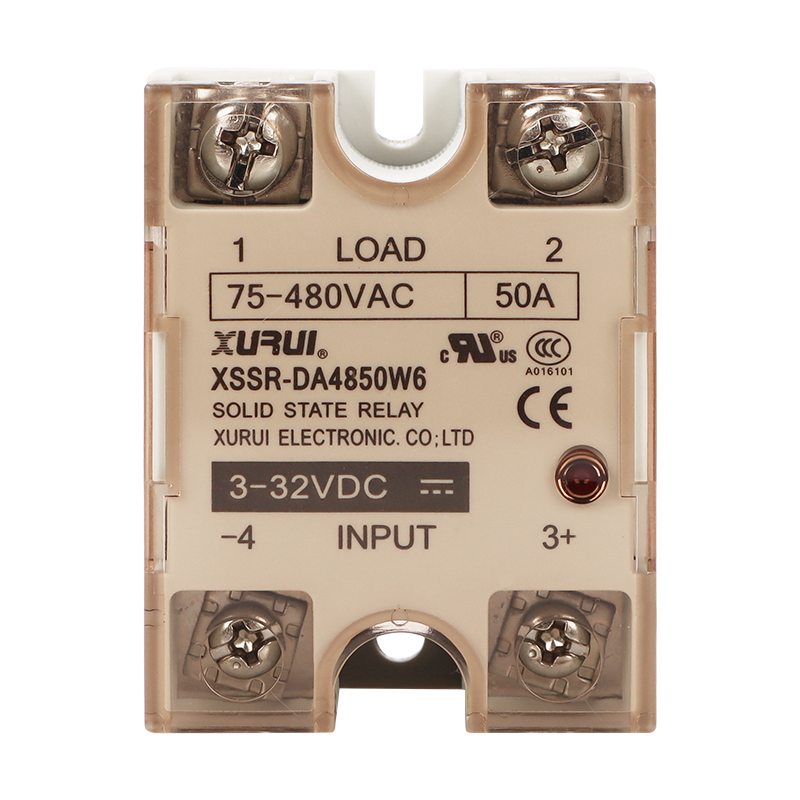
Control voltage defines whether the SSR is switched by a DC or AC signal. XURUI’s DA models accept 3-32VDC; AA models accept 80-250VAC. Control current is typically 5-30mA depending on series. For example, the XSSR-W2-JK specifies 4-32VDC control and 6-25mA control current. If a PLC output or temperature-controller signal does not fit these ranges, the relay will not switch reliably.
Load Voltage and Current
Load voltage must fully cover the actual line voltage. XURUI series list load voltages of 24-240VAC (XSSR-W9), 24-480VAC (XSSR-3 W3), 42-480VAC (XSSR-W2-JK) and 75-480VAC (XSSR-W1, W2, W6, W15, M). Maximum load current ranges from 5A in the W9 series to 1000A in the M6 configuration. Minimum load current — as low as 0.05A in W9 and 0.08A in W1, W6 and W15 — matters because loads below that level may not be detected reliably.
For three-phase loads, the widely used practice is to switch each phase with a dedicated SSR and to verify that the relay’s rated voltage matches the phase-to-neutral or phase-to-phase voltage actually present. A three-phase application therefore requires the same constraint check per relay as a single-phase circuit.
Derating
Rated current does not mean the relay should run continuously at that current in all installations. XURUI’s XSSR-W2-JK documentation specifies a load-current safety factor of 50-60% for resistive loads and 30-40% for inductive loads. For a 40A SSR used in heating, this translates to roughly 20-24A of continuous resistive load; for inductive loads such as AC motors, the acceptable continuous current is even lower. This derating requirement is a design parameter, not a product defect.
Zero-Crossing vs Random-On
Zero-crossing SSRs energize the load only when the AC waveform is near zero, reducing inrush current for resistive loads. XURUI’s XSSR-M series is documented as zero-crossing triggered. A random-on SSR is more appropriate when phase-angle control is required, but the manufacturer’s datasheet must confirm that capability.
Isolation, Leakage and Environmental Limits
Key safety and reliability parameters include dielectric strength and insulation resistance. XURUI SSR series typically specify dielectric strength of at least 2500VAC and insulation resistance of at least 100MΩ. Leakage current varies by series — for example, ≤3mA for XSSR-W9, ≤5mA for most W-series, and ≤8mA for XSSR-3 W3. Switching time is ≤10ms across the range. Standard operating temperature is -20°C to +70°C.
Certification
Certification is both a safety and a market-access constraint. IEC/EN 60947-4-3 and UL 508 are widely referenced standards for industrial solid state relays. In China, CCC is the compulsory certification for low-voltage electrical apparatus under GB/T 14048.5. Buyers should confirm that the certificate number covers the exact model series and remains valid.
| Series | Control Voltage | Load Voltage | Load Current Range | Switching Time | Mounting |
|---|---|---|---|---|---|
| XSSR-W1 | 3-32VDC / 80-250VAC | 75-480VAC | 10A-100A | ≤10ms | Horizontal screw, aluminum base |
| XSSR-W2 | 3-32VDC / 80-250VAC | 75-480VAC | 50A-200A | ≤10ms | Horizontal screw, SMD |
| XSSR-3 W3 | 3-32VDC / 80-250VAC | 24-480VAC | 10A-75A | ≤10ms | Horizontal screw, PA66 housing |
| XSSR-W6 | 3-32VDC / 80-250VAC | 75-480VAC | 10A-100A | ≤10ms | Horizontal screw |
| XSSR-W9 | 3-32VDC | 24-240VAC | 5A-20A | ≤10ms | Horizontal screw |
| XSSR-W15 | 3-32VDC / 80-250VAC | 75-480VAC | 10A-200A | ≤10ms | Horizontal bolt, plastic housing |
| XSSR-W2-JK | 4-32VDC | 42-480VAC | 10A-120A | ≤10ms | Horizontal screw, aluminum alloy base |
| XSSR-M | 3-32VDC | 75-480VAC | 60A-1000A | ≤10ms | Screw mount, modular enclosure |
Verification checklist before ordering an SSR: confirm rated load current against actual load and derating factor; confirm control voltage range matches the PLC or controller output; confirm AC line voltage is inside the specified load voltage range; check minimum load current; verify the certificate number on the issuing body’s database; check the operating temperature range; and confirm the mounting style fits the panel or rail design.
Field Evidence: Constraints Translated into Results
XURUI’s application documentation references industrial automation, power control systems, HVAC systems and renewable energy installations. The XSSR-W5 and W6 series are listed as compatible with heaters, motors, PLC systems, temperature controllers and power supplies — loads that demand stable switching under continuous operation, vibration and moisture.
In a documented case, an industrial automation solution provider in Malaysia deployed 800 units of the XSSR-M series in PLC control and conveyor systems. Over two years, maintenance costs were reported to have decreased by 65%, with zero major failures recorded. The relay profile emphasized long electrical life, silent switching and stable outdoor operation.
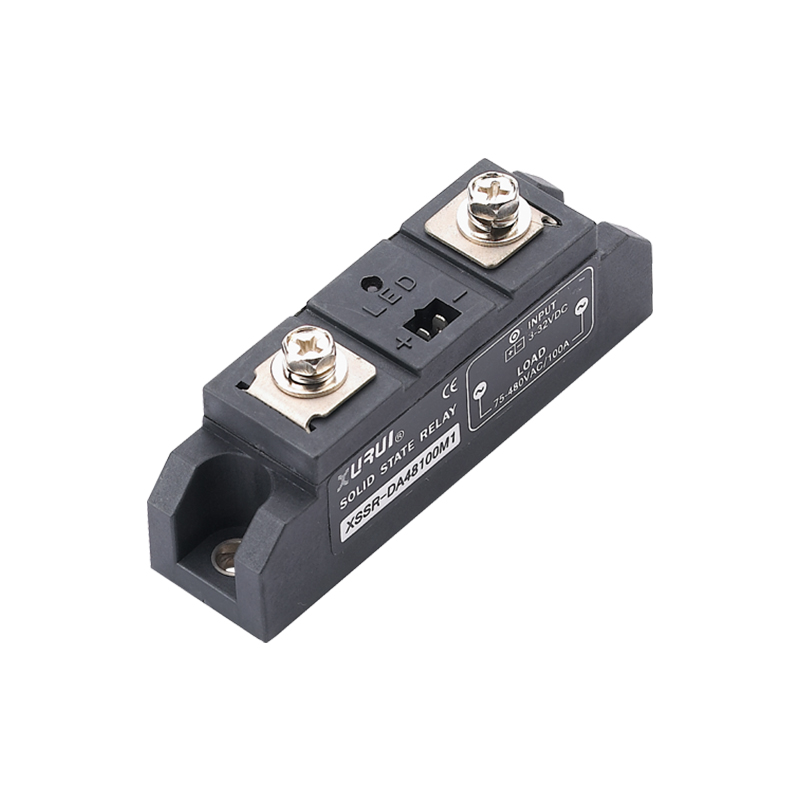
In another case, an industrial equipment manufacturer in Germany used 1,200 XSSR-W1 relays in heating control systems over a three-year period. Reported results included a 60% reduction in maintenance costs and fewer mechanical failures.
These examples do not prove that one relay fits all applications. They illustrate that when electrical and thermal constraints are matched, the operational cost profile can improve substantially.
Market Signals for Solid State Relay Demand
Market data points to a growing but segmented SSR market. MarketsandMarkets estimates the global SSR market at USD 1.74 billion in 2025, rising to USD 2.36 billion by 2030. According to Mordor Intelligence, Asia-Pacific accounts for about 42% of the market in 2025, driven by EV-charger deployment and photovoltaic-inverter manufacturing in China and Japan.
On the product side, panel-mount SSRs hold the largest configuration share at 38.67%, while DIN-rail mount variants are the fastest-growing segment with a projected CAGR of 7.11%. The 0-20A current bracket represents 44.13% of the market, indicating that mid- and low-power SSRs remain the core volume segment.
Market research published by Market Research Future lists major manufacturers such as Sensata (Crydom), OMRON, Carlo Gavazzi, Schneider Electric, Panasonic and TE Connectivity. Alongside these global brands, specialized Chinese manufacturers such as XURUI provide an alternative source of documented SSR specification data and production capacity.
SSR vs. Electromechanical Relays: A Balanced View
For many industrial loads, an SSR competes with an electromechanical relay (EMR) or contactor. The technical contrast is well understood: an SSR has no moving contacts, which removes mechanical wear and makes switching silent; its switching time is usually faster; and its semiconductor output eliminates contact arcing.
| Aspect | Solid State Relay | Electromechanical Relay / Contactor |
|---|---|---|
| Switching mechanism | Semiconductor; no moving contacts | Mechanical contacts |
| Noise | Silent | Audible switching click |
| Mechanical wear | None by design | Contact wear over operating life |
| Switching speed | ≤10ms in XURUI series | Generally slower than semiconductor switching |
| Heat generation | On-state voltage drop; needs heatsinking and derating | Coil and contact losses; less sensitive to continuous duty |
| Output leakage when off | Present in most SSRs (≤3-8mA typical) | No leakage current |
| Overload behavior | Limited overload margin; protection recommended | Marginally more tolerant of short-term overloads |
The boundary that buyers should not ignore is thermal management. Because an SSR has an on-state voltage drop, heat must be removed through the base plate or heatsink. XURUI specifies derating factors precisely because of this. Running an SSR above its derated continuous current, without adequate cooling, shortens its lifetime. A second practical limitation is leakage current: most SSRs pass a small leakage current when off, which may matter in circuits that require a true galvanic break.
Price is also a constraint in the procurement decision. SSR initial price is generally higher than an equivalent EMR, but total cost depends on maintenance frequency, switching cycles and system design. Buyers should compare like-for-like specifications and certifications rather than headline current ratings alone.
What the Next Procurement Cycle Will Require
Several signals point to the direction of SSR demand. Higher power density, smaller module footprints and more integrated protection features are likely to become standard expectations. The fast-growing DIN-rail segment suggests panel-builders are looking for standardized mounting formats. Asia-Pacific’s strong manufacturing base, combined with expanding EV charging and solar infrastructure, will continue to favor suppliers that can demonstrate published ratings and valid certifications.
The practical takeaway for procurement teams is unchanged: verify the full constraint set — electrical, thermal and compliance — before comparing price. The relay that is cheapest on paper may not have the certification coverage or derating documentation needed for a specific machine.
Frequently Asked Questions
What certifications should an industrial solid state relay have?
For industrial control equipment, IEC/EN 60947-4-3 and UL 508 are commonly referenced standards. For China, CCC is the compulsory certification for low-voltage electrical apparatus. XURUI’s XSSR W1, W6 and W12 series are CCC-certified under certificate number 2024010303694597 (GB/T 14048.5-2017, valid until 2029-09-18); the XSSR-W2 series carries CE and RoHS compliance.
What does zero-crossing switching mean in an SSR?
Zero-crossing switching turns the relay on only when the AC waveform crosses zero, minimizing inrush current and electromagnetic interference. It is suitable for resistive loads like heaters. XURUI’s XSSR-M series uses zero-crossing triggering. Random-on switching is used when phase-angle control is needed.
How do I interpret 40A and 25A solid state relay ratings?
The rated current is the maximum continuous current under specified conditions. It is not the same as the actual load current in every installation. For XURUI’s XSSR-W2-JK, the recommended load current safety factor is 50-60% for resistive loads and 30-40% for inductive loads, meaning a 40A SSR would typically be applied to a resistive load around 20-24A.
What is the difference between DC-to-AC and AC-to-AC solid state relays?
A DC-to-AC SSR (often labeled DA) uses a DC control voltage to switch an AC load; an AC-to-AC SSR (labeled AA) uses an AC control voltage. XURUI’s SSR series include DA models with 3-32VDC control and AA models with 80-250VAC control. Load-side output in these series is AC; verify the load type before selection.
How can I verify a manufacturer’s certification claims?
Request the certificate number and check it in the issuing body’s online database. Confirm that the certificate covers the exact model series you intend to buy, and check its validity period. For example, XURUI’s CCC certificate for XSSR W1/W6/W12 can be verified via China Quality Certification Centre records using certificate number 2024010303694597.
Does XURUI accept custom SSR specifications?
XURUI supports OEM and ODM services, including customization of handle/logo, dimensions, and operating characteristics. Its monthly production capacity ranges from 5,000 to 250,000 units, with a MOQ of 100 units and a typical lead time of 15-30 days. All units receive 100% pre-shipment testing.
Additional reference: XURUI’s corporate brochure, which includes the wider switching product portfolio and manufacturing capabilities, is publicly available here: XURUI Corporate Brochure (PDF).